# Polycystic kidney disease | PKD treatment research | PKD Foundation
> Generated by All in One SEO Pro v5.0.3, this is an llms-full.txt file, used by LLMs to index the site.
## Posts
### [In Memoriam of Dr. James Calvet](https://pkdcure.org/blog/in-memoriam-of-dr-james-calvet/)
**Published:** June 24, 2026
**Author:** Shayla
**Content:**
*On June 11th, 2026, the PKD community lost a friend, advocate, and scientific pioneer with the passing of Dr. James Calvet, Professor Emeritus of the University of Kansas Medical Center.*
*Jim entered the world of PKD science after a fortuitous meeting with Dr. Jared Grantham, who intrigued Jim with the neoplastic phenotype of the cysts in PKD kidneys, convincing him that he could apply his expertise in RNA biology to the study of PKD. This led to Jim’s first PKD publication in 1987 detailing the elevated expression of a proto-oncogene in a mouse model of ARPKD, ushering the discipline of molecular biology into the PKD research field, and beginning what became a very productive scientific collaboration.*
*Jim quickly came into his own in the field, publishing numerous papers and reviews that are still relevant today. Some of his more significant contributions (as identified by some of his closest colleagues) include a 1994 review in which Jim postulated that cysts may be locked in an arrested state of differentiation, a 2006 paper utilizing an embryonic kidney culture method (an early technique in the PKD field revitalized by his long-time research assistant and lab manager, Brenda Magenheimer) that persists as an important assay in use today, and several papers on the PKD1 promoter in the early 2000s that presaged current interest in therapeutic mechanisms to increase expression of the PKD1 gene. In 1998, Jim’s lab was the first to show that the polycystin-1 protein can function as a G protein coupled receptor, and in 2004 demonstrated that calcium restriction drives cAMP-mediated cell proliferation in cystic cells.*
*In addition to his seminal observations, Jim co-authored manuscripts w/ countless others in the field, and served as a graduate advisor and scientific mentor to numerous trainees and young faculty members (many of whom continue to be active in PKD research). He shared reagents, knowledge, and expertise with all. He was also instrumental in the founding of the University of Kansas Medical Center Jared Grantham Kidney Institute, which is internationally recognized for excellence in kidney biology (particularly in the area of PKD research), and served as Director of the Kansas PKD Research and Translational Core Center for 17 years. Jim’s many and diverse contributions were recognized with the 2011 Lillian Jean Kaplan International PKD Prize (awarded by the International Society of Nephrology and the PKD Foundation) for excellence and leadership in clinical or basic research in polycystic kidney disease.*
*Above all else, Jim was a valuable and respected mentor, colleague, and friend to all. He will be deeply missed within the PKD community.*
**Categories:** News
**Global Categories:** Blog
---
## Pages
### [Home Page](https://pkdcure.org/)
**Published:** August 1, 2022
**Author:** Caitlin Lasky
---
### [Give](https://pkdcure.org/give/)
**Published:** August 1, 2024
**Author:** Caitlin Lasky
**Content:**
---
### [2025 Impact Report](https://pkdcure.org/who-we-are/2025-impact-report/)
**Published:** April 29, 2026
**Author:** Sarah Lundak
---
### [COE Clinician Resources](https://pkdcure.org/coe-clinician-resources/)
**Published:** April 25, 2025
**Author:** Sarah Lundak
---
### [Patient Navigator Resource Page](https://pkdcure.org/patient-navigator-resource-page/)
**Published:** March 24, 2025
**Author:** Sarah Lundak
---
### [Connecticut](https://pkdcure.org/get-connected/community/connecticut/)
**Published:** February 4, 2025
**Author:** fiftyandfifty
---
### [Community](https://pkdcure.org/get-connected/community/)
**Published:** January 28, 2020
**Author:** Caitlin Lasky
**Content:**
Welcome to thePKD community
Our local Communities, and the volunteers who lead them, are the backbone of the PKD community.
Whether you become a local PKD Community leader or simply attend a local event or meeting, don’t wait any longer . . . get involved today!
Find your local PKD CommunityWhat is a Community?
Communities are groups of volunteers — PKD patients, family members and friends just like you — who want to learn, connect and take action with other committed individuals. In fact, Communities have been forming to fight polycystic kidney disease since the 1980s, funding research, telling others about the disease and providing one another with help and hope — a true sense of community.
PKD Parents Virtual Community
The PKD Parents Community, has been serving parents of children with ARPKD and ADPKD since 2000. The PKD Parents Community offers support, compassion and guidance and can help connect families with experts and other local PKD families. [Learn More](https://pkdcure.org/community/parents/)
PKD Thrive
The PKD Thrive Community was launched in 2022 to bring together young adults with PKD. PKD Thrive offers support, compassion, and a safe place to connect and interact with others that understand where you are in your PKD journey. [Learn More](https://pkdcure.org/community/pkd-thrive/)
About our Communities
Each community is unique and our volunteers work to provide meaningful opportunities for the local community to gather together in support of each other. Community volunteers in cities across the United States hold events to raise awareness of PKD and money for the PKD Foundation’s programs and services, as well as offer education and support. Our volunteers want to hear from you!
International Affiliates
We are a proud member of PKD International, a global alliance of patient organizations dedicated to a cure for polycystic kidney disease (PKD). We are leading the fight against PKD for the millions worldwide by uniting patients and medical professionals committed to ending PKD, providing opportunities to learn the latest on PKD, and supporting the most promising research and clinical trials.
Find International Affiliates [here](https://pkdcure.org/get-involved/chapters/international-affiliates/).
Page last reviewed April 2022
---
### [Funded Grants](https://pkdcure.org/research/grants/funded-research/)
**Published:** April 10, 2020
**Author:** Caitlin Lasky
**Content:**
Current funded research
The goal of the Research Grant and Fellowship Programs will fund critical research to increase understanding of the genetic and pathological processes involved in PKD and to accelerate the development of potential therapies for PKD patients.
The review process
The Review Committee was comprised of the PKDF Scientific Advisory Panel (SAP), additional ad hoc scientists and experts in PKD, as well as a Stakeholder Review Panel made up of PKD patients and caregivers. Each application was assigned three independent reviewers who ranked the grants based on our Guidance for Reviewers that provided separate criteria for scientists and stakeholders. Read more about our Peer Review Process [here](https://pkdcure.org/the-peer-review-process/).
Rankings were based on:
- significance to PKD research
- innovation
- investigator strengths
- scientific environment
- approach

View more grant and fellowship awardees
2024 research grant awardees
We are excited to share with you the ten grants and three fellowships selected for funding in 2024.
Vienna Brunt, Ph.D.
**University of Colorado Anschutz Medical Campus**
Cardiovascular and renal effects of mitochondrial-targeted antioxidant therapy in ADPKD
Autosomal dominant polycystic kidney disease (ADPKD) is the most common inherited kidney disease and accounts for 5-10% of cases of end-stage kidney disease worldwide. Importantly, because ADPKD involves a genetic mutation that affects tissues throughout the body, it is accompanied by abnormalities in organs besides the kidney, known as “extra-renal manifestations”. A major site of extra-renal manifestations of ADPKD is the cardiovascular (CV) system. Consequently, patients with ADPKD are at greatly elevated risk of CV diseases and events, including heart attacks, aneurysms, and sudden cardiac death. Some therapies are currently available to treat CV manifestations of ADPKD, including blood pressure medications. However, CV diseases remain the leading cause of death in ADPKD despite these treatments. Therefore, new therapies are needed.
CV manifestations of ADPKD include dysfunction of the arteries, high blood pressure (hypertension), and an impaired ability of the heart to pump blood efficiently. All of these can directly cause CV diseases. Of these, artery dysfunction shows up very early in the disease course, as early as childhood and before other CV manifestations are detectible. Artery dysfunction is also likely a cause of high blood pressure and heart problems in ADPKD. Therefore, therapies that target the arteries may be the most effective for reducing risk of CV diseases in ADPKD. In addition, artery dysfunction can cause damage to the kidneys and our preliminary data suggest that this could contribute to the growth of kidney cysts. Therefore, therapies that improve artery function could not only reduce CV risk in ADPKD but also have the potential to slow kidney disease progression, which could have a major impact on the lives of patients with ADPKD.
We use a mouse model of ADPKD that has one of the most common mutations in the Pkd1 gene found in human patients, the C57Bl/6J Pkd1RC/RC mouse. As a result, these mice develop cysts in their kidneys in a way that mimics the slowly progressing nature of ADPKD in humans. We have also found that these mice have many of the same abnormalities in the CV system as patients with ADPKD. In our preliminary studies using this mouse model, we have identified the dietary supplement MitoQ as promising new therapy to treat artery dysfunction in ADPKD. We have also seen that MitoQ can slow the growth of kidney cysts and that it may improve heart function. MitoQ is an antioxidant that targets the mitochondria, organelles in cells that use oxygen and fuel from food to produce energy. The mitochondria become dysfunctional in ADPKD and over produce free radicals that cause damage to cells, which we have shown is a key mechanism of artery dysfunction in ADPKD and which can be suppressed by MitoQ.
Therefore, the purpose of this PKD Foundation Grant is to perform a preclinical trial in our mouse model of ADPKD in which we will rigorously test the effectiveness of oral supplementation with MitoQ for improving artery function, slowing kidney cyst growth, and improving other CV manifestations of ADPKD (lowering blood pressure and improving heart function). Importantly, because artery dysfunction develops so early in the disease course but because patients are typically not diagnosed until later, we will compare the effectiveness of MitoQ between when it is initiated early vs. later in PKD progression. This will provide unique insight into the population of patients with ADPKD for whom MitoQ may be most beneficial. We will also perform various measures to identify the molecular mechanisms linking improvements in artery function to effects on the kidney, which could be relevant not only for understanding the effects of MitoQ but also for developing other therapies for slowing kidney disease progr
---
### [For Caregivers](https://pkdcure.org/for-caregivers/)
**Published:** September 2, 2024
**Author:** fiftyandfifty
---
### [San Antonio](https://pkdcure.org/get-connected/community/san-antonio/)
**Published:** February 5, 2025
**Author:** fiftyandfifty
---
### [Meet our Mentors](https://pkdcure.org/get-connected/peermentors/meet-our-mentors/)
**Published:** April 11, 2020
**Author:** Caitlin Lasky
**Content:**
Meet our mentors
My name is Christine Laycock. I am a 53 y.o. Internal Medicine physician with PKD. I have an atypical presentation of PKD. My story begins with my mother having a ruptured and repaired cerebral aneurysm and significant hypertension at age 37. She did not have a renal ultrasound at that time. My sister had an
ultrasound to work up abdominal pain when she was 21. She was diagnosed with PKD, as was my mother. I was 28 and my ultrasound showed no cysts. At age 50, I had abdominal CT scan which incidentally showed PKD and PLD. My sister may need a nephrectomy given the size of her right kidney. At this point, it
is doubtful any of us will need dialysis or a transplant.
My sister and I went to our first PKDF conference this year. We were impressed by all of the resources for PKD patients, physicians, and caregivers to include education, research and general support. I want to be a part of an organization
committed to all aspects of PKD.
I’m a 66 year old retired social worker. As a social worker, I’ve worn many hats, from supervising and managing housing programs to counseling and providing case management to older and disabled people and their families.
I learned of my PKD diagnosis at age 25 when my father started dialysis. I was fairly asymptomatic until age 40 when I began treatment for hypertension and at 60 had reached Stage 4.
I began a two year search for a living donor and after eight months of dialysis and was blessed with a compatible donor and transplant in April of 2017.
One of my goals in life is to help others who live life with this sometimes very debilitating disease. Becoming a peer mentor is one way I may be able to do that.
I am a 3rd generation PKD patient and lucky to have received a kidney at 73 and going strong. Volunteering as a peer mentor is important to me because I have a strong family history of PKD and have one child who has inherited the gene. It’s still an unknown disease for many people and there needs to be continued education about PKD and it’s implications for patients.
Hello! My name is Tasha and I was diagnosed with PKD when I was four years old. My family has a long history of PKD on my dad’s side and my dad received a transplant from my mom 17 years ago. My sister and I have the possibility of transplant looming on the horizon. I am currently hovering on the edge of stage 4 and have had a passion for being proactive in my disease process since I can remember! I have previously participated in two clinical trials and have been on Jynarque the past three years. However, I’m currently off of the medication in anticipation of screening for a new Phase 1 trial utilizing gene therapy!
PKD has made it unhealthy for me to have children, but I am a dog mom to three amazing fur babies. In my spare time I love spending time with them and my wonderfully supportive boyfriend, traveling with my family, and trying out new hobbies and interests!
I also love taking naps 🙂
Growing up my family and I participated in many Walk for PKD events and now I have started getting involved with the Foundation this year! I am currently a part of the Community Reaction Panel, the Advocacy Champions Network, and now looking forward to sharing my experiences and knowledge as a Peer Mentor! I’m excited to help others find hope in still living life and following their dreams, despite PKD!
My name is Theresa Hardnett, a volunteer with the Polycystic Kidney Disease (PKD) Foundation since 2009. I and all of my immediate family members, along with most of our children have PKD. My family lost our mother in 1997 at 54 years of age, my eldest sister in 2012 at 47 years of age and my brother in 2020 at the age of 53 to PKD. I was in the most recent trial study for Tolvaptan beginning in 2015 and ended in 2018. I am currently taking the new FDA approved drug JYNARQUE™ (formerly Tolvaptan).
I have a bachelor degree in Business Leadership and recently received a master’s degree in Counseling. I felt there was a need for support groups to serve those with PKD. Therefore, I have formed PKD support groups via the PKD Foundation’s Detroit Chapter.
I married my long time friend of over 20 years in 2014. I have one child, a son, yet am a godmother to 20 other children, and a great-godmother to their children. When my eldest sibling passed away in 2012, her youngest child (daughter) came to live with us in Michigan, from Maryland. It was a rough transition for us all, but we all made it through. Due to my experience with PKD and volunteering for the PKD Foundation, I thought what better way to help others in somewhat similar situations, than to become a peer mentor?
Michele Karl is a mom to three boys, her three peas. Max who is 21, Nate who is 18, and Gabe who is 15. Max and Gabe were diagnosed with ARPKD in 2006 after Gabe was born with echogenic kidneys. Michele has been involved with the PKD Foundation ever since. Luckily the boys appear to be on the milder side for ARPKD and currently are both hovering around the 70% range for kidney function. They both also have high blood pressure and Gabe has some mild liver issues. Michele is always available to talk to parents with children with PKD. Besides advocating for her boys Michele is a special education preschool teacher, loves gardening and reading, and likes to make jewelry with vintage objects such as typewriter keys.
Hi! My name is Annette Minnich. We have traced PKD back to my paternal grandmother. Mamaw passed PKD along to both of her children, my Uncle Paul, and Dad. Paul had four kids three with PKD. In my family there was just my big brother, Hal, and I. We both inherited it. I was the first one in my generation to get the diagnosis, in 1997. My brother and cousins all quickly followed.
It’s been a long time since that diagnosis. I am the last one to have my native kidneys still chugging along. All the rest are either at least ten years post-transplant, or sadly, deceased. I am also the only one who made lifestyle changes as soon as I got the diagnosis. Nothing too massive: I limit my protein intake, and make sure I stay hydrated. Lately, I’ve been eating mostly plant-based proteins, and that seems to be helping, too.
I am a semi-retired opera singer, while I still perform every so often, mostly I teach voice and piano. I am a past-President of NAMI Albuquerque. (NAMI is the National Alliance on Mental Illness, and I was the President of the Albuquerque affiliate for two years.) I am still active in facilitating groups and classes. In my spare time, I knit, crochet, sew and dabble in origami. I live with my husband, one of our three (adult) kids, three cats, and two dogs.
I am a wife, mom of two grown sons, and a former teacher. I was diagnosed with PKD in 1995 after the birth of my first child. I decided back then that I would take an active role in my health and do whatever I could do to slow down the progression of the disease. I have been in several studies, in a drug trial, and have stayed up to date on research and new treatment options.
Sometimes with a chronic illness, you might feel like you have no control over your own life. Taking a proactive role in my own healthcare has made me feel like I have taken back some of that control.
I love being a volunteer for PKDF! I love being a part of something that’s main purpose is to improve the lives of others. Whether it’s calling our donors to thank them for their support, advocating for funding for research, or simply educating others on this illness, volunteering has made me feel like I have a part in helping
find a cure for PKD.
My journey with PKD began fifteen years ago, when I was diagnosed. My father was the first in his family to have this disease, and we recently found out that our son also has it. I am a strong believer in self-advocacy and learning as much as I can about PKD. I have attended National Conventions, state sponsored programs, and PKD walks, and have participated in several clinical trials, including the Tolvaptan study.
I have enjoyed being a PKD mentor and try to lend support and encouragement to people who are also experiencing this disease. On November 17, 2021, I received a preemptive transplant with my husband as my donor! Post-transplant I have become involved in the NJ Sharing Network, which promotes organ donation. Presently retired, I spent my career as a social worker and art therapist.
Hi friends,
I am a recipient of a preemptive living kidney transplant since November of 2019. I am grateful beyond words to my husband of 32 years who was my donor! It was truly a miracle that the man I met on a blind date in NYC was to be my match!
Having been mentored, I feel led to be a mentor; realizing that the experiences of others made all the difference in my life. My past careers include cardiovascular nurse, health promotion specialist, pharmaceutical/medical sales representative. I feel well prepared to mentor others that have PKD.
I look forward to partnering with you and supporting you on your journey. I was diagnosed with PKD in my early 30’s and made it my priority to manage my hypertension, diet and remain healthy to the best of my ability. These actions I feel are critical to prolonging kidney function.
Hopeful that in the future there will be more treatment options and eventually a cure for PKD.
Tom grew up in Connecticut and started his career in NYC eventually working as a marketing and sales executive for several media companies. Throughout his career, Tom spent many years in the midwest in Detroit, and Chicago before eventually retiring in North Carolina where he can often be found on the golf course. Tom was blessed with being an excellent match for his wife when she needed a kidney several years ago and would be happy to share his experience with anybody thinking of donating.
As a 2010 preemptive (live-donor) kidney transplant recipient, Risa considers herself to be an extremely blessed PKD warrior. Immensely grateful to her remarkable living kidney donor (who saved her from dialysis)—her luck didn’t end there. Risa was also gifted a chance to become a 2x kidney donor. (Not in the typical way, mind you). This gift came in a more fortuitous way, when her transplant team performed a double nephrectomy on the same day as her transplant. Risa gladly “gave up” her troublesome twins by donating them to advance PKD research for a cure.
Risa is best known for her contagious enthusiasm, inspirational coaching and powerful self-help books: “Shift Your Fate: Life-Changing Wisdom for Proactive Kidney Patients” and “In Pursuit of a Better Life: The Ultimate Guide for Finding Living Kidney Donors.” For more than a dozen years, Risa’s been marching forward to illuminate the path towards a better and longer life—the life she now lives. This is what she hopes for you.
Hello everyone, I am a British guy in my sixties, now living near Seattle in the beautiful Pacific Northwest as a tech worker in the software industry. My father died from complications of dialysis in the 1970s, so I have known about PKD most of my life but was finally diagnosed when I turned 40. Two of my five offspring definitely have PKD, one of whom works for Kidney Research UK.
I eventually started hemodialysis with Northwest Kidney Center in 2017 and in 2019 was amazed to be told that I had a benevolent donor, resulting in a successful transplant in August that year. Freedom from dialysis was curtailed by the Covid pandemic, but in mid-2022 I was finally able to meet my donor in person for the first time! The transplant has been a complete success and my gratitude to her knows no end.
I’ve learned a lot through my journey with PKD, and I love the chance to share my journey with members of the Seattle chapter and now a wider group as a Peer Mentor. I have also taken part in numerous studies over the years in the hope that by playing even a small part, we can finally find a cure for PKD.
My name is Jennifer Tompkins, and I am a PKD Connect Peer Mentor. I have been involved with the PKD Foundation for years, and have enjoyed the conferences I have attended. Being able to meet the medical staff and researchers who want to find a cure for PKD is inspiring and meaningful.
I had a Polycystic Liver Disease transplant in July 2018. I am very grateful to the donor and donor’s family. Someone made the choice to donate, and it greatly impacts me every day.
Through my journey of PKD/PLD, I have built relationships and learned from others about our disease. I am happy to be a mentor and pay it forward.
- [Volunteer Resources – Home](https://pkdcure.org/volunteers/)
- [Advocacy Champions](https://pkdcure.org/volunteers/advocacy-champions/)
- [Community Reaction Panel](/volunteers/community-reaction-panel/)
- [Fundraising Ambassadors](https://pkdcure.org/volunteers/fundraising/)
- [Outreach Ambassadors](/volunteers/peer-ambassadors/)
- [PKD Connect Ambassadors](https://pkdcure.org/volunteers/ambassadors/)
- [PKD Connect Interpreters](https://pkdcure.org/volunteers/interpreter/)
- [PKD Connect Mentors](https://pkdcure.org/peermentors/)
- [Social media guidelines](https://pkdcure.org/volunteers/social-media-guidelines)
- [Stewardship Ambassadors](https://pkdcure.org/volunteers/stewardship-ambassador/)
- [Walk for PKD Ambassadors](https://pkdcure.org/volunteers/walk/)
**Sue Full**
Director of Community Fundraising
<suef@pkdcure.org>
**Nicole Harr**
Director of Community Engagement
<nicoleh@pkdcure.org>
**Danielle Rose**
Community Fundraising Specialist
<danieller@pkdcure.org>
**Ireland Christensen**
Community Fundraising Coordinator
<irelandc@pkdcure.org>
[Resource guide](/peermentors/peer-mentor-resource-guide/)
[Peer mentor training](/peermentors/peer-mentor-training/)
[Peer mentor handbook](/wp-content/uploads/2020/01/pkd_connect_peer_to_peer_training_manual_6-15.pdf)
[Meet our mentors](/peermentors/meet-our-mentors/)
#### Contact us
**844-PKD-HOPE**
**Nicole Harr**
Director of Community Engagement
<nicoleh@pkdcure.org>
816-268-8483
Page last updated January 2024
---
### [Leadership team](https://pkdcure.org/who-we-are/leadership-team/)
**Published:** December 9, 2024
**Author:** fiftyandfifty
---
### [Advocacy Champions](https://pkdcure.org/for-volunteers/advocacy-champions/)
**Published:** February 10, 2022
**Author:** Caitlin Lasky
**Content:**
Advocacy Champions
The Advocacy Champion Network (ACN) is vital to raising awareness of PKD and increasing research dollars to bring treatments and therapies to patients and to provide the best care for those who are reliant on dialysis or a kidney transplant to survive.
By joining others and sharing their experience, the ACN will help to further legislation, regulation, and federal funding opportunities to improve the lives of everyone in the PKD community.
[Advocacy Champion Job Description](https://pkdcure.org/wp-content/uploads/Volunteer-Job-Description_PKD-Advocacy-Champion_2022.pdf)
[Virtual Advocacy Day Training Slides](https://pkdcure.org/wp-content/uploads/2023/08/3.14.23-Virtual-Advocacy-Day-Serving-as-a-State-Leader-3-1.pdf)
[Serving as a State Leader Slides](https://pkdcure.org/wp-content/uploads/2023/08/3.14.23-Virtual-Advocacy-Day-Serving-as-a-State-Leader-3-1.pdf)
- [Virtual Advocacy Day State Leader Tool Kit](https://curastrategies.app.box.com/s/6w2khumac31elyk40fdhzmu0j5mcsy6m)
- [ACN Virtual Advocacy Day Promotional Toolkit](https://curastrategies.app.box.com/s/rsu8y1a83im4bf8jgkbllph9rdpo10wo)
- [PKDF Mock Hill Meeting Guide](https://curastrategies.app.box.com/s/bptrbzjpdl3p19rxkcvepzj64orct5ii)
November 2022 – 2023 ACN Kick Off
[2023 Advocacy Champions Kick-Off Webinar](https://curastrategies.app.box.com/s/oov5vgyt6icnkt2zx74uwlr4gg6e8rxg)
[2023 Advocacy Champions Kick-Off Webinar Slides](https://pkdcure.org/wp-content/uploads/2022/12/ACN-2022-2023-Kickoff-Webinar-PPT.pdf)
December 2022 – Advocacy Champion Awards
Watch the [2022 ACN Awards Webinar](https://curastrategies.app.box.com/s/icyyb6g8z9m3w7tf9ngggdvzp95tp2lr) \| View the [2022 ACN Awards Webinar](https://curastrategies.app.box.com/s/icyyb6g8z9m3w7tf9ngggdvzp95tp2lr)
- Watch [Rep. Davids’ video](https://curastrategies.app.box.com/s/t9ma43xcz37d2r84337jcgwbm20q2pdj)
- Watch [Rep. Costa’s video](https://curastrategies.app.box.com/s/9m6ri5nokmusgur8z0ov51t4296qi3g7)
February 2023 – CDMRP / PRMRP
Watch the [recording](https://curastrategies.box.com/s/w75a3samnp7omr9vzycorne3ltqthzf8) \| View the [ slides ](https://curastrategies.box.com/s/k3mfuyztzqny00onyqolmo0n1ewo97ro)
July 2023 – Augusts Recess: Engaging Lawmakers and News Outlets in the District
[View the slides](https://pkdcure.org/wp-content/uploads/2023/08/ACN-Training-Webinar_LTE-In-District-Meetings_V3_July-2023.pdf)
August 2023 – Living Donor Protection Act Deep-Dive & Legislative Update
[View the slides](https://pkdcure.org/wp-content/uploads/2023/08/ACN-Training-Webinar_LTE-In-District-Meetings_V3_July-2023.pdf)
- [Home](https://pkdcure.org/volunteers/)
- [Advocacy Champions](https://pkdcure.org/volunteers/advocacy-champions/)
- [Community Reaction Panel](/volunteers/community-reaction-panel/)
- [Fundraising Ambassadors](https://pkdcure.org/volunteers/fundraising/)
- [Outreach Ambassadors](/volunteers/peer-ambassadors/)
- [PKD Connect Ambassadors](https://pkdcure.org/volunteers/ambassadors/)
- [PKD Connect Interpreters](https://pkdcure.org/volunteers/interpreter/)
- [PKD Connect Mentors](https://pkdcure.org/peermentors/)
- [Social media guidelines](https://pkdcure.org/volunteers/social-media-guidelines)
- [Stewardship Ambassadors](https://pkdcure.org/volunteers/stewardship-ambassador/)
- [Walk for PKD Ambassadors](https://pkdcure.org/volunteers/walk/)
**Sue Full**
Director of Community Fundraising
<suef@pkdcure.org>
**Nicole Harr**
Director of Community Engagement
<nicoleh@pkdcure.org>
**Danielle Rose**
Community Fundraising Specialist
<danieller@pkdcure.org>
**Ireland Christensen**
Community Fundraising Coordinator
<irelandc@pkdcure.org>
Volunteer Hours
PKDF volunteers are making a difference in the lives of everyone impacted by PKD. One way we show volunteer impact is by capturing volunteer hours. ***Volunteer hours = revenue!***
A unique link will be sent to you after each ACN training call you attend. Once you submit your hours, you can delete the submission link.
[Please click to submit volunteer hours associated with media connections, such as OpEds or Letters to the Editor.](https://formstack.io/3qpo-GqnPs4KLWNg-99YJ_KiGATQk0Bgt3iiIKkau0jTJX8QZNp7WIJQVOUaEBmOJSAACFkpB3zSiF5RsNpv_w)
[Please click to submit volunteer hours associated with Recess Visits or communications with your members not associated with Virtual Advocacy Day.](https://formstack.io/3qpo-GqnPs4KLWNg-99YJ_KiGATQk0Bgt3iiIKkau0jTJX8QZNp7WIJQVOUaEBmO5jW82TbON4iqhNlqGZ8Zkw)
If you have questions about this process, please contact your PKDF staff lead or email Nicole at [nicoleh@pkdcure.org](mailto:nicoleh@pkdcure.org "mailto:nicoleh@pkdcure.org").
**resources**
- [Op-Ed Drafting Guide](https://curastrategies.box.com/s/qpbv3fkit9amo5ytuhwhhm926ndrrsnp)
- [Advocacy Alert Recruitment Toolkit](https://curastrategies.box.com/s/2j9mkuvhk73rdfcl3qaxrxuq2hpixsfz)
- [2021 End-of-Year Congressional Check-In Toolkit](https://curastrategies.box.com/s/kbzbx1gtq39kywgjq5at5txg25eutlun)
- [2021-22 Kickoff Webinar](https://curastrategies.box.com/s/6m03h2olb9tcd7hr7pyq2gnu4xtzmurf)
- [Advocacy Priorities and Advocacy Alerts](https://curastrategies.box.com/s/4ppss1fkpg1apder27l8axgjxmt07rkr)
- [December 2021 ACN Awards Webinar](https://curastrategies.box.com/s/18er4qbdj9jdtpbxeiegc3jmm3g652ku)
- [Fostering Relationships with Members of Congress](https://curastrategies.box.com/s/vambr5fgdxjhvv59dxubk3ohqiaal1i8)
Page last updated October 2023
---
### [Get involved](https://pkdcure.org/get-involved/)
**Published:** April 1, 2020
**Author:** Caitlin Lasky
**Content:**
Get involved**We are united in the fight to #endPKD.** **Together, we can:**
Help advance critical research for treatments and a cure for PKD.
Educate our elected officials and ask for increased government spending on PKD research, dialysis support, and kidney transplant after care.
Raise awareness to support every person affected by PKD.
The Walk for PKD is the nation’s largest gathering of the PKD community and our signature fundraising and public awareness event. Every dollar raised supports PKD research.
Drive the next medical breakthrough by joining the ADPKD Registry. Through the Registry, you can easily, securely, and confidentially provide information about your ADPKD experience.
Help us further legislation and increase federal funding to improve the lives of those in the PKD community. Sign up to receive emails and texts about important advocacy initiatives.
Stay up-to-date on all things Foundation by following our Facebook, Instagram, LinkedIn, Twitter, and TikTok accounts.
facebooktwitterinstagramlinkedin
Page last reviewed November 2022
—
Raise awareness and fundraise
PKD is one of the most common, life-threatening genetic diseases, and yet it is not commonly known. Help us raise awareness of PKD and funds to find treatments and a cure.
Raise awareness and funds — 100% supports critical PKD research.

How will you #endPKD?
Share your story with the PKD community and the world.
—
Take action
Your involvement is key to move us forward toward a future without PKD.
- [Find your local Chapter](https://pkdcure.org/find-a-chapter/)
- [Become a volunteer](https://pkdcure.org/get-involved/chapters/volunteer-with-us/)
- [Become an advocate](https://pkdcure.org/get-involved/advocacy/become-an-advocate/)
****
Receive notifications when there are clinical studies in your area.
\[et\_pb\_cta title=”Resource Articles” button\_url=”https://resources.pkdcure.org/resources/?job\_types=arpkd,pkd-in-children” url\_new\_window=”on” button\_text=”Read More” \_builder\_version=”4.4.2″ header\_font=”Montserrat\|900\|\|\|\|\|\|\|” header\_text\_color=”#25205d” header\_line\_height=”1.2em” background\_color=”rgba(0,0,0,0)” custom\_button=”on” button\_text\_size=”16px” button\_text\_color=”#ffffff” button\_bg\_color=”#00778b” button\_border\_width=”0px” button\_font=”\|600\|\|on\|\|\|\|\|” button\_icon=”%%119%%” button\_icon\_placement=”left” button\_on\_hover=”off” button\_alignment=”cent
---
### [Get Connected](https://pkdcure.org/get-connected/)
**Published:** August 1, 2024
**Author:** Caitlin Lasky
**Content:**
---
### [Become a Stakeholder Reviewer](https://pkdcure.org/get-involved/volunteer-with-us/support-research-programs/become-a-stakeholder-reviewer/)
**Published:** July 27, 2020
**Author:** Caitlin Lasky
**Content:**
Become a Stakeholder Reviewer
PKDF demonstrates a patient-centric approach to our mission by incorporating the views of persons affected by polycystic kidney disease into the PKDF grant review process. Stakeholders will read and evaluate research study applications for relevance to the PKD community’s needs and concerns and actively participate in peer review panel discussions.
**We welcome applications from patients, caregivers, and parents of children with PKD who are passionate and committed to serve as reviewers for PKDF.**
To ensure PKDF funds scientific proposals that address our mission and goals, each grant cycle gives special consideration to specific research topics. Check out our latest funding announcements and priority areas [here](https://pkdcure.org/research-medical-professionals/research-funding/apply-for-funding/pkd-foundation-research-rfa/). We are seeking reviewers with diverse perspectives and a range of expertise/experience to help us identify high-quality, patient-centered research applications.
*The PKDF Stakeholder Reviewer program is modeled after the [Department of Defense Consumer Reviewer](https://cdmrp.army.mil/cwg/role) and [PCORI Merit Reviewer](https://www.pcori.org/engagement/engage-us/become-merit-reviewer) programs.*
We ask all panel members to serve a minimum of three grant cycles (three years). [Click here](https://pkdcure.org/the-peer-review-process/) for more information about the Review Process and our past Stakeholder Reviewers.
Please note: In an effort to be good stewards and manage the expenses of our review process, we primarily select U.S. residents as reviewers.
Residents of other countries in North America (Canada, Mexico, Puerto Rico or the U.S. Virgin Islands) are welcome to apply. We may select you to serve during a review cycle if you have expertise that is not represented by our current, U.S.-based reviewers. Unfortunately, we are not able to accept applications from individuals living outside of North America. Thank you in advance for your understanding.
- Ability to succinctly summarize information in writing and through oral presentation.
- Ability to identify and present key concepts efficiently and clearly.
- Ability to speak, read, write, and understand English.
- Access to reliable high-speed internet and email, as well as ability to download documents and use online programs.
**All reviewers will:**
- Understand and apply PKDF’s mission and review criteria specific to our grant review process.
- Review Reviewer Training materials and attend the Reviewer Training webinar.
- Identify conflicts of interest following PKDF guidelines.
- Read, review, and prepare a written critique for all assigned applications. Reviewers can expect to review approximately 4-6 applications per cycle.
- Represent the perspective of the PKD patients, caregivers, or other stakeholders.
- Provide scores and written critiques electronically by the established deadlines.
- Participate in a one- or two-day review panel meeting to discuss the applications with the entire Grant Review Committee and provide an overall score for each.
- Provide feedback to PKDF in an annual Stakeholder Reviewer Committee meeting after the Grant Review.
**How will I be compensated for serving as a PCORI Reviewer?**
The cost for all travel and lodging will be provided by PKDF for the in-person meeting.
*In light of the COVID-19 pandemic, the 2020 Grant Review Meeting took place virtually in April and will take place virtually again in 2021.*
**We rely on our Stakeholder Committee members to review and score applications based on the following:**
1. Relevance to PKD: how this proposal addresses an unmet need in PKD research and the stakeholder vision for how the results may benefit the patient community.
2. Impact/Significance: the potential short- and long-term impact of the research proposed when put in context of the current state of the science and standards of clinical care.
3. Innovation: how the proposed research will foster the development of innovative approaches or techniques that may transform patient care or understanding of PKD.
- Patients and caregivers are invited to submit applications in the Fall of each calendar year asking about their experience with the disease and why they feel that they can best represent the views of the broader patient community.
- The selection panel is made up of the SAC Vice Chair, one additional SAC member, and PKDF’s Chief Research Officer and Director of Research.
- All applications are anonymized (name removed) to reduce bias from any personal relationships.
- Criteria considered:
- Quality of writing sample
- Self-reported connection with others in the community
- Experience with former review panels
- Geographic diversity
- Racial and gender diversity
- Variety of patient experiences (e.g. ADPKD, ARPKD, caregivers)
For questions or information on the Stakeholder Reviewer program, please email <research@pkdcure.org>.
PKDF Research Programs
- [Research homepage](https://pkdcure.org/research/)
- [Current grantees and fellows](https://pkdcure.org/funded-research/)
- [Research news](https://pkdcure.org/research-news/)
- [Clinical studies](https://clinicalstudies.pkdcure.org/)

**Published May 25, 2021** \| At the PKD Foundation, funding PKD research is one of our primary functions. Starting [last year](https://pkdcure.org/pkd-patients-join-research-grant-selection-panel/), caregiver and patient stakeholders joined the research grant review panel to evaluate applications from the patient perspective. We spoke to two of our 2021 patient stakeholders….
Page last edited November 2022.
---
### [Education Video Learning Library](https://pkdcure.org/videolearninglibrary/)
**Published:** August 21, 2025
**Author:** Sarah Lundak
---
### [PKD Care Team Grants](https://pkdcure.org/research/grants/research-funding/pkd-care-team-grants/)
**Published:** May 17, 2022
**Author:** Caitlin Lasky
**Content:**
PKD Care Team Grants
Request for ApplicationsOverview of program goals and scope
The [ADPKD Centers of Excellence](https://pkdcure.org/research-medical-professionals/centers-of-excellence/) program is built upon the belief that the best way to provide ADPKD-centered care is through patient-focused, comprehensive care with the coordination and support of an integrated care team guided by patient navigation services. The program’s mission stands on three pillars: understanding PKD through research, ensuring better care for all individuals with ADPKD, and educating and empowering the community.
Under this RFA, the PKD Foundation solicits grant applications to fund the addition of dedicated staff time toward patient navigation, or other relevant care team member at clinics in the program. Cost and need must be justified by each clinic, and the role responsibilities can be spread out over one or more personnel.
Funding contingent on designation as an ADPKD Center of Excellence or Partner Clinic (designation and funding applications may be submitted at the same time). Grants provide funding for three years.
Patient Navigation Expectations
Staff involved in patient navigation services for patients with ADPKD will be required to attend at least two annual virtual webinars and/or the ADPKD COE Annual Conference.
Under supervision of the Clinic Director, those serving in the patient navigator role will provide comprehensive coordination of care for patients with ADPKD and their families/caregivers to eliminate barriers to timely care, facilitate flow through the system, facilitate interactions with clinical research, increase patient and provider satisfaction, maintain point of contact with providers, and serve as the first point of contact for patients and families with ADPKD.
Role responsibilities include:
- Oversees the planning, scheduling, and implementation of day-to-day clinical activities and procedures for ADPKD patients.
- Assist patients with ADPKD with referrals to outside resources and care coordination as needed.
- Schedule follow up visits (e.g., phone calls) to ensure the patient’s needs were met during the care visit and confirm any medication changes
- Provides education and acts as information resource to patients with ADPKD
- Provide proactive annual check-in with each patient to assess need for other services they may not be aware of (e.g., mental health, nutritionist, pain specialist)
- Collaborates with medical providers, patient care staff and clinic management in the planning and implementation of patient and staff education on ADPKD.
- Facilitate pre-authorization for insurance coverage of medication, imaging, and other services key to ADPKD management
- Refer as needed ADPKD patients to kidney transplantation or educate on various dialysis modalities
- Be the central point of contact for all navigated patients with ADPKD; including interaction with medical, nursing, ancillary services, and when appropriate the clinical research coordinator. Identify potential patients for Clinical Trials protocols and coordinates with the research coordinator to consent the patient.
Program specifics
The PKD Foundation strives to be transparent related to our decision-making processes. We rely on our COE Advisory Group made up of clinicians and patient stakeholders, who develop recommendations for both designation and funding, as well as the processes we use as a Foundation to make funding decisions.
Award amounts will need to be justified in each proposal based on locality and percent staff time needed to meet patient navigation responsibilities. Each grant awarded will be funded for three-years. Future-year funding is dependent upon the availability of funds and interim progress. The funds awarded must be used solely for the purposes specified in the proposal submitted to and approved by the PKD Foundation as executed by the Clinic Director and institution in strict compliance with the budget attached to the application. Grantees must submit an annual Progress Report to be submitted along with a Financial Report. Although Care Team grants are for a three-year period, the PKD Foundation reserves the right to terminate any grant if there has been inadequate progress during the first or second years of the award.A stipulation to all awards is appropriate attribution of the PKD Foundation in any publication, news release, presentation, etc. that results from work funded by the award. The PKD Foundation must also receive a copy of the publication and/or news release. This responsibility extends beyond the interval of provided funding.
Awardees are asked to please use language similar to the following: This position was partially funded by a grant from the Polycystic Kidney Disease Foundation, pkdcure.org. The Foundation had no role in care team design, data collection and interpretation, or the decision to submit the communication for publication.
The PKD Foundation serves as a grantor not an employer for the care team member(s). The responsibility for liability issues and all reporting requirements including local, state and federal regulations will reside with the employment institution, not the PKD Foundation.
Important dates
**Application site opens —** April 2024
**Application deadline —** Sept 2024
**Review period —** Sept to Nov 2024
**Applicant notification —** Nov 2024
**Funding cycle —** Jan 1, 2025 to Dec 31, 2027

Application instructions
1. Clinic Impact Statement –** describe care team needs to be supported through the grant and the assumed impact on patients with ADPKD. Include a clear demonstration of how this funding could lead to an improved process or will elevate care at your clinic.
2. **Resources and environment** — Include description of clinical facilities, access to patient populations, anticipated ADPKD patient census per year, and other resources available to team members providing patient navigation services.
3. **Patient Navigation Plan**
1. List each care team member to participate in patient navigation services. Include educational degree, relevant navigation role responsibilities, ADPKD-specific training (past or expected) and anticipated percent time dedicated.
2. If no care team member currently available, please describe your hiring plan and anticipated characteristics.
4. **Letter of support** – provide letter of support from the ADPKD Clinic Director or Division Chair ensuring oversight over the patient navigator services program and plan for support of any remaining salary not covered by this grant.
5. **Budget and Justification** (in United States dollars) – *Applicants can request up to $80,000 per year for three years. However, the funds requested must align with the percent effort needed for direct ADPKD-patient support. Applicants will likely not receive the full amount requested; please ensure the Letter of Support includes mention of minimum funding support needed to provide a range. PKDF will do our best to provide sufficient funding to support dedicated time to patient navigation services.*
6. **Other support and institutional commitment** — Describe other support you receive for your ADPKD services including grants or donations that cover salaries, administrative support and/or space. Will your institution contribute any new resources as a result of your designation as an PKDF Center of Excellence?
If you have have any questions, please contact <research@pkdcure.org>.
## 2023-2025 Care Team Grant AwardeesMayo Clinic (Jacksonville)Rogosin InstituteSwedish Medical CenterUniversity of Kansas Medical CenterUniversity of MarylandUniversity of Wisconsin-MadisonYale University
Page last updated January 2024
---
### [PKD Care Team Awardees](https://pkdcure.org/research/grants/research-funding/pkd-care-team-grants/pkd-care-team-awardees/)
**Published:** January 9, 2024
**Author:** Caitlin Lasky
**Content:**
PKD Care Team Grant AwardeesOverview of program
Welcome to the esteemed Care Team Grant awardees of the ADPKD Centers of Excellence program, showcasing a dedication to patient-centric care. These institutions have secured grants to bolster their care teams, fostering patient navigation and supporting comprehensive ADPKD-centered care. Aligned with the program’s pillars of research, enhanced care, and community education, their designation as a Center of Excellence, Partner Clinic, or Pediatric Clinic signifies a crucial advancement in ADPKD healthcare. This three-year funding highlights their commitment to raising ADPKD care standards.
2024-2026 Care Team Grant Awardees
Emory Clinic has seen a wonderful surge in patients seeking top-notch care in nephrology and PKD. However, this success has prompted the need for extra hands to ensure smooth scheduling, quicker test results, and smoother authorization processes. Changes in the transplant center’s policy have brought more patients our way, though it’s led to some delays that we’re eager to fix. To tackle this, we’re excited
to introduce a patient navigator and support Dr. Saad’s training. We’re gearing up for more patients, shorter wait times, and an even more efficient and satisfying experience for everyone we care for.
At the PKD COE at Tufts Medical Center, we’re dedicated to providing top-tier, personalized care to our patients, serving as a cornerstone in New England for PKD treatment. With a robust team experienced in managing all facets of PKD and a strong commitment to clinical research, our addition of a Patient Navigator promises to elevate care quality, improve research participation, and expand our educational outreach efforts both locally and nationally. This dedicated support will ensure our patients receive the highest level of care and satisfaction as they navigate their journey with PKD.
The University of Colorado Anschutz Medical Campus has seen remarkable results by funding a nurse navigator dedicated solely to patients with autosomal dominant polycystic kidney disease (ADPKD), experiencing a 50% increase in new patient numbers in just one year. Expanding this support through
the proposed Care Team Grant will enable us to offer comprehensive nursing care, facilitate clinical trials, provide education, coordinate treatments, and ensure seamless support for ADPKD patients across Colorado. This investment will elevate our ability to deliver exceptional care and enhance the overall
patient experience within our PKD Center of Excellence.
Children’s National’s Inherited and Polycystic Kidney Diseases (IPKD) Program offers comprehensive, multidisciplinary care to children with cystic kidney conditions, including a specialized focus on young patients with ADPKD. With a dedicated team of specialists and a commitment to proactive care, we aim
to enhance the well-being of our young patients by fostering preventive cardiology alliances,
streamlining multidisciplinary care, empowering patient education, ensuring seamless transitions to
adult care, and actively contributing to program development and research, ultimately delivering exceptional care and support tailored to children and adolescents with ADPKD.
Columbia University Irving Medical Center’s Polycystic Kidney Diseases Center is poised for transformative improvements in patient care with the introduction of a dedicated patient navigator for PKD patients. Anticipating enhanced access, streamlined referrals, and proactive community engagement, this patient-centric initiative aims to expedite care, foster multidisciplinary collaboration, and pave the way for impactful advancements in PKD research, ensuring a holistic and patient-focused approach to PKD management.
The Care Team Grant at UCSD’s PKD Center of Excellence aims to revolutionize PKD care delivery by addressing key areas of improvement identified through collaboration with clinical experts and patient stakeholders. With dedicated resources, this initiative promises enhanced patient-reported outcomes understanding, streamlined transplant listings, tailored health coaching, and the establishment of a
robust biorepository, all geared towards improving patient experiences and outcomes within a concise timeframe. This grant’s support will be pivotal in driving these transformative changes forward.
2023-2025 Care Team Grant Awardees
Mayo Clinic Florida’s PKD Center envisions a groundbreaking health coach PKD program, intending to ease the burden of ADPKD on patients and families, enhancing their quality of life. With the support of the PKD Foundation grant, this program will empower patients, create personalized tools for managing ADPKD, and revolutionize care delivery. Additionally, bolstering the PKD patient navigator role will
elevate patient experiences, streamline care coordination, and enhance translational capabilities,
marking a pivotal step forward for the center’s growth and commitment to comprehensive ADPKD care.
The Swedish Polycystic Kidney Disease Center serves as a vital referral hub for Washington state and beyond, caring for over 230 ADPKD patients with a growing number of referrals. With the essential role of the nurse patient navigator, we’re dedicated to enhancing care quality, reducing patient burdens, and ensuring personalized support for every individual navigating the complexities of ADPKD management. This grant support will empower our navigator, allowing focused and dedicated time to ensure comprehensive care and support for our expanding patient panel, marking a significant step forward in our commitment to exceptional patient care.
Funding from the Care Team Grant will empower multiple staff members to efficiently manage PKD patient needs, relieving administrative burdens and enabling our PKD administrative assistant to concentrate on delivering exceptional patient facing PKD navigation services. By distributing responsibilities across the team, this support will streamline processes, ensuring prompt and effective
care for our growing roster of PKD patients, marking a significant step towards enhancing our patient focused PKD program.
The University of Kansas Health System is dedicated to optimizing care for ADPKD patients by addressing obstacles they face in accessing and coordinating their treatment. A patient navigator will streamline care, support patients through treatment complexities, assist with transitions in care, and ensure access to resources and clinical trials, enhancing patient support and maximizing the health system’s resources for comprehensive care delivery.
The University of Maryland’s Division of Nephrology, a leading referral center in the Mid-Atlantic region for polycystic kidney disease (PKD), aims to significantly enhance patient care. By seeking funding for a patient coordinator/navigator with medical expertise, they intend to proactively monitor treatment compliance, improve patient education, streamline referrals to specialists, enhance research
opportunities, and better support their growing population of ADPKD patients on Jynarque, ensuring a substantial positive impact on the care experience.
The PKD Clinic at the University of Wisconsin has experienced significant growth, doubling unique patient numbers and tripling total patient visits. However, with fragmented care and increasing workload, the clinic will use funding for a dedicated patient navigator to ensure smoother, more coordinated care, offering patients a reliable point of contact and freeing up providers to expand the clinic’s reach and provide state-of-the-art care to more PKD patients in Wisconsin and neighboring areas. This support will have a substantial impact on patient experience and the clinic’s ability to reach and benefit a larger population of PKD patients.
The Yale Nephrology program spans multiple hospitals and clinics across Southern Connecticut and aims to enhance care for ADPKD patients. Their proposed navigator will serve as a dedicated liaison, facilitating personalized prescreening, ensuring uniform delivery of specialized services, promoting equity in care access, coordinating clinical trials, transitioning care between pediatric and adult nephrology, and
fostering strong partnerships with private practices. This navigator role will streamline patient
experiences and collaborations, ensuring comprehensive care and support for ADPKD patients across
the region.
## 2023-2025 Care Team Grant Awardees
#### Mayo Clinic (Jacksonville)
Mayo Clinic Florida’s PKD Center envisions a groundbreaking health coach PKD program, intending to ease the burden of ADPKD on patients and families, enhancing their quality of life. With the support of the PKD Foundation grant, this program will empower patients, create personalized tools for managing ADPKD, and revolutionize care delivery. Additionally, bolstering the PKD patient navigator role will elevate patient experiences, streamline care coordination, and enhance translational capabilities,
#### Rogosin Institute
Funding from the Care Team Gr
---
### [Walk for PKD 2026 Resources](https://pkdcure.org/walk-2026-resources/)
**Published:** August 27, 2026
**Author:** Sarah Lundak
---
### [For Clinicians And Researchers](https://pkdcure.org/for-clinicians-and-researchers/)
**Published:** August 1, 2024
**Author:** Caitlin Lasky
---
### [PKD Connect Ambassadors](https://pkdcure.org/volunteers/pkd-connect-ambassadors/)
**Published:** April 24, 2025
**Author:** Sarah Lundak
**Content:**
Peer Mentors
PKD Connect Peer Mentors provide resources, guidance, motivation, and emotional support to an individual impacted by PKD. Peer mentors are familiar with the difficulties associated with polycystic kidney disease (PKD) and are open to sharing their own experience with PKD to support and encourage others.
[PKD Connect Peer Mentor Job Description](https://pkdcure.org/wp-content/uploads/Volunteer-Job-Description_PKD-Connect-Peer-Mentor_2022.pdf)
We are excited that you are joining the PKD Connect Peer Mentor team! The PKD Connect staff is here to help you prepare for your mentoring role and provide the support and training you need to be successful.
[Welcome to PKDF! – Information for PKD Foundation Volunteers](https://support.pkdcure.org/event/welcome-to-pkdf-information-for-pkd-foundation-volunteers/e406524)
Mentor Training Series
[Part 1 – Program Overview](https://support.pkdcure.org/event/peer-mentor-training-part-1-program-overview/e389334)
[Part 2 – Engagement](https://support.pkdcure.org/event/peer-mentor-training-part-2-engagement/e389335)
Communication Tools Training
- [Communication Tools – Office 365 Recording](https://support.pkdcure.org/event/communication-tools-office-365/e389876)
- [Communication Tools \_ Office 365 Slides](https://pkdcure.org/wp-content/uploads/Communication-Tools_Office-365_Updated_6_10_2022.pdf)
- [Communication Tools – Zoom Recording](https://support.pkdcure.org/event/communication-tools-zoom/e389874)
- [Communication Tool – Zoom Slides](https://pkdcure.org/wp-content/uploads/Mentor-Communication-Tools_zoom_8_13_21_FINAL.pdf)
[Quarterly training sessions will address topics helpful to mentors as they support mentees. Registration links, recordings and slides will be posted here for convenience.](https://support.pkdcure.org/event/peer-mentor-training-resource-library-and-listening-dialysis/e409519)
[Do you have a topic you would like us to address in training? Email Nicole!](https://support.pkdcure.org/event/peer-mentor-training-resource-library-and-listening-dialysis/e409519)
**September 2024**
Date: Tuesday, Sept. 17, 2024
Time: 4 pm Pacific \| 5 pm Mountain \| 6 pm Central \| 7 pm Eastern
Topic: Experiences with Aneurysm & Mentor Challenges
[RSVP](https://support.pkdcure.org/event/peer-mentor-training-call-9-17-2024/e593898)
Sometimes it’s just hard to remember how to login to all the places you need to be. Let’s Login Quick Video series can help.
[Let’s Login -Office 365 ](https://video.pkdcure.org/v/loginO265)
- Where is my volunteer email account and how do I login?
[Let’s Login – One Drive ](https://video.pkdcure.org/v/OneDrive)
- What is One Drive and how do I get to it?
Need help accessing something else? [Let us know!](mailto:volunteers@pkdcure.org "Let's Login")
**PKD HOPE Line:** 844.PKD.HOPE (844.753.4673)
**Crisis Text Line:** 741741
**National Suicide Prevention Hotline:** 1.800.273.8255
- [Volunteer Resources – Home](https://pkdcure.org/volunteers/)
- [Advocacy Champions](https://pkdcure.org/volunteers/advocacy-champions/)
- [Community Reaction Panel](/volunteers/community-reaction-panel/)
- [Fundraising Ambassadors](https://pkdcure.org/volunteers/fundraising/)
- [Outreach Ambassadors](/volunteers/peer-ambassadors/)
- [PKD Connect Ambassadors](https://pkdcure.org/volunteers/ambassadors/)
- [PKD Connect Interpreters](https://pkdcure.org/volunteers/interpreter/)
- [PKD Connect Mentors](https://pkdcure.org/peermentors/)
- [Social media guidelines](https://pkdcure.org/volunteers/social-media-guidelines)
- [Stewardship Ambassadors](https://pkdcure.org/volunteers/stewardship-ambassador/)
- [Walk for PKD Ambassadors](https://pkdcure.org/volunteers/walk/)
**Sue Full**
Director of Community Fundraising
<suef@pkdcure.org>
**Nicole Harr**
Director of Community Engagement
<nicoleh@pkdcure.org>
**Danielle Rose**
Community Fundraising Specialist
<danieller@pkdcure.org>
**Ireland Christensen**
Community Fundraising Coordinator
<irelandc@pkdcure.org>
Volunteer Hours
PKDF volunteers are making a difference in the lives of everyone impacted by PKD. One way we show volunteer impact is by capturing volunteer hours. Volunteer hours = revenue!
**Please submit all volunteer hours associated with supporting your mentees each month using the link posted here.** You can submit hours as you go (after each call, etc.) or, you can submit all of your hours at the end of each month.
> Submit all volunteer hours associated with mentee support in [May](https://formstack.io/3qpo-GqnPs4KLWNg-99YJ_KiGATQk0Bgt3iiIKkau0h2cb1IDTpXglVYXFevYMHmxKvIGLx2F7K9SUzSowmIKw).
> Submit all volunteer hours associated with mentee support in [June](https://formstack.io/3qpo-GqnPs4KLWNg-99YJ_KiGATQk0Bgt3iiIKkau0h2cb1IDTpXglVYXFevYMHm83JnOS7rFydkK3f6u9kMOQ).
**A unique link for submitting volunteer hours associated with attending training calls** will be sent to you after the training session. Once you have submitted your hours for attending training, you can delete the link. You will not need to use it again.
Meet your fellow peer mentors!
Are you looking for a resource to share? Check out our resource guide or visit the [Resource Library](https://resources.pkdcure.org/). Can’t find what you need, email [Nicole](mailto:nicoleh@pkdcure.org).
Page last updated November 2023
---
### [Clinic Designation](https://pkdcure.org/clinic-designation/)
**Published:** May 17, 2022
**Author:** Caitlin Lasky
**Content:**
Clinic Designation
2024 Request for Applications
DEADLINE: AUGUST 28
Overview of program goals and scope
The [ADPKD Centers of Excellence](https://pkdcure.org/carecenters/) program is built upon the belief that the best way to provide ADPKD-centered care is through patient-focused, comprehensive care with the coordination and support of an integrated care team guided by patient navigation services. The program’s mission stands on three pillars: understanding PKD through research, ensuring better care for all individuals with ADPKD, and educating and empowering the community.
Under this RFA, the PKD Foundation solicits clinic applications to be designated as either an ADPKD Center of Excellence, Partner Clinic, or Pediatric Clinic.
Application Review Procedures
The PKD Foundation strives to be transparent related to our decision-making processes. We rely on our COE Advisory Group made up of clinicians and patient stakeholders, who develop recommendations for both designation and funding, as well as the processes we use as a Foundation to make funding decisions.
Important dates
**Program Applications**
*Application Deadlines*
- Center of Excellence: August 28, 2024
- Partner Clinic: August 28, 2024
- Pediatric Center of Excellence: September 2, 2024
- Pediatric Clinic: September 2, 2024
- Care Team Grant: September 6, 2024
*Review Period:* September – November 2024
*Applicant Notification:* November 2024
**Annual Progress Reports**
*Opens:* December 1, 2024
*Report Deadline:* January 31, 2025
**Email <research@pkdcure.org> with questions.**
Care team and services
ADPKD Centers of Excellence provide comprehensive multidisciplinary clinical service for families affected by ADPKD in the United States. Services are centered around an organized ADPKD clinic in which an individual’s clinical care needs are defined, plans are made to fulfill those needs, and follow-up is provided to continually optimize clinical management.
Core clinic personnel must have established and demonstrated expertise in caring for an adult person with ADPKD. Depending on the level of services offered, ADPKD Centers will be categorized as Centers of Excellence or Partner Clinics. Clinics specialized in the management of pediatric ADPKD will also be designated as Pediatric Clinics.
COE Care Team Expectations
A Center of Excellence will offer comprehensive diagnostic and therapeutic services with identified staff responsible for most services in each of the following disciplines:
- Nephrology
- Radiology
- Hepatology
- Genetics
- Pain
- [Patient navigator services ](https://pkdcure.org/research-medical-professionals/centers-of-excellence/pkd-care-team-grants/)
Non-core specialists that are preferred but not required include:
- Renal nutritionists/ dieticians
- Urologists
- Cardiologists
- Liver surgeons
- Neurosurgeons/ neurologists
- Obstetricians (high-risk pregnancy specialization)
- Psychologists/ Psychiatrists
- Social Workers
- Transplant surgeons
**Core personnel at a Partner Clinic or Pediatric Clinic will include, at a minimum, a nephrologist interested in specialized management of ADPKD.**
In addition, Clinics in the ADPKD COE program will be required to participate in the following:
- Mentorship networks between clinicians requesting peer-to-peer support at local institutions
- Participation in PKDF educational initiatives and quarterly webinars
- Collaboration with the local ADPKD community, including educational and advocacy initiatives and dissemination of information about ADPKD and PKDF
- Patient Advisory Panel: to be recruited by the clinic and must include representatives from the ADPKD patient community. The panel should meet at least once a year to discuss feedback on care services, as well as collaboration on community-facing education and advocacy initiatives
- Multiple experienced ADPKD nephrologists (Nurse Practitioners, Physicians Assistants, and Advanced Practice Providers may also be considered)
- Trained in tolvaptan Risk Evaluation and Mitigation Strategy (REMS) program with experience managing patients on the therapy
- Access to core care team members onsite/on campus as listed above in “COE Care Team Expectations”
- Workflow in place for measurement of total kidney volume by institutional radiology provider(s)
- Participation in clinical research for ADPKD
COEs must meet a subset of at least three of the following:
- Access to at least four of the non-core specialists as listed above in “COE Care Team Expectations”
- Dedicated ADPKD clinic time at least once per month
- Existing patient navigator services
- Affiliated transplant center
- Available advanced CKD clinic and workflow to dialysis center referral (peritoneal dialysis, hemodialysis, and home hemodialysis)
- Current (or recent) interactions with the patient community through PKDF (e.g., served as faculty for a webinar or patient education session, hosted a booth at a local Walk for PKD)
Progress Reports
Designation as an ADPKD Center of Excellence or Partner Clinic is valid for three years. Designation as a Pediatric Clinic is valid for one year. Clinics do not have to re-apply each year unless changes occur in their Clinic Director or other relevant members of the care team. To maintain designation, current Clinics must complete an annual progress report to PKDF by February 1, 2024.
In any year in which an unsatisfactory Progress Report is submitted or upon failure to deliver the services or adhere to the terms and conditions delineated in the letter of designation, PKDF reserves the right to suspend the Center of Excellence designation and any applicable grant funding until such time as identified deficiencies have been satisfactorily addressed. Said deficiencies must be resolved within 120 days of suspension or the ADPKD Center of Excellence designation will be revoked.

PKDF Research Programs
- [Research homepage](https://pkdcure.org/research/)
- [Funding Opportunities](https://pkdcure.org/research-medical-professionals/research-funding/)
- [Current grantees and fellows](https://pkdcure.org/funded-research/)
- [Database resources](https://pkdcure.org/research-medical-professionals/data-resources-in-pkd-research/)
- [Research news](https://pkdcure.org/research-news/)
- [Clinical studies](https://clinicalstudies.pkdcure.org/)
Application instructions
As an applicant for the ADPKD COE program, you’ll be asked to create a Proposal Central account. This helps us to track your application progress and best manage conflicts for our review process. Please upload this completed form as well as any relevant documents (e.g., CVs/resumes) to your application in the portal.
*Clinics must be based in the United States in order to apply.*
*Multi-site practices will need to apply for designation unique to each location. Designations cannot be combined over multiple locations.*
<carecenters@pkdcure.org>
1. **Clinic general information**
2. **Patients —** Including current patient census, population demographic and health equity initiatives.
3. **Clinic Care Services —** Including typical patient wait time for an appointment and follow-up experience, care team members.
4. **ADPKD Expertise:** justification of ADPKD-specific knowledge for key personnel.
5. **Patient Navigator Services —** an acknowledgement of role responsibilities and expectations.
6. **Pediatric ADPKD Patients —** a description of applicable pediatric clinics or pediatric-to-adult care transition practices.
7. **Research —** listings of all current, previous (in the past five years), or anticipated participation in clinical research (both industry-sponsored and investigator-initiated).
1. **Clinic general information**
2. **Patients —** Including current patient census and population demographics.
3. **Clinic Care Services —** Including typical patient wait time for an appointment and follow-up experience, care team members.
4. **ADPKD Expertise:** justification of ADPKD-specific knowledge for key personnel.
5. **Research —** listings of all current participation in clinical research (both industry-sponsored and investigator-initiated).
1. **Clinic general information**
2. **Patients —** Including current patient census and population demographics.
3. **Clinic Care Services —** Including typical patient wait time for an appointment and follow-up experience, care team members.
4. **ADPKD Expertise:** justification of pediatric ADPKD-specific knowledge for key personnel.
5. **Pediatric-to-Adult Care Transition:** details of the clinics relationship with adult specialists and transition processes.
6. **Research —** listings of all current participation in clinical research (both industry-sponsored and investigator-initiated).
Page last updated April 2024
---
### [PKD Awareness Day](https://pkdcure.org/get-involved/awarenessday/)
**Published:** July 16, 2021
**Author:** Caitlin Lasky
**Content:**
# PKD **Awareness Day**
On September 4th every year, we recognize PKD Awareness Day to spread the word about polycystic kidney disease (PKD).
**Will you raise your voice with us?**
What is **PKD?**
**Polycystic kidney disease (PKD)** is a chronic, genetic disease causing uncontrolled growth of fluid-filled cysts in the kidneys.
As the cysts accumulate more fluid, they get bigger and bigger, destroying healthy tissue, which leads to high blood pressure, other complications, and often kidney failure.
A typical kidney is the size of a human fist and weighs about a third of a pound. Polycystic kidneys can be much larger, some growing as large as a football.
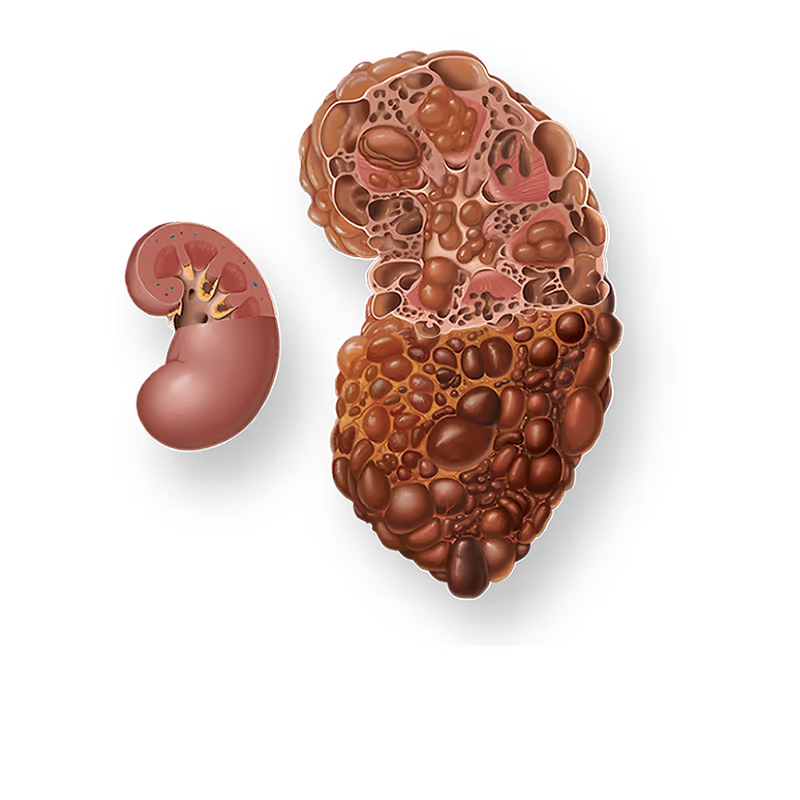
There are two types of PKD:There is no cure. But with the first treatment for ADPKD approved in 2018 and over a dozen treatments in the pipeline, there’s hope for a cure.
ADPKD**Autosomal dominant**
ADPKD is the more common type of PKD and is estimated to affect more than 500,000 Americans and 12.4 million people worldwide.
[What is ADPKD?](/about-the-disease/adpkd/)
ARPKD**Autosomal recessive**
ARPKD is a rare form of PKD that occurs in 1 in 20,000 children worldwide.
[What is ARPKD?](/about-the-disease/arpkd/)
Get **social**[Share your story](https://pkdcure.org/blog/voice/)
[Share the facts](/get-involved/awarenessday/graphics/)
Wear & share teal
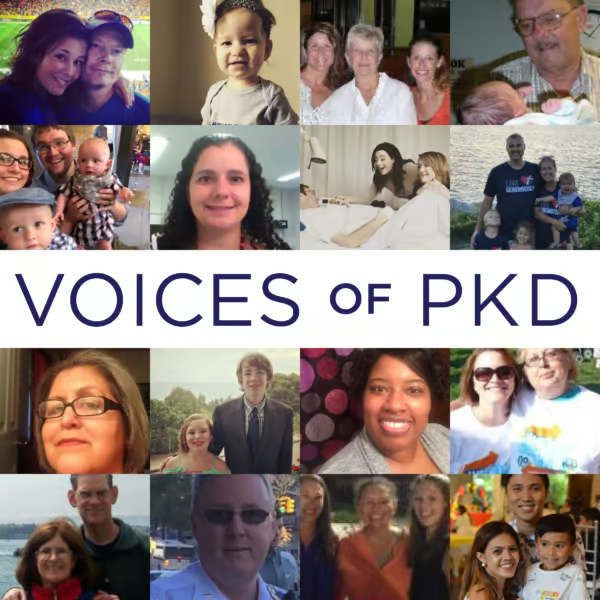 Share your storySubmit your story through Voices of PKD or on social media using the hashtags #VoicesofPKD and #FoundationFeature.
[Submit your Story](https://pkdcure.org/blog/voice/)
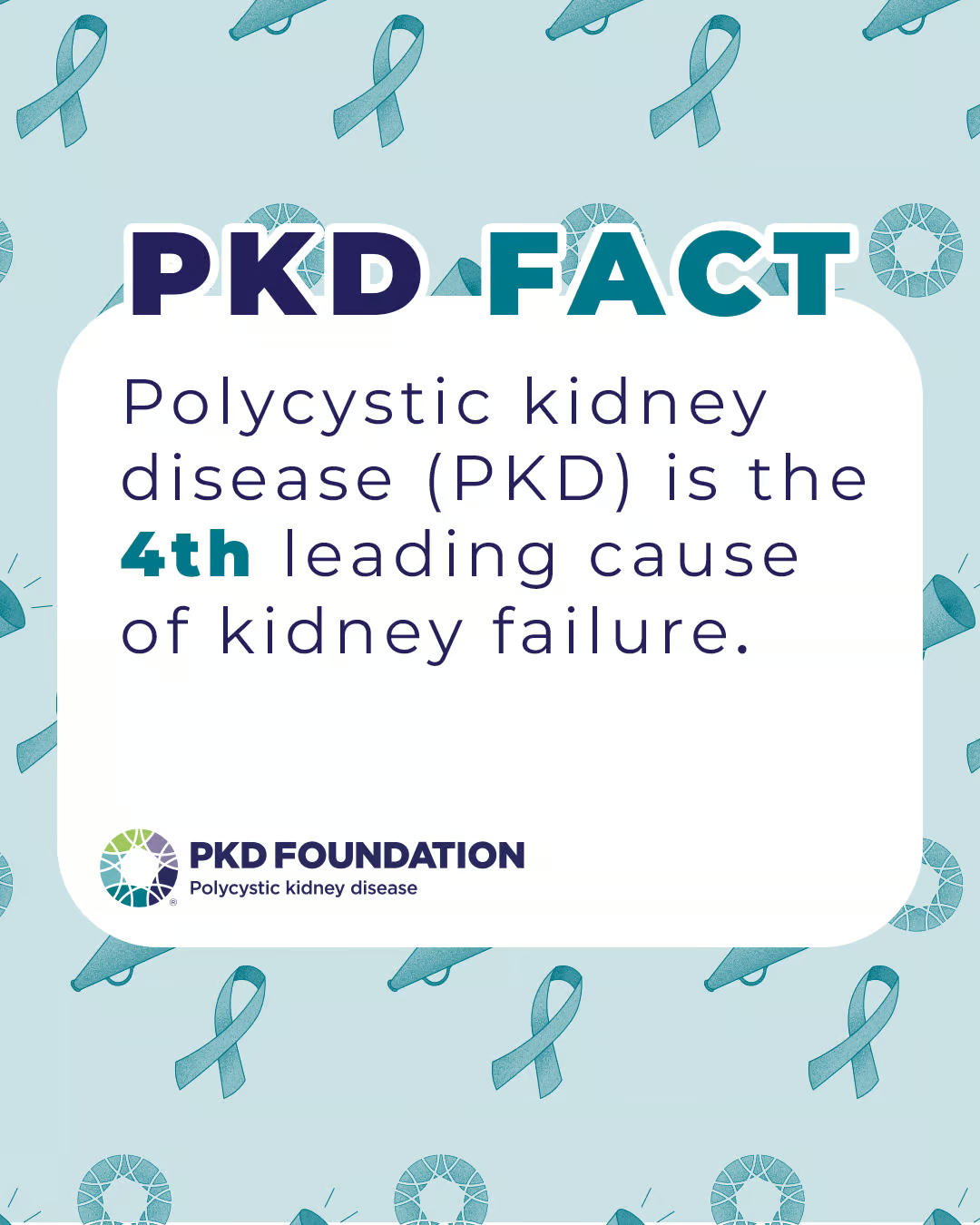 Share the factsVisit our social media channels and share PKD Foundation content. You can also download and share information about ADPKD and ARPKD. Be sure to use hashtags to use: #endPKD and #PKDAwarenessDay
[Awareness Day Graphics](/get-involved/awarenessday/graphics/)
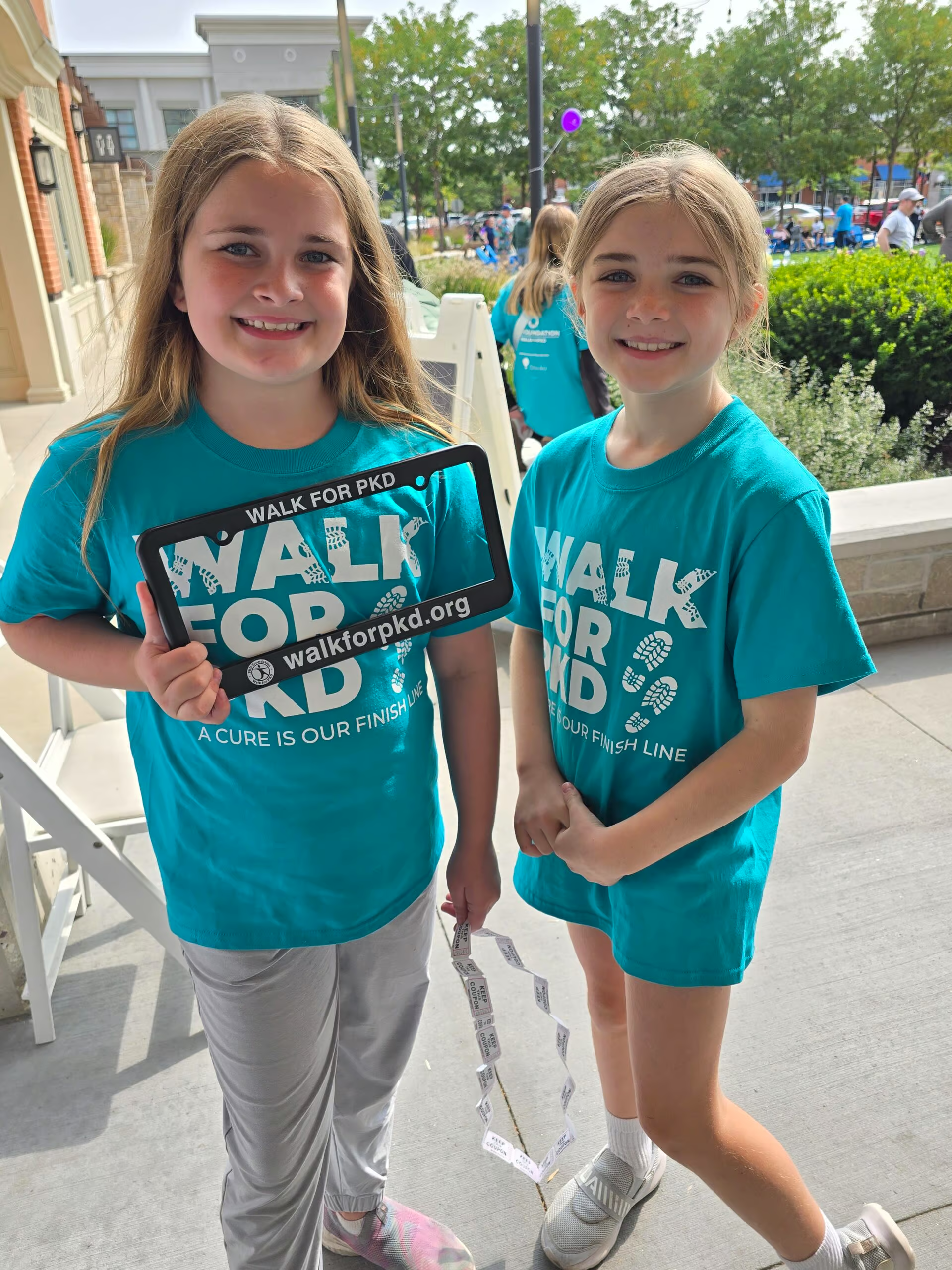 Wear & share tealShare a photo of yourself in teal, the designated awareness color for PKD. Hashtags to use: #endPKD and #PKDAwarenessDay
Get **involved**[Getting Involved](https://pkdcure.org/get-involved/)
[Walk to end PKD](https://walkforpkd.org/)
[Join the ADPKD Registry](/research/the-adpkd-registry/)
[Be an advocate](https://pkdcure.org/advocacy/)
[PKD Cures Act](https://pkdcure.org/advocacy/pkd-cures-act/)
[Volunteer](https://pkdcure.org/get-involved/volunteer-with-us/in-your-community/community-roles/)
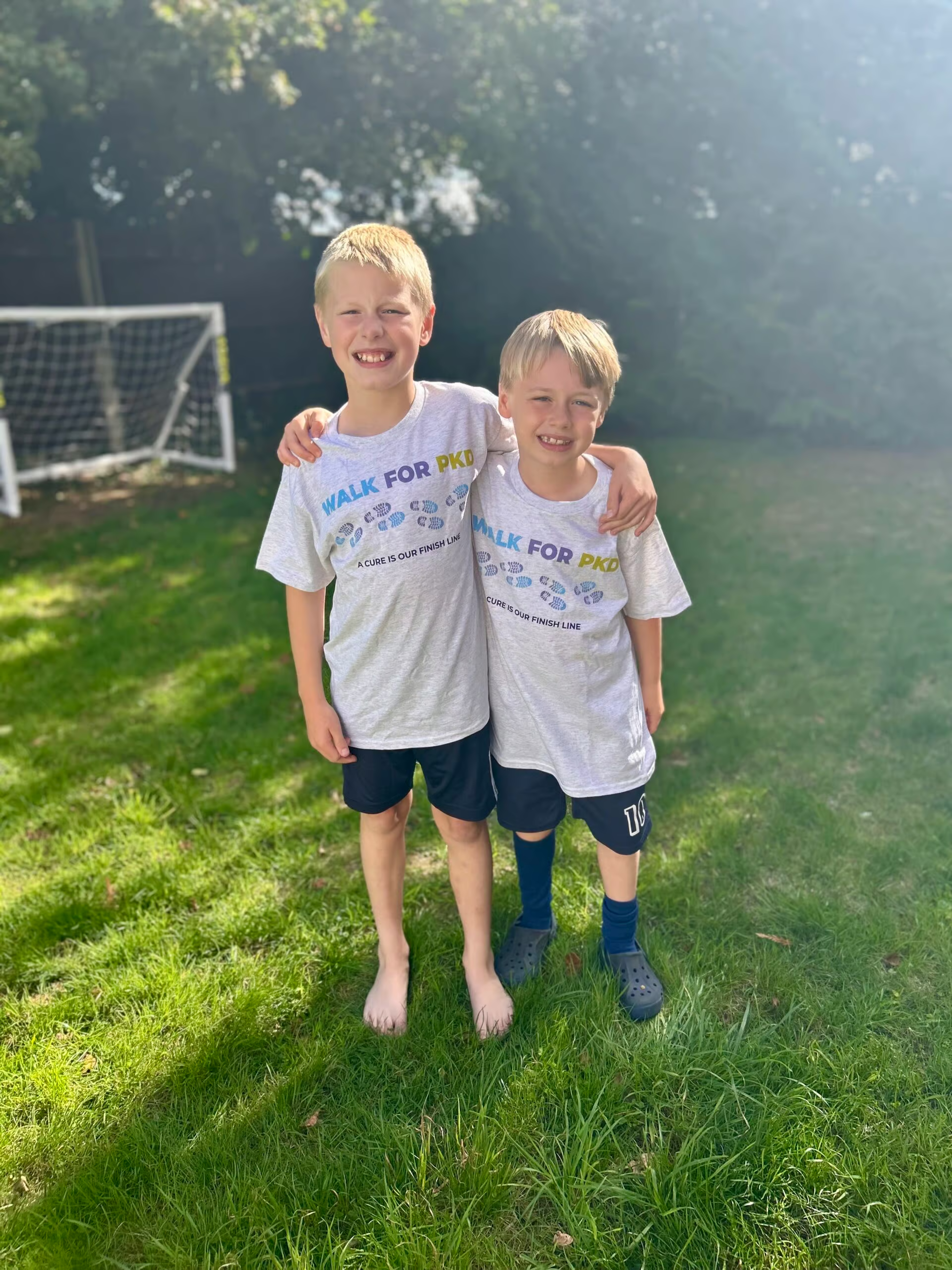 Getting Involved[Learn More](https://pkdcure.org/get-involved/)
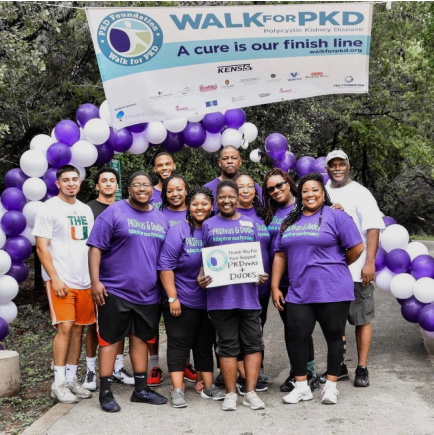 Walk to end PKDBe a part of our largest fundraising and public awareness event.
[Learn More](https://walkforpkd.org/)
 Join the ADPKD RegistryHelp drive the next medical breakthrough for ADPKD patients. You have the power to end PKD.
[Learn More](/research/the-adpkd-registry/)
 Be an advocateLearn how to advocate for legislative changes that benefit our community and receive important alerts.
[Learn More](https://pkdcure.org/advocacy/)
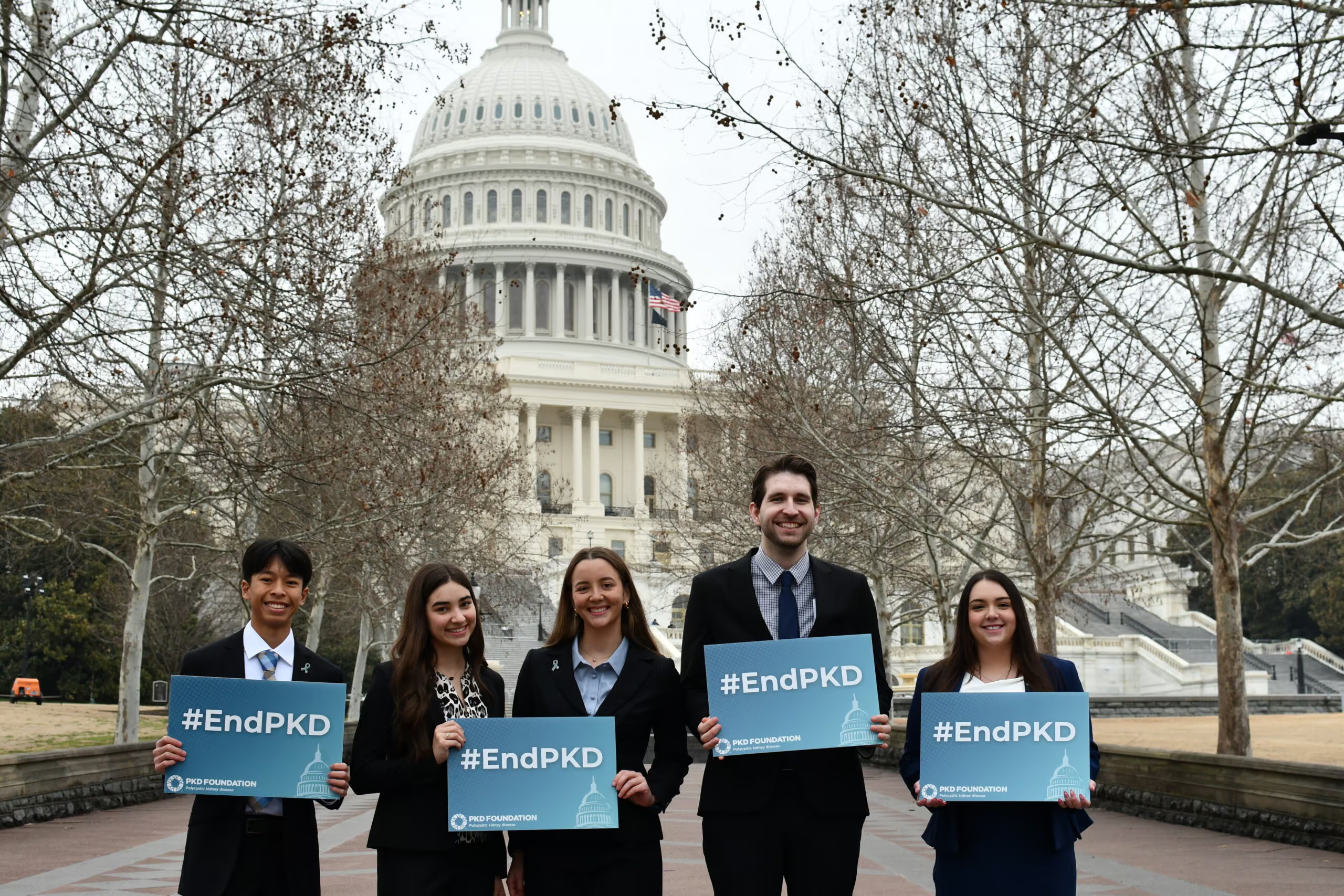 PKD Cures Act[Take Action](https://pkdcure.org/advocacy/pkd-cures-act/)
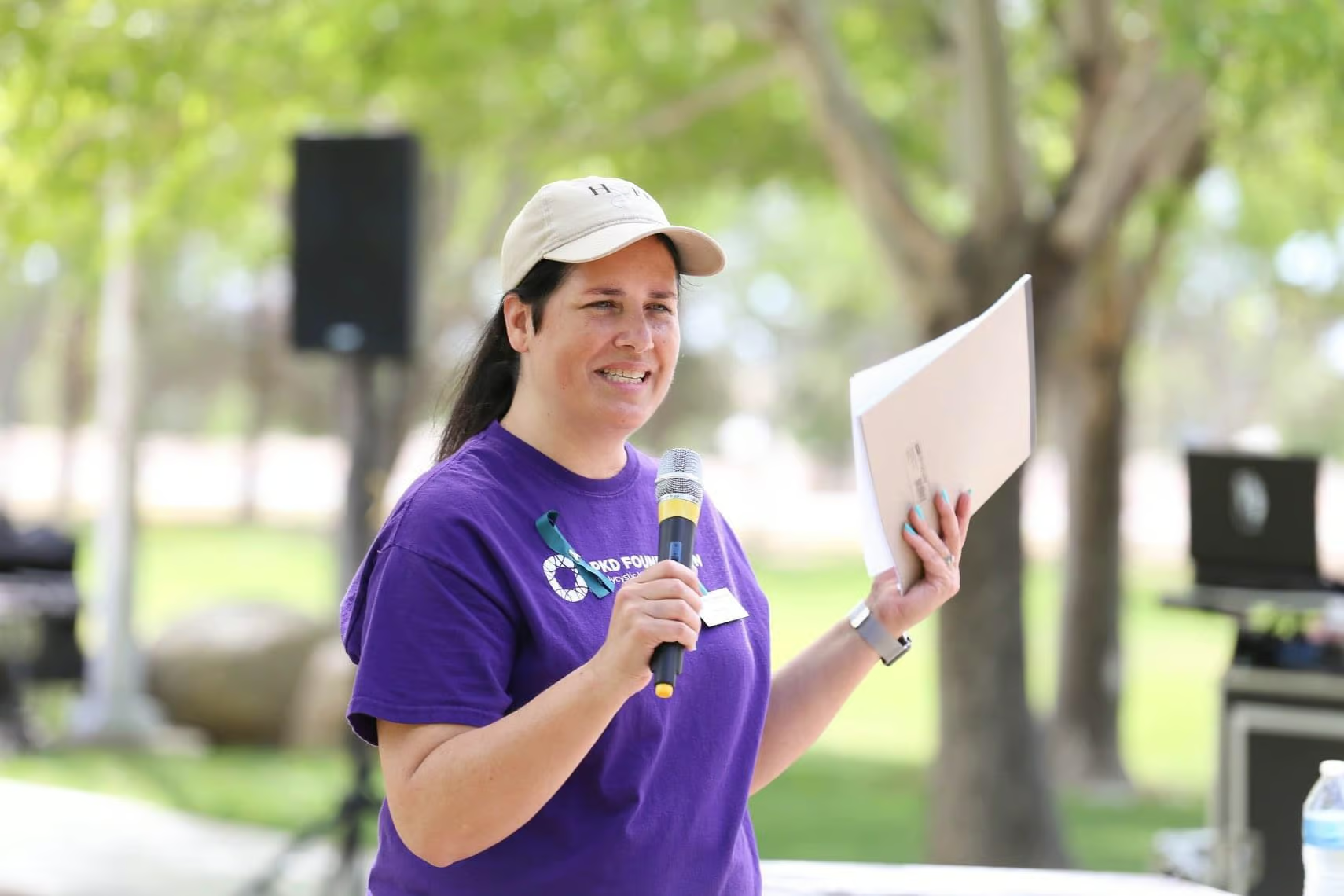 VolunteerVolunteers are the heart of the PKD community. Our volunteers ensure that no one faces PKD alone. When you join our volunteer team, your time and efforts will impact the funds raised for PKD research.
[For Volunteers](https://pkdcure.org/get-involved/volunteer-with-us/in-your-community/community-roles/)
About the PKD Foundation
We’re the only organization in the U.S. solely dedicated to finding treatments and a cure for polycystic kidney disease (PKD) and to improving the lives of those it affects. Since 1982, we’ve proudly funded more than 1,300 research projects and leveraged $1.5B in research funds, while serving our local communities across the country. We’re inspired by our mission. And driven by our vision.
**Our mission**
WE GIVE HOPE. We fund research, advocate for patients, and build a community for all impacted by polycystic kidney disease.
**Our vision**
End PKD
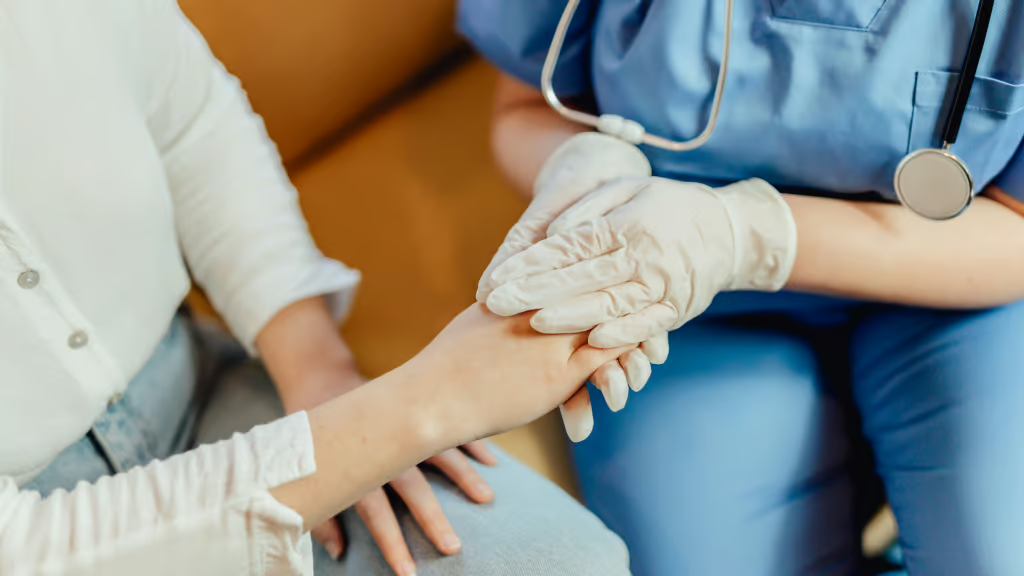
DonateWhen you donate to the PKD Foundation, a Charity Navigator Four Star Charity, you can be confident that your donation is making a real difference for individuals with PKD. Your gift helps us fund research, advocate for patients, and build a community for all impacted by polycystic kidney disease.
[Donate Now](https://go.pkdcure.org/AwarenessDonate)
---
### [Awareness Day Graphics](https://pkdcure.org/get-involved/awarenessday/graphics/)
**Published:** July 21, 2021
**Author:** Caitlin Lasky
**Content:**
Download Graphics
---
### [New England](https://pkdcure.org/get-connected/community/new-england/)
**Published:** February 5, 2025
**Author:** fiftyandfifty
---
### [Salt Lake City](https://pkdcure.org/get-connected/community/salt-lake-city/)
**Published:** February 5, 2025
**Author:** fiftyandfifty
---
### [Spanish Privacy Policy](https://pkdcure.org/privacy-policy-spanish/)
**Published:** August 7, 2026
**Author:** Sarah Lundak
---
### [Research](https://pkdcure.org/research/)
**Published:** August 1, 2024
**Author:** Caitlin Lasky
---
### [Careers](https://pkdcure.org/careers/)
**Published:** April 11, 2020
**Author:** Caitlin Lasky
**Content:**
Join our teamThank you for your interest in a career at the PKD Foundation!Openings
There are no current job openings. Please check back for updates.
The Regional Leadership Giving Director (RLGD) will collaborate with and report directly to the VP, Leadership Giving. The RLGD will play a vital role in the fundraising efforts of the Foundation by cultivating relationships with high-net-worth individuals and securing major gifts ($10,000+ outright gifts or $25,000 multi-year pledge commitments) to support mission related initiatives. The primary focus will be on building and stewarding donor relationships within the western region of the country, with the goal of maximizing philanthropic support for the organization’s research programs. The RLGD will manage a portfolio of approximately 100-125 major gift donors and prospects utilizing a moves management system. [Learn more.](#regionalleadership)This new position will serve as the primary system administrator for the Salesforce environment with around 30 users. Reporting to the Vice President of Integrated Information Systems, the Database Manager works to ensure the highest data integrity while working cross-departmentally to ensure all data is complete, accurate, and able to inform fundraising and marketing strategies. The successful candidate will have a proven track record of improving processes and adoption using the Salesforce platform. She/he will be responsible for executing the day-to-day configuration, data entry, support, maintenance and improvement of our CRM platform. They will be responsible for the service desk cycle, ensuring issues are resolved per the service level agreements (SLA). [Learn more.](#database)
\[Brief description of position (no more than 50 words.\] [Learn more.](#positionname)
About
The PKD Foundation is the only organization in the U.S. solely dedicated to finding treatments and a cure for polycystic kidney disease (PKD) and to improving the lives of those it affects. Since 1982, we have proudly funded more than 1,300 research projects and leveraged $1.5B in research funds, while serving our local communities across the country. We are inspired by our mission. And driven by our vision to #endPKD.
Our employment strategy
Achieving our vision to #endPKD requires great people. We work to maintain the best possible environment for our team and strive to provide a collaborative, creative atmosphere where each person feels encouraged to contribute to our processes, planning, and culture. Our staff models our culture by demonstrating our core values:
- Mission-centric: Respect the mission and those we serve.
- Professionalism: Commit to the highest standards.
- Authenticity: Communicate with candor and transparency
- Teamwork: Advance the Foundation together.
Benefits\*
We value our employees’ time and efforts. Our commitment to your success is enhanced by our competitive compensation (commensurate with experience), in addition to a benefits package including:
- Full medical benefits including healthcare, dental, and vision
- Life insurance and disability insurance
- 403(b) retirement savings plan with 12.5% employer contribution, no match required
- 11+ paid Holidays and 20 PTO days per year
- Remote work environment, with collaborative business center available to employees local to the Kansas City metro area as needed.
\*Benefits are subject to board review annually and may change.
Physical demands
Unless stated otherwise, all positions require the following:
- Must be able to sit or stand for extended periods of time
- Use hands and arms, read, stoop, crouch, talk, hear, see objects clearly at 20 inches or less
- Lift and move items weighing up to 20 pounds
The physical demands described here are representative of those that must be met by an employee to successfully perform the essential functions of organization jobs. The PKD Foundation is committed to providing reasonable accommodations to qualified individuals with disabilities upon request.
EEO/Disability/Veteran Employer
Minorities are encouraged to apply.
The PKD Foundation is an equal opportunity employer and is committed to providing a work environment free of discrimination and harassment of any type without regard to race, color, religion, age, sex, national origin, disability status, genetics, veteran status, sexual orientation, gender identity or expression, family or parental status, or any other characteristic protected by federal, state, or local laws.
All employment decisions at the PKD Foundation are based on business needs, job requirements, and individual qualifications. This policy applies to all terms and conditions of employment, including recruiting, hiring, placement, promotion, termination, layoff, recall, transfer, leaves of absence, compensation, and training.
> **We thank all respondents for their interest in the PKD Foundation.**
These job descriptions are not intended to be all inclusive. PKD Foundation reserves the right to add, delete, or modify job duties and responsibilities as the need arises. Job descriptions do not constitute a written or implied contract of employment.
As part of our standard hiring process for new employees, employment with the PKD Foundation will be contingent upon successful completion of a background check.
**Category:** Full-time, Exempt
**Reports to:** Vice President of Leadership Giving
**Location:** Remote, Western US; Travel Required (30-35%); Must reside near major airport,
within one of the following states: Washington, Oregon, California, Nevada, Arizona, New
Mexico, Utah, Idaho, Montana, Wyoming, Colorado, or Texas.
**Summary**
The Regional Leadership Giving Director (RLGD) will collaborate with and report directly to the VP, Leadership Giving. The RLGD will play a vital role in the fundraising efforts of the Foundation by cultivating relationships with high-net-worth individuals and securing major gifts ($10,000+ outright gifts or $25,000 multi-year pledge commitments) to support mission related initiatives. The primary focus will be on building and stewarding donor relationships within the western region of the country, with the goal of maximizing philanthropic support for the organization’s research programs. The RLGD will manage a portfolio of approximately 100-125 major gift donors and prospects utilizing a moves management system.
**Responsibilities**
- Commit to understanding polycystic kidney disease and the mission of the PKD Foundation and be prepared to fully convey the Foundation’s impact, needs and opportunities with donors/prospects.
- Manages a portfolio of approximately 100-125 major gift donors/prospects.
- Donor Cultivation: Develop and implement strategies to identify, cultivate, solicit, and steward major gift prospects within the assigned region through a variety of mediums, including but not limited to phone calls, mailings, emails, zoom meetings, texts and in person meetings and events.
- Relationship Management: Establish and maintain strong relationships with current and prospective major donors, ensuring regular communication and personalized stewardship to nurture long-term engagement and support.
- Prospect Research: In partnership with Director of Prospect Research & Management, conduct comprehensive research on potential major gift donors, including their philanthropic interests, capacity to give, and connection to our organization’s mission and research initiatives.
- Gift Solicitation: Create compelling and tailored engagement and solicitation strategies to secure major gifts from individuals, including personal solicitations, proposals, and presentations.
- Donor Recognition: Ensure timely and appropriate acknowledgement and recognition of major donors, including personalized communication, donor recognition events, and other stewardship activities.
- Collaboration: Collaborate with the team members and other key stakeholders to align fundraising strategies with the organization’s research priorities and funding needs.
- Goal Achievement: Exceed annual fundraising goals and key performance metrics, tracking progress and providing regular updates and reports to the VP, Leadership Giving.
- Donor Database Management: Maintain accurate and up-to-date records of donor interactions, solicitations, and contributions in the organization’s constituent relationship management system.
- Stay Informed: Stay current on trends and best practices in major gift fundraising and research philanthropy, attending professional development opportunities, donor engagement events and networking functions/events as required.
**Ideal Qualifications**
- Bachelor’s degree from an accredited college or university in non-profit management, fundraising, communications or a related field.
- Seven (7) or more years of experience and proven success in major gift fundraising, preferably within a healthcare or research-focused nonprofit organization.
- Proficiency in using donor management systems (Salesforce or similar), Microsoft Office Suite, and other fundraising-related and moves management software.
- Strong understanding of major gift fundraising principles, strategies, and best practices, with a track record of securing significant gifts from individuals and foundations.
- Excellent interpersonal and relationship-building skills, with the ability to engage and inspire high-net-worth individuals and cultivate lasting donor relationships.
- Ability to think strategically and develop effective cultivation and solicitation strategies, tailored to individual donor interests and giving capacity.
- Exceptional written and verbal communication skills, with the ability to craft compelling proposals, presentations, and donor correspondence.
- Proven ability to work collaboratively with internal and external stakeholders, including staff, researchers/clinicians, volunteers, and board members.
- Demonstrated ability to exceed fundraising goals, track progress, and adjust strategies as needed to achieve desired outcomes.
- Commitment to maintaining the highest standards of ethical conduct in all fundraising activities, adhering to relevant policies, laws and regulations. Ability to exercise judgement and appropriately handle confidential matters and information.
- Familiarity of remote office setting including video communications and a virtual meeting schedule.
- Ability to effectively establish priorities and work in a fast-paced environment. Highly efficient in time management and meeting deadlines.
- Significant travel is required in this role. Ability to travel 30-35% within assigned region for inperson meetings with donors and prospects. Must live within reasonable distance of a major airport in the assigned region.
Physical Demands
- Must be able to sit or stand for extended periods of time.
- Use hands and arms, read, stoop, crouch, talk, hear, see objects clearly at 20 inches or less.
- Lift and move items weighing up to 20 lbs.
The physical demands described here are representative of those that must be met by an employee to successfully perform the essential functions of this job. Reasonable accommodations may be made to enable individuals with disabilities to perform the essential functions.
Benefits\*
We value our employees’ time and efforts. Our commitment to your success is enhanced by our competitive compensation (commensurate with experience), in addition to a benefits package including:
- Employer paid medical benefits including healthcare, dental, and vision for individual.
- Employer funded HSA (for those who elect a HDHP)
- Life insurance and disability insurance
- 401(k) retirement savings plan with 12% employer contribution, no match required, after six months of continuous service
- 11+ paid Holidays and 20 PTO days per year
- Remote work environment, with collaborative business center available to employees local to the Kansas City metro area as needed.
\*Benefits are subject to board review annually and may change.
As required by applicable Pay Transparency laws, PKDF provides a range of minimum compensation for roles that may be hired in locations under these requirements. Multiple factors may be used to determine your actual salary, including: your specific skills and experience, physical location, or other relevant factors. The salary range for this position may be lower or higher in different markets.
The anticipated pay range for this role is: $95,000-$115,000 annually
*The PKD Foundation is an equal opportunity employer and dedicated to the belief that all lives have equal value. We’re committed to creating a work environment where employees thrive both personally and professionally. We do not discriminate on the basis of race, gender, age, disability, sexual orientation, pregnancy status, veteran status, cultures, beliefs or any other status protected by law.*
**To Apply**
Qualified candidates are encouraged to apply online at <https://app.trinethire.com/companies/134813-pkd-foundation/jobs/91884-regional-leadership-giving-director> including their cover letter, resume and salary requirements.
As part of our standard hiring process for new employees, employment with the PKD Foundation will be
contingent upon successful completion of a background check.
For more information about the PKD Foundation, visit our website at pkdcure.org.
**Category:** Full-time, Exempt
**Reports to:** Vice President of Information Systems
**Location:** Remote, USA (HQ in Kansas City, MO; preference to local candidates)
**Summary**
This new position will serve as the primary system administrator for the Salesforce environment with around 30 users. Reporting to the Vice President of Integrated Information Systems, the Database Manager works to ensure the highest data integrity while working cross-departmentally to ensure all data is complete, accurate, and able to inform fundraising and marketing strategies. The successful candidate will have a proven track record of improving processes and adoption using the Salesforce platform. She/he will be responsible for executing the day-to-day configuration, data entry, support, maintenance and improvement of our CRM platform. They will be responsible for the service desk cycle, ensuring issues are resolved per the service level agreements (SLA).
**Core Responsibilities**
- Database Management & Maintenance (60%)
- Upgrade and configure Salesforce systems for optimized integration.
- Manage Salesforce roles, profiles, sharing rules, workflows, and groups.
- Maintain the Salesforce Cloud, as well as build custom reports and dashboards.
- Perform database maintenance tasks, including diagnostic tests and duplicate entry cleansing.
- Develop and maintain database documentation, including data models, system configurations, and operational procedures.
- Document processes, including error reports and changes to field history tables.
- Oversee database design, development, and implementation projects, ensuring adherence to best practices and standards.
- Develop and implement strategies for database administration and optimization to ensure high availability, reliability, and performance.
- Monitor and maintain database performance, identifying and resolving performance bottlenecks and tuning queries as necessary.
- Ensure data integrity and security through regular backups, implementing appropriate access controls, and monitoring for potential security breaches.
- Stay up-to-date with the latest trends and technologies in database administration and recommend innovative solutions to improve efficiency and effectiveness.
- Departmental Leadership (40%)
- Prepare reports for departments across the organization.
- Have a working knowledge of all apps that connect to the CRM.
- Create forms to capture prospect data on Pardot and Formstack.
- Manage and provide leadership to a team of two Database Coordinators, including hiring, training, and performance management.
- Collaborate with the data analyst and cross-functional teams to support database-related needs and projects.
- Provide technical guidance and support to team members, assisting with complex database-related issues and incidents.
- Foster a culture of collaboration, continuous learning, and innovation within the team.
**Ideal Qualifications**
- 3-5+ years of experience as a Salesforce Administrator
- 2-4+ years of experience providing IT help desk support
- Salesforce Certified Administrator or Salesforce Advanced Administrator Certification preferred
- Solid understanding of database architecture and data modeling principles.
- Familiarity with backup and recovery procedures, as well as database security best practices.
- Excellent problem-solving and analytical skills.
- Strong communication and leadership abilities.
- Bachelors Degree in Computer Science or related field is strongly preferred
- Ability to collaborate effectively among a geographic and professionally diverse team.
Travel Requirements
- Minimal; <5%
- Occasional business travel will be required to the PKD Foundation office in Kansas City, Missouri. Employees residing outside of the Kansas City Metro must live within reasonable proximity to a major airport hub for required travel.
Physical Demands
- Must be able to sit or stand for extended periods of time.
- Use hands and arms, read, stoop, crouch, talk, hear, see objects clearly at 20 inches or less.
- Lift and move items weighing up to 20 lbs.
The physical demands described here are representative of those that must be met by an employee to successfully perform the essential functions of this job. Reasonable accommodations may be made to enable individuals with disabilities to perform the essential functions.
Benefits\*
We value our employees’ time and efforts. Our commitment to your success is enhanced by our competitive compensation (commensurate with experience), in addition to a benefits package including:
- Employer paid medical benefits including healthcare, dental, and vision for individual.
- Employer funded HSA (for those who elect HDHP)
- Life insurance and disability insurance
- 401(k) retirement savings plan with 12% employer contribution, no match required, after six months of continuous service
- 11+ paid Holidays and 20 PTO days per year
- Remote work environment, with collaborative business center available to employees local to the Kansas City metro area as needed.
\*Benefits are subject to board review annually and may change.
As required by applicable Pay Transparency laws, PKDF provides a range of minimum compensation for roles that may be hired in locations under these requirements. Multiple factors may be used to determine your actual salary, including: your specific skills and experience, physical location, or other relevant factors. The salary range for this position may be lower or higher in different markets.
The anticipated pay range for this role is: $55,000-$75,000
---
### [PKD Cures Act](https://pkdcure.org/advocacy/pkd-cures-act/)
**Published:** July 30, 2026
**Author:** Sarah Lundak
---
### [Voices of PKD](https://pkdcure.org/voices-of-pkd/)
**Published:** February 17, 2025
**Author:** fiftyandfifty
---
### [Advocacy](https://pkdcure.org/advocacy/)
**Published:** October 14, 2024
**Author:** fiftyandfifty
---
### [Research Pipeline](https://pkdcure.org/research/pipeline/)
**Published:** April 12, 2020
**Author:** Caitlin Lasky
**Content:**
Research pipeline
Since 1982, we’ve led the fight against PKD through the support of basic, translational, and clinical scientists; vital research funding; and patient education. Today, we’re encouraged by the significant strides we’re making to find treatments. We’ve gone from a single drug in clinical trials five years ago to an approved drug, tolvaptan, and more drugs in the pipeline today than ever before.
Read on to learn more about the treatments for PKD currently being developed in the United States.
[Learn more](https://pkdcure.org/research-medical-professionals/clinicaltrialfaqs/) about clinical trials and the difference between Phases 1–3.
Patients play a key role in the research and development process by volunteering to participate in clinical studies. From observational studies to clinical trials, you can help researchers unlock the secrets of PKD and find a treatment by participating in a study. [Learn more](https://clinicalstudies.pkdcure.org/).
[What is PKD?](https://pkdcure.org/what-is-pkd/)
- [Kidney 101](https://pkdcure.org/what-is-adpkd/kidney-101/)
- [Parents of children with PKD](https://pkdcure.org/what-is-adpkd/parents-of-children-with-pkd/)
- [What are cysts?](https://pkdcure.org/what-is-adpkd/what-are-cysts/)
[What is ADPKD?](/what-is-adpkd/)
- [Diagnosis](https://pkdcure.org/what-is-adpkd/how-is-adpkd-diagnosed/)
- [Related health complications](https://pkdcure.org/what-is-adpkd/what-are-the-related-health-complications/)
- [Stages](https://pkdcure.org/what-is-adpkd/what-are-the-stages-of-adpkd/)
- [Symptoms](https://pkdcure.org/what-is-adpkd/what-are-the-symptoms/)
- [Causes](/what-is-adpkd/what-causes-adpkd/)
- [Treatment](/what-is-pkd/latest-research/pipeline/)
[What is ARPKD?](https://pkdcure.org/what-is-arpkd/)
- [Diagnosis](https://pkdcure.org/what-is-arpkd/how-is-arpkd-diagnosed/)
- [Related health complications](https://pkdcure.org/what-is-arpkd/what-are-the-related-health-complications-with-arpkd/)
- [Symptoms](https://pkdcure.org/what-is-arpkd/what-are-the-symptoms/)
- [Causes](https://pkdcure.org/what-is-arpkd/what-causes-arpkd/)
- [Treatment](/what-is-pkd/latest-research/pipeline/)
****
Receive notifications when there are clinical studies in your area.
PKDF Research Programs
- [Research at PKDF](https://pkdcure.org/research/)
- [PKD Connect](https://connect.pkdcure.org/)
- [Clinical Trial FAQs](https://pkdcure.org/research-medical-professionals/clinicaltrialfaqs/)
- [ACT Alerts](/research-medical-professionals/clinical-trial-awareness-program/)
- [ADPKD Registry](https://connect.pkdcure.org/adpkd-registry/)
- [Tissue donation](/research-medical-professionals/tissue-donation/)
**Additional Resources**
– [Dialysis 101](https://resources.pkdcure.org/resources/dialysis-101/)
– [Managing nutrition as dietary needs change from pre-dialysis to post transplant](https://resources.pkdcure.org/resources/managing-nutrition-as-dietary-needs-change-from-pre-dialysis-to-post-transplant/)
Tolvaptan
On [April 24, 2018, the U.S.](https://www.renalandurologynews.com/home/news/nephrology/chronic-kidney-disease-ckd/tolvaptan-cleared-in-us-for-adpkd-in-adults/) [Food and Drug Administration (FDA) granted approval of tolvaptan to be the first treatment in the United States](https://www.renalandurologynews.com/home/news/nephrology/chronic-kidney-disease-ckd/tolvaptan-cleared-in-us-for-adpkd-in-adults/) for adult patients with autosomal dominant polycystic kidney disease (ADPKD), the most common form of polycystic kidney disease (PKD).
Tolvaptan is a medication (taken twice a day as an oral pill) that affects how the kidneys control the concentration of urine. It’s been shown to slow down the growth of kidney cysts (total kidney volume) when it is taken for a long time (several years) by adults at risk of rapidly progressing ADPKD. This may help protect the function of your kidneys and delay the need for a kidney transplant or dialysis. Though your kidney function would continue to decline, it would be at a slower rate. Learn more [here](https://pkdcure.org/tolvaptan/).
Tolvaptan in ARPKD
**What it is**
Tolvaptan was approved by the FDA to treat ADPKD in 2018. It is a medication (taken twice a day as an oral pill) that affects how the kidneys control the concentration of urine. It’s been shown to slow down the growth of kidney cysts (total kidney volume) when it is taken for a long time (several years) by adults at risk of rapidly progressing ADPKD. It is now being studied in pediatric ARPKD patients.
**Why it may be a potential treatment for PKD**
Tolvaptan is an approved drug that inhibits the vasopressin pathway by blocking the activity of the vasopressin receptor 2 (V2). Preclinical studies of tolvaptan in rat models of PKD in which the causative gene of ARPKD, PKHD1, is mutated, demonstrated a reduction in kidney cyst formation, decreased cyst cell growth, and preserved kidney function, suggesting the vasopressin pathway may also play a role in the progression of the renal manifestations of ARPKD. The potential role of the vasopressin pathway in promoting cyst formation caused by mutations in PKHD1 has also been confirmed by genetic studies in rat.
**Clinical study status**
Otsuka is currently studying tolvaptan in a two **phase 3 studies in ARPKD**. These are an 18 month and a 2-year study, each evaluating the safety and efficacy of tolvaptan in up to 20 patients under the age of 18. [Read more](https://clinicalstudies.pkdcure.org/study/a-study-to-see-if-tolvaptan-can-delay-dialysis-in-infants-and-children-who-at-enrollment-are-28-days-to-less-than-12-weeks-old-with-arpkd/) to learn about what participating looks like.RGLS4326/ RGLS8429
**What it is**
RGLS4326 is a novel drug candidate that belongs to a class of drugs that target microRNAs. Micro RNAs are a collection of RNA molecules in cells that play multiple roles in the regulation of cell function. RGLS4326 is being developed by Regulus Therapeutics for ADPKD.
**Why it may be a potential treatment for PKD**
The specific microRNA targeted by RGLS4326, miR-17, is involved in regulating the production of *PKD1* and *PKD2* proteins, the proteins encoded by the causative genes in ADPKD. [Preclinical studies with RGLS4326](https://www.nature.com/articles/s41467-019-11918-y) have demonstrated direct regulation (an increase in the amounts produced) of *PKD1* and *PKD2* in human ADPKD cyst cells, as well as a reduction in kidney cyst formation, decreased cyst cell growth, and preserved kidney function in animal models of ADPKD. A phase 1 multiple dose study of RGLS4326 was completed in healthy volunteers, and demonstrated that the drug was generally well tolerated.
**Clinical study status**
Regulus first studied RGLS4326 for the treatment of ADPKD in a phase 1 dose ranging study in 27 patients in the U.S.. In late 2020, the company [decided to stop this study to instead invest in another compound,](https://www.marketwatch.com/story/regulus-therapeutics-to-prioritize-rgls8429-treatment-for-certain-kidney-disease-271634070864) stating “we have determined that advancing our next-generation compound RGLS8429 is more compelling than further development of RGLS4326.”
The RGLS8429 will begin recruiting in Fall 2022. We rely on ADPKD patients to sign up for the study to move this research forward. Learn more about [what participating in PKD studies looks like here](https://pkdcure.org/research-medical-professionals/clinicaltrialfaqs/).
##  Drug RepurposingCaloric Restriction
**What it is**
Daily caloric restriction (reducing total calories eaten per day) and intermittent fasting (limiting eating to only certain times of day) are two forms of dietary interventions for weight loss.
**Why it may be a potential treatment for PKD**
There’s a growing body of evidence that supports metabolic dysregulation (e.g. abnormal sugar use and storage or abnormal fat metabolism to generate energy within cells) helps drive ADPKD progression. Data from animal studies suggest that a variety of dietary interventions can slow disease progression in animal models of ADPKD. These dietary interventions point to several potential mechanisms by which dietary intervention slows ADPKD progression in animals—weight loss, caloric restriction, and/or periods of fasting—dependent or independent of metabolic reprogramming.
**Clinical study status**
There are multiple studies ongoing to better understand impact and safety of these diets on individuals with ADPKD. [Find out what participation looks like here.](https://clinicalstudies.pkdcure.org/clinical-studies/)
Curcumin
**What it is**
Curcumin is a dietary supplement that is produced by some plants and is found in the spice turmeric.
**Why it may be a potential treatment for PKD**
Curcumin activates transcription of key antioxidants, suppresses inflammation, and reduces cell proliferation (growth). Because of these properties, it’s thought that it could have positive effect in reducing cell growth as well as improve the health and function of arteries in ADPKD.
**Clinical study status**
The University of Colorado Anschutz Medical Campus recently finished [a study](https://clinicalstudies.pkdcure.org/study/curcumin-therapy-to-treat-vascular-dysfunction-in-children-and-young-adults-with-adpkd/) to determine if curcumin can improve the function of blood vessels in children and young adults with ADPKD. In February 2022, investigators published their findings and unfortunately could find no benefit from curcumin supplementation on vascular function or kidney growth. Read more [here](https://cjasn.asnjournals.org/content/17/2/240.abstract).
### Empagliflozin
**What it is**
Empaglifozin is an FDA-approved medication used to manage and treat type 2 diabetes.
**Why it may be a potential treatment for PKD**
Limited data suggests SGLT2i drugs (such as empagliflozin) may stimulate vasopressin and vasopressin receptor expression in patients and animal models without ADPKD. Investigators want to see if the beneficial effects on kidney function, vascular function, and mortality in non-ADPKD patients with CKD will translate to this disease population.
**Clinical study status**
The University of Colorado Anschutz Medical Campus and the University of Maryland Baltimore are conducting a study on empagliflozin. Learn about what participation looks like [here](https://clinicalstudies.pkdcure.org/study/feasibility-of-study-of-empagliflozin-in-patients-with-adpkd/).
Metformin
**What it is**
Metformin is a first-line, FDA-approved drug to treat type 2 diabetes.
**Why it may be a potential treatment for ADPKD**
Mouse models have shown that metformin blocks the aerobic glycolysis pathway, which is linked to cell proliferation that causes cysts to form and grow. When treated with metformin, mice with PKD show inhibition of cyst growth. Metformin has a long established safety profile because it’s been used for decades in the treatment of type 2 diabetes.
Watch our recorded webinar, PKD therapies and potential candidates, to [learn more](https://pkdcure.org/resource/pkd-therapies-potential-candidates/).
**Clinical study status**
Researchers at Tufts University in Boston and at the University of Maryland in Baltimore recently finished a [two-year clinical trial](https://www.kidney-international.org/article/S0085-2538(21)00601-3/fulltext?rss=yes) in 97 patients with ADPKD. They found that metformin in adults with ADPKD was safe and tolerable while slightly reducing kidney function decline (although not to a significant degree). Further evaluation of efficacy will require a larger trial. Read more [here](https://www.kidney-international.org/article/S0085-2538(21)00601-3/fulltext).
Niacinamide
**What it is**
Niacinamide is a form of vitamin B3 available over the counter. It’s used for treating diabetes and certain skin conditions.
**Why it may be a potential treatment for ADPKD**
Niacinamide has been shown to inhibit a regulatory protein called sirtuin 1, which promotes cell growth and may promote cyst growth in PKD. Inhibition of sirtuin 1 may slow or stop cyst growth.
Niacinamide could be an appealing treatment option for PKD because of its low cost and favorable safety profile. The European Nicotinamide Diabetes Intervention Trial (ENDIT) study showed that large doses of niacinamide are safe in humans. Additionally, niacinamide is a dietary supplement, so it doesn’t require approval by the FDA. Studies aimed to establish an optimal dosage for ADPKD patients.
**Clinical study status**
The Randomized, Controlled Pilot Study of Niacinamide in Polycystic Kidney Disease (NIAC-PKD2), conducted at the University of Kansas Medical Center, was designed to determine the effects of niacinamide on markers of kidney injury, inflammation, kidney function, and cyst growth. Unfortunately, although the drug was well-tolerated in ADPKD patients, the [researchers observed no benefit compared to those on placebo.](https://www.kireports.org/article/S2468-0249(20)31293-6/abstract)[ ](https://www.kireports.org/article/S2468-0249(20)31293-6/abstract)
Pioglitazone
**What it is**
Pioglitazone is an FDA-approved treatment for type 2 diabetes.
**Why it may be a potential treatment for ADPKD**
Pioglitazone has been shown to inhibit chloride secretion into cysts, which is a key factor in cyst growth. When chloride moves into the cyst, water follows, filling the cysts with fluid and causing them to grow. By inhibiting chloride from moving into cysts, pioglitazone may potentially slow or stop cyst growth. Pioglitazone may also inhibit cyst cell division by causing terminal cell differentiation.
Watch our recorded webinar, A discussion about pioglitazone Actos as a potential therapy for PKD, to [learn more](https://pkdfoundation.staging.wpengine.com/resource/discussion-pioglitazone-actos-potential-therapy-pkd/).
**Clinical study status**
Researchers at Indiana University Purdue University in Indianapolis (IUPUI) conducted a pilot clinical trial to test the safety and efficacy of low doses of pioglitazone on ADPKD progression. In the 18 patients who participated in the study, [no change in total kidney volume was observed over 1 year for those on study drug compared to placebo](https://academic.oup.com/ckj/article/14/7/1738/6120373). However, pioglitazone was found to be safe in ADPKD patients, and a larger and longer-term trial would be needed to determine the effectiveness of the study drug to slow disease progression. Read more [here](https://pubmed.ncbi.nlm.nih.gov/34221381/).
Statin therapy
**What it is**
Statins comprise a class of drug that lowers the level of cholesterol in the blood.
**Why it may be a potential treatment for PKD**
In addition to their efficacy in lowering cholesterol, statins also have anti-proliferative, anti-inflammatory, and antioxidant effects. Due to this and their relative safety, it’s thought they could potentially be used to slow the progression of ADPKD.
**Clinical study status**
The University of Colorado Anschutz Medical Campus is conducting a study to learn if pravastatin (a common statin) is helpful in slowing down the progression of ADPKD. This study is no longer recruiting patients and results are expected to be available in late 2022.
Page last updated June 2023
---
### [Federal Funding PKD Research](https://pkdcure.org/advocacy/federal-funding-pkd-research/)
**Published:** April 2, 2020
**Author:** Caitlin Lasky
**Content:**
Federal Funding for PKD ResearchDepartment of DefenseCongressionally Directed Medical Research Program (CDMRP)
This program originated in 1992 via a Congressional appropriation to foster new approaches to biomedical research in response to the needs of its stakeholders — the American public, the military, and Congress.
Peer Reviewed Medical Research Program (PRMRP)
The PRMRP is part of the CDMRP, established in 1999. Its vision is to improve the health and well-being of all Military Service members, Veterans and beneficiaries.
PKD has received over $47 million from the PRMRP, which has included funding for two major clinical trials — metformin and statins — as well as numerous basic science projects.
National Institutes of Health (NIH)
NIH, which is part of the Department of Health and Human Services (HHS), is the major federal source of funds for health research programs. Within NIH, the National Institute of Diabetes and Digestive and Kidney Diseases (NIDDK) is the primary source of PKD-related research programs and grants.
More information
- [About PKD advocacy](https://pkdcure.org/get-involved/advocacy/)
- [Tools & resources](https://pkdcure.org/get-involved/advocacy/tools/)
- [Advocacy blog posts](https://pkdcure.org/blog/category/advocacy/)
- [Sign up for Advocacy Alerts](https://pkdcure.org/get-involved/advocacy/become-an-advocate/)
Last reviewed November 2022
---
### [San Francisco](https://pkdcure.org/get-connected/community/san-francisco/)
**Published:** February 5, 2025
**Author:** fiftyandfifty
---
### [Clinical Trials](https://pkdcure.org/research/clinical-trials/)
**Published:** September 20, 2024
**Author:** fiftyandfifty
---
### [Clinical Trial FAQs](https://pkdcure.org/research/clinical-trials/clinicaltrialfaqs/)
**Published:** June 8, 2020
**Author:** Caitlin Lasky
**Content:**
## Clinical Trial FAQs
**Clinical trials** are human studies of new treatments or therapies for a disease to ensure that it is both safe and effective. By participating in a clinical trial, you will not only have access to PKD experts, but you might contribute to a medical breakthrough that will impact how PKD is managed for the next generation.
****
Receive notifications when there are clinical studies in your area.
## Why participate in a clinical trial?
Clinical studies are a critical and required step to develop new therapies. However, many clinical trials fail to recruit enough volunteers to populate the study and so cannot complete the research. Under-enrollment is potentially one of the most significant problems facing PKD drug development. With the approval of tolvaptan in 2018, we are excited to have one option for ADPKD patients to potentially slow the progression of their disease. However, new drugs are in the pipeline and, if approved by the FDA, could provide options to ADPKD patients like never before. Should the new therapy being tested in the clinical trial be effective, participants are also one of the first people to benefit before it is released to the public.
## What is informed consent?
Informed consent is a process of communication between you and your study doctor about what being in the clinical trial will look like so that you can make an informed decision on participating. The consent form should contain the following information:
- The purpose of the research
- How long it is expected to take
- That participation is voluntary, and you may leave at any time
- A list of procedures you will undergo during your time in the study
- Risk to participating, including potential side effects of the treatment being tested
- Details of how your information will be kept private and confidential
- Contact information for the study team and ethics review board
If you have any questions that are not on the consent form, you do not have to sign it and agree to participate until those questions are answered to your satisfaction by the study team.
And remember: by signing an informed consent form, you are not signing a contract. You can leave the study at any time. In addition, those monitoring the trial for safety (such as your study doctor or study medical monitor) can pull you from a study at any time if they believe your health is declining.
## What are eligibility criteria?
Each study’s protocol has guidelines for who can or cannot participate in the study. These guidelines, called eligibility criteria, describe characteristics that must be shared by all participants. The criteria differ from study to study. They may include age, gender, medical history, and current kidney function. Eligibility criteria for treatment studies often require that patients have a particular risk of progression or stage of PKD.
Enrolling participants with similar characteristics ensures that the results will be due to what is under the control of the study, and not other factors. In this way, eligibility criteria help researchers achieve accurate and meaningful results. These criteria also make certain that people who could be made worse by participating in the study are not exposed to the potential risks. The study criteria are approved by ethics review boards and no exceptions can be made.
## What are the types of clinical research?
**Observational studies** do not test new drugs or treatments. In observational studies, doctors and researchers analyze health data to find links between a diagnosis and certain health conditions, disease progression, symptoms or quality of life.
**Interventional studies** test new ways to prevent, detect, or treat diseases. Treatments may be new drugs, combinations of drugs, surgical procedures, medical devices, or lifestyle interventions like diet and exercise.
## What are the “phases” of clinical trials and what do they mean for participants?
The U.S. Food and Drug Administration (FDA) is the federal agency charged with oversight of all the clinical trials going on in the U.S. at any time. A new drug to treat PKD must move through each stage before it can be reviewed for approval by the FDA. The FDA defines the phases for the clinical trials.
- **Phase I** – The new drug is tested for safety and side effects in a small number of healthy volunteers with PKD.
- **Phase II** – The new drug is tested for safety, dose ranging, and preliminary effectiveness in a small number of volunteers.
- **Phase III** – The new drug is tested in a large number of volunteers with PKD to establish effectiveness, monitor side effects, and compare results with current treatments. The data collected during the clinical trial is analyzed and then submitted to the FDA for regulatory review, which can take one to three years. If there is an intent to apply for an NDA (new drug application), it is communicated to the FDA and shapes the design of the study. Once it is approved, the new drug can be prescribed by physicians to treat PKD.
- **Phase IV** – These studies are done after the drug has been approved by the FDA and it is in use (considered a post-marketing study). Additional information about risks, benefits, and optimal use is collected and analyzed.
## What is expected of me once I sign up to be in a clinical trial?
When participating in a clinical trial, one of the biggest commitments is your time. Many trials ask you to come into the clinic for frequent check-ups, blood, and urine tests or other procedures to monitor if the treatment is working and if it’s safe. The best way to get good research results is if all participants complete their scheduled visits and tests. It’s important that you do your best to follow the protocol. If at any time you no longer want to participate, reach out to your study team. They will help you to leave the study safely.
## What are the risks?
Every clinical trial is different, and researchers are required to tell you about all possible risks before you agree to participate. Possible risks include:
- Side effects of the medications or treatments being studied
- Unwanted events during the trial that may or may not be related to the study drug
- Failure of the treatment to work
The research team will continuously monitor your health and safety throughout the trial, whether you are receiving the drug being studied or a placebo. A placebo is a sugar pill used to study the difference between those taking and not taking the medication, without either the participant or study team knowing which is which until after the trial.
## What happens when the study is over?
After the study is complete for all participants, the data is analyzed and shared with experts and several government agencies (like the FDA) for the drug approval process.
You can request to see your data from the study or to get results from the study as a whole once ready. In some cases, participants can continue to take the medication if it helps and is safe but are not required to continue with other phases of the trials. Each clinical trial is different so be sure to talk to your research team.
## How is my privacy protected?
As much as possible, your identifiable information (name, birth date, address, contact information, etc.) is kept private from most members of the research team. No identifiable information is shared outside the research team without your knowing consent. Only authorized staff members of the research team can view the data at any time during, and after, the clinical trial. Privacy policies of the clinical trial are described the informed consent document and are regulated by an ethics review board.
## Is there a cost to participate?
There is usually not a cost to participate in a clinical trial. Prior to agreeing to participate, speak to your doctor and research team to make sure the clinical trial is right for you. Participants may also be eligible for travel cost reimbursements through the sponsor of the clinical trial.
## Will I really help make a difference?
Yes!
ALL advances in treating diseases have only been made possible because of volunteer participants. To have better treatments in PKD, researchers rely on the participation of patients like you!
## PKDF Research Programs
- [PKD Outcome Consortium (PKDOC)](/research-medical-professionals/pkdoc/)
- [ACT Alerts](/research-medical-professionals/clinical-trial-awareness-program/)
- [ADPKD Registry](https://connect.pkdcure.org/adpkd-registry/)
- [Tissue donation](/research-medical-professionals/tissue-donation/)
- [Scientific meetings](/research-medical-professionals/scientific-meetings/)
## Blog posts
[How motherhood inspired PKD patient to get involved with tolvaptan clinical trials](https://pkdcure.org/motherhood-inspired-pkd-patient-get-involved-tolvaptan-clinical-trials/)
[PKD researcher weighs in on how patient participation brought about first treatment](https://pkdcure.org/pkd-researcher-weighs-patient-participation-brought-first-treatment/)
Page last reviewed November 2022
---
### [Clinical Trial Awareness Program](https://pkdcure.org/research/clinical-trial-awareness-program/)
**Published:** April 11, 2020
**Author:** Caitlin Lasky
**Content:**
## Accelerating Clinical Trials (ACT) Alerts
One of the largest impediments to patient participation in research begins with awareness. We believed it was our goal to address this challenge and aim to increase awareness of PKD clinical studies among patients and families. The goal is to simplify the process of finding clinical studies for PKD patients in their geographic area by sending **Accelerating Clinical Trials (ACT)** Alert emails about studies that are being conducted.
In order to ensure that PKDF is promoting studies that address our mission to find treatments and a cure for PKD, only research approved by an ethics review board (IRB) and that meet one of the following categories will qualify for the program.
- Clinical trials or activities supporting clinical trial development
- Observational studies of disease progression
- Quality of life burden research
- Clinical outcomes research
- Survey tool development or validation
### PKDF Research Programs
- [Research homepage](https://pkdcure.org/research/)
- [Funding Opportunities](https://pkdcure.org/research-medical-professionals/research-funding/)
- [Current grantees and fellows](https://pkdcure.org/funded-research/)
- [Database resources](https://pkdcure.org/research-medical-professionals/data-resources-in-pkd-research/)
- [Research news](https://pkdcure.org/research-news/)
- [Clinical studies](https://clinicalstudies.pkdcure.org/)
### ADPKD
### ARPKD

Get notified of **ARPKD** clinical studies in your area.
## Schedule an ACT Alert for your study
Email <research@pkdcure.org> for more information.

The ADPKD Registry is a collection of individuals with autosomal dominant polycystic kidney disease (ADPKD). By joining, ADPKD patients fill out questionnaires that help us identify their eligibility for clinical studies. PKDF can then provide these individuals with details on how to participate.
Page last reviewed November 2022
---
### [What are cysts?](https://pkdcure.org/about-the-disease/adpkd/what-are-cysts/)
**Published:** February 10, 2025
**Author:** fiftyandfifty
---
### [New Jersey](https://pkdcure.org/get-connected/community/new-jersey/)
**Published:** February 5, 2025
**Author:** fiftyandfifty
---
### [Financials](https://pkdcure.org/who-we-are/financial-and-organizational-information/)
**Published:** April 11, 2020
**Author:** Caitlin Lasky
**Content:**
Financial and organizational information
Since our founding in 1982, we have raised millions of dollars toward finding a treatment and a cure for PKD. However, what’s even more important than the money we raise is what we do with it. We are extremely careful with the dollars you have entrusted to our care.
More information
- [Executive leadership](/who-we-are/executive-leadership/)
- [Board of Directors](/who-we-are/board-of-trustees/)
- [Scientific Advisory Panel](/who-we-are/scientific-advisory-committee/)
- [Financial and organizational information](/who-we-are/financial-and-organizational-information/)
- [Careers](/who-we-are/careers/)
- [Contact us](/contact-us/)
[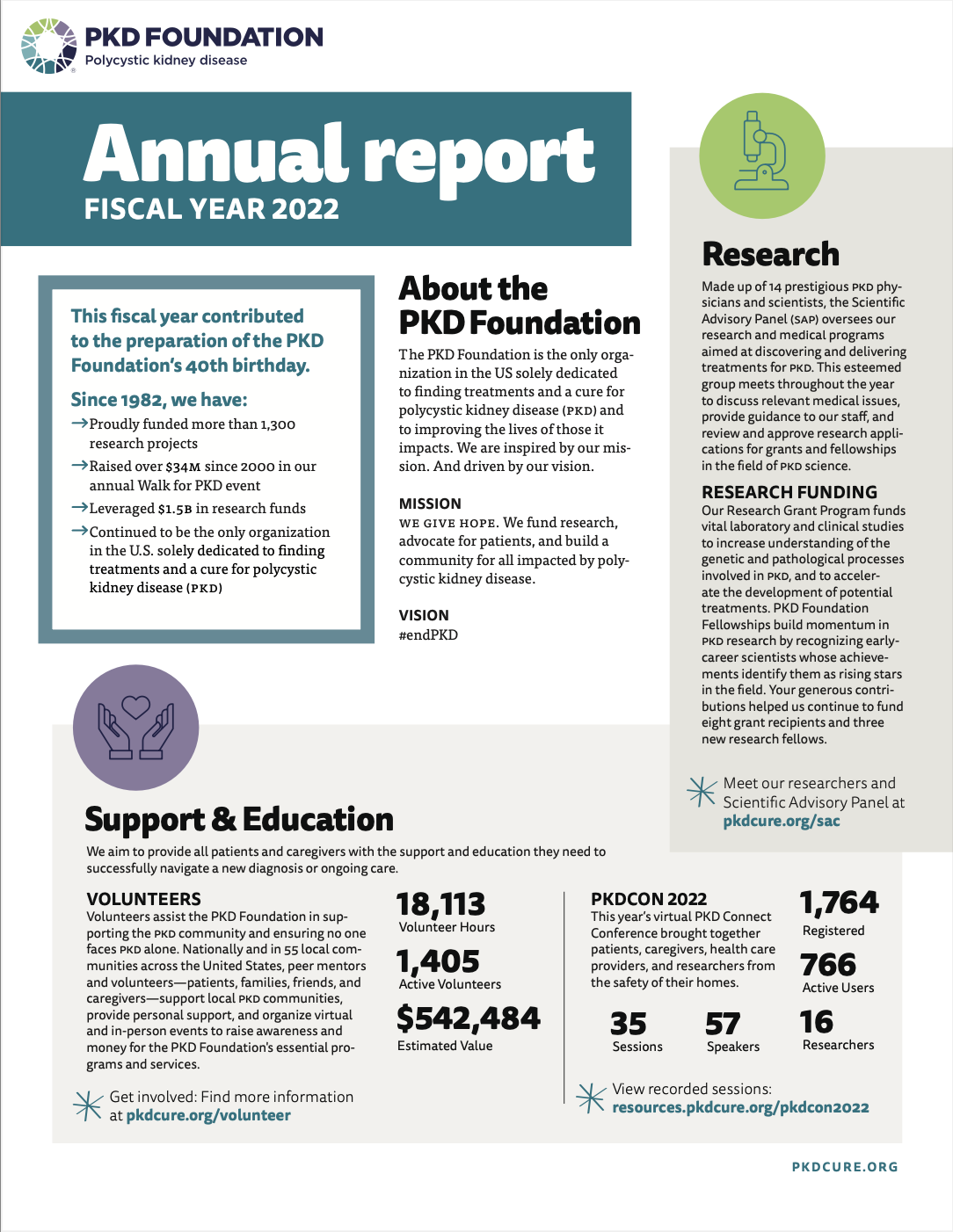](https://pkdcure.org/wp-content/uploads/2023/04/FY22-PKDF-Annual-Report-Apr13.pdf)
Financial documents
- [2021 IRS Form 990](https://pkdcure.org/wp-content/uploads/2023/05/2021-PKD-Foundation-990-_-public.pdf)
- [2020 IRS Form 990](https://pkdcure.org/wp-content/uploads/PKD-Foundation-2020-990_Public-Disclosure-Copy.pdf)
- [2019 IRS Form 990](https://pkdcure.org/wp-content/uploads/PKD-Foundation-2019-990-Public.pdf)
- [2018 IRS Form 990](https://pkdcure.org/wp-content/uploads/pkd-foundation-2018-990-public-inspection-signed.pdf)
- [2017 IRS Form 990](https://pkdcure.org/wp-content/uploads/public-disclosure-copy-pkd-foundation-2017-990-1.pdf)
- [2016 IRS Form 990](https://pkdcure.org/wp-content/uploads/990-public-disclosure-copy.pdf)
- [2022-23 Audited financial statements](https://pkdcure.org/wp-content/uploads/PKD-Foundation-Report-1.pdf)
- [2021-22 Audited financial statements](https://pkdcure.org/wp-content/uploads/2022/12/PKD-Foundation-Report.pdf)
- [2020-21 Audited financial statements](https://pkdcure.org/wp-content/uploads/PKD-Foundation-Audited-Financial-Statements-as-of-June-30-2021.pdf)
- [2019–20 Audited financial statements](https://pkdcure.org/wp-content/uploads/PKD-Foundation-Financial-Statements-June-30-2020.pdf)
- [2018–19 Audited financial statements](https://pkdcure.org/wp-content/uploads/2019-pdf-financial-statements.pdf)
- [2017–18 Audited financial statements](https://pkdcure.org/wp-content/uploads/pdf-signed-financial-statements.pdf)
- [2016–17 Audited financial statements](https://pkdcure.org/wp-content/uploads/audited-financial-statements.pdf)
- [IRS determination letter](https://pkdcure.org/wp-content/uploads/irs-tax-exempt-determination-letter_-8-15-16.pdf)
- [Conflict of interest policy](https://pkdcure.org/wp-content/uploads/Conflict-of-Interest-Policy-Disclosure.pdf)
- [Gift acceptance policy](https://pkdcure.org/wp-content/uploads/Gift-Acceptance-Policy_Approved_01_09_2022.pdf)
- [By-laws](https://pkdcure.org/wp-content/uploads/PKD-Foundation-Bylaws_05_08_2021.pdf)
**Federal tax ID: 43-1266906**
Other important documents
- [AFP code of ethics](https://pkdcure.org/wp-content/uploads/afp-code-of-ethics.pdf)
- [AFP donor bill of rights](https://pkdcure.org/wp-content/uploads/afp-donor-bill-of-rights.pdf)
- [ePhilanthropy code of ethics](https://pkdcure.org/wp-content/uploads/ephilanthropy-code-of-ethics.pdf)
- [NCPG model standards of practice for the charitable gift](https://pkdcure.org/wp-content/uploads/ncpg-model-standards-of-practice-for-the-charitable-gift.pdf)
- [State fundraising notices](https://pkdcure.org/who-we-are/financial-and-organizational-information/state-fundraising-notices/)
- [Statement of values and code of ethics](https://pkdcure.org/wp-content/uploads/statement-of-values-and-code-of-ethics.pdf)
- [Industry relations policy](https://pkdcure.org/wp-content/uploads/pkdf-industry-relations-policy-board-approved-27-april-2019-gm.pdf)
- [Whistleblower Policy](https://pkdcure.org/wp-content/uploads/PKDF-Final-Whistleblower-Policy-05_08_2021.pdf)
Page last reviewed November 2022
---
### [ARPKD PFDD](https://pkdcure.org/el-pfdd/)
**Published:** April 13, 2023
**Author:** Caitlin Lasky
**Content:**
[ARPKD Voice of the
Patient Report](https://pkdcure.org/wp-content/uploads/ARPKD-VOP-Report-.pdf)
Externally-Led Patient-Focused Drug Development Meeting for ARPKD
The PKD Foundation, the only organization in the U.S. solely dedicated to finding treatments and a cure for PKD and improving the lives of those affected, hosted its first-ever Externally-Led Patient-Focused Drug Development (EL-PFDD) meeting on Autosomal Recessive PKD (ARPKD) on August 29th, 2023. The objective of the meeting was to connect the ARPKD community with the U.S. Food and Drug Administration (FDA), providing regulators with direct input from patients, families, caregivers, and patient advocates. The EL-PFDD meeting marks a significant step forward in the PKD Foundation’s mission to discover and deliver effective treatments and ultimately find a cure for PKD. This progress will be documented in a Voice of Patient Report, consolidating the meeting’s findings and serving as a key reference for future ARPKD drug development efforts.
The ARPKD EL-PFDD was held virtually on August 29, 2023. The meeting was an important opportunity for the PKD Foundation to share patient perspectives regarding the symptoms and daily impact of ARPKD, as well as current and future approaches to therapies. The virtual meeting format allowed many ARPKD community members to participate through live online polls, telephone call-ins, and by providing written comments through an online portal.
One-hundred and twenty-eight viewers attended the livestream, including 13 individuals living with ARPKD, 34 parent/caregivers, nine other family members, two friends, one teacher, 16 members from the FDA, 19 scientists/researchers, seven from the healthcare industry, three healthcare providers, 18 from non-profit organizations, and six others.
This Voice of the Patient report is provided to all ARPKD community supporters including the US FDA, other government agencies, regulatory authorities, medical products developers, academics, clinicians, and any other interested individuals. The input received from the August 29, 2023, EL-PFDD meeting reflects a wide range of ARPKD experiences, however not all symptoms and impacts may be captured in this report.
**[Read the ARPKD Voice of the Patient Report here.](https://pkdcure.org/wp-content/uploads/ARPKD-VOP-Report-.pdf)** If you have additional questions, please reach out to <research@pkdcure.org>.
Key Meeting Insights
The clinical course of ARPKD is highly variable and can present any time from before birth to adulthood. An ARPKD diagnosis is traumatic, and consequences can be tragic. The disease is progressive and affects the kidneys as well as the liver.
Kidney failure and high blood pressure are the most bothersome, followed by liver problems including congestive hepatic fibrosis (CHF). Many patients also experience enlarged kidneys, gastrointestinal problems, fatigue, anxiety/depression, enlarged spleen, growth failure, breathing issues, immunosuppression, pain, and premature death. Signs and symptoms worsen as kidney and liver disease in ARPKD progress.
Most children cannot fully participate in sports, school, and social activities e.g. due to fatigue and the risk of injury or pressure from their enlarged organs. Many miss out on school because of illness and frequent care appointments. Some who are living with the disease have a sense of being different and do not want to draw attention to their needs. Many find it hard to make longer term plans as their future is uncertain.
Many parents worry about their child’s uncertain future and some feel like their child is living on borrowed time.
Patients will do everything they can do to spare their organs. Patients rely on many off-label medications and medical procedures for symptom management, including blood pressure medications, growth hormone, dialysis, splenectomy, prescription iron supplements, bowel medications, and sleep medications. Other approaches include a low salt diet, dietary modifications, and hydration. Those living with ARPKD require a great deal of monitoring, scans, and lab tests.
Many children have received kidney and liver transplants from their parents, but donated organs have a finite lifespan and eventually need to be replaced.
Treatments only help somewhat or only treat some of the symptoms, and it can be challenging to tell that they are working. Most treatments have many side effects, and the amount of monitoring is excessive.
The community needs symptom-reducing treatments, better treatments for those with both kidney and liver involvement, better ways to measure blood pressure, more information for patients and physicians, and more research, especially more clinical trials.
Additional ResourcesMeeting organizers
Meeting sponsors
**Externally-Led Patient-Focused Drug Development Meeting for ARPKD**
We’re incredibly grateful for everyone who participated in the Externally-Lead Patient Focused Drug Development meeting on ARPKD. Your input and participation will help the FDA make informed decisions on approvals of potential medicines for ARPKD and help pharmaceutical companies to design therapies and clinical trials that are meaningful for patients.
The meeting brought together the ARPKD community — patients, parents, and stakeholders — to make a change. Many families and individuals bravely shared their stories because of their commitment to accelerate a cure for PKD.
Again, thank you for your passion, participation, and commitment.
**ARPKD Adjunct EL-PFDD
Scientific Meeting**On January 23, 2024, the PKD Foundation invited members of the scientific community for a discussion about themes heard in the August EL-PFDD meeting and next steps for ARPKD research. See second video above for more information. The report is currently in draft and will be available late Spring 2024.
Agenda\*all times in CST
| 1:00-1:05 p.m. | Opening Remarks | Matt Becka – PKDF |
|---|---|---|
| 1:05-1:20 p.m. | Recap of EL-PFDD: What’s Important to ARPKD Patients/Caregivers | Larry Bauer – Hyman, Phelps & McNamara |
| 1:20-1:30 p.m. | Framework for Integrating the Patient Voice into Drug Development | James Valentine – Hyman, Phelps & McNamara |
| 1:30-1:40 p.m. | Opportunities to Conduct Clinical Trials in ARPKD | Lisa Guay-Woodford – CHOP |
| 1:40-2:15 p.m. | Panel Discussion: Perspectives on Facilitating Clinical Trials in ARPKD | |
| 2:15-2:25 p.m. | Landscape Analysis of Tools to Evaluate What’s Important to ARPKD Patients | Katherine Dell – Cleveland Children’s |
| 2:25-2:55 p.m. | Panel Discussion: Setting a Patient-Focused Research Agenda for Drug Development Tools | |
| 2:55-3:00 p.m. | Closing Remarks | Matt Becka – PKDF |
**Panelists:**
– Lisa Guay-Woodford, CHOP
– Katherine Dell, Cleveland Children’s
– Erum Hartung, CHOP
– Max Liebau, University of Cologne
– Djalila Mekahli, KU Leuven
FAQs
There are two types of PKD: autosomal dominant PKD and autosomal recessive PKD. ADPKD is the more common type and affects more than 600,000 Americans and 12.4 million people worldwide. ARPKD is a rare form of the disease that occurs in 1 in 25,000 children worldwide.
The PFDD initiative started in 2012 as part of FDA’s commitments under the Prescription Drug User Fee Act (PDUFA) V. After conducting FDA-led PFDD meetings, FDA recognized there are many more diseases/conditions that can be addressed beyond those that were planned and conducted by FDA.
To help expand the benefits of FDA’s PFDD initiative, in 2015, FDA announced the opportunity for externally-led (EL-PFDD) meetings. EL-PFDD meetings are planned and hosted by patient organizations, with the input of FDA staff, and use the process established by FDA-led PFDD meetings as a model. Learn more here <https://www.fda.gov/industry/prescription-drug-user-fee-amendments/externally-led-patient-focused-drug-development-meetings>
**Patients:** know the FDA and drug sponsors have heard their voices. Patients’ experiences are validated, reducing feelings of isolation. Hearing other patients voice their experiences and needs helps patients to better self-advocate. EL-PFDD meetings can also help to bring new treatments to the market, which benefits patients.
**FDA**: gains understanding of what it’s like to live with a particular disease. The FDA becomes informed of side effects and risks patients may be willing to accept to gain a certain level of symptom relief or slowing of their disease progression. The FDA learns about patients’ needs regarding new drugs, and what their preferences are for clinical trials for their disease. EL-PFDD meetings assist the FDA in knowing if a new drug addresses patient needs.
**Patient advocacy groups:** EL-PFDD Meetings help these groups (like the PKD Foundation) identify what needs exist for patient education and advocacy. More effective advocacy increases public awareness and knowledge of the disease. In addition, these meetings help patient advocacy groups connect patients with their peers.
**Pharmaceutical companies:** gain insights into the major concerns of patients. This helps the companies develop treatments and design clinical trials that match patients’ needs and preferences. Drug sponsors learn which disease symptoms or treatment side effects are, or are not, tolerable by the patients. This helps the companies develop drugs that matter to patients. With knowledge gained from EL-PFDD Meetings, pharmaceutical companies receive advice from the FDA on developing potential drugs and therefore help to advance medicines that meet patients’ needs.
Click here to explore patient and physician resources, consider advancing research by participating in a clinical study, learn more about the PKD Foundation’s investment in ARPKD research, and mark your calendar for national awareness events. <https://pkdcure.org/what-is-arpkd/arpkd-resources/>
FAQs
There are two types of PKD: autosomal dominant PKD and autosomal recessive PKD. ADPKD is the more common type and affects more than 600,000 Americans and 12.4 million people worldwide. ARPKD is a rare form of the disease that occurs in 1 in 25,000 children worldwide.
The PFDD initiative started in 2012 as part of FDA’s commitments under the Prescription Drug User Fee Act (PDUFA) V. After conducting FDA-led PFDD meetings, FDA recognized there are many more diseases/conditions that can be addressed beyond those that were planned and conducted by FDA.
To help expand the benefits of FDA’s PFDD initiative, in 2015, FDA announced the opportunity for externally-led (EL-PFDD) meetings. EL-PFDD meetings are planned and hosted by patient organizations, with the input of FDA staff, and use the process established by FDA-led PFDD meetings as a model. Learn more here <https://www.fda.gov/industry/prescription-drug-user-fee-amendments/externally-led-patient-focused-drug-development-meetings>
\[et\_pb\_toggle title=”Who benefits from EL-PFDD meetings?” open\_toggle\_text\_color=”#00778b” closed\_toggle\_text\_color=”#00778b” closed\_toggle\_background\_color=”#ffffff” icon\_color=”#00778b” admin\_label=”What will I learn at the 2021 PKD Connect Conference?” \_builder\_version=”4.4.2″ ti
---
### [Community Volunteer Roles](https://pkdcure.org/get-involved/volunteer-with-us/in-your-community/community-roles/)
**Published:** March 24, 2025
**Author:** Sarah Lundak
**Content:**
# [Join Our **Volunteer Team**](https://pkdfoundation.jotform.com/260276353880057)
[Volunteer today!](https://pkdfoundation.jotform.com/260276353880057)
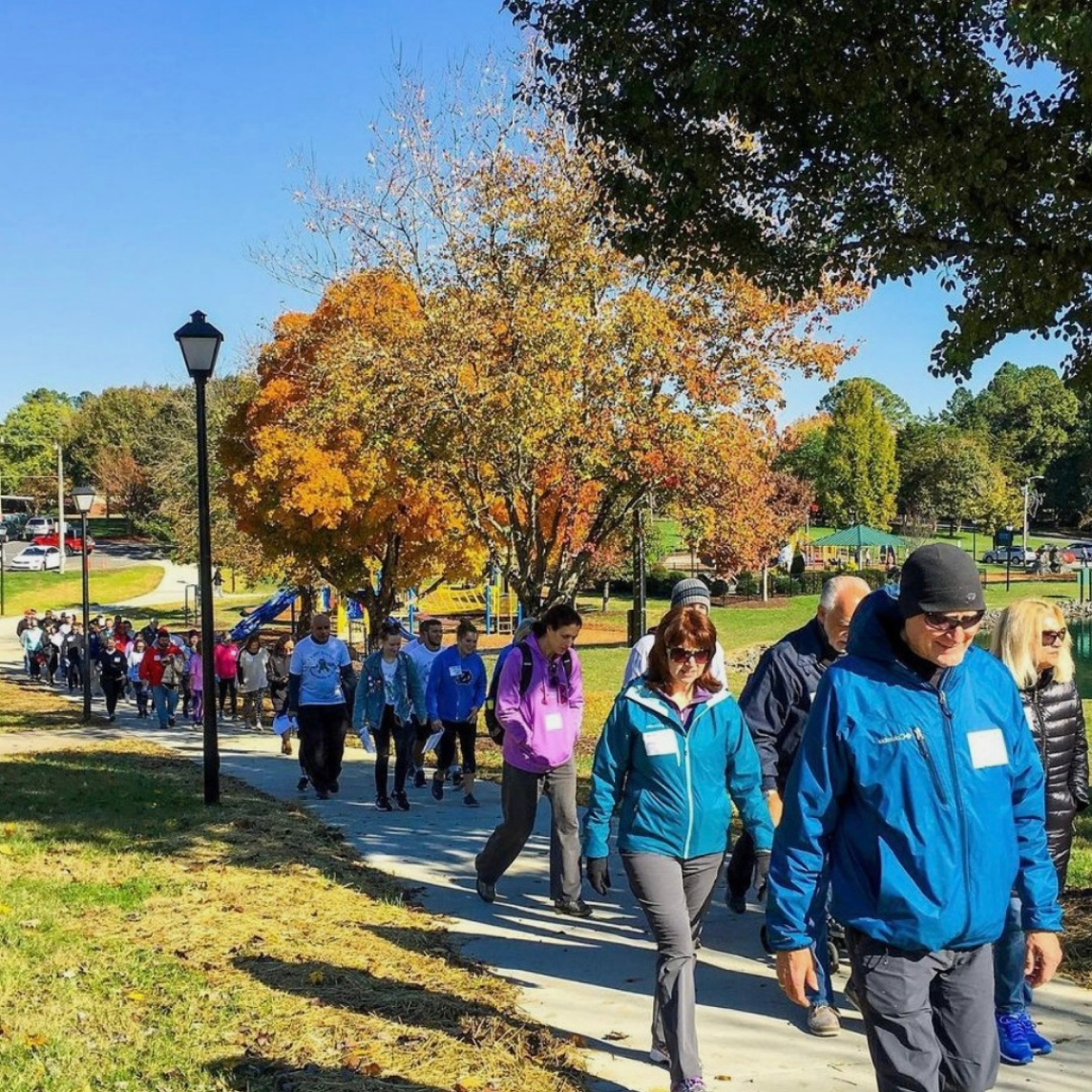 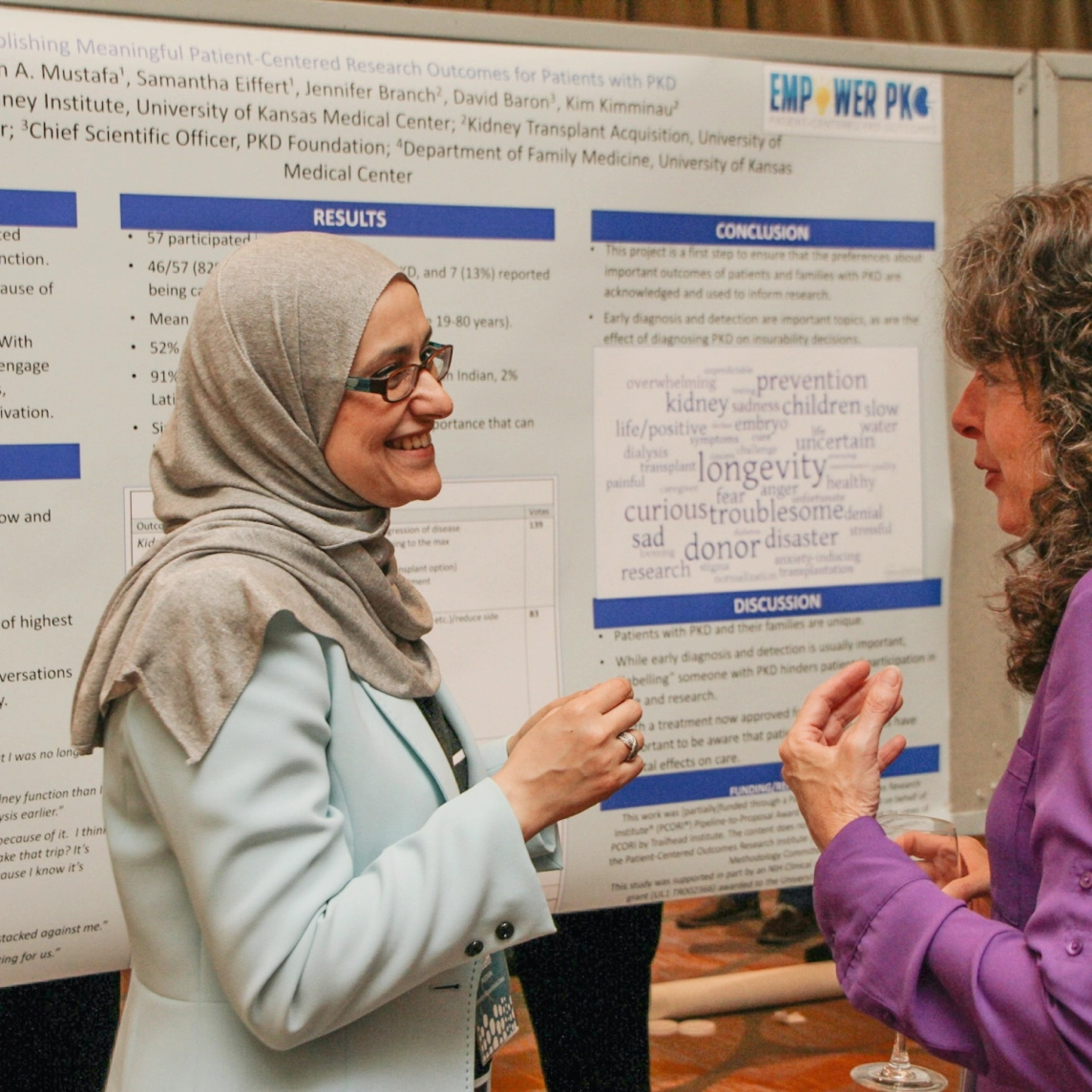
At the PKD Foundation, we’re fortunate to have a diverse group of ambassadors who are passionate about our mission to find treatments and a cure for polycystic kidney disease (PKD). Each ambassador brings unique strengths, perspectives, and personal experiences to our cause, helping us raise awareness, advocate for research, and support those affected by PKD. Whether they’re patients, caregivers, medical professionals, or community leaders, our ambassadors play a vital role in spreading hope and driving change. Let’s meet the different types of PKD Foundation ambassadors and learn how each contributes to our shared vision.
Walk for PKD Ambassador in San AntonioIn this role, you’ll play a pivotal part in fundraising, growing the local PKD community, and ensuring we have a successful 2026 Walk for PKD. This is your chance to make a meaningful impact and join a dedicated team committed to raising critical funds for PKD research and patient support.
Become the San Antonio Walk Ambassador today.
[Volunteer](https://pkdfoundation.jotform.com/260276353880057)
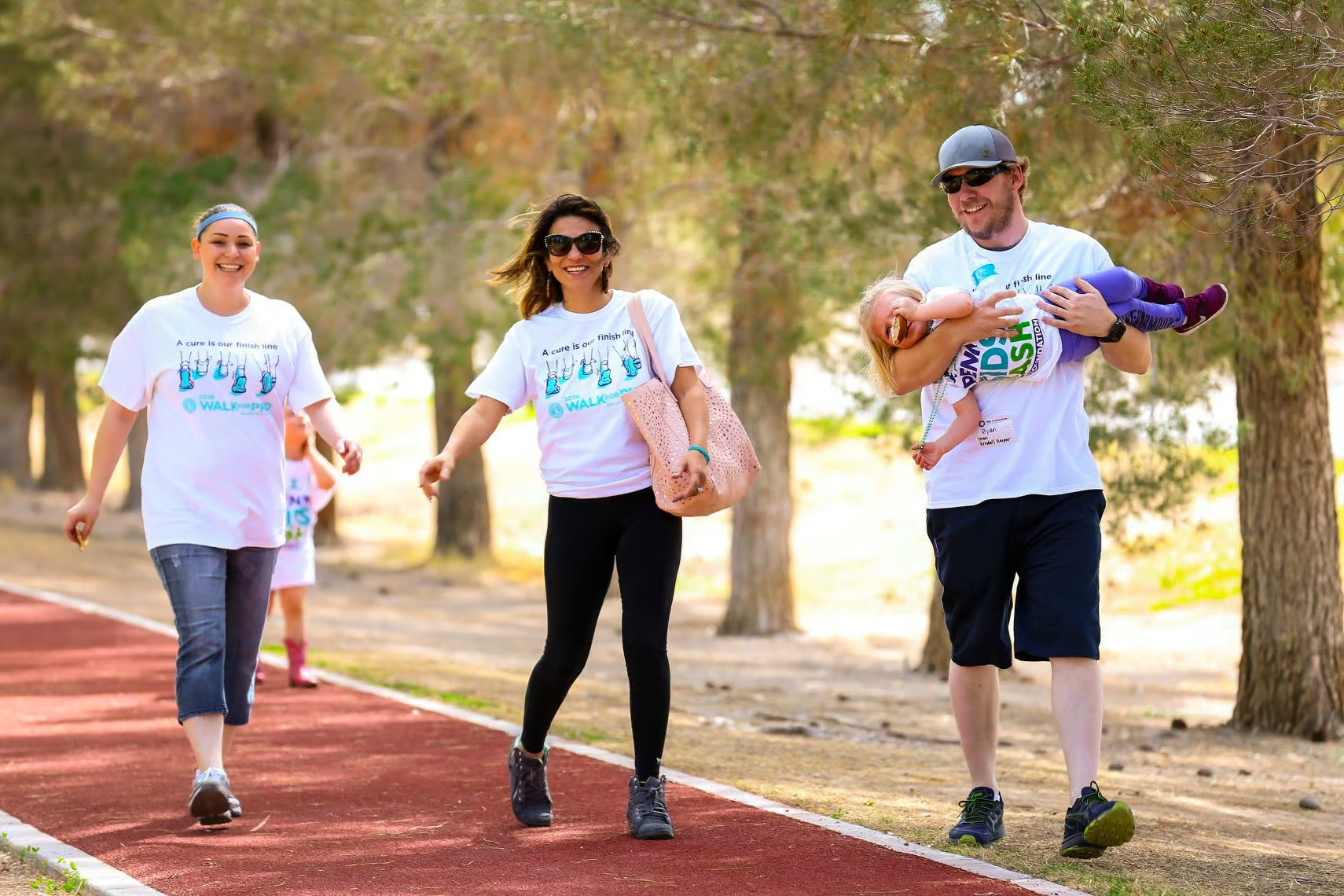
Fundraising AmbassadorsFundraising Ambassadors play an important role in PKD communities by identifying local fundraising opportunities and organizing events. With help from PKD Foundation staff, your contribution drives critical fundraising to support our mission.

Outreach AmbassadorsOutreach Ambassadors are meant to build new bridges between the PKD Foundation and previously underserved communities. These ambassadors will also guide communities of color through the Foundation’s resources on disease management, treatment options, and navigating health care systems.

PKD Connect AmbassadorsPKD Connect Ambassadors serve as the frontline for individuals new to the PKD Foundation, providing local support to PKD communities nationwide. Within their local communities, these volunteers share educational opportunities, connect families to PKD Foundation programs and services, and create a space for understanding and support.

Stewardship AmbassadorsThe Stewardship Ambassador is vital in helping the PKD Foundation share gratitude with our generous donors. In this role, you will thank donors through various types of communication: phone calls, emails, hand-written notes, etc.

Walk for PKD AmbassadorsOur Walk for PKD Ambassadors serve an important role in their community. They’re responsible for planning and executing their local Walk for PKD event with support from PKD Foundation staff. This volunteer role raises important donations and plans an event that brings the local PKD community together. Your contribution will help fulfill our vision to end PKD.
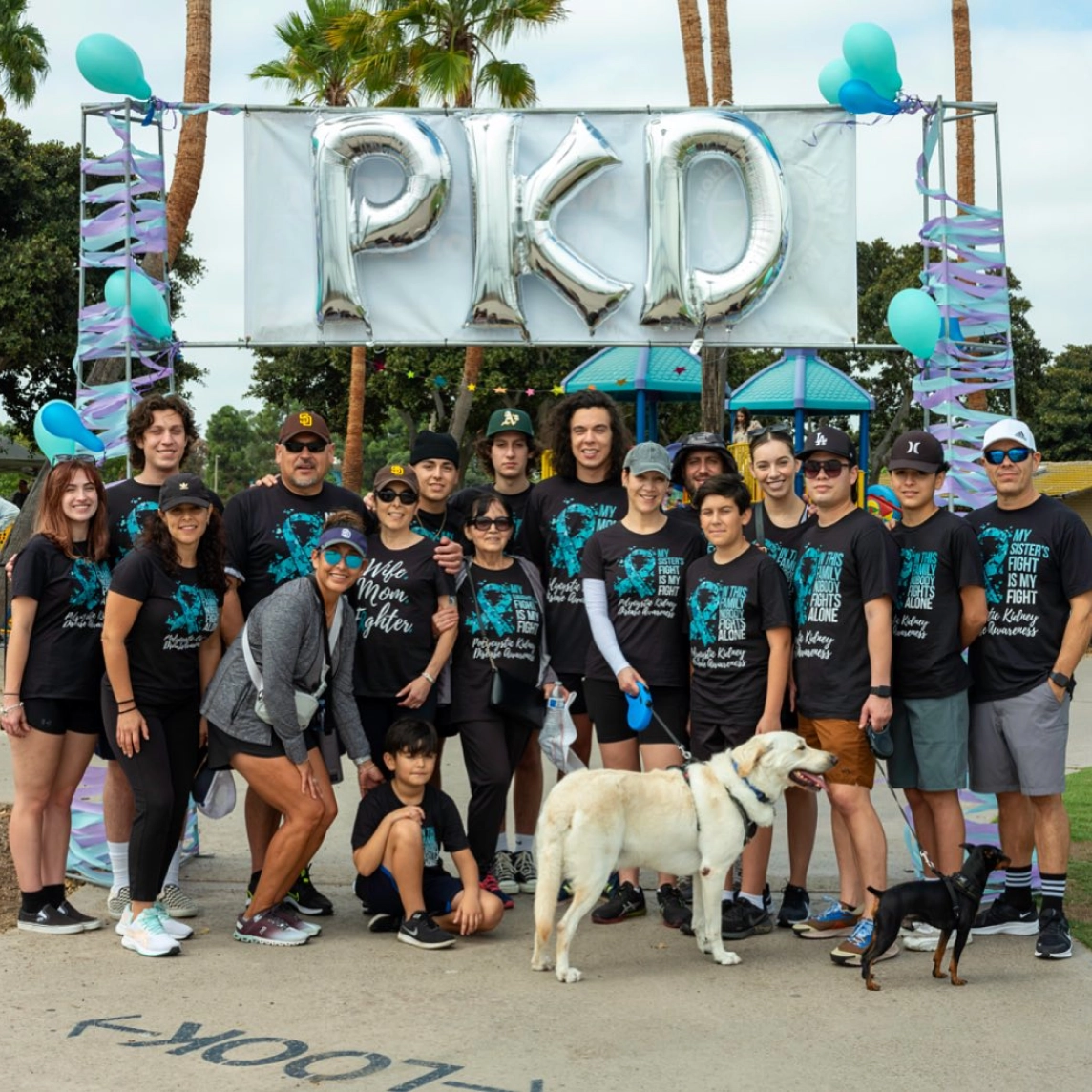
Advocacy ChampionsThe Advocacy Champion Network (ACN) is vital to raising awareness of PKD and increasing research dollars to bring treatments and therapies to patients and to provide the best care for those who are reliant on dialysis or a kidney transplant to survive.

Peer MentorsPKD Connect Peer Mentors provide resources, guidance, motivation, and emotional support to people impacted by PKD.

Community Reaction PanelThe PKD Foundation Community Reaction Panel provides feedback on pre-determined topics of interest to Industry partners and PKD Foundation programs and services. The panel consists of patients and caregivers with varied experiences across the continuum of disease progression and includes experience with ADPKD and ARPKD.

PKD Connect InterpretersPKD Connect Interpreters will translate emails and assist with returning phone calls on an as-needed basis. Volunteers will connect individuals with PKD Foundation programs and services as appropriate and assists with building a sense of community for non-English speaking patients and families.

---
### [About the Disease](https://pkdcure.org/about-the-disease/)
**Published:** August 1, 2024
**Author:** Caitlin Lasky
---
### [Kaplan Award](https://pkdcure.org/research/kaplan-award/)
**Published:** April 12, 2020
**Author:** Caitlin Lasky
**Content:**
Kaplan Award
Lillian Jean Kaplan International Prize for Advancement in the Understanding of Polycystic Kidney Disease
The Lillian Jean Kaplan International Prize for Advancement recognizes an individual(s) whose seminal scientific work constitutes tangible achievement toward improving knowledge and treatment of PKD. More than one prize may be awarded, and it may be awarded to residents of any country without restriction.
Award-winner 2024
Professor Caplan earned his undergraduate degree from Harvard in 1980, and his M.D. and Ph.D. degrees from Yale in 1987, working in the laboratories of James D. Jamieson and George Palade. He joined Yale’s Department of Cellular and Molecular Physiology as a faculty member in 1988. He received a fellowship from the David and Lucille Packard Foundation, a National Young Investigator Award from the National Science Foundation, and the Young Investigator Awards from the American Physiological Society and the American Society of Nephrologists. He has delivered the American Physiological Society’s Carl W. Gottschalk Distinguished Lectureship and was elected to membership in the American Association of Physicians. He was humbled to receive Yale Medical School’s Bohmfalk Prize for teaching and to be selected as the first recipient of Yale University’s Award for Postdoctoral Mentorship.
Professor Caplan’s laboratory studies Autosomal Dominant Polycystic Kidney Disease, a prevalent and serious genetic disorder and a major cause of kidney failure. The Caplan laboratory is working to understand the mechanisms responsible for this condition and to identify targets for new therapies.
Commenting on his award he says, “I am thrilled, honored and deeply humbled. I am also extremely grateful to the wonderful co-workers in my own laboratory and to collaborators around the world for their tremendous help and support.”
Nominations for 2025
**Nominations for the 2025 award are due August 2024.**
**Nomination requirements:**
- Your details: complete name, ISN membership number, and contact information
- Nominee details: complete name (as listed in publications) and contact information
- Support statement: a description of how and why the nominee’s work represents a major advance in basic or clinical understanding of PKD, distinguishing those aspects which clearly set it apart from the work of others in the field, and a summary of the nominee’s contributions
- Full curriculum vitae and bibliography of the nominee
- Letters of support: at least two
**All nominations and supporting materials are to be sent via email to Jo-Ann Donner at <jdonner@theisn.org>.**
Winners are selected by the Lillian Jean Kaplan Prize Advisory Committee: Committee Chair Dr. Vicente Torres, two committee members selected by the PKD Foundation, and two ISN members.
Past award recipients


Get the latest information on treating PKD.
Research Resources
- [Research homepage](https://pkdcure.org/research/)
- [Funding Opportunities](https://pkdcure.org/research-medical-professionals/research-funding/)
- [Current grantees and fellows](https://pkdcure.org/funded-research/)
- [Database resources](https://pkdcure.org/research-medical-professionals/data-resources-in-pkd-research/)
- [Clinical studies](https://clinicalstudies.pkdcure.org/)
- [ADPKD Centers of Excellence](https://pkdcure.org/adpkd-care)
2023
*Baltimore, MD*
2022
*Italy*
*United Kingdom*
2021
*Pittsburgh, PA*
2020
*Chicago*
2019
*Canada*
*Birmingham, Ala.*
2017
*Boston*
*Seattle*
2015
*Minneapolis*
*Worcester, Mass.*
2013
*Indianapolis*
*Leiden, Netherlands*
2011
*Germany*
*Kansas City, Kan.*
2009
*Birmingham, Ala.*
*Paris*
*Boston*
2007
*Boston*
*Rochester, Minn.*
2005
*Baltimore*
*New Haven, Conn.*
2003
*Kansas City, Kan.*
*Rochester, Minn.*
Page last edited January 2023
MICHAEL CAPLAN, 2024 AWARDEE INFORMATION:
Award-Winner 2024
Professor Caplan earned his undergraduate degree from Harvard in 1980, and his M.D. and Ph.D. degrees from Yale in 1987, working in the laboratories of James D. Jamieson and George Palade. He joined Yale’s Department of Cellular and Molecular Physiology as a faculty member in 1988. He received a fellowship from the David and Lucille Packard Foundation, a National Young Investigator Award from the National Science Foundation, and the Young Investigator Awards from the American Physiological Society and the American Society of Nephrologists. He has delivered the American Physiological Society’s Carl W. Gottschalk Distinguished Lectureship and was elected to membership in the American Association of Physicians. He was humbled to receive Yale Medical School’s Bohmfalk Prize for teaching and to be selected as the first recipient of Yale University’s Award for Postdoctoral Mentorship.
Professor Caplan’s laboratory studies Autosomal Dominant Polycystic Kidney Disease, a prevalent and serious genetic disorder and a major cause of kidney failure. The Caplan laboratory is working to understand the mechanisms responsible for this condition and to identify targets for new therapies.
Commenting on his award he says, “I am thrilled, honored and deeply humbled. I am also extremely grateful to the wonderful co-workers in my own laboratory and to collaborators around the world for their tremendous help and support.”
---
### [Data resources in PKD research](https://pkdcure.org/research/data-resources-in-pkd-research/)
**Published:** April 11, 2020
**Author:** Caitlin Lasky
**Content:**
Data resources in PKD research
The PKD Foundation is dedicated to the support and advancement of PKD research. The [FDA approval of total kidney volume as a biomarker](https://pkdcure.org/blog/moving-toward-new-treatments-for-adpkd/) for ADPKD progression demonstrated the value of data sharing in enhancing and accelerating research towards new treatments. By encouraging utilization of existing datasets, the Foundation hopes to bring new perspectives from the re-analysis of past PKD studies and utilization of ongoing data resources to contribute to a cost-effective and efficient resource for advancing research in PKD.
PKD Research Resource Consortium
The Polycystic Kidney Disease Research Resource Consortium (PKD RRC), funded by The National Institutes of Diabetes, Digestive and Kidney Diseases (NIDDK) goal is to support a collaborative, diverse community of investigators who are working to advance discovery in the area of polycystic kidney disease. We aim to help researchers achieve their PKD research goals by sharing, distributing, and developing innovative reagents and resources. We encourage you to browse our core services and resources and to reach out with questions [here](https://www.pkd-rrc.org/).
The PKD RRC’s **PKD Genome Browser** serves as a repository of variants across the exomes and targeted panel sequencing of individuals with polycystic kidney disease (PKD). Our goal is to aggregate and harmonize exome and genome sequencing data from sequencing projects of PKD and to make summary data available to the wider scientific community. Check it out [here](https://pkdgenes.org/).
The PKD Genome Browser is actively seeking additional cohorts to include in the aggregation efforts. If you want to contribute targeted sequencing, exome or genome data to the PKD Genome Browser, please contact the PKD RRC.


Get the latest information on treating PKD.
Research Resources
- [Research homepage](https://pkdcure.org/research/)
- [Funding Opportunities](https://pkdcure.org/research-medical-professionals/research-funding/)
- [Current grantees and fellows](https://pkdcure.org/funded-research/)
- [Database resources](https://pkdcure.org/research-medical-professionals/data-resources-in-pkd-research/)
- [Clinical studies](https://clinicalstudies.pkdcure.org/)
- [ADPKD Centers of Excellence](https://pkdcure.org/adpkd-care)
Consortium for Radiologic Imaging Studies of PKD (CRISP)
CRISP was established to develop and implement studies to test whether imaging techniques can provide accurate and reproducible markers of progression of renal disease in patients with ADPKD. The cohort study longitudinally observed ADPKD individuals using high-resolution magnetic resonance (MR) imaging to determine if change in renal and cyst volumes can be detected over time, and if they correlate with decline in renal function.
Find more details on CRISP and how to access study specimens and datasets [here](https://repository.niddk.nih.gov/studies/crisp1/).
The HALT Progression of PKD (HALT-PKD)
The HALT-PKD studies are two simultaneous multicenter clinical trials designed to test the efficacy of aggressive renin-angiotestin-aldosterone system (RAAS) blockade and rigorous vs standard blood pressure targets on the ADPKD progression.
Find more details on HALT-PKD and how to access study specimens and datasets [here](https://repository.niddk.nih.gov/studies/halt_pkd_a/).
The Critical Path Institute’s PKD Outcomes Consortium (PKDOC)

The PKDOC database consists of de-identified data from three longitudinal observational patient registries. The data have been standardized and aggregated into a common format using a Clinical Data Interchange Standards Consortium (CDISC) Standard Data Tabulation Model (SDTM) structure. This enables analyses to be performed on a larger expanded dataset. The data cover approximately seven decades of patient visits from 2,498 subjects in patient registries at the University of Colorado – Denver, Mayo Clinic and Emory University.
Find more details on PKDOC and how to access study datasets [here](https://c-path.org/programs/pkd/).
The Mayo Clinic ADPKD Mutation Database
The ADPKD Database (PKDB) has been established to facilitate the characterization of ADPKD variants in *PKD1* and *PKD2,* the two major causative ADPKD genes. It has been set up as a repository of all variants in these genes, whether likely disease causing or not.
Find more details on PKDB and how to access mutation datasets [here](https://pkdb.mayo.edu/).
Rare Disease Cures Accelerator-Data and Analytics Platform
The Rare Disease Cures Accelerator-Data and Analytics Platform (RDCA-DAP®) is an FDA-funded initiative that provides a centralized and standardized infrastructure to support and accelerate rare disease characterization, with the goal of accelerating therapy development across rare diseases. RDCA-DAP promotes the sharing of existing patient-level data and encourages the standardization of new data collection. By integrating such data in a regulatory-grade format suitable for analytics, RDCA-DAP accelerates the understanding of disease progression (including sources of variability to optimize the characterization of subpopulations), clinical outcome measures and biomarkers, and facilitates the development of mathematical models of disease and innovative clinical trial designs.
Find more details on RDCA-DAP and how to access the platform [here](https://c-path.org/programs/rdca-dap/).
German Mutation Database ARPKD/PKHD1
The ARPKD/PKHD1 Database recognizes that it has been crucial to catalogue all changes detected in the *PKHD1* gene in a locus specific database to provide the users with information on all known variants and therefore to facilitate the characterization of detected *PKHD1* variants. The database has been set up to be a collection of all variants in this gene, whether they are likely disease causing or not.
Find more details on the Mutation Database and how to access ARPKD datasets [here](http://www.humgen.rwth-aachen.de/).
Page last edited August 2023
---
### [PKDCON 2026](https://pkdcure.org/pkdcon26/)
**Published:** November 3, 2025
**Author:** Sarah Lundak
**Content:**

---
### [Grant Applications](https://pkdcure.org/research/grants/pkd-foundation-research-rfa/)
**Published:** April 12, 2020
**Author:** Caitlin Lasky
**Content:**
Request for Applications — Research Grants[**Apply Now!**](https://proposalcentral.com/)Overview of program goals and scope
The PKD Foundation’s principal mission is to support basic, translational, and clinical research that will benefit patients with autosomal dominant and autosomal recessive polycystic kidney disease (ADPKD and ARPKD).
Under this RFA, the PKD Foundation solicits research grant applications in the following areas:
- Basic research — to enhance understanding of molecular basis of PKD and its pathobiology
- Translational research — to accelerate development of predictive and therapeutic strategies for PKD
- Clinical research — such as small pilot studies
- Epidemiology/data analysis research — to conduct secondary data analyses utilizing existing database resources, or to develop new statistical methodologies or test hypotheses [using existing data](https://pkdcure.org/research-medical-professionals/data-resources-in-pkd-research/)
**Special consideration will be given to proposed research in the following areas:**
- Autosomal Recessive PKD (ARPKD)
- ADPKD in children
- Innovative approaches to machine learning
- Lifestyle interventions (e.g., in dietary habits)
- Epidemiology/ data analysis (e.g., using [existing datasets](https://pkdcure.org/research-medical-professionals/data-resources-in-pkd-research/))
- Extra-renal manifestations of PKD, including but not limited to congenital hepatic fibrosis, polycystic liver disease and intracranial aneurysms
- Clinical care disparities (e.g., race, ethnicity, socioeconomic status, rural versus urban)
- Drug delivery mechanisms
Thanks to international PKD Foundation alliances, special consideration will also be given to grant applications for research conducted in:
- Canada (made possible by a collaboration with the PKD Foundation of Canada)
- Australia (made possible by a collaboration with the PKD Australia)
Important dates
Applicants must submit a pre-application in order to be considered for funding, and will be notified by October as to whether or not they are invited to submit full grant proposals. Full applications will not be accepted unless notification of invitation has been received from PKDF.
| **Pre-Application opens** | July 1, 2025 |
|---|---|
| **Pre-Application Deadline** | August 11, 2025 @ 5 PM CST |
| **Review Period** | August – October 2025 |
| **Invitations to submit full applications\*** | Mid-October 2025 |
| **Full Application Deadline** | January 12, 2026 @ 5 PM CST |
| **Review Period** | January – April 2026 |
| **Applicant Notification** | May 2026 |
| **Funding Cycle** | July 1, 2026 – June 30, 2028 |
Program specifics
Applicants must have an M.D., Ph.D. or equivalent degree and hold a faculty appointment or equivalent at the institution where the research will be conducted at the time of award. Researchers are invited to apply from all over the world and do not need to be United States citizens. No fellowships will be awarded under this RFA, although salary support for personnel working on the project may be requested. Applicants may only submit one grant proposal per funding cycle.
Award amounts will equal **$80,000** direct costs per year for two years, for a total grant award of **$160,000** (or $240,000 for a three-year Young Investigator Award). Future-year funding is dependent upon the availability of funds and interim research progress. The funds awarded must be used solely for the purposes specified in the proposal submitted to and approved by the PKD Foundation as executed by the investigator and institution in strict compliance with the budget attached to the application. Please note the following restrictions on salary, travel and indirect costs:
- **No Indirect Costs are paid on this award**.
- No more than 50% of the Direct Costs ($40,000) may be used for the applicant’s or other personnel’s salary. Any use of the award for salary support must be justified in the application.\*
- Consultant costs cannot exceed $10,000; equipment costs cannot exceed $12,000.
- No more than $1500 per year may be used for travel.
- Successful applicants may not hold any other research funding from the PKD Foundation at the time funding of this grant begins.
- Applicants with existing funding from other sources will be eligible to apply for this award as long as there is no scientific overlap between the new application and existing or anticipated funding.
- All current or potential funding must be disclosed at the time of application.
\**Salary and equipment cost limitations may be waived on research involving epidemiology/data analysis research or other proposals requiring heavy personnel support. Please contact* [*eliseh@pkdcure.org*](mailto:eliseh@pkdcure.org) *with details of your project to be considered.*
The PKD Foundation strives to be transparent related to our decision-making processes. We rely on our grant review committees, who develop recommendations for funding, as well as the process we use as a Foundation to make funding decisions. Learn more [here](https://pkdcure.org/the-peer-review-process/).
An optional third year of support will be available to a young investigator(s). The recipient(s) will be selected from meritorious grant applications to support the transition of a junior scientist to an independent investigator.
Specific eligibility criteria at the **time of the beginning of this additional support** include:
- Primary faculty appointments not required at time of application but must be held by start of funding
- A letter of support is required from the department/division chair outlining the applicants’ path to independence and institutional/divisional commitment to the candidate’s research career development (commitment to the candidate having ability to devote required effort to activities under the award, access to appropriate office/laboratory space etc.,). If the applicant is a post-doctoral fellow at time of
award submission, the letter needs to provide assurance of promotion to a faculty appointment at time of award initiation
- No other career development award may be held (e.g., NIH K-award or equivalent)
- No major research award may be held (in the role of lead investigator) (e.g., NIH R01 or equivalent)
- No more than 7\* years from completing post-doctoral or clinical fellowship training
*\*does not include maternity leave, FMLA, or time lost during the COVID-19 pandemic*
Interested applicants will need to clearly outline their interest, eligibility, and scope of research for this third year of funding. Grant applications should be written for the standard two-year proposal; a section will be provided for those applying to the YIA to provide an additional page justification.
Applicants are restricted to one application resubmission and will be asked to provide a one-page response to reviewer comments. Thereafter, the application must be submitted as a new application.
Grantees must submit an annual Progress Report to be submitted along with a Financial Report. As part of these reports, a brief (one or two paragraph) summary written for the lay public must be included. Although Research Grant and Fellowship Awards are for a two-year period, the PKD Foundation reserves the right to terminate any grant if there has been inadequate research progress during the first year of the award.
Download the [PKDF Report Requirements](https://pkdcure.org/wp-content/uploads/Interim-and-Final-Report-Requirements.pdf).
A stipulation to all awards is appropriate attribution of the PKD Foundation in any publication, news release, presentation, etc. that results from work funded by the award. The PKD Foundation must also receive a copy of the publication and/or news release. This responsibility extends beyond the interval of provided funding.
Grantees are asked to please use language similar to the following: *This research was funded by a grant from the Polycystic Kidney Disease Foundation, pkdcure.org. The Foundation had no role in study design, data collection and interpretation, or the decision to submit the work for publication.*
All research projects funded by the PKD Foundation are subject to its intellectual property policy. Details can be found at **[pkdcure.org/intellectualpropertypolicy](https://pkdcure.org/wp-content/uploads/pkd-foundation-intellectual-property-policy-27-september-2018.pdf).** By accepting a PKD Foundation award for a research project, the Principal Investigator or other personnel contributing to and working on the project, as well as the Institution(s) with which they are affiliated, agree to be bound by the terms and conditions of this policy.
All research projects are encouraged to publish as high-quality, peer-reviewed research articles, monographs, and book chapters. We believe that maximizing the distribution of these publications – by providing free, online access – is the most effective way of ensuring that the research we fund can be accessed, read, and built upon. In turn, this will foster a richer research culture.
Click [here](https://pkdcure.org/wp-content/uploads/2023/09/PKDF-Open-Access-Policy.pdf) to learn more about the Open Access Policy
The PKD Foundation serves as a grantor not a sponsor for research grant projects. For those involving human subjects, the responsibility for liability issues and all reporting requirements including local, state and federal regulations and requirements including those of the FDA, will reside with the sponsoring institution, not the PKD Foundation.
Any relationship between the investigators and any industrial collaborator must be disclosed in the application.
Prior to releasing funding, the PKD Foundation will require an Authorized Organizational Representative to certify by means of a signed letter on institutional letterhead, institutional commitment to ensuring:
1. Proper policies, procedures and oversight are in place to prevent discriminatory harassment and other discriminatory practices, and;
2. Commitment to respond promptly and appropriately to allegations of discriminatory practices.
Failure to provide the signed letter will result in withdrawal of the application/funding. The full Foundation policy can be found [here](https://pkdcure.org/wp-content/uploads/harassment-policy_grants_030419.pdf).
Pre-application Instructions
Applicants must submit a pre-application in order to be considered for funding, and will be notified by October as to whether or not they are invited to submit full grant proposals. Full applications will not be accepted unless notification of invitation has been received from PKDF.
**Instructions:**
Submit your pre-application through the [Proposal Central submission portal](https://proposalcentral.com/ProposalGI.asp?SectionID=9389&ProposalID=-1) by August 12th, 2024 at 5 pm CST.
**Pre-application requirements:**
1. Letter of Intent
- Abstract (*3,500 characters w/ spaces*)
- Significance; Innovation; Specific aims and approach; and Scientific team and environment (4*,500 characters w/ spaces)*
- *Tables and figures (one page limit, PDF upload*))
2. References (*one page limit, PDF upload)*
3. Biosketch (*five page limit*): new style NIH Biosketch [format](https://grants.nih.gov/grants/forms/biosketch.htm). Include relevant details of applicant’s career trajectory as relating to this proposal.
- Also include a Biosketch for all key personnel.
Full Application Instructions
Applicants **must submit a pre-application** in order to be considered for funding, and will be notified by October as to whether or not they are invited to submit full grant proposals. Full applications will not be accepted unless notification of invitation has been received from PKDF.
Applicants will be asked to submit a project proposal, letters of support, and budget details through the ProposalCentral platform. If the application is a resubmission, a response to reviewers will be requested. If eligible, applicants may also submit justification to be considered for the Young Investigator Award.
Font size and types, margins, and line spacing requirements are necessary to ensure readability. Applications that do not strictly adhere to the following guidelines will be administratively withdrawn.
- **Font size:** Must be 11 points or larger. Smaller text in figures, graphs, diagrams, and charts is acceptable, as long as it is clearly legible when the page is viewed at 100%.
- Some PDF conversion software reduces the font size. It is important to confirm that the final PDF document complies with the font requirements.
- **Text fonts:** please use one of the following:
- Arial
- Georgia
- Helvetica
- **Page margins:** 1-inch margins from top, bottom, left and right aspects of each page. The NIH Biosketch may use 1/2 inch margins.
- **Line spacing:** No more than six lines per vertical inch (e.g., text using Arial font size 11 would need to be at least single (1.0) spaced).
- **Text color:** No restriction. Though not required, black or other high-contrast text colors are recommended since they print well and are legible to the largest audience.
- \*All images, graphs, charts, etc. should be included in the Project Plan section of the application.
For general guidance how to structure and write a grant application consider NIH resources (e.g., [Format and Write Applications](https://grants.nih.gov/grants/how-to-apply-application-guide/format-and-write/write-your-application.htm) or [Research Forms](https://grants.nih.gov/grants/how-to-apply-application-guide/forms-e/research-forms-e.pdf))
If you have any questions, please contact <research@pkdcure.org>.


Get the latest information on treating PKD.
##### Research Resources
- [Research homepage](https://pkdcure.org/research/)
- [Funding Opportunities](https://pkdcure.org/research-medical-professionals/research-funding/)
- [Current grantees and fellows](https://pkdcure.org/funded-research/)
- [Database resources](https://pkdcure.org/research-medical-professionals/data-resources-in-pkd-research/)
- [Clinical studies](https://clinicalstudies.pkdcure.org/)
- [ADPKD Centers of Excellence](https://pkdcure.org/adpkd-care)
#### Learn more
In 2020, we awarded research grants to nine outstanding PKD researchers for a total investment of $1.4 million over the next two years. The Research Grant Program will fund critical research to increase understanding of the genetic and pathological processes involved in PKD and to accelerate the development of potential therapies for PKD patients.
Page last updated June 2024
---
### [Fellowship Applications](https://pkdcure.org/research/fellowships/pkd-foundation-fellowship-rfa/)
**Published:** April 12, 2020
**Author:** Caitlin Lasky
**Content:**
Request for Applications — Fellowships[Apply for a 2024 Fellowship now! ](https://proposalcentral.com/)Overview of program goals and scope
The PKD Foundation’s principal mission is to support basic, translational and clinical research that will benefit patients with autosomal dominant and autosomal recessive polycystic kidney disease (ADPKD and ARPKD).
The PKD Foundation is interested in fostering research in the areas relevant to PKD with the goal of furthering our understanding of the physiological, biochemical, molecular and genetic mechanisms of this disease. This fellowship is designed to facilitate young investigators to obtain significant research experience as they initiate careers in PKD research. This program is intended to assure the continuity over time of outstanding investigators committed to the study of PKD.
Under this RFA, the PKD Foundation solicits research fellowship applications in the following areas:
- Basic research – to enhance understanding of molecular basis of PKD and its pathobiology
- Translational research – to accelerate development of predictive and therapeutic strategies for PKD
- Clinical research – such as small pilot studies
- Epidemiology/data analysis research – to conduct secondary data analyses utilizing existing database resources, or to develop new statistical methodologies or test hypotheses [using existing data](https://pkdcure.org/research-medical-professionals/data-resources-in-pkd-research/)
**Special consideration will be given to proposed research in the following areas:**
- Autosomal Recessive PKD (ARPKD)
- ADPKD in children
- Biomarker discovery and validation
- Behavioral interventions (e.g., in dietary habits)
- PKD drug discovery
- Epidemiology/ data analysis (e.g., using [existing datasets)](https://pkdcure.org/research-medical-professionals/data-resources-in-pkd-research/)
- Extra-renal manifestations of PKD, including but not limited to congenital hepatic fibrosis, polycystic liver disease and intracranial aneurysms
- Clinical care disparities (e.g., race, ethnicity, socioeconomic status, rural versus urban)
- Diabetes and PKD
Important dates
| **Application opens** | October 13, 2023 |
|---|---|
| **Application deadline** | January 16, 2024 @ 5pm CST |
| **Review period** | January – May 2024 |
| **Applicant notification** | May 2024 |
| **Funding cycle** | July 1, 2024 – June 30, 2026 |
Program specifics
Fellows may submit a proposal that examines any aspect of polycystic kidney disease biology. Applicants must:
1. Hold an M.D. or Ph.D. or the equivalent degree at the time of the award.
2. May not have completed the equivalent of more than four years of research training (excluding clinical training) after completion of the M.D. (or equivalent) or postdoctoral research training after the Ph.D. at the time the award begins. This does not include medical leave or FMLA.
3. Complete research under the direction of a mentor.
4. Not hold another full fellowship award although institutional supplemental support is acceptable.
5. Commit a minimum of 75% of time to **research and training** during the fellowship period.
The Award of **$60,000** per year will be provided for two years (grant total of **$120,000**).
The funds awarded must be used solely for the purposes specified in the proposal submitted to and approved by the PKD Foundation as executed by the investigator and institution in strict compliance with the budget attached to the application. Future-year funding is dependent upon availability of funds and interim research progress.
This funding opportunity has following restrictions:
1. **No Indirect Costs are paid on this award**.
2. Any use of the award for salary support must be justified in the application.
3. Consultant costs cannot exceed $10,000; equipment costs cannot exceed $10,000.
4. No more than $1,500 per year may be used for travel.
5. Successful applicants may not hold any other research funding from the PKD Foundation at the time funding of this grant begins.
6. Applicants with existing funding from other sources (on which they are in the role of the lead investigator) will not be eligible to apply for this award, although institutional supplemental support is acceptable.
7. All current or potential funding must be disclosed at the time of application.
The PKD Foundation strives to be transparent related to our decision-making processes. We rely on our grant review committees, who develop recommendations for funding, as well as the process we use as a Foundation to make funding decisions. Learn more [here](https://pkdcure.org/the-peer-review-process/).
Grantees must submit an annual Progress Report to be submitted along with a Financial Report. As part of these reports, a brief (one or two paragraph) summary written for the lay public must be included. Although Research Grant and Fellowship Awards are for a two-year period, the PKD Foundation reserves the right to terminate any grant if there has been inadequate research progress during the first year of the award.
Download the [PKDF Report Requirements.](https://pkdcure.org/wp-content/uploads/Interim-and-Final-Report-Requirements.pdf)
A stipulation to all awards is appropriate attribution of the PKD Foundation in any publication, news release, presentation, etc. that results from work funded by the award. The PKD Foundation must also receive a copy of the publication and/or news release.
Please use language similar to the following: *This research was funded by a grant from the Polycystic Kidney Disease Foundation, pkdcure.org. The Foundation had no role in study design, data collection and interpretation, or the decision to submit the work for publication.*
All research projects funded by the PKD Foundation are subject to its intellectual property policy. Details can be found [**here**.](https://pkdcure.org/wp-content/uploads/pkd-foundation-intellectual-property-policy-27-september-2018.pdf) By accepting a PKD Foundation award for a research project, the Principal Investigator or other personnel contributing to and working on the project, as well as the Institution(s) with which they are affiliated, agree to be bound by the terms and conditions of this policy.
The PKD Foundation serves as a grantor not a sponsor for research grant projects. For those involving human subjects, the responsibility for liability issues and all reporting requirements including local, state and federal regulations and requirements including those of the FDA, will reside with the sponsoring institution, not the PKD Foundation.
Any relationship between the investigators and any industrial collaborator must be disclosed in the application.
Prior to releasing funding, the PKD Foundation will require an Authorized Organizational Representative to certify by means of a signed letter on institutional letterhead, institutional commitment to ensuring:
1. Proper policies, procedures and oversight are in place to prevent discriminatory harassment and other discriminatory practices, and;
2. Commitment to respond promptly and appropriately to allegations of discriminatory practices.
Failure to provide the signed letter will result in withdrawal of the application/funding. The full Foundation policy can be found [here](https://pkdcure.org/wp-content/uploads/harassment-policy_grants_030419.pdf).
#### **APPLICATION INSTRUCTIONS**
Applicants will be asked to submit a project proposal, letters of support, a mentorship plan, and budget details through the ProposalCentral platform.
Font size and types, margins and line spacing requirements are necessary to ensure readability. Applications that do not strictly adhere to the following guidelines will be administratively withdrawn.
- **Font size:** Must be 11 points or larger. Smaller text in figures, graphs, diagrams, and charts is acceptable, as long as it is clearly legible when the page is viewed at 100%.
- Some PDF conversion software reduces the font size. It is important to confirm that the final PDF document complies with the font requirements.
- **Text fonts:** please use one of the following:
- Arial
- Georgia
- Helvetica
- **Page margins:** 1-inch margins from top, bottom, left and right aspects of each page.
- **Line spacing:** No more than six lines per vertical inch (e.g., text using Arial font size 11 would need to be at least single (1.0) spaced).
- **Text color:** No restriction. Though not required, black or other high-contrast text colors are recommended since they print well and are legible to the largest audience.
- \*All images, graphs, charts, etc. should be included in the Project Plan section of the application.
For general guidance how to structure and write a grant application consider NIH resources (e.g., [Format and Write Applications](https://grants.nih.gov/grants/how-to-apply-application-guide/format-and-write/write-your-application.htm) or [Research Forms](https://grants.nih.gov/grants/how-to-apply-application-guide/forms-e/research-forms-e.pdf))
If you have any questions, please contact <research@pkdcure.org>.


Get the latest information on treating PKD.
##### Research Resources
- [Research homepage](https://pkdcure.org/research/)
- [Funding Opportunities](https://pkdcure.org/research-medical-professionals/research-funding/)
- [Current grantees and fellows](https://pkdcure.org/funded-research/)
- [Database resources](https://pkdcure.org/research-medical-professionals/data-resources-in-pkd-research/)
- [Clinical studies](https://clinicalstudies.pkdcure.org/)
- [ADPKD Centers of Excellence](https://pkdcure.org/adpkd-care)
Page last updated January, 2024
---
### [Education Handouts](https://pkdcure.org/education-handouts/)
**Published:** June 16, 2025
**Author:** Sarah Lundak
---
### [PKD Patient Handbooks](https://pkdcure.org/for-patients/patient-handbooks/)
**Published:** October 29, 2020
**Author:** Caitlin Lasky
**Content:**
Patient Handbooks
Thank you for your interest in a free information packet on polycystic kidney disease (PKD). This complimentary packet of resources includes general information about PKD and a PKD Patient Handbook.
- We are proud to offer both a digital and print version of the information packet and patient handbook at no cost to you.
- We ask that you please consider requesting the digital version as we do incur some costs to print and mail hard copies.
- We are only able to mail hard copy packets within the United States.
- The digital version will be sent to you immediately.
There are three versions of the handbook: one for autosomal dominant polycystic kidney disease (ADPKD), which is also available in [Spanish,](#manualparapacientesconerpad) and one for autosomal recessive polycystic kidney disease (ARPKD).
The purpose of this handbook is to provide information about ADPKD. It will be useful to those who have the disease, those who are at risk due to an affected parent as well as invested family members and friends. It is not intended for those affected by autosomal recessive polycystic kidney disease (ARPKD).
- ADPKD is the more common type and occurs in approximately 1 in 500 to 1 in 2000 live births.
- ADPKD is the fourth leading cause of kidney failure.
- Parents have a 50% chance of passing the disease to their children, so it often affects many people in one family.
El propósito de este manual es proporcionar información sobre la enfermedad renal poliquística autosómica dominante (ERPAD). Será un documento útil para aquellas personas que tienen la enfermedad, para las que tienen riesgo de tenerla debido a un progenitor afectado, así como para los familiares y amigos involucrados. No está dirigido a los pacientes con enfermedad renal poliquística autosómica recesiva (ERPAR). Para los pacientes con esta enfermedad, hay un manual disponible en pkdcure.org. En lo sucesivo, nos referiremos a la ERPAD simplemente como ERP.
The purpose of this handbook is to provide information about autosomal recessive polycystic kidney disease (ARPKD) and congenital hepatic fibrosis (CHF). It will be useful to children and families who have been diagnosed with ARPKD/CHF, as well as family members, caregivers and health professionals. It is not intended for those with autosomal dominant polycystic kidney disease (ADPKD).
***\*We’re working on an updated version, coming in early 2024.***
- ARPKD is a rare form of the disease that occurs in 1 in 25,000 children worldwide.
- Previously thought to be a fatal condition, the prognosis for children with ARPKD has improved dramatically.
---
### [ARPKD](https://pkdcure.org/about-the-disease/arpkd/)
**Published:** February 26, 2020
**Author:** Caitlin Lasky
**Content:**
What is ARPKD?
**Autosomal recessive polycystic kidney disease (ARPKD)** is a rare genetic disorder occurring in approximately 1 in 25,000 children, equally affecting boys and girls.
ARPKD can come as a scary, overwhelming diagnosis. And while ARPKD can cause death in the first month of life, almost 80% of ARPKD children survive the newborn period. Past that, one-third will need a transplant or dialysis in the first 10 years, however. But that’s no reason to be pessimistic.
The prognosis for ARPKD has changed dramatically—it’s no longer considered a fatal condition. Twenty years ago, only half of the children born with the disease survived to their 10th birthday. Now, more than 90% of children who survive the newborn period reach their 20th birthday and 50% of these survivors do not yet require dialysis or a transplant.
[What is PKD?](https://pkdcure.org/what-is-pkd/)
- [Kidney 101](https://pkdcure.org/what-is-adpkd/kidney-101/)
- [Parents of children with PKD](https://pkdcure.org/what-is-adpkd/parents-of-children-with-pkd/)
- [What are cysts?](https://pkdcure.org/what-is-adpkd/what-are-cysts/)
[What is ADPKD?](/what-is-adpkd/)
- [Diagnosis](https://pkdcure.org/what-is-adpkd/how-is-adpkd-diagnosed/)
- [Related health complications](https://pkdcure.org/what-is-adpkd/what-are-the-related-health-complications/)
- [Stages](https://pkdcure.org/what-is-adpkd/what-are-the-stages-of-adpkd/)
- [Symptoms](https://pkdcure.org/what-is-adpkd/what-are-the-symptoms/)
- [Causes](/what-is-adpkd/what-causes-adpkd/)
- [Treatment](/what-is-pkd/latest-research/pipeline/)
[What is ARPKD?](https://pkdcure.org/what-is-arpkd/)
- [Diagnosis](https://pkdcure.org/what-is-arpkd/how-is-arpkd-diagnosed/)
- [Related health complications](https://pkdcure.org/what-is-arpkd/what-are-the-related-health-complications-with-arpkd/)
- [Symptoms](https://pkdcure.org/what-is-arpkd/what-are-the-symptoms/)
- [Causes](https://pkdcure.org/what-is-arpkd/what-causes-arpkd/)
- [Treatment](/what-is-pkd/latest-research/pipeline/)

[Download a flyer](/wp-content/uploads/2019/06/uab-hrfdcc-core-a-infographic-final-4.jpg) for more information and to learn how to participate.
The basicsWhere can I find support?
The PKD Foundation funds ARPKD research and supports ARPKD families through education, awareness events, and community connection. How is ARPKD Diagnosed?
Prenatal ultrasounds, prenatal genetic testing, and pre-implantation genetic diagnosis (PGD) can be used to diagnose ARPKD.
What causes ARPKD?
ARPKD is caused by a mutation in chromosome 6 (*PKHD1* gene). In recessive disorders such as ARPKD, the child must inherit a copy of the *PKHD1* gene from each parent.
What are the symptoms of ARPKD?
There are prenatal symptoms and symptoms immediately after birth. In most cases, children with ARPKD have a progressive loss of kidney function.

Get the latest information on treating PKD.
****
Receive notifications when there are clinical studies in your area.
ComplicationsWhat are the related health complications?
ARPKD affects both kidneys and the liver and can impact lung development, blood pressure, and gastrointestinal health.
Page last updated July 2021
---
### [ADPKD](https://pkdcure.org/about-the-disease/adpkd/)
**Published:** February 25, 2020
**Author:** Caitlin Lasky
**Content:**
What is ADPKD?
**Autosomal dominant polycystic kidney disease (ADPKD)** is one of the most common, life-threatening genetic diseases. In ADPKD, fluid-filled cysts develop and enlarge in both kidneys, eventually leading to kidney failure. It is the fourth leading cause of kidney failure and more than 50 percent of people with ADPKD will develop kidney failure by age 50. Once a person has kidney failure, dialysis or a transplant are the only options.
ADPKD is a painful disease that impacts quality of life. The average size of a typical kidney is a human fist. Polycystic kidneys can get much larger, some growing as large as a football, and weighing up to 30 pounds each.
Unlike some genetic diseases, ADPKD does not skip a generation meaning it often affects many people in one family. Approximately 10 percent of the people diagnosed with ADPKD have no family history of the disease, with the disease developing as a spontaneous (new) mutation. Once a person has ADPKD, even through a spontaneous mutation, they have a 50 percent chance of passing it on to each of their children.

Get the latest information on treating PKD.
**Additional Resources**
– [Dialysis 101](https://resources.pkdcure.org/resources/dialysis-101/)
– [Managing nutrition as dietary needs change from pre-dialysis to post transplant](https://resources.pkdcure.org/resources/managing-nutrition-as-dietary-needs-change-from-pre-dialysis-to-post-transplant/)
The basicsHow is ADPKD Diagnosed?
Ultrasounds, CTs, and MRIs are the three main tests used to diagnose ADPKD. DNA testing is also available for PKD.
What are the stages of ADPKD?
Kidney damage or a decrease in kidney function occurring over three or more months is called chronic kidney disease (CKD). There are five stages of CKD with progressive symptoms.
What causes ADPKD?
ADPKD is caused by mutations in two genes. Mutations of the first gene, *PKD1*, account for about 85 percent of patients while mutations of the second gene, *PKD2*, account for the remaining patients.
Your bodyWhat are the symptoms?
There are often few or no symptoms early in the disease. As it progresses, people may experience high blood pressure, kidney pain, bloody urine, urinary tract infections, and kidney stones.
What are cysts?
A cyst in the kidney begins as an outpouching of the nephron, similar to a blister, and can occur anywhere along the length of the nephron. In general, cysts cause problems because of their size and the space they occupy.
What are the related health complications?
PKD can affect organs other than the kidneys. Potential issues include liver cysts, mitral valve prolapse, aneurysms, hernias, diverticulosis, and diabetes.
Other important links
ADPKD Registry
ADPKD Centers of Excellence
PKD Connect
Page last reviewed June 2021
---
### [Stages](https://pkdcure.org/about-the-disease/adpkd/what-are-the-stages-of-adpkd/)
**Published:** March 11, 2020
**Author:** Caitlin Lasky
**Content:**
What are the stages of ADPKD?
If you have kidney damage and/or a decrease in kidney function for three or more months, it is called **chronic kidney disease (CKD)**. There are five stages of CKD, with progressive symptoms.
Stages of CKD
**Stage 1**
Includes signs of mild kidney disease, with a normal GFR showing 90 percent or higher kidney function.
**Stage 2**
Includes signs of mild kidney disease with a GFR showing 60–89 percent kidney function.
**Stage 3**
Includes signs of moderate kidney disease and a GFR showing 30–59 percent kidney function.
**Stage 4**
Includes signs of severe kidney disease and GFR showing 15–29 percent kidney function.
**Stage 5**
Includes signs of severe kidney disease and kidney failure, with a GFR showing less than 15 percent kidney function.
These indicators can occur in all stages
- May have some blood in urine
- May have urinary tract infections (UTIs)
- May have kidney stones
- Can have aneurysms in brain
Treatment options to discuss with your doctor
- Limit protein intake
- Limit salt intake
- Consider hypertension medication
The stages of CKD in PKD have specific indicators
**PKD Stages 1–2**
- Few physical symptoms
- Labs may show slightly elevated creatinine
**PKD Stages 3–4**
May have no physical symptoms or may have:
- Fatigue
- Back pain
- Puffiness or swelling
- Loss of appetite
- Food may taste funny
- Hypertension
- Abdominal swelling
**PKD Stage 5**
Physical symptoms include:
- Anemia
- Weak, tired, drowsy
- Headaches
- Confusion, difficulty concentrating
- Nausea, vomiting, decreased appetite
- Itching
- Muscle cramps
- Swelling and puffiness
- Shortness of breath
- Hypertension
- Change in skin color (grayish or yellowish)
- Women may experience changes in menstrual cycle
How can I tell if my kidneys have failed?
**End-stage renal disease (ESRD)** is when normal kidney function declines and needs to be replaced by dialysis or transplant. This is also known as kidney failure. At this point, GFR is at 10 or less, and kidneys can no longer balance electrolytes and acids in the blood or remove wastes and excess water.
Symptoms that some people experience during this time could include:
- Decreased energy
- Weakness
- Shortness of breath
- Weight loss
- Nausea and/or vomiting
- Metallic taste in the mouth
- Mild to moderate depression
- Decreased ability to think problems through
**It is important to keep your doctor informed of your symptoms so she/he can help you decide when it’s time to start dialysis or be evaluated for transplant.**
Blood tests will show that your **blood urea nitrogen (BUN)** and creatinine are not being properly eliminated by the kidneys and are building up in the blood. These tests may also show that your electrolytes and pH are out of balance.
Generally, planning for kidney replacement therapy (dialysis) is done when your kidney function is at about 25 percent. If you wait until you are very sick, it will take you much longer to recover and may require hospitalizations.
[What is PKD?](https://pkdcure.org/what-is-pkd/)
- [Kidney 101](https://pkdcure.org/what-is-adpkd/kidney-101/)
- [Parents of children with PKD](https://pkdcure.org/what-is-adpkd/parents-of-children-with-pkd/)
- [What are cysts?](https://pkdcure.org/what-is-adpkd/what-are-cysts/)
[What is ADPKD?](/what-is-adpkd/)
- [Diagnosis](https://pkdcure.org/what-is-adpkd/how-is-adpkd-diagnosed/)
- [Related health complications](https://pkdcure.org/what-is-adpkd/what-are-the-related-health-complications/)
- [Stages](https://pkdcure.org/what-is-adpkd/what-are-the-stages-of-adpkd/)
- [Symptoms](https://pkdcure.org/what-is-adpkd/what-are-the-symptoms/)
- [Causes](/what-is-adpkd/what-causes-adpkd/)
- [Treatment](/what-is-pkd/latest-research/pipeline/)
[What is ARPKD?](https://pkdcure.org/what-is-arpkd/)
- [Diagnosis](https://pkdcure.org/what-is-arpkd/how-is-arpkd-diagnosed/)
- [Related health complications](https://pkdcure.org/what-is-arpkd/what-are-the-related-health-complications-with-arpkd/)
- [Symptoms](https://pkdcure.org/what-is-arpkd/what-are-the-symptoms/)
- [Causes](https://pkdcure.org/what-is-arpkd/what-causes-arpkd/)
- [Treatment](/what-is-pkd/latest-research/pipeline/)

Join a nationwide community of ADPKD patients empowered to #endPKD.
Receive notifications of new PKDF webinars, programs, and other resources.

Get the latest information on treating PKD.

Get notified of studies in your area.
Page last reviewed June 2021
---
### [For Donors](https://pkdcure.org/for-donors/)
**Published:** September 2, 2024
**Author:** fiftyandfifty
---
### [Health Complications](https://pkdcure.org/about-the-disease/adpkd/what-are-the-related-health-complications/)
**Published:** March 11, 2020
**Author:** Caitlin Lasky
**Content:**
What are the related health complications of ADPKD?
PKD can affect organs other than the kidneys. The following list of potential problems may look long and overwhelming, but it is important to remember that most people do not have all of these problems. If you have PKD, you and your family should be aware of the following possibilities so you can play an active role in understanding and managing your own healthcare.
Liver cysts
More than eighty percent of patients with PKD develop liver cysts during their lifetime. Liver cysts can occur in those under the age of 30, but are usually small and detectable only by MRI scanning. The liver can remain normal in size with a few cysts or can become enlarged. Even with increased liver size from PKD, the amount of functional liver tissue remains more than adequate. This means it is highly unlikely that patients with severe **polycystic liver disease (PLD)** would develop liver failure.
Although not common, severe PLD can present with symptoms due to a “mass effect” (i.e. abdominal fullness, pain, early **satiety** (feeling full), ankle swelling and fluid accumulation within the abdomen). In the severe and symptomatic cases, cyst decompression may be needed. When a few very large cysts are present, additional surgical intervention may be recommended to take care of these cysts. Partial liver resection may be considered in selected cases. This should only be performed at specialized centers with experienced surgeons.
Liver cysts occur more often in women than men. Women develop liver cysts at a younger age and have more and larger cysts than men. Women with previous pregnancies have more numerous and larger liver cysts than women without any pregnancies. This observation suggests that female hormones may influence the development of liver cysts. Because estrogen may be a factor in liver cyst growth, the benefits of estrogen replacement therapy (ERT) and the risk of PLD must be carefully weighed. A Nurses’ Health study has disproved any benefit of estrogen to prevent cardiovascular disease, however, estrogen replacement therapy is protective against osteoporosis and decreases vasomotor instability – a cause of hot flashes in postmenopausal women. Thus, the risk of estrogen for aggravating PLD against its potential benefits on post-menopausal symptoms and osteoporosis needs to be weighed. Work with all of your doctors (nephrologist, Ob/Gyn, and general practitioner) to determine what would be the best course for you.
Women with PKD who use estrogen after menopause should have a baseline ultrasound of their liver before they start ERT and every two years thereafter. This will help your doctor evaluate if liver cysts are increasing in number and/or size. It is unclear at this time if it is better to take ERT in pill form or by skin patch. Theoretically, the patch would be a better choice since oral therapy provides high concentrations of estrogen directly to the liver. Finally, there is no data looking at the effect of low-dose oral contraceptives on women with ADPKD. If you have significant PLD, you should discuss the use of these with your doctor.
One complication of PLD is liver cyst infection. Symptoms range from fever to pain in the upper right side of the abdomen. These symptoms need to be reported to your doctor as soon as possible. Treatments of an infected liver cyst usually require antibiotic therapy and occasionally needle drainage.
Mitral valve prolapse (MVP)
**Mitral valve prolapse (MVP)** is a condition where the valve separating the top and the bottom of the left side of the heart does not close properly. Sometimes this causes blood to leak back to the top part of the heart. This is called **regurgitation** and can be heard during an examination of the heart as a heart murmur. Symptoms that can be associated with MVP are palpitations, a feeling that the heart is running away or that there are extra beats in the heart and chest pain that is not associated with exercise or exertion. MVP occurs with increased frequency in patients with PKD as compared to the general population but rarely causes any significant clinical problems.
MVP is usually confirmed with an ultrasound of the heart valves called an echocardiogram. If MVP is present and causes palpitations that are bothersome, they can be treated with medications. Restricting the use of caffeine, alcohol, and
cigarettes may be enough to decrease or stop the palpitations in many cases.
Rarely, an infection of a heart valve can occur as a complication of MVP. Although not a common occurrence, it can lead to destruction of the heart valve. Therefore, if you have MVP and a heart murmur, inform all doctors who care for you.
Aneurysm
An **aneurysm** is an outpouching in a blood vessel, which can leak or rupture.
**Intracranial (brain) aneurysms** occur in the blood vessels of the brain. Symptoms can include sudden severe headache, pain in moving your neck, nausea/vomiting, difficulties with speech or movement and/or loss of consciousness. A ruptured aneurysm can be fatal. If you know you have an aneurysm (or have a family history of aneurysms) and you are experiencing any of these symptoms, you should call emergency services immediately.
Recent studies done in the United States have shown that PKD patients have about a 5 – 10 percent risk of developing intracranial aneurysms. This is about five times the risk of the general population. They also seem to cluster in certain families – that is, if a member of your family has an aneurysm or has ruptured an aneurysm, you may be at a higher risk of having an aneurysm yourself.
Because the risk for aneurysm is small, not everyone with PKD needs to be tested. However, people who have PKD and a family history of aneurysm should be tested, along with those whose job or hobbies would put them or others at risk if they lost consciousness (such as those who fly airplanes or drive buses). It is important to inform your doctor if you have a family history of intracranial aneurysms and/or if you have a high-risk occupation or hobby.
Aneurysms in other vessels such as the aorta have also been reported.
**Magnetic resonance angiography (MRA)** is the preferred test to screen for an aneurysm.
When an aneurysm is detected on an MRA, an arteriogram is usually performed. This test is more invasive and is done by putting dye directly into the blood vessels which will more clearly show if there is an aneurysm and how large it is.
If an aneurysm is found, surgical repair or a **therapeutic coil** (a device placed in the aneurysm by a **neuroradiologist**) may be recommended. If and when surgery is performed depends on the size and location of the aneurysm. Often an aneurysm can be repaired surgically before it leaks or ruptures. If you have had one aneurysm, you may develop others over time and need periodic follow-up. Recent studies suggest that patients with a positive family history of ICA should be screened with MRA every 5-10 years.
Hernias
Both inguinal and umbilical hernias are more common in those with PKD. Inguinal hernias are outpouchings in the area of the groin. Umbilical hernias are outpouchings at or near the navel. These should be surgically repaired if they are large or are causing problems, just as they would be in someone who does not have PKD.
Diverticulosis
**Diverticula** are outpouchings on the large intestine (colon). It appears that patients with PKD who are on dialysis or have had a transplant have diverticula more often and also have more complications from diverticula, including infection, than patients with other kidney diseases.
**Diverticulitis** can occur when diverticuli rupture or become infected, requiring treatment with antibiotics. This is a rare occurrence.
Diabetes
A recent study found that ADPKD patients face elevated risk of diabetes after a kidney transplant.
The *Canadian Journal of Diabetes* reports a detailed analysis of 12 studies, which comprised 1,379 patients with ADPKD of a total of 9,849 patients who had undergone kidney transplants and found that individuals with ADPKD who undergo a kidney transplant have a higher association of new-onset diabetes than non-ADPKD kidney transplant patients. These findings may impact disease management of ADPKD patients before transplant and follow up after transplant.
In a comment from [SAC member](https://pkdcure.org/who-we-are/scientific-advisory-committee/) Ronald Perrone, M.D. “In light of this study, the advice I have for patients is that maintaining a healthy diet and healthy weight both before and after transplant are key to avoiding an increased risk of type 2 diabetes”.
You can [read a synopsis of this paper here](http://www.canadianjournalofdiabetes.com/article/S1499-2671(15)30084-8/abstract).
Does ADPKD in children involve organs besides the kidney?
Just as in adults, children who have ADPKD are more likely to have mitral valve prolapse (MVP) and hernias than children who do not have ADPKD. Approximately 12 percent of all ADPKD children will have MVP, but unlike adults, it is unusual for them to have any symptoms. If your child has a hernia, they should be treated as they would in any other child. Children rarely have any of the other manifestations of ADPKD.
[What is PKD?](https://pkdcure.org/what-is-pkd/)
- [Kidney 101](https://pkdcure.org/what-is-adpkd/kidney-101/)
- [Parents of children with PKD](https://pkdcure.org/what-is-adpkd/parents-of-children-with-pkd/)
- [What are cysts?](https://pkdcure.org/what-is-adpkd/what-are-cysts/)
[What is ADPKD?](/what-is-adpkd/)
- [Diagnosis](https://pkdcure.org/what-is-adpkd/how-is-adpkd-diagnosed/)
- [Related health complications](https://pkdcure.org/what-is-adpkd/what-are-the-related-health-complications/)
- [Stages](https://pkdcure.org/what-is-adpkd/what-are-the-stages-of-adpkd/)
- [Symptoms](https://pkdcure.org/what-is-adpkd/what-are-the-symptoms/)
- [Causes](/what-is-adpkd/what-causes-adpkd/)
- [Treatment](/what-is-pkd/latest-research/pipeline/)
[What is ARPKD?](https://pkdcure.org/what-is-arpkd/)
- [Diagnosis](https://pkdcure.org/what-is-arpkd/how-is-arpkd-diagnosed/)
- [Related health complications](https://pkdcure.org/what-is-arpkd/what-are-the-related-health-complications-with-arpkd/)
- [Symptoms](https://pkdcure.org/what-is-arpkd/what-are-the-symptoms/)
- [Causes](https://pkdcure.org/what-is-arpkd/what-causes-arpkd/)
- [Treatment](/what-is-pkd/latest-research/pipeline/)

Join a nationwide community of ADPKD patients empowered to #endPKD.

Get notified of studies in your area.

Get the latest information on treating PKD.
Receive notifications of new PKDF webinars, programs, and other resources.
Page last reviewed June 2021
---
### [Newly Diagnosed](https://pkdcure.org/about-the-disease/newly-diagnosed/)
**Published:** August 1, 2024
**Author:** Caitlin Lasky
---
### [Resource guide](https://pkdcure.org/for-volunteers/resource-guide/)
**Published:** April 11, 2020
**Author:** Caitlin Lasky
**Content:**
Resource Guide
A guide to help PKDF Volunteers
Are you looking for a resource to share? The PKD Connect staff is here to help volunteers find resources to share with the PKD community.
[**pkdcure.org/what-is-adpkd**](https://pkdcure.org/what-is-adpkd/)
**Autosomal dominant polycystic kidney disease (ADPKD)** is one of the most common, life-threatening genetic diseases. In ADPKD, fluid-filled cysts develop and enlarge in both kidneys, eventually leading to kidney failure. It is the fourth leading cause of kidney failure and more than 50 percent of people with ADPKD will develop kidney failure by age 50. Once a person has kidney failure, dialysis or a transplant are the only options.
Unlike some genetic diseases, ADPKD does not skip a generation meaning it often affects many people in one family. Approximately 10 percent of the people diagnosed with ADPKD have no family history of the disease, with the disease developing as a spontaneous (new) mutation. Once a person has ADPKD, even through a spontaneous mutation, they have a 50 percent chance of passing it on to each of their children.
[**Resource Library** ](https://resources.pkdcure.org/)
PKD Basics
[**https://pkdcure.org/what-is-arpkd/** ](https://pkdcure.org/what-is-arpkd/ )
**Autosomal recessive polycystic kidney disease (ARPKD)** is a rare genetic disorder occurring in approximately 1 in 25,000 children. It affects boys and girls equally and can cause death in the first month of life. If a child with ARPKD survives the newborn period, the chances of survival are good. For these children, approximately one-third will need dialysis or transplantation by the age of 10.
[**Resource Library** ](https://resources.pkdcure.org/)
PKD Basics
PKD is usually not diagnosed by biopsy. Usually, patients are diagnosed by ultrasound.
[pkdcure.org/what-is-pkd/adpkd/what-are-the-symptoms/](https://pkdcure.org/what-is-pkd/adpkd/what-are-the-symptoms/)
Blood pressure is a measurement of the force of the blood as it flows through the body.
High blood pressure or hypertension affects about 60 -70 percent of people with ADPKD and begins early in the course of the disease. Many times, the increase in blood pressure will be the first sign of ADPKD and is the primary reason a person gets tested.
High blood pressure should be treated aggressively. If left untreated, hypertension causes further damage to the kidneys, enlarges and thickens the heart muscle and increases the risk for strokes and other cardiovascular events.
**Resources:**
Webinar – The HALT\_PKD study: What do the results of this study mean for me?
[pkdcure.org/resource/halt-pkd-study-results/](https://pkdcure.org/resource/halt-pkd-study-results/)
Webinar – Hypertension and HALT PKD Study Results
[youtube.com/watch?list=PLm8pivZkga9iPwY5vZcU8TBI4F5xHzWoQ&v=M6ufGZwmLok](https://www.youtube.com/watch?list=PLm8pivZkga9iPwY5vZcU8TBI4F5xHzWoQ&v=M6ufGZwmLok)
[pkdcure.org/living-with-pkd/nutrition/](https://pkdcure.org/living-with-pkd/nutrition/)
There is no direct evidence that caffeine will damage your polycystic kidneys. However, studies of PKD cells grown in a lab have shown that caffeine-like substances promoted cyst growth in PKD. At this time, it may be wise to limit caffeine intake to less than 200 to 250 mg per day.
<https://connect.pkdcure.org/caregivers/>
Caring for a loved one with PKD can be a stressful. It is easy to feel overwhelmed and unable to cope. Find more information about symptoms related to stress and self-care at the link above.
[**Resource Library:** ](https://resources.pkdcure.org/)
Caregivers need self care, too!
Talking about PKD – Patients and caregivers share experiences talking with friends and family
[davita.com/kidney-disease/overview/stages-of-kidney-disease](http://www.davita.com/kidney-disease/overview/stages-of-kidney-disease)
[clinicalstudiespkdcure.org](https://clinicalstudies.pkdcure.org/%20)
Patients play a key role in the research and development process by volunteering to participate in clinical studies. From observational studies to clinical trials, you can help researchers unlock the secrets of PKD and find a treatment by participating in a study
The link provided will direct you to a list of studies that are currently recruiting participants. Use the contact information provided to find out how to participate.
<https://pkdcure.org/what-is-adpkd/parents-of-children-with-pkd/>
PKD affects children as well as adults. Cystic kidney disease in children can dramatically affect quality of life for children who have it. Our [PKD Parents Chapter](https://pkdcure.org/chapter/parents/) supports parents of children with PKD.
[**Resource Library** ](https://resources.pkdcure.org/)
Managing family life when your child has PKD
How to talk to children about PKD
Basics of clinical care for children with ARPKD and ADPKD
Advocating for your child – Communication is key
Day to day living for children with PKD
ARPKD Patient Handbook
ADPKD Patient Handbook
Genetics – PKD genes and how they work
<https://pkdcure.org/what-is-adpkd/what-are-cysts/>
A cyst in the kidney begins as an outpouching of the nephron, similar to a blister, and can occur any where along the length of the nephron. Cysts can also form in other organs, with the liver being the most common site.
Creatinine is a measure of kidney function. It is a waste product of muscle metabolism (the work the muscles do). After creatinine leaves the muscles, it enters into the blood, then is filtered by the kidneys and ends up in the urine. There is always some creatinine in the blood and some in the urine. When there is a loss in kidney function, the kidneys do not clear creatinine from the blood as efficiently as they once did. This causes an increase of creatinine in the blood, which can be measured by a simple blood test.
[pkdcure.org/what-is-arpkd/how-is-arpkd-diagnosed](https://pkdcure.org/what-is-arpkd/how-is-arpkd-diagnosed/)
Many children with ARPKD are diagnosed before birth if prenatal ultrasound shows enlarged, bright-appearing or echogenic kidneys and low amniotic fluid levels.
Children diagnosed with ARPKD later in childhood generally have milder disease progression.
[**Resource Library:** ](https://resources.pkdcure.org/)
What is ARPKD?
Basics of clinical care for children with ARPKD and ADPKD
Genetics — PKD genes and how they work
ARPKD Patient Handbook
ADPKD Patient Handbook
[pkdcure.org/what-is-pkd/adpkd/how-is-adpkd-diagnosed/](https://pkdcure.org/what-is-pkd/adpkd/how-is-adpkd-diagnosed/)
Currently, there are three main clinical tests that can be used to diagnose a person with PKD: ultrasound, computed tomography (CT) or magnetic resonance imaging (MRI).
Ultrasound is the most common and least costly screening method for ADPKD.
**Testing children**
[pkdcure.org/what-is-pkd/adpkd/how-is-adpkd-diagnosed/](https://pkdcure.org/what-is-pkd/adpkd/how-is-adpkd-diagnosed/)
The question of whether or not to have your child / children tested for PKD is a difficult and personal one. Once a diagnosis is confirmed by imaging or genetic testing, it becomes part of an individual’s health records.
PKD patients get diagnosed at all different ages.
[pkdcure.org/living-with-pkd/dialysis/](https://pkdcure.org/living-with-pkd/dialysis/)
Dialysis is a kidney replacement option, when transplant is not immediately available, that does some of the things healthy kidneys do. It is needed when your own kidneys fail or can no longer function well enough to take care of your body’s needs.
There are two main types of dialysis: hemodialysis and peritoneal dialysis.
**[Resource Library: ](https://resources.pkdcure.org/)**
Dialysis 101
Kidney Failure – What to expect
[connect.pkdcure.org/resources-and-education/financial-assistance](https://connect.pkdcure.org/resources-and-education/financial-assistance/)
The cost of managing chronic kidney disease can be expensive, especially once your disease progresses to kidney function decline and kidney failure. We have gathered some financial assistance resources that might help you afford different aspects of your care.
Renal replacement in the form of dialysis is typically recommended when the GRF is about 10 percent. However, this does require planning, discussion with your nephrologist about dialysis modalities and what will work best for you and placement of dialysis access in advance. Your nephrologist will not only be looking at the creatinine level, but also how you are feeling (signs and symptoms) and other electrolyte imbalances.
[**Resource Library:** ](https://resources.pkdcure.org/)
Dialysis 101
Kidney failure – what to expect
To find a dialysis center near you and find out how it ranks in terms of quality and care, you can go use the “Dialysis Center Comparison” tool provided by the Department of Health and Human Services. To access this tool, [click here.](https://www.medicare.gov/care-compare/?providerType=DialysisFacility&redirect=true#profile&pid=682568&pdist=1.4&loc=LAKE%20CITY,%20FL&lat=30.1896756&lng=-82.6392899&sort=12%7CASC&dist=25&previouspage=results)
If you are looking to change dialysis facilities because you are not happy with your current center, keep in mind you may also need to change doctors.
[pkdcure.org/what-is-pkd/adpkd/how-is-adpkd-diagnosed/](https://pkdcure.org/what-is-pkd/adpkd/how-is-adpkd-diagnosed/)
Autosomal dominant polycystic kidney disease (ADPKD) is caused by mutations in two genes. Mutations of the first gene, PKD1, account for about 85 percent of patients while mutations of the second gene, PKD2, account for the remaining patients. Recently, another gene thought to case the disease, GANAB, was discovered in a small number of patients.
<https://pkdcure.org/what-is-pkd/adpkd/how-is-adpkd-diagnosed/>
Autosomal recessive polycystic kidney disease (ARPKD) is caused by a mutation in the PKHD1 gene. In recessive disorders such as ARPKD, the child must inherit a copy of the PKHD1 gene from each parent. Since the parents each have only one copy of the disease gene, they do not have the disease and are referred to as “carriers.” Parents carrying the mutated PKHD1 gene have a 25 percent chance that each child will have ARPKD. There is also a 50 percent chance each child will not have ARPKD but will be a carrier of the disease.
To find information about genetic testing visit, [Financial Resources page](https://connect.pkdcure.org/resources-and-education/financial-assistance/).
**Resource Library:**
Genetics testing panel
Genetics – How your genes impact your family tree
Genetics: PKD genes and how they work
PKD genetics
**Employer Group Health Plan (EGHP)**
If you or your spouse are working, you may be eligible for insurance through your employer. Employers with 50 full-time employees or more must offer insurance to their employees. Children up to age 26 are eligible under parents’ insurance plan.
**Affordable Care Act**
If you do not have medical insurance through your employer, you can apply for individual insurance plans through the Affordable Care Act Marketplace. For more information, visit healthcare.gov.
**Medicare**
Patients that have ESRD (end stage renal disease) can apply for medicare coverage regardless of age.
[medicare.gov/people-like-me/esrd/esrd.html](https://www.medicare.gov/people-like-me/esrd/esrd.html)
Medigap is extra health insurance that you buy from a private company to pay health care costs not covered by Original Medicare, such as co-payments, deductibles, and health care if you travel outside the US.
[medicare.gov/supplement-other-insurance/when-can-i-buy-medigap/when-can-i-buy-medigap.html](https://www.medicare.gov/supplement-other-insurance/when-can-i-buy-medigap/when-can-i-buy-medigap.html)
[Financial Assistance Resources](https://connect.pkdcure.org/resources-and-education/financial-assistance/)
[pkdcure.org/living-with-pkd/transplant/about-donating-your-kidney/](https://pkdcure.org/living-with-pkd/transplant/about-donating-your-kidney/)
For more information about being a kidney donor, please contact a transplant center near you and ask for the living donor coordinator.
**Resource Library:**
Living Donation
Guide to Transplantation & Living Donation
Signs of kidney failure are:
- Fatigue
- Poor appetite
- Nausea/vomiting
- Trouble concentrating (in severe cases, confusion)
- Dry, itchy skin, especially if phosphate is high
- Funny taste in your mouth; food tastes funny, metallic
- Muscle cramps at night
- Swelling in feet and ankles
[Resource Library:](https://resources.pkdcure.org/)
Understanding your risk for ADPKD progression
Best practices for disease management – working with your doctor
Kidney failure – what to expect
\[et\_pb\_accordion\_item title=”Kidney stones” \_builder\_version=”4.4.2″ background\_color=”#ffffff” background\_enabl
---
### [PKD Connect Interpreter](https://pkdcure.org/get-involved/volunteer-with-us/remote-virtual-opportunities/interpreter/)
**Published:** March 31, 2022
**Author:** Caitlin Lasky
**Content:**
PKD Connect Interpreters
PKD Connect Interpreters will translate emails and assist with returning phone calls on an as-needed basis. Volunteers will connect individuals with PKD Foundation programs and services as appropriate and assists with building a sense of community for non-English speaking patients and families.
[PKD Connect Interpreter Job Description](https://pkdcure.org/wp-content/uploads/Volunteer-Job-Description_PKD-Connect-Volunteer-Interpreter_2022.pdf)
[Welcome to PKDF! – Information for PKD Foundation Volunteers](https://support.pkdcure.org/event/welcome-to-pkdf-information-for-pkd-foundation-volunteers/e406524)
Communication Tools Training
- [Communication Tools – Office 365 Recording](https://support.pkdcure.org/event/communication-tools-office-365/e389876)
- [Communication Tools \_ Office 365 Slides](https://pkdcure.org/wp-content/uploads/Communication-Tools_Office-365_Updated_6_10_2022.pdf)
- [Communication Tools – Zoom Recording](https://support.pkdcure.org/event/communication-tools-zoom/e389874)
- [Communication Tool – Zoom Slides](https://pkdcure.org/wp-content/uploads/Mentor-Communication-Tools_zoom_8_13_21_FINAL.pdf)
[Quarterly training sessions will address topics helpful to mentors and interpreters as they support the PKD Community. Registration links, recordings and slides will be posted here for convenience.](https://support.pkdcure.org/event/peer-mentor-training-resource-library-and-listening-dialysis/e409519)
[Do you have a topic you would like us to address in training? Email Nicole!](https://support.pkdcure.org/event/peer-mentor-training-resource-library-and-listening-dialysis/e409519)
[August 2022](https://support.pkdcure.org/event/peer-mentor-training-resource-library-and-listening-dialysis/e409519)
[During this training session, we will tour the Resource Library at pkdcure.org and learn about new resources for the PKD Community recently added to the library.](https://support.pkdcure.org/event/peer-mentor-training-resource-library-and-listening-dialysis/e409519)
[In your volunteer role, you connect with others and build connections ensuring that no one feels alone with PKD. Lets take the opportunity to hear from patients that have had experience on dialysis. Learning from others about their experiences with PKD helps us when we have the need to support someone with questions.](https://support.pkdcure.org/event/peer-mentor-training-resource-library-and-listening-dialysis/e409519)
[RSVP today!](https://support.pkdcure.org/event/peer-mentor-training-resource-library-and-listening-dialysis/e409519)
[January 2023](https://support.pkdcure.org/event/peer-mentor-training-resource-library-and-listening-dialysis/e409519)
[Listening – PKD in Children](https://support.pkdcure.org/event/peer-mentor-training-resource-library-and-listening-dialysis/e409519)
PKDF volunteers are making a difference in the lives of everyone impacted by PKD. One way we show volunteer impact is by capturing volunteer hours. Volunteer hours = revenue!
**Please submit all volunteer hours associated with translating and communicating with constituents.** You can submit hours as you go (after each call, etc.) or, you can submit all of your hours at the end of each month.
[Submit all volunteer hours for the month of JUNE here. ](https://formstack.io/3qpo-GqnPs4KLWNg-99YJ_KiGATQk0Bgt3iiIKkau0h2cb1IDTpXglVYXFevYMHm3Ib6azjC6gV5PRvlW14IEg)
**A unique link for submitting volunteer hours associated with attending training calls** will be sent to you after the training session. Once you have submitted your hours for attending training, you can delete the link. You will not need to use it again.
- [Home](https://pkdcure.org/volunteers/)
- [Advocacy Champions](https://pkdcure.org/volunteers/advocacy-champions/)
- [Community Reaction Panel](/volunteers/community-reaction-panel/)
- [Fundraising Ambassadors](https://pkdcure.org/volunteers/fundraising/)
- [Outreach Ambassadors](/volunteers/peer-ambassadors/)
- [PKD Connect Ambassadors](https://pkdcure.org/volunteers/ambassadors/)
- [PKD Connect Interpreters](https://pkdcure.org/volunteers/interpreter/)
- [PKD Connect Mentors](https://pkdcure.org/peermentors/)
- [Social media guidelines](https://pkdcure.org/volunteers/social-media-guidelines)
- [Stewardship Ambassadors](https://pkdcure.org/volunteers/stewardship-ambassador/)
- [Walk for PKD Ambassadors](https://pkdcure.org/volunteers/walk/)
**Sue Full**
Director of Community Fundraising
<suef@pkdcure.org>
**Nicole Harr**
Director of Community Engagement
<nicoleh@pkdcure.org>
**Danielle Rose**
Community Fundraising Specialist
<danieller@pkdcure.org>
**Ireland Christensen**
Community Fundraising Coordinator
<irelandc@pkdcure.org>
Spanish Resources
**ADPKD Patient Handbook**
The purpose of this handbook is to provide information about ADPKD. It will be useful to those who have the disease, those who are at risk due to an affected parent as well as invested family members and friends. It is not intended for those affected by autosomal recessive polycystic kidney disease (ARPKD).
[ https://resources.pkdcure.org/resources/manual-para-pacientes-con-erpad/](https://resources.pkdcure.org/resources/manual-para-pacientes-con-erpad/)
**resources**
Are you looking for a resource to share, check out our resource guide or visit the [Resource Library](https://resources.pkdcure.org/). Can’t find what you need, email [Nicole](mailto:nicoleh@pkdcure.org).
Are you looking for a resource to share, check out our resource guide or visit the [Resource Library](https://resources.pkdcure.org/). Can’t find what you need, email [Nicole](mailto:nicoleh@pkdcure.org).
Page last updated November 2023
---
### [PKD Foundation Centers of Excellence Search Results](https://pkdcure.org/coe-search-results/)
**Published:** November 5, 2022
**Author:** Caitlin Lasky
**Content:**
Find ADPKD care\[put\_wpgm id=4\]
To view a full list of centers click **[here](https://pkdcure.org/coe-locations/)**.
Reference
To be a PKD Foundation Center of Excellence, a care center offers diagnostic and therapeutic services with identified staff responsible for most services in each of the following disciplines:
- Nephrology
- Radiology
- Nutrition
- Hepatology
- Genetics
- Pain management
- Patient navigation services
Non-core specialists available at some Centers of Excellence:
- Pediatric nephrologists
- Kidney nutritionists/dieticians
- Urologists
- Cardiologists
- Liver surgeons
- Neurosurgeons/neurologists
- Obstetricians (high-risk pregnancy specialization)
- Psychologists/psychiatrists
- Social workers
- Transplant surgeons
Under supervision of the Clinic Director, a patient navigator helps coordinate care for patients with ADPKD and their families and caregivers.
They work to:
- serve as the first point of contact for patients and families with ADPKD
- eliminate barriers to timely care
- facilitate flow through the system
- facilitate interactions with clinical research
- increase patient and provider satisfaction
- maintain point of contact with providers.
PKD Foundation Partner Clinics include, at a minimum, a nephrologist interested in specialized management of ADPKD. Partner Clinics are part of the overall mentorship and educational network.
---
### [Why Join](https://pkdcure.org/research/the-adpkd-registry/why-join/)
**Published:** September 20, 2024
**Author:** fiftyandfifty
---
### [What causes ADPKD?](https://pkdcure.org/about-the-disease/adpkd/what-causes-adpkd/)
**Published:** March 12, 2020
**Author:** Caitlin Lasky
**Content:**
What causes ADPKD?
**Mutations** (unintended changes or typos) in one of two genes (*PKD1* or *PKD2*) account for most cases of ADPKD. Recently, researchers discovered a new gene, *GANAB*, that is believed to cause polycystic liver and kidney disease as well. Mutations of the first gene, *PKD1*, are the most common and account for about 85 percent of patients affected by ADPKD. However, in about seven percent of patients, it is not possible to determine which gene mutation is causing the disease.
The *PKD1* and *PKD2* genes encode the proteins **polycystin-1** and **polycystin-2**, respectively. These two proteins interact to regulate cells in the kidneys and liver, are a part of the process to form tubular structures, and influence growth and fluid secretion function. Mutations of the *PKD1* or *PKD2* gene creates cells with abnormal functions and ultimately result in the cyst growth that is common in ADPKD.
Clinicians have observed a big difference in the severity of kidney disease depending on which gene is affected.
- Patients with ***PKD1* mutations** have bigger kidneys, more kidney related complications and require dialysis at an earlier age compared to those with ***PKD2* mutations** (55 versus 75 years, respectively). More recent studies have also identified a subset of *PKD1* patients with milder kidney disease in which their mutations do not seem to completely inactivate polycystin-1 function; this is called a **non-truncating *PKD1* mutation**.
- Patients with ***PKD2* mutations** not only have a milder disease, but have a later onset of symptoms which can lead to delayed diagnosis.
- ***DNAJB11*** and ***IFT140*** mutations can also be a rare cause of atypical ADPKD, and other mutations are being studied. Learn more about genetic causes of ADPKD [here](https://www.uptodate.com/contents/1682).
Determining the specific gene mutation you have requires genetic testing. This type of testing is not typically covered by health insurance and could be costly (several thousand dollars). Diagnosis with ADPKD is mostly done through imaging (CT, MRI or Ultrasound) to look for cysts, and genetic testing is usually reserved for atypical cases or to rule out ADPKD in a young potential kidney donor. If you’re interested in getting a genetic test, talk to your doctor or find a PKD-specialist [here](https://pkdcure.org/carecenters).
How is ADPKD inherited?
The term **“autosomal dominant”** in ADPKD refers to two important features of the disease. First, because the disease genes reside on an **autosome** (i.e. *PKD1* on chromosome 16 and *PKD2* on chromosome 4), both male and female at-risk patients have an equal chance of inheriting ADPKD. This means that the possibility of transmitting ADPKD from an affected parent to a child is 1 in 2, or 50 percent (like flipping a coin) when a large number of families are studied. However, the number of affected children within a single family is entirely due to chance and may or may not be 50 percent. Second, the disease is dominant because inheritance of one copy of the mutated *PKD1* or *PKD2* gene from one parent is sufficient to cause disease.
Four to 10 percent of patients with ADPKD may have **“de novo”** disease due to a **spontaneous mutation**. Typically these patients do not have a family history of ADPKD. Their disease is due to a spontaneous mutation of the *PKD1* or *PKD2* gene in one of the germ cells (i.e. egg or sperm) of one of their parents that then gets passed on to them. Individuals with “spontaneous mutations” thus become the founders of a bloodline which is continued into the next generation with 50 percent chance of disease transmission. Most of your body cells carry one normal and one mutated copy of the ADPKD gene. However, when sperms or eggs are formed in that person, only one of the two copies of an ADPKD gene is passed on, typically with equal chance. Only the sperms or eggs that carry a mutated PKD gene can pass on the disease. Therefore, the chance of disease transmission to your children is typically 50 percent.
Will a person with a mutation for ADPKD always have the disease?
Yes, the genes for ADPKD are dominant, which means that inheriting only one mutated copy of the *PKD1* or *PKD2* gene from an affected parent is sufficient to cause the disease. **There is no carrier state with a dominant disease, and it does not skip a generation.** This means that the disease will eventually manifest as you get older and that all generations have the potential to be affected. If you have a mutation, at some point in your life at least some of the symptoms of the disease will probably occur, although they could be very mild. **When an at-risk individual does not have a mutation for ADPKD, he/she is not affected and the disease cannot be passed to the next generation.**
This does not mean that everyone who gets the ADPKD gene will have the same signs or symptoms or the same course of the disease. There is a wide spectrum of severity within ADPKD. At one end are children who are diagnosed before birth or in the first year of life with cysts or big kidneys, at the other end are people who have few symptoms, even when they are much older. It is important to note that some individuals (especially those with a *PKD2* or non-inactivating *PKD1* mutation) are more likely to live a normal life span and die of other causes before there is a need for dialysis or transplantation. A majority of patients with ADPKD will fall in the middle and at some point in their life will have some signs or symptoms associated with ADPKD.
Will everyone with a mutation in the same family have the same type of ADPKD?
Yes, all affected ADPKD patients with the same mutation in a family will have the same type of ADPKD. However, their signs, symptoms and course of the disease are often different. The most dramatic example of this occurs in families with children who are diagnosed before birth or in the first year of life. These children have symptoms long before their parents. Sometimes the parent may not even be aware they have ADPKD until after their child is diagnosed. Significant kidney disease variability within ADPKD families suggest other genetic and environmental factors can modify the severity of this disease.
[What is PKD?](https://pkdcure.org/what-is-pkd/)
- [Kidney 101](https://pkdcure.org/what-is-adpkd/kidney-101/)
- [Parents of children with PKD](https://pkdcure.org/what-is-adpkd/parents-of-children-with-pkd/)
- [What are cysts?](https://pkdcure.org/what-is-adpkd/what-are-cysts/)
[What is ADPKD?](/what-is-adpkd/)
- [Diagnosis](https://pkdcure.org/what-is-adpkd/how-is-adpkd-diagnosed/)
- [Related health complications](https://pkdcure.org/what-is-adpkd/what-are-the-related-health-complications/)
- [Stages](https://pkdcure.org/what-is-adpkd/what-are-the-stages-of-adpkd/)
- [Symptoms](https://pkdcure.org/what-is-adpkd/what-are-the-symptoms/)
- [Causes](/what-is-adpkd/what-causes-adpkd/)
- [Treatment](/what-is-pkd/latest-research/pipeline/)
[What is ARPKD?](https://pkdcure.org/what-is-arpkd/)
- [Diagnosis](https://pkdcure.org/what-is-arpkd/how-is-arpkd-diagnosed/)
- [Related health complications](https://pkdcure.org/what-is-arpkd/what-are-the-related-health-complications-with-arpkd/)
- [Symptoms](https://pkdcure.org/what-is-arpkd/what-are-the-symptoms/)
- [Causes](https://pkdcure.org/what-is-arpkd/what-causes-arpkd/)
- [Treatment](/what-is-pkd/latest-research/pipeline/)
ARPKD, PKD in children
**Additional Resources**
– [Dialysis 101](https://resources.pkdcure.org/resources/dialysis-101/)
– [Managing nutrition as dietary needs change from pre-dialysis to post transplant](https://resources.pkdcure.org/resources/managing-nutrition-as-dietary-needs-change-from-pre-dialysis-to-post-transplant/)
Page last reviewed June 2021
---
### [Oklahoma](https://pkdcure.org/get-connected/community/oklahoma/)
**Published:** February 5, 2025
**Author:** fiftyandfifty
---
### [Coronavirus](https://pkdcure.org/coronavirus/)
**Published:** April 9, 2020
**Author:** Caitlin Lasky
**Content:**
COVID-19 and PKD: What you should know
The [Pfizer-BioNTech Vaccine has been authorized for emergency use by the FDA](https://www.cdc.gov/vaccines/covid-19/info-by-product/pfizer/index.html) in individuals **above 5 years of age**. View the fact sheet for recipients over 12 years of age and caregivers [here](https://www.fda.gov/media/144414/download), and for those between 5-11 [here](https://www.fda.gov/media/153717/download).
On December 18, 2020, the [Moderna Vaccine was also approved for emergency use by the FDA](https://www.cdc.gov/vaccines/covid-19/info-by-product/moderna/index.html) in individuals **above 18 years of age**. View the fact sheet for recipients and caregivers [here](https://www.fda.gov/media/144638/download).
On February 27, 2021, the [Janssen (Johnson & Johnson) Vaccine was also approved for emergency use by the FDA](https://www.cdc.gov/vaccines/covid-19/info-by-product/janssen/index.html) in individuals **above 18 years of age.** View fact sheet for recipients and caregivers [here](https://www.fda.gov/media/146305/download).
Everyone 12-yrs or older should get a **booster shot** at least 5 months after completing the COVID-19 vaccination series. Read more [here](https://www.cdc.gov/coronavirus/2019-ncov/vaccines/booster-shot.html?s_cid=11706:mix%20and%20match%20vaccines:sem.ga:p:RG:GM:gen:PTN:FY22).
The CDC recommends that all individuals over the age of 5 years receive a vaccine. These are available at many pharmacies around the country, as well as with your health care provider. The federal government is providing the vaccine free of charge to all people living in the United States, regardless of their immigration or health insurance status.
**Find a COVID-19 vaccine:** Search [vaccines.gov](https://www.vaccines.gov/), text your ZIP code to 438829, or call 1-800-232-0233 to find locations near you.
PKDF has put together some FAQs about the vaccines and how either may impact the PKD community. [Read more here ](https://pkdcure.org/wp-content/uploads/PKDF-answers-to-PKD-communitys-questions-about-COVID-19-Vaccines_11_09_2021.pdf)or check out [our blog](https://pkdcure.org/pkd-and-the-covid-19-vaccine/) with a conversation between our Chief Research Officer and Dr. Patrick Dean, a transplant nephrologist.
Coronavirus Disease 2019 (COVID-19) is a type (strain) of coronavirus. A virus is a very small (microscopic) type of germ that can cause an infection. It can only replicate in a host, such as a person or other living things. You might not always feel sick from viruses. However, viruses can make you seriously ill and cause disease.
The most common symptoms of coronavirus disease (COVID-19) are:
- Fever
- Cough
- Shortness of Breath
The virus spreads mainly from person-to-person (within about 6 feet) through small drops of liquid made when an infected person coughs or sneezes (known as respiratory droplets). Having [chronic kidney disease of any stage increases risk for severe illness](https://www.cdc.gov/coronavirus/2019-ncov/need-extra-precautions/people-with-medical-conditions.html#chronic-kidney-disease) from COVID-19. Therefore, it is especially important for people with PKD to take [actions to reduce your risk of exposure](https://www.kidney.org/coronavirus/vaccines-kidney-disease).
**WEBINAR**
Patients with late-stage kidney disease or who are post-transplant should consult with their doctors to see if any additional preventative measures are necessary.
Recently, research was published by a team including PKDF’s Scientific Advisory Panel Chair, Michal Mrug MD, and PKDF’s 2019 grantee Xiangqin Cui PhD, that concluded that [ADPKD doesn’t appear to be a risk factor for worse COVID-19 outcomes](https://kidney360.asnjournals.org/content/2/6/981) as compared to patients with other forms of CKD, cystic or liver diseases. This study was conducted among veterans in the VA health record system and larger studies may be needed to truly understand the impact of COVID-19 on PKD patients. However, in the meantime, a Canadian research group run by Dr. Matthew Lankentree [found similar results](https://www.ncbi.nlm.nih.gov/pmc/articles/PMC8586165/).
Find more information on what COVID-19 is at the [Centers for Disease Control (CDC) website](https://www.cdc.gov/coronavirus/2019-ncov/faq.html).
Vaccines are one of the most effective tools to protect your health and prevent disease. Vaccines work with your body’s natural defenses so your body will be ready to fight the virus if you are exposed (also called immunity).
While the effectiveness rates of COVID-19 vaccines are very good, we now know that people who are on immunosuppression medications for the treatment of advanced kidney disease and kidney transplant recipients, [may not receive the same level of protection](https://www.hopkinsmedicine.org/news/newsroom/news-releases/organ-transplant-recipients-remain-vulnerable-to-covid-19-even-after-second-vaccine-dose), also known as antibody immunity, from the COVID-19 vaccine as people who are not on immunosuppressive medications. The [CDC recommends that these individuals receive an additional dose](https://www.cdc.gov/coronavirus/2019-ncov/vaccines/recommendations/immuno.html) of mRNA COVID-19 vaccine (Pfizer or Moderna) at least 28 days after their second dose.
While more research is needed to learn more about the effectiveness in people with advanced CKD, those on dialysis, and transplant recipients — these vaccines have been demonstrated to be safe in this population.
Data from clinical studies demonstrates that getting a COVID-19 vaccine may help keep you from getting seriously ill if you do get COVID-19. ***These vaccines cannot give you COVID-19.***
**Staying safe after vaccines**
Although getting vaccinated is the best way to protect yourself and those around you from COVID-19, the [omicron variant](https://www.cdc.gov/coronavirus/2019-ncov/your-health/index.html) causes more infections and spreads faster than earlier forms of the virus that cause COVID-19. Important things to know:
- Unvaccinated people may experience more severe illness than previous strains of COVID-19
- In those who are fully vaccinated and have a rare breakthrough case of COVID-19, you are at significantly less risk of hospitalization and death, and appear to be infectious for a shorter period
Regardless of vaccination status, due to the omicron variant, the CDC recommends once again wearing masks indoors in public spaces to reduce the spread of this disease.
Read more about the CDC’s recommendations for choosing safer activities after vaccinations [here](https://www.cdc.gov/coronavirus/2019-ncov/daily-life-coping/participate-in-activities.html).
### What’s the latest on treatments?
In October 2020, the FDA approved [Veklury (remdesivir)](https://www.fda.gov/news-events/press-announcements/fda-approves-first-treatment-covid-19) for use in adult and pediatric patients (12 years of age or older and weighing at least 88 pounds) to treat cases of COVID-19 requiring hospitalization. Three anti-SARS-CoV-2 mAb products ([monoclonal antibodies](https://www.covid19treatmentguidelines.nih.gov/therapies/anti-sars-cov-2-antibody-products/anti-sars-cov-2-monoclonal-antibodies/)) have received Emergency Use Authorizations for the treatment of mild to moderate cases in non-hospitalized patients who are at a high risk of severe disease (such as patients on immunosuppressive medications). These are administered as an IV infusion and are called:
- *Bamlanivimab plus etesevimab*
- *Casirivimab plus imdevimab*
- *Sotrovimab*
Treatment using monoclonal antibodies should be started as soon as possible after a positive COVID-19 test and within 10 days of onset of symptoms.
On December 22, 2021, The FDA also issued an Emergency Use Authorization for [Paxlovid (an oral antiviral](https://www.fda.gov/news-events/press-announcements/coronavirus-covid-19-update-fda-authorizes-first-oral-antiviral-treatment-covid-19) similar to remdesivir) for the treatment of mild to moderate cases in non-hospitalized patients who are at a high risk of severe disease (such as patients on immunosuppressive medications). Paxlovid should also be started as soon as possible after a positive COVID-19 test and within 5 days of onset of symptoms.
On Dec. 24, 2021, a pre-exposure prophylaxis called [EVUSHELD](https://emergency.cdc.gov/han/2021/han00461.asp) received Emergency Use Authorization from the FDA to be made available during the COVID-19 pandemic to patients that are moderately to severely immune compromised, such as transplant patients taking immunosuppressive medications, that may not mount an adequate immune response to COVID-19 vaccination. EVUSHELD is a combination of tixagevimab and cilgavimab, and can be used in adults and adolescents (12 years of age and older and weigh at least 88 pounds) for prevention of COVID-19 in patients that are not infected with SARS-CoV-2 and have not had recent contact with someone that is infected.
**If you are a post-transplant patient or are otherwise at risk for more severe illness, talk to your doctor about these treatment options.**
To stay up to date on the latest treatments, check out the [guidance provided by the NIH](https://www.covid19treatmentguidelines.nih.gov/management/clinical-management/nonhospitalized-adults--therapeutic-management/) or [UpToDate](https://www.uptodate.com/contents/covid-19-outpatient-evaluation-and-management-of-acute-illness-in-adults?search=covid%2019%20treatment%20monoclonal&source=search_result&selectedTitle=1~150&usage_type=default&display_rank=1) here.
The best way to protect yourself is to talk to your doctor about getting the COVID-19 vaccine.
### Where can I get tested?
There are two kinds of tests are available:
- Viral tests tell you if you have a current infection
- Antibody tests tell you if you previously had COVID-19. We do not yet know if having antibodies for the virus can protect you from getting infected again or how long the protection would last.
It is important to remember that a negative test result means that the virus that causes COVID-19 was not found in a person’s sample. In the early stages of infection, it is possible the virus will not be detected especially in those who do not have any symptoms.
The CDC has [guidance for who should be tested:](https://www.cdc.gov/coronavirus/2019-ncov/symptoms-testing/testing.html)
- People who have symptoms of COVID-19
- People who have had close contact (within 6 feet for a total of 15 minutes or more) with someone with confirmed COVID-19
- People who have been asked or referred to get testing by their healthcare provider, local or state health department
- Unvaccinated people who have taken part in activities that put them at higher risk for COVID-19, such as travel, attending large social gatherings, or being in crowded or poorly-ventilated indoor settings
Not everyone needs to be tested. If you do get tested, you should self-quarantine/isolate at home pending test results.
Ask your doctor or click here to find a [testing location near you](https://www.hhs.gov/coronavirus/community-based-testing-sites/index.html).
### Call ahead
If you are experiencing symptoms and feel you need to be seen by your doctor, call your healthcare provider before your appointment. Tell your health provider that you are concerned that you may have COVID-19. This allows your provider to take steps necessary to keep others from being exposed.
### Health insurance
Visit [healthcare.gov’s new coronavirus webpage](https://www.healthcare.gov/coronavirus/?_cldee=ZWxpc2VoQHBrZGN1cmUub3Jn&recipientid=contact-f39186eecf20e911a2cd000c2959e3d7-ef06ed21f85c49848e8b7b6bc1b921a4&esid=d47c8694-9684-ea11-a2de-000c2959e3d7) to find information on purchasing exchange plans, continuing employer-sponsored coverage through COBRA, or getting help with premiums for those who have lost their employer-sponsored coverage or have had a significant change in their income.
### Medical care and social distancing
Due to hospital capacity issues, restrictions on the services offered during peak COVID-19 cases in your area, or personal preference, you may consider using [telehealth](https://telehealth.hhs.gov/patients/) to access your clinician or other medical providers. This allows you to communicate using a phone or device with the internet to talk to your doctor live, send and receive messages, and get many aspects of standard medical care remotely. Check with your doctor to find out your options.
### Guidance on returning to work
The CDC recommends that vulnerable individuals and those taking immunosuppressive medications are considered a high risk group for more serious COVID-19 illness and so should [continue to limit interactions with other people as much as possible](https://www.cdc.gov/coronavirus/2019-ncov/need-extra-precautions/groups-at-higher-risk.html). There are laws to protect people with chronic conditions and illnesses from discrimination in the workplace. As an individual with PKD (or a caregiver), you may qualify for one of the following acts designed to provide paid leave:
- [Americans with Disabilities Act](https://www.dol.gov/general/topic/disability/ada)
- [Family and Medical Leave Act](https://www.dol.gov/agencies/whd/fmla)
- [Families First Coronavirus Response Act](https://www.dol.gov/agencies/whd/pandemic/ffcra-employer-paid-leave)
NKF has also drafted a [letter to your employer ](https://pkdcure.org/wp-content/uploads/covid-19_reasonable-accomodations-letter.docx)requesting work accommodations because you are at high risk for severe disease from COVID-19. We recommend sharing it with your doctor to complete.
### COVID-19’s impact on racial and ethnic minority groups
Recent data tells us that some [racial and ethnic minority groups are at increased risk of getting COVID-19 or experiencing severe illness](https://www.cdc.gov/coronavirus/2019-ncov/need-extra-precautions/racial-ethnic-minorities.html), including non-Hispanic black persons, Hispanics and Latinos, and American Indians/Alaska Natives. The CDC is developing strategies to collect data from healthcare systems to better understand this disparity, supporting partnerships with community-based groups, and providing accessible information on how to slow the spread of the virus. NKF has also been [advocating on the federal level](https://www.linkedin.com/pulse/covid-19-kidney-disease-minority-communities-kevin-longino/) to put resources towards addressing this issue.
We will continue to update this page as information from these efforts becomes available. In the meantime, we encourage everyone in our community to follow [CDC guidelines](https://www.cdc.gov/coronavirus/2019-ncov/prevent-getting-sick/prevention.html) to reduce risk of exposure or spreading the disease to others (including getting vaccinated), and to seek medical care if you have symptoms. In addition, check out our Guidance for Returning to Work section (above) for paid leave or work accommodation options, and explore ways to [cope with stress](https://www.cdc.gov/coronavirus/2019-ncov/daily-life-coping/managing-stress-anxiety.html) and connect with others while limiting face-to-face contact.
### Guidance for dialysis treatments
If you are a dialysis patient, you may be at higher risk for becoming seriously ill from COVID-19 but it’s important that you do **not** miss your treatments. If you feel sick, please be sure to tell a member of your healthcare team. The [National Kidney Foundation](https://www.kidney.org/help) has up-to-date information on clinic closings and emergency resources. The [CDC ](https://www.cdc.gov/coronavirus/2019-ncov/index.html)and [American Society of Nephrology ](https://www.asn-online.org/ntds/)have also provided guidance to dialysis centers to help them identify and handle suspected cases of COVID-19 and to minimize exposure to other patients. If you’re concerned, here are some [questions](https://www.kidneyfund.org/kidney-today/coronavirus-and-kidney-patients.html) you can ask the staff at your center:
- Can I wait in my car instead of in the waiting room?
- What should I do if I have any flu-like symptoms?
- Can you provide a mask for me to wear during my treatment?
- What procedures do you have in place if you suspect a patient at the center may have COVID-19?
- How will you inform patients of any emergency information?
- Where will I receive dialysis if I get sick?
- Are you offering telehealth options for regular clinic appointments?
Check out this [3-Day Emergency Diet Plan](https://www.kcercoalition.com/contentassets/6270a03f0aef48ee8bb83100f04e37f2/kcer_-3-day-emergency-diet_final_508.pdf); it does not take the place of dialysis but can reduce the waste that builds up in your blood in an emergency where you are unable to get to your treatment.
The [Kidney Community Emergency Response](https://www.kcercoalition.com/en/covid-19/) Coalition provides assistance to patients who are having difficulty contacting their dialysis facility, provider, or ESRD Network.
### Guidance for transplant patients
If you received a transplant (e.g., kidney), due to your need for immunosuppressive drugs, you may be at higher risk for becoming seriously ill from COVID-19. You may be able to get a medical exemption and should discuss with your workplace and/or transplant team. For other guidance, stay in close contact with your transplant center for recommendations.
If you feel sick, please be sure to tell a member of your healthcare team. If you’re concerned, here are some questions you can ask the staff at your center:
- What should I do about having medications on hand?
- If I am feeling sick, should I contact my primary care doctor?
- If I am feeling sick, should I contact the transplant center?
- Should I wear a face mask when I need to have labs?
While the effectiveness rates of COVID-19 vaccines are very good, we now know that people who are on immunosuppression medications for the treatment of advanced kidney disease and kidney transplant recipients, [may not receive the same level of protection](https://www.hopkinsmedicine.org/news/newsroom/news-releases/organ-transplant-recipients-remain-vulnerable-to-covid-19-even-after-second-vaccine-dose), also known as antibody immunity, from the COVID-19 vaccine as people who are not on immunosuppressive medication. The [CDC recommends that these individuals receive an additional dose](https://www.cdc.gov/coronavirus/2019-ncov/vaccines/recommendations/immuno.html) of mRNA COVID-19 vaccine (Pfizer or Moderna) at least 28 days after their second dose.
The [American Society of Transplantation](https://www.myast.org/statement-covid-19-vaccination-solid-organ-transplant-recipients%20) currently recommends that transplant recipients:
- Get vaccinated pre-transplant if feasible (living donor transplant scheduled or on the kidney transplant list)
- Get vaccinated as soon as recommended by your transplant team, and ask those in your household to get vaccinated to reduce exposure risk
- Continue taking your immunosuppressive medications at the time of vaccination to avoid the risk of organ rejection until more data is available
- Continue adherence to all transplant recipient protective measures including masking and social distancing regardless of vaccination status
#### Guidance for transplant candidates
The risk of getting COVID-19 from organ donation is low. Information about recent travel and exposure history is being asked about deceased donors. Living donors that have traveled to high-risk areas, have been exposed to the virus or are currently being evaluated for COVID-19 will generally be asked to postpone donation for 14 to 28 days.
If you are a transplant recipient or are currently waiting for a kidney transplant, contact your transplant center directly with questions. For additional resources and information, visit the [United Network for Organ Sharing](https://transplantliving.org/covid/) (UNOS).
### Guidance for pediatric patients
So far, it is not well understood whether pediatric kidney disease patients are at a higher risk for more serious illness, but [pediatric nephrologists recommend](https://nephcure.org/2020/03/guidance-on-covid-19-for-pediatric-kidney-disease-patients/?org=1003&lvl=100&ite=3270&lea=800565&ctr=0&par=1&trk=) following the advice from the CDC that has been issued for the elderly, especially if they are receiving immunosuppressive drugs. Many schools are already closing but consult your nephrologist if your child’s school is still open and you’re considering keeping them home.
Visit the CDC for [tips on keeping children healthy while school is out](https://www.cdc.gov/coronavirus/2019-ncov/daily-life-coping/children.html#:~:text=The%20symptoms%20of%20COVID%2D,the%20disease%20impacts%20children.).
###### **[Pediatric Multi-System Inflammatory Syndrome](https://discoveries.childrenshospital.org/covid-19-inflammatory-syndrome-children/)** Potentially Associated with COVID-19
You may have heard or read about a serious inflammatory syndrome in children associated with COVID-19. It is very early and this condition is also rare. Pediatric experts in intensive care, cardiology, rheumatology, infections disease and Kawasaki disease have reviewed data from cases in Europe and the United States and have offered guidance for clinicians. If this is suspected, contact your child’s pediatrician.
Symptoms observed in children have included:
- Fever
- Rash
- Conjunctivitis
- Red, swollen hands
- Red, cracked lips
### Guidance for patients taking tolvaptan
[Tolvaptan](https://pkdcure.org/tolvaptan/) is a medication approved by the FDA to help slow the progression of autosomal dominant polycystic kidney disease (ADPKD). So far there have been
---
### [UpToDate](https://pkdcure.org/uptodatepages/)
**Published:** June 19, 2025
**Author:** Sarah Lundak
---
### [Social Media](https://pkdcure.org/for-volunteers/social-media-guidelines/)
**Published:** April 7, 2020
**Author:** Caitlin Lasky
**Content:**
Social Media for PKDF VolunteersSocial Media Policy
The PKD Foundation utilizes social media to engage with the PKD community. Local PKD Communities may have local social media accounts approved by the Foundation and managed by volunteer PKD Connect Ambassadors and/or Walk Ambassadors. Volunteers are not permitted to set up social media accounts in connection with the PKD Foundation without prior permission from the PKD Foundation. If you are interested in starting a social media account, please contact your staff lead for additional information.
We appreciate our volunteers who run these accounts for spreading awareness about PKD and supporting our mission. By adhering to this updated policy, we can amplify our impact and maintain a unified voice across all platforms.
**If you manage PKDF social media accounts, you must adhere to the following PKD Foundation policies:**
- Be responsible and professional. Volunteers are responsible for the content they publish on behalf of the PKD Foundation and their local Community on any social media platform. Volunteers must ensure that all social media content aligns with the mission, values, and objectives of the PKD Foundation. If your actions on social media do not align with our mission, values, and objectives, we reserve the right to take corrective action.
- Respect confidentiality. Volunteers may not post content that discloses any confidential information about the PKD Foundation. Do not publish or report conversations that are private or internal to the Foundation.
- If you make a mistake, please immediately advise your staff lead of the matter. If you are able to, correct your mistakes immediately.
- Respect PKD Foundation branding. All local PKD Community social media accounts should be uniform, coordinated, and consistent with the Foundation’s brand guidelines. If you need a PKD Foundation logo, please reach out to your staff lead or email <volunteers@pkcure.org>.
- Add value. Social media communications from local PKD Communities should be beneficial to the community. Content should be relevant and appropriate.
- Be responsive. If someone asks a question or comments, volunteers should respond as soon as possible. If you’re not sure how to answer the question or respond to the comment, contact your staff lead or email [volunteers@pkdcure.org](volunteers@pkdcure.org).
- Keep in Mind: your posted content must align with and not contradict or conflict with any official partnerships, affiliations, or vetted associations of the organization. If you are not sure if the content aligns, please contact your staff lead before posting.
**Growing Engagement — Social Media Tips**
- Social media exposure can feel like it is building slowly at first, but make it a regular part of your communication and it will grow.
- Utilize formats approved in the PKD Foundation [style guide](https://pkdcure.org/wp-content/uploads/Brand-Guide_4_3_20-1.pdf).
- Post information, invitations, photos, links, etc., on the local PKD Community social media pages.
- Use the images on the page below to share PKD Foundation facts. Images on this page will be updated so you will be sharing the most up to date information.
- Include hashtags like #endPKD or #WalkforPKD in your content to help your post get noticed by the PKD community. Other hashtags to be utilized with your best judgement: #PolycysticKidneyDisease #ARPKD #ADPKD #PKDWarrior
- Recognize teams, sponsors and volunteers. Highlight milestones in their success and be sure to tag them in the post for more exposure.
- Be sure to promote upcoming events. Start with one or two posts the month before and build to more frequent posts as you get closer to the event (week of event and a thank you after the event).
- If your community is hosting an upcoming event (like the Walk for PKD), make sure to include any detailed information in your promotion and utilize copy and graphics from the national PKD Foundation account. Community members will come looking to your page for general event info like registration links, start times, and location.
- After you post the information, be sure to share it with your own, personal social media followers and ask the local PKD community, team captains, top fundraisers, volunteers, and others to do the same.
- Ask sponsors to like your social media pages and share Walk/event information on their pages.
**A Bit More About Content — What should I share?**
It is important to share accurate information when sharing research updates or PKD facts. Review these tips and if you have questions about content you would like to share, please contact your staff lead or email <volunteers@pkdcure.org>.
Share PKDF content. If you have not liked the national PKD Foundation Facebook page, please do so and share PKD Foundation content on your local PKD Foundation Community social media.
Occasionally, we do share information from sources outside of the Foundation. If our national page shares an outside source, you may also share any of these posts locally. If you run across relevant information that you would like to share, please confirm with your staff lead before posting.
Ask members of your community if you may share their posts. Whether they are promoting a personal fundraiser or telling the story of their journey with PKD, these add a human element to your page and encourage others to get involved.
Check out our further resources below. If you have questions, please email <volunteers@pkdcure.org>.
Growing Engagement — Social Media TipsSocial media exposure can feel like it is building slowly at first, but make it a regular part of your communication and it will grow.
- Utilize formats approved in the PKD Foundation style guide, located on the Volunteer Resource pages.
- Post information, invitations, photos, links, etc., on the local PKD Community social media pages.
- Include hashtags like #endPKD or #WalkforPKD in your content to help your post get noticed by the PKD community. Other hashtags to be utilized with your best judgement: #PolycysticKidneyDisease #ARPKD #ADPKD #PKDWarrior
- Recognize teams, sponsors and volunteers. Highlight milestones in their success and be sure to tag them in the post for more exposure.
- Be sure to promote upcoming events. You may want to start with one or two posts the month before and build to more frequent posts as you get closer to the event (week of event and a thank you after the event).
- If your community is hosting an upcoming event (like the Walk for PKD), make sure to include any detailed information in your promotion. Community members will come looking to your page for general event info like registration links, start times and location.
- After you post the information, be sure to share it with your own, personal social media followers and ask the local PKD community, Team Captains, top fundraisers, volunteers and others to do the same.
- Ask sponsors to like your social media pages and share Walk/event information on their pages
A Bit More About Content — What should I share?
It is important to share accurate information when sharing research updates or PKD facts. Review these tips and if you have questions about content you would like to share, please contact your staff lead or email <volunteers@pkdcure.org>.
- Start by sharing PKDF content. If you have not liked the PKDF Facebook page, please do so and share PKDF content on local PKDF Community social media.
- Use local Community social media to promote PKDF programs and services. We use social media to promote national events and programs. Share this information with your local PKD Community.
- Use the images here to share PKDF facts. Images here will be updated so you will be sharing the most up to date information.
- Occasionally, we do share information from sources outside of PKDF. Feel free to share any of these posts locally. If you run across relevant information that you would like to share, make sure it is from a reliable source and if you have any doubts, please share the information and source with PKDF first.
- Ask members of your community if you may share their posts. Whether they are promoting a personal fundraiser or telling the story of their journey with PKD, these add a human element to your page and encourage others to get involved.
- [Volunteer Resources – Home](https://pkdcure.org/volunteers/)
- [Advocacy Champions](https://pkdcure.org/volunteers/advocacy-champions/)
- [Community Reaction Panel](/volunteers/community-reaction-panel/)
- [Fundraising Ambassadors](https://pkdcure.org/volunteers/fundraising/)
- [Outreach Ambassadors](/volunteers/peer-ambassadors/)
- [PKD Connect Ambassadors](https://pkdcure.org/volunteers/ambassadors/)
- [PKD Connect Interpreters](https://pkdcure.org/volunteers/interpreter/)
- [PKD Connect Mentors](https://pkdcure.org/peermentors/)
- [Social media guidelines](https://pkdcure.org/volunteers/social-media-guidelines)
- [Stewardship Ambassadors](https://pkdcure.org/volunteers/stewardship-ambassador/)
- [Walk for PKD Ambassadors](https://pkdcure.org/volunteers/walk/)
**Sue Full**
Director of Community Fundraising
<suef@pkdcure.org>
**Nicole Harr**
Director of Community Engagement
<nicoleh@pkdcure.org>
**Danielle Rose**
Community Fundraising Specialist
<danieller@pkdcure.org>
**Ireland Christensen**
Community Fundraising Coordinator
<irelandc@pkdcure.org>
#### resources
###### local community facebook page instructions
###### shareable graphics
###### Cover images
###### Profile images
 
Page last updated July 2023
---
### [The Peer Review Process](https://pkdcure.org/research/the-peer-review-process/)
**Published:** July 7, 2020
**Author:** Caitlin Lasky
**Content:**
The Peer Review Process
The PKD Foundation strives to be transparent related to our decision-making processes. The following outlines the general composition of our grant review committees, who develop recommendations for funding, as well as the process we use as a Foundation to make funding decisions. If you have further questions about our processes or a recent review of your grant application, please email <research@pkdcure.org>.
Grant and Fellowship application review
Invitations to submit full awards will be determined by the Grant Review Committee as well as PKDF’s determination of programmatic relevance (whether the proposed research supports our mission and current priorities). Read more about the review and scoring of pre-applications [here](https://pkdcure.org/wp-content/uploads/Pre-application-review-process-2.pdf).
Funding of awards is based on the priority score (based on the [**NIH scoring system)**](https://grants.nih.gov/grants/peer/guidelines_general/scoring_system_and_procedure.pdf), the recommendations of the Grants Review Committee, and the availability of funds. Final review and approval rests with the Board of Directors.
The assigned scientific reviewers will evaluate at least five individual criteria (e.g., Significance, Innovation, Approach, Investigator(s), Environment), considering the strengths and weaknesses within each criterion. Reviewers may also specifically consider:
- The conceptual basis on which the proposal rests.
- The novelty of the concept and strategy.
- The clarity of the presentation.
- The overall plan for transitioning research findings to clinical applications.
- The likelihood that the proposed project will contribute to or result in a viable therapeutic intervention for PKD patients.
- The experience, background, and qualifications of investigators.
- The adequacy of the applicant’s resources and environment (facilities, patient population, data management, and data analysis).
- The likelihood that successful completion of the proposed studies would result in further research funded by another agency (e.g. NIH, DOD, FDA).
- The adequacy of provisions for the protection of human subjects (if applicable).
Grant Review Committees
All applications are evaluated by the PKD Foundation’s Grants Review Committee, comprised of the following members:
**PKDF’s [Scientific Advisory Panel](https://pkdcure.org/who-we-are/scientific-advisory-committee/)**
Made up of 14 prestigious PKD physicians and scientists, the Scientific Advisory Panel (SAP) oversees our research and medical programs aimed at discovering and delivering treatments for PKD. The SAP meets throughout the year to discuss relevant medical issues, provide guidance to our staff and review and approve research applications for grants and fellowships in the field of PKD science. All our materials and publications are approved by SAP members, who possess the highest level of experience and knowledge in PKD clinical and scientific work.
**A Stakeholder Review Panel**
This panel has been selected by PKDF to be representative of PKD patients or caregivers following a process modeled after the Consumer Review programs used by [**DOD Consumer Reviewer program**](https://cdmrp.army.mil/cwg/role) and other disease-oriented research foundations. Download our [**Guidance for Reviewers** ](https://pkdcure.org/wp-content/uploads/pkdf-review-guidance-for-applicants_2019-1.pdf)with more details on how the Stakeholder Review may impact your application. Stakeholder Reviewers will review full applications only.
*We welcome applications from patients, caregivers, and parents of children with PKD who are passionate and committed to serve as reviewers for PKDF. [Click here](https://pkdcure.org/become-a-stakeholder-reviewer/) to find out more.*
**Independent ad hoc scientific reviewers.**
Selected by the Chair of PKDF’s Scientific Advisory Panel to serve as experts in any unmet scientific expertise needed to review the given year’s proposals.
**SAP**
- Michael Caplan, MD, PhD (Yale University)
- Neera Dahl, MD (Mayo Clinic-Rochester)
- Emilie Cornec-Le Gall, MD, PhD (University of Brest)
- Berenice Gitomer, PhD ((University of Colorado Anchutz Medical Campus)
- Erum Hartung, MD (Children’s Hospital of Philadelphia) – fellowship review only
- Jinghua Hu, PhD (Mayo Clinic)
- Max Liebau, MD (University Hospital Cologne)
- Vishal Patel, MD (University of Texas Southwestern Medical Center)
- Greg Pazour, PhD (University of Massachusetts)
- Feng Qian, PhD (University of Maryland)
- Frederic Rahbari-Oskoui, MD (Emory University)
- Alan Yu, MD (University of Kansas Medical Center)
**Stakeholders**
- Gregory Mainolfi (patient)
- Andrew Tweeten (patient)
- Linda Herman (stakeholder)
- Danielle DeSouza (patient)
- Elliot Kaye (patient)
- Ashley Garcia-Everett (stakeholder)
**Ad hoc**
- Takamitsu Saigusa, MD (University of Alabama at Birmingham)
- Luiz Onuchic, MD, PhD (University of São Paulo)
- Moe Mahjoub, PhD (Washington University)
View the research proposals scored for funding in 2024 [here](https://pkdcure.org/funded-research/).
**SAP**
- Alessandra Boletta, PhD (San Raffaele Scientific Institute)
- Neera Dahl, MD (Yale University)
- Berenice Gitomer, PhD (University of Colorado Anchutz Medical Campus)
- Erum Hartung, MD (Children’s Hospital of Philadelphia) – fellowship review only
- Jinghua Hu, PhD (Mayo Clinic)
- Max Liebau, MD (University Hospital Cologne)
- Vishal Patel, MD (University of Texas Southwestern Medical Center)
- Greg Pazour, PhD (University of Massachusetts)
- Feng Qian, PhD (University of Maryland)
- Frederic Rahbari-Oskoui, MD (Emory University)
- Alan Yu, MD (University of Kansas Medical Center)
**Stakeholders**
- Gregory Mainolfi (patient)
- Andrew Tweeten (patient)
- Linda Herman (stakeholder)
- Glenn Frommer (patient)
- Alisha Graham (patient)
- Jim Myers (patient)
- Ashley Garcia-Everett (stakeholder)
**Ad hoc**
- Charles Edelstein, MD, PhD (University of Colorado Anchutz Medical Campus)
- Takamitsu Saigusa, MD (University of Alabama at Birmingham)
- Madhulika Sharma, PhD (University of Kansas Medical Center)
- Kurt Zimmerman, PhD (University of Oklahoma)
View the research proposals scored for funding in 2023 [here](https://pkdcure.org/funded-research/).
**SAP**
- Alessandra Boletta, PhD (San Raffaele Scientific Institute)
- Neera Dahl, MD (Yale University)
- Erum Hartung, MD (Children’s Hospital of Philadelphia) – fellowship review only
- Jinghua Hu, PhD (Mayo Clinic)
- Max Liebau, MD (University Hospital Cologne)
- Vishal Patel, MD (University of Texas Southwestern Medical Center)
- Greg Pazour, PhD (University of Massachusetts)
- Feng Qian, PhD (University of Maryland)
- Frederic Rahbari-Oskoui, MD (Emory University)
- Richard Sandford, MD, PhD (University of Cambridge)
- Alan Yu, MB (University of Kansas Medical Center)
**Stakeholders**
- Kristee Adams (PKD patient)
- Alisha Graham (PKD patient)
- James Myers (PKD patient)
- Dwight Odland (PKD patient)
**Ad hoc**
- Katharina Hopp, PhD (University of Colorado Anchutz Medical Campus)
- Marie Trudel, PhD (Montreal Clinical Research Institute)
- Kurt Zimmerman, PhD (University of Oklahoma)
View the research proposals scored for funding in 2022 [here](https://pkdcure.org/funded-research/).
**SAP**
- Alessandra Boletta, PhD (San Raffaele Scientific Institute)
- Neera Dahl, MD (Yale University)
- Berenice Gitomer, PhD (University of Colorado Anschutz Medical Campus)
- Erum Hartung, MD (Children’s Hospital of Philadelphia) – fellowship review only
- Jinghua Hu, PhD (Mayo Clinic)
- Vishal Patel, MD (University of Texas Southwestern Medical Center)
- Greg Pazour, PhD (University of Massachusetts)
- Frederic Rahbari-Oskoui, MD (Emory University)
- Richard Sandford, MD, PhD (University of Cambridge)
- Robert Weiss, MD (University of California Davis)
- Alan Yu, MB (University of Kansas Medical Center)
**Stakeholders**
- Kristee Adams (PKD patient)
- Alisha Graham (PKD patient)
- James Myers (PKD patient)
- Dwight Odland (PKD patient)
**Ad hoc**
- Benjamin D. Cowley Jr, MD (University of Oklahoma)
- Paul DeCaen, PhD (Northwestern University)
- Sorin Fedeles, PhD (Yale University)
- Peter Harris, PhD (Mayo Clinic)
- Max Liebau, MD (University of Cologne, Germany)
- Robin Maser, PhD (University of Kansas Medical Center)
- Surya Nauli, PhD (Chapman University)
- Takamitsu Saigusa, MD (University of Alabama at Birmingham)
- Zhaoxia Sun, PhD (Yale University)
- Marie Trudel, PhD (Montreal Clinical Research Institute)
- Oliver Wessely, PhD (Cleveland Clinic/ Case Western Reserve University)
- Owen Woodward, PhD (University of Maryland, Baltimore)
- Yong Yu, PhD (St. John’s University)
View the research proposals scored for funding in 2021 [here](https://pkdcure.org/funded-research/).
**SAP**
- Alessandra Boletta, PhD (San Raffaele Scientific Institute)
- Neera Dahl, MD (Yale University)
- Berenice Gitomer, PhD (University of Colorado Anschutz Medical Campus)
- Erum Hartung, MD (Children’s Hospital of Philadelphia)
- Jinghua Hu, PhD (Mayo Clinic)
- Vishal Patel, MD (University of Texas Southwestern Medical Center)
- Greg Pazour, PhD (University of Massachusetts)
- Frederic Rahbari-Oskoui, MD (Emory University)
- Richard Sandford, MD, PhD (University of Cambridge)
- Terry Watnick, MD (University of Maryland)
- Robert Weiss, MD (University of California Davis)
- Alan Yu, MB (University of Kansas Medical Center)
**Stakeholders**
- Kristee Adams (PKD patient)
- Beverly Benson, PhD (caregiver)
- Walt Hunt, PhD (PKD patient)
- Michele Karl (caregiver and ARPKD parent)
- Klee Kleber (PKD patient)
- Dwight Odland (PKD patient)
**Ad hoc**
- Whitney Besse, MD (Yale University)
- Benjamin D. Cowley Jr, MD (University of Oklahoma)
- Paul DeCaen, PhD (Northwestern University)
- Iain Drummond, PhD (Mount Desert Island Biological Laboratory)
- Peter Harris, PhD (Mayo Clinic)
- Katharina Hopp, PhD (University of Colorado Anschutz Medical Campus)
- Robin Maser, PhD (University of Kansas Medical Center)
- Luiz Menezes, PhD (NIDDK)
- Surya Nauli, PhD (Chapman University)
- Takamitsu Saigusa, MD (University of Alabama at Birmingham)
- Oliver Wessely, PhD (Cleveland Clinic/ Case Western Reserve University)
- Yong Yu, PhD (St. John’s University)
View the research proposals scored for funding in 2020 [here](https://pkdcure.org/research/2020-grants/).
**SAP**
- Alessandra Boletta, PhD (San Raffaele Scientific Institute)
- Neera Dahl, MD (Yale University)
- Iain Drummond, PhD (Mount Desert Island Biological Laboratory)
- Berenice Gitomer, PhD (University of Colorado Anschutz Medical Campus)
- Erum Hartung, MD (Children’s Hospital of Philadelphia)
- Jinghua Hu, PhD (Mayo Clinic)
- Vishal Patel, MD (University of Texas Southwestern Medical Center)
- Frederic Rahbari-Oskoui, MD (Emory University)
- Richard Sandford, MD, PhD (University of Cambridge)
- Darren Wallace, PhD (University of Kansas Medical Center)
- Terry Watnick, MD (University of Maryland)
- Robert Weiss, MD (University of California Davis)
**Ad hoc**
- Nicolas Berbari, PhD (Indiana University-Purdue University Indianapolis)
- Whitney Besse, MD (Yale University)
- Benjamin D. Cowley Jr, MD (University of Oklahoma)
- Peter Harris, PhD (Mayo Clinic)
- Joshua Lipschutz, MD (Medical University of South Carolina)
- Robin Maser, PhD (University of Kansas Medical Center)
- Luiz Menezes, PhD (NIDDK)
- Surya Nauli, PhD (Chapman University)
- Reena Rao, PhD (University of Kansas Medical Center)
- Angela Wandinger-Ness, PhD (University of New Mexico)
- Oliver Wessely, PhD (Cleveland Clinic/ Case Western Reserve University)
- Yong Yu, PhD (St. John’s University)
View the research proposals scored for funding in 2019 [here](https://pkdcure.org/research/2019-grants/).
Conflicts of Interest
PKD Foundation Grant Reviewers are expected to be impartial and fair when reviewing grant and fellowship applications, and are expected to identify all conflicts of interest beforehand. The PKD Foundation follows guidelines set by the NIH regarding conflicts of interest on the grant review committee.
For more information, read our [Reviewer Conflicts of Interest Guidance](https://pkdcure.org/wp-content/uploads/pkdf-coi-guidance.pdf).
Confidentiality Standards for Reviewers
To preserve the integrity of the peer review process, all parties involved in the review
process (including the Grant Review Committee, and PKDF leadership and adminstrators) must adhere to PKDF’s practices regarding confidentiality and non-disclosure.
For more information, read our [Non-Disclosure Agreement for reviewers](https://pkdcure.org/wp-content/uploads/PKDF-Grant-Review-NDA.pdf).
PKDF Programmatic Review
In order to ensure that PKDF funds scientific proposals that address our mission and goals, each grant cycle gives special consideration to specific research topics. The priority areas for 2021 are:
- Autosomal Recessive PKD (ARPKD)
- ADPKD in children
- Biomarker discovery and validation
- Lifestyle interventions (e.g., in dietary habits)
- PKD drug discovery
- Epidemiology/ data analysis (e.g., using [existing datasets](https://pkdcure.org/research-medical-professionals/data-resources-in-pkd-research/))
- Extra-renal manifestations of PKD, including but not limited to congenital hepatic fibrosis, polycystic liver disease and intracranial aneurysms
- Clinical care disparities (e.g., race, ethnicity, socioeconomic status, rural versus urban)
Funding opportunities
The mission of the PKD Foundation is to discover and deliver treatments and a cure for polycystic kidney disease and to improve the quality of lives of patients living with this disease. To achieve this, we support investigator-initiated research that range across the research continuum, including basic, translational and clinical research. Additionally, we are committed to supporting a robust pipelines of junior investigators interested in a career in PKD through our Fellowship and Young Investigator Award programs.
If you have any questions, please contact <research@pkdcure.org>.

##### PKDF Research Programs
- [Research homepage](https://pkdcure.org/research/)
- [Funding Opportunities](https://pkdcure.org/research-medical-professionals/research-funding/)
- [Current grantees and fellows](https://pkdcure.org/funded-research/)
- [Database resources](https://pkdcure.org/research-medical-professionals/data-resources-in-pkd-research/)
- [Research news](https://pkdcure.org/research-news/)
- [Clinical studies](https://clinicalstudies.pkdcure.org/)
Page last reviewed May 2022
---
### [Cookies Policy](https://pkdcure.org/cookies-policy/)
**Published:** May 22, 2026
**Author:** support@elevationweb.org
---
### [About the Foundation](https://pkdcure.org/who-we-are/)
**Published:** February 21, 2020
**Author:** Caitlin Lasky
**Content:**
We’re on a mission to #endPKD
We’re the only organization in the U.S. solely dedicated to finding treatments and a cure for polycystic kidney disease (PKD). We fund research, education, advocacy, support, and awareness on a national and local level. Since 1982, we have proudly funded more than 1,300 research projects and leveraged $1.5B in research funds, making us the largest private funder of PKD research. We fund basic and clinical research, nephrology fellowships, and scientific meetings with a simple goal: to discover and deliver treatments and a cure for PKD.
- [Meet our executive leadership](/who-we-are/executive-leadership/)
- [Meet our Board of Directors](/who-we-are/board-of-trustees/)
- [Meet our Scientific Advisory Panel](/who-we-are/scientific-advisory-committee/)
Our vision
> \#endPKD
Our mission
> WE GIVE HOPE. We fund research, advocate for patients, and build a community for all impacted by PKD.
How we came to be[Jared J. Grantham, M.D.](/who-we-are/jared-grantham/), and [Joseph H. Bruening](/who-we-are/joseph-bruening/) founded the PKD Foundation on August 20, 1982, to find treatments and a cure for polycystic kidney disease (PKD). This original vision has been at the heart of the Foundation’s work ever since. When they started, no one knew much about PKD. The genes had not yet been identified, and only a small number of researchers were working in PKD science.
Since then, the PKD Foundation, headquartered in Kansas City, has continued to invest in research and researchers. These researchers include Vicente Torres, M.D., Jim Calvet, Ph.D., Ronald Perrone, M.D., Terry Watnick, M.D., Arlene Chapman, M.D., Steve Somlo, M.D., and many others. A host of institutions have been supported by the Foundation as well, including Mayo Clinic Translational PKD Center, University of Kansas, Tufts University, University of Maryland and Yale University.
About us
- [Executive leadership](/who-we-are/executive-leadership/)
- [Board of Directors](/who-we-are/board-of-trustees/)
- [Scientific Advisory Panel](/who-we-are/scientific-advisory-committee/)
- [Financial and organizational information](/who-we-are/financial-and-organizational-information/)
- [Careers](/who-we-are/careers/)
- [Contact us](/contact-us/)
How far we’ve comeLearn about our progress toward a future without PKD.
- 1982The PKD Research Foundation is established by Jared Grantham, M.D., and Joseph Bruening to find treatments and a cure for PKD.
- 1984First PKD Foundation (PKDF) research grant of $25,000 is awarded to William Bennett, M.D., who went on to be awarded the PKD Foundation Jared J. Grantham Distinguished Achievement Award and honored for his contributions to nephrology.
- 1985First *PKD Progress* magazine produced. Chromosomal location of a human ADPKD gene discovered.
- 1987First local PKD Community formed in Chicago. Evidence found that cysts are benign neoplasms. Proto-oncogenes are found to be elevated in cysts.
- 1988Explant cultures of human cysts developed for laboratory studies of pathogenesis and therapy of ADPKD.
- 1989First PKD National Convention held in Kansas City to educate patients and health care professionals about PKD. Discovery of the important role for cyclic AMP to increase cell proliferation in cystic disease.
- 1990PKDF lobbies Congress to include the first Appropriations Committee report language about PKD research support by the National Institutes of Health (NIH), encouraging the NIH to expand research in the pathogenesis and treatment of PKD.
- 1992Important factors affecting the progression of cystic disease found in a large cohort of patients.
- 1993The National Institutes of Health (NIH) makes major federal investment in PKD research of $5.73 million.
- 1994PKD1 gene is discovered (responsible for 85% of ADPKD cases).
- 1995PKD2 gene is discovered (responsible for 15% of ADPKD cases).
- 1996Polycystin 1 & 2, protein products of PKD genes identified.
- 1998NIH establishes PKD Centers of Excellence at four research institutions. PKD Foundation website is launched.
- 2000900 PKD patients, families and friends raise $214,000 in the first [Walk for PKD](http://walkforpkd.org). Consortium for Renal Imaging Studies of PKD (CRISP) study begins as the first longitudinal study of PKD patients supported by the NIH.
- 2001Strategic planning meeting for PKD co-sponsored with NIH occurred.
- 2002ARPKD gene is discovered. Vasopressin receptor is identified as possible therapeutic target for PKD.
- 2004Tolvaptan, which targets the vasopressin receptor and the first drug to potentially treat PKD, enters clinical trials.
- 2005HALT clinical trial to study effects of blood pressure control in PKD patients begins.
- 2006U.S. Senate passes first-ever National PKD Awareness Week Resolution to help promote the Walk for PKD.
- 2007FDA (US Food and Drug Administration) and PKD Foundation workshop Clinical Trial Endpoints in PKD held.
- 2008First PKD Foundation United on the Hill event is held in Washington D.C. to push for more federal funding for PKD research and to pass the Genetic Information Nondiscrimination Act (GINA). After a 13-year fight, GINA is passed by Congress and signed into law.
- 2010PKDOC (PKD Outcomes Consortium) is formed to support using total kidney volume (TKV) as an endpoint for human clinical trials.
- 2012PKD Foundation and FDA meet to discuss the PKDOC database analysis. Results of the TEMPO 3:4 clinical trial are presented at the American Society of Nephrology Kidney Week meeting.
- 2013Tolvaptan, the first drug to show promise in treating PKD, is accepted for priority review by the FDA.
- 2014PKDOC submits final qualification package for total kidney volume (TKV) to the FDA and European Medicines Agency (EMA). Fifteen two-year research grants awarded by PKDF for a total investment of $2.4 million. REPRISE, a phase 3b study of tolvaptan for adult patients with ADPKD by Otsuka, begins enrollment. Tolvaptan is approved in Japan as a treatment for ADPKD. Results of HALT-PKD clinical trials are presented at the American Society of Nephrology Kidney Week meeting.
- 2015Tolvaptan is approved in Canada as a treatment for ADPKD. Five two-year PKD research fellowships are awarded by PKDF to rising star clinicians and scientists for a total investment of $500,000. FDA and EMA approve TKV as prognostic enrichment biomarker for use in clinical trial design. The Jared J. Grantham Research Fellowship is established with the American Society of Nephrologists (ASN) to support PKD-related research in perpetuity. PKD Foundation’s $500,000 investment is matched by $1.5 million from the ASN.
- 2016Fifteen two-year research grants awarded by PKDF for a total investment of $2.4 million. ADPKD Biomarker Summit, sponsored by the PKD Foundation, is held to define the regulatory path for approval of novel therapeutic candidates for early treatment of PKD.
- 2017Results of REPRISE (tolvaptan) clinical trial are released at ASN’s Kidney Week. According to results, tolvaptan reduced the rate of decline of kidney function by 35% over a 12-month period in ADPKD patients.
- 2018Tolvaptan approved in the United States as the first treatment for ADPKD.
- 2019First nationwide patient registry for people with ADPKD launched.
- 2020Comprehensive Immunosuppressive Drug Coverage for Kidney Transplant Patients Act of 2019 passed.
- 2022Centers of Excellence in ADPKD program launched.
Help us #endPKD
You can join our fight and help make a difference in the lives of millions of people with PKD.
Page last reviewed November 2022
The PKD Research Foundation is established by Jared Grantham, M.D., and Joseph Bruening to find treatments and a cure for PKD.First PKD Foundation (PKDF) research grant of $25,000 is awarded to William Bennett, M.D., who went on to be awarded the PKD Foundation Jared J. Grantham Distinguished Achievement Award and honored for his contributions to nephrology.Chromosomal location of a human ADPKD gene discovered.
First local PKD Community formed in Chicago.
Evidence found that cysts are benign neoplasms. Proto-oncogenes are found to be elevated in cysts.
Explant cultures of human cysts developed for laboratory studies of pathogenesis and therapy of
ADPKD.
First PKD National Convention held in Kansas City to educate patients and health care professionals about PKD.
Discovery of the important role for cyclic AMP to increase cell proliferation in cystic disease.
PKDF lobbies Congress to include the first Appropriations Committee report language about PKD research support by the National Institutes of Health (NIH), encouraging the NIH to expand research in the pathogenesis and treatment of
PKD.
Important factors affecting the progression of cystic disease found in a large cohort of patients.
The National Institutes of Health (NIH) makes major federal investment in PKD research of $5.73 million.
*PKD1* gene is discovered
(responsible for 85% of ADPKD
cases).
*PKD2* gene is discovered
(responsible for 15% of ADPKD
cases).
Polycystins 1 and 2, protein products of PKD genes identified.
NIH establishes PKD Centers of
Excellence at four research
institutions.
PKD Foundation website is launched.
900 PKD patients, families and friends raise $214,000 in the first Walk for PKD.
Consortium for Renal Imaging Studies of PKD
(CRISP) study begins as the first longitudinal study of PKD patients supported by the NIH.
Strategic planning meeting for PKD co-sponsored with NIH.
ARPKD gene is discovered.
Vasopressin receptor is identified as possible therapeutic target for PKD.
Tolvaptan enters clinical trials as first drug to potentially treat PKD by targeting the
vasopressin receptor.
HALT clinical trial to study effects of blood pressure control in PKD patients begins.
U.S. Senate passes first-ever National PKD Awareness Week Resolution to help promote the Walk for PKD.
FDA (US Food and Drug Administration) and PKD
Foundation hold workshop “Clinical Trial Endpoints in PKD.”
First PKD Foundation United on the Hill event is held in Washington, D.C., to push for more federal funding for PKD research and to pass the Genetic Information Nondiscrimination Act (GINA). After a 13-year fight, GINA is passed by Congress and signed
into law.
PKDOC (PKD Outcomes Consortium) is formed to
support using total kidney volume (TKV) as an endpoint for human clinical trials.
PKD Foundation and FDA meet to discuss the PKDOC database analysis.
Results of the TEMPO 3:4 clinical trial are presented at the American Society of Nephrology Kidney Week meeting.
Tolvaptan, the first drug to show promise in treating PKD, is accepted for priority review by the FDA.
PKDOC submits final qualification package for total kidney volume (TKV) to the FDA and European Medicines Agency (EMA).
Fifteen research grants of two years awarded by PKDF for a total investment of $2.4 million.
REPRISE, a phase 3b study of tolvaptan for adult patients with ADPKD by Otsuka, begins enrollment.
Tolvaptan is approved in Japan as a treatment for ADPKD.
Results of HALT-PKD clinical trials are
presented at the American Society of Nephrology Kidney Week meeting.
Tolvaptan is approved in Canada as a treatment for ADPKD.
Five PKD research fellowships of two years are awarded by PKDF to rising star clinicians and scientists for a total investment of $500,000.
FDA and EMA approve TKV as prognostic enrichment biomarker for use in clinical trial
design.
The Jared J. Grantham Research Fellowship is
established with the American Society of Nephrologists (ASN) to support PKD-related research in perpetuity. PKD Foundation’s $500,000 investment is matched by $1.5 million from the ASN.
Fifteen research grants of two years awarded by PKDF for a total investment of $2.4 million.
ADPKD Biomarker Summit, sponsored by the PKD Foundation, is held to define the regulatory path for approval of novel therapeutic candidates for early treatment of PKD.
Results of REPRISE (tolvaptan) clinical trial are released at ASN’s Kidney Week. According to results, tolvaptan reduced the rate of decline of kidney function by 35% over a 12-month period in ADPKD patients.
Tolvaptan approved in the United States as the first treatment for ADPKD.
First nationwide patient registry for people with ADPKD launched.
Comprehensive Immunosuppressive Drug Coverage for Kidney Transplant Patients Act of 2019 passed.
---
### [Impact](https://pkdcure.org/who-we-are/impact/)
**Published:** September 20, 2024
**Author:** fiftyandfifty
---
### [Advocacy Champions Network](https://pkdcure.org/get-involved/volunteer-with-us/become-an-advocate/acn/)
**Published:** November 6, 2020
**Author:** Caitlin Lasky
**Content:**
Advocacy Champions Network
The PKD Foundation’s Advocacy Champions Network (ACN) is a group of PKD community members from across the U.S. engaged in formal advocacy efforts with federal policymakers. Members of the ACN are hand-picked to share their personal stories and advance the legislative priorities of the PKD community.
After completing training courses on topics like Congress and the media, our champions will participate in formal PKD Advocacy hill days and routine outreach to their Congressional representatives. We are focused on advocating for federal funding through multiple avenues to improve the lives of the PKD community. Check out our [recent blog](https://pkdcure.org/introducing-the-advocacy-champions-network/) to learn more.
Why the Advocacy Champions Network?
With so many groups competing for the attention of Congress and regulators, it’s critical for the PKD community to voice our legislative priorities as a united collective. The PKD Foundation dedicates resources to ensuring Congress and federal agencies are aware of the nuanced needs of the PKD community, with the goal of promoting legislation, regulation and federal funding opportunities.
The PKD Foundation’s advocacy with Congress and federal agencies is an annual cycle that rewards consistent, regular outreach and the development of years-long relationships with bipartisan legislators from a variety of districts. PKDF advocacy efforts engage more than 35,000 advocates across 49 states and the District of Columbia. Even if you are not participating in the ACN in this cycle, we encourage advocates across the country to write letters to and meet with their representatives because it really **does** make a significant difference.
**[Share your interest](https://pkdfoundation.jotform.com/252965453990066) in joining the ACN today.**
Why is advocacy important?
With so many people and groups competing for the attention, it is critical to make your voices heard. We encourage people to meet with their representatives because it can make a significant difference.

Receive notifications about opportunities to raise your voice for PKD patients.
Amy Apprill
**Massachussetts**
PKD literally punched me in the gut and woke me up to the many needs of PKD patients. I am a marine biologist and I lead an active lifestyle, often SCUBA diving multiple times per day. However, one morning I woke up with a distended abdomen and pain and was not able to eat a full meal or walk my dogs. Imaging revealed that the entire left lobe of my liver was covered with cysts, and subsequent tests revealed that my liver condition was due to PKD (PKD2 mutation). I was very lucky that the cysts were so localized, and I was able to have my left liver lobe surgically removed. I’m just a few months after surgery and thankfully able to return to most of my previous lifestyle. My father also has PKD and is awaiting a kidney transplant. During my PKD journey, I’ve become aware of some things that I’d like to help fix. First, there is little knowledge of PKD and its impacts on the general population and even some physicians are unaware of this disease and its symptoms. Secondly, PKD takes a huge financial and emotional impact on patients and families and I found few resources or guidance available in those areas. Lastly, the transplant system in the U.S. is broken. There are too many people awaiting kidney and liver transplants, and transplants need to happen sooner when patients are healthier, regardless of wealth status or racial background. Part of the reason I became an Advocacy Champion was to help provide a voice to my own physician, who under the current guidelines, is not able to provide the transplants (the cures) to the patients who need them.Yes, my father and I are both living with PKD.**What I’m excited about:** I’m excited to spread awareness of PKD to my community and representatives by sharing my story, and to educate about the changes needed to help PKD patients and researchers work toward a cure.
**The moment:** When my doctor started off our initial conversation with “this is a really hard disease” and “none of the treatment options are good ones.” I’m an optimist and advocacy seemed like the best choice to help myself and others living with PKD.**To someone recently diagnosed with PKD:** You’re not alone and will benefit from establishing a support network. The PKD Foundation has an outstanding mentor program and there are also active Facebook groups that can provide support.**PKD Foundation:** It’s given me hope. I feel like I’m doing something worthwhile to help others.
**Other resources:** A Facebook group for polycystic liver disease has provided me with immense resources as well as support.Tom Cecere
**Vermont**
I learned of my diagnosis at 19. My grandmother passed away of kidney disease at 51; my father went on dialysis in his 50s and it complicated an existing heart problem. He passed away at the age of 63. However, my aunt who also had PKD, thrived on dialysis and lived to 80. I knew that my onset would very likely be in my 50s, so it didn’t cloud my days much when I was young. I did take preventative measures; my doctor had me on blood pressure reducers before I needed them and I stayed active through my 30s. We did decide to have children because I had a strong sense that my experience was so much easier than my older relatives so if a child had it, there would be even more time for treatments to improve their disease. We’re very fortunate that neither child has the disease. I began to have elevated creatinine in my early 50s. It accelerated and by the time I was 56 it was pretty high and was somewhat affecting my day-to-day life. It was hard to climb stairs and regulating my body temperature was impossible. I was cold all the time unless I was sitting in the sunshine. My work is in software, so I was able to continue working through my sickness. I couldn’t prevent my son from donating a kidney; I received the donation at 58 and it seems to have gone very well. COVID-19 has been a trial, but after a transplant, you learn to be wary of being around sick people anyway. I work remotely and it hasn’t had too much of an impact on my life. I live in rural Vermont (is there any other kind of Vermont?) so getting outside is easy without encountering others. My family is solicitous of my health—perhaps a bit too much—and I’m quite a hypochondriac at this point, but overall I’m enormously lucky. You’ll hear of many people who have difficult outcomes, but mine has so far gone as well as one could possibly ask.My father, grandmother, and aunt all had PKD**What I’m excited about:** The political outreach training and speaking with the congressional staff. Meeting other PKD patients!**To aspiring advocates:** Don’t be afraid—everyone is very nice and accommodating.
**To someone recently diagnosed with PKD:** Take a deep breath. There are so many things to think and worry about—but you generally have a lot of time to do it. I was quite sick before my transplant but I was still able to work full-time up to the day before the transplant. The bigger worry is passing it on to children, but the difference between my life and my father’s life is night and day, even though we shared the same disease. The PKD Foundation has driven so much progress in stabilization and treatment that most people can lead a full life even with the disease.PKD website and emails; local hospital materials.Karen Solomon Edwards
**Michigan**
No**What I’m excited about:** There were many beneficial moments that I encountered as an ACN Champion. One that is the most exciting was receiving the email stating that I’d been accepted as an Advocacy Champion. Additionally, speaking with the legislators and sharing my “kidney journey” was equally important. Further, having polycystic kidney disease is a contributor to kidney failure, however, few people are aware of this fact. As the only person in my family with PKD, having PKD was challenging. I, nor anybody I knew, knew very much about this disease. As I’ve been given another lease on life by having received a kidney transplant, I’m committed to advocating and educating to illuminate the adverse ills of PKD.
**What it means:** An advocate is one who is committed to impacting a cause in a manner that will evoke positive change to societal members, and in my case, PKD patients are my society and target audience.
**The moment:** I realized that I wanted to be a kidney advocate after I received my kidney transplant. Moreover, I realized that with the knowledge I obtained after my transplant and getting involved with the PKD Foundation I believed I would have had better health outcomes from the onset.**To aspiring advocates:** Be persistent, study, ask questions, and participate.
**To someone recently diagnosed with PKD:** Ask questions, take responsibility for your health care, identify a kidney network, and find a mentor or coach familiar with PKD. Lastly, ask questions, ask questions, and ask more questions.**PKD Foundation:** Being involved with the Advocacy Champions Network and serving as a PKD peer mentor allows me to feel good about myself. It’s so important to share your story to serve others. I felt uncomfortable and isolated having PKD and don’t want others to go through what I went through.
**Other resources:** PKD Foundation, NKF, AAKP.Lainie Esquivel
**California**
I was diagnosed with PKD in my early 20s and I’m the third generation in my family, as far as we know. It’s been so encouraging to see the positive progress in each generation. My grandfather was diagnosed late in life and needed dialysis, my father received a living donation from my mother, and now I have the opportunity to consider tolvaptan for treatment. Although I’m sometimes disheartened by the complications I’ve experienced, most recently a near-septic kidney infection and preeclampsia during my pregnancy with my daughter, my heart is so full for the opportunities the future holds. I am loving being a new member of the ACN, building relationships within the PKD community, and working together to improve outcomes for current and future patients!My father (living with PKD, transplant recipient), my aunt (passed away and had PKD), my grandfather (passed away and had PKD) **What I’m excited about:** In my short time as an ACN champio
---
### [Become a Mentor](https://pkdcure.org/get-involved/volunteer-with-us/remote-virtual-opportunities/become-a-mentor/)
**Published:** September 20, 2024
**Author:** fiftyandfifty
---
### [Remote/Virtual Opportunities](https://pkdcure.org/get-involved/volunteer-with-us/remote-virtual-opportunities/)
**Published:** October 22, 2024
**Author:** fiftyandfifty
---
### [In Your Community](https://pkdcure.org/get-involved/volunteer-with-us/in-your-community/)
**Published:** October 22, 2024
**Author:** fiftyandfifty
---
### [Nutrition](https://pkdcure.org/about-the-disease/living-with-pkd/nutrition/)
**Published:** March 16, 2020
**Author:** Caitlin Lasky
**Content:**
Nutrition
Currently no specific diet has been proven to make your polycystic kidneys better or keep them from getting worse. It is, however, ideal to eat a balanced and healthy diet to maintain optimal body conditions. A healthy body is able to fight infection better, and bounce back faster. Accumulation of waste products filtered by your kidneys will build up in your blood as kidney function declines. At the more advanced stages of kidney failure (i.e., GFR <30–40 percent), significant accumulation of these waste products in your blood can cause symptoms of kidney failure.
**For the latest information on diet and nutrition, visit our [Resource Library](https://resources.pkdcure.org/resources/?search_keywords=diet) and subscribe to [*PKD Life*](https://pkdcure.org/pkdlife/).**
Essentials for a balanced and healthy diet
A transplant can greatly improve the recipients’ health and quality of life, allowing them to return to normal activities. They get to spend more time with family and friends, resume work and physical activities, and pursue interests and hobbies they could not enjoy while ill. There are many reasons living donation is better than the alternative (deceased donation). These reasons include:
- Scheduling the transplant at a time optimal for both yourself and the recipient.
- Better genetic matches between yourself and your recipient may decrease the risk of organ rejection.
- Kidneys from living donors usually work immediately, as the kidney is removed from a healthy donor and transplanted right away in an operating room.
- The gift of an organ can save the life of someone in need. The experience of providing this special gift can serve as the ultimate positive aspect of the donation.
The major source of these waste products is the food you eat, especially protein. Therefore, when you have lost a significant amount of kidney function, a lower protein diet may be ordered by your doctor. Studies from both animals and humans with chronic kidney failure have shown that eating large amounts of protein may accelerate the progressive decline of kidney function. However, the Modification in Diet in Renal Disease (MDRD) study done by the National Institutes of Health (NIH) looked at protein intake and kidney function. The results did not show any benefit of lowering protein intake in individuals with PKD. At this time, there is no convincing evidence to suggest protein restriction as beneficial unless you are in kidney failure. Despite all of this, many consider it unwise to consume a very high protein diet. If you have moderate to advanced kidney failure, however, a modest restriction may be appropriate. For more information, you should consult your doctor and a dietitian experienced with kidney disease and ideally knowledge of PKD (also known as a renal dietician). Recommended: 0.8 g/Kg of body weight. (56 grams/day for a 150 LBs patient). May eat more if you’re vegetarian. [View the handy protein chart](https://pkdcure.org/should-i-stop-eating-protein/)
High blood pressure in PKD does not seem to be caused by salt intake. Regardless, excessive amounts of salt should be avoided and lowering dietary salt may help in blood pressure control. This becomes important when people are on certain types of blood pressure medicine and when they have kidney failure. Helpful tips to manage salt in your diet: Do not add salt to your food when cooking or eating. Try cooking with fresh herbs, lemon juice, ginger, garlic or other salt-free spices (pepper, cinnamon, cumin) and herbs(cilantro, dill, etc) Choose fresh or frozen vegetables instead of canned vegetables. If you do use canned vegetables, drain and rinse them to remove extra salt before cooking or eating them. Avoid processed meats like ham, bacon, sausage and lunch meats. Munch on fresh fruits and vegetables rather than crackers or other salty snacks. Avoid canned soups and frozen dinners that are high in sodium. Avoid pickled foods (olives and pickles). Be careful with salt substitutes and “reduced sodium” foods. Many salt substitutes are high in potassium. Also limit high-sodium condiments like soy sauce, BBQ sauce and ketchup. [View the handy sodium chart](https://pkdcure.org/should-i-stop-eating-salt/)
A chemical called cyclic AMP (cAMP) has been shown to promote growth of polycystic kidneys. In your kidney, cAMP is produced in response to a hormone, vasopressin, which is produced by the brain in response to not having enough water. Thus avoiding dehydration is thought to be prudent. In addition, generous water intake has the potential to suppress vasopressin production and decrease cAMP production in the kidney. Though there is no good data regarding this in humans with PKD, if kidney function is not impaired, water intake is typically safe. Therefore it seems reasonable to suggest intake of water with a goal of 2-3 quarts of urine output daily. Your urine should generally be pale in color. This will tend to suppress vasopressin production by the brain and cAMP production in the kidneys. In addition, it is generally suggested that PKD patients limit caffeine intake, since caffeine slows degradation of cAMP. Finally, generous water intake helps maintain a dilute urine and decreases the risk of kidney stones, which are seen at increased frequency in PKD patients. It is important to understand that the benefit or risk of high water intake have never been formally studied in PKD patients, and therefore results cannot be predicted or guaranteed. In addition, as kidney function deteriorates, generous water intake can be problematic and even dangerous. Thus, it is important to discuss appropriate water intake with your doctor.
There is no direct evidence that caffeine will damage your polycystic kidneys. However, studies of PKD cells grown in a lab have shown that caffeine-like substances promoted cyst growth in PKD. At this time, it may be wise to limit caffeine intake to less than 200 to 250 mg (i.e. two to three cups of coffee) a day.
Potassium is essential to all living cells and is important for muscle and nerve functions in the body. It is found in most foods including legumes, whole grains, fruits, green vegetables, potatoes, meats, milk and yogurt. Although potassium is vital to the body, it is not wise to take potassium supplements in pill or liquid form without consulting your doctor and/or your renal dietician, especially if your kidney function is reduced. [View the handy potassium chart](https://pkdcure.org/what-about-potassium/)
In non-PKD settings, a deficiency of calcium and magnesium has been associated with high blood pressure. Dietary calcium and magnesium are best provided by dairy products and are important in maintaining a normal mineral balance as part of healthy diet. Phosphorus is a mineral found in the body. Calcium and phosphorus are needed to help build strong, healthy bones and keep other parts of your body healthy. Phosphorus is needed to:
- form strong bones and teeth
- maintain a normal pH balance
- get oxygen to tissues
- create energy by changing protein, fat and carbohydrate into energy
- develop connective tissues and organs
- move muscles
- produce hormones
- use B vitamins
Daily Phosphorus needs:
- Healthy individuals need 800-1200 mg /day (a balanced, nutritious diet provides plenty of phosphorus)
- When kidney function declines, it becomes difficult for the body to balance phosphorus. As kidney function declines, kidney disease patients may need to adjust phosphorus intake to 800 mg/day. Your nephrologist will watch phosphorus levels in your labs and will advise you how to manage phosphorus.
- It may become necessary to take phosphorus binders to manage phosphorus levels.
[View the handy phosphorus chart](https://pkdcure.org/what-about-calcium-and-magnesium/)
If you are maintaining a balanced and healthy diet, you typically will not need extra vitamins. Unlike food, vitamins are needed only in tiny amounts. Excess amounts of vitamin A, D and E can accumulate in your body and cause medical problems. Generally, if you feel you need extra vitamins, a one-a-day generic brand of vitamin is sufficient. Consult your doctor before taking extra vitamins of any kind. Because there is an increased incidence of calcium kidney stones in individuals with PKD, women with PKD should discuss with their doctor the proper amount of calcium needed. Limiting calcium in the diet will not prevent kidney stones in non-PKD patients and the beneficial effects of dairy product intake on skeletal and cardiovascular systems are well established.
Light and/or occasional use of alcohol has not been shown to damage the kidneys or the liver. However, drinking three or more ounces of alcohol a day for many years has been associated with increases in blood pressure and can damage the liver.
Smoking increases the risk of heart disease and stroke and when paired with hypertension, the risks are even greater. Smoking also increases the risk of cancer.
DASH diet
Studies in high blood pressure patients without PKD have shown that the so-called DASH diet (Dietary Approach to Stopping Hypertension), which consists of lots of fruits and vegetables combined with low-fat dairy, may lower blood pressure. A diet based on these guidelines could also seem appropriate for you. Look in the resources section at the back of the book for web resources on the DASH diet. Talk to your doctor before significantly altering your diet.
**Example of a Renal Diet # 1**
- Breakfast: One serving of egg substitute, scrambled with fresh chopped onion and red and green bell peppers. Pair with one slice of white toast with one or two teaspoons of cream cheese and a small bowl (about a ½ cup) of fresh strawberries.
- Snack: One apple, medium in size.
- Lunch: Cabbage rolls-use two or three large, crisp, cabbage leaves to roll up shredded baked chicken, chopped apple, onions, a little bit of mayonnaise, and a sprinkle of honey mustard vinaigrette (made by whisking together apple cider vinegar, yellow mustard, and honey). Serve with a serving of unsalted pretzels.
- Snack: One serving of baby carrots, with homemade, low sodium hummus or ranch dressing.
- Dinner: Low sodium turkey and vegetable chili, topped with a small dollop of low fat sour cream. Serve with five unsalted crackers.
- Dessert: Small slice of angel food cake with fresh strawberries and low fat, non-dairy whipped cream
**Example of a renal diet #2**
- Breakfast: One English muffin with one teaspoon of cream cheese and one teaspoon of sugar free fruit preserve. Side with ½ cup of yellow grits and a small bowl of mixed berries.
- Snack: One small bunch of grapes.
- Lunch: ½ cup Cauliflower and ¼ cup chopped red bell pepper, sautéed in 1 tbsp olive oil with garlic and chopped onion. Toss with ½ cup of cooked noodles. Sprinkle with grated Parmesan cheese.
- Snack: ½ cup peach slices with ¼ cup cottage cheese.
- Dinner: Two chicken tacos, topped with a small amount of natural shredded cheese, chopped onions, and shredded cabbage. Serve with ½ cup of rice, seasoned with cilantro and lime juice.
- Dessert: One medium apple, sliced and baked with cinnamon.
***The PKD Foundation does not offer medical advice. The information shared on this website is not intended to be a substitute for professional medical advice, diagnosis, or treatment. We strongly recommend that your care and treatment decisions be made in consultation with your healthcare professional team.***
**Resources**
- [Latest Research on Nutrition Metabolism and Diet in ADPKD](https://resources.pkdcure.org/resources/latest-research-on-nutrition-metabolism-and-diet-in-adpkd/)
- [Managing nutrition as dietary needs change from pre-dialysis to post transplant](https://resources.pkdcure.org/resources/managing-nutrition-as-dietary-needs-change-from-pre-dialysis-to-post-transplant/)[](https://resources.pkdcure.org/resources/nutritional-considerations-for-pkd-patients/)
- [Nutritional Considerations for PKD Patients](https://resources.pkdcure.org/resources/nutritional-considerations-for-pkd-patients/)
Page last reviewed June 2021
---
### [Kidney 101](https://pkdcure.org/about-the-disease/adpkd/kidney-101/)
**Published:** March 11, 2020
**Author:** Caitlin Lasky
**Content:**
Kidney 101
Typically, each of us is born with two kidneys. They are located in the back of the body on each side of the spine, tucked under the rib cage. Each kidney is about five inches long (12 cm), three inches wide (8 cm), and two inches thick (5 cm) with each one weighing 10 to 12 ounces (280 to 340 grams).
Both kidneys are affected by polycystic kidney disease (PKD). The number of cysts that are detectable by imaging tests increases with age and can range from just a few to too many to count. The size of individual cysts also increases with age and may range from that of a pinhead to a grapefruit.
On average, a PKD patient’s **total kidney volume (TKV)** as measured by MRI will increase by about five percent per year despite your kidney function remaining within the normal range for several decades. Studies have shown that TKV expansion to 1,000 to 1,500 mL (normal TKV: 250–350 mL) is associated with a significant risk for a future decline in kidney function. Thus, TKV is being used as a surrogate disease outcome measure in clinical trials of novel drug treatments for PKD.
Your kidney is a filter
Each of your kidneys contains about one million tiny filters called **nephrons**. The nephrons are made of a tuft of thin blood vessels in a spherical structure called the **glomerulus** which is connected to a series of tubules. Almost a quarter of the blood your heart pumps every second passes through the nephrons. Red blood cells, white blood cells, and large substances like proteins do not normally pass through, staying inside the glomerular blood vessels instead. The 180 liters (approx. 47 gallons) of fluid that passes through the filters of your kidneys each day is made up of water, electrolytes (sodium, potassium, calcium, and phosphorus) and other small substances. Most of the fluid that passes through the glomerulus is modified and reabsorbed during transit through the tubules of the nephron. This leaves one to two liters (a quart to a half-gallon) as **urine** each day. The process of filtering and reclaiming fluid along the nephron enables normal kidneys to perfectly maintain your body’s fluid composition with electrolytes and blood pH regulated within a specific concentration or range. Your kidneys also filter and excrete waste products generated from your diet and body metabolism each day.
Waste products of the kidneys
Blood Urea Nitrogen (BUN) and creatinine are two waste products removed by the kidneys. In particular, creatinine is removed so efficiently that an estimate of actual kidney function can be made by the level of this substance in the blood. Your doctor can calculate approximately how much actual kidney function you have with a blood test for creatinine. This can be used to calculate your estimated glomerular filtration rate (eGFR). Your eGFR tells your doctor the approximate percent of “normal” kidney function you have.
Hormones and your kidneys
Your kidneys also make several essential hormones and enzymes. One of these is renin, an enzyme that facilitates the production of other hormones such as **angiotensin** (helps regulate blood pressure) and **aldosterone** (aids in the body’s handling of salt and potassium). Another hormone made in the kidneys is **erythropoietin**, commonly known as EPO. This hormone tells the bone marrow to make red blood cells. If your kidneys are surgically removed or if they fail because of kidney disease, EPO is no longer produced and you may become anemic. Synthetic forms of EPO are available that patients can take to correct their anemia. The kidneys also modify vitamin D to its active form, which helps the body absorb calcium from the diet. In this way, the kidneys help control the blood calcium and phosphate levels and thus bone formation.
[What is PKD?](https://pkdcure.org/what-is-pkd/)
- [Kidney 101](https://pkdcure.org/what-is-adpkd/kidney-101/)
- [Parents of children with PKD](https://pkdcure.org/what-is-adpkd/parents-of-children-with-pkd/)
- [What are cysts?](https://pkdcure.org/what-is-adpkd/what-are-cysts/)
[What is ADPKD?](https://pkdcure.org/what-is-adpkd/)
- [Diagnosis](https://pkdcure.org/what-is-adpkd/how-is-adpkd-diagnosed/)
- [Related health complications](https://pkdcure.org/what-is-adpkd/what-are-the-related-health-complications/)
- [Stages](https://pkdcure.org/what-is-adpkd/what-are-the-stages-of-adpkd/)
- [Symptoms](https://pkdcure.org/what-is-adpkd/what-are-the-symptoms/)
- [Causes](https://pkdcure.org/what-is-adpkd/what-causes-adpkd/)
[What is ARPKD?](https://pkdcure.org/what-is-arpkd/)
- [Diagnosis](https://pkdcure.org/what-is-arpkd/how-is-arpkd-diagnosed/)
- [Related health complications](https://pkdcure.org/what-is-arpkd/what-are-the-related-health-complications-with-arpkd/)
- [Symptoms](https://pkdcure.org/what-is-arpkd/what-are-the-symptoms/)
- [Causes](https://pkdcure.org/what-is-arpkd/what-causes-arpkd/)

Get the latest information on treating PKD.
Volunteer to participate in clinical studies.

Join a nationwide community of ADPKD patients empowered to #endPKD.
Page last reviewed April 2021 by Alan Yu, M.B., B.Chir.
---
### [What are the symptoms?](https://pkdcure.org/about-the-disease/adpkd/what-are-the-symptoms/)
**Published:** March 11, 2020
**Author:** Caitlin Lasky
**Content:**
What are the symptoms of ADPKD?
Early in the disease, there are generally no symptoms at all. In fact, many people are never diagnosed with PKD because they have few or no symptoms. Often the first sign of PKD is high blood pressure, blood in the urine or a feeling of heaviness or pain in the back or abdomen. Sometimes the first sign may be a urinary tract infection or kidney stones.
High blood pressure (Hypertension)
High blood pressure, or hypertension, affects about 60 to 70 percent of PKD patients and begins early in the course of the disease. Half of PKD patients who have normal kidney function have hypertension. It is more common in men than in women. Twenty to 30 percent of children with PKD also have hypertension. Many times, the increase in blood pressure is the first sign of PKD. Patients with high blood pressure generally have larger cystic kidneys than those with normal blood pressure.
Much has been learned to understand how hypertension occurs. In general, there is either an increase in cardiac output or constriction of the blood vessels. In PKD, enlarging cysts may press on blood vessels in the kidney which increases activity of the renin-angiotensin aldosterone system.
**Renin** is an enzyme produced in the kidneys. It acts on **angiotensinogen**, a substance in the blood that forms a hormone called angiotensin. **Angiotensin** is a powerful constrictor of blood vessels; it also stimulates the production of **aldosterone**, which causes the body to retain salt and lose potassium.
In ordinary circumstances, the kidneys make renin when blood pressure is low and the kidneys sense they need more blood flow. This is considered a protective mechanism. In PKD, cysts can press on blood vessels in the kidney, resulting in decreased blood flow to some parts of the kidney. Sensors in the nephron react as though the blood pressure in the kidney was low, triggering the secretion of renin, which in turn generates angiotensin, constricting the blood vessels, and causing high blood pressure.
There is a relationship between poor blood pressure control and progressive loss of kidney function in PKD. Even if you do not have hypertension, you should have your own blood pressure cuff to monitor and log your blood pressure regularly. This will give your doctor a better picture of your blood pressure over time.
Hypertension in PKD is often treated by a group of drugs called angiotensin converting enzyme inhibitors (**ACE inhibitors**) or angiotensin receptor blockers (**ARBs**). These two classes of drugs are usually the first drugs of choice because of the role of angiotensin in high blood pressure in PKD. In general, both types of drugs are safe and effective, however, in some patients with decreased kidney function, these drugs can make kidney function worse and can raise potassium levels.
Regardless of what kind of blood pressure medication is used, the most important thing is to have your blood pressure at or near the normal range of about 110/70 to 130/80. There are many choices of very good medications to treat high blood pressure so you should work with your doctor to find the right one(s) for you. **Remember, a blood pressure medicine only works if you take it, so you need to have a regular, prescribed time to take your medicine every day so you don’t forget.**
Although medication is important in treating blood pressure, in some individuals, non-drug methods can also help to lower blood pressure. **Living a healthy life-style including weight loss, exercise, and a low-salt diet are all an important part of staying as healthy as possible.**
[What is PKD?](https://pkdcure.org/what-is-pkd/)
- [Kidney 101](https://pkdcure.org/what-is-adpkd/kidney-101/)
- [Parents of children with PKD](https://pkdcure.org/what-is-adpkd/parents-of-children-with-pkd/)
- [What are cysts?](https://pkdcure.org/what-is-adpkd/what-are-cysts/)
[What is ADPKD?](/what-is-adpkd/)
- [Diagnosis](https://pkdcure.org/what-is-adpkd/how-is-adpkd-diagnosed/)
- [Related health complications](https://pkdcure.org/what-is-adpkd/what-are-the-related-health-complications/)
- [Stages](https://pkdcure.org/what-is-adpkd/what-are-the-stages-of-adpkd/)
- [Symptoms](https://pkdcure.org/what-is-adpkd/what-are-the-symptoms/)
- [Causes](/what-is-adpkd/what-causes-adpkd/)
- [Treatment](/what-is-pkd/latest-research/pipeline/)
[What is ARPKD?](https://pkdcure.org/what-is-arpkd/)
- [Diagnosis](https://pkdcure.org/what-is-arpkd/how-is-arpkd-diagnosed/)
- [Related health complications](https://pkdcure.org/what-is-arpkd/what-are-the-related-health-complications-with-arpkd/)
- [Symptoms](https://pkdcure.org/what-is-arpkd/what-are-the-symptoms/)
- [Causes](https://pkdcure.org/what-is-arpkd/what-causes-arpkd/)
- [Treatment](/what-is-pkd/latest-research/pipeline/)

Get the latest information on treating PKD.
Receive notifications of new PKDF webinars, programs, and other resources.

Join a nationwide community of ADPKD patients empowered to #endPKD.
Kidney pain
Abdominal, side (flank) or back pain in patients with PKD can be severe, signaling a sudden problem like bleeding into a cyst, cyst infection or passage of a kidney stone. Intense pain in this setting can also be due to non-kidney related causes such as vertebral disc herniation, ruptured liver cyst, passage of gall stones, or diverticulitis.
Blood in the urine
More than half of patients with PKD will have blood in their urine (**hematuria**) at some point. The urine may look pink, red or brown. Passing small amounts of red blood cells in the urine that can only be seen under a microscope may also occur. This is called **microscopic hematuria**.
Hematuria is more common in an individual with large kidneys and high blood pressure. It is thought that the rupture of cysts or of the small blood vessels around cysts is the cause. Other causes could include kidney or bladder infection and kidney stones.
Blood in the urine can last for less than a day or may go on for days. Notify your doctor as soon as possible if you see blood in the urine. Bed rest, increased fluid intake, and acetaminophen (if there is pain) are the usual treatments. **Avoid taking non-steroidal anti-inflammatory drugs (NSAIDs) like aspirin or ibuprofen** as they may prolong the bleeding and could damage your kidneys. If the blood is going directly into a cyst, you may not have blood in the urine but pain could be severe.
Urinary tract infection
A **urinary tract infection**, commonly called a UTI, is an infection caused by bacteria in the bladder, kidneys or cysts. Other names used for UTIs are **cystitis** for bladder infection and **pyelonephritis** when the infection is in the kidney.
The infection usually starts in the **bladder** but, if not treated, can progress up the **ureters** (the tubes from the kidneys to the bladder) and into the kidneys. Although both men and women can have UTIs, they are far more common in women because they have a shorter **urethra** (the tube that goes from the bladder to the outside).
UTIs are quite common in the general population but may be more frequent in those with PKD. There is an association between frequent UTIs and worsening kidney function. Both males and females with PKD are more likely to have an infection after a Foley catheter is placed in the bladder.
The most common symptom of a UTI, particularly if the infection is in the bladder, is pain or burning with urination and/or an urgent need to urinate even though only a small amount of urine is passed. When the infection is in the kidney or in a cyst, there may be fever, chills, back or flank pain.
You should notify your doctor if any of these symptoms occur so treatment can be started. Usually a **urinalysis** is done. This includes providing a urine sample to be screened to determine the type of bacteria that is causing the infection so the appropriate antibiotic can be prescribed.
Women who have frequent bladder infections may decrease or eliminate the rate of recurrence by:
- Wiping from front to back after urinating or a bowel movement. This prevents dragging bacteria from the anus and vagina to the urethral opening.
- Avoid taking baths.
- Drinking fluid prior to intercourse and urinating afterward. This can help flush out any bacteria that may have entered the urethra.
- For those who have frequent UTIs, antibiotics may be prescribed on a daily basis to prevent recurring infections.
Kidney stones
Kidney stones occur in about 20 to 30 percent of patients with PKD as compared to one to two percent in the general population. One reason kidney stones are more common may be due to cysts blocking the **tubules** (filtering part of the kidney), preventing normal drainage. When the urine stays in one area longer than it should, crystals can form and cause kidney stones. **Uric acid** and **calcium oxalate** are the two most common types of crystals that lead to stones. Stones may also form in some PKD patients because of a decrease in **urine citrate**, a substance that prevents formation of kidney stones.
The symptoms of kidney stones include severe pain in the back, side or into the groin. Kidney stones are treated the same way in PKD patients as in non-PKD patients. Smaller stones can be passed with the urine; often there is blood in the urine during the passing process. In the case of bigger stones that cannot be passed, treatment with a machine using ultrasound waves, called a **lithotripter**, may be required to break the stones into smaller pieces for easier passage. If you have recurring stones, your doctor may order a 24-hour urine collection to analyze the composition of your urine.
Page last reviewed June 2021
---
### [Volunteer Roles](https://pkdcure.org/get-involved/volunteer-with-us/in-your-community/roles/)
**Published:** February 10, 2022
**Author:** Caitlin Lasky
**Content:**
# [Join Our **Volunteer Team**](https://pkdfoundation.jotform.com/260276353880057)
[Volunteer today!](https://pkdfoundation.jotform.com/260276353880057)
 
At the PKD Foundation, we’re fortunate to have a diverse group of ambassadors who are passionate about our mission to find treatments and a cure for polycystic kidney disease (PKD). Each ambassador brings unique strengths, perspectives, and personal experiences to our cause, helping us raise awareness, advocate for research, and support those affected by PKD. Whether they’re patients, caregivers, medical professionals, or community leaders, our ambassadors play a vital role in spreading hope and driving change. Let’s meet the different types of PKD Foundation ambassadors and learn how each contributes to our shared vision.
Fundraising AmbassadorsFundraising Ambassadors play an important role in PKD communities by identifying local fundraising opportunities and organizing events. With help from PKD Foundation staff, your contribution drives critical fundraising to support our mission.

Outreach AmbassadorsOutreach Ambassadors are meant to build new bridges between the PKD Foundation and previously underserved communities. These ambassadors will also guide communities of color through the Foundation’s resources on disease management, treatment options, and navigating health care systems.

PKD Connect AmbassadorsPKD Connect Ambassadors serve as the frontline for individuals new to the PKD Foundation, providing local support to PKD communities nationwide. Within their local communities, these volunteers share educational opportunities, connect families to PKD Foundation programs and services, and create a space for understanding and support.

Stewardship AmbassadorsThe Stewardship Ambassador is vital in helping the PKD Foundation share gratitude with our generous donors. In this role, you will thank donors through various types of communication: phone calls, emails, hand-written notes, etc.

Walk for PKD AmbassadorsOur Walk for PKD Ambassadors serve an important role in their community. They’re responsible for planning and executing their local Walk for PKD event with support from PKD Foundation staff. This volunteer role raises important donations and plans an event that brings the local PKD community together. Your contribution will help fulfill our vision to end PKD.

---
### [PKD Connect Peer Mentors](https://pkdcure.org/get-connected/peermentors/)
**Published:** February 10, 2022
**Author:** Caitlin Lasky
**Content:**
Peer Mentors
PKD Connect Peer Mentors provide resources, guidance, motivation, and emotional support to an individual impacted by PKD. Peer mentors are familiar with the difficulties associated with polycystic kidney disease (PKD) and are open to sharing their own experience with PKD to support and encourage others.
[PKD Connect Peer Mentor Job Description](https://pkdcure.org/wp-content/uploads/Volunteer-Job-Description_PKD-Connect-Peer-Mentor_2022.pdf)
We are excited that you are joining the PKD Connect Peer Mentor team! The PKD Connect staff is here to help you prepare for your mentoring role and provide the support and training you need to be successful.
[Welcome to PKDF! – Information for PKD Foundation Volunteers](https://support.pkdcure.org/event/welcome-to-pkdf-information-for-pkd-foundation-volunteers/e406524)
Mentor Training Series
[Part 1 – Program Overview](https://support.pkdcure.org/event/peer-mentor-training-part-1-program-overview/e389334)
[Part 2 – Engagement](https://support.pkdcure.org/event/peer-mentor-training-part-2-engagement/e389335)
Communication Tools Training
- [Communication Tools – Office 365 Recording](https://support.pkdcure.org/event/communication-tools-office-365/e389876)
- [Communication Tools \_ Office 365 Slides](https://pkdcure.org/wp-content/uploads/Communication-Tools_Office-365_Updated_6_10_2022.pdf)
- [Communication Tools – Zoom Recording](https://support.pkdcure.org/event/communication-tools-zoom/e389874)
- [Communication Tool – Zoom Slides](https://pkdcure.org/wp-content/uploads/Mentor-Communication-Tools_zoom_8_13_21_FINAL.pdf)
[Quarterly training sessions will address topics helpful to mentors as they support mentees. Registration links, recordings and slides will be posted here for convenience.](https://support.pkdcure.org/event/peer-mentor-training-resource-library-and-listening-dialysis/e409519)
[Do you have a topic you would like us to address in training? Email Nicole!](https://support.pkdcure.org/event/peer-mentor-training-resource-library-and-listening-dialysis/e409519)
**September 2024**
Date: Tuesday, Sept. 17, 2024
Time: 4 pm Pacific \| 5 pm Mountain \| 6 pm Central \| 7 pm Eastern
Topic: Experiences with Aneurysm & Mentor Challenges
[RSVP](https://support.pkdcure.org/event/peer-mentor-training-call-9-17-2024/e593898)
Sometimes it’s just hard to remember how to login to all the places you need to be. Let’s Login Quick Video series can help.
[Let’s Login -Office 365 ](https://video.pkdcure.org/v/loginO265)
- Where is my volunteer email account and how do I login?
[Let’s Login – One Drive ](https://video.pkdcure.org/v/OneDrive)
- What is One Drive and how do I get to it?
Need help accessing something else? [Let us know!](mailto:volunteers@pkdcure.org "Let's Login")
**PKD HOPE Line:** 844.PKD.HOPE (844.753.4673)
**Crisis Text Line:** 741741
**National Suicide Prevention Hotline:** 1.800.273.8255
- [Volunteer Resources – Home](https://pkdcure.org/volunteers/)
- [Advocacy Champions](https://pkdcure.org/volunteers/advocacy-champions/)
- [Community Reaction Panel](/volunteers/community-reaction-panel/)
- [Fundraising Ambassadors](https://pkdcure.org/volunteers/fundraising/)
- [Outreach Ambassadors](/volunteers/peer-ambassadors/)
- [PKD Connect Ambassadors](https://pkdcure.org/volunteers/ambassadors/)
- [PKD Connect Interpreters](https://pkdcure.org/volunteers/interpreter/)
- [PKD Connect Mentors](https://pkdcure.org/peermentors/)
- [Social media guidelines](https://pkdcure.org/volunteers/social-media-guidelines)
- [Stewardship Ambassadors](https://pkdcure.org/volunteers/stewardship-ambassador/)
- [Walk for PKD Ambassadors](https://pkdcure.org/volunteers/walk/)
**Sue Full**
Director of Community Fundraising
<suef@pkdcure.org>
**Nicole Harr**
Director of Community Engagement
<nicoleh@pkdcure.org>
**Danielle Rose**
Community Fundraising Specialist
<danieller@pkdcure.org>
**Ireland Christensen**
Community Fundraising Coordinator
<irelandc@pkdcure.org>
Volunteer Hours
PKDF volunteers are making a difference in the lives of everyone impacted by PKD. One way we show volunteer impact is by capturing volunteer hours. Volunteer hours = revenue!
**Please submit all volunteer hours associated with supporting your mentees each month using the link posted here.** You can submit hours as you go (after each call, etc.) or, you can submit all of your hours at the end of each month.
> Submit all volunteer hours associated with mentee support in [May](https://formstack.io/3qpo-GqnPs4KLWNg-99YJ_KiGATQk0Bgt3iiIKkau0h2cb1IDTpXglVYXFevYMHmxKvIGLx2F7K9SUzSowmIKw).
> Submit all volunteer hours associated with mentee support in [June](https://formstack.io/3qpo-GqnPs4KLWNg-99YJ_KiGATQk0Bgt3iiIKkau0h2cb1IDTpXglVYXFevYMHm83JnOS7rFydkK3f6u9kMOQ).
**A unique link for submitting volunteer hours associated with attending training calls** will be sent to you after the training session. Once you have submitted your hours for attending training, you can delete the link. You will not need to use it again.
Meet your fellow peer mentors!
Are you looking for a resource to share? Check out our resource guide or visit the [Resource Library](https://resources.pkdcure.org/). Can’t find what you need, email [Nicole](mailto:nicoleh@pkdcure.org).
Page last updated November 2023
---
### [Volunteer](https://pkdcure.org/get-involved/volunteer-with-us/)
**Published:** April 4, 2020
**Author:** Caitlin Lasky
**Content:**
Volunteer with us
Volunteers are the heart of the PKD community. Our volunteers ensure that no one faces PKD alone. When you join our volunteer team, your time and efforts will impact the funds raised for PKD research.
We are the only organization in the U.S. solely dedicated to finding treatments and a cure for PKD to improve the lives of those it affects. We do this through promoting fundraising, education, advocacy, support and awareness on a national level, along with direct services to local communities across the country.
If you’re interested in learning more about joining our volunteer team, please contact us at <volunteers@pkdcure.org> and we will follow up with you.
Whether you are interested in signing up for a one-time, day-of-event opportunity, or you are interested in joining our volunteer leadership, we would love to talk with you! Please submit your [volunteer form](https://pkdfoundation.jotform.com/260276353880057) and a member of our team will follow up with you.
Learn about more ways to take action.
Connect with PKD patients in your area and across the nation.Do you live in one of the areas listed below and want to help improve lives of those with PKD and their loved ones? Check out some of the volunteer opportunities we are actively recruiting for:Volunteer Today!Recruiting for PKD Connect Ambassador:Recruiting for Outreach Ambassadors:Recruiting for Walk for PKD Ambassadors:
- Chicago
- Northeast Ohio
- Houston
- Indianapolis
- Iowa
- Atlanta
- Chicago
- Jacksonville
- Twin Cities
- Charleston
- Tidewater
- Seattle
- Birmingham
- San Diego
- San Francisco
- Denver
- Iowa
- South Florida
- North Texas
- Connecticut
- Philadelphia
- Connecticut
- Los Angles
- Western NY
Do you live in one of the areas listed below and want to help improve lives of those with PKD and their loved ones? Check out some of the volunteer opportunities we are actively recruiting for:Volunteer Today!Recruiting for PKD Connect Ambassadors:
Chicago
New York City
Houston
Indianapolis
Northeast Ohio
Las Vegas
Sacramento
Western New York
Recruiting for PKD Connect Ambassador + Walk Ambassador:
Salt Lake City
Western New York
Recruiting for Walk Ambassadors: Chicago
Connecticut
North Texasmeet our volunteers
Julia Adams
PKD Connect Ambassador
Greg Mainolfi
Advocacy Champions Network
Volunteer roles
The Advocacy Champion Network (ACN) is vital to raising awareness of PKD and increasing research dollars to bring treatments and therapies to patients and to provide the best care for those who are reliant on dialysis or a kidney transplant to survive.
By joining others and sharing their experience, the ACN will help to further legislation, regulation, and federal funding opportunities to improve the lives of everyone in the PKD community.
The PKD Foundation recruits ACN members in the fall. If you are interested in volunteering, please complete our [Become a Volunteer](https://go.pkdcure.org/l/886163/2024-01-02/mn71y) form.

The PKD Foundation Community Reaction Panel provides feedback on pre-determined topics of interest to Industry Alliance partners and PKD Foundation programs and services. The panel consists of patients and caregivers with varied experiences across the continuum of disease progression and includes experience with ADPKD and ARPKD.
If you are interested in volunteering, please complete our [Become a Volunteer](https://go.pkdcure.org/l/886163/2024-01-02/mn71y) form.

Chair
The Education Advisory Panel Chair will be a nephrologist and work with PKDF staff to provide guidance to the Education Advisory Panel to create recommendations for the PKDF Education program. Recruitment for this position occurs in the fall.
Member
The Education Advisory Panel member actively contributes to the development of recommendations for the PKDF Education program. The group consists of one each of the following: ADPKD-focused nephrologist, ARPKD-focused nephrologist, radiologist, pain specialist, renal nurse, patient, ADPKD caregiver, and an ARPKD caregiver. Recruitment for these positions occurs in the fall.
The Fundraising Ambassador plays an important role in the local PKD community by identifying local fundraising opportunities and organizing events. With support from PKD Foundation staff, their contribution will facilitate fundraising that supports the mission of the PKD Foundation.
If you are interested in volunteering, please complete our [Become a Volunteer](https://go.pkdcure.org/l/886163/2024-01-02/mn71y) form.
The Outreach Ambassador program is meant to build new bridges between the PKD Foundation and previously underserved communities. The Outreach Ambassadors Program will also guide communities of color through the Foundation’s resources on disease management, treatment options, and navigating health care systems.
If you are interested in volunteering, please complete our [Become a Volunteer](https://go.pkdcure.org/l/886163/2024-01-02/mn71y) form.

PKD Connect Ambassadors play a vital role in providing local support for PKD communities across the United States and serve as the frontline for individuals new to the PKD Foundation. In this role, volunteers provide educational opportunities and support to their local PKD community while connecting individuals to PKDF programs and services as appropriate.
Currently recruiting in the following communities:
[Chicago](https://pkdcure.org/community/chicago/)
[Northeast Ohio](https://pkdcure.org/community/northeast-ohio/)
[Houston](https://pkdcure.org/community/houston/)
[Sacramento](https://pkdcure.org/community/sacramento/)
[Birmingham](https://pkdcure.org/community/birmingham/)
[Indianapolis](https://pkdcure.org/community/indianapolis/)
[Iowa](https://pkdcure.org/community/iowa/)
[New York City](https://pkdcure.org/community/new-york-city/)

PKD Connect Interpreters will translate emails and assist with returning phone calls on an as-needed basis. Volunteers will connect individuals with PKD Foundation programs and services as appropriate and assists with building a sense of community for non-English speaking patients and families.
If you are interested in volunteering, please complete our <https://go.pkdcure.org/l/886163/2024-01-02/mn71y”>Become a Volunteer form.

The Registry Patient Advisory Group will provide oversight and guidance on the development and execution of the ADPKD Registry. A Patient Advisory Group will serve as a working group under the larger steering committee and meet quarterly. More information on the Registry program here: [pkdcure.org/registry](https://pkdcure.org/registry)
If interested in serving on this panel, email <registry@pkdcure.org>.
\[et\_pb\_toggle title=”Stakeholder Reviewer Panel ” open\_toggle\_background\_color=”rgba(255,255,255,0.75)” closed\_toggle\_text\_color=”#25205d” closed\_toggle\_background\_color=”#6fb9c3″ icon\_color=”#8f80ac” \_builder\_version=”4.4.2″ title\_text\_color=”#25205d” title\_font=”\|700\|\|\|\|\|\|\|” title\_font\_size=”20px” title\_line\_height=”1.4em” closed\_title\_font=”\|700\|\|\|\|\|\|\|” closed\_title\_font\_size=”20px” closed\_title\_line\_height=”1.4em” body\_ul\_type=”square” body\_ul\_item\_indent=”20px” body\_l
---
### [Centers of Excellence](https://pkdcure.org/research/centers-of-excellence/)
**Published:** August 1, 2024
**Author:** Caitlin Lasky
---
### [Find Us On Social](https://pkdcure.org/find-us-on-social/)
**Published:** March 16, 2025
**Author:** Sarah Lundak
---
### [Atlanta](https://pkdcure.org/get-connected/community/atlanta/)
**Published:** January 31, 2025
**Author:** Sarah Lundak
---
### [Community Meeting Toolkits](https://pkdcure.org/for-volunteers/community-meeting-toolkits/)
**Published:** March 14, 2022
**Author:** Caitlin Lasky
**Content:**
Community Meeting Toolkits
**Meeting Planner**
**Meeting Purpose**
One of the biggest challenges PKD patients face is finding the right healthcare providers. In fact, “Where do I find a nephrologist that understands PKD?”, is one of the most often asked question we receive from patients and caregivers. PKD Foundation Centers of Excellence (COE) and Partner Clinics provide a higher level of care to patients with ADPKD.
**The Program’s Mission**
- Ensuring better care for all individuals with ADPKD
- Understanding ADPKD through research
- Educating and empowering the community
The purpose of this meeting is to connect the local PKD community with the Center of Excellence or Partner Clinic in their area. In addition to finding a nephrologist, PKD patients may also need access to other specialists. COEs provide comprehensive care with the support of an integrated healthcare team. Let’s meet local experts and learn about the COE or Partner Clinic in your area!
**Meeting Preparations:**
- Reach out to the Patient Navigator at your local clinic and request to arrange a virtual Meet & Greet. Sample email template provided below. Please copy <nicoleh@pkdcure.org> on all communications.
- Once date, time, location, and local speakers are confirmed, please complete our [Event Submission Form.](https://pkdcure.org/volunteers/event-submission-form/) Make sure to inform speakers if you would like to have a Q & A session ahead of the meeting!
- Need a refresher on the steps involved in the Community Meeting process? Review this [training session](https://support.pkdcure.org/event/volunteer-training_leading-a-pkd-community_part-1/e420775).
- Once PKDF receives the form, we will build the registration page and reach out to the local speakers to complete the required forms.
- We will set up a practice session to ensure everyone joining the call is familiar with Microsoft Teams.
**Meeting agenda**
***Welcome and introductions***
- *Welcome everyone as they arrive / sign into a virtual meeting.*
- *Introduce yourself and community volunteers attending the call.*
***PKDF Updates***
- Take a moment to provide a brief update from PKDF and about local activities.
***Discussion topic: Introducing your local COE / Partner Clinic***
*Provide a brief introduction to PKDF COE program*
- Patient-focused, comprehensive care with the coordination and support of an integrated healthcare team.
- Access to top ADPKD experts, leading research, clinical studies, and new therapies.
- A network for nephrologists, specialists and other providers for referrals, partnerships, and mentoring.
- Navigate to PKDF COE web page: https://pkdcure.org/carecenters/
*Introductions*
- Introduce Patient Navigator
- Patient Navigator introduces each clinician or researcher in attendance.
- Center staff members introduce themselves and share about their role at the clinic.
*Q & A with the clinic* (Clear this with clinic staff ahead of the meeting)
- Open the meeting to questions from the community attendees
- Bests practices for managing Q & A
- Ask participants to remain on mute for Q & A
- Individuals can raise their hand when they have a question or unmute depending you facilitators comfort level
**Share resources**
- Centers of Excellence [https://pkdcure.org/carecenters/](https://pkdcure.org/carecenters/ )[ ](https://pkdcure.org/carecenters/ )
- Clinical Trials [https://clinicalstudies.pkdcure.org/](https://clinicalstudies.pkdcure.org/ )[ ](https://clinicalstudies.pkdcure.org/ )
- ADPKD Registry <https://connect.pkdcure.org/adpkd-registry/>
- ADPKD Patient Handbook [https://pkdcure.org/patient-handbooks/](https://pkdcure.org/patient-handbooks/ )[ ](https://pkdcure.org/patient-handbooks/ )
**Take Action**
- Make sure all meeting attendees are signed up to receive [PKD News](http://go.pkdcure.org/l/886163/2020-10-27/459z) and have a [patient handbook](https://pkdcure.org/patient-handbooks/).
- [Watch Communicating with your health care team](https://resources.pkdcure.org/resources/communicating-with-your-health-care-team/)
**Engagement ideas**
- After the meeting, follow up with all attendees and provide links to resources discussed during the meeting, including Communicating with your health care team recording.
**Templates – Sample email communications to clinic**
- All emails should be sent from your volunteer email account.
- Please CC nicoleh@pkdcure.org
***Introduction email to Patient Navigator or center contact:***
*Email subject: <Insert Clinic name> Meet & Greet*
Hello <insert name>,
My name is <insert your name> and I am a PKD Foundation volunteer in <insert community / city>. In my volunteer role, I support our local PKD community and provide opportunities for support and education. I would like to organize a virtual Meet & Greet with health providers at <insert clinic name> on <day, date, time or provide a date range to allow for flexibility>.
The purpose of this meeting is to introduce our local PKD community to <insert clinic name> and providers patients may meet when visiting the local clinic. Our speakers should be prepared to introduce themselves and share their role in patient care (5-10 minutes). Additional information specific to this clinic that would be helpful to patients would be welcome and power point presentations are not required. If approved by the providers joining us, we would like to provide time, after introductions, for a Q & A session with attendees. Ideally, our speakers would include several members of a health care team such as a nephrologist, transplant nephrologist or transplant coordinator, nurse practitioner, dietitian, social worker, etc.
I would welcome the opportunity to answer any questions you have or provide additional details.
Thank you for considering this request,
***Confirmation email – send to clinic contact once details are confirmed***
Hello <Insert contact name>
Thank you for confirming the details for our Meet & Greet. We are very excited to offer this opportunity to the <Community name> community. Nicole Harr is copied here and will be following up with PKDF Conflict-of-Interest form and speaker agreements.
Please feel free to contact us with your questions.
**Let’s promote you meeting!**
- PKDF will send 2 blast emails to the local community distribution list.
- It is always helpful to send a save the date email to individuals that have registered for previous local meetings.
-
---
### [Advocacy 2026 Recap](https://pkdcure.org/advocacyrecap26/)
**Published:** March 16, 2026
**Author:** Sarah Lundak
---
### [Houston](https://pkdcure.org/get-connected/community/houston/)
**Published:** February 4, 2025
**Author:** fiftyandfifty
---
### [PKD Thrive](https://pkdcure.org/for-parents/pkd-thrive/)
**Published:** June 13, 2023
**Author:** Caitlin Lasky
**Content:**
Welcome to the PKD Thrivecommunity
With the help of our communities in cities across the country and beyond, we provide a forum for patients who want to join in the fight to find treatments and cure for PKD.
Connect with us to find out how you can make a difference in the lives of thousands in the U.S. and millions worldwide.
About us
The PKD Thrive Community was launched in 2022 to bring together young adults with PKD. PKD Thrive offers support, compassion, and a safe place to connect and interact with others that understand where you are in your PKD journey.
**Email <volunteers@pkdcure.org> for more information and to get involved.**
PKD Thrive Community Meeting
**We are launching a new PKD Community
for young adults with PKD!**
Join us for a virtual coffee chat focused on young adults and their experience with PKD (AR and AD). Pop in anytime within the meeting window to join the open discussion and
share what’s on your mind.
This is a supportive space where the PKD community can exchange ideas and make connections.
Event Details
**Saturday, august 24, 2024**
**10 am Pacific, 11 am Mountain, 12 pm Central & 1 pm Eastern**
Video conference link will be emailed upon registration.
Save the date and plan to join us on Saturday, November 11.
[RSVP today!](https://support.pkdcure.org/event/pkd-thrive-community-meeting_11-11-2023/e466384)
|  | Registration for the 2024 Walk for PKD is now open! Find your walk at [walkforpkd.org](https://walkforpkd.org/). |
|---|---|
[](https://pkdcure.org/conference/)
Registration for PKD Connect Conference (PKDCON) is open!
PKDCON brings together every part of the PKD community to provide education, research updates, resources, and networking opportunities. In-person and virtual options are available. [Learn more and register today](https://pkdcure.org/conference/).
The PKD Foundation is excited to the announce the newest cohort of Centers of Excellence, Partner Clinics, and Pediatric Clinics. If you are looking for the right healthcare providers to help you manage living with PKD, visit our [Centers of Excellence page](https://pkdcure.org/carecenters) to learn more about the program and to find a Center of Excellence, Partner Clinic, or Pediatric Clinic.

There’s a new way ADPKD Registry participants can step up to provide hope today, and for future generations. The nation’s first dedicated [ADPKD Registry](https://pkdcure.org/registry) is now also one of the first patient registries of any kind to integrate patient-provided health records. Share your health records through your provider’s online portal with a few simple steps on the ADPKD Registry.
Now, as always, the PKD Foundation is committed to our mission of giving hope, advocating for patients, and building a community for all impacted by PKD. We’ll continue supporting our community by providing important [resources](https://pkdcure.org/coronavirus/) and timely updates on [social media](https://connect.pkdcure.org/social/). If you have questions or need help navigating this unprecedented health crisis, we are here for you. [Email](mailto:pkdconnect@pkdcure.org) or call (844) PKD-HOPE.

If you’re looking for a shoulder to lean on or want to help others from the safety of your home, our [Peer Mentor Program](https://connect.pkdcure.org/p2p-mentoring/) is a great resource:
- **Interested in connecting with a mentor?** Please take a moment to fill out our mentee [ survey](https://pkdfoundation.salsalabs.org/pkdconnectmenteesurvey) and our team will follow up with you via email or by phone.
- **Interested in becoming a peer mentor?** Please complete our [mentor application](https://pkdfoundation.salsalabs.org/pkdconnectpeermentorapplication) and a member of our staff will follow up with you by email or by phone.
Sea Krob
**PKD Connect Ambassador \| PKD Thrive Community**
Hi! My name is sea Krob (they/them). I am a visual artist that lives in Los Angeles, California. Of the many hats I wear, some of them are parent, student, artist, partner, public transit rider, photographer, and comic book reader. I am fourth generation of having cystic kidneys with the diagnosis of ADPKD. Somethings I am very passionate about are holding space for hard experiences, processing a diagnosis, and holding space for grief as well as incorporating art into life as
another way to think about the world.
It is important to me to be in conversation with folks impacted with chronic kidney disease. I am chewing over thoughts and ideas around my own body and it is nice to connect with other folks to see what thoughts they have around their experiences. I also am really interested in finding new ways, we as a community, can bring art into our community as a way to share about our journeys and give new language to ourselves for deeper understanding as part of the PKD community. Art can be healing and express thoughts that words are unable to do.
*Photo credit to Ashley BohmMoore from*
*ashleybohm.com*
Dani Buckner
**PKD Connect Ambassador \| PKD Parent Community**
My name is Dani Buckner. I live in Northeastern Ohio. During the day, I work in higher education. I am also a full time student, recently going back to College. My greatest job is being a wife and mother to 5 amazing girls. Our oldest, my bonus daughter, is 20 years old. The other four stagger in ages between almost 10 and almost 16. They are all the perfect mix of sensitivity, boldness, and beauty. It’s an honor every day to be their mom.
Two of my daughters have ADPKD. My husband and I do not have PKD. That question eventually comes up. Our journey with PKD started when the girls were young, four and five years old. They have an aggressive genetic mutation. While most people with the dominant form to not become symptomatic until later in life, we are over achievers and started early. We can follow our family tree, showing that each generation has needed transplant earlier and earlier.
PKD isn’t a one size fits most, disease. My girls diseases, each presented with completely different symptoms and continue to display different symptoms of the disease to this day. Our story has many ups and downs and twists and turns. From medication changes, to chronic pain, and eventually experimental surgeries. We have learned how to find our ‘new normal’ over and over.
Years ago, my husband and I went to our first PKD conference. I had zero faith in the pediatric Nephrologist who diagnosed our girls. We went for a second opinion and we were met with the same doom and gloom. After a google search, I found the PKD foundation. Knowledge is power. Before the conference we had no clue how to advocate for our girls. The conference led to finding our ‘forever Doctor’. I have had the privilege of becoming close with many people in the foundation.
Over the years, I have had the honor of speaking at conferences and talking to some of the best minds. My family started to build a new family, our PKD family. I will forever be grateful for the friends we have made. On our worst days, I always had people who understood exactly what I was feeling. I was able to connect my girls to other kids who face the same challenges. When I was asked to work with the PKD Parents chapter, I couldn’t say no. I look forward to getting to know new parents throughout the country, sharing our story and hearing yours
Page last updated June 2023
---
### [Giving Block](https://pkdcure.org/givingblock/)
**Published:** February 4, 2026
**Author:** Sarah Lundak
---
### [Research Grants](https://pkdcure.org/research/grants/research-funding/research-grants/)
**Published:** September 20, 2024
**Author:** fiftyandfifty
---
### [Northeast Ohio](https://pkdcure.org/get-connected/community/northeast-ohio/)
**Published:** February 5, 2025
**Author:** fiftyandfifty
---
### [PKD Parents](https://pkdcure.org/get-connected/community/parents/)
**Published:** May 6, 2021
**Author:** Caitlin Lasky
**Content:**
Welcome to the@ET-DC@eyJkeW5hbWljIjp0cnVlLCJjb250ZW50IjoicG9zdF90aXRsZSIsInNldHRpbmdzIjp7ImJlZm9yZSI6IiIsImFmdGVyIjoiIn19@community
With the help of our communities in cities across the country and beyond, we provide a forum for patients who want to join in the fight to find treatments and cure for PKD.
Connect with us to find out how you can make a difference in the lives of thousands in the U.S. and millions worldwide.
About us
The PKD Parents Chapter has been serving parents of children with ARPKD and ADPKD since 2000. The PKD Parents Chapter offers support, compassion, and guidance, and helps connect families with experts and other local PKD families. To contact our volunteer Chapter Coordinator, Michele, email <pkdparents@pkdcure.org>.
**Email <volunteers@pkdcure.org> for more information and to get involved.**
PKD Parents Community Meeting
The PKD Parents Community has been serving parents of children with ARPKD and ADPKD since 2000. We offer support, compassion and connections for PKD Parents across the US.
Join our upcoming community meeting via video conference. Two young adults living with ARPKD will join us to share their journey and answer your questions.
Hear from others within the PKD community who understand what you are experiencing. We’ll share updates and resources to help you manage living with PKD.
Event Details
**Thursday, May 16, 2024**
**4:30 pm Pacific, 5:30 pm Mountain, 6:30 pm Central & 7:30 pm Eastern**
Video conference link will be emailed upon registration.
Meet our Guest Speaker
Erum Aftab Hartung, M.D., MTR, is a pediatric nephrologist at the Children’s Hospital of Philadelphia (CHOP). Her research interests include autosomal recessive polycystic kidney disease (ARPKD), development of imaging biomarkers of kidney and liver disease, and neurocognitive outcomes in children with chronic kidney disease. She currently serves as chair of the Research Committee of the American Society of Pediatric Nephrology, and is the Associate Program Director for the pediatric nephrology fellowship at CHOP. Dr. Hartung’s research is funded by grants from the National Institute of Diabetes and Digestive and Kidney Diseases (National Institutes of Health) and the University of Pennsylvania (Penn). Dr. Hartung is on the faculty of the Perelman School of Medicine at Penn as Assistant Professor of Pediatrics. She lives in Swarthmore, PA with her husband and two children.
ARPKD RESEARCH FUND
WALK FOR PKD
**The Walk for PKD ARPKD Research Fund**
invites you to join us anywhere, anytime and
fundraise in whatever way suits you best!
When you participate in the Walk for PKD, you increase awareness, support families impacted by the disease, and raise critical funds to accelerate a cure for PKD.
**To get started,** register and [start fundraising](https://walkforpkd.org/fundraising/) today!
|  | Registration for the 2024 Walk for PKD is now open! Find your walk at [walkforpkd.org](https://walkforpkd.org/). |
|---|---|
[](https://pkdcure.org/conference/)
Registration for PKD Connect Conference (PKDCON) is open!
PKDCON brings together every part of the PKD community to provide education, research updates, resources, and networking opportunities. In-person and virtual options are available. [Learn more and register today](https://pkdcure.org/conference/).
The PKD Foundation is excited to the announce the newest cohort of Centers of Excellence, Partner Clinics, and Pediatric Clinics. If you are looking for the right healthcare providers to help you manage living with PKD, visit our [Centers of Excellence page](https://pkdcure.org/carecenters) to learn more about the program and to find a Center of Excellence, Partner Clinic, or Pediatric Clinic.

There’s a new way ADPKD Registry participants can step up to provide hope today, and for future generations. The nation’s first dedicated [ADPKD Registry](https://pkdcure.org/registry) is now also one of the first patient registries of any kind to integrate patient-provided health records. Share your health records through your provider’s online portal with a few simple steps on the ADPKD Registry.
Now, as always, the PKD Foundation is committed to our mission of giving hope, advocating for patients, and building a community for all impacted by PKD. We’ll continue supporting our community by providing important [resources](https://pkdcure.org/coronavirus/) and timely updates on [social media](https://connect.pkdcure.org/social/). If you have questions or need help navigating this unprecedented health crisis, we are here for you. [Email](mailto:pkdconnect@pkdcure.org) or call (844) PKD-HOPE.

If you’re looking for a shoulder to lean on or want to help others from the safety of your home, our [Peer Mentor Program](https://connect.pkdcure.org/p2p-mentoring/) is a great resource:
- **Interested in connecting with a mentor?** Please take a moment to fill out our mentee [ survey](https://pkdfoundation.salsalabs.org/pkdconnectmenteesurvey) and our team will follow up with you via email or by phone.
- **Interested in becoming a peer mentor?** Please complete our [mentor application](https://pkdfoundation.salsalabs.org/pkdconnectpeermentorapplication) and a member of our staff will follow up with you by email or by phone.
Michele Karl
**PKD Connect Ambassador \| PKD Parent Community**
Michele Karl is a mom to three boys, her three peas. Max who is 21, Nate who is 18, and Gabe who is 15. Max and Gabe were diagnosed with ARPKD in 2006 after Gabe was born with echogenic kidneys. Michele has been involved with the PKD Foundation ever since. Luckily the boys appear to be on the milder side for ARPKD and currently are both hovering around the 70% range for kidney function. They both also have high blood pressure and Gabe has some mild liver issues. Michele is always available to talk to parents with children with PKD. Besides advocating for her boys Michele is a special education preschool teacher, loves gardening and reading, and likes to make jewelry with vintage objects such as typewriter keys.
Dani Buckner
**PKD Connect Ambassador \| PKD Parent Community**
My name is Dani Buckner. I live in Northeastern Ohio. During the day, I work in higher education. I am also a full time student, recently going back to College. My greatest job is being a wife and mother to 5 amazing girls. Our oldest, my bonus daughter, is 20 years old. The other four stagger in ages between almost 10 and almost 16. They are all the perfect mix of sensitivity, boldness, and beauty. It’s an honor every day to be their mom.
Two of my daughters have ADPKD. My husband and I do not have PKD. That question eventually comes up. Our journey with PKD started when the girls were young, four and five years old. They have an aggressive genetic mutation. While most people with the dominant form to not become symptomatic until later in life, we are over achievers and started early. We can follow our family tree, showing that each generation has needed transplant earlier and earlier.
PKD isn’t a one size fits most, disease. My girls diseases, each presented with completely different symptoms and continue to display different symptoms of the disease to this day. Our story has many ups and downs and twists and turns. From medication changes, to chronic pain, and eventually experimental surgeries. We have learned how to find our ‘new normal’ over and over.
Years ago, my husband and I went to our first PKD conference. I had zero faith in the pediatric Nephrologist who diagnosed our girls. We went for a second opinion and we were met with the same doom and gloom. After a google search, I found the PKD foundation. Knowledge is power. Before the conference we had no clue how to advocate for our girls. The conference led to finding our ‘forever Doctor’. I have had the privilege of becoming close with many people in the foundation.
Over the years, I have had the honor of speaking at conferences and talking to some of the best minds. My family started to build a new family, our PKD family. I will forever be grateful for the friends we have made. On our worst days, I always had people who understood exactly what I was feeling. I was able to connect my girls to other kids who face the same challenges. When I was asked to work with the PKD Parents chapter, I couldn’t say no. I look forward to getting to know new parents throughout the country, sharing our story and hearing yours
Page last updated March 2022
---
### [For Parents](https://pkdcure.org/for-parents/)
**Published:** April 2, 2020
**Author:** Caitlin Lasky
**Content:**
Parents of children with PKD
PKD affects children as well as adults. Cystic kidney disease in children devastates families, and dramatically affects quality of life for children who have it. For those who have lost a child, their lives are changed forever.
ARPKD
**Autosomal recessive polycystic kidney disease, ARPKD**, is a rare genetic disorder occurring in approximately 1 in 25,000 children and can cause death in the first month of life. If a child with ARPKD survives the newborn period, the chances of survival are good. For these children, approximately one-third will need dialysis or transplantation by the age of 10.
ADPKD and children
**Autosomal dominant polycystic kidney disease, ADPKD**, can be diagnosed at a very young age or even before birth. Diagnostic tests performed during pregnancy should be done in conjunction with medical counseling so the test results can be completely understood. For example, knowing your baby could have (or does have) an ADPKD gene does not determine the course or severity of the disease.
There are two different groups of children with ADPKD – those diagnosed before birth or in their first year of life with large cystic kidneys and those who are diagnosed after their first year.
**Children who are diagnosed in the first year of life have some**
**special characteristics:**
- One parent may have severe ADPKD.
- Some of these severely affected infants may have a related syndrome which causes a genetic disease called tuberous sclerosis complex which can also cause kidney cysts. Many will not have a family history of having ADPKD or tuberous sclerosis complex.
- Most are diagnosed in-utero with large kidneys cysts.
- Most develop high blood pressure (hypertension) in childhood which should be monitored and treated by a doctor/pediatric nephrologist.
- Some patients could develop end stage renal disease (ESRD) by their teenage years.
**Children who are diagnosed after one year of age:**
- Usually, one of the parents is known to be affected with typical ADPKD.
- Often have kidney cysts without kidney enlargement.
- These cases most likely represent incidental findings due to widespread use of ultrasounds and improved resolution of the scans to detect smaller sized cysts.
Almost all children who are diagnosed after the first year of life will have perfectly normal kidney function throughout childhood.
***The PKD Foundation does not offer medical advice. The information shared on this website is not intended to be a substitute for professional medical advice, diagnosis, or treatment. We strongly recommend that your care and treatment decisions be made in consultation with your healthcare professional team.***
[What is PKD?](https://pkdcure.org/what-is-pkd/)
- [Kidney 101](https://pkdcure.org/what-is-adpkd/kidney-101/)
- [Parents of children with PKD](https://pkdcure.org/what-is-adpkd/parents-of-children-with-pkd/)
- [What are cysts?](https://pkdcure.org/what-is-adpkd/what-are-cysts/)
[What is ADPKD?](https://pkdcure.org/what-is-adpkd/)
- [Diagnosis](https://pkdcure.org/what-is-adpkd/how-is-adpkd-diagnosed/)
- [Related health complications](https://pkdcure.org/what-is-adpkd/what-are-the-related-health-complications/)
- [Stages](https://pkdcure.org/what-is-adpkd/what-are-the-stages-of-adpkd/)
- [Symptoms](https://pkdcure.org/what-is-adpkd/what-are-the-symptoms/)
- [Causes](https://pkdcure.org/what-is-adpkd/what-causes-adpkd/)
[What is ARPKD?](https://pkdcure.org/what-is-arpkd/)
- [Diagnosis](https://pkdcure.org/what-is-arpkd/how-is-arpkd-diagnosed/)
- [Related health complications](https://pkdcure.org/what-is-arpkd/what-are-the-related-health-complications-with-arpkd/)
- [Symptoms](https://pkdcure.org/what-is-arpkd/what-are-the-symptoms/)
- [Causes](https://pkdcure.org/what-is-arpkd/what-causes-arpkd/)
How we’re fighting PKD in children
Since 2006, nearly $2 million has been invested for ARPKD-related research, support, and education. These investments also benefit children with ADPKD and congenital hepatic fibrosis (CHF), a disease closely associated with ARPKD.
[Learn more](https://pkdcure.org/resource/pkd-in-children)
Questions? Need more information?

[Download a flyer](/wp-content/uploads/2019/06/uab-hrfdcc-core-a-infographic-final-4.jpg) for more information and to learn how to participate.

Join a nationwide community of ADPKD patients empowered to #endPKD.
---
### [Western New York](https://pkdcure.org/get-connected/community/western-new-york/)
**Published:** February 5, 2025
**Author:** fiftyandfifty
---
### [Twin Cities](https://pkdcure.org/get-connected/community/twin-cities/)
**Published:** February 5, 2025
**Author:** fiftyandfifty
---
### [Tidewater](https://pkdcure.org/get-connected/community/tidewater/)
**Published:** February 5, 2025
**Author:** fiftyandfifty
---
### [Tampa](https://pkdcure.org/get-connected/community/tampa/)
**Published:** February 5, 2025
**Author:** fiftyandfifty
---
### [St. Louis](https://pkdcure.org/get-connected/community/st-louis/)
**Published:** February 5, 2025
**Author:** fiftyandfifty
---
### [South Florida](https://pkdcure.org/get-connected/community/south-florida/)
**Published:** February 5, 2025
**Author:** fiftyandfifty
---
### [San Diego](https://pkdcure.org/get-connected/community/san-diego/)
**Published:** February 5, 2025
**Author:** fiftyandfifty
---
### [Sacramento](https://pkdcure.org/get-connected/community/sacramento/)
**Published:** February 5, 2025
**Author:** fiftyandfifty
---
### [Portland](https://pkdcure.org/get-connected/community/portland/)
**Published:** February 5, 2025
**Author:** fiftyandfifty
---
### [Pittsburgh](https://pkdcure.org/get-connected/community/pittsburgh/)
**Published:** February 5, 2025
**Author:** fiftyandfifty
---
### [Phoenix](https://pkdcure.org/get-connected/community/phoenix/)
**Published:** February 5, 2025
**Author:** fiftyandfifty
---
### [Philadelphia](https://pkdcure.org/get-connected/community/philadelphia/)
**Published:** February 5, 2025
**Author:** fiftyandfifty
---
### [North Texas](https://pkdcure.org/get-connected/community/north-texas/)
**Published:** February 5, 2025
**Author:** fiftyandfifty
---
### [New York City](https://pkdcure.org/get-connected/community/new-york-city/)
**Published:** February 5, 2025
**Author:** fiftyandfifty
---
### [New Orleans](https://pkdcure.org/get-connected/community/new-orleans/)
**Published:** February 5, 2025
**Author:** fiftyandfifty
---
### [Nebraska](https://pkdcure.org/get-connected/community/nebraska/)
**Published:** February 4, 2025
**Author:** fiftyandfifty
---
### [National Capital](https://pkdcure.org/get-connected/community/national-capital/)
**Published:** February 4, 2025
**Author:** fiftyandfifty
---
### [Nashville](https://pkdcure.org/get-connected/community/nashville/)
**Published:** February 4, 2025
**Author:** fiftyandfifty
---
### [Milwaukee](https://pkdcure.org/get-connected/community/milwaukee/)
**Published:** February 4, 2025
**Author:** fiftyandfifty
---
### [Memphis](https://pkdcure.org/get-connected/community/memphis/)
**Published:** February 4, 2025
**Author:** fiftyandfifty
---
### [Los Angeles](https://pkdcure.org/get-connected/community/los-angeles/)
**Published:** February 4, 2025
**Author:** fiftyandfifty
---
### [Long Island](https://pkdcure.org/get-connected/community/long-island/)
**Published:** February 4, 2025
**Author:** fiftyandfifty
---
### [Las Vegas](https://pkdcure.org/get-connected/community/las-vegas/)
**Published:** February 4, 2025
**Author:** fiftyandfifty
---
### [Kansas City](https://pkdcure.org/get-connected/community/kansas-city/)
**Published:** February 4, 2025
**Author:** fiftyandfifty
---
### [Jacksonville](https://pkdcure.org/get-connected/community/jacksonville/)
**Published:** February 4, 2025
**Author:** fiftyandfifty
---
### [Iowa](https://pkdcure.org/get-connected/community/iowa/)
**Published:** February 4, 2025
**Author:** fiftyandfifty
---
### [Indianapolis](https://pkdcure.org/get-connected/community/indianapolis/)
**Published:** February 4, 2025
**Author:** fiftyandfifty
---
### [Hudson Valley](https://pkdcure.org/get-connected/community/hudson-valley/)
**Published:** February 4, 2025
**Author:** fiftyandfifty
---
### [Detroit](https://pkdcure.org/get-connected/community/detroit/)
**Published:** February 4, 2025
**Author:** fiftyandfifty
---
### [Denver](https://pkdcure.org/get-connected/community/denver/)
**Published:** February 4, 2025
**Author:** fiftyandfifty
---
### [Cincinnati Dayton](https://pkdcure.org/get-connected/community/cincinnati-dayton/)
**Published:** February 4, 2025
**Author:** fiftyandfifty
---
### [Chicago](https://pkdcure.org/get-connected/community/chicago/)
**Published:** February 4, 2025
**Author:** fiftyandfifty
---
### [Charlotte](https://pkdcure.org/get-connected/community/charlotte/)
**Published:** February 4, 2025
**Author:** fiftyandfifty
---
### [Charleston](https://pkdcure.org/get-connected/community/charleston/)
**Published:** February 4, 2025
**Author:** fiftyandfifty
---
### [Central Ohio](https://pkdcure.org/get-connected/community/central-ohio/)
**Published:** February 4, 2025
**Author:** fiftyandfifty
---
### [Central Florida](https://pkdcure.org/get-connected/community/central-florida/)
**Published:** February 3, 2025
**Author:** Sarah Lundak
---
### [Birmingham](https://pkdcure.org/get-connected/community/birmingham/)
**Published:** January 31, 2025
**Author:** Sarah Lundak
---
### [Baltimore](https://pkdcure.org/get-connected/community/baltimore/)
**Published:** January 31, 2025
**Author:** Sarah Lundak
---
### [Austin](https://pkdcure.org/get-connected/community/austin/)
**Published:** April 15, 2020
**Author:** Caitlin Lasky
---
### [Seattle](https://pkdcure.org/get-connected/community/seattle/)
**Published:** February 5, 2025
**Author:** fiftyandfifty
---
### [All Past Funded Research](https://pkdcure.org/research/past-funded-research/)
**Published:** February 11, 2026
**Author:** Sarah Lundak
**Content:**
Past PKD research fellowships
To move us forward in finding treatments, we select outstanding researchers as recipients of the PKD Foundation Fellowships. The fellowships recognize early-career scientists whose achievements and potential identify them as rising stars – the next generation of scientific leaders in PKD research. **Each fellow receives $60,000 a year for two years.**
**Below is information about completed fellowships. Looking for current fellows?**


Get the latest information on treating PKD.
Research Resources
- [Research homepage](https://pkdcure.org/research/)
- [Funding Opportunities](https://pkdcure.org/research-medical-professionals/research-funding/)
- [Current grantees and fellows](https://pkdcure.org/funded-research/)
- [Database resources](https://pkdcure.org/research-medical-professionals/data-resources-in-pkd-research/)
- [Clinical studies](https://clinicalstudies.pkdcure.org/)
- [ADPKD Centers of Excellence](https://pkdcure.org/adpkd-care)
2023 fellowsSarah Miller, Ph.D.
**University of Oklahoma, Health Sciences Center**
The Role of Trem2+ Cyst Associated Macrophages in Polycystic Kidney Disease
Polycystic kidney disease (PKD) affects over half a million people in the United States and is one of the most common genetic kidney diseases. The disease is characterized by gradual development of kidney cysts throughout a patient’s lifetime, which eventually leads to end-stage kidney disease requiring renal replacement therapy or transplant. The slow progressing nature of autosomal dominant PKD (ADPKD) means there are opportunities for pharmacological or behavioral interventions aimed at slowing disease progression. Data from multiple studies indicate that a type of immune cell in the kidney, called macrophages, promote cyst progression in animal models of the disease. However, the majority of data that supports these findings was collected using rapidly progressing congenic (i.e. born with the disease) or injury accelerated (i.e. mice are given a renal injury to make cysts grow faster) models of disease. This equates to studying the role of macrophages during 0-10 (congenic) or 16-24 years of age (injury accelerated) in humans. This does not accurately reflect the timing (age of cyst onset) or rate of disease progression (slow) in humans, where cysts begin to enlarge in the 2nd decade of life and gradually progress until end stage renal disease is reached in the 5th-9th decade. In preliminary studies, I analyzed the gene expression profiles of kidneys from both slowly and rapidly progressing models of cystic disease as well as non-cystic controls. My data identified a major difference in the macrophage profile between slow and rapid cystic models and non-cystic controls. This included a population of cyst associated macrophages (CAM) that were only present in the slowly progressing model that expressed the gene Trem2. Based on data showing a protective role for Trem2+ macrophages in other slowly progressing diseases, I hypothesize that Trem2+ CAMs restrict cyst growth. In this project I will use a slowly progressing mouse model (Pkd1RC/RC) that develops cystic disease at an age and rate similar to patients to determine the role of Trem2+ CAMs in a clinically relevant animal model. I will also test whether Trem2+ CAM macrophages are present in kidneys isolated from end stage ADPKD patients. Thus, these studies will challenge the central paradigm that all kidney macrophages promote PKD progression, and instead pursue the concept that there are beneficial subpopulations of macrophages that can help restrict cyst growth. The idea of enhancing protective macrophages which may directly inhibit cyst growth has the potential to be of significant translational value to the field as antibodies that enhance Trem2+ CAM activity are currently in clinical trials for patients with Alzheimer’s disease and may be rapidly repurposed for patients with ADPKD.
I am postdoctoral researcher working under the mentorship of Dr. Kurt Zimmerman in the Department of Internal Medicine, Division of Nephrology at the University of Oklahoma Health Sciences Center (OUHSC). During my graduate training in the lab of Dr. Jimmy Ballard, my work was primarily focused on the large clostridial toxin TcdB, produced by the bacteria Clostridioides difficile. During my studies, I found a 19-amino acid region in the toxin that, when deleted, prevented membrane translocation while leaving the toxin enzymatically active. This toxin mutant was used as a vaccine candidate in later studies and was found to elicit an immune response that was protective against disease in an animal model. This patented technology is currently being investigated for use in patients. As a result of my graduate studies, I have a strong background in microbiology, protein biology, and immunology.
As a postdoctoral researcher, my studies have focused on the intercellular crosstalk between the cystic epithelium and kidney resident macrophages. Using single cell RNA sequencing, I identified two possible clusters of cystic epithelium that shared expression of several genes, including Spp1. My spatial transcriptomics and RNA scope data confirm that Spp1 expression is strongly enriched in cystic epithelium. Further, loss of Spp1 worsened cystic disease suggesting that Spp1 restricts cyst progression, possibly through influencing macrophage accumulation and activation. The results of these studies are currently being assembled into a manuscript. My current project is focused on understanding how macrophages influence the progression of cystic kidney disease. In particular, I found that a specific subset of macrophages, termed Trem2+ cyst associated macrophages (CAM), was significantly enriched in mice with cystic kidney disease compared to non-cystic littermate controls. To test the functional importance of these cells, I have crossed cystic mice to mice lacking Trem2. Preliminary data from these studies indicate that loss of Trem2 worsens cystic kidney disease, suggesting that Trem2+ CAM may restrict cyst progression. In these studies, I will challenge the paradigm that all kidney macrophages promote cyst progression, and instead, pursue the concept that there are beneficial populations of macrophages that can restrict cyst growth.
Thomas Naert, Ph.D.
**Ghent University**
Morphological and molecular insights into vascular complications of ADPKD
A common non-renal manifestation of autosomal dominant polycystic kidney disease (ADPKD) is the development of aneurysms, abnormal outpouchings in the walls of a blood vessels. Unfortunately, aneurysms can rupture leading to life-threatening internal bleeding. Especially when located in the brain vasculature (intracranial aneurysms), rupture is a catastrophic event with a high mortality rate or leading to permanent neurological impairment. These severe vascular outcomes of ADPKD also cluster in certain families. While better quality of care for the renal manifestations of ADPKD carefully becomes available to patients, it is becoming apparent that the cardiovascular complications are still poorly characterized and there is no consensus yet on the clinical management.
Meanwhile, it is becoming accepted that these vascular complications are not simply secondary to kidney pathology. Indeed, alterations in polycystin-1 or -2 expression (PC-1 or 2, protein products of PKD1 or PKD2) directly affect non-renal cell types.
Recently, I used the aquatic model organism Xenopus tropicalis to establish novel animal models for ADPKD, by using CRISPR/Cas9 to target and inactivate either the pkd1 or the pkd2 gene. I can inject this CRISPR/Cas9 molecular scissors into freshly fertilized frog embryos and watch them develop renal cystogenesis in real-time within a time-span of two days (Naert et al, Development 2021, public news release – https://www.eurekalert.org/news-releases/933875).
While our model is also well-positioned to elucidate further insights into the renal manifestations of ADPKD, I here propose to use our unique externally developing animal model to investigate the cardiovascular complications of ADPKD. I will use so-called clearing technologies, which render biological tissues “see-through” and then employ advanced microscopy (light-sheet microscopy) to gather three-dimensional recordings of the entire vasculature in our intact frog tadpoles. Next, I will use state-of-the-art artificial intelligence (deep learning) image processing to automatically process these very large datasets and score for vascular pathology. As such, I intend to use our xenopus ADPKD models to scrutinize the entire cardiovascular structures of Xenopus embryos and investigate morphologically the presence, location and characteristics of intra- and extracranial aneurysms. After locating these, I will use single cell multi-omics (a method to understand how cells are wired) to investigate the abnormal cell signalling leading to vascular disease (finding out which wires are in the wrong position).
I believe that gaining deeper insights into the morphology as well as the signaling programs of cells composing ADPKD-associated aneurysms will yield novel insights, which could then be used to derive novel treatment strategies.
Thomas Naert, Ph.D is currently a junior postdoctoral research fellow in the laboratory of Dr. Soeren Lienkamp, in the Department of Anatomy at Zurich University. Dr. Naert will soon move as senior postdoctoral fellow in the laboratory of Dr. Kris Vleminckx, in the Department of Biomedical Molecular Biology at Ghent University. Dr. Naert has a longstanding research interest in modeling rare genetic diseases and elucidating their molecular mechanisms using the amphibian model organism Xenopus. His work has provided novel insights in both the molecular drivers of rare cancers (desmoid tumors, glioblastoma, …) as well as rare genetic diseases (ADPKD, renal agenesis, …). Dr. Naert has recently established Xenopus animal models for ADPKD, which are amenable for higher-throughput investigation via employing artificial intelligence and computer vision approaches. These new tools will be used to investigate the cardiovascular manifestations of ADPKD, with an emphasis on intracranial cerebral aneurysms.
Duuamene Nyimanu, Ph.D.
**University of Kansas Medical Center**
The Role of the Apelin system in polycystic kidney disease (ADPKD)
Autosomal dominant polycystic kidney disease (ADPKD) is one of the most common and potentially life-threatening diseases. A key feature of ADPKD is the presence of numerous fluid-filled cysts in the kidneys. The size of the cysts increases with time, making the kidneys extremely large and causing them not to function properly. Large kidneys can be very painful and impact the quality of life. ADPKD affects both children and adults, and over 50% of people with the disease develop kidney failure by age 50. Dialysis is the only option for these individuals while waiting for a kidney transplant. Heart disease is one of the most common causes of death in people with ADPKD. Despite FDA approval of tolvaptan, there is still an unmet need for more effective drugs for treating ADPKD due to the unfavorable side effects of tolvaptan. The apelin pathway has emerged as a new drug target that could help individuals with ADPKD. Activation of the apelin pathway improves heart and kidney function and lowers blood pressure in animal models. This study proposes that activating the apelin pathway in PKD will slow cyst growth and improve kidney function. Apelin signaling may also reduce the development of high blood pressure in ADPKD patients. To test these hypotheses, we will activate the apelin pathway in animal models of PKD and determine if this approach slows cyst development and reduces disease progression. We will also determine whether it prevents the activation of pathways responsible for high blood pressure in ADPKD. We will measure apelin levels in the blood of people with ADPKD and normal volunteers to determine if apelin levels can be used to predict disease progression. Apelin has already been tested in humans and found to be safe. Therefore, this study could lead to the discovery of a new treatment approach that could improve the quality of life of people with ADPKD.
Dr Nyimanu received his Ph.D. in Cardiovascular Pharmacology at the University of Cambridge, England. His doctoral thesis research focused on the role of the apelin pathway in the cardiorenal system. He holds a bachelor’s degree in Biomedicine and a master’s degree in Molecular Medicine from the University of East Anglia, Norwich, England. He also holds a Master of Research (MRes) degree in Medical Sciences (Metabolic and Cardiovascular Disease) from the University of Cambridge, England. He moved to the Jared Grantham Kidney Institute at the University of Kansas Medical Center, Kansas City, Kansas, in 2022 to pursue postdoctoral research training under the mentorship of Dr. Alan Yu.
2022 fellowsZhang Li, Ph.D.
**University of Alabama at Birmingham**
Injury-induced tubular obstruction promotes cyst formation in ADPKD
Autosomal Dominant Polycystic Kidney Disease (ADPKD) is one of the most commonly inherited genetic renal disorders affecting more than 500,000 people in the United States and 13 million people worldwide. ADPKD is due to a genetic mutation in one of two genes, *PKD1* or *PKD2*, that encode the proteins polycystin-1 (PC1) and polycystin-2 (PC2), respectively. Despite its strong genetic basis, the presentation and progression of ADPKD varies widely in the population. The typical course is adult-onset disease with end-stage renal disease in the 6th decade of life. However, a small proportion of patients have adequate renal function into the 9th decade, whereas others present with enlarged kidneys as teenagers. This suggests that other factors, including environment and modifier genes, also play a role in disease severity.
Recent discoveries from animal studies have found that injury to the kidney can play an important role in cyst progression. In mice the absence of functional PC1/PC2 in the kidney results in slow cyst growth in focal locations. Subsequent injury to the kidneys, however, promotes rapid and widespread cyst growth. How injury drives the rapid disease progression is a mystery.
Based on my preliminary studies, I hypothesize that tubule obstruction caused by renal injury triggers rapid cyst formation. The kidney contains millions of renal tubules that function as filtration units for the blood to eliminate waste through the urine. If this filtration is blocked, it can cause the tubules to dilate causing injury to the surrounding tubules and promoting additional tubule dilation and accelerated cyst formation.
I predict that PC1 and PC2 have an important role in the kidney to respond to injury. Under normal conditions, cells in the kidney tubules respond and repair the injury to restore full function. However, in kidneys with *PKD1* or *PKD2* mutations, the kidney loses the ability to fully repair. The cells that fail to correctly repair die and slough off into the tubule. The accumulation of these dead cells in the tubule lumen leads to tubule obstruction and subsequent dilation, resulting in rapid cyst progression and further injury to surrounding nephrons. This hypothesis is supported by the nature of disease progression among patients with evidence showing individual cysts form early in life but progressively increase during adult
---
### [PKD Connect Peer Mentors](https://pkdcure.org/volunteers/pkd-connect-peer-mentors/)
**Published:** April 24, 2025
**Author:** Sarah Lundak
**Content:**
Peer Mentors
PKD Connect Peer Mentors provide resources, guidance, motivation, and emotional support to an individual impacted by PKD. Peer mentors are familiar with the difficulties associated with polycystic kidney disease (PKD) and are open to sharing their own experience with PKD to support and encourage others.
[PKD Connect Peer Mentor Job Description](https://pkdcure.org/wp-content/uploads/Volunteer-Job-Description_PKD-Connect-Peer-Mentor_2022.pdf)
We are excited that you are joining the PKD Connect Peer Mentor team! The PKD Connect staff is here to help you prepare for your mentoring role and provide the support and training you need to be successful.
[Welcome to PKDF! – Information for PKD Foundation Volunteers](https://support.pkdcure.org/event/welcome-to-pkdf-information-for-pkd-foundation-volunteers/e406524)
Mentor Training Series
[Part 1 – Program Overview](https://support.pkdcure.org/event/peer-mentor-training-part-1-program-overview/e389334)
[Part 2 – Engagement](https://support.pkdcure.org/event/peer-mentor-training-part-2-engagement/e389335)
Communication Tools Training
- [Communication Tools – Office 365 Recording](https://support.pkdcure.org/event/communication-tools-office-365/e389876)
- [Communication Tools \_ Office 365 Slides](https://pkdcure.org/wp-content/uploads/Communication-Tools_Office-365_Updated_6_10_2022.pdf)
- [Communication Tools – Zoom Recording](https://support.pkdcure.org/event/communication-tools-zoom/e389874)
- [Communication Tool – Zoom Slides](https://pkdcure.org/wp-content/uploads/Mentor-Communication-Tools_zoom_8_13_21_FINAL.pdf)
[Quarterly training sessions will address topics helpful to mentors as they support mentees. Registration links, recordings and slides will be posted here for convenience.](https://support.pkdcure.org/event/peer-mentor-training-resource-library-and-listening-dialysis/e409519)
[Do you have a topic you would like us to address in training? Email Nicole!](https://support.pkdcure.org/event/peer-mentor-training-resource-library-and-listening-dialysis/e409519)
**September 2024**
Date: Tuesday, Sept. 17, 2024
Time: 4 pm Pacific \| 5 pm Mountain \| 6 pm Central \| 7 pm Eastern
Topic: Experiences with Aneurysm & Mentor Challenges
[RSVP](https://support.pkdcure.org/event/peer-mentor-training-call-9-17-2024/e593898)
Sometimes it’s just hard to remember how to login to all the places you need to be. Let’s Login Quick Video series can help.
[Let’s Login -Office 365 ](https://video.pkdcure.org/v/loginO265)
- Where is my volunteer email account and how do I login?
[Let’s Login – One Drive ](https://video.pkdcure.org/v/OneDrive)
- What is One Drive and how do I get to it?
Need help accessing something else? [Let us know!](mailto:volunteers@pkdcure.org "Let's Login")
**PKD HOPE Line:** 844.PKD.HOPE (844.753.4673)
**Crisis Text Line:** 741741
**National Suicide Prevention Hotline:** 1.800.273.8255
- [Volunteer Resources – Home](https://pkdcure.org/volunteers/)
- [Advocacy Champions](https://pkdcure.org/volunteers/advocacy-champions/)
- [Community Reaction Panel](/volunteers/community-reaction-panel/)
- [Fundraising Ambassadors](https://pkdcure.org/volunteers/fundraising/)
- [Outreach Ambassadors](/volunteers/peer-ambassadors/)
- [PKD Connect Ambassadors](https://pkdcure.org/volunteers/ambassadors/)
- [PKD Connect Interpreters](https://pkdcure.org/volunteers/interpreter/)
- [PKD Connect Mentors](https://pkdcure.org/peermentors/)
- [Social media guidelines](https://pkdcure.org/volunteers/social-media-guidelines)
- [Stewardship Ambassadors](https://pkdcure.org/volunteers/stewardship-ambassador/)
- [Walk for PKD Ambassadors](https://pkdcure.org/volunteers/walk/)
**Sue Full**
Director of Community Fundraising
<suef@pkdcure.org>
**Nicole Harr**
Director of Community Engagement
<nicoleh@pkdcure.org>
**Danielle Rose**
Community Fundraising Specialist
<danieller@pkdcure.org>
**Ireland Christensen**
Community Fundraising Coordinator
<irelandc@pkdcure.org>
Volunteer Hours
PKDF volunteers are making a difference in the lives of everyone impacted by PKD. One way we show volunteer impact is by capturing volunteer hours. Volunteer hours = revenue!
**Please submit all volunteer hours associated with supporting your mentees each month using the link posted here.** You can submit hours as you go (after each call, etc.) or, you can submit all of your hours at the end of each month.
> Submit all volunteer hours associated with mentee support in [May](https://formstack.io/3qpo-GqnPs4KLWNg-99YJ_KiGATQk0Bgt3iiIKkau0h2cb1IDTpXglVYXFevYMHmxKvIGLx2F7K9SUzSowmIKw).
> Submit all volunteer hours associated with mentee support in [June](https://formstack.io/3qpo-GqnPs4KLWNg-99YJ_KiGATQk0Bgt3iiIKkau0h2cb1IDTpXglVYXFevYMHm83JnOS7rFydkK3f6u9kMOQ).
**A unique link for submitting volunteer hours associated with attending training calls** will be sent to you after the training session. Once you have submitted your hours for attending training, you can delete the link. You will not need to use it again.
Meet your fellow peer mentors!
Are you looking for a resource to share? Check out our resource guide or visit the [Resource Library](https://resources.pkdcure.org/). Can’t find what you need, email [Nicole](mailto:nicoleh@pkdcure.org).
Page last updated November 2023
---
### [Fellowships](https://pkdcure.org/research/fellowships/)
**Published:** April 10, 2020
**Author:** Caitlin Lasky
**Content:**
Past PKD research fellowships
To move us forward in finding treatments, we select outstanding researchers as recipients of the PKD Foundation Fellowships. The fellowships recognize early-career scientists whose achievements and potential identify them as rising stars – the next generation of scientific leaders in PKD research. **Each fellow receives $60,000 a year for two years.**
**Below is information about completed fellowships. Looking for current fellows?**


Get the latest information on treating PKD.
Research Resources
- [Research homepage](https://pkdcure.org/research/)
- [Funding Opportunities](https://pkdcure.org/research-medical-professionals/research-funding/)
- [Current grantees and fellows](https://pkdcure.org/funded-research/)
- [Database resources](https://pkdcure.org/research-medical-professionals/data-resources-in-pkd-research/)
- [Clinical studies](https://clinicalstudies.pkdcure.org/)
- [ADPKD Centers of Excellence](https://pkdcure.org/adpkd-care)
2023 fellowsSarah Miller, Ph.D.
**University of Oklahoma, Health Sciences Center**
The Role of Trem2+ Cyst Associated Macrophages in Polycystic Kidney Disease
Polycystic kidney disease (PKD) affects over half a million people in the United States and is one of the most common genetic kidney diseases. The disease is characterized by gradual development of kidney cysts throughout a patient’s lifetime, which eventually leads to end-stage kidney disease requiring renal replacement therapy or transplant. The slow progressing nature of autosomal dominant PKD (ADPKD) means there are opportunities for pharmacological or behavioral interventions aimed at slowing disease progression. Data from multiple studies indicate that a type of immune cell in the kidney, called macrophages, promote cyst progression in animal models of the disease. However, the majority of data that supports these findings was collected using rapidly progressing congenic (i.e. born with the disease) or injury accelerated (i.e. mice are given a renal injury to make cysts grow faster) models of disease. This equates to studying the role of macrophages during 0-10 (congenic) or 16-24 years of age (injury accelerated) in humans. This does not accurately reflect the timing (age of cyst onset) or rate of disease progression (slow) in humans, where cysts begin to enlarge in the 2nd decade of life and gradually progress until end stage renal disease is reached in the 5th-9th decade. In preliminary studies, I analyzed the gene expression profiles of kidneys from both slowly and rapidly progressing models of cystic disease as well as non-cystic controls. My data identified a major difference in the macrophage profile between slow and rapid cystic models and non-cystic controls. This included a population of cyst associated macrophages (CAM) that were only present in the slowly progressing model that expressed the gene Trem2. Based on data showing a protective role for Trem2+ macrophages in other slowly progressing diseases, I hypothesize that Trem2+ CAMs restrict cyst growth. In this project I will use a slowly progressing mouse model (Pkd1RC/RC) that develops cystic disease at an age and rate similar to patients to determine the role of Trem2+ CAMs in a clinically relevant animal model. I will also test whether Trem2+ CAM macrophages are present in kidneys isolated from end stage ADPKD patients. Thus, these studies will challenge the central paradigm that all kidney macrophages promote PKD progression, and instead pursue the concept that there are beneficial subpopulations of macrophages that can help restrict cyst growth. The idea of enhancing protective macrophages which may directly inhibit cyst growth has the potential to be of significant translational value to the field as antibodies that enhance Trem2+ CAM activity are currently in clinical trials for patients with Alzheimer’s disease and may be rapidly repurposed for patients with ADPKD.
I am postdoctoral researcher working under the mentorship of Dr. Kurt Zimmerman in the Department of Internal Medicine, Division of Nephrology at the University of Oklahoma Health Sciences Center (OUHSC). During my graduate training in the lab of Dr. Jimmy Ballard, my work was primarily focused on the large clostridial toxin TcdB, produced by the bacteria Clostridioides difficile. During my studies, I found a 19-amino acid region in the toxin that, when deleted, prevented membrane translocation while leaving the toxin enzymatically active. This toxin mutant was used as a vaccine candidate in later studies and was found to elicit an immune response that was protective against disease in an animal model. This patented technology is currently being investigated for use in patients. As a result of my graduate studies, I have a strong background in microbiology, protein biology, and immunology.
As a postdoctoral researcher, my studies have focused on the intercellular crosstalk between the cystic epithelium and kidney resident macrophages. Using single cell RNA sequencing, I identified two possible clusters of cystic epithelium that shared expression of several genes, including Spp1. My spatial transcriptomics and RNA scope data confirm that Spp1 expression is strongly enriched in cystic epithelium. Further, loss of Spp1 worsened cystic disease suggesting that Spp1 restricts cyst progression, possibly through influencing macrophage accumulation and activation. The results of these studies are currently being assembled into a manuscript. My current project is focused on understanding how macrophages influence the progression of cystic kidney disease. In particular, I found that a specific subset of macrophages, termed Trem2+ cyst associated macrophages (CAM), was significantly enriched in mice with cystic kidney disease compared to non-cystic littermate controls. To test the functional importance of these cells, I have crossed cystic mice to mice lacking Trem2. Preliminary data from these studies indicate that loss of Trem2 worsens cystic kidney disease, suggesting that Trem2+ CAM may restrict cyst progression. In these studies, I will challenge the paradigm that all kidney macrophages promote cyst progression, and instead, pursue the concept that there are beneficial populations of macrophages that can restrict cyst growth.
Thomas Naert, Ph.D.
**Ghent University**
Morphological and molecular insights into vascular complications of ADPKD
A common non-renal manifestation of autosomal dominant polycystic kidney disease (ADPKD) is the development of aneurysms, abnormal outpouchings in the walls of a blood vessels. Unfortunately, aneurysms can rupture leading to life-threatening internal bleeding. Especially when located in the brain vasculature (intracranial aneurysms), rupture is a catastrophic event with a high mortality rate or leading to permanent neurological impairment. These severe vascular outcomes of ADPKD also cluster in certain families. While better quality of care for the renal manifestations of ADPKD carefully becomes available to patients, it is becoming apparent that the cardiovascular complications are still poorly characterized and there is no consensus yet on the clinical management.
Meanwhile, it is becoming accepted that these vascular complications are not simply secondary to kidney pathology. Indeed, alterations in polycystin-1 or -2 expression (PC-1 or 2, protein products of PKD1 or PKD2) directly affect non-renal cell types.
Recently, I used the aquatic model organism Xenopus tropicalis to establish novel animal models for ADPKD, by using CRISPR/Cas9 to target and inactivate either the pkd1 or the pkd2 gene. I can inject this CRISPR/Cas9 molecular scissors into freshly fertilized frog embryos and watch them develop renal cystogenesis in real-time within a time-span of two days (Naert et al, Development 2021, public news release – https://www.eurekalert.org/news-releases/933875).
While our model is also well-positioned to elucidate further insights into the renal manifestations of ADPKD, I here propose to use our unique externally developing animal model to investigate the cardiovascular complications of ADPKD. I will use so-called clearing technologies, which render biological tissues “see-through” and then employ advanced microscopy (light-sheet microscopy) to gather three-dimensional recordings of the entire vasculature in our intact frog tadpoles. Next, I will use state-of-the-art artificial intelligence (deep learning) image processing to automatically process these very large datasets and score for vascular pathology. As such, I intend to use our xenopus ADPKD models to scrutinize the entire cardiovascular structures of Xenopus embryos and investigate morphologically the presence, location and characteristics of intra- and extracranial aneurysms. After locating these, I will use single cell multi-omics (a method to understand how cells are wired) to investigate the abnormal cell signalling leading to vascular disease (finding out which wires are in the wrong position).
I believe that gaining deeper insights into the morphology as well as the signaling programs of cells composing ADPKD-associated aneurysms will yield novel insights, which could then be used to derive novel treatment strategies.
Thomas Naert, Ph.D is currently a junior postdoctoral research fellow in the laboratory of Dr. Soeren Lienkamp, in the Department of Anatomy at Zurich University. Dr. Naert will soon move as senior postdoctoral fellow in the laboratory of Dr. Kris Vleminckx, in the Department of Biomedical Molecular Biology at Ghent University. Dr. Naert has a longstanding research interest in modeling rare genetic diseases and elucidating their molecular mechanisms using the amphibian model organism Xenopus. His work has provided novel insights in both the molecular drivers of rare cancers (desmoid tumors, glioblastoma, …) as well as rare genetic diseases (ADPKD, renal agenesis, …). Dr. Naert has recently established Xenopus animal models for ADPKD, which are amenable for higher-throughput investigation via employing artificial intelligence and computer vision approaches. These new tools will be used to investigate the cardiovascular manifestations of ADPKD, with an emphasis on intracranial cerebral aneurysms.
Duuamene Nyimanu, Ph.D.
**University of Kansas Medical Center**
The Role of the Apelin system in polycystic kidney disease (ADPKD)
Autosomal dominant polycystic kidney disease (ADPKD) is one of the most common and potentially life-threatening diseases. A key feature of ADPKD is the presence of numerous fluid-filled cysts in the kidneys. The size of the cysts increases with time, making the kidneys extremely large and causing them not to function properly. Large kidneys can be very painful and impact the quality of life. ADPKD affects both children and adults, and over 50% of people with the disease develop kidney failure by age 50. Dialysis is the only option for these individuals while waiting for a kidney transplant. Heart disease is one of the most common causes of death in people with ADPKD. Despite FDA approval of tolvaptan, there is still an unmet need for more effective drugs for treating ADPKD due to the unfavorable side effects of tolvaptan. The apelin pathway has emerged as a new drug target that could help individuals with ADPKD. Activation of the apelin pathway improves heart and kidney function and lowers blood pressure in animal models. This study proposes that activating the apelin pathway in PKD will slow cyst growth and improve kidney function. Apelin signaling may also reduce the development of high blood pressure in ADPKD patients. To test these hypotheses, we will activate the apelin pathway in animal models of PKD and determine if this approach slows cyst development and reduces disease progression. We will also determine whether it prevents the activation of pathways responsible for high blood pressure in ADPKD. We will measure apelin levels in the blood of people with ADPKD and normal volunteers to determine if apelin levels can be used to predict disease progression. Apelin has already been tested in humans and found to be safe. Therefore, this study could lead to the discovery of a new treatment approach that could improve the quality of life of people with ADPKD.
Dr Nyimanu received his Ph.D. in Cardiovascular Pharmacology at the University of Cambridge, England. His doctoral thesis research focused on the role of the apelin pathway in the cardiorenal system. He holds a bachelor’s degree in Biomedicine and a master’s degree in Molecular Medicine from the University of East Anglia, Norwich, England. He also holds a Master of Research (MRes) degree in Medical Sciences (Metabolic and Cardiovascular Disease) from the University of Cambridge, England. He moved to the Jared Grantham Kidney Institute at the University of Kansas Medical Center, Kansas City, Kansas, in 2022 to pursue postdoctoral research training under the mentorship of Dr. Alan Yu.
2022 fellowsZhang Li, Ph.D.
**University of Alabama at Birmingham**
Injury-induced tubular obstruction promotes cyst formation in ADPKD
Autosomal Dominant Polycystic Kidney Disease (ADPKD) is one of the most commonly inherited genetic renal disorders affecting more than 500,000 people in the United States and 13 million people worldwide. ADPKD is due to a genetic mutation in one of two genes, *PKD1* or *PKD2*, that encode the proteins polycystin-1 (PC1) and polycystin-2 (PC2), respectively. Despite its strong genetic basis, the presentation and progression of ADPKD varies widely in the population. The typical course is adult-onset disease with end-stage renal disease in the 6th decade of life. However, a small proportion of patients have adequate renal function into the 9th decade, whereas others present with enlarged kidneys as teenagers. This suggests that other factors, including environment and modifier genes, also play a role in disease severity.
Recent discoveries from animal studies have found that injury to the kidney can play an important role in cyst progression. In mice the absence of functional PC1/PC2 in the kidney results in slow cyst growth in focal locations. Subsequent injury to the kidneys, however, promotes rapid and widespread cyst growth. How injury drives the rapid disease progression is a mystery.
Based on my preliminary studies, I hypothesize that tubule obstruction caused by renal injury triggers rapid cyst formation. The kidney contains millions of renal tubules that function as filtration units for the blood to eliminate waste through the urine. If this filtration is blocked, it can cause the tubules to dilate causing injury to the surrounding tubules and promoting additional tubule dilation and accelerated cyst formation.
I predict that PC1 and PC2 have an important role in the kidney to respond to injury. Under normal conditions, cells in the kidney tubules respond and repair the injury to restore full function. However, in kidneys with *PKD1* or *PKD2* mutations, the kidney loses the ability to fully repair. The cells that fail to correctly repair die and slough off into the tubule. The accumulation of these dead cells in the tubule lumen leads to tubule obstruction and subsequent dilation, resulting in rapid cyst progression and further injury to surrounding nephrons. This hypothesis is supported by the nature of disease progression among patients with evidence showing individual cysts form early in life but progressively increase during adult
---
### [PKD Life magazine](https://pkdcure.org/pkdlife/)
**Published:** April 9, 2020
**Author:** Caitlin Lasky
**Content:**
*PKD Life*, a free magazine distributed by the PKD Foundation, focuses on the topics that matter most to our community members. Each issue includes stories written with physicians, health care providers, patients, and caregivers.
If you have any feedback or you would like to be featured in an upcoming edition, please email [pkdlife@pkdcure.org](mailto:pkdlife@pkdcure.org "mailto:pkdlife@pkdcure.org").
Past issues


[ ](https://www.nxtbook.com/nxtbooks/pkdlife/pkdlife_2022summer/index.php)
[](https://www.nxtbook.com/nxtbooks/pkdlife/pkdlife_2022spring/index.php)
[](https://www.nxtbook.com/nxtbooks/pkdlife/pkdlife_2021fall/index.php)
[](https://www.nxtbook.com/nxtbooks/pkdlife/pkdlife_2021summer/index.php)
[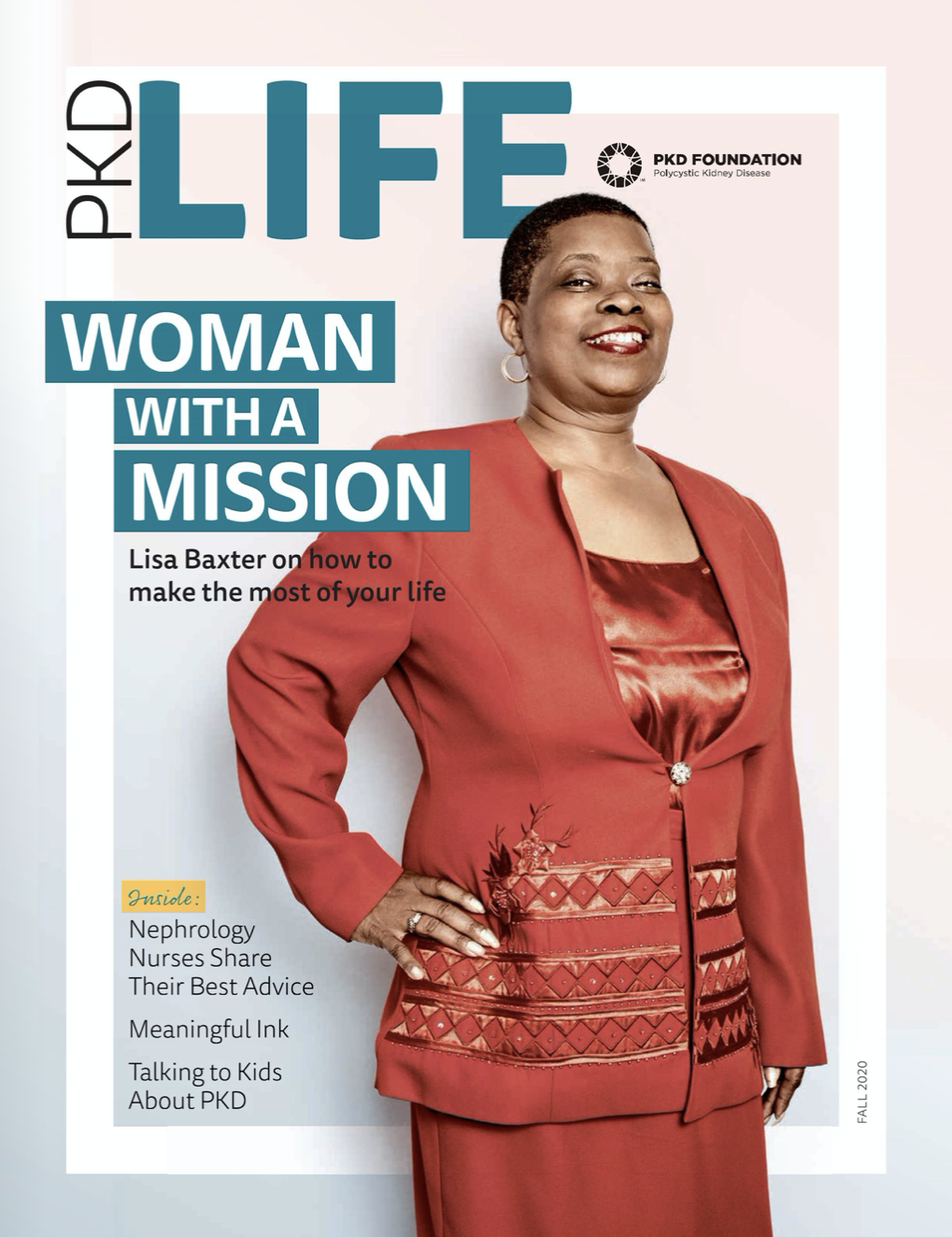](https://www.nxtbook.com/nxtbooks/pkdlife/pkdlife_2020fall/)
\[et\_pb\_cta title=”Summer 2020″ button\_url=”https://www.nxtbook.com/nxtbooks/pkdlife/pkdlife\_2020summer/index.php
---
### [Volunteer Resources Hub](https://pkdcure.org/volunteers/)
**Published:** March 24, 2025
**Author:** Sarah Lundak
**Content:**
# [Volunteer **Resource Hub**](https://go.pkdcure.org/l/886163/2024-01-02/mn71y)
  
At the PKD Foundation, we’re fortunate to have a diverse group of ambassadors who are passionate about our mission to find treatments and a cure for polycystic kidney disease (PKD). Each ambassador brings unique strengths, perspectives, and personal experiences to our cause, helping us raise awareness, advocate for research, and support those affected by PKD. Whether they’re patients, caregivers, medical professionals, or community leaders, our ambassadors play a vital role in spreading hope and driving change. Let’s meet the different types of PKD Foundation ambassadors and learn how each contributes to our shared vision.
Fundraising AmbassadorsFundraising Ambassadors play an important role in PKD communities by identifying local fundraising opportunities and organizing events. With help from PKD Foundation staff, your contribution drives critical fundraising to support our mission.
[Fundraising Ambassadors](https://pkdcure.org/get-involved/volunteer-with-us/remote-virtual-opportunities/fundraising/)

Outreach AmbassadorsOutreach Ambassadors are meant to build new bridges between the PKD Foundation and previously underserved communities. These ambassadors will also guide communities of color through the Foundation’s resources on disease management, treatment options, and navigating health care systems.
[Outreach Ambassadors](https://pkdcure.org/get-involved/volunteer-with-us/in-your-community/outreach-ambassadors/)

PKD Connect AmbassadorsPKD Connect Ambassadors serve as the frontline for individuals new to the PKD Foundation, providing local support to PKD communities nationwide. Within their local communities, these volunteers share educational opportunities, connect families to PKD Foundation programs and services, and create a space for understanding and support.
[PKD Connect Ambassadors](https://pkdcure.org/volunteers/pkd-connect-ambassadors/)

Stewardship AmbassadorsThe Stewardship Ambassador is vital in helping the PKD Foundation share gratitude with our generous donors. In this role, you will thank donors through various types of communication: phone calls, emails, hand-written notes, etc.
[Stewardship Ambassadors](https://pkdcure.org/get-involved/volunteer-with-us/in-your-community/stewardship-ambassador/)

Walk for PKD AmbassadorsOur Walk for PKD Ambassadors serve an important role in their community. They’re responsible for planning and executing their local Walk for PKD event with support from PKD Foundation staff. This volunteer role raises important donations and plans an event that brings the local PKD community together. Your contribution will help fulfill our vision to end PKD.
[Walk for PKD Ambassadors](https://pkdcure.org/get-involved/volunteer-with-us/in-your-community/walk/)

Advocacy ChampionsThe Advocacy Champion Network (ACN) is vital to raising awareness of PKD and increasing research dollars to bring treatments and therapies to patients and to provide the best care for those who are reliant on dialysis or a kidney transplant to survive.
[Advocacy Champions](https://pkdcure.org/for-volunteers/advocacy-champions/)

Peer MentorsPKD Connect Peer Mentors provide resources, guidance, motivation, and emotional support to people impacted by PKD.
[Peer Mentors](https://pkdcure.org/volunteers/pkd-connect-peer-mentors/)

Community Reaction PanelThe PKD Foundation Community Reaction Panel provides feedback on pre-determined topics of interest to Industry Alliance partners and PKD Foundation programs and services. The panel consists of patients and caregivers with varied experiences across the continuum of disease progression and includes experience with ADPKD and ARPKD.
[Community Reaction Panel](https://pkdcure.org/get-involved/volunteer-with-us/remote-virtual-opportunities/community-reaction-panel/)

PKD Connect InterpretersPKD Connect Interpreters will translate emails and assist with returning phone calls on an as-needed basis. Volunteers will connect individuals with PKD Foundation programs and services as appropriate and assists with building a sense of community for non-English speaking patients and families.
[PKD Connect Interpreters](https://pkdcure.org/get-involved/volunteer-with-us/remote-virtual-opportunities/interpreter/)

Social Media Guidelines Social Media for PKD Foundation Volunteers
[Social Media Guidelines](https://pkdcure.org/for-volunteers/social-media-guidelines/)

---
### [Partners](https://pkdcure.org/who-we-are/partners/)
**Published:** September 28, 2024
**Author:** fiftyandfifty
---
### [Fundraising Ambassadors](https://pkdcure.org/get-involved/volunteer-with-us/remote-virtual-opportunities/fundraising/)
**Published:** February 10, 2022
**Author:** Caitlin Lasky
**Content:**
Fundraising Ambassadors
The Fundraising Ambassador plays an important role in the local PKD community by identifying local fundraising opportunities and organizing the event. With the support from PKD Foundation staff, your contribution will facilitate fundraising that supports the mission of the PKD Foundation.
[Fundraising Ambassador — Volunteer Job Description](https://pkdcure.org/wp-content/uploads/Volunteer-Job-Description_Fundraising-Ambassador_2022.pdf)
Please reach out to Danielle Rose at <danieller@pkdcure.org> to discuss and plan your next community fundraising event.
The PKD Foundation is committed to the safety and well-being of the PKD community. The spread of COVID-19 is fluid and guidance for in-person gatherings can be different for each of our local communities. We are currently planning to host in-person Walk events and the Community Fundraising team is already communicating this with walk volunteers. For community meetings, we encourage meeting virtually as this offers a safe option for all members of the community to gather safely.
This is a fluid situation, and we will communicate any changes to our policy with you as soon as possible. Please talk to your staff lead if you have questions.
You can find our latest information on COVID-19 at [Coronavirus and PKD: What you should know.](https://pkdcure.org/coronavirus/)
- [Home](https://pkdcure.org/volunteers/)
- [Advocacy Champions](https://pkdcure.org/volunteers/advocacy-champions/)
- [Community Reaction Panel](/volunteers/community-reaction-panel/)
- [Fundraising Ambassadors](https://pkdcure.org/volunteers/fundraising/)
- [Peer Ambassadors](/volunteers/peer-ambassadors/)
- [PKD Connect Ambassadors](https://pkdcure.org/volunteers/ambassadors/)
- [PKD Connect Mentors](https://pkdcure.org/peermentors/)
- [Walk for PKD Ambassadors](https://pkdcure.org/volunteers/walk/)
**Sue Full**
Director of Community Fundraising
<suef@pkdcure.org>
**Nicole Harr**
Director of Community Engagement
<nicoleh@pkdcure.org>
**Danielle Rose**
Community Fundraising Specialist
<danieller@pkdcure.org>
**Ireland Christensen**
Community Fundraising Coordinator
<irelandc@pkdcure.org>
**PKD Volunteer Team**
Who has the best ideas for success? *You*, of course!
Join our new Team PKD Volunteer Team Facebook closed group page and connect with all of our communities, share your ideas, successes and receive news and information from staff. PKD Volunteer Team is for official PKD Foundation volunteers only.
**RESOURCES**
- [W-9 ](https://pkdcure.org/wp-content/uploads/PKD-Foundation-W9-2021.pdf)
- [PKD Foundation letterhead](https://pkdcure.org/wp-content/uploads/pkdfoundation_letterhead_with_header_footer.dotx)
Page last updated February 2022
---
### [Stewardship Ambassadors](https://pkdcure.org/get-involved/volunteer-with-us/in-your-community/stewardship-ambassador/)
**Published:** March 31, 2022
**Author:** Caitlin Lasky
**Content:**
Stewardship Ambassador
The Stewardship Ambassador is vital in helping the PKDF share gratitude with donors who support the foundation through monetary donations. The Stewardship Ambassador will thank donors through various types of communication; phone calls, emails, hand-written notes, etc.
[Stewardship Ambassador Job Description](https://pkdcure.org/wp-content/uploads/Volunteer-Job-Description_Stewardship-Ambassador_2022.pdf)
[Welcome to PKDF! – Information for PKD Foundation Volunteers](https://support.pkdcure.org/event/welcome-to-pkdf-information-for-pkd-foundation-volunteers/e406524)
Communication Tools Training
- [Communication Tools – Office 365 Recording](https://support.pkdcure.org/event/communication-tools-office-365/e389876)
- [Communication Tools \_ Office 365 Slides](https://pkdcure.org/wp-content/uploads/Communication-Tools_Office-365_Updated_6_10_2022.pdf)
- [Communication Tools – Zoom Recording](https://support.pkdcure.org/event/communication-tools-zoom/e389874)
- [Communication Tool – Zoom Slides](https://pkdcure.org/wp-content/uploads/Mentor-Communication-Tools_zoom_8_13_21_FINAL.pdf)
[Let’s Login -Office 365 ](https://video.pkdcure.org/v/loginO265)
- Where is my volunteer email account and how do I login?
Need help accessing something else? [Let us know!](mailto:volunteers@pkdcure.org "Let's Login")
- [Volunteer Resources – Home](https://pkdcure.org/volunteers/)
- [Advocacy Champions](https://pkdcure.org/volunteers/advocacy-champions/)
- [Community Reaction Panel](/volunteers/community-reaction-panel/)
- [Fundraising Ambassadors](https://pkdcure.org/volunteers/fundraising/)
- [Outreach Ambassadors](/volunteers/peer-ambassadors/)
- [PKD Connect Ambassadors](https://pkdcure.org/volunteers/ambassadors/)
- [PKD Connect Interpreters](https://pkdcure.org/volunteers/interpreter/)
- [PKD Connect Mentors](https://pkdcure.org/peermentors/)
- [Social media guidelines](https://pkdcure.org/volunteers/social-media-guidelines)
- [Stewardship Ambassadors](https://pkdcure.org/volunteers/stewardship-ambassador/)
- [Walk for PKD Ambassadors](https://pkdcure.org/volunteers/walk/)
**Sue Full**
Director of Community Fundraising
<suef@pkdcure.org>
**Nicole Harr**
Director of Community Engagement
<nicoleh@pkdcure.org>
**Danielle Rose**
Community Fundraising Specialist
<danieller@pkdcure.org>
**Ireland Christensen**
Community Fundraising Coordinator
<irelandc@pkdcure.org>
Volunteer hours
.
PKDF volunteers are making a difference in the lives of everyone impacted by PKD. One way we show volunteer impact is by capturing volunteer hours. Volunteer hours = revenue!
**Please submit all volunteer hours associated with your donor communications using the link posted here.** You can submit hours as you go (after each call, etc.) or, you can submit all of your hours at the end of each month.
> Submit all volunteer hours associated with [June](https://formstack.io/3qpo-GqnPs4KLWNg-99YJ_KiGATQk0Bgt3iiIKkau0h2cb1IDTpXglVYXFevYMHmyDYGk4vUTieuPrdQQqMwKw) Communications.
> Submit all volunteer hours associated with [July](https://formstack.io/3qpo-GqnPs4KLWNg-99YJ_KiGATQk0Bgt3iiIKkau0jTJX8QZNp7WIJQVOUaEBmO-Bg0pv1lcZtiM0cQwc12tA) Communications.
**A unique link for submitting volunteer hours associated with attending training calls** will be sent to you after the training session (Volunteer Connection Calls, etc.). Once you have submitted your hours for attending training, you can delete the link. You will not need to use it again.
**resources**
Use the event form to tell us about your community meeting or awareness event. When we receive your form, we will follow up to discuss details.
Are you looking for a resource to share, check out our resource guide or visit the [Resource Library](https://resources.pkdcure.org/). Can’t find what you need, email [Nicole](mailto:nicoleh@pkdcure.org).
Page last updated November 2023
---
### [Walk for PKD Ambassadors](https://pkdcure.org/get-involved/volunteer-with-us/in-your-community/walk/)
**Published:** February 10, 2022
**Author:** Caitlin Lasky
**Content:**
Walk for PKD Ambassadors
Our Walk for PKD Ambassadors serve an important role in their community. They are responsible for planning and executing their local Walk for PKD with support from PKD Foundation staff. This volunteer role raises important financial support and plans an event that brings the local PKD community together. Your contribution will help to fulfill our vision to end PKD.
[Walk for PKD Ambassador — Volunteer Job Description](https://pkdcure.org/wp-content/uploads/Volunteer-Job-Description_Walk-for-PKD-Ambassador_2022.pdf)
[Walk for PKD Ambassador Handbook](https://pkdcure.org/wp-content/uploads/Walk-Handbook_2022.pdf)
WALK PLANNING MATERIALS
\*When scheduling your 2024 Walk for PKD, please avoid scheduling your event on Yom Kippur (Oct. 12, 2024).
[Accessibility checklist](https://pkdcure.org/wp-content/uploads/Walk-Accessibility-checklist_updated-2024.pdf)
[Walk committees and descriptions](https://pkdcure.org/wp-content/uploads/Walk-for-PKD-Committee-Descriptions_2024.pdf)
**2024 TRAINING**
***\*New!*** [May – Walk Launch Training – recording](https://youtu.be/NhVk3nVHNfg%20)
[Walk Ambassador Training March 2024 recording](https://www.youtube.com/watch?v=O6-MkOYplqU)
Sponsorship
**[2024 Sponsorship packet](https://walkforpkd.org/wp-content/uploads/2023/11/2024-walk_for_pkd_local_sponsorship_opportunities_v3.pdf)**
[Sponsorship letter/email templates](https://pkdcure.org/wp-content/uploads/2023/12/2024-sponsor-email-templates.docx)
2024 Sponsorship deadline **August 1** for all levels.
WALK DAY MATERIALS
[Photography shot list](https://pkdcure.org/wp-content/uploads/Walk-Photography-shot-list_updated-2024.pdf)
[2024 Donation submission form](https://pkdcure.org/wp-content/uploads/2023/12/2024-Walk-Donation-submission-form.pdf)
[How to register and donate](https://pkdcure.org/wp-content/uploads/Walk-day-registration-personal-device-1.pdf)
**Q: Where can I find this year’s sponsorship agreement**
A: You can find the sposnorship opportunities and agreement document linked above and at [walkforpkd.org/sponsor](https://walkforpkd.org/sponsor/).
**Q: How do sponsors submit their agreement and payment?**
A: Sponsors are asked to send their completed sponsorship agreement via email to <walkforpkd@pkdcure.org>. They may also print and mail their form alongside check payment to our P.O. Box address listed on the form. If a sponsor chooses to pay by credit card, they should indicate that on their agreement at which point they will be contacted by our team to process payment.
**Q: How can I get a list of my past sponsors?**
A: You will receive a list with past sponsor information once a year, typically around the month of December. If you need additional information or to be resent your list, please reach out to Ireland Christensen, <irelandc@pkdcure.org>.
- [Volunteer Resources – Home](https://pkdcure.org/volunteers/)
- [Advocacy Champions](https://pkdcure.org/volunteers/advocacy-champions/)
- [Community Reaction Panel](/volunteers/community-reaction-panel/)
- [Fundraising Ambassadors](https://pkdcure.org/volunteers/fundraising/)
- [Outreach Ambassadors](/volunteers/peer-ambassadors/)
- [PKD Connect Ambassadors](https://pkdcure.org/volunteers/ambassadors/)
- [PKD Connect Interpreters](https://pkdcure.org/volunteers/interpreter/)
- [PKD Connect Mentors](https://pkdcure.org/peermentors/)
- [Social media guidelines](https://pkdcure.org/volunteers/social-media-guidelines)
- [Stewardship Ambassadors](https://pkdcure.org/volunteers/stewardship-ambassador/)
- [Walk for PKD Ambassadors](https://pkdcure.org/volunteers/walk/)
**Sue Full**
Director of Community Fundraising
<suef@pkdcure.org>
**Nicole Harr**
Director of Community Engagement
<nicoleh@pkdcure.org>
**Danielle Rose**
Community Fundraising Specialist
<danieller@pkdcure.org>
**Ireland Christensen**
Community Fundraising Coordinator
<irelandc@pkdcure.org>
**Monthly action items**
[**Full Calendar**](https://pkdcure.org/wp-content/uploads/Walk-for-PKD-Planning-Calendar_updated-2024.docx)
JUNE & JULY
- **Finalize event times with your staff lead**
- Request last year’s participants and team captain list from staff lead
- Send a Save the Date
- Identify new sponsorship asks
- Follow up on rentention/reactivation sponsorship asks
- Have first meeting with your committee volunteers
- Post, call, and engage with your participants to encourage registration in June
**RESOURCES**
- [2024 Walk donation submission form](https://pkdcure.org/wp-content/uploads/2023/12/2024-Walk-Donation-submission-form.pdf)
- [W-9 – ***UPDATED 2024!***](https://pkdcure.org/wp-content/uploads/PKDF-2024-W9.pdf)
- [Tax Exempt letter](https://pkdcure.org/wp-content/uploads/irs-tax-exempt-determination-letter_-8-15-16.pdf)
- [PKD Foundation letterhead](https://pkdcure.org/wp-content/uploads/PKDF_Letterhead_volunteers.docx)
- [2024 In-kind donation ask letter](https://pkdcure.org/wp-content/uploads/2024-GIK-letter.docx)
- [Team Captain \[pdf\]](https://pkdcure.org/wp-content/uploads/How-to-Register-Team-Captains_2020.pdf)
- [Team Captain registration video](https://youtu.be/2fLfFfqmkmY)
- [Team Member \[pdf\]](https://pkdcure.org/wp-content/uploads/walk-registration-steps-2020-join-team-v2.pdf)
- [Join a team registration video](https://youtu.be/5lL3_2uAiYg)
- [Individuals \[pdf\]](https://pkdcure.org/wp-content/uploads/walk-registration-steps-2020-as-individual-v2.pdf)
- [Individual registration video](https://youtu.be/txfQ_hhrqt4)
**Fundraising tips — one sheets**
- [How to: Customize your fundraising page](https://pkdcure.org/wp-content/uploads/customizing-your-fundraising-page-2021.pdf)
- [Maximize your fundraising page](http://walkforpkd.org/wp-content/uploads/maximize-your-fundraising-page-may2020-walk.pdf)
- [The Key is to Ask](http://walkforpkd.org/wp-content/uploads/the-key-is-to-ask-may2020-walk.pdf)
- [Overcoming fundraising fears](http://walkforpkd.org/wp-content/uploads/overcoming_fundraising_fears-may2020-walk_for_pkd.pdf)
- [Roadmap to $500](http://walkforpkd.org/wp-content/uploads/roadmap-to-500-may2020-walk.pdf)
- [Tips for engaging your fundraisers](https://pkdcure.org/wp-content/uploads/coaching-recommendations-for-fundraisers.pdf)
- [Connecting your Facebook fundraiser to your Walk page](https://pkdcure.org/resource/link-your-fundraising-page-to-a-facebook-fundraiser/)
**Sharing your story**
- [Why I Walk template](https://walkforpkd.org/wp-content/uploads/2020/07/I-walk-for-template.pdf)
- [How to claim your page video](https://youtu.be/rXrjk_f6RHU)
- [How to personalize your fundraising page video](https://youtu.be/y5CkI5ZE2mI)
- [PKD Fact graphics](https://pkdcure.org/resource/pkd-facts/)
- [2022 Walk Ambassador Kick-off 5/17/2022 recording](https://youtu.be/QiSOu8k8RiY%20)
- **[2022 WALK REGISTRATION TRAINING (pdf) ](https://pkdcure.org/wp-content/uploads/2022-Walk-Registration-Training.pdf)[ 2022 WALK REGISTRATION TRAINING (recording)](https://youtu.be/EGkX5ILAxIE)**[**2022 WALK PLANNING Q & A – TRAINING! (recording)**](https://youtu.be/uiTLTOMInrg)[**2022 Walk planning Q&A (pdf)**](https://pkdcure.org/wp-content/uploads/2022-Walk-DOE-QA.pdf)
- [March 2023 Walk Ambassador Training](https://pkdcure.org/wp-content/uploads/2023/03/Walk-Ambassador-Training-3.2023.pdf)[March 2023 training recording](https://youtu.be/BjX1OmTd3qk)
- [2023 Walk Ambassador Kickoff training – recording](https://www.youtube.com/watch?v=5xfNa1Jss38)
- [2023 Day of Event training – recording](https://www.youtube.com/watch?v=5hWevataEiE)
- [2023 Day of Event training – pdf](https://pkdcure.org/wp-content/uploads/2023/08/2023-Walk-DOE-training.pdf)
Download and print these fun activities for your younger walkers.
- [Code cracker](https://pkdcure.org/wp-content/uploads/Code-Cracker.pdf)
- [Hidden pictures](https://pkdcure.org/wp-content/uploads/Hidden-pictures.pdf)
- [Kidney Maze](https://pkdcure.org/wp-content/uploads/Kidney-Maze.pdf)
- [PKD Crossword](https://pkdcure.org/wp-content/uploads/PKD-Crossword.pdf)
- [PKD Crossword 2](https://pkdcure.org/wp-content/uploads/Penny-Kids-Dash-crossword-2.pdf)
- [Word search ](https://pkdcure.org/wp-content/uploads/Word-Search-1.pdf)
- [Word search 2](https://pkdcure.org/wp-content/uploads/WORD-SEARCH-2.pdf)
- [Jumble](https://pkdcure.org/wp-content/uploads/JUMBLE.pdf)
- [Coloring sheet 1](https://pkdcure.org/wp-content/uploads/Penny-Kids-Dash-Coloring-Activity.pdf)
- [Coloring sheet 2](https://pkdcure.org/wp-content/uploads/Coloring-Page.pdf)
- [11×17 Activity Placemat](https://pkdcure.org/wp-content/uploads/PlaceMat.pdf)
Page last updated February 2024
---
### [Outreach Ambassadors](https://pkdcure.org/get-involved/volunteer-with-us/in-your-community/outreach-ambassadors/)
**Published:** March 31, 2022
**Author:** Caitlin Lasky
**Content:**
Outreach Ambassadors
The Outreach Ambassadors Program is meant to build new bridges between the PKD Foundation and previously underserved communities. The Outreach Ambassadors Program will also guide communities of color through the Foundation’s resources on disease management, treatment options, and navigating health care systems.
[Outreach Ambassador Job Description](https://pkdcure.org/wp-content/uploads/2023/07/Volunteer-Job-Description_Outreach-Ambassador_2023.pdf)
[Welcome to PKDF! – Information for PKD Foundation Volunteers](https://support.pkdcure.org/event/welcome-to-pkdf-information-for-pkd-foundation-volunteers/e406524)
Communication Tools Training
- [Communication Tools – Office 365 Recording](https://support.pkdcure.org/event/communication-tools-office-365/e389876)
- [Communication Tools \_ Office 365 Slides](https://pkdcure.org/wp-content/uploads/Communication-Tools_Office-365_Updated_6_10_2022.pdf)
Connecting with your local PKD Community
[Recording](https://support.pkdcure.org/event/outreach-ambassador-call_connecting-with-you-pkd-community/e560371) \| [Slides](https://pkdcure.org/wp-content/uploads/Connecting-With-Your-Local-PKD-Community_FY24_UPdated-for-recording-1.pdf)
Nov. 1, 2022 Call
ADPKD Patient Registry –[ watch recording](https://youtu.be/7VXUA7idO1M)
[Review slides](https://pkdcure.org/wp-content/uploads/11.1.22-PKDF-Peer-Ambassadors_ADPKD-Registry.pdf)
June – Outreach Ambassador Launch
[Recording](https://www.youtube.com/watch?v=gaSX_7Abzxo) \| [Slides](https://pkdcure.org/wp-content/uploads/2023/07/Peer-Ambassador-Call_June-2023.pdf)
February 2024 – Connecting with your local PKD Community
[Recording](https://support.pkdcure.org/event/outreach-ambassador-call_connecting-with-you-pkd-community/e560371) \| [Slides](https://pkdcure.org/wp-content/uploads/Connecting-With-Your-Local-PKD-Community_FY24_UPdated-for-recording-1.pdf)
Sometimes it’s just hard to remember how to login to all the places you need to be. Let’s Login Quick Video series can help.
[Let’s Login -Office 365 ](https://video.pkdcure.org/v/loginO265)
- Where is my volunteer email account and how do I login?
[Let’s Login – One Drive ](https://video.pkdcure.org/v/OneDrive)
- What is One Drive and how do I get to it?
Need help accessing something else? [Let us know!](mailto:volunteers@pkdcure.org "Let's Login")
PKDF volunteers are making a difference in the lives of everyone impacted by PKD. One way we show volunteer impact is by capturing volunteer hours. ***Volunteer hours = revenue!***
We have a new process for collecting volunteer hours. Our goal is to make submitting volunteers hours easier for you!
A unique link will be sent to you after each volunteer training session that you attend. You will submit your hours and then, discard the link.
Please use the link below to submit any volunteer hours associated with planning Peer Ambassador awareness activities from July 1, 2022 – June 30, 2023.
[https://formstack.io/3qpo-GqnPs4KLWNg-99YJ\_KiGATQk0Bgt3iiIKkau0h2cb1IDTpXglVYXFevYMHm5r1k2k7D\_vFL8ZenLvcvpQ](https://formstack.io/3qpo-GqnPs4KLWNg-99YJ_KiGATQk0Bgt3iiIKkau0h2cb1IDTpXglVYXFevYMHm5r1k2k7D_vFL8ZenLvcvpQ)
If you have questions about this process, please contact your PKDF staff lead or email Nicole at [nicoleh@pkdcure.org](mailto:nicoleh@pkdcure.org "mailto:nicoleh@pkdcure.org").
- [Volunteer Resources – Home](https://pkdcure.org/volunteers/)
- [Advocacy Champions](https://pkdcure.org/volunteers/advocacy-champions/)
- [Community Reaction Panel](/volunteers/community-reaction-panel/)
- [Fundraising Ambassadors](https://pkdcure.org/volunteers/fundraising/)
- [Outreach Ambassadors](/volunteers/peer-ambassadors/)
- [PKD Connect Ambassadors](https://pkdcure.org/volunteers/ambassadors/)
- [PKD Connect Interpreters](https://pkdcure.org/volunteers/interpreter/)
- [PKD Connect Mentors](https://pkdcure.org/peermentors/)
- [Social media guidelines](https://pkdcure.org/volunteers/social-media-guidelines)
- [Stewardship Ambassadors](https://pkdcure.org/volunteers/stewardship-ambassador/)
- [Walk for PKD Ambassadors](https://pkdcure.org/volunteers/walk/)
**Sue Full**
Director of Community Fundraising
<suef@pkdcure.org>
**Nicole Harr**
Director of Community Engagement
<nicoleh@pkdcure.org>
**Danielle Rose**
Community Fundraising Specialist
<danieller@pkdcure.org>
**Ireland Christensen**
Community Fundraising Coordinator
<irelandc@pkdcure.org>
**PKD Volunteer Team**
Who has the best ideas for success? *You*, of course!
Join our new Team PKD Volunteer Team Facebook closed group page and connect with all of our communities, share your ideas, successes and receive news and information from staff. PKD Volunteer Team is for official PKD Foundation volunteers only.
Planning Awareness Activities
As we begin planning our first Peer Ambassador awareness activities, here are a few resources that will help get you started.
**Social Media Graphics**
If you are planning to use your social media platform(s) to raise awareness, we have graphics available for you. Our social media guidelines page is currently under construction as we add new and updated graphics. Check back in a few days!
**Volunteer Event Submission Form**
Once your logistics are firmed up, please submit our Volunteer Event Submission Form. This give us the information we need to help promote you activity. If you have questions, please email Nicole at <nicoleh@pkdcure.org>.
**resources**
Use the event form to tell us about your community meeting or awareness event. When we receive your form, we will follow up to discuss details.
Are you looking for a resource to share, check out our resource guide or visit the [Resource Library](https://resources.pkdcure.org/). Can’t find what you need, email [Nicole](mailto:nicoleh@pkdcure.org).
Page last updated November 2023
---
### [The ADPKD Registry](https://pkdcure.org/research/the-adpkd-registry/)
**Published:** September 20, 2024
**Author:** fiftyandfifty
---
### [For Patients](https://pkdcure.org/for-patients/)
**Published:** September 2, 2024
**Author:** fiftyandfifty
---
### [Funding Opportunities](https://pkdcure.org/research/grants/research-funding/)
**Published:** April 10, 2020
**Author:** Caitlin Lasky
**Content:**
Research funding
The mission of the PKD Foundation is to give hope. We fund research, advocate for patients, and build a community for all impacted by PKD. To achieve this, we support investigator-initiated research that range across the research continuum, including basic, translational and clinical research. Additionally, we are committed to supporting a robust pipelines of junior investigators interested in a career in PKD through our Fellowship and Young Investigator Award programs.
Questions? Email us at [research@pkdcure.org ](mailto:research@pkdcure.org)
Research grants
The principal goal of our research grant program is the development of clinical interventions for the treatment of PKD. This program funds basic laboratory research aimed at increasing understanding of the genetic and pathological processes involved in PKD as well as research with an obvious or direct potential to accelerate the development of potential therapies. Epidemiologic research proposals utilizing existing data resources to develop new statistical methodologies or to test hypotheses are also welcome.
Timeline
Request for pre-applications for grants are released in June, with invitations for full applications released in October, and an ultimate proposal deadline in mid January. Each grant recipient receives $80,000 per year for two years. After the first year of funding, grant recipients submit updates on the progress of their research. After the final year of funding, grant recipients submit the results of their studies in a final report.
Eligibility
Applicants must have an M.D., Ph.D. or equivalent degree and hold a faculty appointment at the institution where the research will be conducted. Applicants need not be United States citizens.
Young Investigator Award
An optional third year of support will be available to a young investigator(s). The recipient(s) will be selected from meritorious grant applications to support the transition of a junior scientist to an independent investigator.
Interested applicants will need to clearly outline their interest, eligibility, and scope of research for this third year of funding.
Review process
The PKD Foundation strives to be transparent related to our decision-making processes. We rely on our grant review committees, who develop recommendations for funding, as well as the process we use as a Foundation to make funding decisions. Learn more [here](https://pkdcure.org/the-peer-review-process/).


Get the latest information on treating PKD.
Research Resources
- [Research homepage](https://pkdcure.org/research/)
- [Funding Opportunities](https://pkdcure.org/research-medical-professionals/research-funding/)
- [Current grantees and fellows](https://pkdcure.org/funded-research/)
- [Database resources](https://pkdcure.org/research-medical-professionals/data-resources-in-pkd-research/)
- [Clinical studies](https://clinicalstudies.pkdcure.org/)
- [ADPKD Centers of Excellence](https://pkdcure.org/adpkd-care)
**Meet our current fellowship and grant awardees**
**PKD Foundation Grants Policy Statement Regarding Sexual Harassment**
**blog posts**
[PKD research receives $14+ million in DoD funding](https://pkdcure.org/pkd-research-receives-14-million-in-dod-funding/)
Fellowship grants
Our fellowship grant program recognizes early-career scientists whose achievements and potential identify them as rising stars – the next generation of scientific leaders in PKD research. Our fellowships aim to attract promising trainees who will obtain significant research experience as they initiate and – we hope – spend long and productive careers in PKD research.
Timeline
Request for applications for fellowships are released in October with a January deadline. Recipients are notified in May, and the grant cycle begins on July 1 of the same year. Each recipient receives $60,000 a year for two years.
Eligibility
Applicant must have a Ph.D. or M.D. degree. This application is for a training position and requires a mentor who is knowledgeable about PKD and the project. Applicants must describe a clear career path and explain how this project is relevant to that path. A mentor may sponsor only one applicant.
Review process
Applicants are evaluated by our Grants Review Committee, comprised of members of the [Scientific Advisory Panel](/who-we-are/scientific-advisory-committee/). Applications are given a priority score based on the scientific merit of the project, its relevance to PKD research, and the training potential of the applicant. Funding of awards is based on the priority score, the recommendations of the Grants Review Committee and the availability of funds.
Scientific meetings
The scientific meeting grant program is focused on funding PKD-relevant scientific and clinical meetings that bring together PKD scientists from around the world to discuss current findings and encourage research collaborations. We have also funded medical education programs at national clinical meetings to educate medical professionals in the basic science, diagnosis, disease management and potential treatments for PKD.
We have provided funding through educational grants to support scientific conferences and meetings that support our mission.
**We accept scientific meeting applications on a rolling basis.**
Other funding opportunities
**The Department of Defense** has released funding opportunities for [multiple awards in the Peer Reviewed Medical Research Program](https://cdmrp.health.mil/funding/default). A [webinar series](https://cdmrp.health.mil/pubs/webinars/webinar_series) has also been made available to assist in exploring funding opportunities and career development in clinical research.
In March 2023, we held a webinar with a member of the CDMRP staff to talk about what the application process looks like.
[ ](https://go.pkdcure.org/e/886163/recording-5358876067687994714/lkz1j/330344043?h=nEom1asM7LmJs2jTqHG-S3BVisibGqixVEpsZwnw1Kk)
You can also access slides shared in the webinar [**here**](https://pkdcure.org/wp-content/uploads/2023/10/FY23-Funding-Webinar-Presentation_PKD-Foundation.pdf "https://go.pkdcure.org/e/886163/resentation-PKD-Foundation-pdf/lkz11/330344043?h=nEom1asM7LmJs2jTqHG-S3BVisibGqixVEpsZwnw1Kk").
**ASN Foundation for Kidney Research**
A Career Development Grants Program provides funding for young faculty to foster evolution to an independent research career and a successful application for a National Institutes of Health (NIH) full R01 grant or equivalent. By the end of the grant period, a recipient will have an independent research career and be competitive for federal and nonfederal funding. For details, [click here](https://www.asn-online.org/grants/).
*Sign up for our monthly Research Updates to hear about other PKD-related funding opportunities at the NIH and beyond (button located at top of the page).*
Page last updated October 2023
---
### [PKD Foundation in the News](https://pkdcure.org/pkd-foundation-in-the-news/)
**Published:** November 3, 2025
**Author:** Sarah Lundak
---
### [International PKD Organizations](https://pkdcure.org/get-connected/international-pkd-organizations/)
**Published:** April 2, 2020
**Author:** Caitlin Lasky
**Content:**
International AffiliatesWe are a proud member of PKD International, a global alliance of patient organizations dedicated to a cure for polycystic kidney disease (PKD). We are leading the fight against PKD for the millions worldwide by uniting patients and medical professionals committed to ending PKD, providing opportunities to learn the latest on PKD, and supporting the most promising research and clinical trials. Below is the contact information for our international affiliates across the globe.
**Australia**
Contact Person: Charmaine Green
<admin@pkdaustralia.org>
<http://www.pkdaustralia.org>
**Canada**
Contact Person: Jeff Robertson, Executive Director and Volunteer Walk Coordinator
877-410-1741
3-1750 The Queensway, Suite 158
Etobicoke, ON M9C 5H5
<jrobertson@endpkd.ca>
<http://endpkd.ca>
**Finland**
Contact Person: Petri Inomaa
040 5240 679
<petri.inomaa@musili.fi>
<http://www.musili.fi>
**France**
Contact Person: Corinne Lagrafeuil
011-33-2-38-64-05-65
<c.lagrafeuil@dbmail.com><france@pkdcure.org>
<http://www.polykystose.org>
**Germany**
Contact Person: Uwe Korst
+49 171 781 6876
<korst@bnev.de>[](mailto:korst@bnev.de)[bnev.de](bnev.de)
[pkdcure.de](https://www.pkdcure.de)
**Italy**
Contact Person: Luisa Sternfeld Pavla
<http://www.renepolicistico.it>
**Japan**
<http://www.pkdfcj.org>
**Netherlands**
Contact Person: Marjolein Bos
<http://www.nvn.nl>
**Switzerland**
Contact Person: Flavia Galletti
<http://www.swisspkd.ch/de/home>
**United Kingdom**
+44 20-7387-0543
<http://www.pkdcharity.org.uk>
Page last reviewed March 2024
---
### [Resources](https://pkdcure.org/resources/)
**Published:** February 28, 2020
**Author:** Caitlin Lasky
---
### [PKD Outcomes Consortium (PKDOC)](https://pkdcure.org/research/pkdoc/)
**Published:** April 11, 2020
**Author:** Caitlin Lasky
**Content:**
PKD Outcomes Consortium (PKDOC)2021 PKD Regulatory Summit
The Critical Path Institute’s Polycystic Kidney Disease Outcomes Consortium (PKDOC), the PKD Foundation, and Otsuka collaborated to create the **2021 PKD Regulatory Summit on May 19–20, 2021**. Together with key stakeholders from the pharmaceutical industry and academic setting, foundations, patient advocacy groups, individuals living with PKD and regulatory agencies from around the world, the consortium addressed current unmet drug development needs for PKD, identified tools that are needed to deliver new therapies to patients, and catalyzed the development of a regulatory framework to enable advancement of new treatments.
The Summit included a series of three sessions with pre-recorded webinars available for registrants to view at their own pace two weeks prior to the meeting. On May 19 and 20, live presentations summarized content from the pre-recorded webinars, followed by panel discussions with speakers to facilitate dialogue among all participants.
**[Watch the sessions](https://c-path.org/2021-pkd-regulatory-summit-may-19-20/)**
In August 2022, four reports summarizing Sessions 1, 2, and 3B from the 2021 PKD Regulatory Summit were published in the Clinical Journal of the American Society of Nephrology (CJASN).
1. [Drug Development for Cystic Kidney Diseases](https://journals.lww.com/cjasn/Fulltext/2022/10000/Drug_Development_for_Cystic_Kidney_Diseases.18.aspx)
2. [Perspectives on Drug Development in Autosomal Recessive Polycystic Kidney Disease](https://journals.lww.com/cjasn/Fulltext/2022/10000/Perspectives_on_Drug_Development_in_Autosomal.19.aspx)
3. [Perspectives on Drug Development in Early ADPKD](https://journals.lww.com/cjasn/pages/articleviewer.aspx?year=2022&issue=10000&article=00020&type=Fulltext)
4. [Current Challenges and Perspectives on Developing a Clinical Trial Design for ADPKD](https://journals.lww.com/CJASN/Fulltext/2022/10000/Current_Challenges_and_Perspectives_on_Developing.21.aspx)
The **PKD Outcomes Consortium (PKDOC)** is a significant collaboration between the PKD Foundation, [Critical Path Institute](https://c-path.org/programs/pkd/), representatives of the pharmaceutical industry, PKD clinicians, and the U.S. Food and Drug Administration (FDA). It was created to facilitate clinical trial development for PKD therapies by establishing a clear regulatory pathway for the pharmaceutical industry to evaluate the effectiveness of potential treatments.
The consortium has successfully qualified Total Kidney Volume as a prognostic biomarker with both the US Food and Drug Administration and the European Medicines Agency. Currently, PKDOC hosts monthly teleconferences to explore alternative endpoints, innovative trial designs, and other topics of general interest to the participants. Attendees include pharmaceutical companies, academic organizations, foundations, patient advocacy groups, and regulatory agencies from around the world. Anyone who is interested may participate.
Why is PKDOC important?
PKD is marked by a long period of stable kidney function (as measured by the currently accepted endpoints in drug development) during which the kidneys expand enormously due to cyst growth. Traditional endpoints of renal function (serum creatinine levels) only show changes very late in the course of the disease, making it difficult to assess the effectiveness of new medications. There is critical need for a biomarker that will assess disease progression at an earlier stage before patients have incurred serious, irreversible damage and when they may be more likely to respond to new therapies.
The initial goals of the PKD Consortium were to develop CDISC data standards for PKD and to use clinical data from ADPKD patients collected over many years in patient registries and observational studies to support the FDA and EMA qualification of an imaging biomarker, Total Kidney Volume (TKV), for use in drug development trials. These initial goals have been achieved.
Using the data collected, scientists were able to develop a disease progression model that evaluated the relationship between TKV and the known complications of ADPKD, including rate of loss of kidney function, hypertension, gross hematuria, kidney stones, urinary tract infections, development of end-stage renal disease, and mortality. These analyses were used to support the regulatory qualification of TKV as an accepted measure for assessing the progression of ADPKD in clinical trials in which new therapies are tested.
What is a prognostic endpoint?Where has progress been made?
**FDA Qualifies Total Kidney Volume as a Prognostic Biomarker for use in Clinical Trials for Polycystic Kidney Disease**
On August 31, 2015, C-Path announced that the U.S. Food and Drug Administration (FDA) had issued a qualification decision in the form of a draft guidance to C-Path’s Polycystic Kidney Disease Outcomes Consortium (PKDOC) for total kidney volume (TKV) as a prognostic biomarker to select patients for clinical trials of new therapies for Autosomal Dominant Polycystic Kidney Disease (ADPKD).
- [Details of the FDA Qualification Review](https://www.fda.gov/drugs/drug-development-tool-ddt-qualification-programs/reviews-qualification-biomarker-total-kidney-volume-studies-treatment-autosomal-dominant-polycystic)
- [FDA Guidance Document](https://www.fda.gov/regulatory-information/search-fda-guidance-documents/qualification-biomarker-total-kidney-volume-studies-treatment-autosomal-dominant-polycystic-kidney)
- [FDA Drug Development Tools Qualification Programs](https://www.fda.gov/drugs/development-approval-process-drugs/drug-development-tool-ddt-qualification-programs)
**EMA Renders Positive Qualification Decision for Total Kidney Volume as a Prognostic Biomarker for use in Clinical Trials for Polycystic Kidney Disease**
On November 13, 2015, C-Path announced that the European Medicines Agency (EMA) rendered a positive qualification opinion to C-Path’s Polycystic Kidney Disease Outcomes Consortium for total kidney volume (TKV) as a prognostic biomarker to select patients for clinical trials of new therapies for Autosomal Dominant Polycystic Kidney Disease (ADPKD).
- [EMA Qualification Opinion Document](http://www.ema.europa.eu/docs/en_GB/document_library/Regulatory_and_procedural_guideline/2015/11/WC500196569.pdf)
**C-Path’s PKDOC and The PKD Foundation Set to Collaborate Once Again**
On August 21, 2020, to meet the challenge in discovering treatments for PKD, C-Path’s Polycystic Kidney Disease Outcomes Consortium (PKDOC) [announced a collaboration](https://c-path.org/c-paths-pkdoc-and-the-pkd-foundation-set-to-collaborate-once-again/?fbclid=IwAR2ppj4LSYFQ38c8aaK6TnSM4qpqae0BkGpmgpU-pf8wx5M9Lq2dmTvm_uw) with the PKD Foundation, who’s mission is to fund research, advocate for patients and build a community for all impacted by PKD. The agreement renews the significant collaboration between C-Path and The PKD Foundation to facilitate existing and new mutually agreed upon programs to accelerate the pace and reduce the cost of medical product development for the diagnosis and treatment of PKD.
Check out the [PKD Outcomes Consortium](https://c-path.org/programs/pkd/)
[ ](https://c-path.org/programs/pkd/)[ ](https://pkdcure.org/wp-content/uploads/PKD_onesheet_03_23_2021.pdf)[](https://c-path.org/programs/pkd/)[ ](https://pkdcure.org/wp-content/uploads/PKD_onesheet_03_23_2021.pdf)[ ](https://pkdcure.org/wp-content/uploads/PKD_onesheet_03_23_2021.pdf)[ ](https://pkdcure.org/wp-content/uploads/PKD_onesheet_03_23_2021.pdf)
**Consortium Home Page [Executive Summary](https://pkdcure.org/wp-content/uploads/2023/09/PKD_onesheet_Aug_2023.pdf)**


Get the latest information on treating PKD.
##### Research Resources
- [Research homepage](https://pkdcure.org/research/)
- [Funding Opportunities](https://pkdcure.org/research-medical-professionals/research-funding/)
- [Current grantees and fellows](https://pkdcure.org/funded-research/)
- [Database resources](https://pkdcure.org/research-medical-professionals/data-resources-in-pkd-research/)
- [Clinical studies](https://clinicalstudies.pkdcure.org/)
- [ADPKD Centers of Excellence](https://pkdcure.org/adpkd-care)
**Blog posts**
[Moving toward new treatments for ADPKD](https://pkdcure.org/moving-toward-new-treatments-for-adpkd/)
[PKDF Chief Science Officer Dr. David Baron co-authors new paper with FDA and top nephrologists](https://pkdcure.org/pkdf-chief-science-officer-dr-david-baron-co-authors-new-paper-fda-top-nephrologists/)
Page last updated November 2022
---
### [Financial Assistance](https://pkdcure.org/for-patients/financial-assistance/)
**Published:** March 27, 2025
**Author:** Sarah Lundak
---
### [Contact us](https://pkdcure.org/contact-us/)
**Published:** April 1, 2020
**Author:** Caitlin Lasky
**Content:**
Contact usThank you for your interest in learning more about polycystic kidney disease (PKD) and the PKD Foundation. We look forward to hearing from you soon!
**Please note:** We do not employ any medical professionals and cannot answer specific medical questions — other than what has been provided by medical advisors on our website and in educational materials. For specific questions regarding your healthcare, please consult your nephrologist.
About us
- [Executive leadership](https://pkdcure.org/who-we-are/executive-leadership/)
- [Board of Directors](https://pkdcure.org/who-we-are/board-of-trustees/)
- [Scientific Advisory Panel](https://pkdcure.org/who-we-are/scientific-advisory-committee/)
- [Financial and organizational information](https://pkdcure.org/who-we-are/financial-and-organizational-information/)
- [Media](https://pkdcure.org/media/)
- [Careers](https://pkdcure.org/who-we-are/careers/)
- [Contact us](https://pkdcure.org/contact-us/)
Contact information
**address**
**Mailing address:** PKD Foundation
PO Box 871847
Kansas City MO 64187
**Office address:**
PKD Foundation
1001 E 101st Terrace Suite 220
Kansas City MO 64131
**office hours**
Monday through Friday
8 a.m. to 5 p.m. Central Time
**phone**
**Toll-free:** 1.800.PKD.CURE (753.2873)
**Local:** 816.931.2600
**Fax:** 816.268.8496
**Email**
<pkdcure@pkdcure.org>
Page last updated November 2022
---
### [Education Video Library](https://pkdcure.org/education-video-library/)
**Published:** August 21, 2025
**Author:** Sarah Lundak
---
### [Industry Alliance](https://pkdcure.org/research/industry-alliance/)
**Published:** April 4, 2020
**Author:** Caitlin Lasky
**Content:**
Engage with the PKD Foundation
The PKD Foundation is the only organization in the U.S. solely dedicated to finding treatments and a cure for polycystic kidney disease (PKD) and to improving the lives of those it affects. Since 1982, we have proudly funded more than 1,300 research projects and leveraged $1.5B in research funds, while serving our local communities across the country. We are inspired by our mission. And driven by our vision.
The PKD Foundation’s Industry Alliance is an invitation-only group of PKD industry thought leaders. Through a year-long series of guided roundtables, national events, and information sharing, Industry Alliance partner organizations help improve PKD patient and caregiver lives. The Industry Alliance will act as a vehicle to drive involvement and engagement with a broad and diverse group of industry stakeholders with interest and expertise in PKD.
Through facilitating discussions meant to better understand PKD, supporting educational initiatives and resources, and disseminating valuable patient information, the Alliance will take a leadership role in advancing the PKD conversation.
The PKD Foundation follows strict guidelines in order to present unbiased and medically correct information to patients. See our full [Industry Relations policy](/wp-content/uploads/2019/06/pkdf-industry-relations-policy-board-approved-27-april-2019-gm.pdf).
Connect with usTo learn more about our Industry Alliance program, please contact**Krystn Kuckelman**
Vice President of Community Development
[ krystnk@pkdcure.org](mailto:krystnk@pkdcure.org)
(816) 268-84682024 Industry Alliance Members
Page last reviewed June 2025
---
### [Vehicle Donation](https://pkdcure.org/vehicle-donation/)
**Published:** April 11, 2020
**Author:** Caitlin Lasky
**Content:**
Vehicle Donation
Through the **PKD Foundation Vehicle Donation Program**, you can donate your vehicle and designate the funds to the PKD Foundation. With just one phone call, you can turn your old vehicle into hope for treatments and a cure to end PKD.
It only takes a few minutes to make a difference of a lifetime. Call 855.9PKD.CAR (855.975.3227) to begin the process today.
We accept cars, trucks, vans, SUVs, motor homes, boats, motorcycles and more.
Benefits of vehicle donation include:
- Free pick-up
- Tax receipt provided
- Save the time and hassle of selling your car yourself
- Avoid paying hefty repair bills
- Free up space in your garage or driveway
- Available anywhere in the U.S.
We accept cars, trucks, vans, SUVs, motor homes, boats, motorcycles and more.
Page last reviewed November 2022
---
### [Fiscal Year End 2025](https://pkdcure.org/fiscal-year-end-2025/)
**Published:** June 16, 2025
**Author:** Sarah Lundak
---
### [Grants](https://pkdcure.org/research/grants/)
**Published:** September 20, 2024
**Author:** fiftyandfifty
---
### [Privacy Policy](https://pkdcure.org/privacy-policy/)
**Published:** April 4, 2020
**Author:** Caitlin Lasky
**Content:**
# Privacy **Policy**
The PKD Foundation is committed to safeguarding your privacy on our website located at https://pkdcure.org. We use this privacy policy to clearly disclose to you our privacy practices in a manner that is easy to understand. If there is something you do not understand about our privacy practices, please feel free to contact us at pkdcure@pkdcure.org.
We may change this policy from time to time so please check back often. If we significantly change our collection, use, or disclosure practices, we will try to send you a notice via email if you have provided us with an email address.
FAQsFind answers to the most commonly asked questions.
- What information do we collect from you?
We collect information in several ways. Some of the information we collect is personal to you such as information related to your donations or membership. Other information is anonymous. We collect information in contact-us forms and information concerning your website activity.
- When you ask us to contact you, we ask for your name and email address.
- When you report a problem with our site or services we will collect contact information along with a description of your problem.
- When you contact us via the PKD email address, we will collect your contact information and any information you include in your email.
- When you donate, we collect your donation amount, your name, email address, phone number and company.
- When you purchase products at the online PKD Store, we collect contact information and payment information.
- When you engage in fundraising activities, we ask you to create a PKD Foundation account through our third party service provider Classy. We ask for your email address and password, your first and last name and your fundraising goal. We also collect your photo should you choose to add one.
- When you visit and navigate our site, use our applications or third party sites, or open our emails, we may collect technical information about your use of our site including IP address, device identifier, and viewing information.
- When you donate or set up a recurring donation, our third party fundraising platform service called Classy uses a payment service called Stripe to collect payment information such as credit card number. This information is not collected or stored directly by PKD Foundation.
- If you are a volunteer, we collect your contact information.
- How do we collect information from you?
We collect information directly from you when you provide it to us through our website. We collect information indirectly through cookies and other tracking tools.
**Direct Collection:** This includes information such as registration information, donation information, volunteer information, contact information, and user submissions. If you do not want to share your information, you can choose not to participate in a particular service or activity. We collect much of the information listed above directly from you when you submit it on our website.
*Fundraising Platform.* Our third party fundraising platform service, Classy collects information when you register for a Classy account to participate in PKD Foundation fundraising efforts. Classy, also permits users to login to Classy using their Facebook account. In that case, Classy requests permission from Facebook to (i) access your basic information, which includes your name, profile picture, networks, Facebook user ID, list of friends and any other information that you have made public on Facebook; and (ii) manage your participation in fundraising campaigns. For more information about Classy’ s privacy practices, see their privacy policy at https://www.classy.org/terms/privacy/. Please note that while the PKD Foundation is the controller of your personal information relating to our fundraising efforts, Classy also permits users to use their Classy account to participate in other unrelated fundraising efforts.
*Text Messaging Platform.* No mobile information will be shared with third parties/affiliates for marketing/promotional purposes. All other categories exclude text messaging originator opt-in data and consent; this information will not be shared with any third parties.
**Indirect Collection:** As part of offering and providing customizable and personalized services, many websites use cookies and other online tracking technologies to store and sometimes track information about you.
*Cookies.* A cookie is a small amount of data that is sent to your browser from a Web server and stored on your computer’s hard drive. Cookies enable us to identify your browser as a unique user. Cookies may involve the transmission of information from us to you and from you to us. Cookies may also be used by another party on our behalf to transfer information to us in accordance with their privacy policy. Some cookies are “persistent cookies”. They are used by us each time you access our website. Other cookies are called “session cookies”. Session cookies are used only during a specific browsing session. We may use a session cookie, for example, to remember that you have already navigated through a particular menu, or that you have entered in password information for a portion of the website that is password protected. We may also use “analytics cookies” that allow web analytics services to recognize your browser or device and, for example, identify whether you have visited our website before, what you have previously viewed or clicked on, and how you found us. This information is provided anonymously for statistical analysis only. Analytics cookies are usually persistent cookies. We use Google Analytics for traffic reporting.
*Log Files.* Like most standard website servers, we use log files. Log files track Internet protocol (IP) addresses, browser type, Internet service provider (ISP), referring/exit pages, platform type, date/time stamp, and number of clicks. We utilize this information to analyze trends, administer the site, prevent fraud, track website navigation in the aggregate, and gather broad demographic information for aggregate use.
- How do we use your information?
Our main goal in collecting information is to raise funds to help in the fight for treatments and a cure for PKD. We also use your information to improve the website and provide you with the best possible experience on the website.
For example, by using the information we collect, we can get back to you with information on Polycystic Kidney Disease, our fundraising efforts, and how you can donate to these efforts.
We will also use your personal information to:
- Notify you of donation and fundraising opportunities supporting the fight for treatments and a cure for PKD
- Enable you to participate in online donations, fundraising efforts and PKD events.
- Personalize online content so that is applies to you and your interests
- Make our fundraising efforts and website better
- To process payments for and shipment of items you purchase in the PKD Store.
- Compile, analyze and do research on our users’ demographics and behavior
- Detect, investigate and prevent activities that may violate our policies or be illegal
- Provide you with personalized content based on your use of our site
- Enable you to more easily use our website by remembering and using contact information, purchasing information, and registration information
- Evaluate, monitor and analyze the use of our website and its traffic patterns to help improve our website and services.
Our third party fundraising platform service, Classy, also permits users to login to Classy using their Facebook account. In that case, Classy requests permission from Facebook to (i) access your basic information, which includes your name, profile picture, networks, Facebook user ID, list of friends and any other information that you have made public on Facebook; and (ii) manage your participation in fundraising campaigns.
- Who is collecting information?
Except as provided in this Privacy Policy, only PKD Foundation and our service providers will have access to your personal account information and be able to collect information.
When you are on our site and are asked for personal information, you are sharing that information with the PKD Foundation and our service providers. If personal data is to be collected and/or maintained by any organization other than PKD Foundation or its service providers, we will try to notify you on the website or in an updated version of this Privacy Policy. If you do not want your data to be shared, you can choose not to allow the transfer by not using that particular service.
When you sign-up for an account to donate to PKD, participate in fundraising efforts or participate in a PKD event, you sharing your information with our online fundraising platform for non-profits. For more information about how Classy handles personal information, see their privacy policy available at <https://www.classy.org/terms/privacy/>.
Other websites to which we link may collect personally identifiable information about you when you visit those sites. The information practices of other websites linked to our websites are not covered by this Privacy Policy.
- With whom does PKD Foundation share my information?
We will not disclose any of your personally identifiable information except when we have your permission, when required by law, for security and compliance, to service providers working on our behalf, or if we sell our company or assets. We may also disclose information to third party partners in blinded or aggregated form that does not identify individuals.
These are some of the ways that your information may be disclosed:
**Service Providers**
We occasionally hire other companies to provide limited services on our behalf, including mailing, website development and operation, answering customer questions about products or services, sending postal mail or email, analyzing website use, processing payments, providing investor information and processing data. We will only provide those companies the information they need to deliver the service, and they are contractually prohibited from using that information for any other reason.
We use Classy as our third party fundraising platform. Classy provides services for fundraising, event ticketing and direct donations. Contact information collected from Classy is stored in our Salesforce database to help us manage your relationship with the PKD Foundation and gifts you give to support our cause.
We use Stripe to process payments as collected through Classy.
We store contact information about volunteers in Financial Edge cloud service for non-profits.
We use Mid-America Merchandising Incorporated to process our PKD Store payments and shipments.
We use Salesforce for data management, reporting, and mass marketing. Salesforce manages our donor database.
We use SMS Magic for our mobile messaging platform.
Our analytics providers include Pardot, Lucky Orange, Google Analytics, Facebook Domain Insights, Google Conversion Tracking, and the Google Global Site Tag.
We may provide personal information to our strategic consultant, Cura Strategies, Phone 2 Action for donor research services, and our third party advertisers, Newport One, Manifest, Facebook and Google.
**Data in the Aggregate**
We may disclose “blinded” aggregated data and user statistics and blinded and aggregated versions of the Client Data to prospective partners and other third parties. Blinded data is data that does not identify an individual person.
**Other**
We also may disclose your information in special cases. For example, when we believe that we must disclose information to identify, contact or bring legal action against someone who may be violating our Terms of Use, or may be causing injury to or interference with our rights or property, other website users or customers, or anyone else who may be harmed by such activities. We may disclose or access account information when we believe in good faith that the law requires it and for administrative and other purposes that we deem necessary to maintain, service, and improve our products and services.
In the event of a transaction involving a restructuring of PKD Foundation, customer and site visitor information may be one of the transferred assets and may be disclosed in connection with negotiations relating to a proposed transaction. In such case, the transferred information may become subject to a different privacy policy.
- How can I control my personal information?
To make a request to view, edit or delete your personal information, contact us at us at pkdcure@pkdcure.org. You may also disable some collection through your browser settings or Google’s opt-out tool.
We offer our customers choices for the collection, use and sharing of personal information. You may contact us at <pkdcure@pkdcure.org>. If you wish to view, edit, or delete your personal information from our database, and we will use commercially reasonable efforts to accommodate your request.
If you believe that any inaccurate or inappropriate information has been obtained or provided to others through your use of this website, you should contact us at <pkdcure@pkdcure.org>.
*You may disable browser cookies in your browser or set your browser to warn you when a cookie is being sent*. You may lose some features or functionality when you disable cookies. Remember, also, that disabling cookies is browser specific. If you log on using Google Chrome, you must also disable cookies in Safari if you use that browser at a different time. You may opt-out of Google Analytics collection by downloading the browser plugin “Google Analytics Opt-out Browser Add-on” [here](https://tools.google.com/dlpage/gaoptout?hl=en)
To ensure that you will not receive recurring marketing or other information from us unless you choose to, we will provide you with simple instructions on each marketing email from the PKD Foundation for you to let us know that you have chosen to stop receiving such emails from us.
- What security precautions are in place to protect against the loss, misuse, or alteration of my information?
We use encryption in designated areas of our website. We use commercially reasonable efforts to protect your information when it is in our system.
Because information sent through the Internet travels from computer to computer throughout the world, when you give us information, that information may be sent electronically to servers outside of the country where you originally entered the information. Unfortunately, no data transmission over the Internet can be guaranteed to be 100% secure. Except as specifically stated, this site does not use security encryption measures. We use Transport Layer Security (TLS) encryption to secure certain areas of our website, such as the Contact Us page. You will know that a webpage uses TLS security when you see “https” or the padlock symbol in your browser URL. Information that you disclose by use of our website (as with any website that is non-secure), by posting a message or using e-mail, potentially could be collected and used by others. This may result in unsolicited messages from third parties or use of such information by third parties for their own purposes, legal or illegal. As a result, while we strive to protect your personal information, we cannot ensure or warrant the security of any information you transmit to us or from our services, and you do so at your own risk. Once we receive your transmission, we use commercially reasonable efforts to ensure its security on our systems.
- What else should I know about my privacy?
Please keep in mind that whenever you voluntarily disclose information online, that information may be accessible to other customers and users. Ultimately, you are solely responsible for maintaining the secrecy of your passwords and/or any account information. Please be careful and responsible whenever you are online.
When you or we end your donor, fundraiser or volunteer relationship with us, we will treat the information we have about you as if you were still our donor, fundraiser or volunteer.
- Your California Privacy Rights
California residents are entitled to additional protections under California Law including the right to request information about third parties to whom we disclose information for marketing purposes.
**California Shine the Light Law**
California Civil Code Section 1798.83 permits our visitors who are California residents to request certain information regarding our disclosure of personal information to third parties for their direct marketing purposes. To make such a request, please send an email or written request at the address below.
Make sure to state that you are a California Resident.
**Do Not Track**
Do Not Track (DNT) is a privacy preference that users can set in their web browsers. While the United States Federal Trade Commission has endorsed DNT, our website does not support DNT codes.
**Your Rights**
The California Consumer Privacy Act (“CCPA”) grants State of California residents the following rights, to:
- Know what personal information is being collected about them;
- Know whether their personal information is sold or disclosed and to whom;
- Say no to the sale of their personal information;
- Access their personal information;
- Have their personal information deleted; and
- Have the right to equal service and price, even if they exercise their privacy rights under this law.
**Categories of Personal Information We Collect Rights**
We collect, or may collect, information that identifies you, your household or your device or is reasonably capable of being connected with or linked to you, your household, or your device (“Personal Information”).
Personal information does not include public information available from government records, de-identified or aggregated information or information that is protected by certain laws such as HIPAA for health related information and the Gramm-Leach Bliley Act (GLBA) for certain financial information.
We collect identifiers, personal information listed in the California Consumer Records Statute, and Internet or Other Network Activity Information. We collect this information from you as described above.
**Categories of Sources of Personal Information**
We collect information from the following categories of sources:
- Directly from you. For example, when you submit information on our Website, make a donation, fundraise or volunteer.
- From Third Parties. We do not currently collect information from third parties online but may in the future if we add features.
- How We Retain and Store Your Personal Information
We retain your personal information for as long as necessary to fulfill the purpose(s) for which we collected it and to comply with applicable laws. We use reasonable security precautions to protect your information while in storage.
- Your Nevada Privacy Rights
Nevada law (SB 220), permits customers in Nevada to opt-out of the sale of certain kinds of personal information. A sale under Nevada law is the transfer of this personal information to third parties for monetary consideration so these third parties can then re-sell or license the sold information. We do not sell your personal information to third parties as defined in Nevada law.
- Special Privacy Provisions for Children Under 13
The PKD Foundation does not directly collect information from children under the age of 13.
Our Website is not intended for use by those under the age of 13. It is directed towards adult donors and fundraisers. If you are under the age of 13, please do not submit your information on our website.
- Who do users contact with questions or concerns about our Privacy Policy?
If you need further assistance, please send an e-mail with your questions or comments to <pkdcure@pkdcure.org> or write us at:
Privacy
PKD Foundation
1001 E. 101st Terrace, Suite 220
Kansas City, MO 64131
Important documentsClick on the links below for more information.
[Donor privacy and confidentiality policy](/donor-privacy-and-confidentiality-policy/)
[AFP code of ethics](https://pkdcure.org/wp-content/uploads/2024/10/afp-code-of-ethics.pdf)
[AFP donor bill of rights](https://pkdcure.org/wp-content/uploads/2024/10/afp-donor-bill-of-rights.pdf)
[ePhilanthropy code of ethics](https://pkdcure.org/wp-content/uploads/2024/10/ephilanthropy-code-of-ethics.pdf)
[NCPG model standards of practice for the charitable gift](https://pkdcure.org/wp-content/uploads/2024/10/ncpg-model-standards-of-practice-for-the-charitable-gift.pdf)





---
### [PKD Foundation Podcast](https://pkdcure.org/pkd-foundation-podcast/)
**Published:** May 13, 2025
**Author:** Sarah Lundak
---
### [Find Care](https://pkdcure.org/get-connected/find-care/)
**Published:** August 1, 2024
**Author:** Caitlin Lasky
---
### [Working with your doctor](https://pkdcure.org/about-the-disease/living-with-pkd/working-with-your-doctor/)
**Published:** March 11, 2020
**Author:** Caitlin Lasky
**Content:**
Working with your doctor

What kind of doctor should I see?
In addition to your general practitioner (also called an internist), you should also see a doctor who specializes in kidneys. A **nephrologist** (kidney specialist) will be able to advise you best on how to care for your polycystic kidneys and the other related symptoms. Ideally you would find a nephrologist with experience treating PKD, but this could be difficult depending on where you live.
If you have more than one doctor, they should all be working together in a coordinated approach to your health care. This does not always happen so you must not be afraid to vocalize your concerns and ask your doctors to talk to each other, especially if you are getting conflicting advice from them. If you are being prescribed medication by multiple doctors, keep track of this and be sure to tell each doctor about all of your prescriptions to ensure no adverse effects arise.
Find a doctor(s) who you trust and with whom you work well. Don’t be afraid to “shop around” or visit with several different doctors until you find one you like and trust. Be involved in your own health care and become your own expert by gathering as much information as possible about PKD and any other health concerns you may have. This will assist you in knowing your choices and allow you to make well-informed decisions. Pay attention to symptoms and write them down, including details like: when symptoms started; what time of day they occur and how frequently; how long they last and what makes them better or worse. This will give you and your doctor a clear picture of what is happening. Ask questions and make certain you understand the answers. Don’t be afraid to ask them to repeat the answer if you don’t understand the first time.
Choosing a nephrologist familiar with PKD
There is no one simple answer on how to pick a good nephrologist (or any physician for that matter). Selecting a physician who meets your needs is a multi-step process, the key being the ability to network. Here are some tips on how to find a good nephrologist:
- **Word of mouth** – Talk with other patients in your area with similar health concerns for a doctor recommendation. Your friends or co-workers may also know someone dealing with similar health issues that would share information about their health care providers.
- **Primary Care Physician (PCP)** – Ask your PCP for a referral to a nephrologist familiar with PKD.
- **Academic referral** – Try calling the closest major academic medical center or university hospital/medical school and ask for the nephrology department.
- **Issues of insurance** – You may be limited on what nephrologists or specialists you can see by your insurance provider. Make sure to check your insurance company’s provider list.
- **Details of referral** – Consider all aspects of the doctor and the practice you are looking to join as a patient. Make sure the office meets your expectations for returning phone calls and getting in touch with your physician or nurse.
- **Be your own best advocate** – To effectively use our current health care system, you must be your own best advocate. Do not be afraid to interview your doctor and ask questions.
Locating a pediatric nephrologist in your area
Finding a nephrologist familiar with issues related to children is important to getting the best care possible for your child. Locating a doctor in this specialty, however, can be challenging.
The [American Society of Pediatric Nephrology](http://www.aspneph.com/) has indicated families who need assistance in locating a doctor familiar with kidney issues in children can send an email to <info@aspneph.com>. When contacted by families, the organization will provide a listing of all pediatric nephrologists in the family’s home state.
What about prescription medications?
Know about the medications you are taking. When one of your doctors prescribes a drug, be sure to ask questions like:
- What does this drug do?
- What are the advantages of this drug?
- What are the possible side effects?
- Is it dangerous to take this drug with any foods, beverage or other medications
- I’m taking other (including over-the- counter medications), is this a problem?
- Will any other condition I have be aggravated or made worse by this drug?
- Are there alternatives to this drug (generic brand, other medication, different treatment)?
In addition to talking to your doctor, ask your pharmacist questions regarding over-the-counter medications and your medical condition. *Never* take medications that were prescribed for a friend or other family member.
[Find a clinic near you](/carecenters)
The PKD Foundation does not offer medical advice. The information shared on this website is not intended to be a substitute for professional medical advice, diagnosis, or treatment. We strongly recommend that your care and treatment decisions be made in consultation with your healthcare professional team.Types of doctors
**Primary care** — general practitioner (G.P.) or family doctor
**Nephrologist** — kidney specialist
**Hepatologist** — liver specialist
**Transplant surgeon** — doctor who performs transplants
**Renal dietician** — nutrition and diet specialist focusing on kidney and dialysis patients
**Pharmacist** — expert in drug chemistry and how drugs may interact with each other
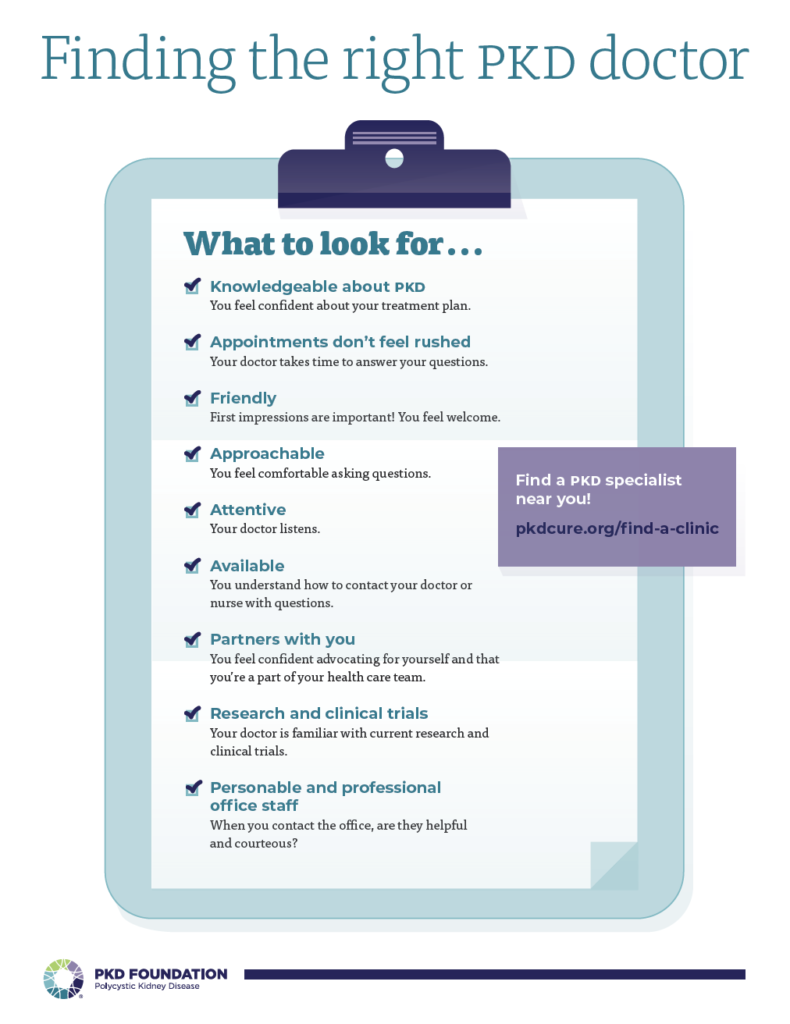

Get the latest information on treating PKD.
****
Receive notifications when there are clinical studies in your area.
Page last reviewed November 2022
---
### [Community Reaction Panel](https://pkdcure.org/get-involved/volunteer-with-us/remote-virtual-opportunities/community-reaction-panel/)
**Published:** March 31, 2022
**Author:** Caitlin Lasky
**Content:**
Community Reaction Panel
The PKD Foundation Community Reaction Panel provides feedback on pre-determined topics of interest to Industry Alliance partners and PKD Foundation programs and services. The panel consists of patients and caregivers with varied experiences across the continuum of disease progression and includes experience with ADPKD and ARPKD.
[Community Reaction Panel Job Description](https://pkdcure.org/wp-content/uploads/Volunteer-Job-Description_Community-Reaction-Panel_2022.pdf)
Join us for our next meeting Tuesday January 23, 2024!
[Click here to register](https://support.pkdcure.org/event/volunteer-training_community-reaction-panel_01-2024/e552367)
[Welcome to PKDF! – Information for PKD Foundation Volunteers ](https://support.pkdcure.org/event/welcome-to-pkdf-information-for-pkd-foundation-volunteers/e406524)
[Slides only](https://pkdcure.org/wp-content/uploads/2023/06/Welcome-to-PKDF-Information-for-PKDF-Volunteers.pdf)
PKDF volunteers are making a difference in the lives of everyone impacted by PKD. One way we show volunteer impact is by capturing volunteer hours. ***Volunteer hours = revenue!***
We have a new process for collecting volunteer hours. Our goal is to make submitting volunteers hours easier for you!
A unique link will be sent to you after each Community Reaction Panel call you attend. Once you submit your hours, you can delete the submission link.
If you have questions about this process, please contact your PKDF staff lead or email Nicole at [nicoleh@pkdcure.org](mailto:nicoleh@pkdcure.org "mailto:nicoleh@pkdcure.org").
- [Volunteer Resources – Home](https://pkdcure.org/volunteers/)
- [Advocacy Champions](https://pkdcure.org/volunteers/advocacy-champions/)
- [Community Reaction Panel](/volunteers/community-reaction-panel/)
- [Fundraising Ambassadors](https://pkdcure.org/volunteers/fundraising/)
- [Outreach Ambassadors](/volunteers/peer-ambassadors/)
- [PKD Connect Ambassadors](https://pkdcure.org/volunteers/ambassadors/)
- [PKD Connect Interpreters](https://pkdcure.org/volunteers/interpreter/)
- [PKD Connect Mentors](https://pkdcure.org/peermentors/)
- [Social media guidelines](https://pkdcure.org/volunteers/social-media-guidelines)
- [Stewardship Ambassadors](https://pkdcure.org/volunteers/stewardship-ambassador/)
- [Walk for PKD Ambassadors](https://pkdcure.org/volunteers/walk/)
**Sue Full**
Director of Community Fundraising
<suef@pkdcure.org>
**Nicole Harr**
Director of Community Engagement
<nicoleh@pkdcure.org>
**Danielle Rose**
Community Fundraising Specialist
<danieller@pkdcure.org>
**Ireland Christensen**
Community Fundraising Coordinator
<irelandc@pkdcure.org>
**PKD Volunteer Team**
Who has the best ideas for success? *You*, of course!
Join our new Team PKD Volunteer Team Facebook closed group page and connect with all of our communities, share your ideas, successes and receive news and information from staff. PKD Volunteer Team is for official PKD Foundation volunteers only.
**resources**
Use the event form to tell us about your community meeting or event. When we receive your form, we will build a registration page and add an update to your community webpage.
Are you looking for a resource to share, check out our resource guide or visit the [Resource Library](https://resources.pkdcure.org/). Can’t find what you need, email [Nicole](mailto:nicoleh@pkdcure.org).
Page last updated November 2023
---
### [UptoDate Treatments](https://pkdcure.org/research/research-medical-professionals/)
**Published:** April 4, 2020
**Author:** Caitlin Lasky
**Content:**
UpToDate information on treating PKD
**UpToDate is the only clinical decision support resource associated with improved outcomes.**
More than 80 research studies demonstrate its impact on improved patient care and hospital performance.
We are committed to providing resources for medical professionals to educate and empower their patients with PKD to manage and improve their health. To provide medical professionals with in-depth information about various aspects of PKD, we have teamed up with [UpToDate](https://www.uptodate.com/home/index.html), an evidence based, peer reviewed online information resource.
- [Patient information: Polycystic Kidney Disease (Beyond the Basics)](https://www.uptodate.com/contents/4419)
- [Autosomal **recessive** polycystic kidney disease (ARPKD) in children](https://www.uptodate.com/contents/6138)
- [Autosomal **dominant** polycystic kidney disease (ADPKD) in children](https://www.uptodate.com/contents/15319)
ADPKD in adults
- [Diagnosis of and screening for ADPKD](https://www.uptodate.com/contents/diagnosis-of-and-screening-for-autosomal-dominant-polycystic-kidney-disease)
- [Epidemiology, clinical presentation, and diagnosis ](https://www.uptodate.com/contents/1678)
- [Pain syndromes in ADPKD](https://www.uptodate.com/contents/14015)
- [Evaluation and management of urinary tract infection](https://www.uptodate.com/contents/1676)
- [Evaluation and management of hypertension ](https://www.uptodate.com/contents/1675)
- [Renal manifestations of ADPKD](https://www.uptodate.com/contents/1680)
- [Extrarenal manifestations ](https://www.uptodate.com/contents/1679)
- [Genetics of ADPKD and mechanisms of cyst growth](https://www.uptodate.com/contents/1682)
- [Treatment for ADPKD](https://www.uptodate.com/contents/1677)
The [Polycystic Kidney Disease Research Resource Consortium](https://www.pkd-rrc.org/) (PKD RRC), funded by The National Institutes of Diabetes, Digestive and Kidney Diseases (NIDDK), consists of three national Research and Translation Core Centers (RTCC) and a Central Coordinating Site. Their goal is to support a collaborative, diverse community of investigators who are working to advance discovery in the area of polycystic kidney disease.
Check out their video on **Risk Stratification in Autosomal Dominant Polycystic Kidney Disease** by Namrata Krishnan, M.D. (Yale School of Medicine)
PKDF Research Programs
- [Research homepage](https://pkdcure.org/research/)
- [Funding Opportunities](https://pkdcure.org/research-medical-professionals/research-funding/)
- [Current grantees and fellows](https://pkdcure.org/funded-research/)
- [Database resources](https://pkdcure.org/research-medical-professionals/data-resources-in-pkd-research/)
- [Research news](https://pkdcure.org/research-news/)
- [Clinical studies](https://clinicalstudies.pkdcure.org/)
---
### [Terms and Conditions](https://pkdcure.org/terms-and-conditions/)
**Published:** April 11, 2020
**Author:** Caitlin Lasky
**Content:**
PKD Foundation Website Terms of Use
This website is an educational and informational service provided by the PKD Foundation. By using the website, you agree to these Website Terms of Use. We may amend these terms from time to time so please check back here frequently for updates. THIS AGREEMENT CONTAINS A BINDING ARBITRATION PROVISION WHICH MAY BE ENFORCED BY THE PARTIES AND A WAIVER OF YOUR CLASS ACTION RIGHTS.
Disclaimer
You acknowledge that the information on this website is provided “as is” for general information only. This website does not offer medical advice or recommendations and individuals should not rely on the information posted on this website as a substitute for consultations with qualified health care professionals who are familiar with individual medical conditions and needs. The PKD Foundation strongly recommends that care and treatment decisions related to polycystic kidney disease and any other medical condition be made in consultation with a patient’s nephrologist or other qualified health care professionals who are familiar with the individual’s specific health situation. The PKD Foundation makes no representations with respect to the information, services, products or message on this website and specifically disclaims any other warranties, including but not limited to implied or express warranties of merchantability or fitness for any particular usage, application or purpose. The PKD Foundation makes no warranties of any kind regarding the operation of this website, including but not limited to any warranty of accuracy, completeness, uptime, currency, reliability, merchantability or fitness for a particular purpose, or any warranty that these pages, or the server that makes them available, are free of viruses, worms, Trojan horses, other harmful elements or other code that manifest contaminating or destructive properties and such warranties are expressly disclaimed.
Donation disclaimer
Please consult your personal advisors on all legal, tax, or financial issues related to your gift or personal matters. Nothing contained on this website or in any of its documents, attachments, or links: (a) should be considered legal, tax, or financial advice, (b) represents the signature of the sender or PKD Foundation, (c) is intended or written to be used, and cannot be used for the purpose of avoiding tax-related penalties. For information about the specific tax benefits to which you may be entitled through your charitable gifting of appreciated (or even depreciated) stock or securities, please consult your tax advisor or attorney.
Links from this website
The PKD Foundation makes no representation, warranty or endorsement, express or implied, as to any of the information, services, products or messages on any other websites which may be accessed through a hyperlink on this website. In particular, these links are provided for convenience of reference only and are not intended as an endorsement by the PKD Foundation or individual operating the website or a warranty or endorsement of any type regarding the website or the information, services, products or messages posted on or available from such website.
Copyright and trademark
Unless otherwise indicated, all information contained on this website, such as text, graphics, logos, button icons, images, audio and video clips, is copyrighted by and proprietary to the PKD Foundation. The content displayed on any page of this website may be used for personal and noncommercial uses which do not harm the reputation of the PKD Foundation, provided that the user does not remove any trademarks, copyright and any other notice contained in such content. The name and mark, the PKD Foundation and its attendant logos and taglines, are trademarks of the PKD Foundation and may not be used or reproduced without its prior written consent.
No unlawful or prohibited use
As a condition of your use of this website, you warrant to the PKD Foundation that you will not use this website for any purpose that is against the law or prohibited by these terms. If you violate any of these terms, your permission to use this website automatically ends. You may not without our prior written permission use any computer code, data mining software, “robot,” “bot,” “spider,” “scraper” or other automatic device, or program, algorithm or methodology having similar processes or functionality, or any manual process, to monitor or copy any of the Web pages, data or content found on this website or accessed through this website. You may not republish PKD Foundation content or other content from this website on another website or use in-line or other linking to display such content without our permission. You may not introduce viruses, spyware, or other malicious code to this website. You represent and warrant that you use frequently updated, commercially standard virus protection software to ensure that the system you use to access our website is virus free.
Changes to the website and these terms
We may make improvements or changes in the information, services, products, and other materials on this website, or terminate this website at any time. We may modify this Agreement at any time, and such modifications will be effective immediately upon posting of the modified Agreement. Accordingly, you agree to review the Agreement periodically, and your continued access or use of this website will be deemed your acceptance of the modified Agreement.
Liability
You agree that you will hold harmless the PKD Foundation and its officers, directors, agents, employees, and volunteers from all claims arising out of or related to your access or use of, or your inability to access or use, this website or the information, services, products or messages contained in this website or other websites to which it is linked, including but not limited to claims that you have found something you have heard, viewed or downloaded from this website or another website to which it is linked to be obscene, offensive, defamatory, or infringing upon your intellectual property rights. In no event will the PKD Foundation or the contributors of information to this website be liable to you or anyone else for any decision made or action taken by you in reliance on such information or for any consequential, special or similar damages, even if advised of the possibility of such damages. YOU HEREBY RELEASE AND FOREVER WAIVE ANY AND ALL CLAIMS YOU MAY HAVE AGAINST THE PKD FOUNDATION, ITS OFFICERS, DIRECTORS, AGENTS, EMPLOYEES, AND VOLUNTEERS FOR LOSSES OR DAMAGES YOU SUSTAIN IN CONNECTION WITH YOUR USE OF THIS WEBSITE. YOU EXPRESSLY UNDERSTAND AND AGREE THAT THE PKD FOUNDATION SHALL NOT BE LIABLE FOR ANY DIRECT, INDIRECT, INCIDENTAL, SPECIAL, CONSEQUENTIAL OR EXEMPLARY DAMAGES, INCLUDING BUT NOT LIMITED TO, DAMAGES FOR LOSS OF PROFITS, GOODWILL, USE, DATA OR OTHER INTANGIBLE LOSSES (EVEN IF ADVISED OF THE POSSIBILITY OF SUCH DAMAGES), RESULTING FROM: (i) THE USE OR THE INABILITY TO USE THE WEBSITE OR FORUMS; (ii) THE COST OF SUBSTITUTE SERVICES RESULTING FROM ANY DATA, INFORMATION OR SERVICES OBTAINED OR MESSAGES RECEIVED OR TRANSACTIONS ENTERED INTO ON THE WEBSITE OR THROUGH OR FROM THE FORUMS; (iii) UNAUTHORIZED ACCESS TO OR ALTERATION OF YOUR TRANSMISSIONS OR DATA; (iv) STATEMENTS OR CONDUCT OF ANY THIRD PARTY ON THE WEBSITE; OR (v) ANY OTHER MATTER RELATING TO THE WEBSITE OR THE SERVICES. IN NO EVENT WILL OUR MAXIMUM LIABILITY TO YOU EXCEED $100.
Governing law
This website (excluding linked sites) is controlled by the PKD Foundation, which is headquartered in the State of Missouri, United States of America. It can be accessed from all 50 states, as well as from other countries around the world. As each of these places has laws that may differ from those of Missouri, by accessing this website both you and the PKD Foundation agree that the statutes and laws of the State of Missouri, without regard to conflicts of laws principles thereof, will apply to all matters arising from or relating to use of this website. You and the PKD Foundation also agree and hereby submit to the exclusive personal jurisdiction and venue of Jackson County, Missouri and the United States District Court with respect to such matters. The PKD Foundation makes no representation that materials on the website are appropriate or available for use in other locations, and accessing them from territories where their contents are illegal is prohibited. Those who choose to access this website from other locations do so on their own initiative and are responsible for compliance with local laws.
You agree that: (1) Any claim, dispute, or controversy (whether in contract, tort, or otherwise) arising out of, relating to, or connected in any way with the website or the services provided on the website will be resolved exclusively by final and binding arbitration conducted pursuant to the American Arbitration Association (“AAA”) Procedures for Consumer-Related Disputes in conjunction with the AAA Commercial Arbitration Rules (if and as applicable depending on the amount in controversy); (2) This arbitration agreement is made pursuant to a transaction governed by the Federal Arbitration Act (“FAA”), 9 U.S.C. §§ 1-16; (3) The arbitration will be held at the AAA regional office nearest you; (4) The arbitrator’s decision will be controlled by the terms and conditions of this Agreement; (5) The arbitrator will apply Missouri law consistent with the FAA and applicable statutes of limitations and will honor claims of privilege recognized at law; (6) There will be no authority for any claims to be arbitrated on a class or representative basis; arbitration can decide only your individual claims and the arbitrator may not consolidate or join the claims of other persons or parties who may be similarly situated; (7) The arbitrator will not have the power to award punitive damages against any party; (8) In the event that the administrative fees and deposits you are required to pay under the AAA rules exceed $125, and you are unable to pay the additional fees and deposits, the PKD Foundation retains the right to forward them to the AAA on the your behalf, subject to ultimate allocation by the arbitrator. In addition, if you are able to demonstrate that the costs of arbitration will be prohibitive as compared to the costs of litigation, the PKD Foundation retains the right to pay as much of your filing and hearing fees in connection with the arbitration as the arbitrator deems necessary to prevent the arbitration from being cost-prohibitive; and (9) If any part of this Arbitration Provision is deemed to be invalid or otherwise unenforceable or illegal, the balance of this Arbitration Provision will remain in full force and effect and will be construed in accordance with its terms as if the invalid or illegal provision were not contained herein. **You understand that, in the absence of this provision, you would have had a right to litigate disputes through a court, including the right to litigate claims on a class-wide or class-action basis, and that You have expressly and knowingly waived those rights and agreed to resolve any disputes through binding arbitration in accordance with the provisions of this paragraph.**
Linking from other websites
The PKD Foundation may grant the owner of a website permission to use a hyperlink to this website from its website, provided: (a) any such link must clearly be marked “the PKD Foundation;” (b) the appearance, position and other aspects of either the link or the host website may not be such as to damage or dilute the goodwill associated with the PKD Foundation’s name and trademarks; (c) the appearance, position and other aspects of either the link or the host website may not create the false appearance that any other entity is associated with or sponsored by the PKD Foundation; and (d) the link, when activated by a user, must display this website full-screen and not with a “frame” on the linked website. The owner of any website with a hyperlink to this website agrees to the foregoing terms and agrees to delete any such link upon notice from the PKD Foundation that such permission has been revoked, which notice may be given at any time and for any reason. The PKD Foundation is not responsible for the information or materials contained on websites linking to this website. Links to this website are provided for convenience of reference only and are not intended as an endorsement by the PKD Foundation of the organization or individual operating the host website or a warranty of any type regarding the host website or the information on the host website.
Comments and submissions
PKD Foundation welcomes your comments, photos, videos, or any other content that you submit through or to the Site, or any content or information you publish through any social media and allow PKD Foundation to feature, such as your name, social media handle, accompanying text, and any images from your social media accounts (e.g. Twitter™, Instagram™, Pinterest™) (collectively, “User Content”) as long as the User Content submitted by you complies with these Terms of Use. You agree that any User Content: will be accurate; will not violate or facilitate the violation of any law or regulation; will not violate any right of a third party, including copyright, trademark, privacy or publicity rights; will not cause injury to any person or entity; and will not contain, or provide links to, obscene, profane, or threatening language, malware, political campaigning, commercial solicitation, chain letters, mass mailings, any form of “spam”, or any material that could be considered harmful, sexually explicit, indecent, lewd, violent, abusive, or degrading. You are solely responsible for the User Content you submit, and PKD Foundation assumes no liability for any User Content submitted by you. You acknowledge and agree that we reserve the right (but have no obligation) to do any or all of the following, in our sole discretion: (i) monitor User Content; (ii) alter, remove, or refuse to post or allow to be posted any User Content; and/or (iii) disclose any User Content, and the circumstances surrounding its transmission, to any third party. For any User Content you submit, you grant to PKD Foundation a non-exclusive, sub-licensable, fully paid-up, perpetual, irrevocable, royalty-free, transferable right and license to use, display, perform, transmit, copy, modify, delete, adapt, publish, translate, create derivative works from, sell and distribute such User Content and to incorporate the User Content into any form, medium, or technology, now known or hereafter developed, throughout the world, all without compensation to you. For this reason, do not send us any User Content that you do not wish to license to us, including any confidential information or any original creative materials such as stories, product ideas, computer code or original artwork. In addition, you grant to PKD Foundation the right to include the name provided along with the User Content submitted by you; provided, however, PKD Foundation shall have no obligation to include such name with such User Content. We are not responsible for the use or disclosure of any personal information that you voluntarily disclose in connection with any User Content you submit. You represent and warrant that you have all rights necessary for you to grant the licenses granted in this section, including but not limited to permission from or on behalf of any individuals that appear in the User Content to use, and grant to third parties such as PKD Foundation the right to use, their name, image, voice and/or likeness without compensation to you or any other person or entity. You further irrevocably waive any “moral rights” or other rights with respect to attribution of authorship or integrity of materials regarding User Content that you may have under any applicable law under any legal theory.
Opt-out policy
If, at any time after registering for information or an event, you change your mind about receiving information from us, you have the ability to opt out of being contacted by the PKD Foundation at any time. To opt out of receiving emails, telephone solicitations or other forms of contact from the PKD Foundation, send an email to [pkdcure@pkdcure.org](mailto:pkdcure@pkdcure.org?subject=Opt-out) with “Opt-Out” in the subject line, or a letter by postal mail to:
PKD Foundation
ATTN: Opt-Out
1001 E 101st Terr, Suite 220
Kansas City, MO 64131Please specify which particular type of contact you are choosing to opt out from (i.e. only solicitations, only emails, only information regarding a specific event, only postal mail, only third-party emails, etc.). Be sure to include your full name, any business mailings and email addresses. If we are able to locate your contact information based on the information you provide us, it will be removed from the areas you referenced in our databases and mailings lists.
Infringement claims/copyright agent
If you believe that any material contained on the website infringes your copyright or other intellectual property rights, you should notify Company of your copyright infringement claim in accordance with the following procedure. Company will process notices of alleged infringement which it receives and will take appropriate action as required by the Digital Millennium Copyright Act (DMCA) and other applicable intellectual property laws. The DMCA requires that notifications of claimed copyright infringement should be sent to this website’s Designated Agent who is:
By mail:
DMCA Copyright Agent
c/o PKD Foundation
1001 E 101st Terrace #220,
Kansas City, MO 64131
By phone: (816) 931-2600
By email, reference DMCA in subject line: [pkdcure@pkdcure.org](mailto:DMCAcopyrightagent@pkdcure.com)
To be effective, the notification must be in writing and contain the following information (DMCA, 17 U.S.C. §512(c)(3)):
- Physical or electronic signature of a person authorized to act on behalf of the owner of an exclusive right that is allegedly infringed;
- Identification of the copyrighted work claimed to have been infringed, or, if multiple copyrighted works at a single online site are covered by a single notification, a representative list of such works at that site;
- Identification of the material that is claimed to be infringing or to be the subject of infringing activity and that is to be removed or access to which is to be disabled, and information reasonably sufficient to permit the service provider to locate the material;
- Information reasonably sufficient to permit the service provider to contact the complaining party, such as an address, telephone number, and, if available, an electronic mail address at which the complaining party may be contacted;
- A statement that the complaining party has a good faith belief that use of the material in the manner complained of is not authorized by the copyright owner, its agent, or the law; and
- A statement that the information in the notification is accurate, and under penalty of perjury, that the complaining party is authorized to act on behalf of the owner of an exclusive right that is allegedly infringed.
Emails sent to <pkdcure@pkdcure.org> or purposes other than communication about copyright claims may not be acknowledged or responded to.
We will, in appropriate circumstances, terminate repeat infringers. If you believe that an account holder or subscriber is a repeat infringer, please follow the instructions above to contact Company and provide information sufficient for us to verify that the account holder or subscriber is a repeat infringer.
Page last reviewed November 2022
---
### [Become an Advocate](https://pkdcure.org/get-involved/volunteer-with-us/become-an-advocate/)
**Published:** January 26, 2016
**Author:** Caitlin Lasky
**Content:**
Become an advocate
Join us in educating your elected officials about how they can help fight PKD. Your voice is a vital piece of the puzzle for helping increase PKD research dollars to bring treatments and therapies to patients, and provide the best care for those who are reliant on dialysis or a kidney transplant to stay alive. Sign up to receive advocacy alerts and you’ll receive an email whenever important issues related to PKD arise.
Advocacy Alert
Receive notifications about opportunities to raise your voice for PKD patients.
[Subscribe](https://p2a.co/rpqRAYS)
PKD Foundation Advocacy Champions Network
Learn about the patients, family members, and clinicians dedicated to improving the lives of people living with PKD.
[Learn more](https://pkdcure.org/advocacy/acn/)
This link will be updated in the coming months as PKDF transitions to Quorum as an advocacy platform
More information
- [About PKD advocacy](https://pkdcure.org/get-involved/advocacy/)
- [Tools & resources](https://pkdcure.org/get-involved/advocacy/tools/)
- [Advocacy blog posts](https://pkdcure.org/blog/category/advocacy/)

Receive notifications about opportunities to raise your voice for PKD patients.

Learn about the patients, family members, and clinicians dedicated to improving the lives of people living with PKD.
Page last reviewed November 2022
---
### [Living with PKD](https://pkdcure.org/about-the-disease/living-with-pkd/)
**Published:** February 26, 2020
**Author:** Caitlin Lasky
**Content:**
Living with PKD
If you or someone you care about live with PKD, some of your top priorities are to maintain a high quality of life and manage the disease. This means having a well-balanced diet, staying physically active, learning how to manage pain and finding effective ways to communicate with your health care team. It is also important to learn as much as possible about PKD. The more you know, the better you can take care of yourself or your loved one with PKD.
Here you can learn from the world’s leading medical experts about PKD and how to live a better life with it. Not sure where to begin? Here are some topics to get you started:
Other Helpful Links
- [Working with your doctor](https://pkdcure.org/living-with-pkd/working-with-your-doctor/)
- [Parents of children with PKD](https://pkdcure.org/living-with-pkd/parents-of-children-with-pkd/)
- [Family and caregivers](https://pkdcure.org/living-with-pkd/family-caregivers/)
- [Join the ADPKD Patient Registry](https://connect.pkdcure.org/adpkd-registry/)
- [Clinical studies](https://pkdcure.org/living-with-pkd/clinical-studies/)
- [Resources](https://pkdcure.org/living-with-pkd/resources/)
- [UpToDate information on treating PKD](https://pkdcure.org/research-medical-professionals/)
- [Understanding lab results](https://resources.pkdcure.org/resources/understanding-lab-results/)
The basics
Just Diagnosed
Learn more about PKD, explore our resources and education, and connect with the PKD community.
Nutrition
While a specific diet won’t make polycystic kidneys better, it is ideal to eat a balanced and healthy diet.
Exercise
Regular exercise can decrease blood pressure, improve stamina, and enhance your sense of well-being.
Complications
Chronic Pain Management
Pain frequency and tolerance vary greatly among individuals. It is important to understand your treatment options.
Pregnancy & PKD
Early diagnosis of PKD has become increasingly more common and has important implications for family planning.
Treatment
Dialysis
If your kidneys fail or can no longer take care of your body’s needs, dialysis is a kidney replacement option that does some of the things healthy kidneys do.
Transplant
Considering and preparing for transplantation can be overwhelming. We have resources to help you navigate the process.
Finding a clinic
Search our database for a clinic near you.
Page last reviewed November 2022
---
### [All Resources](https://pkdcure.org/all-resources/)
**Published:** April 15, 2025
**Author:** Sarah Lundak
---
### [Delaware](https://pkdcure.org/get-connected/community/delaware/)
**Published:** February 4, 2025
**Author:** fiftyandfifty
---
### [Should I stop eating protein?](https://pkdcure.org/should-i-stop-eating-protein/)
**Published:** June 1, 2020
**Author:** Caitlin Lasky
**Content:**
More about protein
| **Name of food** | **Serving size** | **Protein (g)** |
|---|---|---|
| Pinto Beans, cooked | 1/2 cup | 11 |
| Adzuki Beans, cooked | 1/2 cup | 9 |
| Lentils, cooked | 1/2 cup | 9 |
| Edamame, cooked | 1/2 cup | 9 |
| Black Beans, cooked | 1/2 cup | 8 |
| Red Kidney Beans, cooked | 1/2 cup | 8 |
| Chickpeas, cooked | 1/2 cup | 7 |
| Black-eyed Beans, cooked | 1/2 cup | 7 |
| Wheat Berries, cooked | 1/2 cup | 6 |
| Kamut, cooked | 1/2 cup | 6 |
| Lima Beans, cooked | 1/2 cup | 6 |
| Quinoa, cooked | 1/2 cup | 3 |
| Peas, green, cooked | 1/2 cup | 4 |
| Spinach, cooked | 1/2 cup | 3 |
| Soy nuts | 1 oz | 12 |
| Pumpkin seeds | 1 oz | 9 |
| Peanuts | 1 oz | 7 |
| Peanut butter | 1 Tbsp | 7 |
| Almonds | 1 oz | 6 |
| Pistachios | 1 oz | 6 |
| Flax seeds | 1 oz | 6 |
| Chia seeds | 1 oz | 5 |
| Walnuts | 1 oz | 4 |
| Cashews | 1 oz | 4 |
| Chicken, skinless | 3 oz | 28 |
| Steak | 3 oz | 26 |
| Turkey, roasted | 3 oz | 25 |
| Lamb | 3 oz | 23 |
| Pork | 3 oz | 22 |
| Ham | 3 oz | 14 |
| Egg, large | 1 egg | 6 |
| Salmon | 3 oz | 22 |
| Tuna | 3 oz | 22 |
| Shrimp | 3 oz | 20 |
| Lobster | 3 oz | 16 |
| Scallops | 3 oz | 14 |
| French fries | 4 oz | 3-4 |
| Sweet potatoes | 4 oz | 1.6 |
| Lentils | 4 oz | 9 |
| Peanuts | 4 oz | 24-28 |
| Bread | 4 oz | 6-11 |
| Crackers | 4 oz | 7.5 |
| Green vegetables | 4 oz | 0.3-3 |
| Black beans | 4 oz | 9 |
| Chicken egg | 4 oz | 11-14 |
| Cow milk | 4 oz | 5-7 |
| Almond milk | 4 oz | 1 |
| Beef (steak) | 4 oz | 30-40 |
| Beef (ground) | 4 oz | 25 |
| Corned beef | 4 oz | 17 |
| Lamb | 4 oz | 21-50 |
| Chicken | 4 oz | 27 |
| Fish | 4 oz | 20 |
| Mock meat (cooked veggie) | 4 oz | 19-29 |
| Gamalost | 4 oz | 54 |
| Pamesan | 4 oz | 40.79 |
| Gruyere | 4 oz | 29.8 |
| Cheddar (traditional) | 4 oz | 27.2 |
| Cheddar (processed) | 4 oz | 24.6 |
| Camembert | 4 oz | 19.8 |
| Feta | 4 oz | 14.7 |
| Ricotta | 4 oz | 11.39 |
Page last reviewed November 2022
---
### [Should I stop eating salt?](https://pkdcure.org/should-i-stop-eating-salt/)
**Published:** June 1, 2020
**Author:** Caitlin Lasky
**Content:**
Should I stop eating salt?
| Name of Food | Sodium (mg) |
|---|---|
| 1 cup Baked black bean (canned) with pork and tomato sauce | 1140 |
| One 4’’ bagel | 220-400 |
| Fast foods, cheeseburger, double patty, with condiments and vegetables | 1051 |
| 5 Fast food-hush puppies | 965 |
| 1 cup chicken noodle soup (commercial) | 1050 |
| 2 slices of ham (regular) | 739 |
| 1 cup of chicken noodle soup (homemade) | 575 |
| 1 cup Mashed potatoes | 670 |
| 1 butter croissant | 440 |
| 1 medium donut | 257 |
| 1 cup Kellogg’s Corn flakes | 202 |
| 1 slice white bread toasted | 130 |
| ¼ cup Gravy | 250-350 |
| 3 oz of canned Tuna fish | 287 |
| 1 medium size French fries (Mcdonald’s) | 260 |
| 1 oz Chips | 250 |
| 1/2 Chicken breast, roasted | 64 |
| 1/2 Chicken breast, fried with flour | 74 |
| 1/2 Chicken breast, fried with batter | 375 |
| 1 cup 2% Milk | 100 |
| 1 cup rice cooked | 5-10 |
| 1 Tbsp Italian dressing | 243 |
| 1 Tbsp Mayonnaise | 78 |
| 3 oz Ground beef | 65 |
| 1 square Graham Crackers | 43 |
| 1 cup Raw cabbage | 13 |
| 1 cup Espresso | 4 |
| 1 cup Lettuce | 4 |
| 1 cup Lentils | 6 |
| 1 cup most fruits | 5-10 |
Page last reviewed November 2022
---
### [Diagnosis](https://pkdcure.org/about-the-disease/adpkd/diagnosis/)
**Published:** April 9, 2020
**Author:** Caitlin Lasky
**Content:**
How is ADPKD diagnosed?
Currently, there are three main tests that are used to screen for ADPKD:
1. Ultrasound
2. Computed tomography (CT)
3. Magnetic resonance imaging (MRI)
**Ultrasound** is the most common and least costly screening method for PKD. There are accepted standards for ultrasound testing to determine if you have PKD. These standards include the number of cysts visible, age, and family history.
**CT** and **MRI** scans are considered to be more sensitive than ultrasound. CT scans, however, involve radiation or may also require iodinated contrast dye which, can be toxic to the kidneys. CT scans or MRIs may be used to look at complications like bleeding into a cyst or a suspected kidney stone. They may also be used detect small cysts as needed.
DNA testing
**DNA testing** is available for PKD. There are two types of DNA tests: **Gene linkage testing** and **direct mutation analysis/DNA sequencing**. Gene linkage can determine if you have PKD with a 99 percent probability in those with family history. Linkage testing is not a direct analysis of the DNA sequence of the *PKD1* and *PKD2* genes. Instead, it relies on the identification of certain “markers” in the DNA of several members of a family in which PKD has been diagnosed. For linkage analysis, blood samples must be obtained from the person being tested as well as several (typically three or more) family members including those affected and unaffected by PKD. A detailed family history is also required. The results are typically reported to all family members that provided blood samples for the analysis.
In contrast, **direct DNA sequencing** requires only a single sample from you (the person being tested). This method is a direct analysis of the DNA sequences of the *PKD1* and *PKD2* genes. It is private, and the results are only reported to you and your doctor.
Using very specialized scientific equipment, each of the nearly 17,000 “bases” of DNA are analyzed and the entire sequence is thus determined.
This method is capable of identifying those changes in the sequence that cause PKD. It may be your only option if family members are unavailable or unwilling to participate in a linkage study. Each of these methods could be costly and should not be done without consideration of the pros and cons.
Health, life and disability insurance coverage vary between countries and may influence your decision to have genetic testing. In the United States, the Affordable Care Act has guaranteed health insurance for all regardless of any preexisting conditions. This does not guarantee life or disability coverage.
A diagnosis of PKD should be carefully considered and discussed with your doctor.
Should I be tested?
It is an important and impactful decision. Things to consider before being tested include:
- What will I do with the information once I have it?
- Will it prevent me from obtaining medical or life insurance?
- Am I better off knowing or not knowing?
- Can I financially afford the test?
Some people choose to remain undiagnosed but live a healthy lifestyle, eating well and monitoring their own blood pressure. They see the doctor often to monitor kidney function. If or when they have symptoms, they can revisit the decision to be tested. Our understanding of PKD is progressing every year. Early diagnosis may benefit from early therapies and could also mean you are eligible to participate in clinical studies.
All these factors and more must be considered before making a decision.
[What is PKD?](https://pkdcure.org/what-is-pkd/)
- [Kidney 101](https://pkdcure.org/what-is-adpkd/kidney-101/)
- [Parents of children with PKD](https://pkdcure.org/what-is-adpkd/parents-of-children-with-pkd/)
- [What are cysts?](https://pkdcure.org/what-is-adpkd/what-are-cysts/)
[What is ADPKD?](/what-is-adpkd/)
- [Diagnosis](https://pkdcure.org/what-is-adpkd/how-is-adpkd-diagnosed/)
- [Related health complications](https://pkdcure.org/what-is-adpkd/what-are-the-related-health-complications/)
- [Stages](https://pkdcure.org/what-is-adpkd/what-are-the-stages-of-adpkd/)
- [Symptoms](https://pkdcure.org/what-is-adpkd/what-are-the-symptoms/)
- [Causes](/what-is-adpkd/what-causes-adpkd/)
- [Treatment](/what-is-pkd/latest-research/pipeline/)
[What is ARPKD?](https://pkdcure.org/what-is-arpkd/)
- [Diagnosis](https://pkdcure.org/what-is-arpkd/how-is-arpkd-diagnosed/)
- [Related health complications](https://pkdcure.org/what-is-arpkd/what-are-the-related-health-complications-with-arpkd/)
- [Symptoms](https://pkdcure.org/what-is-arpkd/what-are-the-symptoms/)
- [Causes](https://pkdcure.org/what-is-arpkd/what-causes-arpkd/)
- [Treatment](/what-is-pkd/latest-research/pipeline/)

Join a nationwide community of ADPKD patients empowered to #endPKD.

Get the latest information on treating PKD.
Receive notifications of new PKDF webinars, programs, and other resources.
Page last reviewed June 2021
---
### [Community Engagement Grants](https://pkdcure.org/research/grants/research-funding/community-engagement-grants/)
**Published:** January 30, 2023
**Author:** Caitlin Lasky
**Content:**
PKD Community Engagement Grants
Overview of program goals and scope
The [ADPKD Centers of Excellence](https://pkdcure.org/research-medical-professionals/centers-of-excellence/) program is built upon the belief that the best way to provide ADPKD-centered care is through patient-focused, comprehensive care with the coordination and support of an integrated care team guided by patient navigation services. The program’s mission stands on three pillars: understanding PKD through research, ensuring better care for all individuals with ADPKD, and educating and empowering the community.
The PKD Foundation recognizes the unprecedented need for community-level initiatives, programs, and events. In 2023, the PKD Foundation awarded $40k in community grants to support programs providing services that educate and spread awareness of ADPKD, reaching those who are newly diagnosed, and targeting either health care providers or patients and families living with ADPKD*.*
Funding is contingent upon designation in the ADPKD Center of Excellence program. Grants provide up to $6,000 in funding for one year.
Program specifics
PKD Foundation has funded projects and initiatives that are impactful and measurable, especially with the potential to be sustainable and scalable through future support. Projects were new and existing grant-supported areas and/or pilot initiatives. All funded organizations and institutions must demonstrate a commitment to diversity, equity, accessibility, and inclusion.
The 2023 community grant cycle solicits applications in the following areas:
- Host a patient educational or awareness seminar
- Improve underdiagnosis and misdiagnosis of ADPKD among the general chronic kidney disease community.
- Encourage primary care and non-specialized clinicians to refer patients with ADPKD to specialists at the PKDF Centers of Excellence and Partner Clinics.
- Collect and address challenges from patients in your community around barriers to accessing local care.
- Support shared decision-making around dialysis modalities and related barriers.
- Improve support of preparations for transplant, including early education and the transplant evaluation process, especially for those candidates affected by the race-based calculation to estimate eGFR.
- Training in diversity, cultural sensitivity, and working with underrepresented groups within the ADPKD community (for example: individuals with disabilities, people of color, and individuals who speak a non-English language)
- Active outreach initiatives to underrepresented groups within the ADPKD community.
- Identify the social determinants of health that affect your community the most significantly and identify a plan to assist patients in overcoming those barriers.
*Proposal topics are not limited to the above suggestions.*
The Community Engagement grant program was open to team members in the PKD Foundations Centers of Excellence and Partner Clinic program. These grants do not support indirect costs, salary costs for individuals employed on the project, or capital expenses (i.e., computers, furniture, building fixtures). Requests for funds can support participant costs and facilitator/instructor (person providing direct service to participants) expenses.
Grants were required to have at least two investigators: (1) clinician, nurse practitioner, patient navigator, or other care team member, and (2) a patient stakeholder. PKD Foundation encouraged including members of the center’s Patient Advisory Panel in the initiative planning process (Centers of Excellence are required to have a Patient Advisory Panel; these are optional for Partner Clinics, although encouraged).
The PKD Foundation strives to be transparent related to our decision-making processes. We rely on our COE Advisory Group review committee, who develop recommendations for center designation, as well as the process we use as a Foundation, to make funding decisions.
Award amounts are justified in each proposal. Each grant awarded was funded for one year. The funds awarded were used solely for the purposes specified in the proposal submitted and approved by PKD Foundation as executed by the investigator and institution in strict compliance with the budget attached to the application.
Grantees must submit a final Progress and Financial Report, and are encouraged to present their results at PKDF’s annual Centers of Excellence or PKD Connect Conferences.
A stipulation to all awards is appropriate attribution of the PKD Foundation in any publication, news release, presentation, etc. that results from work funded by the award. The PKD Foundation must also receive a copy of the publication and/or news release. This responsibility extends beyond the interval of provided funding.
Awardees are asked to please use language similar to the following: *This project was partially funded by a grant from the Polycystic Kidney Disease Foundation, pkdcure.org. The Foundation had no role in care team design, data collection and interpretation, or the decision to submit the communication for publication.*
The PKD Foundation serves as a grantor not a sponsor for community engagement projects. The responsibility for liability issues and all reporting requirements including local, state and federal regulations will reside with the employment institution, not the PKD Foundation.
Important datesApplication instructions
1. **Co-Investigator Biographies (1000 characters):** briefly describe the qualifications and experience of both investigators. Proposals are required to have at least two investigators: (1) clinician, nurse practitioner, patient navigator, or other care team member, and (2) a patient stakeholder.
2. **Project summary (*3500 characters*):** describe the project, including expected impact on diversity, equity, accessibility or inclusion of individuals impacted by ADPKD in your local community. Note potential for sustainability or scalability through future support if successful. Projects may be new and existing grant-supported areas and/or pilot initiatives.
3. **Metrics and progress evaluation (*1500 characters*):** Include brief description of outcomes and metrics to be used to evaluate the community impact of your project.
4. **Project staff and outreach strategy:**
1. List and briefly describe project staff and collaborators.
2. Describe how these individuals will contribute to project activities, including maximizing outreach with the local community.
5. **Letter of support (*no page limit*):** provide letter of support from the ADPKD Clinic Director and any other relevant supervising staff.
6. **Additional questions**
1. Have you engaged an individual living with ADPKD in the planning of your project? (Y/N)
2. Will this project receive funding from another organization or grant? (Y/N)
3. If yes, please describe where this funding will come from, how much it will be for, and what the funding would cover.
7. **Budget and Justification** (in United States dollars) – *Applicants can request up to $6,000 for a one-year initiative or project. These grants will not support indirect costs, salary costs for individuals employed on the project, or capital expenses (i.e., computers, furniture, building fixtures). Applicants may request funds to support participant costs and facilitator/instructor (person providing direct service to participants) expenses.*
If you have have any questions, please contact <research@pkdcure.org>.
Page last updated June 2024
---
### [Pregnancy and PKD](https://pkdcure.org/about-the-disease/living-with-pkd/pregnancy-and-pkd/)
**Published:** March 12, 2020
**Author:** Caitlin Lasky
**Content:**
Pregnancy and PKD
The diagnosis of PKD is most commonly made by pre-symptomatic screening of at-risk patients with a positive family using ultrasonography which is inexpensive, safe, and readily available. Alternatively, incidental findings of kidney cysts in at-risk patients who undergo imaging studies for other indications may also lead to the diagnosis of PKD. In both scenarios, early diagnosis of PKD has become increasingly more common and has important implications for family planning.
Generally, women with PKD who have normal blood pressure and normal kidney function have uneventful pregnancies and deliver healthy babies. Risk factors associated with pregnancy and PKD are due to increased blood pressure. Some women with PKD will develop hypertension during their pregnancy and are more likely to have continued elevations in their blood pressure after delivery. Women who have high blood pressure prior to becoming pregnant have the risk of further elevations in their blood pressure while pregnant and women with complications in their first pregnancy are more likely to have complications in future pregnancies.
It is important for a woman with PKD to be closely monitored during pregnancy whether she has hypertension or not. Increases in blood pressure as well as protein in the urine could signal a serious complication of pregnancy called preeclampsia – a condition where the placenta can be prevented from getting enough blood. If the placenta doesn’t get enough blood, the growth of the fetus can be compromised resulting in low birth weight, premature birth, and other problems for the baby. Most women with preeclampsia still deliver healthy babies.
Pregnancy does not seem to affect the growth of kidney cysts but there appears to be a slight increase in the rate of loss of kidney function in women with hypertension and four or more pregnancies, as compared to PKD women with hypertension who have fewer than four pregnancies.
The decision to have children is a very personal one. Both parents need to discuss the risks involved and the joy associated with having a child. With an affected parent, there is a 50 percent probability of having a child who has inherited the gene for PKD. Pre-implantation genetic diagnosis (PGD) is now feasible and has been successfully applied in more than 300 genetic disorders for selecting healthy embryos created by in-vitro fertilization (IVF) for implantation. The utility of this new approach in PKD in the context of family planning has not been formally assessed. Should you be interested in learn more, please contact your physician for referral to specialized centers experienced in PGD.
[Read a post on our blog about choices](https://pkdcure.org/choices/)
[Watch our video on ADPKD and Pregnancy Considerations ](https://www.youtube.com/watch?v=1T1vasahDEY)
[Watch our video about Family Planning and Achieving Reproduction Success](https://resources.pkdcure.org/resources/family-planning-and-achieving-reproductive-success/)
The PKD Foundation does not offer medical advice. The information shared on this website is not intended to be a substitute for professional medical advice, diagnosis, or treatment. We strongly recommend that your care and treatment decisions be made in consultation with your healthcare professional team.Page last reviewed June 2021
---
### [List of Centers](https://pkdcure.org/research/coe-locations/)
**Published:** January 23, 2023
**Author:** Caitlin Lasky
**Content:**
[**← Go back to the Care Centers Page**](https://pkdcure.org/carecenters/)List of Centers Centers of Excellence
[Beth Israel Deaconess Medical Center](https://pkdcure.org/coe-search-results/?search=boston)
[Columbia University Medical Center](https://pkdcure.org/coe-search-results/?search=new%20york)
[Emory University](https://pkdcure.org/coe-search-results/?search=georgia)
[Geisinger Clinic](https://pkdcure.org/coe-search-results/?search=pennsylvania)
[Indiana University School of Medicine](https://pkdcure.org/coe-search-results/?search=indiana)
[Mayo Clinic (Arizona)](https://pkdcure.org/coe-search-results/?search=arizona)
[Mayo Clinic (Jacksonville)](https://pkdcure.org/coe-search-results/?search=jacksonville)
[Mayo Clinic (Rochester)](https://pkdcure.org/coe-search-results/?search=minnesota)
[Medical University of South Carolina](https://pkdcure.org/coe-search-results/?search=south%20carolina)
[Nephrology Associates of Tidewater](https://pkdcure.org/coe-search-results/?search=tidewater)
[Saint Louis University](https://pkdcure.org/coe-search-results/?search=st.%20louis)
[St. Luke’s Clinic (ID)](https://pkdcure.org/coe-search-results/?search=idaho)
[Swedish Medical Center](https://pkdcure.org/coe-search-results/?search=seattle)
[The Kidney Institute (TX)](https://pkdcure.org/coe-search-results/?search=texas)
[The Rogosin Institute](https://pkdcure.org/coe-search-results/?search=new%20york)
[Thomas Jefferson University](https://pkdcure.org/coe-search-results/?search=philadelphia)
[Tufts Medical Center](https://pkdcure.org/coe-search-results/?search=boston)
[University of Alabama at Birmingham](https://pkdcure.org/coe-search-results/?search=alabama)
[University of California Los Angeles](https://pkdcure.org/coe-search-results/?search=los%20angeles)
[University of California San Diego](https://pkdcure.org/coe-search-results/?search=san%20diego)
[University of California San Fransisco](https://pkdcure.org/coe-search-results/?search=san%20fransisco)
[University of Chicago](https://pkdcure.org/coe-search-results/?search=chicago)
[University of Colorado Denver](https://pkdcure.org/coe-search-results/?search=denver)
[University of Iowa](https://pkdcure.org/coe-search-results/?search=iowa)
[University of Kansas Medical Center](https://pkdcure.org/coe-search-results/?search=kansas)
[University of Maryland](https://pkdcure.org/coe-search-results/?search=baltimore)
[University of Miami](https://pkdcure.org/coe-search-results/?search=miami)
[University of Michigan](https://pkdcure.org/coe-search-results/?search=michigan)
[University of North Carolina at Chapel Hill](https://pkdcure.org/coe-search-results/?search=north%20carolina)
[University of Pennsylvania](https://pkdcure.org/coe-search-results/?search=pennsylvania)
[University of Southern California](https://pkdcure.org/coe-search-results/?search=southern%20california)
[University of Texas Southwestern Medical Center](https://pkdcure.org/coe-search-results/?search=dallas)
[University of Vermont](https://pkdcure.org/coe-search-results/?search=vermont)
[University of Virginia Health](https://pkdcure.org/coe-search-results/?search=virginia)
[University of Wisconsin-Madison](https://pkdcure.org/coe-search-results/?search=wisconsin)
[Vanderbilt University](https://pkdcure.org/coe-search-results/?search=vanderbilt)
[Yale University](https://pkdcure.org/coe-search-results/?search=connecticut)
 Partner Clinics
[Brigham and Women’s Hospital](https://pkdcure.org/coe-search-results/?search=brigham)
[Colorado Kidney Care](https://pkdcure.org/coe-search-results/?search=colorado)
[Commonwealth Nephrology Associates (MA)](https://pkdcure.org/coe-search-results/?search=commonwealth)[ Dallas Nephrology Associates
Dallas Renal Group](https://pkdcure.org/coe-search-results/?search=dallas)
[George Washington University](https://pkdcure.org/coe-search-results/?search=george)
[Gundersen Health System (WI)](https://pkdcure.org/coe-search-results/?search=wisconsin)
[Hackensack University (NJ)](https://pkdcure.org/coe-search-results/?search=new%20jersey)
[Montefiore Medical Center](https://pkdcure.org/coe-search-results/?search=new%20york)
[Mount Sinai Hospital
](https://pkdcure.org/coe-search-results/?search=new%20york)[Nephrology Associates (DE)](https://pkdcure.org/coe-search-results/?search=delaware)
[Nephrology Associates of Mobile (AL)](https://pkdcure.org/coe-search-results/?search=alabama)
[Nephrology and Hypertension Specialists (GA)](https://pkdcure.org/coe-search-results/?search=georgia)
[North Carolina Nephrology Associates](https://pkdcure.org/coe-search-results/?search=north%20carolina)
[The Ohio State University
](https://pkdcure.org/coe-search-results/?search=ohio)[Partners in Nephrology and Endocrinology – Carroll (PA)](https://pkdcure.org/coe-search-results/?search=pennsylvania)
[Partners in Nephrology and Endocrinology – Jefferson Hills (PA)](https://pkdcure.org/coe-search-results/?search=pennsylvania)
[Partners in Nephrology and Endocrinology – Washington (PA)](https://pkdcure.org/coe-search-results/?search=pennsylvania)
[Reliant Medical Group (MA)](https://pkdcure.org/coe-search-results/?search=reliant)
[Rockford Nephrology Associates](https://pkdcure.org/coe-search-results/?search=rockford)
[SUNY Downstate Health Sciences University](https://pkdcure.org/coe-search-results/?search=downstate)
[University of California Irvine](https://pkdcure.org/coe-search-results/?search=irvine)
[University of Oklahoma](https://pkdcure.org/coe-search-results/?search=oklahoma)
[University of Texas Health San Antonio](https://pkdcure.org/coe-search-results/?search=houston)
 Pediatric Clinics
[Children’s National Hospital](https://pkdcure.org/coe-search-results/?search=childrens)
[Mayo Clinic Children’s Center (Rochester)](https://pkdcure.org/coe-search-results/?search=rochester)
[Cleveland Clinic Children’s Hospital](https://pkdcure.org/coe-search-results/?search=cleveland)
[Children’s Hospital of Philadelphia](https://pkdcure.org/coe-search-results/?search=philadelphia)
[Rady Children’s Kidney Center](https://pkdcure.org/coe-search-results/?search=san%20diego)
---
### [Available Treatment](https://pkdcure.org/about-the-disease/living-with-pkd/treatments/)
**Published:** April 11, 2020
**Author:** Caitlin Lasky
**Content:**
Tolvaptan treatment for ADPKD
Early in the disease, there are generally no symptoms at all. In fact, many people are never diagnosed with PKD because they have few or no symptoms. Often the first sign of PKD is high blood pressure, blood in the urine or a feeling of heaviness or pain in the back or abdomen. Sometimes the first sign may be a urinary tract infection or kidney stones.
On [April 24, 2018, the U.S. Food and Drug Administration (FDA) granted approval of tolvaptan to be the first treatment in the United States](https://www.renalandurologynews.com/home/news/nephrology/chronic-kidney-disease-ckd/tolvaptan-cleared-in-us-for-adpkd-in-adults/) for adult patients with autosomal dominant polycystic kidney disease (ADPKD), the most common form of polycystic kidney disease (PKD).
Tolvaptan is a medication (taken twice a day as an oral pill) that affects how the kidneys control the concentration of urine. It has been shown to slow down the growth of kidney cysts (total kidney volume) when it is taken for a long time (several years) by adults at risk of rapidly progressing ADPKD. This may help protect the function of your kidneys and delay the need for a kidney transplant or dialysis. Your kidney function would continue to decline, but at a slower rate.
**Known major side effects:**
Thirst and frequent urination are the most common side effects. Making large amounts of urine and urinating at night are also common. Rare but potentially serious liver injury is possible. Patients must be under the care of the prescribing physician to monitor all side effects and the drug should be discontinued at the first sign of liver effects. This effect is most often reversible when the drug is stopped based on the first finding of elevated liver enzymes in a blood test.
**Read more about tolvaptan research results and treatment recommendations:**
- **[Tolvaptan in Later-Stage Autosomal Dominant Polycystic Kidney Disease](https://www.nejm.org/doi/full/10.1056/NEJMoa1710030)**
- [Burden of Proof for Tolvaptan in ADPKD. Did REPRISE provide the answer?](https://cjasn.asnjournals.org/content/13/7/1107)
- [A Practical Guide for Treatment of Rapidly Progressive ADPKD with Tolvaptan](https://jasn.asnjournals.org/content/29/10/2458)
- [ADPKD Treatment](https://www.uptodate.com/contents/1677) on UpToDate
**Watch our webinar** to learn about the first treatment for ADPKD. Hosted by Ronald Perrone, M.D.
****
Receive notifications when there are clinical studies in your area.
**Blog posts**
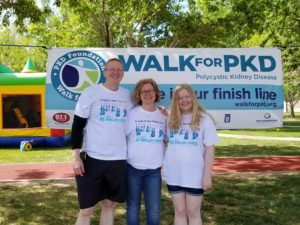
[PKD researcher weighs in on how patient participation brought about first treatment](https://pkdcure.org/pkd-researcher-weighs-patient-participation-brought-first-treatment/)
**Frequently Asked Questions**
The out of pocket expense for each patient will vary depending on their insurance company and the type of plan chosen. Insurance companies will negotiate to determine the price they pay for the drug and will determine what consumers pay based on their coverage.
Patients will need to be under the care of a nephrologist or experienced internist who has read the latest study results and understands the requirements and steps necessary to prescribe this drug. Please keep in mind that this drug will not be prescribed for all ADPKD patients. Patients will have to meet the criteria of at risk for rapidly progressing ADPKD based on results from the clinical trials. For help finding a nephrologist with experience prescribing tolvaptan, visit our [Find a PKD Clinic page](https://pkdcure.org/find-a-clinic/) or connect with [your local Chapter](https://connect.pkdcure.org/chapters/).
Generally speaking, yes. It is the company’s intent to ensure all trial patients who want to continue taking the drug are able to do so. However, the drug will need to be prescribed by a nephrologist and previous study participants will undergo the same standard of care as all other patients receiving tolvaptan.
Every insurance company will negotiate to determine coverage for tolvaptan as a treatment for PKD and each individual plan available will be different. To find out if your insurance will cover tolvaptan, please reach out to your insurance company.
If you do not see a nephrologist regularly but you think you will benefit from tolvaptan, now is the time to set up an appointment. Take information about tolvaptan with you to your appointment and also, take a list of all of your questions. Keep in mind, not all patients will benefit from taking this drug and your nephrologist may tell you that you do not meet the criteria to be prescribed this drug. If this is the case, ask questions and be sure you understand why. For help finding a nephrologist with experience prescribing tolvaptan, visit our [Find a PKD Clinic page](https://pkdcure.org/find-a-clinic/) or connect with [your local Chapter](https://connect.pkdcure.org/chapters/).
No, tolvaptan is only approved for use in adult (18 and older) ADPKD patients.
Tolvaptan has not been clinically tested in children at this time. Ongoing studies in Europe are evaluating the safety and efficacy in patients younger than 18.
We cannot comment on the interaction of specific drugs — this is a question you need to discuss with your nephrologist.
Yes. A REMS (risk evaluation and mitigation strategy) that patients and nephrologists will have to follow is described in the label. To ensure the safety of patients taking tolvaptan, it is necessary to measure ALT, AST and bilirubin before initiating treatment, at 2 weeks and 4 weeks after initiation, then monthly for 18 months and every 3 months thereafter, for as long as the patient is on tolvaptan treatment. This will mean regular blood labs to monitor liver function and discussions with your physician.
Tolvaptan is indicated to slow kidney function decline in adults at risk of rapidly progressing ADPKD. “Rapidly progressing” is not a defined standard – it takes many factors specific to each patient into account. Because of this, patients who are interested in the drug need to speak with their physician to consider all factors, as well as potential side effects, to decide if it is a good choice for them. If your risk of rapid progression is determined as high, it would be best to initiate the treatment early, even if kidney function it relatively normal. This will allow for maximum gain out of the tolvaptan therapy.
No. Tolvaptan is intended for patients with rapidly progressing ADPKD who have not had a transplant and are not on dialysis.
Tolvaptan is available in Japan, the European Union, Canada, the Republic of South Korea, Switzerland, Hong Kong, Australia, Turkey, and Taiwan. Approval in other countries will be subject to the regulatory agencies in each individual country.
Ongoing clinical studies have been done on humans to test the efficacy of water intake to slow disease progression in ADPKD. Until the results of these studies are available, it is not possible to compare the use of tolvaptan to that of water intake. However, ADPKD patients are generally advised to drink fluids throughout the day to suppress the thirst hormone (vasopressin). It is advised to discuss details of the water suppression with your nephrologist.
It is not possible to know exactly how long tolvaptan may preserve kidney function. Clinical studies showed that the drug slowed the growth of cysts and preserved kidney function as compared to placebo. In patients with risk of rapid progression, it is estimated that each four years of tolvaptan treatment could delay the need for renal replacement therapy (dialysis or transplant) by one year.
Tolvaptan is approved for use in patient with rapid progressing ADPKD. Future studies are still needed to determine if tolvaptan could help reducing the liver cysts. At this time, tolvaptan is not indicated to slow progression of polycystic liver disease.
As far as we know, tolvaptan will not help or hurt cysts in the liver. The TEMPO trial showed no association between the severity of liver cysts/PLD and the risk for liver toxicity, therefore liver cysts/PLD are not associated with the liver toxicity issues associated with tolvaptan. You should consult your physician if you have concerns about liver cysts, PLD or any other liver disease and this drug.
The PKD Foundation not only supported early studies that led to the development of tolvaptan as a treatment but also helped guide PKD patients to the clinical trials.
“Today is a historic day in providing hope to patients with polycystic kidney disease, and we are thrilled to be a part of this first milestone to treat patients with ADPKD,” said Andy Betts, President and CEO of the PKD Foundation, when news of the approval was announced. “For the past 35 years, our goal has been to support PKD patients from care to cure. It is gratifying to play a part in the discovery of this treatment and to see it come to fruition.”
Betts added, “Many thanks to all of the patients who graciously took the time and resources to participate in the clinical trials to bring this treatment to the PKD community. This treatment would not exist without these patients.”
The time to develop a drug from inception to market is long, expensive and impossible to predict. There are several therapies in clinical trials now, but we can’t say how long it will take for the next one to be submitted for approval. Learn more about the latest in research and potential treatments [here](https://pkdcure.org/what-is-pkd/latest-research/pipeline/) and explore clinical trials [here](https://clinicalstudies.pkdcure.org/).
The first study for ARPKD is underway now, and if the early results are positive, the study will continue to the next phase of clinical trials. To aid in the development of treatments for ARPKD, consider joining the ARPKD database. Visit [arpkdb.org](https://arpkdb.org/) for more information or contact Research Coordinator Elena Gibson, RN with questions or to participate by calling 202-476-6877.
The PKD Foundation is committed to keeping our constituents informed about advances toward treatments for PKD. Subscribe to the PKD Blog and sign up to receive our emails. You can always learn about the latest in PKD research [here](https://pkdcure.org/research/).
Whether or not to have children screened for ADPKD is a very personal decision. The availability of tolvaptan as an approved treatment for ADPKD and the potential future therapies encourages individuals at risk of ADPKD (i.e. one of their parents have ADPKD) to consider screening. Screening children younger than 18 is not highly recommended unless a therapy is approved for patients younger than 18. Keep in mind that tolvaptan is approved for use in adults, 18 and over. Things to consider before screening children include:
- What will you do with the information once you have it?
- Will a diagnosis prevent you from obtaining medical or life insurance for your children? Are you better off knowing or not knowing?
- Can you financially afford the test (although ultrasound is relatively inexpensive, confirmation by genetic testing is expensive)?
Some people choose to remain undiagnosed but live a healthy lifestyle, eating well and monitoring blood pressure. They see the doctor often to monitor kidney function. If or when they have symptoms, they can revisit the decision to be tested. PKD is a progressive disease from year to year. Early diagnosis may allow the use of therapeutics earlier in the course of the disease and could also mean you are eligible to participate in clinical studies. All these factors and more must be considered before making a decision.
**Content last updated November 2, 2020 — Reviewed by Fouad Chebib, M.D. (Mayo Clinic)**
Page last reviewed November 2022
---
### [Founders](https://pkdcure.org/who-we-are/founders/)
**Published:** December 18, 2024
**Author:** fiftyandfifty
---
### [What causes ARPKD?](https://pkdcure.org/about-the-disease/arpkd/what-causes-arpkd/)
**Published:** March 11, 2020
**Author:** Caitlin Lasky
**Content:**
What causes ARPKD?
Autosomal recessive polycystic kidney disease is caused by a mutation in chromosome 6 (*PKHD1* gene). In recessive disorders such as ARPKD, the child must inherit a copy of the *PKHD1* gene from each parent. Since the parents each have only one copy of the disease gene, they do not have the disease and are referred to as “**carriers**.” Parents carrying the mutated *PKHD1* gene have a 25 percent chance that each child will have ARPKD. There is also a 50 percent chance each child will not have ARPKD but will be a carrier of the disease.
ARPKD inheritance
[What is PKD?](https://pkdcure.org/what-is-pkd/)
- [Kidney 101](https://pkdcure.org/what-is-adpkd/kidney-101/)
- [Parents of children with PKD](https://pkdcure.org/what-is-adpkd/parents-of-children-with-pkd/)
- [What are cysts?](https://pkdcure.org/what-is-adpkd/what-are-cysts/)
[What is ADPKD?](https://pkdcure.org/what-is-adpkd/)
- [Diagnosis](https://pkdcure.org/what-is-adpkd/how-is-adpkd-diagnosed/)
- [Related health complications](https://pkdcure.org/what-is-adpkd/what-are-the-related-health-complications/)
- [Stages](https://pkdcure.org/what-is-adpkd/what-are-the-stages-of-adpkd/)
- [Symptoms](https://pkdcure.org/what-is-adpkd/what-are-the-symptoms/)
- [Causes](https://pkdcure.org/what-is-adpkd/what-causes-adpkd/)
[What is ARPKD?](https://pkdcure.org/what-is-arpkd/)
- [Diagnosis](https://pkdcure.org/what-is-arpkd/how-is-arpkd-diagnosed/)
- [Related health complications](https://pkdcure.org/what-is-arpkd/what-are-the-related-health-complications-with-arpkd/)
- [Symptoms](https://pkdcure.org/what-is-arpkd/what-are-the-symptoms/)
- [Causes](https://pkdcure.org/what-is-arpkd/what-causes-arpkd/)
Volunteer to participate in clinical studies.

Get notified of studies in your area.
Page last updated June 2021
---
### [Diagnosis](https://pkdcure.org/about-the-disease/arpkd/diagnosis/)
**Published:** March 11, 2020
**Author:** Caitlin Lasky
**Content:**
How is ARPKD diagnosed?
Typically in ARPKD, the kidneys appear to be larger than normal. In some babies, prenatal ultrasound can detect the enlarged kidneys as early as 18 weeks after conception. Some families may also hear their doctor say the kidneys look “echogenic” (more white) during an ultrasound, which can be an indicator of kidney problems such as ARPKD.
Prenatal genetic testing is possible using samples from either **chorionic villus sampling** or **amniocentesis**. These genetic tests can either involve a direct search of the gene for mutations or an indirect association using linkage analysis. For linkage analysis, DNA samples are required from the fetus, a previously affected child, and the parents.
Another option for pre-natal diagnosis in affected families is a recently developed procedure called **pre-implantation genetic diagnosis, or PGD**. This is an early form of genetic diagnosis that involves the detection of specific genetic abnormalities in single cells taken from fertilized human embryos. The PGD procedure involves in vitro fertilization whereby eggs harvested from a mother are fertilized in a laboratory with the father’s sperm. Then, the fertilized embryos are tested for ARPKD by removing one or two cells for genetic analysis. Embryos that are diagnosed as free of the disorder are then placed in the uterus with the intent to initiate a pregnancy.
[What is PKD?](https://pkdcure.org/what-is-pkd/)
- [Kidney 101](https://pkdcure.org/what-is-adpkd/kidney-101/)
- [Parents of children with PKD](https://pkdcure.org/what-is-adpkd/parents-of-children-with-pkd/)
- [What are cysts?](https://pkdcure.org/what-is-adpkd/what-are-cysts/)
[What is ADPKD?](/what-is-adpkd/)
- [Diagnosis](https://pkdcure.org/what-is-adpkd/how-is-adpkd-diagnosed/)
- [Related health complications](https://pkdcure.org/what-is-adpkd/what-are-the-related-health-complications/)
- [Stages](https://pkdcure.org/what-is-adpkd/what-are-the-stages-of-adpkd/)
- [Symptoms](https://pkdcure.org/what-is-adpkd/what-are-the-symptoms/)
- [Causes](/what-is-adpkd/what-causes-adpkd/)
- [Treatment](/what-is-pkd/latest-research/pipeline/)
[What is ARPKD?](https://pkdcure.org/what-is-arpkd/)
- [Diagnosis](https://pkdcure.org/what-is-arpkd/how-is-arpkd-diagnosed/)
- [Related health complications](https://pkdcure.org/what-is-arpkd/what-are-the-related-health-complications-with-arpkd/)
- [Symptoms](https://pkdcure.org/what-is-arpkd/what-are-the-symptoms/)
- [Causes](https://pkdcure.org/what-is-arpkd/what-causes-arpkd/)
- [Treatment](/what-is-pkd/latest-research/pipeline/)
Use this tool to compare and assess clinics close to your home or work.

[Download a flyer](/wp-content/uploads/2019/06/uab-hrfdcc-core-a-infographic-final-4.jpg) for more information and to learn how to participate.

Get the latest information on treating PKD.

Get notified of studies in your area.
Page last reviewed June 2021
---
### [Lifestyle](https://pkdcure.org/about-the-disease/living-with-pkd/lifestyle/)
**Published:** March 5, 2020
**Author:** Caitlin Lasky
**Content:**
LifestyleExercise and sports
Exercise is an important part of maintaining good, overall health. Regular exercise can decrease your blood pressure and stress as well as improve muscle strength, heart function and stamina. It can also enhance a sense of well-being. In general, you will do much better on dialysis and with a transplant if you are physically fit.
What kind of exercise is best?
There is no one best kind of exercise. The key is to find an activity that is comfortable for you and that you enjoy doing. Generally, PKD patients can do any activity they want unless they get blood in the urine or it causes back, flank or abdominal pain. The exercises that are least jarring to the kidneys include walking, swimming and biking.
Be sure to talk with your doctor before starting an exercise regimen, as he or she may have guidance about what will be most effective for you, or what to avoid. Remember to always keep well hydrated when exercising, and do your best to be active on a regular basis.
Are sports dangerous to my kidneys?
In general, most sports do not affect kidney function. However, PKD does present unique circumstances and so there are some issues that need to be considered. Given the unique nature of PKD, where kidneys are enlarged and cysts can rupture, there are some simple precautions to take. Contact sports where the kidneys may be traumatized (flank/side or lower back impact) should either be avoided or protective pads should be worn. Examples of these types of sports include football, rugby, basketball, hockey and particularly boxing or kickboxing. Horseback riding and cross-country biking are other sports with repetitive impact that could potentially cause issues with your kidneys. There is no evidence that these activities worsen renal function, but they can result in pain and/or blood appearing in the urine.
Diet and nutrition
There are many reasons to maintain a healthy diet as a PKD patient including the potential to slow cyst growth, diabetes, and faster transplant recovery times. [Learn more about diet and nutrition](/living-with-pkd/nutrition/).
Should I limit the physical activity of a child who has ADPKD?
There is no information to support limiting physical activity in any child simply because he or she has ADPKD. It is possible that children with large kidneys and/or large cysts may have more episodes of blood in the urine if they play contact sports such as football, however each child should be evaluated by a doctor on an individual basis.
Page last reviewed November 2022
---
### [Support Research Programs](https://pkdcure.org/get-involved/volunteer-with-us/support-research-programs/)
**Published:** October 22, 2024
**Author:** fiftyandfifty
---
### [Symptoms](https://pkdcure.org/about-the-disease/arpkd/what-are-the-symptoms-2/)
**Published:** July 14, 2020
**Author:** Caitlin Lasky
**Content:**
What are the symptoms of ARPKD?
In autosomal recessive polycystic kidney disease (ARPKD), symptoms can begin prenatally when small cysts form in the last section of the nephron called the collecting tubule. A cyst is a balloon-like widening of the tubule. Due to the numerous nephrons with small balloon-like dilatations, the kidneys can become quite enlarged. In addition, the normal function of the collecting tubule is disrupted. In the normal kidney, the collecting tubule fine-tunes the amount of water and acid in the tubular fluid so that the body retains an appropriate amount of water and eliminates excess amounts of acid. In ARPKD, the cystic collecting ducts cannot retrieve water efficiently, causing much more urine production than in children with normal kidneys. For reasons that are not completely understood, the majority of children with ARPKD have a progressive loss of kidney function. However, the age at which kidney failure develops varies greatly among patients, and, for reasons still unknown, the size of the kidneys does not necessarily correlate with the severity of the disease.
Prenatal symptoms
- Diminished amniotic fluid levels during pregnancy
- Enlarged kidneys on fetal ultrasound
- Lung immaturity and functioning issues
Symptoms immediately after birth
- Enlarged kidneys due to cysts
- Breathing problems due to lack of space because of enlarged kidneys and decreased urine production. Ventilation is frequently required to sustain life.
- Excessive urine production
- Hypertension
- Growth problems
- Congenital hepatic fibrosis
- Enlarged spleen with low red blood cell, white blood cell and platelet counts
[What is PKD?](https://pkdcure.org/what-is-pkd/)
- [Kidney 101](https://pkdcure.org/what-is-adpkd/kidney-101/)
- [Parents of children with PKD](https://pkdcure.org/what-is-adpkd/parents-of-children-with-pkd/)
- [What are cysts?](https://pkdcure.org/what-is-adpkd/what-are-cysts/)
[What is ADPKD?](/what-is-adpkd/)
- [Diagnosis](https://pkdcure.org/what-is-adpkd/how-is-adpkd-diagnosed/)
- [Related health complications](https://pkdcure.org/what-is-adpkd/what-are-the-related-health-complications/)
- [Stages](https://pkdcure.org/what-is-adpkd/what-are-the-stages-of-adpkd/)
- [Symptoms](https://pkdcure.org/what-is-adpkd/what-are-the-symptoms/)
- [Causes](/what-is-adpkd/what-causes-adpkd/)
- [Treatment](/what-is-pkd/latest-research/pipeline/)
[What is ARPKD?](https://pkdcure.org/what-is-arpkd/)
- [Diagnosis](https://pkdcure.org/what-is-arpkd/how-is-arpkd-diagnosed/)
- [Related health complications](https://pkdcure.org/what-is-arpkd/what-are-the-related-health-complications-with-arpkd/)
- [Symptoms](https://pkdcure.org/what-is-arpkd/what-are-the-symptoms/)
- [Causes](https://pkdcure.org/what-is-arpkd/what-causes-arpkd/)
- [Treatment](/what-is-pkd/latest-research/pipeline/)
Receive notifications of new PKDF webinars, programs, and other resources.

Get notified of studies in your area.

Get the latest information on treating PKD.
Page last reviewed June 2021
---
### [Chronic pain management](https://pkdcure.org/about-the-disease/living-with-pkd/chronic-pain-management/)
**Published:** April 2, 2020
**Author:** Caitlin Lasky
**Content:**
Chronic pain management
**Chronic pain** is one of the most common problems for patients with PKD. The pain is usually in the back or the side and occasionally in the stomach. It can be intermittent and mild requiring only occasional pain medicine such as acetaminophen (Tylenol). However, in a small number of patients with severe PKD, the pain can be constant and quite severe. For these patients, surgery may be needed.
If you have a few very big cysts causing the pain, they can be **aspirated** and **sclerosed** with chemicals that are injected into cysts. Sclerosis is done using an ultrasound or CAT scan to guide your doctor to insert a needle into the cyst(s), drain the fluid, and then coat the cyst wall with a sclerosing substance to remove the cyst’s lining cells. If you have severe pain due to a greatly enlarged polycystic kidney, surgical approaches may also be considered. For example, **laproscopic cyst decortication** or **surgical nephrectomy** may be possible, especially if you are already on dialysis/end stage renal disease.
Pain is a very subjective feeling. Only the person feeling the pain can measure how bad it is. It is important to remember that pain frequency and tolerance vary greatly among individuals. Pain tolerance appears to be influenced by a person’s cultural background, expectations, behaviors, physical and emotional health. For this reason, **pain clinics** that utilize biofeedback and support groups can be very helpful in managing your pain. Pain clinics are sometimes a division of the anesthesiology department of a surgical hospital. To find a pain clinic, talk with your doctor or nephrologist to be directed to one that can help you with your specific PKD pain needs.
*The PKD Foundation does not offer medical advice. The information shared on this website is not intended to be a substitute for professional medical advice, diagnosis, or treatment. We strongly recommend that your care and treatment decisions be made in consultation with your healthcare professional team.*
Next steps and helpful links[Kidney Cyst Sclerotherapy](https://pkdcure.org/research-medical-professionals/kidney-cyst-sclerotherapy/)
[Pain Management](https://resources.pkdcure.org/resources/pain-management/)
Page last reviewed November 2022
---
### [FAQs](https://pkdcure.org/faqs/)
**Published:** February 26, 2025
**Author:** fiftyandfifty
---
### [State fundraising notices](https://pkdcure.org/who-we-are/financial-and-organizational-information/state-fundraising-notices/)
**Published:** March 12, 2020
**Author:** Caitlin Lasky
**Content:**
State fundraising notices
Although our financial report is always sent free to anyone requesting a copy, certain States require us to advise you that a copy of our financial report is available from them.
Your gift is very much appreciated and fully deductible as a charitable contribution. A copy of our latest financial report may be obtained by writing to **PKD Foundation, 1001 East 101st Terrace, Suite 220, Kansas City, MO 64131, 800.753.2873**.
If you are a resident of one of these states, you may obtain financial information directly from the state agency:
- FLORIDA — A COPY OF THE OFFICIAL REGISTRATION AND FINANCIAL INFORMATION MAY BE OBTAINED FROM THE DIVISION OF CONSUMER SERVICES BY CALLING TOLL-FREE, 1-800-435-7352 (800-HELP-FLA) WITHIN THE STATE. REGISTRATION DOES NOT IMPLY ENDORSEMENT, APPROVAL, OR RECOMMENDATION BY THE STATE. Florida Registration **CH 5917**.
- GEORGIA — A full and fair description of the programs of **PKD Foundation** and our financial statement summary is available upon request at the office and phone number indicated above.
- MARYLAND – For the cost of copies and postage, Office of the Secretary of State, State House, Annapolis, MD 21401
- MISSISSIPPI — The official registration and financial information of **PKD Foundation** may be obtained from the Mississippi Secretary of State’s office by calling 1-888-236-6167. Registration by the Secretary of State does not imply endorsement.
- NEW JERSEY — INFORMATION FILED WITH THE ATTORNEY GENERAL CONCERNING THIS CHARITABLE SOLICITATION AND THE PERCENTAGE OF CONTRIBUTIONS RECEIVED BY THE CHARITY DURING THE LAST REPORTING PERIOD THAT WERE DEDICATED TO THE CHARITABLE PURPOSE MAY BE OBTAINED FROM THE ATTORNEY GENERAL OF THE STATE OF NEW JERSEY BY CALLING (973) 504-6215 AND IS AVAILABLE ON THE INTERNET AT <http://www.state.nj.us/lps/ca/charfrm.htm>. REGISTRATION WITH THE ATTORNEY GENERAL DOES NOT IMPLY ENDORSEMENT.
- NEW YORK — Office of the Attorney General, Department of Law, Charities Bureau, 120 Broadway, New York, NY 10271.
- NORTH CAROLINA — FINANCIAL INFORMATION ABOUT THIS ORGANIZATION AND A COPY OF ITS LICENSE ARE AVAILABLE FROM THE STATE SOLICITATION LICENSING BRANCH AT 1-888-830-4989. THE LICENSE IS NOT AN ENDORSEMENT BY THE STATE.
- PENNSYLVANIA — The official registration and financial information of **PKD Foundation** may be obtained from the Pennsylvania Department of State by calling toll-free, within Pennsylvania, 1-800-732-0999. Registration does not imply endorsement. VIRGINIA – Virginia State Office of Consumer Affairs, Department of Agricultural and Consumer Services, PO Box 1163, Richmond, VA 23218.
- WASHINGTON — Charities Division, Office of the Secretary of State, State of Washington, Olympia, WA 98504-0422, 1-800-332-4483.
- WEST VIRGINIA — Residents may obtain a summary of the registration and financial documents from the Secretary of State, State Capitol, Charleston, WV 25305. Registration with any of these state agencies does not imply endorsement, approval or recommendation by any state.
Page last reviewed June 2021
---
### [Tissue donation](https://pkdcure.org/research/tissue-donation/)
**Published:** April 12, 2020
**Author:** Caitlin Lasky
**Content:**
Donating PKD affected kidneys for research
Researchers continue to make breakthroughs in in PKD research, often with the help of donated cystic kidney tissue. Polycystic kidneys retrieved for research at the time of nephrectomy (surgical removal of non-functioning kidneys) provide an opportunity for scientists to study the cells and tissues that contain the genetic mutations responsible for cyst formation.
Our PKD tissue donation program provides patients with an avenue to contribute to the advancement of our understanding of PKD. We coordinate donations of discarded human PKD kidneys to research labs across the country.
As of April 2022, PKDF is able to connect patients with both **autosomal dominant** and **autosomal recessive** PKD with researchers collecting human tissue samples. Researchers are also interested in liver donations from ARPKD patients.
Why should I donate my kidney for research?
- Tissue donation is one of the most important things patients can do to support PKD research.
- Patient samples provide an important opportunity to study the disease in the human condition.
- ADPKD cells harbor the genetic mutations that are responsible for cyst formation. ARPKD cells also provide valuable genetic information about disease progression.
- It is very difficult to replicate human disease in animals.
- Medical research using human samples benefits future patients.
- There is no cost to the patient to donate discarded PKD kidneys for research.
- Your decision to donate does not impact your care.
- Tissue donation is anonymous; your patient identifiers are removed at the hospital prior to shipping the tissues to the lab. The only information provided about you is age, gender, prior dialysis and/or transplant status, blood urea nitrogen, creatinine levels and details about your procedure.
****
Receive notifications when there are clinical studies in your area.

Get the latest information on treating PKD.
PKDF Research Programs
- [Research homepage](https://pkdcure.org/research/)
- [Funding Opportunities](https://pkdcure.org/research-medical-professionals/research-funding/)
- [Current grantees and fellows](https://pkdcure.org/funded-research/)
- [Database resources](https://pkdcure.org/research-medical-professionals/data-resources-in-pkd-research/)
- [Research news](https://pkdcure.org/research-news/)
- [Clinical studies](https://clinicalstudies.pkdcure.org/)
How do I donate my PKD kidneys?
PKD kidneys are retrieved by participating hospitals at the request and consent of the patient or parent of young patients. We facilitate the retrieval of the kidneys by acting as the liaison between the patient and the receiving research lab. There are no costs to the patient for tissue donation.
If your kidney(s) will be removed and you wish to donate them to PKD research, please follow these steps:
1. Advise your surgeon, nurse coordinator and anyone else at the hospital of your wish to donate.
2. Complete these two forms:
- [Tissue donation information form](https://pkdcure.org/wp-content/uploads/Blank-Tissue-Donation-Form-2024.pdf)
- [ADPKD Consent Form](https://pkdcure.org/wp-content/uploads/tissue-donation_blank-patient-consent-form.pdf)
- [ARPKD Consent Form](https://pkdcure.org/wp-content/uploads/ARPKD-Tissue-Consent.pdf)
3. Contact us at 800.753.2873 or by email at <research@pkdcure.org>.
You must notify us and submit the forms at least two weeks before your surgery to allow time to coordinate the donation.
Is tissue donation anonymous?
Yes, the patient identifiers are removed at the hospital prior to shipping the tissues to the research lab. The only information provided is age, sex, prior dialysis and/or transplant, blood urea nitrogen, creatinine levels and the gene mutation, if known. The use of human materials complies with federal regulations and is approved by the lab’s Institutional Review Board (IRB).
What happens to my kidneys
- In the Operating Room, the kidneys are immediately sealed and chilled on ice.
- After examination by the pathologist, kidneys are shipped to the research laboratory.
- Tissues are isolated in a semi-sterile environment.
- Fixed in formalin and embedded in paraffin for tissue sections
- Snap-frozen in liquid nitrogen and stored in -80° C (-112° F) freezers
- Tissue may be homogenized to study DNA, RNA, and protein levels
- Individual and pooled cyst fluids are collected and stored at -80° C.
- Surface cysts are used to generate primary cultures of ADPKD cells.
What can researchers learn from donated ADPKD kidneys?
- Processes involved in initial cyst formation
- Genetic events that initiate cyst formation
- Cellular pathways that cause tubule cells to proliferate to form a cyst
- Origin of cysts (i.e., tubule type)
- Therapeutic targets that are important for the progression of the disease
- The role of the “microenvironment” within the PKD kidney on cyst growth, inflammation, and fibrosis
- The effect of new therapeutic agents on human ADPKD and ARPKD cyst cells.

Human PKD kidney donation
What happens once your surgical team removes your kidneys and ships them off to the research lab? Learn how PKD kidney donation can help us #endPKD.Unfortunately, my loved one with PKD is in failing health. How can we arrange for his/her kidneys to be donated to research after their death?
The anatomy department of your state university may be able to accept the kidneys, so you should contact them directly. Another option is the [National Disease Research Interchange (NDRI).](https://ndriresource.org/)
Learn more about the NDRI [here](https://pkdcure.org/wp-content/uploads/Intro-to-NDRI.pdf).
Facts about donating organs and tissues to research [here](https://pkdcure.org/wp-content/uploads/What-you-should-know-about-donation_NDRI.pdf).
I want to donate my healthy kidney to someone with PKD. How do I arrange that?
If you are interested in giving the generous gift of one of your healthy kidneys to someone in need, you can learn more from the [United Network for Organ Sharing (UNOS)](http://unos.org) or call us at 1.800.PKD.CURE (753.2873).
I have a question that isn’t answered here. How can I learn more?
Please feel free to contact us by [email](mailto:research@pkdcure.org) at <research@pkdcure.org> or at 816.268.8478 for more information!
Page last updated November 2022
---
### [Kidney Month](https://pkdcure.org/kidneymonth/)
**Published:** April 4, 2020
**Author:** Caitlin Lasky
**Content:**
For National Kidney Month, we challenge the PKD community to take action to spread the word about polycystic kidney disease (PKD). PKD is a chronic, genetic disease that causes fluid-filled cysts in the kidneys that often lead to kidney failure. There is no cure. In 2018, the very first ADPKD treatment in the United States was approved by the FDA, but we still have so much to do!
Use your social media to raise awareness of polycystic kidney disease.\[et\_pb\_cta title=”World Kidney Day” button\_url=”https://www.worldkidneyday.org/” url\_new\_window=”on” button\_text=”s” admin\_label=”Call To Action: LEARN MORE” \_builder\_version=”4.4.2″ header\_level=”h4″ header\_font=”\|600\|\|\|\|\|\|\|” header\_text\_align=”left” header\_text\_color=”#00778b” header\_font\_size=”20px” body\_font=”\|\|\|\|\|\|\|\|” body\_text\_align=”left” body\_text\_color=”#25205d” body\_font\_size=”16px” body\_line\_height=”1.4em” body\_link\_font=”\|600\|\|\|\|\|\|\|” body\_link\_text\_color=”#00778b” use\_background\_color=”off” background\_image=”https://pkdcure.org/wp-content/uploads/2019/02/Button-learn-more-1.png” background\_size=”contain” background\_position=”bottom\_center” custom\_button=”on” button\_text\_size=”12px” button\_text\_color=”rgba(0,119,139,0.01)” button\_border\_width=”0px” button\_border\_radius=”0px” button\_font=”Montserrat\|\|\|on\|\|\|\|\|” button\_use\_icon=”off” button\_alignment=”center” button\_custom\_margin=”25px\|0px\|-2
---
### [Matching Gift](https://pkdcure.org/give/matching-gift/)
**Published:** April 22, 2021
**Author:** Caitlin Lasky
**Content:**
Let your company double or triple your impact!
Did you know that hundreds of employers match donations made to the PKD Foundation? Last year, these matching gift programs provided $154,075, helping us advance our vision to #endPKD.
Use the search tool below and discover which companies match donations to the PKD Foundation. You’ll also find access to the forms, guidelines, and instructions you need to submit a matching gift.
[Matching Gift](https://doublethedonation.com/matching-grant-resources/matching-gift-basics/) and [Volunteer Grant](https://doublethedonation.com/matching-grant-resources/volunteer-grant-basics/) information provided by
[](https://doublethedonation.com)Our Information
93% of all matching gifts are submitted electronically.
When submitting your matching gift through your company’s portal or if your company still uses a paper form, you may need the following information:
**Our EIN**
43-1266906
**Our Mailing Address**
PKD Foundation
Attn: Matching gifts
PO Box 871847
Kansas City, MO 64187
**Contact information**
1-800-PKD-CURE
<matchinggifts@pkdcure.org>
Employee matching gift programs are corporate giving programs.
For example: Let’s say you donate $100 to the PKD Foundation. Your company’s matching gift policy has a minimum gift requirement of $25 and matches at a 1:1 ratio. After you submit your matching gift form, your company will double your donation by also writing a check for $100. Gifts from employees’ spouses and retirees may also qualify for a match.
It’s a quick and easy way to double your contribution! Use the search tool above to see if your company will match your gift and to find everything you need to apply.
Requesting a matching gift is normally a five-minute process which must be initiated by the donor. You can do this by filling out and submitting a paper form provided by your employer or through an electronic submission process. There are typically three steps:
**1. Donate**
Make your personal donation and save your tax receipt. Many matching programs will allow for up to one year after you’ve made your donation to request a corporate match.
**2. Search**
Using the search tool, find out if your company offers a matching gift program and review the guidelines. No results? Contact your HR department directly to ask if they offer a matching gift program.
**3. Match**
There are two common ways to submit the matching gift request:
– Click on the company’s intranet link provided in the search results, log in, and submit your request electronically.
– Download your company’s matching gift verification form using the link provided in the search results. Print it, fill it out, and send it to us. We’ll take care of the rest!
Yes! It’s not too late to apply for a matching gift! Many companies allow employees to submit match requests up to one year following the date of the donation.
Volunteer grant programs (also referred to as volunteer matching programs or Dollars for Doer’s) are corporate giving programs in which companies provide monetary donations to organizations where employees volunteer regularly.
For example: If you volunteered as a team captain and spent time raising awareness and funds for the Walk for PKD, your employer may donate cash for that volunteer time.
Each company has specific guidelines for their volunteer grant programs — use the search tool to see if your company offers this benefit and to find everything you need to submit your volunteer time. You can always contact your company’s HR department for more information. If you volunteer with us, it’s an easy way to provide us with additional financial support!
It’s still possible that your employer will match your donation, even if you don’t find your company on our list. Check with your company’s HR manager and ask if your donation can be matched.
Absolutely! Matching gifts are a great opportunity to boost participants’ fundraising totals.
We partner with a company called Double the Donation. If you see anything that should be changed, please [email](mailto:data@doublethedonation.com) Double the Donation’s team.
For questions regarding your company’s program policies, please contact your employer’s HR department. Much of the necessary information is also available on your company intranet.
For questions about obtaining a tax receipt or submitting and verifying a matching gift request or a volunteer grant, please [email](mailto:data@doublethedonation.com) us.
---
### [Hope Line](https://pkdcure.org/get-connected/hope-line/)
**Published:** September 20, 2024
**Author:** fiftyandfifty
---
### [Advocacy Action Center](https://pkdcure.org/advocacy/advocacy-action-center/)
**Published:** September 20, 2024
**Author:** fiftyandfifty
---
### [Research Findings](https://pkdcure.org/research/the-adpkd-registry/research-findings/)
**Published:** September 20, 2024
**Author:** fiftyandfifty
---
### [What to Expect](https://pkdcure.org/research/the-adpkd-registry/what-to-expect/)
**Published:** September 20, 2024
**Author:** fiftyandfifty
---
### [Kidney Cyst Sclerotherapy](https://pkdcure.org/research/kidney-cyst-sclerotherapy/)
**Published:** April 11, 2020
**Author:** Caitlin Lasky
**Content:**
Kidney Cyst Sclerotherapy
ADPKD patients commonly report symptoms such as abdominal or flank pain and fullness, which can often be explained by enlarged kidney or liver cysts. As cysts grow, they press on the surrounding parenchyma (kidney tissue or liver tissue) which can lead to obstruction of blood or urine flow. Over time, these enlarged cysts can contribute to the deterioration of kidney function for ADPKD patients. Large liver cysts are associated with abdominal and rib pain, shortness of breath.
Some [ADPKD Centers of Excellence](https://pkdcure.org/carecenters) have specialist radiologists who are able to perform a procedure called **cyst sclerotherapy** which involves two steps: (1) aspiration (draining) of the large painful cyst(s), and then (2) sclerosing (destroying) the inner lining cells to prevent fluid from reaccumulating in the cyst. The procedure is a day procedure performed under conscious sedation or even local anesthetic and some patients have reported an improvement in pain and mass symptoms. The risks of this procedure include local self-limiting pain that may last for a few days requiring medication for pain relief in up to 20% of patients. However, research is still ongoing regarding:
1. Which ADPKD patients will benefit from the procedure.
2. Long-term benefits of cyst drainage on renal blood flow, total kidney volume or function.
3. Sclerosing agents used for cyst drainage (ablation) and use of new foaming sclerosant agents
How can I find out if I qualify for this procedure?
Clinicians currently recommend cyst sclerotherapy in cases of very large (i.e. generally greater than 5 cm, or the size of an orange) kidney cysts which may cause pain or a “mass effect” such as bloating and abdominal distention. Ongoing research and small studies suggest as to how cyst sclerotherapy does not influence kidney function long-term. Talk to your nephrologist about options to address your symptoms. Check if your nephrologist can show you your imaging finding with you and how they relate to your pain and discomfort. Sometime a diagnostic aspiration of a cyst >5 cm in diameter may help to establish if the cyst (s) of interest are causing your pain.
Where can I go to have this procedure? How can I find a clinician who can do this procedure?
Most PKD-specialized clinical centers will be aware of cyst sclerotherapy, but may have their own strategy for recommending the procedure to their patients. As the procedure is guided by imaging of the kidney, it is often led by an interventional radiologist who would need to be familiar with this type of procedure and make the decision in consultation with your nephrologist.
The PKD Foundation has designated Centers of Excellence in ADPKD who are required to have an interventional radiologist as a part of their core care team. Check out our [Care Centers](https://pkdcure.org/carecenters) page to find one near you. If you know of a PKD clinic in your area that is not listed, please email carecenters@pkdcure.org.
Where can I find information about current research?
There is some research ongoing to see if draining large cysts within kidneys will slow decline in kidney function. **This is research and does not currently apply to clinical care**. At the 2018 Toronto PKD Scientific Conference, Dr. Eran Shlomovitz demonstrated the Foam Sclerotherapy procedure and Dr. Andrei Iliuta presented preliminary results of its efficacy in reducing kidney volume in selected patients and associated side-effects. Please view their presentations [here](https://ukidney.com/nephrology-resources/adpkd-channel/2018-toronto-pkd-scientific-conference?highlight=WyJwa2QiLCJjb25mZXJlbmNlIiwiY29uZmVyIiwiY29uZmVycmVkIiwiY29uZmVycyIsImNvbmZlcmVuY2VzIl0=#day-2). Mayo clinic is also doing these procedures for both liver and kidney cysts for suitable patients. [Click here](https://pkdcure.org/wp-content/uploads/Foam-ASN-Poster-Final.pdf) to see their latest poster on their research.


Get the latest information on treating PKD.
Research Resources
- [Research homepage](https://pkdcure.org/research/)
- [Funding Opportunities](https://pkdcure.org/research-medical-professionals/research-funding/)
- [Current grantees and fellows](https://pkdcure.org/funded-research/)
- [Database resources](https://pkdcure.org/research-medical-professionals/data-resources-in-pkd-research/)
- [Clinical studies](https://clinicalstudies.pkdcure.org/)
- [ADPKD Centers of Excellence](https://pkdcure.org/adpkd-care)
Page last updated January 2023
---
### [What are the related health complications with ARPKD?](https://pkdcure.org/about-the-disease/arpkd/what-are-the-related-health-complications-with-arpkd/)
**Published:** March 11, 2020
**Author:** Caitlin Lasky
**Content:**
What are the related health complications with ARPKD?
**ARPKD affects both kidneys and the liver**. Affected children may have significant kidney involvement at the time of birth. In-utero, urine production is a critical factor in maintaining normal amniotic fluid levels. When amniotic fluid levels are very low, lung development can be impaired. In some newborns with low levels of amniotic fluid, impaired lung development can result in serious breathing difficulties that require ventilation upon birth and sometimes can cause death.
Children with ARPKD often produce very large volumes of urine and must urinate much more frequently than children with normal kidneys. Given the kidney abnormality, urine production in ARPKD children does not slow down at night or even when liquid intake is limited.
**High blood pressure** is very common in children with ARPKD, and current information indicates that untreated high blood pressure can lead to kidney failure more quickly than if the blood pressure is kept within the normal range with medications.
Children with ARPKD also have the liver abnormality called **congenital hepatic fibrosis (CHF)** that may lead eventually to enlargement of the liver and spleen. In the liver, the abnormality can impede the return of blood from the intestine to the liver. This condition, called **portal hypertension**, can lead to distention and increased pressure in the veins around the esophagus, the stomach, and the intestine. This can rupture, leading to possibly life-threatening gastro-intestinal bleeding. In addition, portal hypertension can cause spleen enlargement and hypersplenism resulting in low red blood cell, white blood cell and platelet counts.
Autosomal recessive polycystic kidney disease inheritance
[What is PKD?](https://pkdcure.org/what-is-pkd/)
- [Kidney 101](https://pkdcure.org/what-is-adpkd/kidney-101/)
- [Parents of children with PKD](https://pkdcure.org/what-is-adpkd/parents-of-children-with-pkd/)
- [What are cysts?](https://pkdcure.org/what-is-adpkd/what-are-cysts/)
[What is ADPKD?](/what-is-adpkd/)
- [Diagnosis](https://pkdcure.org/what-is-adpkd/how-is-adpkd-diagnosed/)
- [Related health complications](https://pkdcure.org/what-is-adpkd/what-are-the-related-health-complications/)
- [Stages](https://pkdcure.org/what-is-adpkd/what-are-the-stages-of-adpkd/)
- [Symptoms](https://pkdcure.org/what-is-adpkd/what-are-the-symptoms/)
- [Causes](/what-is-adpkd/what-causes-adpkd/)
- [Treatment](/what-is-pkd/latest-research/pipeline/)
[What is ARPKD?](https://pkdcure.org/what-is-arpkd/)
- [Diagnosis](https://pkdcure.org/what-is-arpkd/how-is-arpkd-diagnosed/)
- [Related health complications](https://pkdcure.org/what-is-arpkd/what-are-the-related-health-complications-with-arpkd/)
- [Symptoms](https://pkdcure.org/what-is-arpkd/what-are-the-symptoms/)
- [Causes](https://pkdcure.org/what-is-arpkd/what-causes-arpkd/)
- [Treatment](/what-is-pkd/latest-research/pipeline/)

Get the latest information on treating PKD.

[Download a flyer](/wp-content/uploads/2019/06/uab-hrfdcc-core-a-infographic-final-4.jpg) for more information and to learn how to participate.
****
Receive notifications when there are clinical studies in your area.
Take a look at our additional resources.
Page last reviewed June 2021
---
### [Types of kidney donation](https://pkdcure.org/about-the-disease/living-with-pkd/transplant/types-of-donation/)
**Published:** March 12, 2020
**Author:** Caitlin Lasky
**Content:**
Types of kidney donation
There are two ways to get a kidney transplant — through a living donation or through a deceased donation.Living donation
Living donation is when a living person decides to donate a kidney (or other organ) to someone who needs a transplant. 6,000 organ transplants a year are made possible by living donors. The kidney is the most commonly transplanted organ from a living donor.
**Positive aspects of living donation:**
- A living donation makes it possible to schedule the transplant surgery at a time that is optimal for both you and your donor.
- Better genetic matches between you and your donor decrease the risk of organ rejection.
- Kidneys from living donors usually work immediately, as the kidney is removed from a healthy donor and transplanted right away.
- A living donor transplant may reduce or eliminate your time on dialysis and/or years of waiting for a deceased donor organ.
Types of living donor transplants
Directed donation
Directed donation is the most common type of living donation. In a directed donation, the donor names the specific person to receive the transplant.
**The donor may be:**
- Related: your biological relative, such as a parent, brother, sister or adult child
- Non-related: a biologically unrelated person who has a personal or social connection with you, such as a spouse or significant other, a friend or a coworker
Non-directed/altruistic donation
In a non-directed or altruistic donation, the donor does not name a specific person to get their organ. The match is arranged based on medical compatibility with a patient in need. Some non-directed donors choose never to meet their recipient. In other cases, the donor and recipient may meet at some time, if they both agree, and if the transplant center policy permits it.
Paired donation or paired exchange
Paired donation involves two or more pairs of living kidney donors and transplant candidates who do not have matching blood types. The candidates “trade” donors so that each candidate receives a kidney from a donor with a compatible blood type. For example, Joan wants to donate to her sister Betty, but they do not have matching blood types. Jim wants to donate to his wife Donna, but they are also not compatible. By “swapping” donors so that Jim matches Betty and Joan matches Donna, two transplants are made possible. This type of exchange often involves multiple living kidney donor/transplant candidate pairs and can join incompatible pairs from different centers or even different parts of the country!
Deceased donation
In the United States, most kidney transplants come from deceased kidney donors. Deceased donors are most often individuals who die from accidents or sudden death and have previously indicated their wish to be an organ donor or their next of kin consent to organ donation. Donor organs are matched to waiting recipients by a national registry called the Organ Procurement and Transplantation Network (OPTN). This registry is operated by the United Network for Organ Sharing (UNOS).
Kidney Allocation System (KAS)
The current kidney allocation system, implemented in Dec. 2014, aims to provide recipients with longer function with their transplanted kidney by matching the donated kidney that has the longest potential life with the recipient who has the longest potential life with that kidney.
Once you are listed for a transplant, you will be assigned an estimated post-transplant survival score (EPTS) — a percentile score that ranges from zero to 100. The score is based on how long you will need a functioning kidney as compared to all other transplant candidates on the list. If you have an EPTS of 20, it means that you will need a kidney longer than 80 percent of all other candidates. Your EPTS will be electronically updated daily.
**To determine your EPTS, four factor values are entered into a mathematical formula:**
1. Whether or not you are diabetic
2. Your current age
3. If you are on dialysis and, if so, for how long
4. Previous transplantation of any organ(s)
Each available deceased kidney is assigned a kidney donor profile index (KDPI) score — a percentile score ranging from zero to 100. The KDPI is associated with how long the kidney is likely to function as compared to other kidneys, based on information about the donor. A KDPI score of 60 means that the kidney is likely to function longer than 40 percent of other available kidneys.
**The KDPI is calculated based on factors including:**
- Age
- Height
- Weight
- Ethnicity
- Cause of death
— Loss of heart function
— Loss of brain function
— Stroke
- History of high blood pressure
- History of diabetes
- Exposure to Hepatitis C
- Serum creatinine (renal function)
The EPTS and KDPI allocate kidneys
When a kidney becomes available and is given a KDPI score, the EPTS scores of all recipients are considered. The 20 percent of kidneys expected to last the longest (those with a KDPI score of 20 or less) will first be offered to patients likely to need a transplant the longest (those with an EPTS of 20 or less). If a kidney with a KDPI of 20 or less is not accepted for any of these patients, it will then be offered to any other person who would match, regardless of their EPTS score. Kidneys with high KDPI scores are expected to function for a shorter amount of time than others. They may be best used to help candidates who are less able to stay on dialysis for a long time, thus needing a kidney very quickly.
The KAS and PKD patients
A common concern is that as a PKD patient, you receive fewer transplant opportunities because you would not be accumulating time on dialysis, as your kidney function declines more slowly (early in the disease). However, the remedy for this is to be evaluated and listed as early as possible.
In this case, based on the natural rate of progression of PKD, most patients should have at least several years of waiting time before being faced with dialysis, and so “preemptive” (before dialysis begins) transplantation should still be a common option. A second concern is that “all the young donors’ kidneys will be given to other groups.” This is a valid concern because PKD patients are often older on average when you reach stage 4–5 CKD. However, two points must be considered:
1. Even people into their 60s can have an EPTS under 20
2. The majority of kidneys are allocated without regard to the EPTS or KDPI (all kidneys from 20–85 KDPI)
Previous listing
If you were on the transplant list prior to the KAS changes being made (Dec. 2014), you do not need to be reevaluated or relisted. You may be contacted by your transplant program for information, but only to ensure everything is accurate in the system. You will not lose credit for any time you have already spent waiting and if you began dialysis before you were listed, your transplant waiting time will be backdated to your first dialysis date.
The PKD Foundation does not offer medical advice. The information shared on this website is not intended to be a substitute for professional medical advice, diagnosis, or treatment. We strongly recommend that your care and treatment decisions be made in consultation with your healthcare professional team.More information
- [Pre-transplant preparation](/living-with-pkd/transplant/pre-transplant-preparation/)
- [Types of kidney donation](/living-with-pkd/transplant/types-of-donation/)
- [Life after transplant](/living-with-pkd/transplant/life-after-transplant/)
- [About donating your kidney](/living-with-pkd/transplant/about-donating-your-kidney/)
- [Getting ready for kidney transplantation webinar](/resource/getting-ready-kidney-transplantation/)
- [Tissue donation](/research-medical-professionals/tissue-donation/)
Page last reviewed June 2021
---
### [Pre-transplant preparation](https://pkdcure.org/about-the-disease/living-with-pkd/transplant/pre-transplant-preparation/)
**Published:** March 11, 2020
**Author:** Caitlin Lasky
**Content:**
Transplant
When you and your doctor agree it is time for you to be evaluated for a transplant, you undergo a series of tests to assess your options. You’ll be evaluated for potential issues like heart disease, obesity, and diabetes. A social worker or transplant coordinator will discuss the logistics with you as well; things like transportation, housing, financial and family support will all be considered.
[Watch our webinar on pre-transplant preparation.](https://pkdcure.org/resource/getting-ready-kidney-transplantation/)
Screening tests
There are several screening tests to determine your blood and tissue type which are needed to match you to a donor kidney. In addition to the tests below, other tests may be required depending on your age, medical history, etc. A mammogram, colonoscopy, or other tests may be required.
Blood type
**Blood type** is the first test; it will tell you which of the four blood types — A, B, AB, or O — you are. You must have a blood type that is compatible with your donor for the transplant to be successful.
Compatible blood types:
- If your blood type is A, donor blood type must be A or O
- If your blood type is B, donor blood type must be B or O
- If your blood type is AB (universal recipient), donor blood type must be A, B, AB or O
- If your blood type is O (universal donor), donor blood type must be O
The Rh type (+ or -) is not a factor in donor matching.
Human leukocyte antigens (HLA)
**Human leukocyte antigens (HLA)** (also called tissue typing) is the second blood test you’ll undergo. The HLA are found mostly on white blood cells; they are markers that let your immune system know which cells belong to your body and which do not.
Crossmatch
**Crossmatch** is another blood test you will undergo. This test tells you what antibodies you have in your body. Antibodies are produced by your immune system when it attacks foreign substances. You make antibodies when you have an infection, are pregnant, have a blood transfusion or undergo a kidney transplant. If you have antibodies to the donor kidney, your body will fight that kidney until it is destroyed. The crossmatch test is done by mixing your blood with cells from your donor. If the crossmatch is positive, you have antibodies against your donor and should not receive the kidney.
All of these blood tests, along with the discussions mentioned above, are all required before you can be considered for a transplant. Once the results from all the tests are back, your transplant team will meet to discuss your results. They will discuss your medical and social history (history of drug or alcohol abuse, level of family and financial support, etc.) and make a decision. If they decide you should be listed for a transplant, you are then placed on the United Network for Organ Sharing (UNOS) waiting list.
Transplant centers
The distance between you and your transplant center(s) is very important. Once you have been notified that a kidney is available, you will have a limited amount of time to get to the center. The less time the organ must be held outside the donor’s body will mean a better chance that the kidney will function when transplanted. There are three geographic levels to consider:
1. **Local:** this is your local area and is served by the local organ procurement organization (OPO). There are 58 OPOs in the U.S.; they are typically state-wide but can be smaller or larger. Your transplant center will tell you what your local area and OPO is. An available organ will be offered within the OPO first.
2. **Region or zone:** if the local OPO does not find a suitable match for an organ, they can be offered to patients at centers in a wider area. Kidneys are first offered within one of 11 regions of the U.S.
3. **Nationwide:** if there are no local or regional matches, kidneys can be offered to anyone in the U.S. who is a potential match.
Multiple listing
Most candidates are listed at a single transplant center, but some people choose to register at two or more transplant centers, called multiple listing, to potentially increase their chances of receiving a kidney. Unfortunately, there is no guarantee that multiple listing will shorten waiting time. Of the many factors affecting how long you will wait, location is only one. Multi-listing may offer more benefit to some patients than others and this should be discussed with your nephrologist or local transplant team.
Restrictions and considerations
The Organ Procurement and Transplantation Network (OPTN) has a policy to allow for multiple listing. That said, it is up to each individual transplant center to decide if they will accept you as a transplant candidate. Multiple listing in the same local area will probably not be of many benefits, even if you are listed at multiple hospitals. Some centers may have policy against accepting multiple-listed patients.
Process
You must be considered and accepted as a transplant candidate at each center you want to be listed. This could include completing the full medical evaluation and agreeing to conditions set by the center. You will need to check with your insurance provider to understand how the cost of additional evaluations will be covered (they may only cover the cost of one evaluation). You’ll need to maintain current lab results and contact information for each center.
Waiting time is an important factor when waiting for a kidney transplant. The longest amount of time you have waited at any center is called your primary waiting time. If you are listed at multiple centers, your waiting time will start from the date each individual center listed you (unless you started dialysis before your first listing in which case they all date back to the dialysis start date). You can transfer your primary waiting time to another center (where you are listed) or switch time waited at different programs. All requests to transfer or switch waiting time must be approved by all involved centers.
Transfer of care
You may want to end your listing at one center and transfer it to another. You can do this as long as you coordinate with both programs. The new center will generally ask you to put your request in writing. It is very important to note that if you end your listing at one center before your new center formally accepts you, ***you may not be able to continue to accumulate waiting time***.
The PKD Foundation does not offer medical advice. The information shared on this website is not intended to be a substitute for professional medical advice, diagnosis, or treatment. We strongly recommend that your care and treatment decisions be made in consultation with your healthcare professional team.Donating PKD affected kidneys for research
Researchers continue to make breakthroughs in PKD research, often with the help of donated cystic kidney tissue. Polycystic kidneys retrieved for research at the time of nephrectomy (surgical removal of non-functioning kidneys) provide an opportunity for scientists to study the cells and tissues that contain the genetic mutations responsible for cyst formation.
Our PKD tissue donation program provides patients with an avenue to contribute to the advancement of our understanding of PKD. We coordinate donations of discarded human PKD kidneys to research labs across the country. Click [here](https://pkdcure.org/research-medical-professionals/tissue-donation/) for more information.
More information
- [Pre-transplant preparation](/living-with-pkd/transplant/pre-transplant-preparation/)
- [Types of kidney donation](/living-with-pkd/transplant/types-of-donation/)
- [Life after transplant](/living-with-pkd/transplant/life-after-transplant/)
- [About donating your kidney](/living-with-pkd/transplant/about-donating-your-kidney/)
- [Getting ready for kidney transplantation webinar](/resource/getting-ready-kidney-transplantation/)
- [Tissue donation](/research-medical-professionals/tissue-donation/)
Page last reviewed June 2021
---
### [Life after transplant](https://pkdcure.org/about-the-disease/living-with-pkd/transplant/life-after-transplant/)
**Published:** March 12, 2020
**Author:** Caitlin Lasky
**Content:**
Life after transplant
Transplant surgery is a major operation and comes with risks for complications just like any other. During the surgery, you will receive general anesthesia and possibly other forms of pain-blocking anesthetic as well. Your transplant surgeon will make an incision in your lower abdomen to insert the new kidney and connect it to your blood vessels and bladder. Your own kidneys are not removed at this time. Often your new kidney will begin to function immediately, although sometimes it can take several days for it to “wake up” and start working. In some cases, dialysis is needed for a short time (one to three weeks) after surgery to help your new kidney until it is fully functional.
Post surgery
After your transplant, you’ll remain in the hospital anywhere from two to seven days, depending on your recovery progress and the protocol in place. Your transplant surgeon and nephrologist will monitor your recovery until you are released.
Once you are discharged, you’ll still require follow up care, provided by the hospital and your primary care physician (internist or nephrologist). You’ll need regular blood draws to monitor kidney function, your immunosuppressive medication levels, and watch for signs of infection or rejection. You will communicate regularly with your transplant nurse coordinator and your doctors for up to a year to check your progress and ensure your health.
Your activity will be restricted for several weeks. No driving or lifting and a general “take it easy” approach will be necessary. Return to work will occur only after your doctor and insurance have both signed off. It could take up to two months before you’re ready to go back. It is absolutely necessary to follow your doctor’s orders; do not rush physical activity until you’ve discussed and received approval. Becoming active too quickly could put your transplant, and your health, in jeopardy.
Medications
You’ll be required to take immunosuppressive medications for the rest of your life to keep your body from rejecting your kidney. Your drug regimen can vary and is determined by your transplant team and doctor. Be sure to ask questions so you can fully understand each medication you are taking, what its function is and possible interactions with other drugs, food, etc. Understanding and taking your medicine exactly as prescribed is one of the most important factors in keeping your new kidney healthy. Failing to do so could result in losing the kidney to rejection.
Immunosuppressive medications will lower your body’s immune system, leaving it open to infections. You must take special care to avoid exposure as even a common cold could result in serious health issues for you. You must report anything out of the ordinary to your doctor. A wound that doesn’t heal quickly, pain during urination, cloudy or foul-smelling urine, and symptoms of illness (tired, cough, nasal congestion, fever, etc.) all need to be reported immediately. This is important because you may not feel as sick as you really are.
Be sure to get vaccinated only as your doctor advises as some vaccines can be dangerous to your new organ (they can cause the disease they are supposed to prevent). Wash your hands frequently. You also should carry antimicrobial gel and use often, especially during cold and flu season.
**Tips to avoid infection:**
- Frequent hand washing, especially after shaking hands, using the bathroom, touching a door handle, using public transportation, being in a crowd, touching pets and before eating or touching your face or nose
- Avoid contact with people who have contagious illness
- Avoid contact with anyone who has recently had live vaccinations, including the nasal flu vaccine
- Know and practice safe food handling: proper food storage, minimum cooking temperatures, and clean up practices are all important
Although this advice may seem overwhelming at first, transplant patients can and do enjoy an active life including travel, sports, and most other normal activities.
Diabetes and PKD
Maintaining a healthy diet and lifestyle both before and after transplant is key to making the most of your transplant
The PKD Foundation does not offer medical advice. The information shared on this website is not intended to be a substitute for professional medical advice, diagnosis, or treatment. We strongly recommend that your care and treatment decisions be made in consultation with your healthcare professional team.More information
- [Pre-transplant preparation](/living-with-pkd/transplant/pre-transplant-preparation/)
- [Types of kidney donation](/living-with-pkd/transplant/types-of-donation/)
- [Life after transplant](/living-with-pkd/transplant/life-after-transplant/)
- [About donating your kidney](/living-with-pkd/transplant/about-donating-your-kidney/)
- [Getting ready for kidney transplantation webinar](/resource/getting-ready-kidney-transplantation/)
- [Tissue donation](/research-medical-professionals/tissue-donation/)
Page last reviewed June 2021
---
### [Kidney Allocation System (KAS)](https://pkdcure.org/about-the-disease/living-with-pkd/transplant/kidney-allocation-system/)
**Published:** March 12, 2020
**Author:** Caitlin Lasky
**Content:**
Kidney Allocation System (KAS)
On Dec. 4, 2014, the United Network for Organ Sharing (UNOS) and the Organ Procurement and Transplantation Network (OPTN) enacted a new approach to allocating kidneys to those on the transplant waiting list.
The previous kidney matching system helped tens of thousands of people successfully receive kidney transplants, but there were things that could be improved. Issues included some kidney recipients were not receiving kidneys that work as long as they needed them to, thus requiring re-transplantation at some point later in life. Another issue was that patients with difficult-to-match blood type or highly sensitive immune response were waiting significantly longer than other patients.
The new Kidney Allocation System (KAS) is the result of years of review and consensus-building among transplant professionals, patients and others personally connected to kidney donation and transplantation. They set out with one primary goal in mind: make the system better without making major changes to the parts of the system that worked well.
KAS and the PKD community
UNOS’s new KAS aims to help more people have longer function with their transplanted kidney by matching the donated kidney that has the longest potential life with the recipient who has the longest potential life. Additionally, the KAS will give priority to groups of people who are hard to match based on blood type or immune sensitivity.
This system is will be beneficial to younger patients with ARPKD but may negatively impact patients who need transplants later in life, including ADPKD patients. Age is only one factor, however, and an individual in their 50’s or 60’s who are not diabetic and not on dialysis could be among the top candidates. This is why we encourage you to speak with your medical team to be referred to the transplant list early and, ideally, before starting dialysis.
The PKD Foundation does not offer medical advice. The information shared on this website is not intended to be a substitute for professional medical advice, diagnosis, or treatment. We strongly recommend that your care and treatment decisions be made in consultation with your healthcare professional team.Page last reviewed June 2021
---
### [About donating your kidney](https://pkdcure.org/about-the-disease/living-with-pkd/transplant/about-donating-your-kidney/)
**Published:** March 12, 2020
**Author:** Caitlin Lasky
**Content:**
About donating your kidney
![]()disclaimer
*The PKD Foundation does not offer medical advice. The information shared on this website is not intended to be a substitute for professional medical advice, diagnosis, or treatment. We strongly recommend that your care and treatment decisions be made in consultation with your healthcare professional team.*
More information
- [Pre-transplant preparation](/living-with-pkd/transplant/pre-transplant-preparation/)
- [Types of kidney donation](/living-with-pkd/transplant/types-of-donation/)
- [Life after transplant](/living-with-pkd/transplant/life-after-transplant/)
- [About donating your kidney](/living-with-pkd/transplant/about-donating-your-kidney/)
- [Tissue donation](/research-medical-professionals/tissue-donation/)

Page last reviewed June 2021
---
### [Transplant](https://pkdcure.org/about-the-disease/living-with-pkd/transplant/)
**Published:** March 11, 2020
**Author:** Caitlin Lasky
**Content:**
Transplant
With more than 100,000 people waiting for a kidney in the United States, it is important to educate yourself and your family about transplantation as early as possible so that you are prepared. There are many questions when it comes to transplantation. When is the right time – before dialysis or after? What is the process? Do I get listed at one center or several?
When your GFR nears 20, you can start considering a transplant. Making the decision to be evaluated for a kidney transplant should be considered carefully with your doctor and/or nephrologist and your immediate family. Because of the way kidneys are allocated (read more on this below) combined with the progressive nature of PKD, it is important to consider being listed early – before dialysis begins. Although you cannot be officially listed until your GFR is at 20 or below, it is important to gather information early. You may have to start the conversation with your physician; don’t wait for them to bring it up!Transplant process steps
Once you have decided to be evaluated for the transplant list, there are many steps to take.
1. You are evaluated for a transplant by the medical team at your transplant center.
2. If accepted as a transplant candidate, you are registered on the national organ transplant waiting list. A living donor may also be identified and evaluated for living donation. This is also the time to decide if you want to register at more than one transplant center.
3. Organize your support system.
4. Develop your financial strategy.
5. The waiting period begins.
6. Your transplant takes place.
7. Your medical team manages your post-transplant care.
Making the decision to be evaluated for a kidney transplant should be discussed with your doctor and/or nephrologist and your closest family and friends.
Pediatric transplantation
Transplantation in children differs from adult transplantation. Not only are children smaller than adults, but they also have special emotional and medical needs. So that children can reach their full potential, their care must be focused on the fact that they are constantly growing and developing. That is why it is important that professionals who are trained in pediatric care perform pediatric transplantation.
Like with adults, children in need of a kidney have two main options: a living donor kidney transplant and a deceased donor kidney transplant. A pediatric nephrologist and a transplant surgeon will discuss both types of kidney transplants with the family to help determine which approach is more suitable for their situation.
Finding the right doctor is important to your child’s care. A pediatric nephrologist should be able help you monitor your child’s kidney health and be able to connect you with a pediatric transplant surgeon when a transplant is necessary. If you do not already have a pediatric nephrologist, the [American Society of Pediatric Nephrology](http://www.aspneph.com) has indicated families who need assistance in locating a doctor familiar with kidney issues in children can send an email to <info@aspneph.com>. When contacted by families, the organization will provide a listing of all pediatric nephrologists in the family’s home state.
Medical professionals involved in a pediatric kidney transplant typically include:
- Pediatric nephrologist
- Pediatric transplant surgeon
- Social workers
- Child psychiatrists
- Dietitians
- Physicians
- Nurses
If possible, get to know the members of the team before the transplant so you are more comfortable with the role they play before, during or after the procedure.
Be prepared for changes in life following the transplant. Life will be different for a child, and their family, after a transplant. There are new medicines to take, new routines to follow and doctors visits to make. However, with a little pre-planning with the healthcare or transplant team, you can put together a plan of action that works well and keeps your child healthy.
More information
- [Pre-transplant preparation](https://pkdcure.org/about-the-disease/living-with-pkd/transplant/pre-transplant-preparation/)
- [Types of kidney donation](https://pkdcure.org/about-the-disease/living-with-pkd/transplant/types-of-donation/)
- [Life after transplant](https://pkdcure.org/about-the-disease/living-with-pkd/transplant/life-after-transplant/)
- [About donating your kidney](https://pkdcure.org/about-the-disease/living-with-pkd/transplant/about-donating-your-kidney/)
- [Getting ready for kidney transplantation webinar](https://pkdcure.org/resources/getting-ready-kidney-transplantation/)
- [Tissue donation](https://pkdcure.org/research/tissue-donation/)
- [Personal stories](https://pkdcure.org/blog/category/voices-of-pkd/)
Page last reviewed June 2021
---
### [Dialysis](https://pkdcure.org/about-the-disease/living-with-pkd/dialysis/)
**Published:** April 2, 2020
**Author:** Caitlin Lasky
**Content:**
**Dialysis**
Dialysis is a kidney replacement option, when transplant is not immediately available, that does some of the things healthy kidneys do. It is needed when your own kidneys fail or can no longer function well enough to take care of your body’s needs.
There are two main types of dialysis: hemodialysis and peritoneal dialysis.
Hemodialysis (Hemo)
**Hemodialysis (Hemo)** – This entails using a machine to clean waste from your blood. Your blood flows on one side of an artificial membrane, with special fluid on the other side. The membrane permits waste molecules (extra fluid, electrolytes, etc.) that have built up in the blood to pass into the fluid and be removed, thus cleaning your blood.
- **Home hemodialysis** – dialysis that is done at home with an assistant and your own dialysis machine.
- **In-center, self-care hemodialysis** – dialysis done in a center with you doing as much as possible with the assistance of staff at the dialysis center.
- **In-center hemodialysis** – dialysis that is done in a center with the staff providing all of the care.
Required for hemodialysis:
**Dialysis access**
When you are in need of dialysis, your doctor will require you to have a vascular access surgically placed. This will provide access to your bloodstream in order to allow blood to be cleaned by the dialysis machine. It will stay with you as long as you are on dialysis.
There are two types of vascular access designed for long-term use.
An **arteriovenous (AV) fistula** is a surgically created connection from an artery to a vein. Your surgeon will typically place an AV fistula in the forearm or upper arm as an outpatient procedure; occasionally, doctors require patients to stay overnight after the procedure. The procedure is done under local anesthesia, only numbing the area where the AV fistula is created. An AV fistula generally requires two to three months to mature before it can be used; if it fails to mature, the procedure must be repeated.
This type of access is recommended because it:
- Provides good blood flow for dialysis;
- Lasts longer than other types; and,
- Is less likely to get infected or cause blood clots
An **arteriovenous graft** is a looped, synthetic tube that connects an artery to a vein. This type of access is also placed in an outpatient procedure using local anesthesia. You can generally use an AV graft two to three weeks after surgery. It is generally more likely to have issues with infection and clotting but a well-cared for graft can last several years.
A third type of access, a **venous catheter** is not intended for long-term use. It is a tube inserted into a vein in your neck, chest, or groin area. The tube splits in two after it exits your body to carry blood to the dialyzer and then back again. A venous catheter will be used if you progress to kidney failure quickly and there is not enough time for placement of a permanent access before starting dialysis. This type of access is more likely to become infected, cause clots, etc. It is preferential to begin hemodialysis with a fistula or graft.
Caring for your vascular access is key to your health. Recommendations for such care include:
- Keep the access area clean at all times;
- Use the access only for dialysis;
- Do not bump or cut the access;
- Check the “thrill” in the AV fistula or AV graft daily. The “thrill” is the rhythmic vibration a person can feel over their access;
- Report any signs of infection including redness, tenderness and/or pus;
- Do not let anyone put a blood pressure cuff on your access arm;
- Do not let anyone draw blood from your access arm;
- Do not wear jewelry or tight clothes over the access site;
- Do not sleep with the access arm under the head or body;
- Do not lift heavy objects or put pressure of any kind on the access arm; and,
- Do not get your venous catheter wet.
Peritoneal dialysis (PD)
**Peritoneal dialysis (PD)** – a type of dialysis that removes extra fluid, electrolytes and wastes using the lining of the abdominal cavity (peritoneum). PD requires a soft plastic tube be surgically placed in your belly. A sterile cleansing fluid is then put into your belly via the tube to filter the fluid.
There are two ways to do peritoneal dialysis:
**Continuous ambulatory peritoneal dialysis (CAPD)** – this is done on a continuous basis. It is machine-free and happens while you go about your normal life, including work, school, or social activities. It is done by hooking a plastic bag of cleaning fluid to the tube in your belly then raising the bag to shoulder level. This allows gravity to pull the fluid into your belly. When the bag is empty, it is removed and thrown away. After 30 to 40 minutes, the fluid is drained from your belly (through the plastic tube) and discarded. This process is usually done three, four, or even five times each day.
**Continuous cyclic peritoneal dialysis (CCPD)** – the process for CCPD is the same as for CAPD, but it is done during the night using a machine to make the exchanges while you sleep.

Get the latest information on treating PKD.
**Additional Resources**
– [Dialysis 101](https://resources.pkdcure.org/resources/dialysis-101/)
– [Managing nutrition as dietary needs change from pre-dialysis to post transplant](https://resources.pkdcure.org/resources/managing-nutrition-as-dietary-needs-change-from-pre-dialysis-to-post-transplant/)
Use this tool to compare and assess clinics close to your home or work.

[Download a flyer](/wp-content/uploads/2019/06/uab-hrfdcc-core-a-infographic-final-4.jpg) for more information and to learn how to participate.
Page last reviewed June 2021 by Chad Stevenson, RN, BS, CNN
---
### [National Volunteer Week](https://pkdcure.org/for-volunteers/national-volunteer-week/)
**Published:** April 12, 2021
**Author:** Caitlin Lasky
**Content:**
National Volunteer Week
Volunteers are the heart of the PKD community and ensure no one faces polycystic kidney disease alone. The first local volunteer community was formed in 1987 and, since then, the PKD Foundation has been committed to growing our volunteer program to meet the evolving needs of all impacted by PKD.
Our local volunteers participate in fundraisers to support research, host community events, and build a true sense of belonging among PKD patients, family members, and friends throughout their journey with PKD. In addition, national groups of volunteers support the Foundation’s mission in areas of advocacy, patient support, education, and research. On average each year, PKD Foundation volunteers contribute over 27,000 volunteer hours valued at more than $700,000.
Learn more about our different volunteer roles and openings here.
Thank you, PKD Foundation volunteers, for everything you do!Download Graphics
Page last updated April 2022
---
### [Event submission form](https://pkdcure.org/for-volunteers/event-submission-form/)
**Published:** April 10, 2020
**Author:** Caitlin Lasky
**Content:**
Event submission form
- [Home](https://pkdcure.org/volunteers/)
- [Advocacy Champions](https://pkdcure.org/volunteers/advocacy-champions/)
- [Community Reaction Panel](/volunteers/community-reaction-panel/)
- [Fundraising Ambassadors](https://pkdcure.org/volunteers/fundraising/)
- [Peer Ambassadors](/volunteers/peer-ambassadors/)
- [PKD Connect Ambassadors](https://pkdcure.org/volunteers/ambassadors/)
- [PKD Connect Interpreters](https://pkdcure.org/volunteers/interpreter/)
- [PKD Connect Mentors](https://pkdcure.org/peermentors/)
- [Stewardship Ambassadors](https://pkdcure.org/volunteers/stewardship-ambassadors)
- [Walk for PKD Ambassadors](https://pkdcure.org/volunteers/walk/)
**Sue Full**
Director of Community Fundraising
<suef@pkdcure.org>
**Nicole Harr**
Director of Community Engagement
<nicoleh@pkdcure.org>
**Danielle Rose**
Community Fundraising Specialist
<danieller@pkdcure.org>
**Ireland Christensen**
Community Fundraising Coordinator
<irelandc@pkdcure.org>
Page last reviewed March 2022
---
### [Legislative Priorities](https://pkdcure.org/advocacy/legislative-priorities/)
**Published:** February 21, 2025
**Author:** Sarah Lundak
---
### [PKD Awareness Day](https://pkdcure.org/awarenessday/)
**Published:** August 20, 2024
**Author:** Caitlin Lasky
**Content:**
# PKD **Awareness Day**
On September 4th every year, we recognize PKD Awareness Day to spread the word about polycystic kidney disease (PKD).
**Will you raise your voice with us?**
What is **PKD?**
**Polycystic kidney disease (PKD)** is a chronic, genetic disease causing uncontrolled growth of fluid-filled cysts in the kidneys.
As the cysts accumulate more fluid, they get bigger and bigger, destroying healthy tissue, which leads to high blood pressure, other complications, and often kidney failure.
A typical kidney is the size of a human fist and weighs about a third of a pound. Polycystic kidneys can be much larger, some growing as large as a football.

There are two types of PKD:There is no cure. But with the first treatment for ADPKD approved in 2018 and over a dozen treatments in the pipeline, there’s hope for a cure.
ADPKD**Autosomal dominant**
ADPKD is the more common type of PKD and is estimated to affect more than 500,000 Americans and 12.4 million people worldwide.
[What is ADPKD?](/about-the-disease/adpkd/)
ARPKD**Autosomal recessive**
ARPKD is a rare form of PKD that occurs in 1 in 20,000 children worldwide.
[What is ARPKD?](/about-the-disease/arpkd/)
Get **social**[Share your story](https://pkdcure.org/blog/voice/)
[Share the facts](/get-involved/awarenessday/graphics/)
Wear & share teal
 Share your storySubmit your story through Voices of PKD or on social media using the hashtags #VoicesofPKD and #FoundationFeature.
[Submit your Story](https://pkdcure.org/blog/voice/)
 Share the factsVisit our social media channels and share PKD Foundation content. You can also download and share information about ADPKD and ARPKD. Be sure to use hashtags to use: #endPKD and #PKDAwarenessDay
[Awareness Day Graphics](/get-involved/awarenessday/graphics/)
 Wear & share tealShare a photo of yourself in teal, the designated awareness color for PKD. Hashtags to use: #endPKD and #PKDAwarenessDay
Get **involved**[Getting Involved](https://pkdcure.org/get-involved/)
[Walk to end PKD](https://walkforpkd.org/)
[Join the ADPKD Registry](/research/the-adpkd-registry/)
[Be an advocate](https://pkdcure.org/advocacy/)
[PKD Cures Act](https://pkdcure.org/advocacy/pkd-cures-act/)
[Volunteer](https://pkdcure.org/get-involved/volunteer-with-us/in-your-community/community-roles/)
 Getting Involved[Learn More](https://pkdcure.org/get-involved/)
 Walk to end PKDBe a part of our largest fundraising and public awareness event.
[Learn More](https://walkforpkd.org/)
 Join the ADPKD RegistryHelp drive the next medical breakthrough for ADPKD patients. You have the power to end PKD.
[Learn More](/research/the-adpkd-registry/)
 Be an advocateLearn how to advocate for legislative changes that benefit our community and receive important alerts.
[Learn More](https://pkdcure.org/advocacy/)
 PKD Cures Act[Take Action](https://pkdcure.org/advocacy/pkd-cures-act/)
 VolunteerVolunteers are the heart of the PKD community. Our volunteers ensure that no one faces PKD alone. When you join our volunteer team, your time and efforts will impact the funds raised for PKD research.
[For Volunteers](https://pkdcure.org/get-involved/volunteer-with-us/in-your-community/community-roles/)
About the PKD Foundation
We’re the only organization in the U.S. solely dedicated to finding treatments and a cure for polycystic kidney disease (PKD) and to improving the lives of those it affects. Since 1982, we’ve proudly funded more than 1,300 research projects and leveraged $1.5B in research funds, while serving our local communities across the country. We’re inspired by our mission. And driven by our vision.
**Our mission**
WE GIVE HOPE. We fund research, advocate for patients, and build a community for all impacted by polycystic kidney disease.
**Our vision**
End PKD

DonateWhen you donate to the PKD Foundation, a Charity Navigator Four Star Charity, you can be confident that your donation is making a real difference for individuals with PKD. Your gift helps us fund research, advocate for patients, and build a community for all impacted by polycystic kidney disease.
[Donate Now](https://go.pkdcure.org/AwarenessDonate)
---
### [Donate Online](https://pkdcure.org/give/donate-online/)
**Published:** October 22, 2024
**Author:** fiftyandfifty
---
### [Executive leadership](https://pkdcure.org/who-we-are/executive-leadership/)
**Published:** April 11, 2020
**Author:** Caitlin Lasky
**Content:**
Executive Leadership
From just a couple staff members and a doctor with a vision, we have grown to be the largest PKD patient advocacy organization in the world. Located in Kansas City, we are run by a dedicated staff proud to be the voice for the millions of people impacted by polycystic kidney disease.
More information
- [Executive leadership](/who-we-are/executive-leadership/)
- [Board of Directors](/who-we-are/board-of-trustees/)
- [Scientific Advisory Panel](/who-we-are/scientific-advisory-committee/)
- [Financial and organizational information](/who-we-are/financial-and-organizational-information/)
- [Careers](/who-we-are/careers/)
- [Contact us](/contact-us/)
Susan Bushnell
**President
Chief Executive officer**
Susan is a seasoned executive with more than 25 years of experience leading strategic initiatives and programs at national, regional and local levels for nonprofit organizations. She has an extensive track record as a leader focused on building and empowering high-performing teams with an ability to synthesize the cross-departmental needs of organizations for mission funding, galvanizing supporters, and growing revenue. Prior to joining the PKD Foundation, Susan served as the vice president of development operations at JDRF International, overseeing revenue growth and resource development across core fundraising programs. In addition to JDRF International, she has also served in various leadership roles for March of Dimes, Autism Speaks, and the American Cancer Society. Susan holds a bachelor’s degree in Media Communications from Webster University – St. Louis.
Matt Becka MBA, DNP, R.N.
**Chief Research officer**
Matt comes to the PKD Foundation from Teleflex, a global provider of medical technologies. While there, he built and led a global team of healthcare professionals who were responsible for professional education, clinical research, clinical trials, post-market surveillance, and patient safety. With a background in academic and clinical nursing, Matt’s served as clinical faculty at Texas A&M University – Corpus Christi and practiced clinically at various emergency departments in South Texas.
Carmen Gleason
**Chief operating officer**
Carmen is an executive leader with over 15 years’ experience driving operational success. As a pioneering and practical self-starter recognized for delivering excellence, she has an extensive history in building and sustaining effective internal and external relationships. Prior to PKD Foundation, Carmen served as the COO for Girl Scouts where she was recognized for her strong business judgment and customer centric focus. She is passionate about developing high performing teams through coaching and mentorship in an environment that fosters diverse thought and robust problem solving. Carmen holds a bachelor’s degree from Central Missouri State University and a master’s degree in Human Resources Management from Keller Graduate School.
Craig Robertson
**Chief Growth officer**
Craig is a highly experienced non-profit executive with a successful track record of fundraising, field management, and community engagement. For more than 25 years, Craig has served in several field and development leadership positions at prominent national health organizations including the Muscular Dystrophy Association, Multiple Myeloma Research Foundation, National MS Society, March of Dimes, and JDRF International. Craig recently served as the Vice President, Field Development at JDRF International where he led the US field structure that generated nearly $200M in annual revenues. Craig holds a bachelor’s degree from Niagara University in Niagara Falls, New York.
Senior LeadershipTanya Bissen
**vice president of leadership giving**
Tanya is a highly experienced non-profit leader with over 25 years of experience in event-based fundraising, staff and volunteer engagement, portfolio management, donor development, and major gifts. She’s served in various leadership positions at Children’s Hospital of Wisconsin Foundation, Cardinal Stritch University, and JDRF International. Most recently, she served as the executive director at JDRF Wisconsin, driving profitable, diversified, and sustainable year-over-year growth in the chapter, and raising over $27M in support of type 1 diabetes research. She holds a bachelor’s degree in business management from Cardinal Stritch University. A lifelong Wisconsinite, Tanya, along with her husband and three daughters, love supporting Wisconsin’s sports teams.
Elise Hoover
**vice president of research programs**
Elise is a strategic leader with a decade of experience in public health initiatives and national-level collaborative partnerships. Prior to joining the PKD Foundation, she worked in clinical research coordination for PKD-specific studies and clinical trials, as well as held an epidemiology fellowship at the NIH. She has led the launch of two novel and impactful programs in ADPKD – the patient-centered ADPKD Registry and the Centers of Excellence in ADPKD. She is passionate about including the community perspective in program strategy and design and manages multiple stakeholder groups consisting of clinicians, researchers, and patient advocates. Elise holds a bachelor’s degree from New York University and a master’s degree in Public Health from Boston University.
Krystn Kuckelman
**vice president of community development**
Krystn has more than 20 years of experience building and leading national fundraising campaigns and initiatives. She has extensive experience in building partnerships that move mission priorities. Prior to joining the PKD Foundation, Krystn served as the Vice President of Event Development at the National Kidney Foundation. Krystn is passionate about strengthening and empowering communities to make a difference. Krystn holds a bachelor’s degree from San Francisco State University and a master’s degree in administration of human services from Wilmington University. She lives in Philadelphia with her husband and two teenagers and is active in her community with civic projects.
Desiree White
**Vice President of information systems**
Desiree, originally from Missouri, has worked in the nonprofit community field for over 20 years. Starting her nonprofit journey at the American Cancer Society, she quickly found her passion for helping others. She became part of the PKD Foundation team in 2004 and currently holds the VP of Information Systems position. Desiree’s main objective is to bring value to the organization and its constituents by modernizing the PKD Foundation’s infrastructure environment through Cloud migration. She earned a specialized bachelor’s degree in Business and Information Technology from the University of Missouri – Kansas City.
Page last reviewed September 2023
---
### [UI Kit](https://pkdcure.org/ui-kit/)
**Published:** August 15, 2024
**Author:** fiftyandfifty
---
### [Blog](https://pkdcure.org/resources/blog/)
**Published:** February 27, 2020
**Author:** Caitlin Lasky
**Content:**
About
The PKD Foundation Blog is contributed to by PKD Foundation staff and members of our incredible community. Focused on bringing you important PKD and Foundation updates, our blogs cover advocacy initiatives; awareness events; education for patients, caregivers, and health care professionals; and updates from and for our researchers.
SubscribeAdvocacyAwarenessEducationResearch\[wp\_blog\_designer id=”1″\]
---
### [Donor Privacy and Confidentiality Policy](https://pkdcure.org/donor-privacy-and-confidentiality-policy/)
**Published:** April 2, 2020
**Author:** Caitlin Lasky
**Content:**
Donor privacy and confidentiality policy
Your trust and confidence are important to us. The purpose of this policy is to state the position of the PKD Foundation on donor confidentiality and donor anonymity and will guide the actions of the Board of Directors, the CEO and staff and committee members who may serve the Foundation, regarding the rights of donors and potential donors to confidentiality regarding their transactions with the Foundation.
The PKD Foundation recognizes that the operation of the Foundation requires the maintenance and management of extensive donor and prospect records. Donor records often contain sensitive information that has been shared with or developed by Foundation staff on a confidential basis. “Records” means all files, including electronic data, containing information on donors or prospective donors to the Foundation.
Information about donors and donations is handled with respect and confidentiality. Employees and volunteers of the PKD Foundation are not permitted to use this information for any purpose other than to carry out the services they are performing for the benefit of the PKD Foundation.
PoliciesConfidentiality of records
The CEO shall be responsible for maintaining the confidentiality of donor and prospect records and will ensure that all staff have clear direction regarding the confidentiality of records through the establishment of appropriate operating procedures. He/she may, in his/her discretion, make all or part of any record available to staff members or volunteers if essential to them in executing their responsibilities. Disclosure decisions will honor the wishes of donors related to disclosure unless a larger legal issue is related. The PKD Foundation will not sell, share, or trade your personal information for third party fundraising or marketing purposes. The PKD Foundation does not sell its mailing lists.
To carry out its responsibilities, the Board of Directors or committee members may need to review donor/prospect records. They shall respect the Foundation’s significant interest in protecting the sensitive nature of those records and shall maintain these policies for donor confidentiality.
The Foundation’s auditors are authorized to review donor and prospect records as required for the purposes for which they are engaged. Gift agreements are considered “strictly confidential information” and are not public documents. Particulars of a gift agreement will not be shared with the general public unless the donor has granted permission to do this.
Publication of donor namesThe names of donors may be listed in the Foundation’s annual report, on the website and/or in similar public relations communications. Exceptions will be made for any donor who specifically requests anonymity.
The Foundation will not publish the specific amount of any donor’s gift without the permission of the donor.
Donors making gifts to the Foundation by bequest or other testamentary device are deemed to have granted such permission, unless otherwise noted.Honor/memorial giftsThe names of donors of memorial or honor gifts may be released to the honoree, next of kin or individual(s) designated by the immediate family, unless otherwise specified by the donor. Gift amounts are not to be released without express consent of the donor.Anonymous giftsThe CEO is authorized to accept anonymous gifts to the Foundation. In the event the CEO is uncertain about the desirability of accepting an anonymous gift, he/she shall consult with the Executive Committee. The CEO shall disclose to the Executive Committee, upon a request by a majority of the Executive Committee, the names of any anonymous donors.Kinds of informationThe Foundation defines “personal information” as information that can be used to distinguish, identify or contact a specific individual. It does not include publicly available information such as business contact information, names, addresses and telephone numbers as published in public sources, such as telephone directories. Credit card information is handled by a secure third party host and used only to process payment initiated by a person contacting the PKD Foundation. This information is not stored by the PKD Foundation.How we use it
The Foundation collects, uses and discloses personal information concerning our donors for the following reasons:
- To establish a relationship and communicate with donors
- To understand who our donors are and how we may improve our services to meet their preferences and expectations
- To process a donation (e.g. a credit card transaction)
- To issue a tax receipt
- To recognize contributions
- To meet requirements imposed by law
How we protect your information
To learn more about how the Foundation protects your information, please refer to the [privacy policy](https://pkdcure.org/privacy-policy/).
**If you have questions about this policy, please contact the Foundation’s Chief Advancement Officer at <donorrelations@pkdcure.org> or by calling 800.753.2873 (PKD CURE).**
Page last reviewed June 2021
---
## Resources
### [What’s Next for ADPKD Treatment?](https://pkdcure.org/resources/whats-next-for-adpkd-treatment/)
**Published:** August 27, 2026
**Author:** Shayla
**Content:**
For many years, tolvaptan has been the only approved treatment shown to slow the progression of ADPKD. But the research landscape is changing. Scientists are studying new treatments that target PKD in different ways, with the goal of slowing, stopping, or even reversing the disease.
In this new overview, Dr. Chris Chen, Vice President of Research Programs at the PKD Foundation, takes a closer look at the ADPKD clinical trial pipeline and the promising therapies being studied today. He explains what researchers are learning and what these advances could mean for the future of people living with ADPKD.
[Learn More](https://lifesciencedaily.news/adpkd-therapies-beyond-tolvaptan/)
---
### [Building the Foundation for Future PKD Breakthroughs: CDISC, PKD Foundation, and Critical Path Institute Expand Global Research Standard](https://pkdcure.org/resources/building-the-foundation-for-future-pkd-breakthroughs-cdisc-pkd-foundation-and-critical-path-institute-expand-global-research-standard/)
**Published:** September 4, 2026
**Author:** Sarah Lundak
**Content:**
**New PKD Data Standard Aims to Multiply the Impact of Research Investments Worldwide**
AUSTIN, Texas, 4 September 2026 – The Clinical Data Interchange Standards Consortium (CDISC), in partnership with the PKD Foundation and Critical Path Institute (C-Path), today announced the expansion of their collaboration to develop Version 2.0 of the Therapeutic Area User Guide for Polycystic Kidney Disease (TAUG-PKD). Announced in conjunction with PKD Awareness Day on September 4, the enhanced digital TAUG will help researchers worldwide generate more comparable, reusable, and regulatory-ready data, accelerating scientific discovery and therapeutic development for people affected by autosomal dominant polycystic kidney disease (ADPKD) and, for the first time, autosomal recessive polycystic kidney disease (ARPKD).
High-quality data standards are essential to research infrastructure. By enabling data from studies, registries, and clinical trials to be collected and structured consistently, the PKD Therapeutic Area User Guide helps maximize the value of research investments, strengthens collaboration across organizations, and creates a foundation for future breakthroughs. As scientific discoveries accelerate, investments in shared research infrastructure are becoming increasingly important to ensure that valuable research data can be connected, reused, and translated into meaningful advances for patients. Therapeutic area user guides provide one such foundation, benefiting the entire disease community.
For patients and families affected by PKD, greater data consistency means researchers can learn more from every study, helping transform individual research efforts into collective progress toward new treatments. Originally developed through a collaboration among the Critical Path Institute’s Polycystic Kidney Disease Outcomes Consortium (PKDOC), CDISC, and the PKD Foundation, Version 1.0 of TAUG-PKD incorporated data collected through patient registries, observational studies including CRISP, and landmark clinical trials such as HALT-PKD. The TAUG has supported the pooling and analysis of data across studies and contributed to regulatory review activities, including the qualification of total kidney volume as a biomarker for disease progression for ADPKD.
As clinical research increasingly relies on interoperable data and advanced analytics, TAUG-PKD v2.0 reflects a new generation of standards. It will no longer simply be a static document but part of a connected digital ecosystem that can evolve alongside the science and be consumed by modern technologies, including AI-enabled tools. This approach makes the TAUG more accessible, easier to maintain, and better positioned to support the future of clinical research.
“Every clinical study represents a significant investment by patients, researchers, funders, and sponsors. By making those data more reusable and connected, we can help ensure that each study contributes to a larger body of knowledge that accelerates the path toward better treatments.” said Bess LeRoy, Head of Standards Innovation at CDISC. “By combining modern CDISC standards with digitally connected biomedical concepts, this update creates infrastructure that supports collaboration across researchers, registries, sponsors, and regulators. The result is higher-quality evidence, greater efficiency, and faster progress toward new treatments.”
PKD TAUG Version 2.0 extends CDISC Foundational Standards and provides researchers, sponsors, patient registries, and research organizations with a common framework for collecting and organizing PKD research data. The updated guide reflects advances in PKD science, terminology, and implementation experience gained since the original publication while incorporating CDISC’s 360i principles through digitally connected biomedical concepts that support greater automation and interoperability throughout the clinical research lifecycle.
The scope of Version 2.0 has also expanded to include Autosomal Recessive Polycystic Kidney Disease (ARPKD), reflecting growing scientific interest and therapeutic development efforts in this rare form of the disease. Standardized data collection will help researchers better understand disease progression, compare outcomes across studies, and generate stronger evidence to support future treatment development.
By creating a common approach to data collection and organization, the updated standard makes it easier for researchers across institutions, countries, and studies to share, compare, combine, and reuse data. This reduces duplication of effort, improves data quality, supports more efficient regulatory review, and enables more powerful analyses that can reveal new insights into disease progression, treatment response, and patient outcomes.
“Funding data standards is one of the highest-leverage investments a foundation can make because it multiplies the value of every future research study. A common data standard transforms individual studies into a shared scientific resource,” said Sorin Fedeles, Executive Director, Rare and Orphan Disease Program, Critical Path Institute. “Expanding the PKD Therapeutic Area User Guide to include ARPKD will enable researchers to generate stronger evidence from collective data, creating new opportunities to accelerate therapeutic development and improve outcomes for patients.”
“The PKD Therapeutic Area User Guide creates a common language for research that allows data to be more effectively shared, compared, and reused,” said Dr. Ron Perrone on behalf of the PKD Foundation. “By including both ADPKD and ARPKD, this update strengthens the research ecosystem and helps ensure that every study contributes more effectively to improving outcomes for patients and families affected by PKD.
The TAUG-PKD v2.0 reflects a shared commitment by CDISC, the PKD Foundation, and Critical Path Institute to ensure that data generated today can continue driving discoveries for years to come. By enabling collaboration, data sharing, and evidence generation across the global research community, the standard helps create a stronger foundation for innovation, bringing researchers, funders, clinicians, and patient advocates together to accelerate progress toward better therapies for people living with PKD.
TAUG-PKD v2.0 is being developed through collaboration among CDISC, the PKD Foundation, and Critical Path Institute, with additional information about release timing and availability to be shared as the work progresses.
**About CDISC**
The Clinical Data Interchange Standards Consortium (CDISC) creates clarity in clinical research by convening a global community to develop and advance data standards of the highest quality. CDISC standards enable the collection, sharing, and analysis of clinical research data in ways that improve efficiency, increase interoperability, and accelerate the generation of evidence needed to advance human health.
**About Critical Path Institute**
The Polycystic Kidney Disease Outcomes Consortium (PKDOC), a program of [Critical Path Institute](https://c-path.org/), brings together patients, researchers, industry, regulators, and advocacy organizations to accelerate therapeutic development for polycystic kidney disease.
**About PKD Foundation**
The [PKD Foundation](https://pkdcure.org/) is dedicated to finding treatments and a cure for polycystic kidney disease while improving the lives of those affected by the disease through education, advocacy, research, and support.
Media Contact:** CDISC Communications, <communications@cdisc.org>
**Global Categories:** ADPKD, Advocacy, ARPKD, Press Release
---
### [Living with Purpose Through the PKD Journey](https://pkdcure.org/resources/living-with-purpose-through-the-pkd-journey/)
**Published:** August 28, 2026
**Author:** Shayla
**Content:**
**Alix Piccirrilli, PKD Foundation Board of Directors**
**Gabriella Sage, PKD Foundation Volunteer**
**Rachel Vallarelli Volunteer, PKD Foundation**
**Sean Piccirrilli, PKD Foundation Volunteer**
Hear members of the PKD community share their personal journeys, hard-earned wisdom, and the purpose they’ve discovered along the way. This keynote session will highlight the strength, resilience, and meaning that can emerge from navigating life with PKD. Through these stories, you’ll gain insight, hope, and a deeper sense of connection to the community walking this path with you.
**Formats:** Videos
**Resource Categories:** Advocacy, Communities, Education, Family Life, Featured, Living with PKD, Voices of PKD
**Global Categories:** 2026, Advocacy, Communities, Education, Family Life, Featured, Living with PKD, Mental Health, PKD, PKDCON, Voices of PKD, Wellness
---
### [Understanding the Importance of Self Care for the Caregiver](https://pkdcure.org/resources/understanding-the-importance-of-self-care-for-the-caregiver/)
**Published:** August 28, 2026
**Author:** Shayla
**Content:**
Cristen Wathen, Ph.D., LCPC, NCC, Associate Professor Palo Alto University
Caregivers support patients with PKD, yet their own needs are often overlooked. In this session, we’ll dive into ways caregivers can protect their health, recharge, and find support—because caring for yourself is as essential as caring for your loved one.
**Formats:** Caregivers, Living with PKD, Videos
**Resource Categories:** Caregivers, Education, Family Life, Living with PKD, Staying Healthy
**Global Categories:** 2026, Caregivers, Education, Family Life, Living with PKD, Mental Health, PKD, PKDCON, Staying Healthy, Wellness
---
### [Living Well with PKD at Every Stage](https://pkdcure.org/resources/living-well-with-pkd-at-every-stage/)
**Published:** August 28, 2026
**Author:** Shayla
**Content:**
**Heedeok Han, M.D., COE Clinic Director Columbia University**
**Nercy Sullivan, President & Founder Renavida**
Wherever you are on your PKD journey, living well, staying healthy, and maintaining balance is important. In this session, we’ll explore approaches to daily life, wellness, and long-term management—offering insights, practical advice, and inspiration.
**Formats:** Living with PKD, Newly Diagnosed, Videos
**Resource Categories:** Education, Living with PKD, Newly Diagnosed
**Global Categories:** 2026, Education, Living with PKD, Management, Mental Health, Newly Diagnosed, PKD, PKDCON, Progression
---
### [Preparing for Transplant: Advice From Those Who've Lived It](https://pkdcure.org/resources/preparing-for-transplant-advice-from-those-whove-lived-it/)
**Published:** August 28, 2026
**Author:** Shayla
**Content:**
**Sixto G. Giusti, M.D., University of Colorado Anschutz Medical Campus**
Preparing for a transplant has many steps, including financial planning, donor decisions, and practical life adjustments. In this session, we’ll explore resources and strategies to help patients and families feel informed, empowered, and prepared every step of the way.
**Formats:** Caregivers, Living Post-Transplant, Videos
**Resource Categories:** Caregivers, Education, Family Life, Living Post-Transplant, Transplantation
**Global Categories:** 2026, Caregivers, Education, Family Life, Kidney donation, Kidney transplant, living donation, Living donor, Living Post-Transplant, PKD, PKDCON, Transplant evaluation, Transplantation
---
### [Pediatric PKD: What Parents Need to Know](https://pkdcure.org/resources/pediatric-pkd-what-parents-need-to-know/)
**Published:** August 28, 2026
**Author:** Shayla
**Content:**
**Katherine Dell, M.D., Pediatric COE Clinic Director, Cleveland Children’s Clinic**
**Lisa Guay-Woodford, M.D., Pediatric COE Clinic Director, The Inherited Kidney Diseases Program at the Children’s Hospital of Philadelphia**
Caring for a child with PKD can feel overwhelming, and parents often have many questions about disease management, monitoring, and long-term planning. This session provides practical guidance for parents of children with ADPKD and ARPKD, recognizing symptoms, navigating treatments, and supporting your child’s overall health and well-being.
**Formats:** Caregivers, PKD Parents, Videos
**Resource Categories:** ADPKD, ARPKD, Caregivers, Education, Family Life, PKD Parents, Staying Healthy, Young Children
**Global Categories:** 2026, ADPKD, ARPKD, Caregivers, Children, Education, Family Life, Management, PKD, PKD Parents, PKDCON, Staying Healthy, Young Children
---
### [Discover, Connect, Engage: How you can make a difference](https://pkdcure.org/resources/discover-connect-engage-how-you-can-make-a-difference/)
**Published:** August 28, 2026
**Author:** Shayla
**Content:**
**Scott Leezer, VP of Government Relations, CURA Strategies**
Your voice and energy are what make the PKD community strong. Join this session to discover opportunities within the PKD Foundation to volunteer, advocate, fundraise, or mentor others. Meet our staff and volunteers who will share tips for getting connected locally or virtually and learn how you can contribute to the Foundation’s mission of supporting patients, families, and research.
**Formats:** Videos
**Resource Categories:** Advocacy, Communities, Donate, Education, Fundraise Your Way, Research
**Global Categories:** 2026, Advocacy, Communities, Conference, Donate, Education, Fundraise Your Way, PKD, PKDCON, Research
---
### [Grantham Dinner: PKD Foundation Leadership Panel and Q&A](https://pkdcure.org/resources/grantham-dinner-pkd-foundation-leadership-panel-and-qa/)
**Published:** August 28, 2026
**Author:** Shayla
**Content:**
**Formats:** Videos
**Resource Categories:** Advocacy, Education, Research
**Global Categories:** 2026, Advocacy, Conference, Education, PKD, PKDCON, Research
---
### [Empowered Decision-Making in PKD: Practical Tips for Getting Your Best Care and Treatment](https://pkdcure.org/resources/empowered-decision-making-in-pkd-practical-tips-for-getting-your-best-care-and-treatment/)
**Published:** August 31, 2026
**Author:** Shayla
**Content:**
**Jim Chevalier, M.D., COE Clinic Director, The Rogosin Institute**
Navigating PKD care can be overwhelming, but you have the power to make informed decisions that support your health and well-being. This session covers tips and tools to help you feel confident and empowered at every stage of your PKD journey.
**Formats:** Living with PKD, Newly Diagnosed, Videos
**Resource Categories:** Education, Living with PKD, Newly Diagnosed, Staying Healthy
**Global Categories:** 2026, Education, Healthcare, Healthcare Team, Living with PKD, Management, Newly Diagnosed, PKD, PKDCON, Staying Healthy, Treatment
---
### [Navigating Kidney Failure: Making Informed Choices About Dialysis and Transplant](https://pkdcure.org/resources/navigating-kidney-failure-making-informed-choices-about-dialysis-and-transplant/)
**Published:** August 31, 2026
**Author:** Shayla
**Content:**
**Fredric Rahbari-Oskoui, M.D., COE Clinic Director, Emory University Hospital**
Deciding between dialysis and a transplant can be stressful. In this session, experts will outline how to evaluate treatment options, prepare for procedures, understand impacts on daily life, and navigate financial considerations so you can find the best fit for your health goals and lifestyle.
**Formats:** Living with PKD, Videos
**Resource Categories:** Dialysis, Education, Living with PKD, Transplantation
**Global Categories:** 2026, Dialysis, Education, End Stage Kidney Disease, ESKD, Healthcare, Kidney Failure, Kidney transplant, Living with PKD, Management, PKD, PKDCON, Transplant evaluation, Transplantation, Treatment
---
### [Could a Clinical Trial be Right for You: Exploring Facts and Myths](https://pkdcure.org/resources/could-a-clinical-trial-be-right-for-you-exploring-facts-and-myths/)
**Published:** August 31, 2026
**Author:** Shayla
**Content:**
**Michel B. Chonchol, M.D., COE Clinic Director, University of Colorado Anschutz Medical Campus**
Want to know more or thinking about joining a clinical trial? In this session, we’ll address common myths, give tips and guidance on participation, and discuss how clinical trials can help people get new treatments.
**Formats:** Living with PKD, Videos
**Resource Categories:** Drug Therapy and Treatments, Education, Living with PKD, Research
**Global Categories:** 2026, Clinical Trials, Drug Therapy and Treatments, Education, Healthcare, Healthcare Team, Living with PKD, PKD, PKDCON, Research, Treatment
---
### [Genetics and Inheritance of PKD](https://pkdcure.org/resources/genetics-and-inheritance-of-pkd/)
**Published:** September 2, 2026
**Author:** Shayla
**Content:**
**Arlene Chapman, M.D., COE Clinic Director, University of Chicago**
Understanding the genetics of PKD is key to making informed decisions about your health and your family’s health. In this session, experts explore how genetic insights can guide care and treatment decisions.
**Formats:** Videos
**Resource Categories:** ADPKD, ARPKD, Education, Family Life
**Global Categories:** 2026, ADPKD, ARPKD, Diagnosis, Education, Family Life, genetic testing, genetics, PKD, PKDCON
---
### [PKD in Teens and Young Adults: Unique Challenges and Support](https://pkdcure.org/resources/pkd-in-teens-and-young-adults-unique-challenges-and-support/)
**Published:** September 2, 2026
**Author:** Shayla
**Content:**
**Erum A. Hartung, M.D., MTR, Pediatric COE Clinic Director, The Inherited Kidney Diseases Program at the Children’s Hospital of Philadelphia**
Adolescence and young adulthood bring many transitions—and PKD adds even more to navigate. In this session, we’ll discuss the specific challenges faced by young people living with PKD and practical strategies for overcoming them.
**Formats:** Living with PKD, Videos
**Resource Categories:** Communities, Education, Family Life, Living with PKD, Staying Healthy, Teens and Young Adults (13-20)
**Global Categories:** 2026, Communities, Education, Family Life, Living with PKD, Management, Mental Health, PKD, PKDCON, Staying Healthy, Teens and Young Adults (13-20)
---
### [Eating Well with PKD and Kidney Stones: Making Informed Nutrition Choices](https://pkdcure.org/resources/eating-well-with-pkd-and-kidney-stones-making-informed-nutrition-choices/)
**Published:** September 3, 2026
**Author:** Shayla
**Content:**
**Melanie Betz, M.S., R.D., CSR, FNKF, FAND, Founder & CEO, The Kidney Dietitian**
Nutrition plays an important role in managing PKD at every stage. In this session, we will discuss common questions about diet for people living with PKD and explain how certain nutrition choices can help reduce the risk of developing kidney stones.
**Formats:** Living with PKD, Videos
**Resource Categories:** Diet, Education, Living with PKD, Staying Healthy
**Global Categories:** 2026, Diet, Education, Living with PKD, Management, Nutrition, PKD, PKDCON, Progression, Staying Healthy, Symptoms
---
### [Practical Tips for Thriving After Transplant: Lifestyle, Mental Health, and Community Support](https://pkdcure.org/resources/practical-tips-for-thriving-after-transplant-lifestyle-mental-health-and-community-support/)
**Published:** September 3, 2026
**Author:** Shayla
**Content:**
**Anjay Rastogi, M.D., Ph.D., COE Clinic Director, University of California Los Angeles**
Life after a kidney transplant brings new opportunities, but also new considerations for daily living. This session highlights key aspects of post-transplant life, helping patients thrive physically, emotionally, and socially after a transplant.
**Formats:** Living Post-Transplant, Videos
**Resource Categories:** Communities, Education, Family Life, Living Post-Transplant, Staying Healthy, Transplantation
**Global Categories:** 2026, Communities, Education, Family Life, Kidney transplant, Living Post-Transplant, Management, Mental Health, PKD, PKDCON, Staying Healthy, Transplantation, Wellness
---
### [Managing Your Emotional and Mental Health with PKD](https://pkdcure.org/resources/managing-your-emotional-and-mental-health-with-pkd/)
**Published:** September 3, 2026
**Author:** Shayla
**Content:**
**Neera Dahl, M.D., Ph.D., COE Clinic Director, Mayo Clinic Rochester**
**Kasey Boehmer, Ph.D., MPH, NBC-HWC, Associate Professor of Health Services Research & Health and Wellness Coach, Mayo Clinic Rochester**
Living with PKD can bring unique emotional challenges, from stress and anxiety to coping with uncertainty about the future. This session explores strategies for maintaining your mental health while navigating life with a chronic illness.
**Formats:** Caregivers, Living with PKD, Videos
**Resource Categories:** Caregivers, Education, Family Life, Living with PKD, Staying Healthy
**Global Categories:** 2026, Caregivers, Education, Family Life, Living with PKD, Management, Mental Health, PKD, PKDCON, Staying Healthy, Wellness
---
### [Pain Management and PKD: Practical Approaches](https://pkdcure.org/resources/pain-management-and-pkd-practical-approaches/)
**Published:** September 3, 2026
**Author:** Shayla
**Content:**
**Fouad T. Chebib, M.D., FASN, COE Clinic Director, Mayo Clinic Florida**
When it comes to PKD, each person experiences symptoms—including pain—differently. This session will help you understand the different types of pain people with PKD may experience and strategies for management.
**Formats:** Living with PKD, Videos
**Resource Categories:** Education, Living with PKD, Staying Healthy
**Global Categories:** 2026, Complications, Education, Living with PKD, Management, PKD, PKDCON, Staying Healthy, Symptoms, Treatment, Wellness
---
### [Preparing Your Child for Transplantation: What Families Need to Know](https://pkdcure.org/resources/preparing-your-child-for-transplantation-what-families-need-to-know/)
**Published:** September 3, 2026
**Author:** Shayla
**Content:**
**Matthias Wolf, M.D., Pediatric Clinic Director, University of Michigan – Mott Children’s Hospital**
A kidney transplant can be a life-changing step for children with PKD, and there’s a lot to consider. This session will give parents and caregivers practical guidance on the transplant process, including how to manage emotional and planning challenges.
**Formats:** Caregivers, Living Post-Transplant, PKD Parents, Videos
**Resource Categories:** Caregivers, Education, Family Life, Living Post-Transplant, PKD Parents, Transplantation, Young Children
**Global Categories:** 2026, Caregivers, Children, Education, Family Life, Kidney transplant, Living Post-Transplant, Management, PKD, PKD Parents, PKDCON, Transplant evaluation, Transplantation, Young Children
---
### [Beyond the Diagnosis: Caring for the Whole Family](https://pkdcure.org/resources/beyond-the-diagnosis-caring-for-the-whole-family/)
**Published:** September 3, 2026
**Author:** Shayla
**Content:**
**Michal Mrug, COE Clinic Director, University of Alabama**
A PKD diagnosis affects more than just the patient—it impacts the entire family. This session explores strategies for supporting emotional, mental, and physical well-being across family members, including children, partners, and caregivers.
**Formats:** Caregivers, Living with PKD, PKD Parents, Videos
**Resource Categories:** Caregivers, Education, Family Life, Living with PKD, PKD Parents, Staying Healthy, Young Children
**Global Categories:** 2026, Caregivers, Children, Education, Family Life, Living with PKD, Mental Health, PKD, PKD Parents, PKDCON, Staying Healthy, Wellness, Young Children
---
### [Beyond Transplantation: Managing Health Issues After Transplantation](https://pkdcure.org/resources/beyond-transplantation-managing-health-issues-after-transplantation/)
**Published:** September 3, 2026
**Author:** Shayla
**Content:**
**Priya Deshpande, M.D., Partner Clinic Director, Mount Sinai Hospital**
A kidney transplant is life-changing, but it doesn’t “cure” PKD. This session covers important PKD-related health issues, such as polycystic liver disease, aneurysm risk, and heart health, so you know how to stay healthy after your transplant
**Formats:** Living Post-Transplant, Videos
**Resource Categories:** Education, Living Post-Transplant, Polycystic Liver Disease, Staying Healthy, Transplantation
**Global Categories:** 2026, Aneurysm, CHF, Complications, Education, Healthcare, Kidney transplant, Living Post-Transplant, Management, PKD, PKDCON, Polycystic Liver Disease, Staying Healthy, Symptoms, Transplantation
---
### [Planning Ahead: Navigating Insurance, Care, and Costs in PKD](https://pkdcure.org/resources/planning-ahead-navigating-insurance-care-and-costs-in-pkd/)
**Published:** September 3, 2026
**Author:** Shayla
**Content:**
**Rachel White, MSN, R.N., COE Patient Navigator, University of Maryland School of Medicine**
Managing the financial aspects of living with PKD can be complex and stressful. This session shows you that with the right strategies and resources, you can confidently manage the financial side of your PKD journey.
**Formats:** Caregivers, Living with PKD, Newly Diagnosed, Videos
**Resource Categories:** Caregivers, Education, Family Life, Living with PKD, Newly Diagnosed, Staying Healthy
**Global Categories:** 2026, Caregivers, Education, Family Life, Healthcare, Living with PKD, Management, Newly Diagnosed, PKD, PKDCON, Staying Healthy
---
### [Beyond the Kidneys: How PKD Affects More Than Kidney Health](https://pkdcure.org/resources/beyond-the-kidneys-how-pkd-affects-more-than-kidney-health/)
**Published:** September 3, 2026
**Author:** Shayla
**Content:**
**Gauri Bhutani, M.D., COE Clinic Director, University of Wisconsin-Madison**
Managing PKD involves more than monitoring kidney function. This session will explore the broader effects of PKD, highlighting common complications, symptoms to watch for, and strategies for comprehensive care.
**Formats:** Living with PKD, Videos
**Resource Categories:** Education, Living with PKD, Staying Healthy
**Global Categories:** 2026, Complications, Education, Healthcare, Healthcare Team, Living with PKD, Management, PKD, PKDCON, Progression, Staying Healthy, Symptoms
---
### [Cutting Edge Research in PKD: What's on the Horizon](https://pkdcure.org/resources/cutting-edge-research-in-pkd-whats-on-the-horizon/)
**Published:** September 3, 2026
**Author:** Shayla
**Content:**
**Michael J. Caplan, M.D., Ph.D. C.N.H., Long Professor, Chair of Cellular & Molecular Physiology, & Professor of Cell Biology Yale University**
**Xiaogang Li, Ph.D. Researcher Mayo Clinic Rochester**
The field of PKD research is accelerating, bringing new treatments and therapies closer to reality. In this session, experts will highlight the latest innovations in PKD treatments including what’s in development, how research impacts patients, and what the future may hold for PKD treatment.
**Formats:** Videos
**Resource Categories:** Drug Therapy and Treatments, Education, PKD News, Research, The Basics of PKD
**Global Categories:** 2026, Clinical Trials, Drug Therapy and Treatments, Education, Healthcare, Healthcare Team, PKD, PKD News, PKDCON, Progression, Research, The Basics of PKD, Treatment
---
### [Engaging Your Child in PKD Care and Transition to Adult Care Conversations](https://pkdcure.org/resources/engaging-your-child-in-pkd-care-and-transition-to-adult-care-conversations/)
**Published:** September 3, 2026
**Author:** Shayla
**Content:**
**Ashima Gulati, M.D., COE Clinic Director, Children’s National Hospital Inherited and Polycystic Kidney Diseases Program**
Helping your child understand and participate in their PKD care sets the stage for how to take responsibility for their health as adults. In this session, we’ll discuss ways to nurture independence and confidence in your child’s PKD journey.
**Formats:** Caregivers, Living with PKD, PKD Parents, Videos
**Resource Categories:** Caregivers, Education, Family Life, Living with PKD, PKD Parents, Staying Healthy, Teens and Young Adults (13-20), Young Children
**Global Categories:** 2026, Caregivers, Children, Education, Family Life, Healthcare Team, Living with PKD, Management, PKD, PKD Parents, PKDCON, Staying Healthy, Teens and Young Adults (13-20), Young Children
---
### [Charting Your PKD Path: From Diagnosis to Empowerment](https://pkdcure.org/resources/charting-your-pkd-path-from-diagnosis-to-empowerment/)
**Published:** September 3, 2026
**Author:** Shayla
**Content:**
**Greg Mainolfi, PKD Foundation Board of Directors**
**Cristen Wathen, Ph.D., LCPC, NCC, Associate Professor, Palo Alto University**
Hearing “you have PKD” can be overwhelming. But understanding what comes next can make all the difference. In this interactive session, patients and clinicians come together to break down what you need to know now and practical ways to take charge of your health. Hear real stories from people who’ve been in your shoes, learn how to build your care team, and discover trusted PKD Foundation resources to guide your journey.
**Formats:** Living with PKD, Newly Diagnosed, Videos
**Resource Categories:** Communities, Education, Living with PKD, Newly Diagnosed, Staying Healthy, The Basics of PKD, Voices of PKD
**Global Categories:** 2026, Communities, Diagnosis, Education, Healthcare, Healthcare Team, Living with PKD, Management, Newly Diagnosed, PKD, PKDCON, Staying Healthy, The Basics of PKD, Voices of PKD
---
### [Celebration of Hope: Looking Ahead with Courage and Community](https://pkdcure.org/resources/celebration-of-hope-looking-ahead-with-courage-and-community/)
**Published:** September 3, 2026
**Author:** Shayla
**Content:**
Join a powerful event that will leave you feeling inspired, connected, and ready for what’s next. Through an uplifting keynote from an inspirational speaker and heartfelt stories of resilience and hope, we’ll reflect on the strength of this community and the progress we’re making together. Attendees will leave PKDCON 2026 with renewed optimism, practical encouragement, and a deeper sense of belonging—reminded that no one faces PKD alone.
**Formats:** Living with PKD, Videos
**Resource Categories:** Advocacy, Communities, Education, Family Life, Featured, Living with PKD, Voices of PKD
**Global Categories:** 2026, Advocacy, Communities, Conference, Education, Family Life, Featured, Living with PKD, PKD, PKDCON, Voices of PKD, Wellness
---
### [Post-Transplant Care: Managing Medications, Rejection, and Long-Term Kidney Health](https://pkdcure.org/resources/post-transplant-care-managing-medications-rejection-and-long-term-kidney-health/)
**Published:** August 28, 2026
**Author:** Shayla
**Content:**
**Ronak Lakhia, M.D., COE Clinic Director, COE Advisory Panel Co-Chair, University of Texas Southwestern Medical Center**
Living well after a transplant requires careful attention to medications, monitoring, and overall health. In this session, experts will guide you on how to manage immunosuppressants, spot signs of rejection, and stay on top of long-term health risks. Learn practical ways to keep your kidneys healthy and live well after a transplant.
**Formats:** Living Post-Transplant, Videos
**Resource Categories:** Education, Living Post-Transplant, Staying Healthy, Transplantation
**Global Categories:** 2026, Education, Healthcare, Healthcare Team, Immunosuppression, Kidney transplant, Living Post-Transplant, Management, PKD, PKDCON, Staying Healthy, Transplantation, Treatment
---
### [Welcome to the PKD Community: Orientation for Newly Diagnosed and First-Time Attendees](https://pkdcure.org/resources/welcome-to-the-pkd-community-orientation-for-newly-diagnosed-and-first-time-attendees/)
**Published:** August 28, 2026
**Author:** Shayla
**Content:**
Welcome to the PKD community! This session provides an overview of PKDCON for those who are newly diagnosed or attending for the first time. You’ll learn how to navigate the conference; explore opportunities to engage with clinicians, researchers, and peers; and discover resources to help you feel supported and empowered.
**Formats:** Videos
**Resource Categories:** Education, Newly Diagnosed
**Global Categories:** 2026, Education, Newly Diagnosed, PKD, PKDCON, Webinar
---
### [PKD Foundation Marks PKD Awareness Day with Call to Advance PKD Cures Act and Walk Toward a Cure](https://pkdcure.org/resources/pkd-foundation-marks-pkd-awareness-day-with-call-to-advance-pkd-cures-act-and-walk-toward-a-cure/)
**Published:** September 3, 2026
**Author:** Sarah Lundak
**Content:**
*On PKD Awareness Day, bipartisan legislation and Walk for PKD events unite advocacy, awareness and research funding*
*KANSAS CITY, Mo.* (September 4, 2026) — The [PKD Foundation](https://pkdcure.org/) is marking PKD Awareness Day by turning awareness into action and urging the public to support the recently-introduced bipartisan PKD Cures Act and participate in Walk for PKD events nationwide this September and October to help accelerate progress toward better treatments and a cure.
Observed every Sept. 4, PKD Awareness Day raises understanding of polycystic kidney disease (PKD) and amplifies the voices of the 500,000 people in the U.S. living with the disease. PKD is a genetic disorder in which fluid-filled cysts develop in the kidneys and can lead to kidney failure.
The PKD Cures Act, introduced in the U.S. House of Representatives in June by Reps. Debbie Wasserman Schultz (D-Fla.), Carol Miller (R-W.Va.), Emanuel Cleaver (D-Mo.) and Don Bacon (R-Neb.), is the first federal legislation devoted exclusively to PKD research. If enacted, it would expand research at the National Institutes of Health, speed clinical trials and the development of new therapies, convene patients and experts to set research priorities, and establish a long-term federal research roadmap. At a time when PKD research is advancing at an unprecedented pace, the legislation would help ensure promising discoveries move from the laboratory to patients faster.
“A cure is our finish line, and this PKD Awareness Day, we’re asking the nation to move toward it together,” said Susan Bushnell, president and CEO of the PKD Foundation. “We’re in an extraordinary moment for PKD research, but scientific progress requires investment, urgency, and action. The PKD Cures Act would give federal research the additional resources and coordination needed to accelerate discovery, while every person who participates in the Walk for PKD participant helps strengthen our ability to advance our mission and support the PKD community. We have an opportunity to change the trajectory of this disease.”
The [Walk for PKD ](https://walkforpkd.org/walk-your-way/)is the nation’s largest PKD fundraising and awareness event, drawing patients, caregivers, physicians and researchers. Since 2000, it has raised more than $36 million to support critical research and improve the lives of people affected by the disease. More than 25 in-person events are scheduled nationwide from Sept. 12 through Oct. 25.
To find a local event or register for Walk for PKD—Your Way, visit <https://walkforpkd.org/>.
***About the PKD Foundation***
*Since 1982, the PKD Foundation has been dedicated to improving the lives of people impacted by polycystic kidney disease (PKD). The Foundation drives research to find treatments and a cure while providing education, advocacy, and direct support to communities nationwide. It is the largest private funder of PKD research in the U.S.*
*PKD is a chronic, genetic disorder marked by the uncontrolled growth of cysts in the kidneys and other organs, often leading to kidney failure. An estimated 500,000 people in the U.S. have PKD. There is currently no cure and only one approved treatment to slow disease progression.*
*The PKD Foundation is the only U.S. organization solely focused on PKD. Learn more at* [*pkdcure.org*](https://pkdcure.org/)*.
---
### [RideForPKD: Part I](https://pkdcure.org/resources/rideforpkd-part-i/)
**Published:** April 19, 2022
**Author:** fiftyandfifty
**Content:**
**Published on April 19, 2022** \| When it comes to polycystic kidney disease, we all want to feel like we’re making a difference. Some of join clinical trials, others volunteer with the Walk for PKD or serve as peer mentors. But Glenn Frommer had something big in mind. A PKD patient, advocate, and PKDF volunteer, Glenn decided to channel his love for cycling into a fundraiser. Biking from coast to coast, he’s embarking on the RideForPKD on May 1 to raise $500,000 for PKD research.
### **Tell us a little about your journey with PKD**.
**Glenn:** In 2015, I was diagnosed with PKD as a secondary finding of an MRI for a back injury. Like many of us, I had never heard of PKD. Neither of my parents had PKD nor did I have any other family history of PKD. Previous regular annual physical exams and blood tests showed my creatinine and eGFR levels were in “normal” ranges. However, I did have elevated blood pressure, which I now know is an early warning sign of PKD. But I didn’t originally connect to our disease.
While I have the disease, I consider myself fortunate as I receive excellent medical advice from Dr. Edelstein and his team at CU Anschutz Medical Center in Denver. I stay very active, and am a vegetarian who makes healthy nutritional choices. Unfortunately, we know that a significant portion of the 600,000 Americans currently afflicted with PKD don’t have access to the same great healthcare and support that I do. I’ve seen how awful this disease can become —kidney failure, dialysis, and even death—and I’ve witnessed friends suffer without a cure. While my kidneys are three times the size of normal kidneys, through exercise, excellent medical advice, and a good nutrition program, I’m confident I can remain healthy enough this summer to accomplish the goal of riding across America.
### 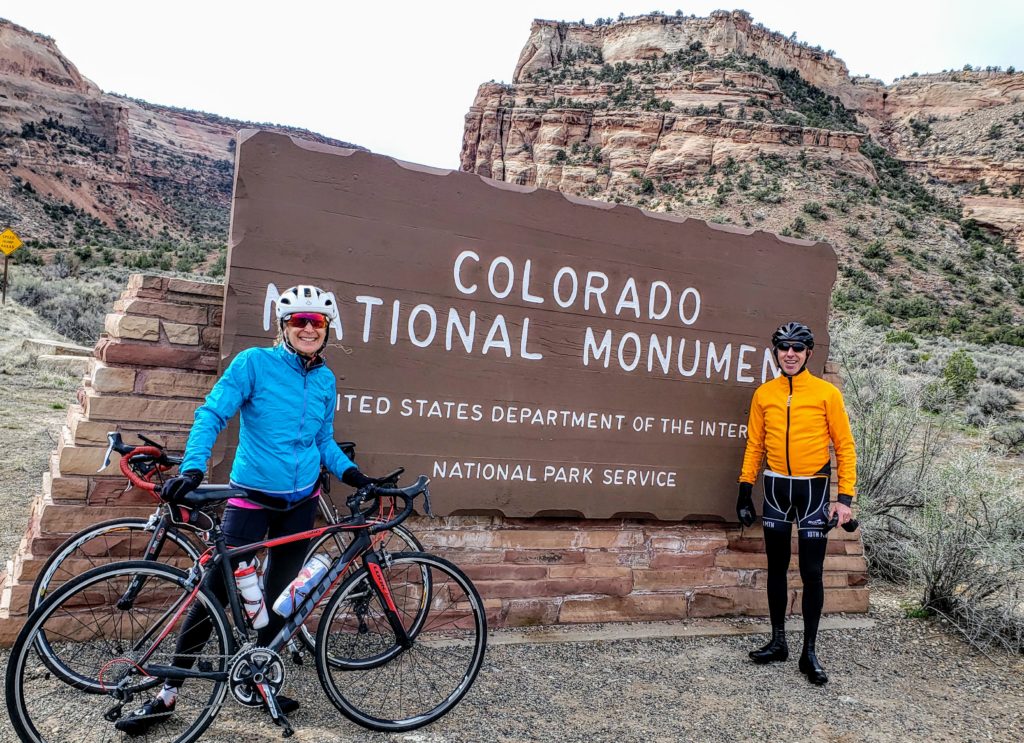
### **How did you find the PKD Foundation?**
**Glenn:** When I learned I had PKD, I did preliminary internet research (what did we all do before the internet) and learned about the Foundation from my nephrologist. The Foundation’s website is full of great information and useful resources and houses the [ADPKD Registry,](https://connect.pkdcure.org/adpkd-registry/) which allows our community to better understand the practical and real-world implications of having our disease.
### **What made you get involved with the Foundation?**
**Glenn:** In 2018, I retired from my career running large multi-national companies and wanted to uncover a new “purpose and meaning” for my life. Through a “Life Planning” process with a local life coach, I was able to clearly articulate my desire to pursue philanthropic endeavors. And I decided to get more actively involved in supporting the Foundation. I spoke to Andy Betts and Chris Rusconi who—based on my deep career in product innovation using Six Sigma methodologies—invited me to join the research grant review committee. It’s through this process that I came to understand that based on budget limitations only 10-20% of grant proposal requests made to the Foundation are funded. Additionally, it costs $160,000 to seed fund a research project to help to find a cure.
I decided to focus my energies on support for the PKD Foundation’s research program, as well as serving on the [Advocacy Champions Network](https://pkdcure.org/introducing-the-advocacy-champions-network/) to advance our advocacy initiatives, like the Living Donor Protection Act, and additional research support from the NIH, NIDDK, and DOD. I realized through my time on the grant committee that the Foundation needed additional funds to support its research program and to help research institutions find a cure or medical options to support our community of hundreds of thousands of Americans who have PKD.
### 
### **What is RideForPKD?**
**Glenn:** My passion for cycling, my decades as a business leader, my experience investing in and supporting start-up businesses, and my determination to #endPKD, led to the creation of the [RideForPKD](http://www.rideforpkd.org) with the objective of being an epic and significant fundraising event.
RideForPKD is a four-month, 5,300-mile bike journey across America this summer with the purpose of raising funds to support the PKD Foundation’s research grant program. There are three key objectives for the Ride. Firstly, to raise at least $500,000 for the Foundation’s research program. Secondly, to raise awareness of PKD. Thirdly, to build community. In addition to cycling an average of nearly 60 miles every day for 100 days, I’ll also be visiting a dozen PKD-specific research universities and video-blogging highlights on the exciting and potentially ground-breaking work they’re doing. Additionally, I’ll be connecting with dozens of local PKD communities along the route to meet fellow PKD patients, talk about highlights of the Ride, and provide insights that I have acquired during my time on the road.
I am very impressed with and thankful for everyone at the PKD Foundation. I want to give a special shout-out and thanks to Andy Betts, Carmen Gleason, Sue Full, Danielle Rose, and Krystn Kuckelman for their ongoing support.
 *Learn more about the RideForPKD and how you can get a jersey like Glenn’s at www.rideforpkd.org.*
### **Can you tell us about the kick-off of the RideforPKD?**
**Glenn:** I will be [starting my ride on Sunday, May 1](https://www.rideforpkd.org/ride) from the Golden Gate Bridge in San Francisco and finishing 18 weeks later on September 2 in Cape Cod, Massachusetts. On April 16, two weeks prior to the start, we’re having a [kickoff concert event in my hometown of Vail, Colorado.](https://support.pkdcure.org/event/ride-for-pkd-kickoff-concert-4-16-2022/e392216) It’ll bring together family, friends, sponsors, donors, and anyone who wants to join as a celebration and fund-raising event. We will have music by The Cheeks (who will also be performing at the Electric Forest Music Festival in Michigan, and incidentally two of the band members are my sons!), food and drinks, and some great [silent auction items](https://www.32auctions.com/RideForPKD), including vacation home rentals, sports tickets and memorabilia, rounds of golf, restaurant gift cards, artwork, jewelry, ski and bike equipment, and much more. The auction will be live and online so people from around the country can also join.
Tickets to the event and information on all the auction items are available on our [website](https://support.pkdcure.org/event/ride-for-pkd-kickoff-concert-4-16-2022/e392216).
### **Can others get involved with RideForPKD?**
**Glenn:** There are two primary ways that people can get involved to support the Ride. First, please sign up to ride with us. Whether you want to ride 20 miles or 500 miles, review the interactive [RideForPKD route maps](http://www.rideforpkd.org/ride) on our website and fill out the contact form to let us know what segment or segments (as indicated by the starting and finishing towns) you’re interested in tagging along for. The Ride is open to all cyclists and, while the Ride is mostly self-supported, we will be providing turn-by-turn directions, will carry your gear, and will provide details of all food stops, hotels, campgrounds, and bike shops along the entire route.
Beyond inviting cyclists to ride along with us, we also need volunteers to help us while we’re on the road. This includes driving for the RV (only a non-commercial driver’s license is required), driving the support vehicle, coordinating visits with local Foundation communities, hosting local fundraising events, arranging for local press coverage, and more. For more details and ways to register, visit our [volunteer website](https://www.rideforpkd.org/volunteer).
### **What are you most excited about with RideForPKD?**
**Glenn:** I can’t wait to get on my bike on May 1 and start pedaling, not only to continue to raise much-needed research funding but also to raise awareness for PKD and build our community. Meeting researchers and PKD patients in the field will likely be some of the most rewarding parts of my journey.
I am humbled by the fact that to date we have already raised over $350,000 from nearly 400 individual donors. And I’m confident that we’ll reach our goal of raising at least $500,000 for the PKD Foundation. I want to acknowledge and thank our 35 current sponsors including: [RBC Wealth Management](https://www.rbcwealthmanagement.com/en-us/), [pkDO](https://www.pkdo.org/), [28Freight](http://www.28freight.com), [Bank of Colorado](http://www.bankofcolorado.com), [Milkbox Partners](http://www.milkboxpartners.com), [Palladio Biosciences](http://www.palladiobio.com), [Goally](http://www.getgoally.com), [VAREco](http://www.thevareco.com), [Bridge of Life](https://www.bridgeoflifeinternational.org/), [City National Bank](http://www.cnb.com), [Domino’s Pizza](http://www.dominos.com), [Grossman Wellness](http://www.grossmanwellness.com), [quip](http://www.getquip.com), [Fruition Partners](http://www.fruitionpe.com), [Regulus Therapeutics](http://www.regulusrx.com), [Murray & Stafford](https://murrayandstafford.com/), [Riemer Communications](https://riemercommunications.com/), [TLD Group](https://www.tldgroupinc.com/), and dozens of others. From what was just an aspirational idea less than a year ago, it’s great to see so many individual and corporate donors getting behind this cause.
### **How else can the PKD community support the Ride and its goals?**
**Glenn:** There are a few different ways.
1. Improve your understanding of polycystic kidney disease with the resources on [pkdcure.org.](http://pkdcure.org)
2. Get involved in clinical trials. Only we (PKD patients) can help researchers study PKD.
3. Sign up for the [ADPKD Registry.](https://connect.pkdcure.org/adpkd-registry/) Your personal experience with PKD can help researchers better understand how to cure it.
4. Advocate with your local congresspeople for more funding for PKD research.
5. Follow the RideForPKD on all social media sites using #RideForPKD or @RideForPKD.
6. Share the RideForPKD website with your friends and ask them to support us.
7. Volunteer, ride, sponsor, or donate to the PKD Foundation on behalf of RideForPKD.
### **Anything else you’d like to add?**
I want to thank my wife Beth, who has been my rock throughout my entire PKD journey. I know she’ll be by my side every day of the RideForPKD. She will be driving an RV from campsite to campsite and managing the complex logistics of the Ride every step of the way. I couldn’t do this without her love and support. And a big thank you to our volunteer staff who are helping me with all the logistics, marketing, fundraising, event coordination, and everything else I will need over the next 120+ days on the road. The RideForPKD has been a herculean undertaking and the team’s support is critical to its success. **Thank you to all the donors—both large and small, and some of whom I don’t personally know—who’ve stepped up and dug deep into their pockets to support this 60-year-old cyclist with PKD for an extremely worthy cause.**
#### Follow Glenn’s journey across the country on [Instagram](https://www.instagram.com/rideforpkd2022/) or his [website](https://www.rideforpkd.org/).
**Resource Categories:** Communities, Donate, Fundraise Your Way
**Global Categories:** Communities, Donate, Fundraise Your Way
---
### [PKDCON Continued: Your Questions Answered](https://pkdcure.org/resources/pkdcon-continued-your-questions-answered/)
**Published:** July 7, 2026
**Author:** Shayla
**Content:**
In this webinar, leading PKD experts will answer attendee-submitted questions from topics reviewed at PKDCON, along with new questions that have emerged since the event. Questions will be collected during registration and throughout the webinar, and the discussion will be moderated by a PKD Foundation staff member.
Whether you attended PKDCON or were unable to join us, this webinar offers an opportunity to gain deeper insights, hear expert perspectives, and stay connected to the PKD community.
**Speakers:**
Terry Watnick, M.D.
University of Maryland
Ashima Gulati, M.D., Ph.D.
Children’s National Hospital Inherited and Polycystic Kidney Disease Program
Priya Deshpande, M.D.
Mount Sinai Hospital
Chris Chen, Ph.D.
PKD Foundation
Melody Chang, MS, RD, LD, CSR
**Formats:** Webinars
**Global Categories:** 2026, ADPKD, ARPKD, Caregivers, Children, Clinical Trials, Complications, Conference, Diagnosis, Diet, Drug Therapy and Treatments, Education, End Stage Kidney Disease, genetic testing, Kidney transplant, Living Post-Transplant, Living with PKD, Management, Newly Diagnosed, Nutrition, PKD, PKDCON, Polycystic Liver Disease, Pregnancy, Progression, Research, Tolvaptan, Transplantation, Webinar, Young Children
---
### [PKD Foundation Increases Research Investment by 50%, Announces 2026 Research Grant and Fellowship Recipients ](https://pkdcure.org/resources/pkd-foundation-increases-research-investment-by-50-announces-2026-research-grant-and-fellowship-recipients/)
**Published:** July 21, 2026
**Author:** Shayla
**Content:**
KANSAS CITY, Mo. (July 21, 2026) — Today, the PKD Foundation announced its 2026 research grant and fellowship recipients, marking a significant increase in its investment in research aimed at accelerating discoveries for people living with polycystic kidney disease (PKD). PKD is one of the most common genetic disorders, causing fluid-filled cysts to grow in the kidneys, impairing kidney function over time, and often leading to kidney failure.
Thanks to the generosity of its donors and supporters, the Foundation increased funding for each two-year research grant from $160,000 to $240,000, a 50% increase that reflects both the extraordinary momentum in PKD research and the urgent need to develop new treatments for the estimated 500,000 people in the United States living with the disease.
Following a thorough peer-review process led by the PKD Foundation’s Scientific Advisory Panel, with input from patients, caregivers, and leading PKD researchers, 12 research projects and one fellowship were selected for funding in 2026. The funded projects explore innovative approaches across genetics, disease mechanisms, precision medicine, therapeutic development, and patient-centered research.
“Today, we are seeing unprecedented momentum in PKD research, and we believe this is the right time to invest boldly in the scientists working to change the future of this disease,” said Susan Bushnell, President and CEO of the PKD Foundation. “Because of the generosity of our donors, we are able to increase our investment in promising research that represents hope for millions of people and families living with PKD.”
“The quality and innovation of this year’s applications were truly exceptional,” said Chris Chen, Ph.D., Vice President of Research at the PKD Foundation. “These investigators are pursuing some of the most transformative scientific questions in PKD today. By supporting strong ideas and emerging researchers, the PKD Foundation is building the pipeline of discoveries that will lead to better therapies and, ultimately, a cure.”
The Foundation’s research program supports investigators at every stage of their careers and funds projects that have the potential to improve understanding of PKD, identify new therapeutic targets, and translate scientific discoveries into meaningful advances for patients.
To learn more about the 2026 funded research projects and fellowship recipient, including plain-language summaries of each study, visit [pkdcure.org/funded-research](https://pkdcure.org/research/grants/funded-research/ "https://pkdcure.org/research/grants/funded-research/").
***About the PKD Foundation***
*Since 1982, the PKD Foundation has been dedicated to improving the lives of people impacted by polycystic kidney disease (PKD). The Foundation drives research to find treatments and a cure while providing education, advocacy, and direct support to communities nationwide. It is the largest private funder of PKD research in the U.S. PKD is a chronic, genetic disorder marked by the uncontrolled growth of cysts in the kidneys and other organs, often leading to kidney failure. An estimated 500,000 people in the U.S. have PKD. There is currently no cure and only one approved treatment to slow disease progression. The PKD Foundation is the only U.S. organization solely focused on PKD. Learn more at* [*pkdcure.org*](https://pkdcure.org/ "https://pkdcure.org/")*.*
**Formats:** Press Release
**Resource Categories:** Grants and Funding
**Global Categories:** Press Release
---
### [ADPKD 101: Foundations for Understanding Autosomal Dominant Polycystic Kidney Disease (ADPKD)](https://pkdcure.org/resources/adpkd-101-foundations-for-understanding-autosomal-dominant-polycystic-kidney-disease-adpkd/)
**Published:** July 9, 2026
**Author:** Sarah Lundak
**Content:**
This session provides an overview of autosomal dominant polycystic kidney disease (ADPKD), helping patients, caregivers, and healthcare professionals better understand the fundamentals of the disease. The session covers key aspects of ADPKD, including what causes the condition, how it affects the body, common symptoms, and important considerations for managing life with ADPKD.
**Global Categories:** 2026, ADPKD, Education, Newly Diagnosed, PKD, PKD Parents, The Basics of PKD, Webinar
---
### [ARPKD 101: Foundations for Understanding Autosomal Recessive Polycystic Kidney Disease (ARPKD)](https://pkdcure.org/resources/arpkd-101-foundations-for-understanding-autosomal-recessive-polycystic-kidney-disease-arpkd/)
**Published:** July 9, 2026
**Author:** Sarah Lundak
**Content:**
This session provides an overview of autosomal recessive polycystic kidney disease (ARPKD), helping patients, caregivers, and healthcare professionals better understand the fundamentals of the disease. The session covers key aspects of ARPKD, including what causes the condition, how it affects the body, common symptoms, and important considerations for managing life with ARPKD.
**Global Categories:** 2026, ARPKD, Education, Newly Diagnosed, PKD, PKD Parents, PKDCON, The Basics of PKD, Webinar
---
### [Mayo Clinic Polycystic Kidney Disease (PKD) Resource Center](https://pkdcure.org/resources/mayo-clinic-polycystic-kidney-disease-pkd-resource-center/)
**Published:** June 23, 2026
**Author:** Sarah Lundak
**Content:**
**The Mayo Clinic Polycystic Kidney Disease (PKD) Resource Center provides comprehensive, evidence-based education to support individuals and families affected by PKD.** This curated collection of articles and videos is designed to inform patients, caregivers, and the general public about all aspects of PKD—ranging from early diagnosis and genetic testing to lifestyle management, treatment options, and advanced care planning. Developed by Mayo Clinic experts, this resource aims to empower individuals with accurate, up-to-date information to support shared decision-making and improve long-term outcomes. [Learn more here.](https://mcpress.mayoclinic.org/polycystic-kidney-disease/)
---
### [Introducing PKD Foundation Centers of Excellence](https://pkdcure.org/resources/introducing-pkd-foundation-centers-of-excellence/)
**Published:** November 22, 2022
**Author:** fiftyandfifty
**Content:**
**Published on November 22, 2022** \| At the PKD Foundation, we’re constantly evaluating how we can better help patients and families get the [PKD care](https://connect.pkdcure.org/) they need. In recent years, more and more data is highlighting inconsistencies in quality of care. It’s time to tackle that head-on. In order to provide the care ADPKD patients deserve, we’re excited to announce the PKD Centers of Excellence (COE) program.
[](https://pkdcure.org/wp-content/uploads/PKDF-Centers-of-Excellence-horizontal-logo-RGB-full-color-1.svg)
### What is the PKD Foundation Centers of Excellence program?
The PKD Foundation Centers of Excellence program will provide a knowledgeable team approach to ADPKD disease care and research in the United States. The PKD Foundation will offer designations to institutions and clinics to serve as a resource for the ADPKD community.
Foremost, the program will help identify clinics where patients can expect to find a care team familiar with managing ADPKD. Providers are categorized as a Center of Excellence or a Partner Clinic based on the level of services they offer. Centers of Excellence provide comprehensive, multidisciplinary clinical services for families affected by ADPKD. Services are coordinated through the center to define an individual’s clinical care needs. Next, plans are made to fulfill those needs, and follow-up is provided to continually optimize clinical management. Patient navigator(s) provide the first point of contact and coordinate your care.
Centers of Excellence provide the broadest range of services and expertise. At minimum, Partner Clinics will include a nephrologist interested in specialized management of ADPKD. We’ll connect Partner Clinics with COE clinicians through mentoring and partnership networks. Importantly, this helps give patients the best care possible if there isn’t a COE nearby.
### What can we look forward to with the PKD Foundation Centers of Excellence?
We created the PKD Centers of Excellence program with the belief that the best way to provide ADPKD-centered care is through patient-focused, comprehensive care with the coordination and support of an integrated care team. The program’s mission stands on three pillars**.** First, **understanding PKD through research**. Second, **ensuring better care for all individuals with ADPKD**. And third, **educating and empowering the community**.
### How did we create the PKD Foundation Centers of Excellence?
As we built this program, we considered every party involved in PKD care. Patients, clinicians, and care facilities. When it came to actually building this program, there were several steps.
- Firstly, we interviewed other disease-centered organizations to ask them about best practices and barriers in designing and managing care center programs.
- Secondly, we met with clinicians treating patients with ADPKD around the country to hear about the barriers they face in the clinic.
- Thirdly, we sat down with our most important stakeholders: patients. Through focus groups, we presented them with our idea for the program, asking: Could this be effective in ensuring quality and patient-centric ADPKD care? Are we missing any challenges that you think are important? What does excellent ADPKD care in the clinic look like to you and your families?
- Finally, we brought clinicians back together at our COE Inception Conference in March. This allowed us to finalize various elements of the program. By including these voices in our program design, we hope to create something that will benefit our communities: both patient and clinician!
### How will the COE program benefit the PKD community?
This program will encourage the creation of peer-to-peer networks and participation in patient education and awareness activities.Through the form of grants, the Foundation will also offer financial support to a small number of centers. Additionally, it’ll support an annual conference, bringing together experts in the field to talk about best practices in ADPKD.
As the program grows, we’ll continue working to fill the gaps in our map so that everyone with PKD has close access to the care they need.
### Will the Centers of Excellence program support PKD research?
In order to ensure centers provide the best possible care, we’ll need to collect more data on the disease journey. And the [ADPKD Registry](https://connect.pkdcure.org/adpkd-registry/) will be a great partner in that effort. In the future, we plan to ask participants to donate details from their electronic health records. This resource will help us better understand what ADPKD care standards should look like in the United States. Moreover, through our network of clinicians, we’ll make sure discoveries made through research are translated to the clinic as fast as possible. The more physicians know about the disease, the better they can treat it.
There’s a lot to be excited about with this new initiative. Through this program, we’ll strive to spread awareness of ADPKD, increase availability and access to knowledgeable care, and improve understanding through clinical research. By working to create more comprehensive care for patients, we’ll create better patient outcomes.
#### Find out more about the PKD Foundation Centers of Excellence program, including the locations of our Centers of Excellence and Partner Clinics, [**here**](https://pkdcure.org/carecenters/).
**Formats:** Blog Post
**Resource Categories:** ADPKD, Centers of Excellence, Education, Family Life, PKD News, PKD Parents, Research
**Global Categories:** ADPKD, Centers of Excellence, Education, Healthcare Team, Nephrologist, PKD News, PKD Parents, Research
---
### [Why the Rare Pediatric Disease Priority Review Voucher Matters for the PKD Community](https://pkdcure.org/resources/why-the-rare-pediatric-disease-priority-review-voucher-matters-for-pkd/)
**Published:** December 15, 2025
**Author:** Sydney Johnston
**Content:**
Innovating new treatments for rare diseases is never simple. And when the patients are children, the challenges can be even more complex. The **[Rare Pediatric Disease Priority Review Voucher (RPD-PRV) program](https://www.fda.gov/industry/medical-products-rare-diseases-and-conditions/rare-pediatric-disease-designation-and-priority-review-voucher-programs)** is one of the key tools designed to help address these challenges. It encourages researchers and companies to focus on conditions that urgently need better options, including polycystic kidney disease (PKD).
Unfortunately, the program expired at the end of 2024. This removed a critical incentive for developing treatments for children with rare diseases. Thankfully, the House of Representatives recently passed the *[Give Kids a Chance Act ](https://www.congress.gov/bill/119th-congress/house-bill/1262)*[(H.R. 1262)](https://www.congress.gov/bill/119th-congress/house-bill/1262)*,* which would reauthorize the RPD-PRV program for at least five more years.
**What is the Rare Pediatric Disease Priority Review Voucher (RPD-PRV)?**
Administered by the U.S. Food and Drug Administration (FDA), the RPD-PRV program awards a “voucher” to drug developers when they receive FDA approval for a treatment targeting a rare pediatric disease. Developers then have two options for using the voucher. They can receive a priority (faster) review for another therapy, often for one serving a broader patient population. Alternatively, they can sell it to another company.
This creates a powerful incentive to invest in treatments for rare childhood illnesses, including autosomal recessive PKD (ARPKD). Currently, many of these diseases have no available therapies.
The [National Organization for Rare Disorders (NORD)](https://rarediseases.org/), of which the PKD Foundation is a proud member, [recently released a new report highlighting the program’s success](https://rarediseases.org/rare-pediatric-disease-prv-program/). Over just 13 years, the RPD-PRV program helped spur the development of more than 60 rare pediatric disease treatments, a remarkable impact for a program aimed at some of the rarest conditions.
**5 Reasons the RPD-PRV Matters for PKD**
1\. Current Treatment Options Focus on Adults
Today, the only FDA-approved treatment for slowing kidney function decline in ADPKD is tolvaptan, which is approved only for adults 18 and older.
2\. There are No Approved Therapies for Children with PKD
As of now, children and teens with PKD have no disease-modifying treatments available. This includes both early-onset ADPKD and the rarer ARPKD.
3\. ARPKD Presents Unique Challenges
ARPKD, which almost always affects children, can lead to serious kidney and liver complications early in life. Families must navigate complex care with limited treatment options beyond supportive management.
4\. Improves a Historical Lack of Investment in Rare Diseases
Historically, research and development for rare childhood kidney diseases haven’t attracted major investment. The voucher program helps solve this by creating a meaningful financial incentive.
5\. The Potential Payoff is Real
This program could help accelerate pediatric clinical trials and expand treatment research for younger patients. Importantly, it could bring forward new options for families facing ARPKD or early-onset ADPKD.
**How Can We Help the RPD-PRV Right Now?**
Progress in rare disease research rarely happens overnight. Through programs like the RPD-PRV, we can help speed up the path toward therapies that children with PKD urgently need. The Senate now has the opportunity to pass its version of the [*Give Kids a Chance Act (*](https://www.congress.gov/bill/119th-congress/senate-bill/932)S. 932), ensuring continued innovation by extending the RPD-PRV program.
You can join the rare disease community by taking action today. [Tell your Senators to support the bill’s passage **by sending a pre-drafted email today**.](https://rarediseases.org/driving-policy/take-action/#/260) It only takes a few minutes of your time. The more attention and support this issue receives, the closer we move toward a future where children with PKD have real treatment options—and real hope.
**Interested in using your voice to advocate for the PKD community?** By signing up for [**Advocacy Alerts**](https://p2a.co/rpqRAYS), you’ll receive emails about urgent opportunities to take action in support of PKD patients.
**Formats:** Blog Post
**Resource Categories:** Advocacy, PKD Parents
**Global Categories:** Blog
---
### [PKD Foundation Applauds Ground-Breaking Introduction of the PKD Cures Act in Congress](https://pkdcure.org/resources/pkd-foundation-applauds-ground-breaking-introduction-of-the-pkd-cures-act-in-congress/)
**Published:** June 5, 2026
**Author:** Sarah Lundak
**Content:**
*First-ever PKD-specific federal legislation aims to advance the path toward new treatments and a cure for more than 500,000 Americans*
**Kansas City, MO (6/5/2026)** — The PKD Foundation applauds the introduction of the PKD Cures Act, the first bill ever introduced in Congress specifically focused on polycystic kidney disease (PKD). This landmark bipartisan legislation would strengthen and expand federal research efforts focused on PKD, one of the most common life-threatening genetic diseases in the United States.
Introduced by Representatives Debbie Wasserman Schultz (D-FL), Carol Miller (R-WV), Emanuel Cleaver (D-MO), and Don Bacon (R-NE) on Thursday, June 4, the legislation directs the National Institutes of Health (NIH) to expand and intensify PKD research across basic, translational, and clinical science. The bill also establishes a dedicated working group tasked with developing a comprehensive roadmap for the future of PKD research and innovation.
PKD affects more than 500,000 Americans and millions of people more worldwide. The disease causes fluid-filled cysts to grow in the kidneys, often leading to enlarged kidneys, chronic pain, high blood pressure, and kidney failure. PKD can also affect other organs throughout the body.
**“The introduction of the PKD Cures Act is a landmark moment for the PKD community,” said Susan Bushnell, President and CEO of the PKD Foundation. “Polycystic kidney disease is one of the most common life-threatening genetic diseases and can impact multiple generations within a single family. Yet until now, Congress has never introduced PKD-specific legislation.”**
Bushnell emphasized that the legislation represents a critical step toward accelerating scientific progress, which is why the PKD Foundation played a key role in developing and advancing the bill alongside congressional champions, researchers, clinicians, patients, and advocates.
Among those advocates is Mike Haggard, a person living with PKD and a member of the PKD Foundation’s Board of Directors, who emphasized what this milestone means for those affected by the disease: “I see every day how far-reaching this disease is, not just for patients, but for families, caregivers, and future generations who are forced to plan their lives around uncertainty. Too often, PKD is a silent burden carried, and it deserves far greater attention and urgency. This legislation brings renewed focus and momentum toward the research and breakthroughs that so many have been waiting for.”
The PKD Foundation encourages members of the PKD community and supporters nationwide to learn more about the legislation and join advocacy efforts to ensure the bill is enacted.
***About the PKD Foundation***
*Since 1982, the PKD Foundation has been dedicated to improving the lives of people impacted by polycystic kidney disease (PKD). The Foundation drives research to find treatments and a cure while providing education, advocacy, and direct support to communities nationwide. It is the largest private funder of PKD research in the U.S.*
*PKD is a chronic, genetic disorder marked by the uncontrolled growth of cysts in the kidneys and other organs, often leading to kidney failure. An estimated 500,000 people in the U.S. have PKD. There is currently no cure and only one approved treatment to slow disease progression.*
*The PKD Foundation is the only U.S. organization solely focused on PKD.*
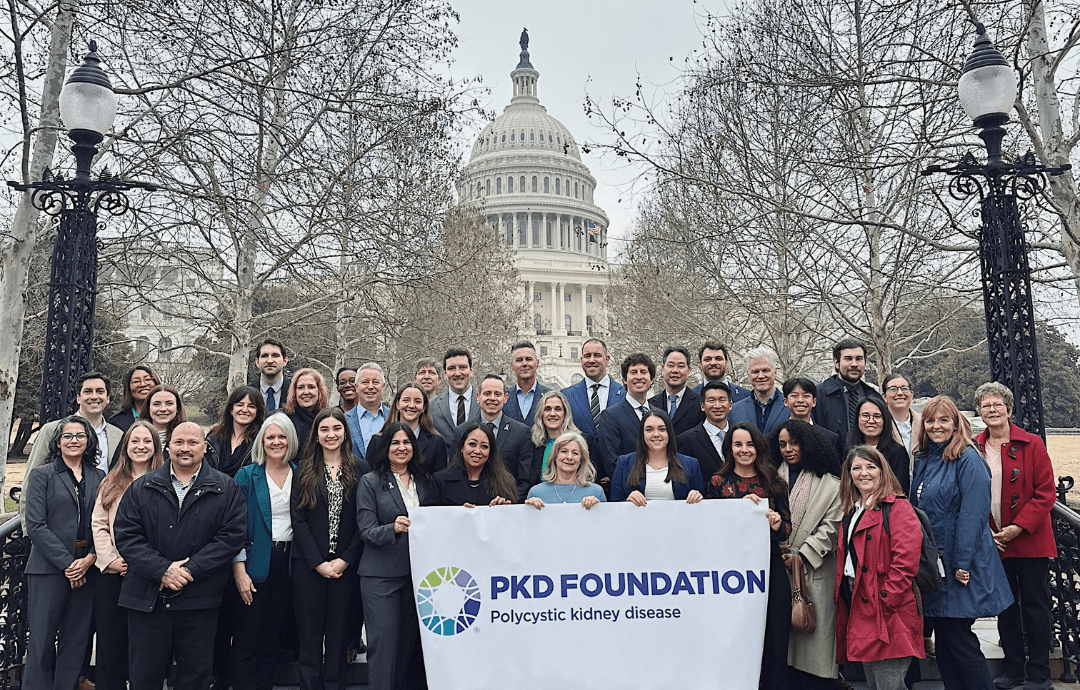
**Formats:** Press Release
**Global Categories:** Press Release
---
### [Mental Health& PKD: Expert Answers to Community Questions with Cristen Wathen, Ph.D., LCPC, NCC.](https://pkdcure.org/resources/mental-health-pkd-expert-answers-to-community-questions-with-cristen-wathen-ph-d-lcpc-ncc/)
**Published:** May 22, 2026
**Author:** Sarah Lundak
**Content:**
We sat down with Cristen Wathen, Ph.D., LCPC, NCC., to voice real questions from the community about mental health and life with PKD.
Dr. Wathen is a counselor educator, tenured associate professor at Palo Alto University, whose work is deeply shaped by her lived experience with chronic illness. As both a kidney and liver transplant recipient, she offers a unique perspective on the realities of navigating PKD.
In this conversation, she explores managing anxiety and uncertainty, shares guidance on seeking mental health support, and communicating needs with others.
**Global Categories:** Mental Health
---
### [Mental Health Resources for the PKD Community](https://pkdcure.org/resources/mental-health-resources-for-the-pkd-community/)
**Published:** April 30, 2026
**Author:** Sarah Lundak
**Content:**
Managing a chronic disease like PKD can be stressful and overwhelming at times—but whether you’re living with PKD, caring for someone who is, or supporting a loved one, you’re not alone.
Here are a few resources and simple ways to support your mental health and emotional well-being.
- Call our HOPE Line: If you need immediate support, dial 844.PKD.HOPE (844.753.4673) to speak with someone directly.
- Take Care of yourself: Prioritize rest, hydration, and stress management. Learn more on our blog: **<https://pkdcure.org/resources/managing-mental-health-and-pkd/>**
- Get outside: Fresh air and a change of scenery can help reset your mind and boost your mood.
- Exercise: Some studies have shown exercise to be a good tool at relieving depression. Try incorporating gentle movement and mindfulness into your routine with these PKD-Friendly Yoga sessions.
**[https://www.youtube.com/watch?v=6wYajRvXJ64&list=PLxPzS1tLjqb7PllYQdHuxZ\_ry2410wW-\_&index=14](https://www.youtube.com/watch?v=6wYajRvXJ64&list=PLxPzS1tLjqb7PllYQdHuxZ_ry2410wW-_&index=14)**
- Connect with the PKD community: Whether you meet with a Peer Mentor or attend a local community meeting, connecting with others who understand life with PKD can help you feel supported. **<https://pkdcure.org/get-connected/>**
- For ADPKD support: Find more tips on managing mental health, quality of life, relationships, and day-to-day well-being in Chapter 7 of the “Understanding the KDIGO 2025 ADPKD Clinical Guideline,” a plain language summary designed to help you better understand and navigate your care. **<https://pkdfoundation.jotform.com/260346147389161>**
- For ARPKD Support: Our “ARPKD Patient Handbook” offers guidance and support on topics like caring for your family and yourself, supporting your child’s emotional health while living with ARPKD, and what families should know after the loss of a baby to ARPKD. **<https://pkdcure.org/for-patients/patient-handbooks/>**
**Global Categories:** Mental Health
---
### [PKD Advocacy in Action: What it Means and How to Get Involved](https://pkdcure.org/resources/pkd-advocacy-in-action-what-it-means-and-how-to-get-involved/)
**Published:** April 9, 2026
**Author:** Shayla
**Content:**
This session will provide an overview of the PKD Foundation’s current legislative priorities, the state of PKD research funding, and highlights from Advocacy Day on Capitol Hill. Helping lead this discussion is the Foundation’s advocacy partner, CURA Strategies, a leading bipartisan strategic communications and public affairs agency. Whether you’re new to advocacy or looking for ways to deepen your involvement, this webinar will offer practical insights and next steps for making an impact in the PKD community today and for generations to come.
**You’ll Learn About:**
- What PKD advocacy is and why patient and family voices are essential to advancing policy, research, and awareness
- Gain insight into the role CURA Strategies plays in helping us shape federal policy initiatives for PKD
- Ways patients and families can get involved in advocacy, regardless of prior experience or comfort level
- Current PKD legislative priorities and research funding, including key takeaways from Advocacy Day on Capitol Hill
**Speakers:**
- Scott Leezer, Senior Vice President, Government Relations & Partner, CURA Strategies
- Patrick Meade, Senior Manager, Government Relations, CURA Strategies
- Advocacy Champion: Cari Maxwell
**Formats:** Webinars
**Resource Categories:** Advocacy
**Global Categories:** 2026, Webinar
---
### [Shared Decision-Making in ADPKD / Collaborating with your Provider](https://pkdcure.org/resources/shared-decision-making-in-adpkd-collaborating-with-your-provider/)
**Published:** July 21, 2023
**Author:** Sarah Lundak
**Content:**
Join us for our new webinar series—Mini Webinars! The best part? Each video is under 20 minutes.
In this series, you’ll learn all about ADPKD and shared decision-making. That includes the various treatment options available for ADPKD and how they can positively impact health. You’ll also learn strategies for expressing your thoughts and preferences by actively participating in discussions with healthcare providers.
About Dr. Judith Maddatu
Dr. Judith Maddatu is a board-certified nephrologist. Her clinical specialties include chronic kidney disease, hemodialysis, hypertension, and polycystic kidney disease. She received her medical degree from Indiana University School of Medicine. She completed her internal medicine residency at the Medical College of Wisconsin in Milwaukee and a nephrology fellowship at Indiana University School of Medicine. Dr. Maddatu is board certified in internal medicine and nephrology.
**Global Categories:** 2024, ADPKD, Healthcare, Healthcare Team, Living with PKD, PKD, Treatment, Webinar
---
### [Shared Decision-Making in ADPKD / Available Treatment Options](https://pkdcure.org/resources/shared-decision-making-in-adpkd-available-treatment-options/)
**Published:** July 21, 2023
**Author:** Sarah Lundak
**Content:**
Join us for our new webinar series—Mini Webinars! The best part? Each video is under 20 minutes.
In this series, you’ll learn all about ADPKD and shared decision-making. That includes the various treatment options available for ADPKD and how they can positively impact health. You’ll also learn strategies for expressing your thoughts and preferences by actively participating in discussions with healthcare providers.
About Dr. Judith Maddatu
Dr. Judith Maddatu is a board-certified nephrologist. Her clinical specialties include chronic kidney disease, hemodialysis, hypertension, and polycystic kidney disease. She received her medical degree from Indiana University School of Medicine. She completed her internal medicine residency at the Medical College of Wisconsin in Milwaukee and a nephrology fellowship at Indiana University School of Medicine. Dr. Maddatu is board certified in internal medicine and nephrology.
**Global Categories:** 2024, ADPKD, Living with PKD, PKD, Treatment, Webinar
---
### [Shared Decision-Making in ADPKD / Principals of Shared Decision Making](https://pkdcure.org/resources/shared-decision-making-in-adpkd-principals-of-shared-decision-making/)
**Published:** July 21, 2023
**Author:** Sarah Lundak
**Content:**
Join us for our new webinar series—Mini Webinars! The best part? Each video is under 20 minutes.
In this series, you’ll learn all about ADPKD and shared decision-making. That includes the various treatment options available for ADPKD and how they can positively impact health. You’ll also learn strategies for expressing your thoughts and preferences by actively participating in discussions with healthcare providers.
About Dr. Judith Maddatu
Dr. Judith Maddatu is a board-certified nephrologist. Her clinical specialties include chronic kidney disease, hemodialysis, hypertension, and polycystic kidney disease. She received her medical degree from Indiana University School of Medicine. She completed her internal medicine residency at the Medical College of Wisconsin in Milwaukee and a nephrology fellowship at Indiana University School of Medicine. Dr. Maddatu is board certified in internal medicine and nephrology.
**Global Categories:** 2024, ADPKD, Healthcare, Living with PKD, PKD, Treatment, Webinar
---
### [ADPKD Diet | What is Known and What is Safe](https://pkdcure.org/resources/adpkd-diet-what-is-known-and-what-is-safe/)
**Published:** January 17, 2024
**Author:** Sarah Lundak
**Content:**
Fouad Chebib MD, Neera Dahl MD, Ph.D., Kristen Nowak Ph.D., MPH, and Michal Mrug, MD explain the findings of the review of research in “Polycystic Kidney Disease Diet: What Is Known and What Is Safe”, published in the Clinical Journal of the American Society of Nephrology. Maintaining a healthy lifestyle is important to everyone living with PKD. Nutritional requirements can vary from person to person and change depending on kidney function. The PKD Foundation does not give medical advice and strongly recommends that you discuss your specific dietary needs with your healthcare team.
Learning Objectives
1.) Evaluate the available evidence regarding the benefits, safety, potential risks, and special considerations associated with caloric restriction in Autosomal Dominant Polycystic Kidney Disease (ADPKD);
2.) Examine the current knowledge gaps and uncertainties surrounding the efficacy of intermittent fasting and time-restricted eating in humans with ADPKD;
3.) Analyze the limited efficacy and safety data available for nutritional supplementation in ADPKD, considering the challenge.
**Global Categories:** 2024, ADPKD, Diet, Nutrition, PKD, Webinar
---
### [Scientific Conference: Patient Perspective Webinar](https://pkdcure.org/resources/scientific-conference-patient-perspective-webinar/)
**Published:** January 30, 2025
**Author:** Sarah Lundak
**Content:**
Join us for a unique opportunity to hear from Ron Perrone, M.D., and Anne Walsh, ADPKD patient and PKD Foundation volunteer, about the value of including the patient voice in research. Anne will share her experience navigating the 2024 American Society of Nephrology (ASN) Conference, including interacting with PKD researchers and bringing the patient perspective to scientific discovery and clinical advancements-focused events. Dr. Perrone will highlight the significance and critical role events like the ASN Conference play in advancing patient-centered care for PKD patients. Highlights from the conference’s poster session and notable studies will also be discussed. Join us to learn more about the patient perspective and the unique experience of engaging in scientific forums to build stronger connections between the PKD community and researchers.
**Resource Categories:** ADPKD
**Global Categories:** 2025, ADPKD, Living with PKD, Research, Webinar
---
### [PKDCON 2023: Care Partners: How to Take Care of Yourself](https://pkdcure.org/resources/pkdcon-2023-care-partners-how-to-take-care-of-yourself/)
**Published:** June 23, 2023
**Author:** Sarah Lundak
**Content:**
**Presenter:** Linda Herman, Meg Munits
**Description:** Linda Herman and Meg Munits, both caregivers to family members with ADPKD and long-time volunteers supporting others on their journey, share their personal experiences as caregivers. They offer practical tips on preventing burnout, managing stress in your marriage, and caring for other children in the family who don’t have PKD—all while emphasizing the importance of taking care of yourself.
**Formats:** Webinars
**Global Categories:** 2023, Caregivers, PKD, PKDCON, Wellness
---
### [PKDCON 2023: Trem2+Cyst Associated Macrophages in PKD](https://pkdcure.org/resources/pkdcon-2023-trem2cyst-associated-macrophages-in-pkd/)
**Published:** June 23, 2023
**Author:** Sarah Lundak
**Content:**
**Presenter:** Sarah Miller, postdoctoral research associate
**COE:** University of Oklahoma
**Formats:** Webinars
**Global Categories:** 2023, ADPKD, PKD, PKDCON, Research
---
### [Donate Life Month Spotlight: Matt Freund’s Transplant Journey with the NKR Voucher Program](https://pkdcure.org/resources/donate-life-month-spotlight-matt-freunds-transplant-journey-with-the-nkr-voucher-program/)
**Published:** April 16, 2026
**Author:** Sarah Lundak
**Content:**
When kidney failure happens, dialysis or transplant become the only option. For many people with PKD, getting a transplant isn’t as simple as finding a willing donor.
Matt Freund knows this firsthand.
Diagnosed with PKD at age 15, Matt managed the disease for 37 years with the support of his family and the PKD Foundation community in Phoenix.
“My mother was a tireless advocate, participating in Walks and Christmas wrapping fundraisers.”
When Matt’s kidney function began to decline at age 51, he had something many patients don’t: five potential living donors ready to help.
But even with that support, the process moved slowly.
“The institution I was at would only test them one at a time. That policy turned a circle of support into a two-year waiting room.”
As each donor went through months of testing, Matt’s health continued to decline. He was just days away from starting dialysis when he finally had his transplant.
“I spent two years in testing limbo, living on the edge of a medical intervention that a preemptive voucher would have eliminated.”
For many patients, transplant planning doesn’t begin until their GFR reaches 20. But for people living with PKD, that can leave very little time to navigate the process before their kidney function worsens.
This is where the National Kidney Registry (NKR) Voucher Program can make a difference.
The program allows a living donor to donate a kidney on someone’s behalf before a transplant is actually needed. In return, the intended recipient receives a voucher that helps secure access to a future living-donor kidney when the time is right through the registry.
For patients like Matt, this kind of preemptive planning can offer major advantages like:
- Helping patients avoid the physical toll of dialysis.
- Allowing donors to give while they’re still healthy and eligible.
- Creating more flexibility for both the donor and recipient.
- Potentially improving access to a highly compatible living-donor match.
Matt and his sister-in-law ultimately chose that path.
“My sister-in-law and I were initially hesitant to move away from a simultaneous paired exchange; it felt safer to go in together. But by decoupling our surgeries through the voucher program, we gained control and flexibility.”
She donated her kidney in January and recovered quickly. Her gift became Matt’s security.
“Because of the registry’s reach, I received a near-perfect match from an unrelated donor in Utah who was donating on her mother’s behalf.”
During Donate Life Month, stories like Matt’s serve as a reminder of the life-changing impact of living donation—not just for individuals, but for the entire PKD community.
More than 100,000 people in the U.S. are currently waiting for an organ transplant, and programs like the NKR Voucher Program can help reduce some of the uncertainty and delays patients face.
Matt’s message to the PKD community is simple:
“If I could go back, I would have secured my voucher years earlier. I would have bypassed the two-year wait and fear of the dialysis machine. Don’t let an institution’s one-at-a-time testing policy dictate your survival. If you have a willing donor, look into the voucher program today. Give yourself the gift of a secured future and give your donor the freedom to help you while they’re at their best.”
Learn more about the NKR Voucher Program: [kidneyregistry.com/for-donors/voucher-program/](https://www.kidneyregistry.com/for-donors/voucher-program/)
**Formats:** Blog Post
**Global Categories:** Donate, Kidney transplant, Living donor, Living Post-Transplant
---
### [PKD Chronicles: Ahead of the Curve: Timely Transplants for Better Kidney Health](https://pkdcure.org/resources/pkd-chronicles-ahead-of-the-curve-timely-transplants-for-better-kidney-health/)
**Published:** April 8, 2026
**Author:** Shayla
**Content:**
[Download Transcript](https://pkdcure.org/wp-content/uploads/2026/04/PKD-Chronicles-Transplants-Transcript.docx)
In this episode, listeners will gain insights into the benefits of preemptive kidney transplants and how they can significantly improve kidney health. Learn how taking a proactive approach to transplantation can help avoid late-stage interventions and dialysis, leading to a better quality of life. We’ll discuss the critical timing of transplant conversations and the essential role nephrologists play in managing kidney health early on. Discover the importance of timely referrals and consultations, and get practical advice on navigating the transplant journey. Tune in to understand how staying ahead of the curve can make a transformative difference in managing PKD.
**Formats:** podcast
**Resource Categories:** Podcast
**Global Categories:** Podcast
---
### [A Patient Perspective on Evolving ADPKD Care](https://pkdcure.org/resources/patient-perspective-evolving-adpkd-care/)
**Published:** April 8, 2026
**Author:** Sarah Lundak
**Content:**
Autosomal dominant polycystic kidney disease (ADPKD) is the most common heritable kidney disease, affecting 1 in 1,000 people.1 The majority of familial cases involve mutations in *PKD1* (78%) or *PKD2* (15%), and the remainder have responsible variants of a variety of genes such as *GANAB, DNAJB11,* and *IFT140*.2 For nephrologists, caring for patients with polycystic kidney disease (PKD) often means caring for an entire family.
Lee Casati is an active member of the Milwaukee, Wisconsin, PKD Foundation chapter as well as the National Kidney Foundation of Wisconsin. He was diagnosed with high blood pressure in his mid-20s but was not diagnosed with kidney disease until his 50s. He recalled, “My mom was pretty healthy when I was diagnosed at 50. She didn’t have any symptoms or treatments for her kidney disease, and it was diagnosed on autopsy after she passed away at age 75.”
[Read more on docwirenews.com.](https://www.docwirenews.com/post/a-patient-perspective-on-evolving-adpkd-care)
**Resource Categories:** PKD News
**Global Categories:** PKD News
---
### [It's Time for Congress to Get This Done](https://pkdcure.org/resources/time-for-congress-to-get-this-done/)
**Published:** March 24, 2026
**Author:** Sarah Lundak
**Content:**
**It’s Time for Congress to Get This Done**
**Susan Bushnell, President & CEO, PKD Foundation**
March is National Kidney Month, a time when the kidney community comes to Washington ready to make the case for patients, donors, and the people who love them. This year, our ask is simple: finish the job.
For over a decade, Congress has considered a straightforward and bipartisan reform that is now long overdue. This year, Congress can finally pass the Living Donor Protection Act, and for the first time, we have real reason to believe it will happen.
Last month, the Living Donor Protection Act advanced out of the Senate Health, Education, Labor and Pensions Committee, the furthest it has ever moved in the legislative process. That is no small thing. It is a signal that momentum has shifted, that long-term advocacy has been rewarded, and that the finish line is now in sight. Congress should seize this moment and sprint toward it.
The Living Donor Protection Act addresses a straightforward injustice that discourages potential donors from stepping forward. People who choose to donate a kidney or part of their liver, giving the gift of life to a stranger or a loved one, can face discrimination from insurance companies simply because they did so. One in four living donors report being charged higher premiums or denied life, disability, or long-term care insurance coverage, not because they are high-risk, but because they were generous. In fact, because of the rigorous screening required before donation, the average living donor is healthier than the average American. The LDPA would prohibit insurers from penalizing living organ donors in this way and ensure that the Family and Medical Leave Act protections donors are entitled to are clear and enforceable.
This is not a controversial idea. Thirty-five states have already established some form of living donor protection, recognizing the need for a baseline of fairness. The federal LDPA would extend that protection to every American. In the last Congress, a bipartisan majority of the House cosponsored the bill, joined by nearly half the Senate. That level of support speaks for itself. With the Senate HELP Committee having now acted, and the House building momentum to move its own version forward, both chambers are positioned to get this done together.
At a time when Americans are worried about the rising cost of health care and the fairness of our insurance system, the Living Donor Protection Act speaks directly to those concerns. It says: if you step up and save someone’s life, your own coverage should not be put at risk. That message resonates across party lines, across geography, and across every community that has been touched by organ failure and the long, desperate wait for a transplant.
The need is urgent. Seventeen people die every day waiting for an organ transplant, twelve of them waiting for a kidney. Polycystic kidney disease, a hereditary, life-threatening condition, is one of the leading causes of kidney failure. More living donors means more lives saved. Every barrier we remove matters.
Congress has spent over a decade expressing support for this reform. Now is the moment to convert that stated support into law. There is no good reason for this Congress to end without the Living Donor Protection Act on the books. The kidney and transplant communities have been patient for long enough. Living donors have waited long enough. It’s time for Congress to get this done.
*Susan Bushnell is President and Chief Executive Officer of the PKD Foundation in Kansas City, Missouri, the only organization in the United States solely dedicated to finding treatments and a cure for polycystic kidney disease.*
*This op-ed was featured in the [Kansas City Star](https://www.kansascity.com/opinion/readers-opinion/guest-commentary/article315155555.html) on March 24, 2026.*
**Global Categories:** Press Release
---
### [Early Diagnosis and Risk Stratification in ADPKD](https://pkdcure.org/resources/early-diagnosis-and-risk-stratification-in-adpkd/)
**Published:** March 17, 2026
**Author:** Shayla
**Content:**
ADPKD is common, yet many nephrologists report uncertainty around diagnosis, risk stratification, and timing of intervention. This clinician-focused webinar provides a practical, case-based review of ADPKD care with highlights from the *KDIGO 2025 Clinical Guideline*.
Through virtual grand rounds, real world cases will illustrate key decision points in diagnosis, monitoring, treatment initiation, and referral. Faculty will review use of tools such as the Mayo Imaging Classification, PROPKD score, genetic testing, and shared decision making around tolvaptan. Participants will gain confidence in identifying rapid progressors and implementing timely, evidence-based interventions.
**Presented by:**
- Fouad Chebib, M.D.: Mayo Clinic Florida PKD Center of Excellence Clinic Director
- Christopher Kwoh, M.D.: The Kidney Institute PKD Center of Excellence Clinic Director
- Aoun Bahous, M.D., Ph.D., MHPE: Professor of Medicine and Dean of the Lebanese American University School of Medicine
**Formats:** Webinars
**Resource Categories:** ADPKD
**Global Categories:** 2026, ADPKD, Webinar
---
### [PKD Chronicles: Beyond the Kidneys: Understanding PKD Side Effects](https://pkdcure.org/resources/pkd-chronicles-beyond-the-kidneys-understanding-pkd-side-effects/)
**Published:** March 10, 2026
**Author:** Shayla
**Content:**
[Download Transcript](https://pkdcure.org/wp-content/uploads/2026/03/PKD-Chronicles-Extrarenal-Transcript.docx)
In this episode, we explore PKD and the side effects and complications that can occur beyond the kidneys. Join us as we discuss common manifestations such as PKD belly and brain aneurysms, and how they impact patients’ lives.
Through expert insights and personal stories, we highlight the challenges these complications can present and share strategies for managing them.
If today’s conversation inspired you, consider making a gift to the PKD Foundation at [Donate to Kidney Month 2026 – KFY266](http://pkdcure.org/NKM2026) . Your support during National Kidney Month helps move life-changing research forward.
Thank you for your commitment to improving the lives of people with PKD and working toward a future without this disease.
**Formats:** podcast
**Resource Categories:** Podcast
**Global Categories:** Podcast
---
### [Confidently Navigating ADPKD: Understanding the New KDIGO Guideline, ADPKD in Women & Children: Special Considerations](https://pkdcure.org/resources/confidently-navigating-adpkd-understanding-the-new-kdigo-guideline-adpkd-in-women-children-special-considerations/)
**Published:** November 10, 2025
**Author:** Shayla
**Content:**
ADPKD presents unique challenges for women, pregnant individuals, and children. In our final session (Part 4 of 4), we’ll focus on pregnancy risks, hypertension, birth control considerations, and pediatric care strategies. This session will include plenty of time for questions, so you can get expert insights tailored to your concerns. Learning Objectives:
- Understand pregnancy risks, preeclampsia, and hypertension in ADPKD.
- Learn about birth control options & how hormones influence cyst growth.
- Explore screening & management strategies for pediatric ADPKD.
- Gain insights into genetic counseling & family planning for ADPKD families.
Speakers:
- Dr. Arlene Chapman, M.D., is a renowned nephrologist specializing in hereditary and rare renal diseases, including ADPKD. A leading researcher in cyst formation mechanisms and precision medicine, she has received continuous NIH funding for nearly two decades and has published extensively.
- Dr. Chapman also plays a vital role in academic leadership, mentorship, and translational medicine at the University of Chicago.
- Dr. Ashima Gulati, M.D., Ph.D., is a pediatric nephrologist specializing in inherited kidney diseases, with a focus on polycystic kidney disease. Trained at Yale School of Medicine, her research integrates human exome analysis and disease modeling in mice and zebrafish to study genetic kidney diseases and vascular complications in autosomal dominant polycystic kidney disease.
- Dr. Dallas Reed, M.D., is the Chief of Genetics and an Assistant Professor at Tufts University School of Medicine, specializing in obstetrics and gynecology as well as medical genetics. She has particular expertise in preconception and prenatal genetic counseling, genetic syndromes, and cancer risk assessment.
**Formats:** Webinars
**Resource Categories:** ADPKD
**Global Categories:** 2025, ADPKD, Webinar
---
### [PKD Chronicles: PKD Lifestyle Essentials for Wellness](https://pkdcure.org/resources/pkd-chronicles-pkd-lifestyle-essentials-for-wellness/)
**Published:** February 17, 2026
**Author:** Shayla
**Content:**
[Download Transcript](https://pkdcure.org/wp-content/uploads/2026/02/PKD-Chronicles-Lifestyle-Transcript.docx)
In this episode, we explore essential everyday lifestyle tips designed to help those living with PKD optimize their health and well-being. From staying active and hydrated to nourishing your body with balanced meals and protecting your sleep, we break down practical, evidence‑informed strategies that support long‑term health and well‑being in a way that’s both realistic and empowering.
Whether you’re newly diagnosed or have been navigating PKD for years, this episode offers guidance and encouragement on how to build a fulfilling, healthy lifestyle amidst the challenges of PKD.
**Formats:** podcast
**Resource Categories:** Podcast
**Global Categories:** Podcast
---
### [PKD Foundation Strengthens National Network as 36 U.S. Clinics Redesignated for Excellence in PKD Care](https://pkdcure.org/resources/pkd-foundation-strengthens-national-network-as-36-u-s-clinics-redesignated-for-excellence-in-pkd-care/)
**Published:** February 11, 2026
**Author:** Sarah Lundak
**Content:**
Three years after launching its inaugural cohort of Centers of Excellence (COEs) and Partner Clinics, the PKD Foundation continues to expand access to high-quality, specialized care for more than 500,000 people living with polycystic kidney disease (PKD) and their loved ones nationwide.
In alignment with the program’s three-year renewal cycle, clinics designated as COEs and Partner Clinics in 2022 were invited to apply for re-designation and underwent a comprehensive review by the Foundation COE Advisory Panel, comprised of clinicians and patient stakeholders.
F**ollowing this review, the PKD Foundation has redesignated 36 clinics, including 27 Centers of Excellence and nine Partner Clinics, reflecting sustained excellence in PKD care across the country.** In addition, one clinic advanced from Partner Clinic to Center of Excellence status.
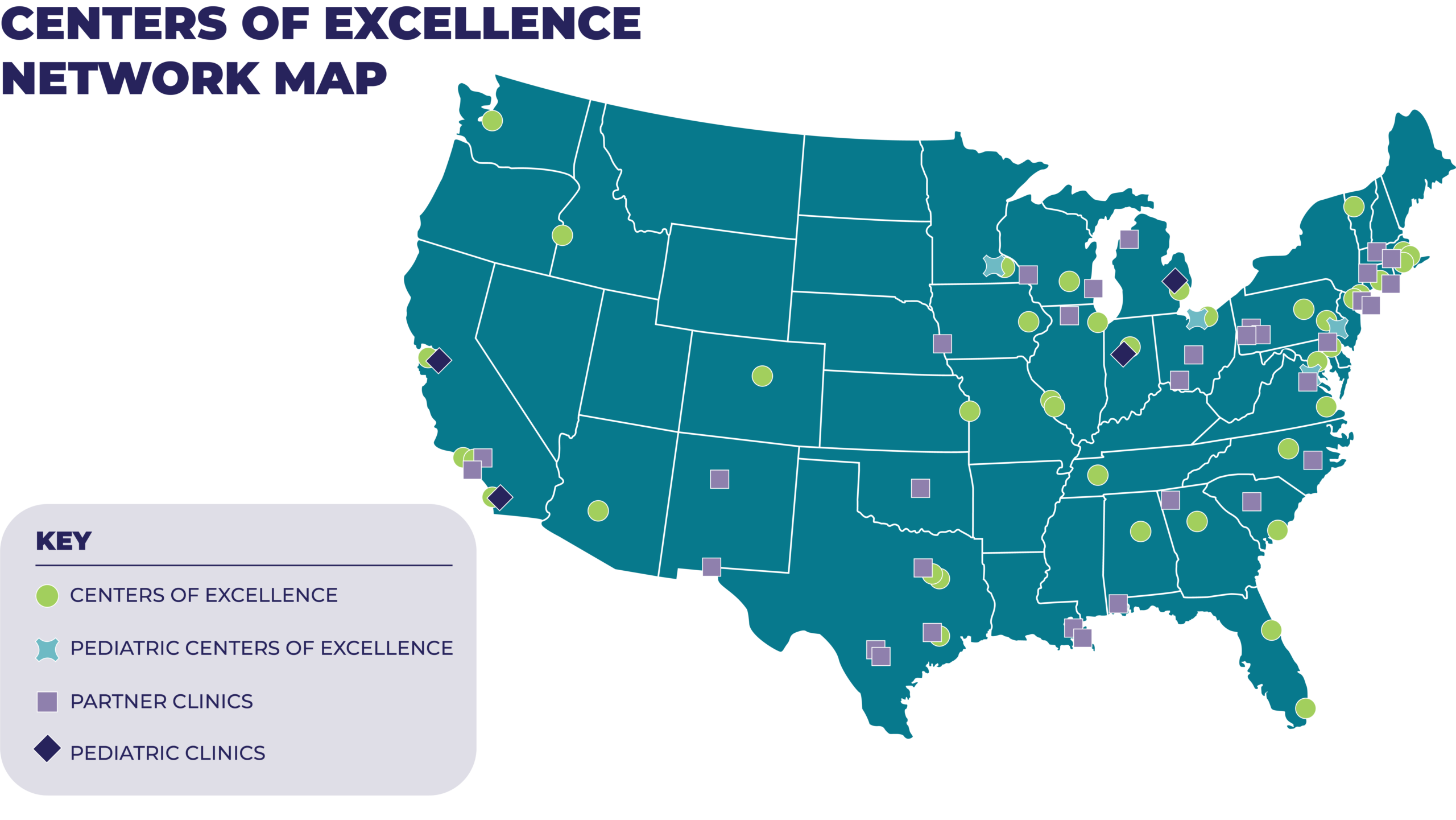
**With these designations, the PKD Foundation’s national network now includes 81 Centers of Excellence and Partner Clinics, serving both pediatric and adult patients.**
“While we continue working toward new treatments and a cure for PKD, we are also making tangible progress in the care patients receive today,” said Susan Bushnell, Chief Executive Officer of the PKD Foundation. “Our Centers of Excellence play a critical role in improving outcomes and supporting families with the expertise and resources they need to navigate PKD.”
The Foundation is also continuing its investment in clinical care by providing $470,000 in FY26 funding to support seven care teams. This investment is designed to strengthen multidisciplinary care models and further empower clinics to meet the complex needs of the PKD community.
For more information on the PKD Foundation’s COE program, please click below:
[COE Overview](https://pkdcure.org/research-medical-professionals/centers-of-excellence/)
[Clinic Designation Process](https://pkdcure.org/research-medical-professionals/centers-of-excellence/clinic-designation/)
For questions or additional information, please contact Caitlin Lasky, Director of Marketing and Communications, at <caitlinl@pkdcure.org> or 816.268.8482.
\###
About the PKD Foundation
Since 1982, the PKD Foundation has been dedicated to improving the lives of people impacted by polycystic kidney disease (PKD). The Foundation drives research to find treatments and a cure while providing education, advocacy, and direct support to communities nationwide. It is the largest private funder of PKD research in the U.S.
PKD is a chronic, genetic disorder marked by the uncontrolled growth of cysts in the kidneys and other organs, often leading to kidney failure. An estimated 500,000 people in the U.S. have PKD. There is currently no cure and only one approved treatment to slow disease progression.
The PKD Foundation is the only U.S. organization solely focused on PKD.
**Global Categories:** Press Release
---
### [Manual para pacientes con ERPAD: Entender y vivir con la enfermedad renal poliquística autosómica dominante](https://pkdcure.org/resources/manual-para-pacientes-con-erpad-entender-y-vivir-con-la-enfermedad-renal-poliquistica-autosomica-dominante-2/)
**Published:** November 18, 2021
**Author:** fiftyandfifty
**Content:**
## Presentación
El propósito de este manual es proporcionar información sobre la enfermedad renal poliquística autosómica dominante (ERPAD). Será un documento útil para aquellas personas que tienen la enfermedad, para las que tienen riesgo de tenerla debido a un progenitor afectado, así como para los familiares y amigos involucrados. No está dirigido a los pacientes con enfermedad renal poliquística autosómica recesiva (ERPAR). Para los pacientes con esta enfermedad, hay un manual disponible en pkdcure.org. En lo sucesivo, nos referiremos a la ERPAD simplemente como ERP.
[Descargar](https://pkdcure.org/wp-content/uploads/2025/03/adpkd-patient-handbook-nov2021-spanish.pdf)
**Formats:** Caregivers, Living with PKD, Newly Diagnosed
**Resource Categories:** Caregivers, Living with PKD, Newly Diagnosed
**Global Categories:** ADPKD, Caregivers, Complications, Diagnosis, Dialysis, Diet, End Stage Kidney Disease, ESKD, genetics, Handbook, Kidney Failure, Kidney transplant, Living with PKD, Newly Diagnosed, Polycystic Liver Disease, Symptoms, Tolvaptan
---
### [5 Tips for Exercising Safely in Winter with PKD](https://pkdcure.org/resources/5-tips-for-exercising-safely-in-winter-with-pkd/)
**Published:** January 14, 2026
**Author:** Sydney Johnston
**Content:**
Regular exercise is a must when you have polycystic kidney disease (PKD). However, cold winter temperatures, ice, and snow can make outdoor workouts hazardous. We asked Lauren Schaffer, a physical therapist at the University of Kansas Health System (a [PKD Foundation Center of Excellence](https://pkdcure.org/get-connected/find-care/)), for advice. Here are her five tips for exercising safely in winter.
**1. Stay Hydrated**
“I often have to remind clients to keep drinking water in winter because they don’t have the same urge to drink as they do in hot weather,” Schaffer says. Keep in mind, thirst isn’t the best way to tell if you’re low on fluids, so be sure to drink water before and after you exercise, even if it feels unnecessary.
**2. Layer Clothing the Right Way**
When it comes to exercising safely in winter, what you wear matters. Wearing layers helps prevent your body from losing heat. The most effective approach: Start with a light synthetic shirt and pants that absorb sweat, then top them with a layer of insulation (sweatshirt, fleece, or jogging pants). Finish with a waterproof or water-resistant jacket and bottoms to keep you warm and dry.

**3. Always Bring Your Phone**
You may need to call someone to pick you up if you get too cold to continue exercising or if you slip and fall on snow or ice.
**4. Take a Shorter Path**
Not sure you can tolerate the elements well enough to do your usual walk or jog? Cut your route in half. If you still feel comfortable when you finish, you can always do another lap. But don’t worry if you can’t. “Getting as little as 20 minutes of exercise is better than nothing,” Schaffer says.
**5. Know the Signs of Hypothermia**
When your body temperature drops below 95°F, hypothermia occurs, and it can be deadly. Seek medical attention if you develop signs of the condition, which include shivering, slurred speech, slow and shallow breathing, and drowsiness.
While cold weather can be challenging, exercising safely in winter is possible with planning. Keep these five tips in mind to make your next workout a success. To find even more resources for living healthy with PKD, check out our magazine, [*PKD Life*](https://pkdcure.org/pkdlife/).
**Formats:** Blog Post
**Resource Categories:** Living with PKD, Staying Healthy
**Global Categories:** Blog
---
### [Research 101 Webinar: Driving Progress Through Clinical Trials and the ADPKD Registry](https://pkdcure.org/resources/research-101-webinar-driving-progress-through-clinical-trials-and-the-adpkd-registry/)
**Published:** December 19, 2025
**Author:** Shayla
**Content:**
This session breaks down the basics of ADPKD research and why your participation matters. Explore how clinical trials work, what to expect if you participate, and how research helps bring new treatments closer to reality. Learn how the ADPKD Registry advances our understanding of PKD by connecting patients, researchers, and data to drive meaningful progress.
Whether you’re new to research or want to understand how your involvement makes a difference, this session will give you the knowledge and confidence to be an informed participant in the journey toward better treatments and a cure.
**Formats:** Videos, Webinars
**Resource Categories:** ADPKD, ADPKD Registry, Drug Therapy and Treatments
**Global Categories:** 2025, ADPKD, ADPKD Registry, Clinical Trials, Drug Therapy and Treatments
---
### [PKD Chronicles: Nourishing Families: A Dive into Nutrition and Cooking](https://pkdcure.org/resources/pkd-chronicles-nourishing-families-a-dive-into-nutrition-and-cooking/)
**Published:** January 7, 2026
**Author:** Shayla
**Content:**
[Download Transcript](https://pkdcure.org/wp-content/uploads/2026/01/PKD-Chronicles-Diet-Transcript.docx)
In this episode, we journey into the world of nutrition and cooking, exploring what it truly means to nourish our families well.
We begin by unpacking general nutrition guidelines, drawing insights from current research on the role diet may play in managing PKD, and explaining what is both evidence-based and safe. Then, we roll up our sleeves and head into the kitchen to explore both the joys and challenges of preparing nourishing meals for you and your loved ones.
Listen today as we blend science with culinary creativity, serving up practical tips and real-world insights to support your family’s PKD journey.
**Formats:** podcast
**Resource Categories:** Podcast
**Global Categories:** Podcast
---
### [Breaking Kidney-Transplant News!](https://pkdcure.org/resources/breaking-kidney-transplant-news/)
**Published:** December 23, 2025
**Author:** Sarah Lundak
**Content:**
A new UCLA clinical trial may allow transplant recipients to stop taking daily immunosuppressive medications, reducing side effects and improving long-term health. PKD Foundation Center of Excellence Director Heedok Han, M.D. (Columbia University Irving Medical Center) shares what this could mean for patients.
“The possibility that some patients might one day need fewer immunosuppressive medications, or potentially come off them entirely, is something we have long wished for. This approach is still in the experimental stage, but it points toward meaningful progress. As someone who cares for many patients living with PKD, I’m very excited by this work and optimistic about where continued research may lead.”
Innovation like this could dramatically improve the quality of life for kidney transplant patients.
[Read more.](https://newsroom.ucla.edu/releases/kidney-transplant-patients-ucla-clinical-trial-eliminate-immunosuppressive-drugs)
**Global Categories:** PKD News
---
### [PKD Chronicles: Family Planning and PKD: What to Know at Every Stage](https://pkdcure.org/resources/pkd-chronicles-family-planning-and-pkd-what-to-know-at-every-stage/)
**Published:** December 8, 2025
**Author:** Shayla
**Content:**
[Download Transcript](https://pkdcure.org/wp-content/uploads/2025/12/PKD-Chronicles-Family-Planning-Transcript.docx)
In this episode, we dive into the unique challenges and considerations individuals with PKD may face when planning a family. From pre-conception through postpartum, we’ll cover the essential information every PKD patient should know before, during, and after pregnancy.
We’ll also share expert insights on managing PKD during pregnancy, navigating childbirth, and supporting postnatal care. Plus, you’ll discover helpful resources and support networks designed to assist PKD patients throughout their family-planning journey.
Whether you’re considering parenthood or already expecting, this episode offers an invaluable guide for individuals with PKD and their families.
*If you’ve found value in this podcast or in the PKD Foundation’s work, please consider giving a year-end gift at* [Donate to Calendar Year End FY2026 \| Acquisitions](http://pkdcure.org/give2025 "http://pkdcure.org/give2025")*. Your donation accelerates research, improves the lives of people living with PKD, and helps make educational resources like this podcast possible.*
**Resource Categories:** Podcast
**Global Categories:** Podcast
---
### [PKD Chronicles: Exploring Genetic Testing in PKD](https://pkdcure.org/resources/pkd-chronicles-exploring-genetic-testing-in-pkd/)
**Published:** November 11, 2025
**Author:** Shayla
**Content:**
[Download Transcript](https://pkdcure.org/wp-content/uploads/2025/11/PKD-Chronicles-Genetic-Testing-Transcript.pdf)
Genetic testing is transforming how we understand and manage polycystic kidney disease (PKD). In our latest episode of *PKD Chronicles*, we dive deep into the science and significance of genetic testing for PKD patients.
Discover why genetic testing is a crucial step in understanding and managing PKD. Explore how genetic insights are shaping personalized treatment strategies, and what you need to know about the potential challenges and limitations. Tune in as we navigate the complexities of genetic testing for PKD, shedding light on its role in shaping the future of patient care.
**Resource Categories:** Podcast
**Global Categories:** Podcast
---
### [Nutritional Considerations for PKD Patients](https://pkdcure.org/resources/nutritional-considerations-for-pkd-patients-2/)
**Published:** April 22, 2021
**Author:** fiftyandfifty
**Content:**
#### Learning objectives
—Describe the basics of a healthy renal diet.
—Assess diet and determine if changes need to be made to meet basic nutritional needs.
## Speaker
#### Angela Cusimano, MS, RD, CSR, LD, CCTD
Angela graduated from Kansas State University with her degree in Nutrition in dietetics, this was followed by completing her Master’s in Nutrition and Dietetics at the University of Kansas Medical Center. For the past 4 years she has been a Renal Transplant Dietitian, specializing in nutrition specific to Kidney Disease and Type 2 Diabetes. She became credentialed as a Certified Specialist in Renal Nutrition (CSR) and as a Certified Clinical Transplant Dietitian (CCTD). Working over 1,000 hours in Kidney Specialized Nutrition. Along with her involvement with the National Kidney Foundation, she is the Treasurer for the Kansas City Council on Renal Nutrition for the 2021 calendar year. Angela has done presentations for the National Kidney Foundation, the Nephrology Nursing Association, and was interviewed for the *PKD Life* magazine.
**Formats:** Webinars
**Resource Categories:** Diet, Living with PKD
**Global Categories:** 2021, ADPKD, Diet, Living with PKD, Newly Diagnosed, Nutrition, Webinar
---
### [New Legislation Offers $5,000 Tax Credit to Living Organ Donors](https://pkdcure.org/resources/new-legislation-offers-5000-tax-credit-to-living-organ-donors/)
**Published:** November 2, 2023
**Author:** fiftyandfifty
**Content:**
**Published on November 1, 2023** \| Today, Representatives Joe Wilson (R-SC-02) and Jerrold Nadler (D-NY-12) [introduced the Living Organ Donor Tax Credit Act of 2023](https://joewilson.house.gov/media/press-releases/wilson-nadler-introduce-bill-providing-tax-credit-living-organ-donors). If it passes, this legislation would provide a one-time, reimbursable tax credit of up to $5,000 to kidney and other living organ donors who choose to donate life-saving organs.
## **A Quick History of Kidney Transplants and Living Organ Donors**
According to the United Network for Organ Sharing (UNOS), there are more than 106,000 people on the national transplant waiting list, with a staggering 92,000 (87%) waiting on a kidney. [In 2022, just 6,466 people became living organ donors, slightly fewer than 2021.](https://unos.org/news/2022-organ-transplants-again-set-annual-records/#:~:text=Living%20donation%20trends,slightly%20fewer%20than%20in%202021)
Living organ donation does more than just decreasing wait times for organ donation. Additionally, it provides an opportunity for better genetic matching and, in some cases, removing the need for dialysis. Each year, dialysis costs Medicare about $100,000 per patient. With nearly 600,000 dialysis patients in the country, that’s approximately 7% of the entire Medicare budget.
For decades, the kidney care community has worked to encourage living organ donation in two ways. Firstly, through educational efforts. Secondly, by advocating for legislation that will bolster the supply of transplantable organs. One thing is clear, more must be done to encourage individuals to become living donors. That’s why the PKD Foundation is proud to stand alongside various kidney stakeholders in support of Living Organ Donor Tax Credit Act. This legislation won’t just remove barriers to kidney donation. In turn, it’ll save lives.

“Over 90,000 Americans are on the kidney transplant waitlist, including thousands of polycystic kidney disease patients in kidney failure who are waiting for a cure. The Federal Government needs to do everything possible to get kidneys to more individuals before it’s too late. The PKD Foundation applauds and stands with Representatives Joe Wilson and Jerry Nadler for introducing the Living Organ Donor Tax Credit Act which will help encourage more Americans to give the gift of life by offsetting some of the financial burdens that discourage living organ donation.”
##### **—Susan Bushnell, PKD Foundation President and CEO**
## **What’s in the Living Organ Donor Tax Credit Act?**
Through the Living Organ Donor Tax Credit Act, living organ donors would receive a $5,000, reimbursable tax credit. This could be used to offset various expenses associated with organ donation including costs related to:
- Travel and lodging
- Legal documentation fees
- Medical costs for donation and subsequent care
- Lost wages incurred during the transplantation process
For more information about the Living Organ Donor Tax Credit Act, [read Rep. Wilson’s Press Release](https://joewilson.house.gov/media/press-releases/wilson-nadler-introduce-bill-providing-tax-credit-living-organ-donors).
---
Start making your own impact on the PKD community today. Learn more about our advocacy efforts [**here**](https://pkdcure.org/advocacy/).
**Formats:** Blog Post
**Resource Categories:** Advocacy, Transplantation
**Global Categories:** Advocacy, living donation, Living donor, Transplantation
---
### [Navigating Emergency Care for ARPKD](https://pkdcure.org/resources/navigating-emergency-care-for-arpkd/)
**Published:** December 1, 2022
**Author:** fiftyandfifty
**Content:**
**Published on December 1, 2022** \| How do you know when it’s time to skip waiting for a doctor’s appointment and going straight to the ER? That’s a decision many parents face as caregivers to children with ARPKD. There are a few things that can help you craft an emergency care plan. Let’s go over what parents need to keep in mind about when and why to seek emergency care.
Amanda Dill and her son Jaxon, who was diagnosed with ARPKD when he was a year old, are no strangers to emergency room visits.
“I took him one time because he had an unexplained fever,” Dill says. “Another time, he had a procedure on his liver, and when he got home, he started having blood in his stool.” She took him to the emergency room to make sure that he didn’t have any internal bleeding.
Now 11, “Jaxon is doing well with his kidneys, but we’re always paying close attention to his liver function,” Dill says.
## **When to Go to Emergency Care**
Because of potential ARPKD complications, many parents like Dill find themselves having to decide when to find emergency care or when to go to the doctor’s office. “Many times you have to go with your instincts,” she says. But in some cases, the decision is a numbers game. “If his temperature goes above a certain number for 24 hours, we go to the ER,” Dill says.
*“Parents like Amanda have learned over time how to be strong advocates for their children and what they need.”*
##### **—Cynthia Pan, M.D., a pediatric nephrologist and Jaxon’s physician**
“As an example, fevers in children with either ADPKD or ARPKD are pretty common, but not much more than others,” Dr. Pan says. However, it’s important that parents not give their children ibuprofen to break the fever because it may disrupt kidney function. Urinary tract infections, dehydration, and (rarely) infections of the liver and biliary tract (in ARPKD) are other reasons that pediatric PKD patients end up in the ER. Dill says her son’s medical team gave her a list of problems that might prompt them to go to the emergency room right away, including a spike in blood pressure.
## **Things to Keep in Mind**
“If possible,” Dr. Pan says, “it’s best to check in with your child’s specialist or primary care provider before heading to the emergency room. They may tell you to come into the office, before going right to the emergency room.”
If you do go to the emergency room, keep in mind that the team there is usually only treating the symptoms that are causing concern. “They aren’t PKD specialists,” Dr. Pan cautions. Before being discharged from emergency care, they may advise you to follow up with your specialist soon after your release. Navigating emergency care is never easy. But with this guidance in mind, hopefully you ca
---
**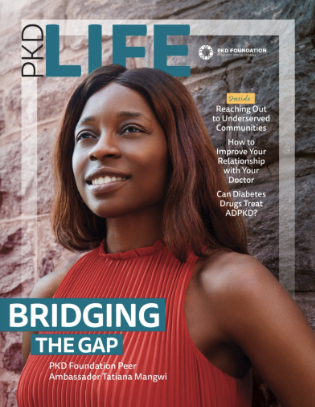Want to see more articles like this?** Read the full issue of our magazine, *PKD Life*, and subscribe to future issues **[here](https://pkdcure.org/pkdlife/)**. If you’re interested in ARPKD, check out [this recent ARPKD-related article](https://pkdcure.org/should-you-enroll-your-child-in-a-clinical-study/) from our summer issue.
**Formats:** Blog Post
**Resource Categories:** ARPKD, Caregivers, Family Life, PKD Parents, Young Children
**Global Categories:** ARPKD, Children, Complications, PKD Parents, Symptoms, Young Children
---
### [National Polycystic Kidney Disease Awareness Day Recognized by US Senate](https://pkdcure.org/resources/national-polycystic-kidney-disease-awareness-day-recognized-by-us-senate/)
**Published:** October 11, 2022
**Author:** fiftyandfifty
**Content:**
**Published October 11, 2022** \| Every year, PKD Awareness Day is celebrated through special ceremonies and activities to educate others about PKD and advocate for the PKD Community. With a [recent resolution](https://bit.ly/3VbclCr) passing in the Senate, this day is now officially designated as National Polycystic Kidney Disease Awareness Day.
## **National PKD Awareness Day**
Thanks to efforts from long time champions for the PKD community, Senators Roy Blunt (R-MO) and Ben Cardin (D-MD), **the Senate recently passed a resolution designating September 4, 2022, as “National Polycystic Kidney Disease Awareness Day.**”
The resolution highlights the severity of PKD symptoms, PKD’s impact on generations of families and communities, and the importance of finding a cure for the genetic disease. Congressional recognition of PKD Awareness Day will help foster the public’s understanding of PKD and drive research funding to improve treatment and care. [You can read the full resolution here.](https://bit.ly/3VbclCr)
“Whereas designating September 4, 2022, as ‘National Polycystic Kidney Disease Awareness Day’ will raise public awareness and understanding of polycystic kidney disease, one of the most prevalent genetic kidney disorders.”
##### **—S.Res.816**
We applaud Senator Blunt and Cardin for their staunch support and leadership on behalf of the PKD community. And we thank the U.S. Senate for recognizing that the PKD community deserves a better quality of life.
## **Getting Involved Beyond PKD Awareness Day**
Everyone can be a PKD advocate. Beyond National Polycystic Kidney Disease Awareness Day, we encourage PKD advocates to continue engaging federal lawmakers. Supporting legislation that will advance PKD research and expand awareness opportunities is vital. Together, advocates and elected officials can bring us closer to our goal of ending PKD. To learn more about PKD advocacy, visit [pkdcure.org/advocacy/](https://pkdcure.org/advocacy/). You can also [register to receive the Foundation’s Advocacy Alerts](https://p2a.co/rpqRAYS) to be notified how you can raise your voice to effect change.
**Formats:** Blog Post
**Resource Categories:** Advocacy
**Global Categories:** Advocacy
---
### [Managing PKD Complications](https://pkdcure.org/resources/managing-pkd-complications/)
**Published:** March 31, 2022
**Author:** fiftyandfifty
**Content:**
**Published on March 31, 2022 \|** After a diagnosis, it’s natural to have questions about polycystic kidney disease. *How will it affect your daily life? Is there a treatment?* *How do I manage PKD complications?* Finding the right healthcare team can make things easier. With the help of her nephrologist, Dr. Michael Lioudis, Sheila Bradac is managing her PKD complications. During their time together, they went from no options for treatment to the development of tolvaptan. The process from diagnosis to managing PKD is a journey you might recognize.
### The Beginning: Diagnosis
For many, polycystic kidney disease comes as a complete surprise. “When I started seeing Dr. Lioudis, it was a very hard time in my life,” Sheila said. “My father had recently died due to PKD, and our family didn’t know what PKD was.” After a little research, she discovered the disease was hereditary and talked to her primary care physician (PCP) about an ultrasound of her kidneys. After the ultrasound, Sheila’s PCP phoned with the news that Sheila’s kidneys were covered in cysts. Initially, she was encouraged to drink lots of water and take blood pressure medication.
Over time, Sheila’s labs weren’t where they needed to be and her PCP struggled to get them in alignment. So, after being treated by her PCP for years, it was time to find a nephrologist.
### Managing PKD Complications: Consulting a Nephrologist
Finally having a care professional who understood PKD gave Sheila hope. Her nephrologist, Michael Lioudis, M.D., is an associate professor of medicine and division chief of nephrology at Update Medical University.
“When people come into the nephrologist’s office, they’re nervous because there is no cure. So, patients have to have a lot of trust in you,” Dr. Lioudis said. “The doctor has to earn that trust every time they interact with the patient. There are a million other things the patient would rather do than be in the office. The question becomes, can you tell the patient I have this with you, so let’s work together to get better control.”
While seeing a nephrologist provided some hope, the lack of a cure remained on Sheila’s mind. At the time, treatments were limited to clinical trials and different medications to treat symptoms. Doctors had to rely on family histories: age of family member’s diagnosis, when did they enter end-stage kidney disease, hospitalizations, complications, etc. From there, treatment meant blood pressure control, cholesterol control, and the theory that drinking water at a certain level helps with hydration.
“As a doctor, you wanted to offer more,” Dr. Lioudis said. Due to limited openings in clinical trials, options were sparse for Sheila. Eventually, Sheila was able to take tolvaptan—and it changed her life.
### PKD Complications
#### What are They?
With Dr. Lioudis, Sheila finally felt like she had someone in her corner. It was empowering that he knew what he was talking about, though disease management was still tricky. Her blood pressure was hard to get under control, but for Sheila, her anxiety was even worse. “Getting labs every month and waiting for the results created a lot of anxiety,” Sheila shared. “If you watch them falling, that creates even more anxiety.”
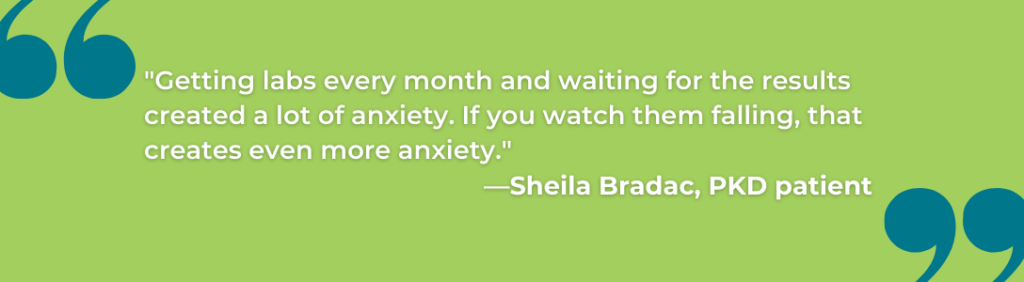
Alongside anxiety and blood pressure concerns, she faced [fatigue](https://pkdcure.org/managing-pkd-and-fatigue/). From lack of sleep, a side effect from needing to go to the bathroom at night while on tolvaptan, Sheila often felt brain fog.
### Learning to Manage PKD Complications
**“**The burden of disease is extremely difficult to carry and manage,” Dr. Lioudis explained. “You have to think about, ‘how do we support people in mind and body?'”
For better sleep, Sheila started using a foam mattress. “It hugs your kidneys, so it’s more comfortable to sleep,” she said. Walking every day helps tremendously with her anxiety. And a medication aids in blood pressure control, though it’s not without side effects.
“It’s a balancing act to get the effects you want out of medications with the side effects. How can you minimize the side effects so people aren’t so fatigued, aren’t getting up to use the bathroom?” Dr. Lioudis said. “And you want to make sure when prescribing meds, they aren’t affecting the kidneys in an adverse way. Sometimes it’s a little trial and error because every person is different—not everyone has the same side effects.”
In managing PKD complications, it’s all about finding a balance of diet and exercise tailored to the patient. Of course, transparency with your doctor is key. “We want to work with patients, we want to hear their side effects,” Dr. Lioudis shared.
Sheila reminds patients like her to be their own best advocates and to always learn and stay active in their health. “The PKD Foundation has the best website with information you can understand. It’s true, accurate, and uplifting,” Sheila explained. “Stay involved with the Foundation or a resource you find on your own to give you a good quality of life. I try to do things I couldn’t do while at work like volunteering at an arts center and joining a book club.” For Sheila, reading *[PKD Life](https://pkdcure.org/pkdlife/),* the free Foundation magazine, gives her hope. In particular, the articles discussing what medical researchers are working on leave her optimistic.
### Things to Remember
“The way I think about PKD is understanding the family history, and the sooner you understand that and have a diagnosis, then the more options you have available. If we can intervene in an earlier stage, we can provide even more hope for people,” Dr. Lioudis stated. With more research and ongoing [clinical trials](https://pkdcure.org/research-medical-professionals/clinicaltrialfaqs/), the understanding of PKD is growing. By finding a nephrologist as soon as possible, it opens up opportunities to participate in clinical trials for emerging therapeutic treatments.
If you have PKD or suspect you do, Dr. Lioudis recommends finding a partner in healthcare. “Whether it’s a doctor or an advanced care provider that you can partner with, get as much information as soon as possible so you understand what’s coming down the pipeline. Have them be your partner so they walk with you on this tough journey.”
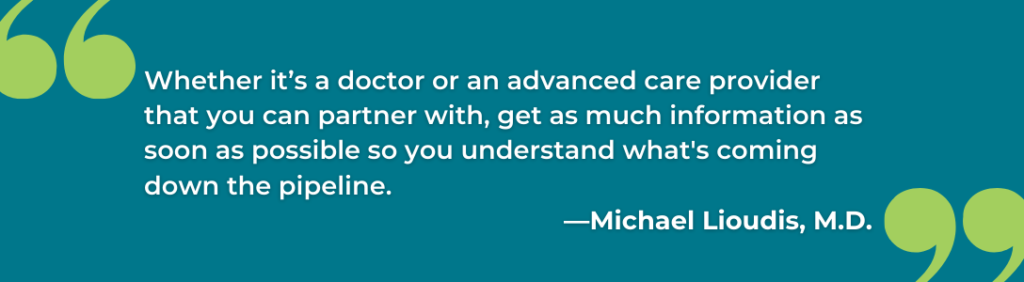
As you navigate PKD, Sheila wants you to remember. “Try not to let PKD define you and always try to create awareness so you can help others.”
---
For resources on living with PKD, check out [PKD Connect](https://connect.pkdcure.org/resources-and-education/). Here you’ll find education and tools to help you at any stage of your PKD journey.
**Resource Categories:** ADPKD, ARPKD, Education, Living with PKD, Newly Diagnosed
**Global Categories:** ADPKD, ARPKD, Complications, Education, Living with PKD, Newly Diagnosed, Symptoms
---
### [Managing PKD and Fatigue](https://pkdcure.org/resources/managing-pkd-and-fatigue/)
**Published:** February 24, 2022
**Author:** fiftyandfifty
**Content:**
**Published on February 22, 2022** \| In living with PKD, a healthy diet and regular exercise are important aspects in managing PKD. But there’s one factor that can make daily life challenging—fatigue. That overwhelming feeling of exhaustion can be frustrating and affects everyone differently. Today, Lara Macklin is sharing how she manages PKD and fatigue.
### **Can you tell us a little bit about your PKD journey?**
**Lara:** Short version—I was diagnosed in my 20s and it started to affect me more in my 40s. I’ve always dealt with blood pressure issues, but nothing too much more than that until I was in my 40s. Although, the anxiety and stress of not knowing what was next were almost worse. Then I developed a large cyst on my liver that caused a lot of discomfort and eating issues with reflux and slight nausea. Between the size of my kidneys and the liver cysts it was frustrating, anxiety and stress built up. Yet, my kidney function remained good enough. I had the large cyst drained and that helped but it filled back up over about a year’s time. This past August, my GFR dropped to 19 and I could start the transplant process. I am now waiting while 3 people are going through the Living Donor Process to see if they are a match.
### **What does your fatigue look like?**
**Lara:** Mostly just tired, no energy. I have about 3-4 good hours in me a day before I feel it setting in and it depends on what I’m doing. I want to lay down and be horizontal or stand up. Sitting is hard. Even eating a small meal makes it hard to sit, so I need to walk or lay down. Walking can be exhausting at the end of the day, so I end up laying down. I am constantly fighting the right thing to do and what I feel like doing. I’m still working full time, mostly remote, but when I do go in I am on my feet all day and just collapse when I get home. When I work from home, I often try and take a break in the middle of the day for a walk and a rest, sometimes a nap.
### **How does it affect you?**
**Lara:** It changes the way I want to live my life and be active with my family and pup. My days are now scheduled around how I feel and not what I want to do.
#### 
### **When did you start noticing the fatigue?**
**Lara:** I had a non-related PKD issue and became severely anemic. That was when it really hit me. But I would say when my GFR was in the low 20s and during all the anemia issues I started noticing it. It took almost three months to get my red blood cell count back up to normal.
### **How do you manage your fatigue?**
**Lara:** I plan my days so that I can rest and selectively choose my activities. Plenty of sleep too.
### **Anything else you’d like to share?**
**Lara:** This is just part of the disease and accepting that may help, instead of trying to be sad or depressed about it. It also helps when family and friends understand how real fatigue can be. It took me a long time to stop feeling sorry for myself and learn to live with my new “normal”. My friends who have received transplants say I will be amazed at how much energy I will have after the transplant. Can’t wait! But that comes with the price of having a compromised immune system for the rest of my life…
---
For resources on living with PKD, check out [PKD Connect](https://connect.pkdcure.org/resources-and-education/). Here you’ll find education and tools to help you at any stage of your PKD journey. *PKD Life* is also a great spot for useful tips on managing PKD. Take a look at these articles on [sleep strategies](https://www.nxtbook.com/nxtbooks/pkdlife/pkdlife_2020spring/index.php#/p/9) and [weighted blankets](https://www.nxtbook.com/nxtbooks/pkdlife/pkdlife_2021summer/index.php#/p/4) to help you feel nice and rested.
**Formats:** Blog Post
**Resource Categories:** ADPKD, ARPKD, Caregivers, Family Life, Living with PKD, Staying Healthy
**Global Categories:** ADPKD, ARPKD, Caregivers, Family Life, Living with PKD, Mental Health, Staying Healthy, Symptoms
---
### [Managing Mental Health and PKD](https://pkdcure.org/resources/managing-mental-health-and-pkd/)
**Published:** May 24, 2022
**Author:** fiftyandfifty
**Content:**
**Published on May 24, 2022** \| May is Mental Health Awareness Month. With chronic illnesses, like ARPKD and ADPKD, mental health is an important factor of your overall care plan. Whether you’re a patient with PKD, [caregiver](https://pkdcure.org/national-family-caregivers-month/), or family member, taking charge of your mental health is empowering. To set you up with the right tools, we sat down with Stephanie Donahue, N.P., and Daniel Cukor, Ph.D of the The Rogosin Institute in New York City.
### **Identifying Mental Health Tools and Resources for PKD Patients**
It’s always important to have a care team you can partner with and truly trust. Put yourself in the care of a knowledgeable team of healthcare providers, including mental health providers, dietitians, and complementary health practitioners (when necessary) who understand that this is about more than just your kidneys. Along with finding the right team, make sure you and your care team are on the same page. That’s an essential component of feeling your best about your treatment options and choices.
Polycystic kidney disease is a complex illness and many people use different treatment strategies at different points in their journey. Make sure to have the facts about your specific situation. With unknown things, it’s so easy for our minds to get stuck on the “what ifs” that may never come. Be prepared to live with the reality of your disease not that of other people you know with PKD. Instead of focusing on what might happen, focus on keeping yourself healthy and hopeful. Get some fresh air and sunshine (while being sun smart), stay active, socialize with people you care about, eat healthy, take your medicines as prescribed, keep your medical appointments, and follow the suggestions of your healthcare team.
To look to the future, stay current on ongoing research opportunities that interest you, They may help advance our knowledge of PKD and maybe even lead to better treatments.
### **Mental Health Signs and Symptoms to Keep an Eye On**
So, how do you recognize that you need to address your mental health? What are the signs and symptoms? Ms. Donahue and Dr. Cukor recommend this checklist to assess your mental health.
- Do you notice you don’t socialize as much, you sleep more, you’re less interested in the world around you and more isolated?
- Do you find your mood is lower than normal or that you are more frequently short or irritable?
- Are you less interested in food and losing weight?
- Do you find yourself gaining weight?
- Are you turning more and more to alcohol or other substances, especially in an effort to feel better?
- Has someone around you told you they notice you aren’t acting like yourself?
If you’re experiencing these symptoms, talk to your healthcare team.
### **Staying Positive With a Chronic Illness**
While life with a chronic illness like PKD can be frustrating, it’s important to stay positive. Every day is an opportunity to change something that might make you healthier and more hopeful. Although it can be something small, over time that will lead to big changes for the better. Focus on the present, think about what you can do today to feel your best, physically and emotionally. Getting too far into thoughts about the future can lead us to jump to conclusions about how things will turn out. If we maximize every day, then we can feel confident that we have done everything in our ability to maximize our health.
Although, while others may have your same disease, which can feel supportive at times, it can also sometimes feel frightening when we identify too much with what they’re going through. Just because they experience something doesn’t mean you necessarily will. Everyone is on their own PKD journey.
When you’re feeling overwhelmed or unhappy, Dr. Cukor offers some advice. **“If you’re overwhelmed, be proactive! Talk to your healthcare team, your friends, family, a professional—anyone or everyone. Don’t allow the negative emotions to build, tackle the issues head-on and early-on.”** Stay connected to people you care about and the world around you.
### Managing Kidney Failure and Your Emotions
While in kidney failure, it’s normal to experience [stress or anxiety](https://www.nxtbook.com/nxtbooks/pkdlife/pkdlife_2020spring/index.php#/p/4). Remember, you’re not alone. If you’re open to it, there are several resources to support you on your journey.
**“Make sure your information is accurate and take it one day at a time. Sometimes one step, one appointment at a time,” said Ms. Donahue. “Remember that your healthcare team will give you good information on which to base your decisions. You’ll decide what is best for you, and the healthier you are, mind and body, the more you’ll trust those decisions and feel good about them.”**
People have different styles of how they respond to a distressing diagnosis. Some people seek as much information as possible and others prefer to avoid thinking about their situation. Research has shown that the more actively one is engaged in their healthcare, the better their outcomes will be. So, take some time to adjust to the shock of the diagnosis, but don’t allow yourself to fall out of touch with your healthcare team, or not follow their recommendations.
For people approaching dialysis, they sometimes feel that this represents a failure of all of their efforts to try and prevent disease progression. We have to accept that sometimes the course of our illness (and our lives in general) are beyond our direct control. We need to continue maximizing our health and taking advantage of all the world has to offer—whether we require renal replacement therapies or not.
**To find more resources, check out our [resource library](https://resources.pkdcure.org/resources/). If you ever have questions or need someone to talk to, our [HOPE Line](https://connect.pkdcure.org/hope-line/) is always here for you.**
**Formats:** Blog Post
**Resource Categories:** ADPKD, ARPKD, Caregivers, Education, Family Life, Living with PKD
**Global Categories:** ADPKD, ARPKD, Caregivers, Education, Family Life, Kidney Failure, Living with PKD, Mental Health
---
### [Losing a Child with ARPKD](https://pkdcure.org/resources/losing-a-child-with-arpkd/)
**Published:** October 15, 2022
**Author:** fiftyandfifty
**Content:**
**Published on October 15, 2022** \| Today is Pregnancy and Infant Loss Remembrance Day. Every October 15, we honor we honor lost pregnancies and infant deaths which includes miscarriages, still births, and of course, [ARPKD](https://pkdcure.org/what-is-arpkd/). A rare genetic disorder, autosomal recessive polycystic kidney disease (ARPKD) occurs in approximately 1 in 25,000 children. Tragically, it can lead to a child passing away within one month of life. Julie Marshall, PKDF volunteer and Board of Directors member, knows just how hard it is to lose a child to ARPKD. Today, she’s sharing her family’s story.
## **My Story of Losing a Child with ARPKD**
When we first heard about ARPKD, we were halfway through our pregnancy with our second child. We went for the anatomy scan naïvely thinking we’d find out the sex of the baby and go along our way. Little did we know that was the day everything would change. We could tell by the way that they were looking and taking extra time that something was wrong. But we didn’t know what it was. When the doctor came back, they said that the kidneys looked echogenic and enlarged.
We went home and did lots of searching on Google, most of which yielded truly scary results. I know they say never to search it, but we all do it. Really, we shouldn’t. The hospital set up appointments with MFM and a genetic counselor. We also met our first pediatric nephrologist shortly after that. The appointment was all “doom and gloom” and very negative. It was difficult and made everything seem hopeless. It became clear that this wasn’t the right doctor for us. We looked into Facebook groups and asked who others see for nephrology. That’s how we [found our nephrologist](https://pkdcure.org/find-a-clinic/).
When I was pregnant with my first child, we had very few appointments and only a couple ultrasounds. Suddenly, we were in the world of high risk and had appointments constantly. There were a ton of ultrasounds and lots of different appointments with different people and specialists. It was a lot of information and a lot of worry. We didn’t really tell many people at first. I think we had hoped they were wrong. Maybe if we didn’t tell, everything would be fine.
When I was a little bit past 31-weeks, we went to Boston for a routine, bi-weekly appointment and ended up being admitted. Porter was showing signs of distress and they wanted to schedule an emergency C-section right away. Porter was with us for about four hours before he passed away. Because I had major surgery, we stayed for a couple days to heal. They had to move me to a different floor, so I wasn’t around babies. Leaving the hospital no longer pregnant and without our child was one of the hardest things I’ve ever done.
All of this also made us worry for our oldest child too. We heard stories of kids being diagnosed later in childhood. We have a third child who also has ARPKD. You would never know, and honestly, we’d still have no idea if we didn’t have the history with Porter.
## **How We Manage ARPKD as a Family**
### Use Your Support System
Find your support system. Our family and friends are really supportive. I went to therapy for a while and joined groups for infant loss. Talking to others who’ve been through similar situations was helpful to know I wasn’t alone.
With ARPKD, there’s a wide range of possibilities \[with disease progression\]. It’s also impossible to know how to prepare. There’s no way to know how severely impacted the kidneys may be or if they’ll be fine. And there’s no predicting how you’ll handle it or what you’ll need. Whatever ends up happening, the people who support you will be invaluable.
## **Improving the Future for ARPKD Patients**
At the PKD Foundation, I’m looking forward to helping ARPKD become more of a focus for the PKDF. Many people hear PKD and instantly think of the dominant form. The recessive form is much rarer and they are very different diseases. It’s important that we specify and talk about each, not using “PKD” interchangeably.
## **Resources for Parents**
If you have a child with ARPKD, you may be looking for support and resources. The PKD Foundation is here to help. Our [ARPKD resource page](https://pkdcure.org/what-is-arpkd/arpkd-resources/) has tons of great information to get you started. Including information on:
- [ARPKD Patient Handbook](https://pkdcure.org/patient-handbooks/)
- [Parent Community](https://pkdcure.org/pkdparentschapter)
- [ARPKD Clinical Trials](https://pkdcure.org/research-medical-professionals/clinical-trial-awareness-program/)
**Formats:** Blog Post
**Resource Categories:** ARPKD, Caregivers, Family Life, PKD Parents, Young Children
**Global Categories:** ARPKD, Caregivers, Children, Family Life, PKD Parents, Young Children
---
### [KETO-PKD Study](https://pkdcure.org/resources/keto-pkd-study-2/)
**Published:** November 2, 2021
**Author:** fiftyandfifty
**Content:**
##### How’s enrollment going in the study (started in October 2020) and what’s the evidence behind this intervention?
### Learning objectives
- Understand why nutrition research needs pilot/feasibility studies before larger clinical trials.
- Learn what do we know about the KETO diet as an intervention in animal PKD vs. human PKD.
- Increase knowledge of PKDF’s funded research programs and projects.
### Speaker
Dr. Müller is Vice Director of the Department 2 for Internal Medicine (Renal Unit) at the University Hospital Cologne. He began his medical career at the universities of Freiburg and Heidelberg in Germany. After finishing medical school, Dr. Müller completed his scientific training at Rockefeller University (New York, USA) and Yale University (New Haven, USA). He then returned to Germany to obtain his board certification in Nephrology in the Department of Prof. Benzing at University Hospital Cologne where he now works.
Here, Dr. Müller is head of the ADPKD unit ([website](https://nephrologie.uk-koeln.de/erkrankungen-therapien/schwerpunkt-diagnostik-therapie-adpkd/ "https://nephrologie.uk-koeln.de/erkrankungen-therapien/schwerpunkt-diagnostik-therapie-adpkd/")) and has established the „AD(H)PKD Registry“, which strives to collect information on the management of ADPKD and has become one of the largest cohorts worldwide. Furthermore, he leads a basic research group that tackles the molecular mechanisms underlying kidney disease, employing modern techniques in molecular biology and biochemistry ([website](https://www.kidneyresearchcenter.org/51/Research/Renal-Damage-and-Cancer/RNA-biology-in-renal-damage-and-cancer-%e2%80%93-Roman-Ulrich-Mueller.htm "https://www.kidneyresearchcenter.org/51/Research/Renal-Damage-and-Cancer/RNA-biology-in-renal-damage-and-cancer-%e2%80%93-Roman-Ulrich-Mueller.htm")). His special interest is dedicated to renal RNA biology — e.g. RNA-binding proteins and non-coding RNAs — including the discovery of small non-coding RNAs in polycystic disease. Research in Dr. Müller’s laboratory has been funded by grants from federal agencies, including the German Research Foundation and the Ministry of Science North-Rhine Westphalia, by private foundations, including the Marga and Walter Boll Foundation and the German Kidney Foundation, as well as several companies involved in biotechnology and medicine. Based on this work, Dr. Müller is the author of numerous publications on clinical and molecular nephrology in renowned journals.
Whenever this leaves time for other activities, Roman loves to discover the world, no matter whether by campervan, bicycle or — as required by the current pandemic — online.
**Formats:** Webinars
**Resource Categories:** Approaching Kidney Failure, Caregivers, Living with PKD, Newly Diagnosed
**Global Categories:** 2021, Approaching Kidney Failure, Caregivers, Clinical Trials, Diet, Featured, Living with PKD, Newly Diagnosed, Nutrition, Research, Webinar
---
### [Introduction to PKD: What should I know about PKD?](https://pkdcure.org/resources/introduction-to-pkd-what-should-i-know-about-pkd-2/)
**Published:** October 27, 2022
**Author:** fiftyandfifty
**Content:**
#### Learning objectives
Describe the different forms of PKD, how PKD develops, and the genetic reasons it happens.
Describe PKD complications and the treatments used to control symptoms, slow the growth of cysts, and help with kidney function.
Discuss lifestyle choices and options that may slow PKD symptoms.
#### Speakers
##### Franz Winklhofer, MD
Dr. Franz Winklhofer is certified by the American Board of Internal Medicine with a subcertification in nephrology. He completed a fellowship at the University of Kansas Medical Center. He earned his medical degree from the University of Kansas School of Medicine and completed his residency at the University of Kansas Medical Center. Dr. Winklhofer is dedicated to the delivery of quality patient care for adult kidney diseases. He is equally interested in the management of autosomal dominant polycystic kidney disease.
##### Ashima Gulati, MD, PhD
Ashima Gulati, MD, PhD, is a pediatric nephrologist with research interest in inherited kidney diseases with a particular focus on polycystic kidney disease. Dr. Gulati trained at the Yale School of Medicine where she also completed a PhD in Investigative Medicine. Her research focuses on human exome based investigation of genetic kidney diseases and using mouse and zebrafish as disease models for investigating vascular complications in autosomal dominant polycystic kidney disease. Dr. Gulati’s clinical interests include integration of genetic knowledge to improve the well-being of children with polycystic and inherited kidney diseases.
**Formats:** Webinars
**Resource Categories:** ADPKD, ARPKD, Caregivers, Education, Living with PKD, Newly Diagnosed, Research, The Basics of PKD
**Global Categories:** 2022, ADPKD, ARPKD, Caregivers, Complications, Education, Living with PKD, Newly Diagnosed, Research, Symptoms, The Basics of PKD, Webinar
---
### [How You Can Join the Advocacy Champions Network](https://pkdcure.org/resources/how-you-can-join-the-advocacy-champions-network/)
**Published:** September 14, 2023
**Author:** fiftyandfifty
**Content:**
**Published on September 14, 2023** \| Aside from funding research, one of the best ways to drive change in the PKD community is through [advocacy](https://pkdcure.org/advocacy/). One way you can take part in PKD advocacy is by joining the Advocacy Champions Network (ACN). Applications are [now open](https://go.pkdcure.org/l/886163/2021-04-23/27z3d) for the 2023-2024 ACN program year! Join other PKD advocates from across the United States to drive policy change in support of the PKD community.
### **What is the Advocacy Champions Network?**
The [ACN](https://pkdcure.org/advocacy/acn/) is an exclusive group of patients, family members, and clinicians dedicated to improving the lives of people living with PKD. As PKDF Advocacy Champions, they work to build relationships with members of Congress and staff. Secondly, they lead advocacy efforts in their states to advance legislation supporting PKD research, treatments, and care.
In their role as a spokesperson for PKD, they take part in several activities at the state and national level.
- Organizing, leading, and/or participating in events and meetings with lawmakers and congressional staff
- Engaging local and national media outlets to raise awareness for the PKD community and the Foundation’s policy priorities
- Recruiting other advocates to raise their voice in support of PKDF’s policy priorities and participate in PKDF events
To prepare them for success, Champions participate in required PKDF policy and media training. Some of these subjects include:
- How to have a successful meeting with congressional lawmakers and staff
- How to share their PKD story
- Pitching op-eds or letters-to-the-editor (LTEs) to local media outlets
### **2022-2023 ACN Class Accomplishments**
Through PKDF’s Virtual Advocacy Day, the [2022-2023 ACN](https://pkdcure.org/2022-advocacy-champion-network-awards/) class led their state delegations to meet with elected officials. Because of their hard work, 92 advocates participated in 110 congressional meetings with lawmakers and staff.
They advocated for:
- [The Living Donor Protection Act](https://www.congress.gov/bill/118th-congress/senate-bill/1384?s=1&r=48) (LDPA), which provides Federal protections for living organ donors
- PKD research funding, including through the Department of Defense’s (DoD) Peer Review Medical Research Program (PRMRP) under the Congressionally Directed Medical Research Program (CDMRP)
- Anticipated legislation that elevates and addresses the consequences of racial disparities in kidney disease. This includes disparities in diagnosis, treatment, and access to transplantation, particularly for PKD
Following the Virtual Advocacy Day, more than 20 members of Congress cosponsored the LDPA. This is all thanks to the work of ACN leaders and their state delegations. In addition, PKD was included as a topic area in the DoD’s Peer Review Medical Research Program.
### **How You Can Become a PKD Advocate**
In order to be a volunteer, you must be able to meet two important needs. First, you need to be able to commit to approximately 8-10 hours per month. Secondly, you’ll need to participate in monthly trainings and webinars.
Start making your impact on the PKD community today. Learn more and [apply by **October 15**](https://go.pkdcure.org/l/886163/2021-04-23/27z3d) to join this fall.
**Formats:** Blog Post
**Resource Categories:** Advocacy
**Global Categories:** Advocacy
---
### [How Fall Kidney Meetings Support PKD Research and Clinical Trials](https://pkdcure.org/resources/how-fall-kidney-meetings-support-pkd-research-and-clinical-trials/)
**Published:** October 8, 2025
**Author:** Sarah Lundak
**Content:**
Throughout September, PKD Foundation leadership joined experts, advocates, academics, and pharmaceutical companies in Washington, D.C., for a variety of meetings to discuss PKD research. Together, they discussed everything from the state of federal research funding to strategies for accelerating PKD clinical trials.
## **Critical Path Institute Global Impact Conference**
As our partner in advancing polycystic kidney disease (PKD) research, including PKD clinical trials, the [Critical Path Institute (C-Path) Global Impact Conference](https://c-path.org/save-the-date-for-c-paths-premier-global-impact-conference/) brought together key stakeholders, ranging from academics to pharmaceutical companies.
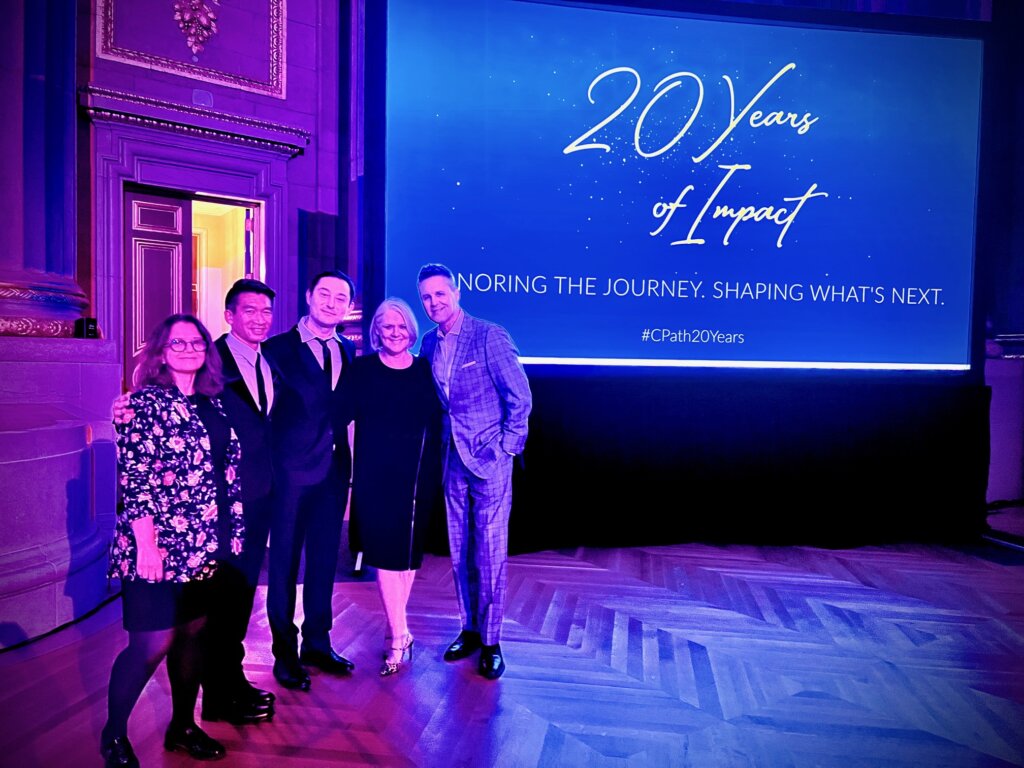PKD Foundation leadership and expert clinicians attend the Critical Path Institute Global Impact Conference. Left to Right: Mayo Clinic, Rochester Director Neera Dahl, M.D., PKD Foundation VP of Research Projects Chris Chen, Ph.D, PKDOC Director Sorin Fedeles Ph.D., PKD Foundation President and CEO Susan Bushnell, and PKD Foundation Chief Growth Officer Craig Robertson.
### **PKD Foundation Collaboration with C-Path**
When it comes to healthcare, **[C-Path](https://c-path.org/)** believes “it takes too much time and costs too much money to take a potential new medicine discovered in the laboratory through the drug development process and achieve a regulatory-approved safe and effective product.” To speed up this process, they bring together leaders from science, medicine, government, and patient advocacy. This not only helps advance the development of new treatments but also ensures patients’ voices are heard.
In 2010, the PKD Foundation co-founded the **[PKD Outcomes Consortium (PKDOC)](https://pkdcure.org/research/pkdoc/)** as a program within C-Path. This partnership brings together representatives from the pharmaceutical industry, PKD clinicians, and the U.S. Food and Drug Administration (FDA). Together, it establishes a clear, official path for pharmaceutical companies to evaluate the effectiveness of potential treatments, facilitating the creation of clinical trials for PKD therapies.
## **How the C-Path Conference Supports PKD Clinical Trials**
Altogether, the Global Impact Conference hosted more than 300 attendees. This unique opportunity connected PKD Foundation staff, clinicians, and researchers with the FDA and members of industry.
One event panel discussed “Reasonably Likely Surrogate to Accelerated Approval: Exploring PKD and Alzheimer’s Disease Approval Pathways.” This session included two PKD clinicians, both of whom have received PKD Foundation research grants: PKDOC Director Sorin Fedeles Ph.D., and Mayo Clinic, Rochester Director Neera Dahl, M.D.
They highlighted how their work in establishing total kidney volume (TKV) as an FDA-approved measurement tool for disease progression in PKD could be translated to Alzheimer’s Disease.
### **TKV and PKD Clinical Trials**
Total kidney volume, or TKV, is a measurement of the volume of both kidneys. In PKD, cysts grow on the kidneys, increasing the volume. This measurement is critical for doctors to assess where patients are in their PKD journey and what’s possible.
Based on the size of a patient’s kidneys (as well as their age and height), doctors can say how aggressive the PKD is. By using that score, they can make predictions and outline what treatment options may be available to the patient.
Because of this milestone, [**tolvaptan**](https://pkdcure.org/about-the-disease/living-with-pkd/treatments/) was developed, the first treatment for PKD.
## **National Institute of Diabetes and Digestive and Kidney Diseases Meeting**
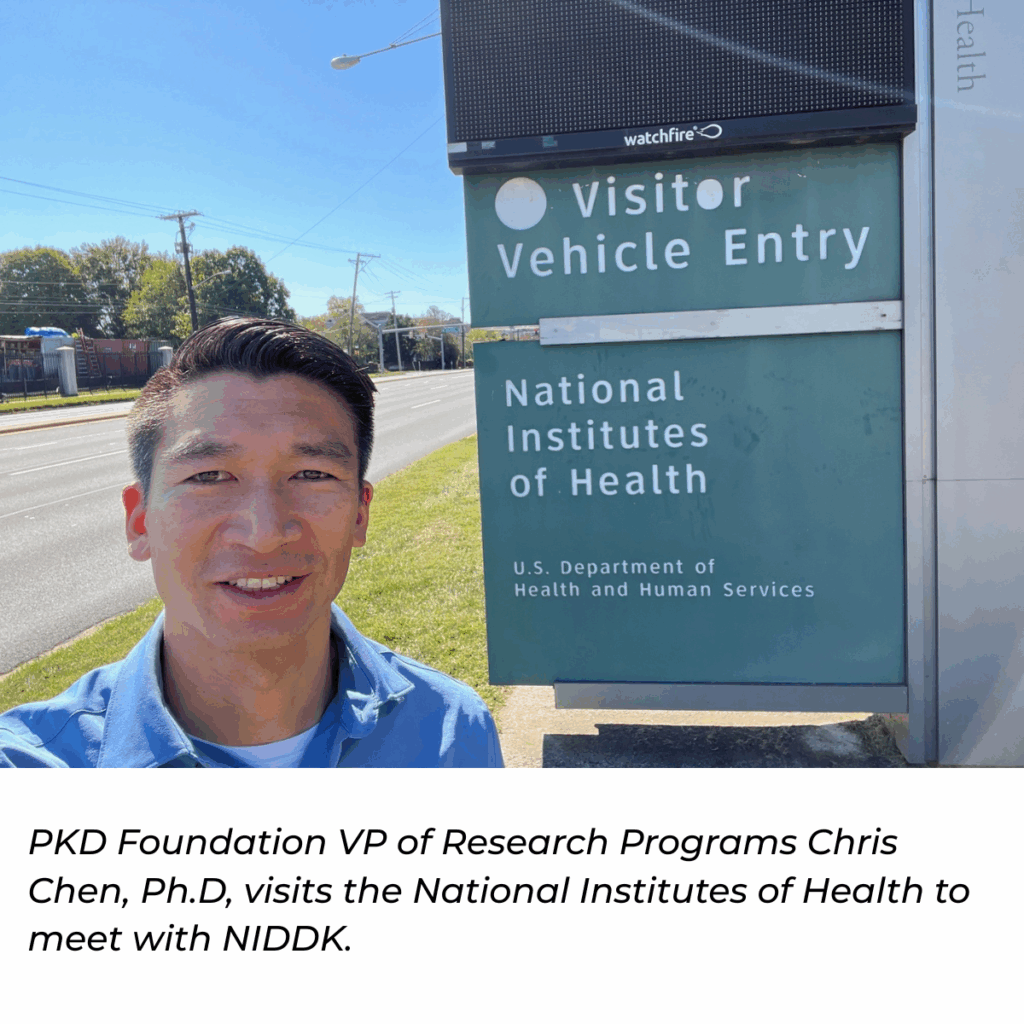
When it comes to PKD research, federal funding is critical to progress. The National Institute of Diabetes and Digestive and Kidney Diseases (NIDDK), part of the National Institute of Health (NIH), supports research on chronic kidney conditions.
Recently, the PKD Foundation’s vice president of research programs, Chris Chen, Ph.D., met with the NIDDK’s chief of renal diagnostics and therapeutics, Robert Star, M.D., and program directors, Susan Mendley, M.D., and Christine Maric-Bilkan, Ph.D. Together, they discussed PKD Foundation priorities, NIH funding challenges, and the [PKD Research Resource Consortium (RRC)](https://www.pkd-rrc.org/about-pkd-rrc/).
### **What is the PKD Research Resource Consortium (RRC)?**
Funded by NIDDK, the RRC’s goal is to advance PKD research by supporting a collaborative, diverse community of investigators. They provide important resources to help grow the study of PKD.
## **Unknown Causes of Kidney Disease Summit**
PKD Foundation leadership, including President and CEO Susan Bushnell, Vice President of Research Programs, Chris Chen, Ph.D., and Vice President of Community Programs and Education Paul Scribner, attended the [American Kidney Fund’s (AKF) Unknown Causes of Kidney Disease Summit](https://www.kidneyfund.org/article/american-kidney-fund-convenes-kidney-community-members-sixth-annual-summit-unknown-causes-kidney#:~:text=%28Sept.,undiagnosed%20or%20misdiagnosed%20kidney%20disease.). The summit focused on the Unknown Causes of Kidney Disease (UCKD) Project. Launched in 2020, this initiative seeks to “improve understanding of how undiagnosed kidney disease or misdiagnosed causes of kidney disease directly impact patient care and outcomes.”
During the summit, sessions emphasized how rural outreach and multidisciplinary care are key in tackling undiagnosed kidney disease. This included topics such as education and genetic testing. Additionally, a panel of advocates shared their experiences, shining an important spotlight on patient voices.
### **Patient Perspectives in PKD Foundation Programs**
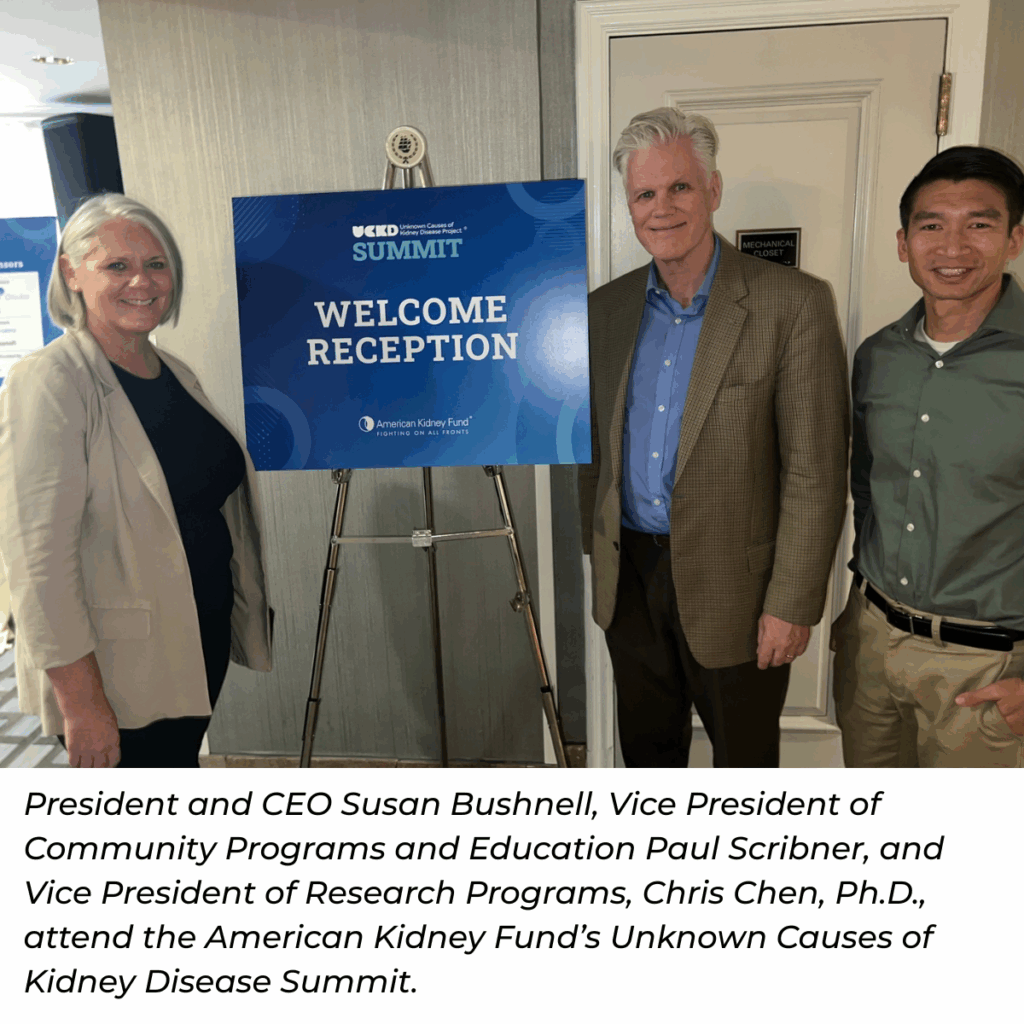
At the PKD Foundation, the voices and perspectives of PKD patients are vital to our work. When selecting which grants and fellowships to fund, we ensure that the needs and perspectives of PKD patients are at the forefront. This includes having patient volunteers participate in the grant review process.
Through our recent survey, we captured feedback from patients, caregivers, clinicians, and others to understand the particular educational, social, emotional, financial, and other support needs of our community. This will help us develop initiatives and improve programs and services for the overall community.

## **What Does This Mean for the Future of PKD Research and Clinical Trials?**
Summits, conferences, and scientific meetings are unique opportunities for collaboration and innovation. Through these events, our leadership can connect with leading experts, patients, pharmaceutical companies, and other kidney health organizations to grow PKD research and chart a path to new treatments and a cure.
**
“At the PKD Foundation, we know that progress doesn’t happen in isolation. Every conversation and collaboration helps accelerate PKD research and advance clinical trials. By uniting researchers, regulators, industry leaders, and patients, we’re building momentum to drive new treatments and a cure for PKD.”
**—Susan Bushnell, PKD Foundation President and CEO**
Partnerships power progress. Today, the PKD Foundation and PKDOC are actively working to advance PKD clinical trials. **Our projects include:**
- Developing new biomarkers for PKD clinical trials
- Creating tools and models that help researchers test potential treatments
- Partnering with patients, researchers, industry, and the FDA to design the next generation of ADPKD and ARPKD clinical trials
#### **If you’re interested in PKD research or PKD clinical trials, you can:**
- Sign up for [ADPKD](https://go.pkdcure.org/l/886163/2020-10-29/49bx) or [ARPKD ACT Alerts](https://go.pkdcure.org/l/886163/2021-08-02/3765w). These emails let you know when a clinical trial is seeking participants.
- Listen to our podcast, [*PKD Chronicles*](https://pkdcure.org/pkd-foundation-podcast/). [Episode four](https://pkdcure.org/resources/measuring-progress-understanding-tkv-in-pkd-management/) discusses TKV, and [episode five](https://pkdcure.org/resources/pkd-chronicles-understanding-clinical-trials-and-registries-in-pkd-research/) dives into clinical trials.
- Join the [ADPKD Registry](https://pkdcure.org/research/the-adpkd-registry/). As a participant, you’ll be matched with ongoing clinical trials.
**Formats:** Blog Post
**Resource Categories:** PKD News, Research
**Global Categories:** Advocacy, Clinical Trials, Conference, Drug Therapy and Treatments, PKD News, Research, TKV, Total kidney volume
---
### [Healthy Diet Tips for ARPKD Parents](https://pkdcure.org/resources/healthy-diet-tips-for-arpkd-parents/)
**Published:** July 7, 2022
**Author:** fiftyandfifty
**Content:**
**Published on July 7, 2022** \| Making sure your child consumes a healthy diet is an important task for all parents, but especially when your child has PKD. So, what can parents do to keep a healthy diet for their child with ARPKD?
“With any complex medical diagnosis, we want to make sure the children are getting enough of the vitamins and minerals they need to help build up the immune system and to ensure proper growth,” says Merideth Miller, R.D., C.S.P., L.D., advanced practice nutrition support dietitian at Cleveland Clinic Children’s. “If they’re not eating a variety of food or if they’re following a plan that’s more restricted than we would normally recommend, they may experience more growth restriction.”
For Lindsay Roper, of Orem, Utah, the main concern is that her 5-year-old daughter, Sadie, stays hydrated. Sadie has ARPKD and needs to drink 64 ounces of water a day to prolong her kidney function for as long as possible. “As you can probably imagine, getting a 5-year-old to drink takes up a lot of my time,” says Roper, who also has a 2ó-year-old and another child on the way.
Try these tips to help ensure your child is eating and drinking properly:
**Get vitamins from food rather than supplements whenever possible.**
Foods will give children other important nutrients such as fiber, phytochemicals, and antioxidants that they might not get from a multivitamin. “For children who are picky eaters, I will recommend the multivitamin but strongly urge food fist,” Miller says.
**Don’t restrict food unless a doctor recommends it.**
“If we restrict too soon, sometimes it can lead to food battles and poor growth,” Miller says.
Make it a game. Roper never makes drinking water into a battle of wills. She also never tries to scare Sadie by telling her that if she doesn’t drink, she may have to have a kidney transplant sooner. “I don’t want fear to be a motivator for her. I want her to feel there are steps that she can take to be as healthy as she can,” Roper says.
Instead, Roper tries to make drinking fun: She has an app on her phone where Sadie waters a plant when she has a certain amount of water. She has also used sticker charts and a chart where Sadie writes down what she’s drinking. “She is very proud that she can do that now,” Roper says.
**Try rewards that aren’t sweets.**
You don’t have to totally restrict sugar unless your doctor says so, but try not to fall into the trap of “if you eat this, you can have a cookie.” Instead, Roper will buy a new juice flavor, a new water bottle, or Dixie cups with different patterns. “We try to mix things up a little bit,” she says.
Roper has found a surprising perk for her and her husband if they get Sadie to properly hydrate. “When we haven’t been as good about keeping up on her fluid goals, she usually is a lot more tired and grouchy. So, besides the long-term health benefits, there’s some more immediate benefits for us as parents to help keep my child happy. That’s motivating to me when it gets hard,” she says.
When it comes to a healthy diet and nutrition, always discuss changes with your healthcare provider. They’ll help you create a plan that’s best suited to your child’s needs. To learn more about nutrition or ARPKD, check out our [resource library](https://resources.pkdcure.org/). And you can read more articles like this in the [spring issue of ](https://pkdcure.org/pkdlife/)*PKD Life.*
**Formats:** Blog Post
**Resource Categories:** ARPKD, Diet, Family Life, Living with PKD, PKD Parents, Staying Healthy, Young Children
**Global Categories:** ARPKD, Diet, Family Life, Living with PKD, Nutrition, PKD Parents, Staying Healthy, Young Children
---
### [ARPKD EL-PFDD 2023](https://pkdcure.org/resources/arpkd-el-pfdd-2023-2/)
**Published:** July 11, 2023
**Author:** fiftyandfifty
**Content:**
| #### **What to Expect from the ARPKD EL-PFDD Meeting** On August 29, 2023 the PKD Foundation will hold its first ever Externally Led Patient-focused Drug Development (EL-PFDD) Meeting on Autosomal Recessive PKD (ARPKD) and Congenital Hepatic Fibrosis (CHF). Should you attend the meeting? What should you expect? Get answers to these questions and more by attending our webinar on August 8! |
|---|
#### What to Expect from the ARPKD EL-PFDD Meeting
On August 29, 2023 the PKD Foundation will hold its first ever Externally Led Patient-focused Drug Development (EL-PFDD) Meeting on Autosomal Recessive PKD (ARPKD) and Congenital Hepatic Fibrosis (CHF). Should you attend the meeting? What should you expect? Get answers to these questions and more by attending our webinar on August 8!
Learn more about this meeting [here.](pdkcure.org/el-pfdd)
#### Speakers
##### ***James Valentine***
##### ***Hyman, Phelps & McNamara***
| James has worked the last 15 years as a champion for the patient voice as part of the regulatory process. James previously worked at the FDA where he was a patient liaison, helping to incorporate the patient voice into medical product review across the FDA’s various medical product centers and review divisions. There, he helped to develop and launch the Patient-Focused Drug Development initiative. |
|---|
##### ***Larry Bauer – Hyman, Phelps & McNamara***
| Larry worked at the NIH for 17 years in clinical research, followed by a position at the FDA as a Regulatory Scientist in the Center for Drug Evaluation and Research’s Rare Diseases Program, a group he co-founded and worked for 10 years, where he advanced rare disease drug development. |
|---|
**Resource Categories:** Advocacy, ARPKD, Education, Young Children
**Global Categories:** Advocacy, ARPKD, Drug Therapy and Treatments, Education, Young Children
---
### [Diet Planning for Both PKD and Diabetes](https://pkdcure.org/resources/diet-planning-for-both-pkd-and-diabetes/)
**Published:** August 2, 2022
**Author:** fiftyandfifty
**Content:**
**Published on August 2, 2022** \| Planning meals and snacks requires extra effort when you have PKD. But if you have both PKD and diabetes, the process can be even more challenging. While a PKD diet and a diabetes diet overlap in many ways, the recommendations for each do conflict sometimes.
This can create a lot of confusion for people who need to control both conditions, says Shima Fazelimanesh, R.D., a nephrology and organ transplant dietitian based in Los Angeles. “Most of the clashes involve the advice for protein and carbohydrate consumption,” she explains. “It’s important to work with a dietitian because people who have PKD and diabetes need education to make the healthiest choices.”
### The PKD-Diabetes Connection
Normally, having PKD doesn’t make a person more likely to develop diabetes (and vice versa), but that may not be the case for those undergoing a kidney transplant. A study in the journal *Transplantation* found that 6.5% of people with autosomal dominant PKD (ADPKD) who received a transplant developed new-onset diabetes after surgery. An additional 11% developed impaired glucose tolerance (pre-diabetes).
While more research is needed to confirm the link, Fazelimanesh says the risk is real. “We’re not sure why it exists, though in some patients it may be due to side effects of the drugs they need to take to prevent organ rejection,” she says. “These can interfere with the pancreas’ ability to produce enough insulin to manage carbohydrate and glucose intake properly.”
### How to Balance Your Diets
If you have PKD and diabetes, these tips can help you navigate the areas where dietary recommendations conflict.
#### **Focus on plant sources of protein.**
Eating (lean) meat usually isn’t an issue for people with diabetes, but it can be a problem for those who also have PKD. “A plant-based diet is thought to be gentler on your kidneys, which may aid in the prevention of kidney disease,” Fazelimanesh says. Also, research in mouse models of PKD shows that limiting animal protein can restrict the growth of cysts and delay the progression of PKD. Good sources of plant-based protein include beans and legumes, quinoa, tofu, unsalted nuts, nut butters, and other seeds. Avoid processed meatless products such as veggie burgers; these contain a high amount of sodium, which both PKD and diabetes patients should limit. If you do want to eat animal protein, Fazelimanesh says eggs and fish are the best options for your kidneys.
#### **Keep your protein intake in check.**
Studies suggest that high-protein diets may be beneficial for people with diabetes, but they’re not a good choice for those with PKD too, Fazelimanesh says. In the early stages of the disease, eating just 0.6 to 0.8 grams of protein per kilogram of body weight may be recommended, while many high-protein diets advise eating double or triple that amount.
#### **Combine carbs with healthy fats.**
Eating whole grains is encouraged in both PKD and diabetes diets, but people with diabetes need to be more careful with their intake of carbs than someone with PKD because they cause the blood sugar to rise. “If you have both conditions, adding a heart-healthy fat to a whole grain can help keep blood sugar steadier,” Fazelimanesh says.
Examples include dipping whole-wheat bread in olive oil; spreading whole-wheat bread with natural peanut or almond butter and topping it with blueberries; or making avocado toast if your potassium levels are normal.
#### **Choose produce wisely.**
People with diabetes can eat most fruits and vegetables—even ones that are higher in natural sugar—but they may need to rely more on produce that’s low in potassium if they’re in the later stages of PKD. Fruits and vegetables with less potassium include apples, berries, broccoli, and peas. High potassium foods that may need to be limited include bananas, kiwis, avocados, and sweet potatoes.
When it comes to a healthy diet and nutrition, always discuss changes with your healthcare provider. They’ll help you create a plan that’s best suited to your needs. To learn more about nutrition, check out our [resource library](https://resources.pkdcure.org/). And you can read more articles like this in the [summer issue of ](https://pkdcure.org/pkdlife/)*PKD Life.*
**Resource Categories:** ADPKD, ARPKD, Diet, Education, Recipes, Staying Healthy
**Global Categories:** ADPKD, ARPKD, Complications, Diet, Education, Living with PKD, Nutrition, Recipes, Staying Healthy
---
### [Cooking Well: Delicious, everyday recipes for the PKD family](https://pkdcure.org/resources/cooking-well-delicious-everyday-recipes-for-the-pkd-family-2/)
**Published:** August 29, 2021
**Author:** fiftyandfifty
**Content:**
## About
Author Jacob Taylor, Ph.D., RD, LD writes that “this cookbook provides those with PKD, who are looking to play an active role in their disease, a helpful hand in understanding how to change their diet, with recipes to suit.”
[Download today.](https://pkdcure.org/wp-content/uploads/2025/03/cooking_well_2021-edit.pdf)
#### Learn more
- [PKD-friendly recipes](https://pkdcure.org/pkd-friendly-desserts-key-lime-pie-recipe/)
- [PKD nutrition](https://pkdcure.org/nutrition)
- [Webinar: Nutritional Considerations for PKD Patients](https://pkdcure.org/resource/nutritional-considerations-for-pkd-patients/)
**Formats:** Books
**Resource Categories:** ADPKD, ARPKD, Diet, Living with PKD, Recipes, Staying Healthy
**Global Categories:** ADPKD, ARPKD, Diet, Living with PKD, Nutrition, Recipes, Staying Healthy
---
### [Confidently Navigating ADPKD: Understanding the New KDIGO Guideline, Decoding ADPKD: Managing ADPKD - Treatments, Lifestyle, & Living Well](https://pkdcure.org/resources/confidently-navigating-adpkd-understanding-the-new-kdigo-guideline-decoding-adpkd-managing-adpkd-treatments-lifestyle-living-well/)
**Published:** July 9, 2025
**Author:** Shayla
**Content:**
ADPKD affects more than just the kidneys. In part three of our four-part series, we’ll explore how ADPKD impacts the heart, liver, bones, and metabolic health.
Learning Objectives:
- Heart and vascular risks in ADPKD, including brain aneurysms.
- Polycystic liver disease (PLD) and how to manage symptoms.
- The impact of ADPKD on bone health, metabolism, and urinary health.
- Preventive care strategies for whole-body health
Speakers: Craig Gordon, M.D., M.S.: Director of the PKD Foundation Center of Excellence at Tufts Medical Center Pranav Garimella, MBBS, MPH, FASN: Director of the PKD Foundation Center of Excellence at University of California San Diego
\*The Kidney Disease: Improving Global Outcomes (KDIGO) 2024 Guidelines for ADPKD provide the latest evidence-based recommendations to help patients, caregivers, and healthcare providers navigate the complexities of autosomal dominant polycystic kidney disease (ADPKD). Our 4-part educational series is designed to help patients and families better understand the latest KDIGO recommendations for ADPKD management.
This webinar is supported by a sponsorship from Otsuka. The PKD Foundation retains full control over the content and speaker selection to ensure unbiased, high-quality education for our community.
**Formats:** Webinars
**Resource Categories:** ADPKD, Caregivers, Drug Therapy and Treatments, Education, Living with PKD, Newly Diagnosed, PKD News, The Basics of PKD
**Global Categories:** 2025, ADPKD, Caregivers, Complications, Education, Living with PKD, Newly Diagnosed, Polycystic Liver Disease, Symptoms, The Basics of PKD, Webinar
---
### [Confidently Navigating ADPKD: Understanding the New KDIGO Guideline, Decoding ADPKD: Diagnosis, Prognosis, & Genetics](https://pkdcure.org/resources/confidently-navigating-adpkd-understanding-the-new-kdigo-guidelines-decoding-adpkd-diagnosis-prognosis-genetics/)
**Published:** June 4, 2025
**Author:** Shayla
**Content:**
This session will explore how ADPKD is diagnosed, what factors influence disease progression, and the role of genetics in understanding and managing ADPKD.
**Learning Objectives:**
- Understand how ADPKD is diagnosed and what to monitor.
- Learn about factors that impact disease severity & prognosis.
- Explore the genetics of ADPKD (PKD1 vs. PKD2) and when genetic testing is beneficial.
- Discuss ethical considerations and family planning related to ADPKD.
**Speakers:**
Dr. Terry Watnick, M.D., is an Associate Professor of Medicine in the Division of Nephrology at the University of Maryland School of Medicine, specializing in inherited kidney diseases. She leads the Baltimore Polycystic Kidney Disease Research and Clinical Core Center and has a strong background in ADPKD genetics, clinical care, and research.
Dr. Neera K. Dahl, M.D., Ph.D., is a board-certified nephrologist specializing in cystic kidney disease, particularly Autosomal Dominant Polycystic Kidney Disease (ADPKD). She is the Director of the PKD Foundation Center of Excellence at Mayo Clinic Rochester, an Adjunct Professor of Medicine at Yale, and an active clinical researcher in ADPKD and kidney stone treatment.
**Patient Commentary:**
Dwight Odland has been a dedicated PKD advocate since 2005, serving as the Los Angeles Chapter Coordinator, a PKD Foundation Board member, and a contributor to KDIGO and other research initiatives. A living donor transplant recipient, he has supported hundreds of PKD patients, reviewed renal research grants, and authored and co-authored multiple PKD-related papers, bringing both professional and personal experience to the cause.
**Formats:** Webinars
**Resource Categories:** ADPKD, Caregivers, Drug Therapy and Treatments, Education, Living with PKD, Newly Diagnosed, PKD News, The Basics of PKD
**Global Categories:** 2025, ADPKD, Caregivers, Complications, Diagnosis, Education, genetic testing, genetics, Living with PKD, Newly Diagnosed, The Basics of PKD, Webinar
---
### [Confidently Navigating ADPKD: Understanding the New KDIGO Guideline, Decoding ADPKD: Beyond the Kidneys - The Whole-Body Impact of ADPKD](https://pkdcure.org/resources/confidently-navigating-adpkd-understanding-the-new-kdigo-guideline-decoding-adpkd-beyond-the-kidneys-the-whole-body-impact-of-adpkd/)
**Published:** August 13, 2025
**Author:** Sarah Lundak
**Content:**
ADPKD affects more than just the kidneys. In part three of our four-part series, we’ll explore how ADPKD impacts the heart, liver, bones, and metabolic health.
Learning Objectives:
- Heart and vascular risks in ADPKD, including brain aneurysms.
- Polycystic liver disease (PLD) and how to manage symptoms.
- The impact of ADPKD on bone health, metabolism, and urinary health.
- Preventive care strategies for whole-body health
Speakers:
- Craig Gordon, M.D., M.S.: Director of the PKD Foundation Center of Excellence at Tufts Medical Center
- Pranav Garimella, MBBS, MPH, FASN: Director of the PKD Foundation Center of Excellence at University of California San Diego
\*The Kidney Disease: Improving Global Outcomes (KDIGO) 2024 Guidelines for ADPKD provide the latest evidence-based recommendations to help patients, caregivers, and healthcare providers navigate the complexities of autosomal dominant polycystic kidney disease (ADPKD). Our 4-part educational series is designed to help patients and families better understand the latest KDIGO recommendations for ADPKD management.
This webinar is supported by a sponsorship from Otsuka. The PKD Foundation retains full control over the content and speaker selection to ensure unbiased, high-quality education for our community.
**Formats:** Webinars
**Resource Categories:** ADPKD, Drug Therapy and Treatments
**Global Categories:** 2025, ADPKD, Complications, Living with PKD, Polycystic Liver Disease, Webinar
---
### [Caregivers: Recognizing When Day-to-Day Stress Becomes a Health Issue](https://pkdcure.org/resources/caregivers-recognizing-when-day-to-day-stress-becomes-a-health-issue-2/)
**Published:** October 12, 2021
**Author:** fiftyandfifty
**Content:**
## About
How do you recognize when day-to-day stress becomes a health issue when you are caring for someone with PKD? Many caregivers experience exhaustion and caregiving can be emotionally, mentally, and financially draining. This session will help you identify if you are experiencing depression, anxiety, or even PTSD, and when should you seek professional help.
#### Learning Objective(s):
Attendees will:
- Understand the links between stress and caregiver burden, depression, burnout, trauma, and compassion fatigue.
- Learn the signs and symptoms of each.
- Become familiar with self-diagnostic tools for identifying the extent of their symptoms.
- Learn what to do to prevent or mitigate becoming overwhelmed and understand when it is time to seek help.
#### Speakers
##### Daniel Cukor, Ph.D.
Dr. Cukor is currently the Director of Behavioral Health at The Rogosin Institute in New York City. He received his Ph.D. in Clinical Health Psychology from Yeshiva University – Ferkauf Graduate School (2002). The bulk of his research has focused on psychosocial issues in patients with chronic kidney disease. He has received grant support for his research from a variety of local and federal funding sources. His current research interests are focused on depression, anxiety, sleep difficulty, pain and caregiver burden in patients with end stage renal disease. He has lectured nationally and internationally on psychosocial issues for patients with CKD and has written extensively in the scientific literature, with his work cited over 3,000 times. He is also an editor of the upcoming volume “Psychosocial Issues in Chronic Kidney Disease.”
##### Stephanie Donahue, NP
Stephanie L. Donahue, MSN, FNP-BC is a nurse practitioner at The Rogosin Institute for the past 20 years, hired to assist in building, from the ground up, a comprehensive, multidisciplinary center for patients with autosomal dominant polycystic kidney disease (ADPKD), the first of its kind in the tri-state area. Cultivated >1,000 patients with ADPKD for both clinical practice and research projects.
In the clinical practice, provided triage for potential new patients and comprehensive medical care to patients at initial and follow up appointments. Provided care in hospital for patients with ADPKD. Provided counseling for issues related to ADPKD and CKD including genetic issues and preparation for dialysis and transplant. Obtained and interpreted genetic test results. Presented on the topic of ADPKD and CKD at symposiums. Developed the operating procedures for the group. Performed outreach to the community and started the first of its kind support group for patients and their families. In the research program, co-developed investigator initiated clinical trial protocols including one of the largest patient data repositories for ADPKD nationwide. Co-developed one of the only studies nationwide studying nephrectomized kidneys. Co-investigator on multiple clinical protocols, Phase II-III for the drug tolvaptan/Jynarque. Enrolled the first subject in the country into all three of those protocols. This work led to the approval in 2018 of tolvaptan as the first and only drug for the treatment of rapidly progressing ADPKD. Worked collaboratively both nationally and internationally with other researchers on various projects. Co-authored approximately 17 scientific papers in various journals including The New England Journal of Medicine. Honored to have worked closely with Jon D. Blumenfeld, MD. And Irina Barash, MD.
**Formats:** Caregivers, Webinars
**Resource Categories:** ADPKD, ARPKD, Caregivers, Family Life, Living with PKD, PKD Parents
**Global Categories:** 2022, ADPKD, ARPKD, Caregivers, Education, Family Life, Living with PKD, Mental Health, PKD Parents, Webinar, Wellness
---
### [ARPKD Outside the Kidneys: Aneurysms and Liver Disease](https://pkdcure.org/resources/arpkd-outside-the-kidneys-aneurysms-and-liver-disease-2/)
**Published:** January 24, 2022
**Author:** fiftyandfifty
**Content:**
Dr. Erum Hartung updates on her “Aneurysms in ARPKD” study (begun August 2021): current enrollment, what she hopes to learn.
#### Learning objectives
Understand the current knowledge of aneurysms and liver disease in ARPKD patients.
Learn what Dr. Hartung’s research studies are looking to learn and how to sign up your child to participate.
Increase knowledge of PKDF’s funded research programs and projects.
#### Speaker
##### Erum Hartung
Erum Hartung, MD, MTR is a pediatric nephrologist at Children’s Hospital of Philadelphia (CHOP) and an Assistant Professor of Pediatrics at the University of Pennsylvania.
Her clinical and research focus is in polycystic kidney disease, particularly autosomal recessive polycystic kidney disease (ARPKD). She co-directs the Combined Kidney/Liver Program at CHOP, which specializes in the care of children with ARPKD and other genetic kidney/liver diseases and ciliopathies. Her research aims to accelerate the development of new treatments for ARPKD through observational and database studies to better define the natural history and complications of ARPKD, and through imaging studies to develop new biomarkers of kidney and liver disease progression.
**Formats:** Living with PKD, Webinars
**Resource Categories:** ARPKD, Education, Research
**Global Categories:** 2022, Aneurysm, ARPKD, CHF, Children, Congenital Hepatic Fibrosis, Education, PKD Parents, Research, Webinar, Young Children
---
### [Advocating on Virtual Advocacy Day with Tamara Walker](https://pkdcure.org/resources/advocating-on-virtual-advocacy-day-with-tamara-walker/)
**Published:** March 30, 2023
**Author:** fiftyandfifty
**Content:**
**Published on March 30, 2023** \| In order to change the future of PKD, it takes more than research. Advocacy plays an important part, too. Our [Advocacy Champions Network](https://pkdcure.org/advocacy/acn/) connects PKD advocates to their local legislators, helping further PKD-centered legislation. In recent years, PKD legislation included the Living Donor Protection Act, Orphan Drug Tax Credit, and Comprehensive Immunosuppressive Drug Coverage for Kidney Transplant Patients Act of 2020. Through our **[Virtual Advocacy Day on April 19](https://pkdcure.org/virtual-advocacy-day-2022-recap/)**, any member of our PKD community can use their voice to push for change. And for those curious about what they can expect if they participate, ACN member Tamara Walker is here to explain.
## **When did you realize you wanted to be an advocate?**
**Tamara Walker:** Directly after my transplant, I wanted to share my journey, especially with those who helped and assisted me. After that, I was paired with a mentee who shared an another organization’s advocacy/ambassador program. Once I was trained and invited to attend Advocacy Day on Capitol Hill in 2019, I was intrigued with advocacy. In 2020, I learned about the ACN program. I’ve been volunteering ever since.
## **What does being an advocate for the ACN mean to you?**
**Tamara Walker:** Being a PKD advocate allows me to reach out and engage with my elected officials, educate others, and share my own personal journey with PKD. I’m personally able to take part in asking that allocations for PKD research are set aside. This makes it certain that there’s government funding specifically for PKD research.
## **What are you most excited to do as an ACN Champion?**
**Tamara Walker:** I’m most excited for the PKDF’s Virtual Advocacy Day with our elected officials. I’m looking forward to sharing our personal stories and educating staffers and members about PKD. Also, asking for funding for research to change the outcome of those of us affected by PKD.
*“As we speak to each elected leader, it allows us, as a community, to move one step closer to ending unfavorable conditions due to PKD. We work together so that future generations will have a chance to live without being affected by PKD.”*
##### **—Tamara Walker, PKD advocate**
## **How would you describe last year’s Virtual Advocacy Day?** **What were your favorite parts?**
**Tamara Walker:** Last year’s Virtual Advocacy Day was empowering and exhilarating. I loved the fact that our appointments for elected officials/staffers were scheduled consecutively throughout the day. I’m happy with the team that scheduled our meetings for us. We wouldn’t have been able to schedule our meetings with ease and efficiency as the team has done.
Team Georgia was able to share our stories, educate, and ask for allocation for PKD research in the allotted time scheduled. We practiced on Zoom a few days before the event. Then we hit all pointers rather swiftly on Virtual Advocacy Day. My favorite part was meeting staffers and being part of Team Georgia. We hit the ball out of the park.
## **What’s one piece of advice you’d give to aspiring advocates?**
**Tamara Walker:** Please consider becoming a PKD advocate or ACN member to ensure federal research funding so we may end PKD. Sharing your journey and educating our leaders about PKD and the daily challenges that we, and our families, face brings light to our unique inherited disease.
## **Can you tell us about your PKD journey?**
**Tamara Walker:** Over 20 years ago, I was diagnosed with PKD at 25 by my OBGYN at a follow-up appointment after the birth of my second son. In my journey, I’ve had many UTIs, infections, and ruptured cysts. My abdomen increased in size to appear as if I were 3-4 months pregnant. Constant ER visits meant taking time off work. Trying to raise my young family and cope with PKD became very challenging. Finally, the ER sent me to a urologist who shared the fact that I was nearing kidney failure and would soon need a kidney transplant. He urged me to move near my family. So, I heeded his advice— uprooting over 300 miles and three states away— to be near my supportive family.
After moving, I had no health insurance so I sought charity assistance at a local clinic. I was unable to see the proper specialist that I needed to treat and care for PKD, but I was given blood pressure meds. I started in-center dialysis for two years. But shortly after being approved for the transplant wait list, I was diagnosed with kidney cancer. The urologist performed a bilateral nephrectomy and both my kidneys were removed. Seven months after the nephrectomy, I received a deceased donor kidney in 2014. Currently, I have numerous cysts on my liver and I’m still monitored for the new kidney and my liver.
#### In our PKD community, everyone has a unique journey and experience. There’s power in sharing that experience with your elected representatives. Join Tamara and the Advocacy Champions Network in using your voice to change the future of polycystic kidney disease. [Register today for **Virtual Advocacy Day 2023**.](https://support.pkdcure.org/event/pkd-foundation-virtual-advocacy-day-2023/e459454)
#### *Please register before Wednesday, April 5 so that you can participate in our training webinar on April 6.*
---
If you’re interested in other advocacy activities, **[sign up](https://p2a.co/rpqRAYS)** to receive **PKD Advocacy Alerts** and the latest advocacy news.
**Formats:** Blog Post
**Resource Categories:** Advocacy, Education
**Global Categories:** Advocacy
---
### [ADPKD Weight Loss Study Findings](https://pkdcure.org/resources/adpkd-weight-loss-study-findings/)
**Published:** January 25, 2022
**Author:** fiftyandfifty
**Content:**
**Published on January 25, 2022** \| Can weight loss play a part in slowing autosomal dominant polycystic kidney disease progression? The University of Colorado, Denver recently released findings from a[ research study](https://www.cell.com/iscience/fulltext/S2589-0042(21)01667-9#secsectitle0020) focused on weight loss and cystic disease progression in ADPKD. Funded in part by a 2020 PKDF Investigator Grant to [Kristen Nowak, Ph.D.](https://pkdcure.org/research-grantee-spotlight/), this ADPKD weight loss study had interesting results.
### **ADPKD Weight Loss Study and Animal Models**
There’s a growing body of evidence that supports metabolic dysregulation (e.g. abnormal sugar use and storage or abnormal fat metabolism to generate energy within cells) helps drive ADPKD progression. Data from animal studies suggest that a variety of dietary interventions, ranging from reducing total calories eaten per day, to limiting eating to only certain times of day, to periodic fasting can slow disease progression in animal models of ADPKD. These dietary interventions point to several potential mechanisms by which dietary intervention slows ADPKD progression in animals—weight loss, caloric restriction, and/or periods of fasting—dependent or independent of metabolic reprogramming
Scientists sought to understand the feasibility of two dietary interventions (**daily caloric restriction** \[DCR\] and **intermittent fasting** \[IMF\]) in overweight or obese adults with ADPKD and to obtain exploratory insights as to whether either dietary approach led to changes in kidney growth. To assist their research, they utilized the [ADPKD Registry](https://connect.pkdcure.org/adpkd-registry/) to support recruitment for the clinical trial.
In order to complement the clinical study in people with ADPKD, they directly compared the impact of DCR, IMF, and time-restricted fasting (TRF) in an orthologous mouse model of ADPKD. To explain, orthologous means the disease in the mouse model is caused by mutation of the same gene that causes ADPKD in humans. Why is the orthologous mouse model important? It allowed direct comparison of all three diets and the study of the effect of diet in normal body weight animals.
With this study, comes a number of research firsts. This is the first study of intermittent fasting in a PKD animal model and the first study of time-restricted fasting in an ADPKD animal model. Furthermore, this is the first clinical trial of behavioral weight loss in people with ADPKD.
### **ADPKD Weight Loss Study Key Findings**
The major takeaway from this work is that both dietary interventions are feasible and result in clinically significant weight loss. Additionally, slowed kidney growth correlated with a reduction in body weight and a reduction in abdominal fat. This finding is important because it’s the first interventional clinical study to demonstrate the feasibility of dietary interventions in ADPKD. Also, it suggests the potential for slowing ADPKD progression by weight loss in overweight or obese patients.
This was designed as a one-year study. Overweight or obese patients with ADPKD, and normal to moderately declined kidney function, were assigned to a DCR or IMF dietary intervention. Throughout the year, they assessed the safety, acceptability, and tolerability of the diet by a combination of questionnaires and clinical measures. They assessed weight loss, loss of various types of body fat, and changes in kidney growth by MRI as well.
#### Human Clinical Trial Highlights
As a result, the study concluded **both DCR and IMF are feasible interventions**. Each led to clinically significant weight loss and loss of fat volume. There was a correlation between the amount of weight loss and reduction in kidney growth and amount of abdominal fat/ total fat loss and kidney growth in overweight or obese patients with ADPKD. In addition, they found:
- - DCR was better tolerated than IMF
- DCR led to a greater loss of weight than IMF, possibly due to diet tolerability and better adherence to the DCR rather than the IMF diet
- Annual change in kidney growth (assessed by height-adjusted total kidney volume) was low in comparison to historical data from other clinical studies
- Annual change in kidney growth was highly correlated to percent change in weight and change in BMI at one year. The greater the percentage of weight loss or reduction in BMI, the slower the change in kidney size.
These findings are consistent with the research team’s prior epidemiologic studies that showed an association between weight and obesity and ADPKD progression.
In the animal studies, only DCR resulted in weight loss as compared to control animals that were not on a dietary intervention. And only DCR resulted in reduction in ADPKD progression in this mouse model of ADPKD.
#### Animal Model Highlights
- - Impact of DCR in this animal model of ADPKD is consistent with prior studies
- Long term DCR diet in normal body weight animals resulted in health risks, likely due to a decrease in lean body mass
- Animal data is consistent and supportive of the conclusions from the clinical study
### **Limitations and Caveats of this Research**
It’s vital to note that this was **a small clinical study that didn’t contain a control group** to directly assess the impact of the dietary interventions relative to each other. Furthermore, the data suggesting weight loss and loss of abdominal and total fat correlates with a reduction in annual kidney growth are **hypothesis-generating.** It will need to be confirmed in a larger study that includes a control group for direct comparison. By expanding the study, they can test how these findings relate to weight or fat loss in ADPKD patients with a normal body weight.
The accompanying mouse model suggests long term DCR in normal weight ADPKD mice could present safety issues. The study also presents a question. Are the effect of the dietary interventions in people or animal models only due to weight loss? Or are they due to changes in the metabolic patterns at the cellular level?
This year, the UC Denver investigators will begin a Phase 2 study. In this phase, they’ll be comparing DCR to a control group in overweight or obese patients with ADPKD. The trial will assess change in kidney growth as the key endpoint of the study.
#### The PKD Foundation’s Role
At the PKD Foundation, we’re funding research to advance our understanding of ADPKD progression. Importantly, this includes funding both animal and human studies to learn how nutrition and metabolism impact ADPKD progression. These grantees include:
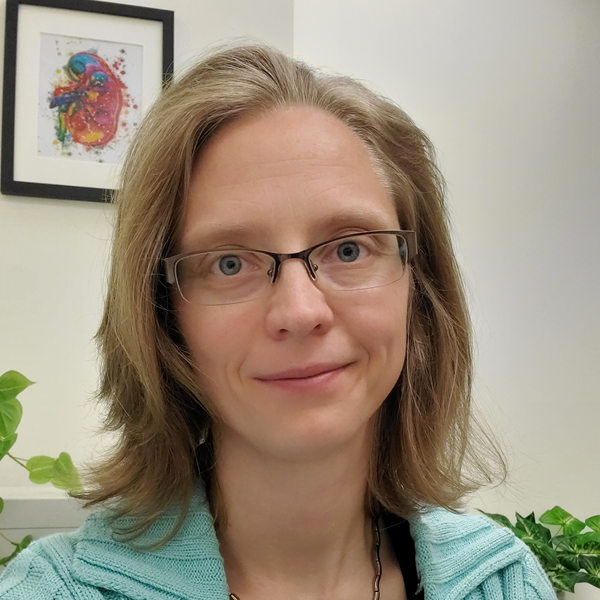
2021 Grant Recipient, Katharina Hopp, UC Denver
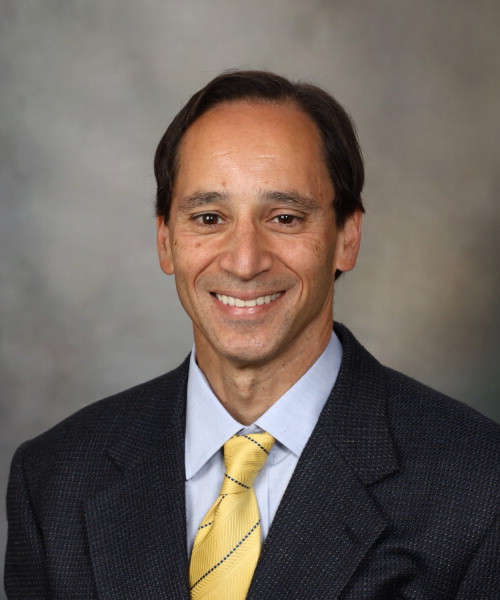
2020 Grant Recipient, Eduardo Chini, Mayo Clinic

2020 Grant Recipient, Roman-Ulrich Muller, University of Cologne
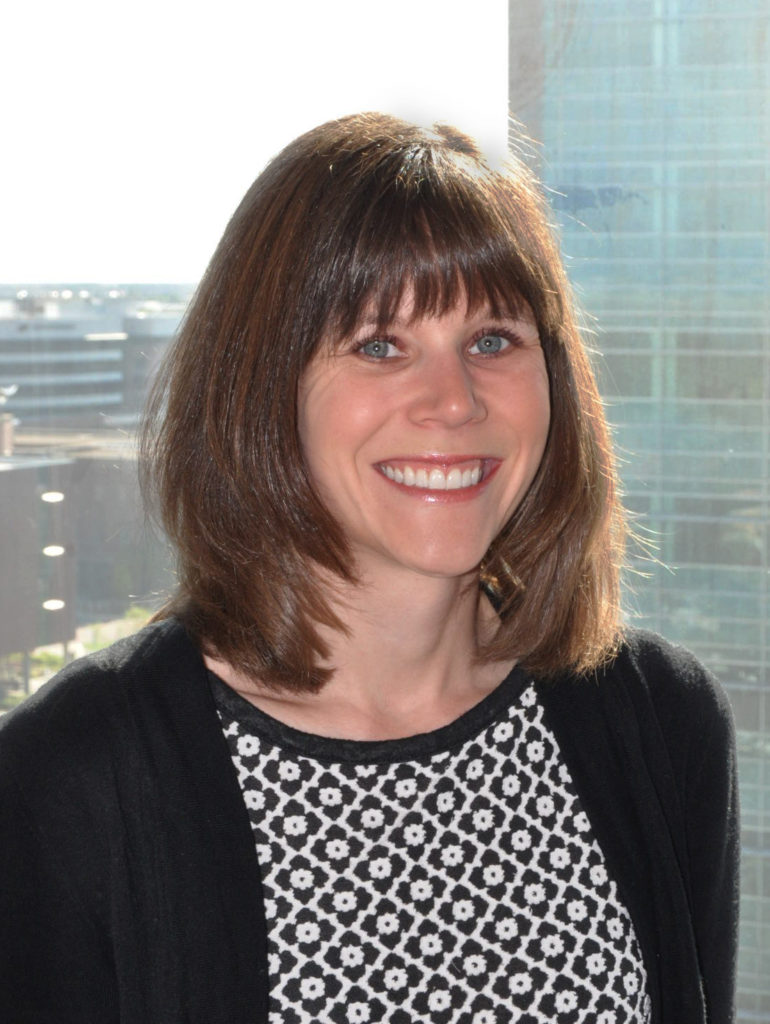
2020 Grant Recipient, Kristen Nowak, UC Denver
We’re funding basic science to understand the mechanism by which dietary or nutritional interventions slow disease progression. This will assist in the evaluation of the results from future clinical studies. These funded projects include:
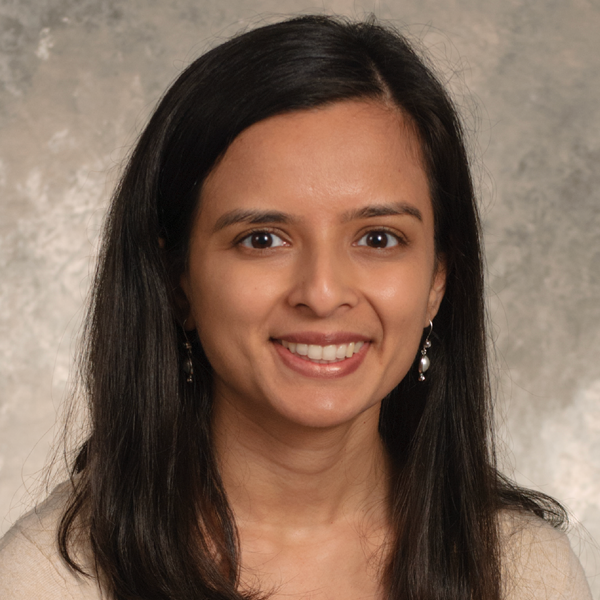
2021 Grant Recipient, Ronak Lakhia, UT Southwestern
2021 Grant Recipient, Jelena Klawitter, Ph.D., University of Colorado Anschutz Medical Campus
Beyond informing how diet can slow progression, this research may reveal new mechanisms in how ADPKD progresses. Hopefully, it’ll present new approaches in treating ADPKD.
---
Interested in ADPKD and ARPKD research in people? Through our Act Alert program, you can sign up for notifications about ongoing research studies and clinical trials. Choose to receive [ADPKD-related](https://go.pkdcure.org/l/886163/2020-10-29/49bx) alerts or [ARPKD](https://go.pkdcure.org/l/886163/2021-08-02/3765w) alerts. Interested in both? Sign up for both!
**Formats:** Blog Post
**Resource Categories:** ADPKD, ARPKD, Diet, Education, Living with PKD, Newly Diagnosed, Research, Staying Healthy
**Global Categories:** ADPKD, Clinical Trials, Diet, Nutrition, Research
---
### [ACN Spotlight: Lainie Esquivel](https://pkdcure.org/resources/acn-spotlight-lainie-esquivel/)
**Published:** June 8, 2022
**Author:** fiftyandfifty
**Content:**
**Published on June 7, 2022** \| In order to advocate for our community, we formed the [Advocacy Champions Network (ACN).](https://pkdcure.org/introducing-the-advocacy-champions-network/) The ACN connects advocates to their local legislators, helping further PKD-centered legislation. Each member has their own unique path to advocacy. Continuing our ACN spotlight series, today we’re highlighting ACN member Lainie Esquivel.
### **What does being an advocate for the [ACN](https://pkdcure.org/introducing-the-advocacy-champions-network/) mean to you?**
**Lainie Esquivel:** I think everyone diagnosed with PKD processes it in their own way. For me, I’ve always struggled with accepting what the future holds, knowing how PKD has impacted other family members. By taking an active role in advocacy efforts, I feel that I’m investing my energy in a positive way and contributing to a better life for future generations.
### **What are you most excited to do as an ACN Champion?**
**Lainie Esquivel:** In my short time as an ACN Champion, I’ve loved learning more about the legislative process and how I can become a more active participant to advocate for the PKD community. Connecting with my representatives has always felt incredibly daunting and intimidating. With the support of my fellow ACN Champions, I wrote 10-15 holiday cards for members of Congress near and far. I’m so excited to see what conversations arise this year!
### **What is one piece of advice you’d give to aspiring advocates?**
**Lainie Esquivel:** Start small! Your voice matters! Advocacy can be a fulfilling way to build your personal community of people touched by PKD.
### **At what moment did you realize you wanted to be an advocate?**
**Lainie Esquivel:** I submitted a [Voices of PKD](https://connect.pkdcure.org/voices-of-pkd/) story last year and was invited to submit a recording for a research summit this summer. It was a huge step out of my comfort zone, but I felt so supported by the PKD Foundation. As I explained my story and gave my perspective into what might help patients like me, something sparked within me. I knew I had to continue pursuing these opportunities.
### **Are there any resources that have helped you throughout your PKD journey?**
**Lainie Esquivel:** Recently, it’s been valuable for me to participate in various Facebook groups within the PKD community, including tolvaptan support groups. While I have a wonderful relationship with my nephrologist, there is something so valuable about hearing someone’s day-to-day experience.
### **Can you tell us about your PKD journey?**
**Lainie Esquivel:** I was diagnosed with PKD in my early 20s and I’m the third generation in my family, as far as we know. Despite that, It’s been so encouraging to see the positive progress in each generation. My grandfather was diagnosed late in life and needed dialysis and my father received a living donation from my mother. Now, I have the opportunity to consider tolvaptan for treatment. Although I’m sometimes disheartened by the complications I’ve experienced, most recently a near-septic kidney infection and preeclampsia during my pregnancy with my daughter, my heart is so full for the opportunities the future holds. I’m loving being a new member of the ACN. I love building relationships within the PKD community and working together to improve outcomes for current and future patients!
##### Want to learn more about Lainie’s advocacy work?[ Check out her op-ed in the *The Fresno Bee*](https://www.fresnobee.com/opinion/readers-opinion/article265802856.html). If you’re interested in ACN activities, **[sign up](https://p2a.co/rpqRAYS)** to receive **PKD Advocacy Alerts** and the latest advocacy news.
**Resource Categories:** Advocacy
**Global Categories:** ADPKD, Advocacy
---
### [ACN Spotlight: Alix Piccirilli](https://pkdcure.org/resources/acn-spotlight-alix-piccirilli/)
**Published:** April 5, 2022
**Author:** fiftyandfifty
**Content:**
**Published on April 5, 2022** \| Launched in 2020, the [Advocacy Champions Network (ACN)](https://pkdcure.org/introducing-the-advocacy-champions-network/) is an exclusive community of patients, family members, and clinicians dedicated to improving the lives of people living with PKD. The inaugural ACN class consisted of 36 members from 22 states. Since then, the ACN helped connect advocates to their local legislators, including helping set 33 Capitol Hill meetings in 2021. To get to know our ACN members a little more, we’ll be sharing their path to advocacy stories in a new series. Today, we’re highlighting ACN member Alix Piccirilli.
### **What does being an advocate for the [ACN](https://pkdcure.org/introducing-the-advocacy-champions-network/) mean to you?**
It’s so important for me to be an advocate not only for my son but also for others with PKD. I always try to engage others and explain why I am passionate about PKD, how they can help, and get them excited about collaborating on a common goal. Whether it’s fundraising, the ACN, working with doctors, or supporting other families, I want my son to understand the importance of working with others to make strides toward the common good.
### **What is one piece of advice you’d give to aspiring advocates?**
Try it! There are so many ways to get involved and advocate for PKD causes, you never know which ones you’ll enjoy the most, how much fun they can be, or who you’ll meet! You may also discover a new talent or skill but you won’t know until you try.
### **How has the PKD Foundation, the ACN, or the PKD community affected your life?**
Volunteering with the PKD Foundation has really helped me feel like I am part of a larger community working toward the same goal. I’ve met so many amazing people through the Foundation and it’s given me a way to channel my energy into something positive.
### **Are there any resources that have helped you throughout your PKD journey?**
These could include websites, blog posts, social media groups, books, movies, songs, etc. I’m part of the PKD in Children Parent’s Chapter and the ARPKD Facebook groups.
### **Can you tell us about your PKD journey?**
Our son was five when I asked his pediatrician for advice about bedwetting. After referrals and testing, doctors told us he had ARPKD. I’d never heard of PKD and I didn’t know anyone who had it; I was shocked and devastated. We traveled to D.C., to meet with Dr. Guay-Woodford who was wonderful and helped explain our son’s condition. He is now nine and doing very well. Since his diagnosis, I’ve looked for ways to volunteer, fundraise, and connect with other families. The PKD Foundation has been a great way for me to get involved and feel like I’m helping work toward finding treatment and a cure for my son and others impacted by this disease.
##### Now that you know more about the ACN, are you interested in ACN activities? Ready to learn more about how you can advocate for PKD patients and families? **[Sign up](https://p2a.co/rpqRAYS)** to receive **PKD Advocacy Alerts** and the latest advocacy news. And don’t forget to join us for the **PKDF Virtual Advocacy Day** on April 27, **[register to attend](https://support.pkdcure.org/event/pkd-foundation-virtual-advocacy-day-2022/e395682)** today.
**Formats:** General Info
**Resource Categories:** Advocacy
**Global Categories:** Advocacy, ARPKD
---
### [5 Reasons to Make Your PKD Legacy Estate Plan](https://pkdcure.org/resources/5-reasons-to-make-your-pkd-legacy-estate-plan/)
**Published:** October 20, 2022
**Author:** fiftyandfifty
**Content:**
**Published on October 20, 2022** \| Have you ever thought about your PKD legacy? This week, we’re celebrating National Estate Planning Awareness Week. One way to create a PKD legacy is by including the PKD Foundation in your estate plan.
## Estate Plan Basics
So, what’s an estate plan? It’s an easy way to ensure how your assets will be preserved, managed, and distributed after your lifetime. A plan can be created online, but most often, it’s completed with the guidance of an attorney. As we come into fall and the season of giving, one way to consider giving to your loved ones and your favorite organizations can be by setting up a legacy plan while also giving yourself peace of mind.
#### Why should you be estate planning?
#### **1. You need more than a will**
A properly designed estate plan allows you to direct distribution of assets including gifts to charities that you want to leave a legacy at or endow your annual giving.
#### **2. It saves time and money**
By doing your legacy planning while living, you keep assets and the estate from being probated. Probate court is often expensive and time consuming for your family.
#### **3. It helps avoid big taxes**
A professionally written estate plan can direct funds in ways that will minimize or eliminate taxes completely.
#### **4. Protects your children**
Legacy planning can protect the assets for your heirs. It also offers life income arrangements to protect and preserve assets directed to children, and in many cases, their heirs in the future. You can rest easy knowing your children and grandchildren will be taken care of.
#### **5. Protects your future**
Good estate planning can provide for you as well as your heirs and even provide support for organizations like the PKDF. Who count on support from generous supporters to continue our critical work and mission to one day End PKD.
## The PKD Foundation is Here to Help
As dedicated and supportive donors, we kindly ask that you continue your support of the PKDF after your lifetime. Celebrate National Estate Planning Awareness Week with us by including the PKDF in your legacy plan. We’d love to hear about your plans and recognize your generosity in our Legacy of Hope campaign.
For more information, visit [pkdcure.org/give](https://pkdcure.org/give/). Additionally, you can speak with a PKD Foundation philanthropic advisor by contacting us at <donorrelations@pkdcure.org> or (816) 931-2600.
---
[Year-end giving](https://pkdcure.org/tod-account-understanding-your-planned-giving-options/) is around the corner! Our team is here to help you as you choose how to distribute your 2022 charitable giving dollars. You can reach out to our team at <donorrelations@pkdcure.org> or (816) 931-2600 with your questions.
**Formats:** Blog Post, General Info
**Resource Categories:** Donate
**Global Categories:** Donate
---
### [5 Powerful Updates to the ADPKD Registry](https://pkdcure.org/resources/5-powerful-updates-to-the-adpkd-registry/)
**Published:** August 3, 2023
**Author:** fiftyandfifty
**Content:**
**Published on August 3, 2023** \| In 2019, the PKD Foundation launched the [ADPKD Registry](https://connect.pkdcure.org/adpkd-registry/), the first national patient-centered registry for people with autosomal dominant polycystic kidney disease. Four years later, the Registry has successfully opened much-needed avenues for discussion and data exchange between patients and researchers.
Last week, the Foundation launched an updated version called PKD Registry 2.0. Here’s an overview of five enhancements adding more value to patients and researchers.
## **1. Link to Patient Health Records**
Originally, the Registry only had patient-reported outcomes via surveys. In Registry 2.0, participating [patients can choose to connect their health records to the Registry](https://youtu.be/EIwIkjlp3Zs). This enables researchers to see patients’ latest labs, medications, and symptoms from their last doctor’s visit. The ADPKD Registry is one of the first patient registries to integrate patient-mediated provider health records.
*“It’s helpful to be able to compare that clinical data alongside the survey data where we learn about their family history and about how PKD impacts their life. Now, researchers can learn more about what that disease progression looks like.”*
##### **—Elise Hoover, Former PKD Foundation Vice President of Research Programs**
## **2. Improved User Experience**
After holding several forums with participants, Registry staff heard loud and clear that parts of it were unnecessarily time-consuming. When patients were asked to update their information, they had to re-enter details that hadn’t changed much from the last time.
For example, there are 25 questions in the core questionnaire, which asks about diagnosis, latest kidney function labs, and symptoms. It takes a long time to reenter the information every year.

*“We heard from many different people that that was a barrier. So, to improve their experience, we found a way to autofill past answers. We’re really excited that it’s now being offered.”*
##### **—Vanessa Holliday, PKD Foundation Research Strategist**
## **3. Personal Impact Calendar**
Holliday was also concerned about how the ADPKD Registry could help participants better understand their disease. In order to combat this, she came up with the Personal Impact Calendar. Each day, users can answer three short questions about their disease, such as pain, fatigue, and how the disease has affected their lives. After answering, various colors on the calendar reflect their answers.
“It makes the calendar interactive with the data visualization tool, where a person can select which type of calendar they’d like to see. They can look at their fatigue calendar over time and see the pattern. This not only helps the user to understand how they’ve been affected over a period of time, but they can share the information with their doctors as well,” Holliday says.
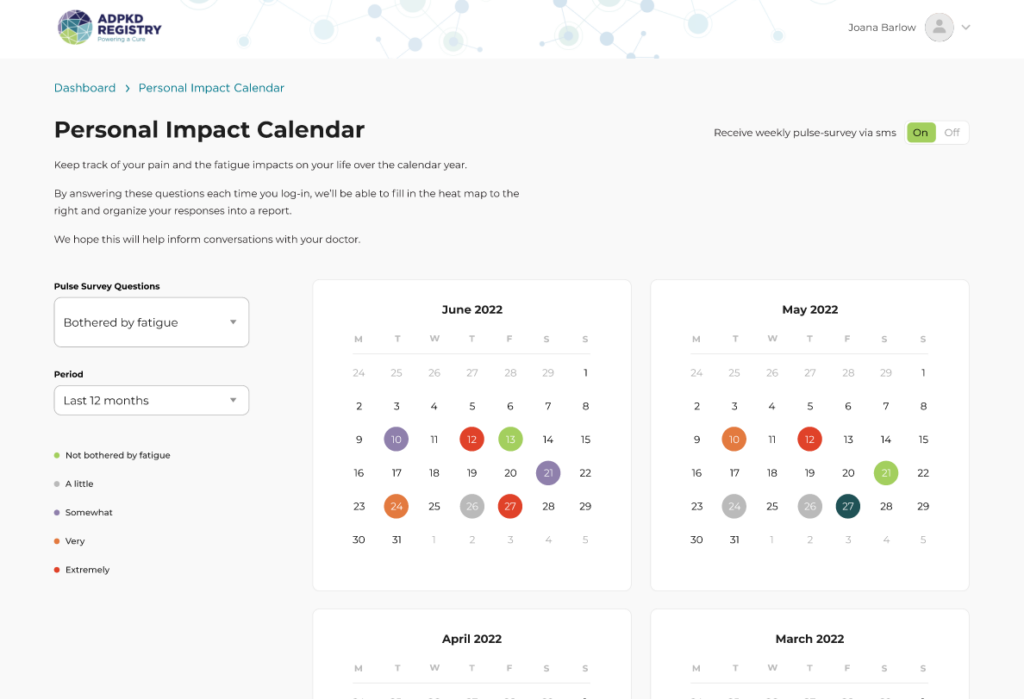 *Example of the Registry 2.0 Personal Impact Calendar*
## **4. Care Summary**
Another new feature is the Care Summary, which highlights information and trends such as kidney function, family history, diet, and water consumption. “This really clear format provides background and potential conversation points with their physician,” Holliday says. “It’ll facilitate more meaningful, direct conversations at appointments when time is limited.”
## **5. Data Sharing Portal**
Later this year, the ADPKD Registry will open up a data sharing portal for researchers. After submitting a formal request, researchers will be able to log in to a portal that shows de-identified, aggregated data based on what’s been gathered in the Registry that could potentially aid in their research process. “This tool will be extremely useful for researchers and accelerate research. Hopefully, they’ll be able to utilize this data in all different aspects of the field,” Holliday says.
She notes that this change adds value not only for researchers but for participants as well.
“Patients understand that to find a cure, participating in research is important,” Holliday says. “So, when we introduced the idea of sharing their data more widely to our patients, the response was overwhelmingly positive.”
### **How You Can Join the ADPKD Registry**
Now that these updates are live, any ADPKD patient living in the U.S. is welcome to join the ADPKD Registry. If you’re interested in being a part of this important research tool or want more information, email <pkdcure@pkdcure.org>, call (816) 931-2600, or visit [pkdcure.org/registry](https://connect.pkdcure.org/adpkd-registry/).
---
**Want to see more articles like this?** Read the full issue of our magazine, *PKD Life*, and subscribe to future issues **[here](https://pkdcure.org/pkdlife/)**.
**Formats:** Blog Post, Living with PKD
**Resource Categories:** ADPKD, ADPKD Registry, Caregivers, Research
**Global Categories:** ADPKD, ADPKD Registry, Caregivers, Research
---
### [5 Important Kidney Topics for National Donor Day](https://pkdcure.org/resources/5-important-kidney-topics-for-national-donor-day/)
**Published:** February 14, 2023
**Author:** fiftyandfifty
**Content:**
**Published on February 14, 2023** \| Since 1998, February 14 has been observed as [National Donor Day](https://www.donatelife.net/celebrations/national-donor-day/). Beyond sending valentines, this day is dedicated to spreading awareness and education about organ, eye, and tissue donation. Donation an organ or tissue is one of the most generous acts a person can do.
According to the [United Network for Organ Sharing](https://unos.org/ "UNOS"), a total of 6,466 people became living organ donors in 2022. Setting a new record, [kidney transplants exceeded 25,000](https://unos.org/news/2022-organ-transplants-again-set-annual-records/) for the first year ever. This is an increase of 3.4% over 2021 and tens of thousands of lives changed for better.
### **1. Deciding to give a kidney donation**
While it’s easy to see why people become living donors, each donor has their own path to making the leap. Last spring, [Craig Gile shared the story](https://pkdcure.org/my-living-donor-journey-craig-gile/) of how he became a living donor to his friend, Klee. It was a big decision, but ultimately, the right one for him. On National Donor Day, we celebrate donors like Craig who give others a new chance at life.
“The lesson from this is that you should live your life in such a way that if something like this were to happen to you, someone would offer to do this for you,” shared Craig.
### **2. Preparing for a kidney transplant**
[With about 90,000 people waiting for a lifesaving kidney transplant](https://unos.org/policy/kidney-pancreas/), ensuring equitable allocation of kidneys is a priority for the entire donation and transplant community. in 2021, [kidney and pancreas policies](https://unos.org/news/new-kidney-pancreas-transplant-allocation-policies-in-effect/) took effect to “improve access for key groups of candidates, including children, women, ethnic minorities and candidates who are particularly hard to match for biological reasons.”
With such a long waitlist for transplants, it’s important for patients to be prepared. Last month, [we shared an article](https://pkdcure.org/preparing-for-a-kidney-transplant/) from our magazine, [*PKD Life*](https://pkdcure.org/pkdlife/), that helps outline everything you should keep in mind ahead of a kidney transplant.
### **3. Sharing a kidney donation story**
Imagine being a nephrologist and learning you have ADPKD from a routine day in the office. That was a reality for Greg Zollner, M.D. On National Donor Day last year, Greg shared the touching story of how his friend became his living donor. In his own words, Greg details his unique perspective of being on both sides of a nephrology appointment. National Donor Day is a great time to **[share your story ](https://connect.pkdcure.org/voices-of-pkd/)**and raise awareness of PKD.
### **4. Learning about protections for living donors**
Living donors play a vital role in treatment for numerous diseases, including PKD. Unfortunately, what comes after their generous gift can be a headache. Since 2021, we’ve worked with the [National Kidney Foundation](https://www.kidney.org/advocacy), [America Kidney Fund](https://www.kidneyfund.org/advocacy/), [Northwest Kidney Council](https://nwkidneycouncil.org/advocacy/), and [Dialysis Patient Citizens](https://www.dialysispatients.org/) to promote the Living Donor Protections Act (LDPA). So, what does that mean? At a state level, LDPA laws protect living organ donors from being fired solely for taking time off to recover from their surgery and prevent them from having their insurance premiums raised or be outright denied coverage for being a donor. In addition, many of these bills provide tax assistance or medical leave for donors.
Want to learn more about the LDPA? Check out [this blog](https://pkdcure.org/protecting-living-donors-state-level-advancements/).
### **5. Joining the [Transplant Games of America](https://www.transplantgamesofamerica.org/)**
Did you know very two years the Transplant Games of America hosts the world’s largest celebration of life? Their event brings together thousands of transplant recipients, living donors, donor families, caregivers, transplant professionals, and more. Over a week, 40 state teams and several international teams, consisting of transplant recipients and living donors, compete in 20 recreational and athletic competitions. Last year, the PKD community was in attendance with Iris Resto.
You can learn all about her experience at the games [here](https://pkdcure.org/pkd-represented-at-transplant-games-of-america/).
---
Thank you to everyone who’s chosen to give the gift of life by becoming a living donor! To learn more about the living donor process and transplantation, check out [these resources](https://pkdcure.org/living-with-pkd/transplant/about-donating-your-kidney/).
**Formats:** Blog Post
**Resource Categories:** ADPKD, ARPKD, Transplantation
**Global Categories:** ADPKD, Advocacy, Kidney donation, Kidney transplant, living donation, Living donor, Transplantation
---
### [PKD Chronicles: Measuring Progress: Understanding TKV in PKD Management](https://pkdcure.org/resources/measuring-progress-understanding-tkv-in-pkd-management/)
**Published:** August 13, 2025
**Author:** Sarah Lundak
**Content:**
[Download Transcript](https://pkdcure.org/wp-content/uploads/2025/09/PKD-Chronicles-Clinical-Trials-Transcript.docx)
What’s total kidney volume (TKV) and why is it a big deal for people with PKD? In this episode, we’re breaking down what total kidney volume is and its role in tracking the progression of PKD.
Discover:
- How TKV is measured
- What it signifies for disease progression
- Its implications for treatment decisions
- Guidance on how patients and caregivers can effectively communicate with their healthcare team about treatment options
Listen today for expert tips on partnering with your care team to manage PKD and monitor TKV.
**Resource Categories:** Podcast
**Global Categories:** Podcast
---
### [PKD Chronicles: What You Should Know About Tolvaptan](https://pkdcure.org/resources/pkd-chronicles-what-you-should-know-about-tolvaptan/)
**Published:** October 8, 2025
**Author:** Shayla
**Content:**
[Download Transcript](https://pkdcure.org/wp-content/uploads/2025/10/PKD-Chronicles-Tolvaptan-Transcript.pdf)
Unravel the story behind tolvaptan, a medication revolutionizing the treatment landscape for polycystic kidney disease (PKD), on *PKD Chronicles*.
**In our latest episode, we’ll:**
- Give a brief of the history of this drug.
- Explain how tolvaptan works and how it specifically targets the underlying causes of PKD
- Explore the nuances of using tolvaptan in PKD treatment, including its effectiveness and potential side effects.
Listen today to learn the ins and outs of first FDA-approved treatment for PKD.
**Resource Categories:** Podcast
**Global Categories:** ADPKD, Drug Therapy and Treatments, Management, Podcast, Tolvaptan, Treatment
---
### [PKD Chronicles: Understanding Clinical Trials and Registries in PKD Research](https://pkdcure.org/resources/pkd-chronicles-understanding-clinical-trials-and-registries-in-pkd-research/)
**Published:** September 11, 2025
**Author:** Shayla
**Content:**
[Download Transcript](https://pkdcure.org/wp-content/uploads/2025/09/PKD-Chronicles-Clinical-Trials-Transcript.docx)
In this episode of *PKD Chronicles*, we’re exploring how participation fuels progress in research and treatment development.
**Nephrologist and PKD researcher, Neera Dahl, M.D., joins us to help you discover:**
- Why clinical trials and registries are critical to advancing PKD research
- Common myths and concerns about participation
- How informed decisions can empower patients and caregivers
- The PKD Foundation’s ADPKD Registry and its role in connecting patients with research opportunities
Listen today to learn how you can play a pivotal role in shaping the future of PKD treatment and research.
**Resource Categories:** Podcast
**Global Categories:** Podcast
---
### [PKDCON 2023: ADPKD and Pregnancy Considerations](https://pkdcure.org/resources/pkdcon-2023-adpkd-and-pregnancy-considerations/)
**Published:** June 23, 2023
**Author:** Sarah Lundak
**Content:**
**Presenter:** Dallas Reed, M.D.
**COE:** Tufts
**Description:** Dallas Reed, M.D., shares important information about ADPKD and what it means for pregnancy. This talk covers key topics like managing high blood pressure and preeclampsia, what to expect during pregnancy and delivery, kidney health, urinary tract concerns, and how your baby will be monitored. You’ll also learn about planning ahead with pre-conception care and genetic testing.
**Formats:** Webinars
**Global Categories:** 2023, ADPKD, Management, PKD, PKDCON, Pregnancy, Webinar
---
### [PKDCON 2023: You Have Been Diagnosed with PKD, Now What?](https://pkdcure.org/resources/pkdcon-2023-you-have-been-diagnosed-with-pkd-now-what/)
**Published:** June 23, 2023
**Author:** Sarah Lundak
**Content:**
**Presenters:** Osama Amro, M.D., Alethea Ritchie, R.N.
**COE:** Swedish
**Description:** In this session, Osama Amro, M.D., and Patient Navigator Alethea Ritchie, R.N., talk about what it’s like being newly diagnosed with ADPKD. They discuss the emotional impact of early-stage disease, the nutrition challenges that can come with it, and how to start building a supportive health care team to help you manage your condition.
**Formats:** Webinars
**Global Categories:** 2023, ADPKD, Diagnosis, Living with PKD, Management, PKD, PKDCON, Progression, TKV, Tolvaptan, Total kidney volume, Webinar
---
### [PKDCON 2023: PKD Manifestations 'Outside' of the Kidneys](https://pkdcure.org/resources/pkdcon-2023-pkd-manifestations-outside-of-the-kidneys/)
**Published:** June 23, 2023
**Author:** Sarah Lundak
**Content:**
**Presenter:** Ashima Gulati, M.D., Ph.D.
**COE:** Children’s National
**Description:** This session focuses on how ARPKD (autosomal recessive polycystic kidney disease) can affect children beyond their kidneys. Learn what to watch for and how to manage common complications, including liver involvement, high blood pressure, and fluid needs. Ashima Gulati, M.D., Ph.D., covers what ARPKD may look like before birth, special considerations for infants, and why a team of different specialists is important for providing the best care.
**Formats:** Webinars
**Resource Categories:** ADPKD
**Global Categories:** 2023, ADPKD, Caregivers, CHF, Children, Congenital Hepatic Fibrosis, PKD Parents, PKDCON, Webinar, Wellness, Young Children
---
### [PKDCON 2023: Transplant 101](https://pkdcure.org/resources/pkdcon-2023-transplant-101/)
**Published:** June 23, 2023
**Author:** Sarah Lundak
**Content:**
**Presenter:** Sixto Giusti, M.D.
**COE:** Colorado University School of Medicine
**Description:** This session walks you through the kidney transplant journey—from the initial referral to life after surgery. You’ll learn about the different members of the transplant team who guide and support you along the way. Sixto Giusti, M.D., will also explain your transplant options and help clear up common questions and concerns about the transplant process.
**Formats:** Webinars
**Global Categories:** 2023, ADPKD, Kidney transplant, PKD, PKDCON, Transplant evaluation, Webinar
---
### [PKDCON 2023: PKD Screening: Tools, Timeline, Impact](https://pkdcure.org/resources/pkdcon-2023-pkd-screening-tools-timeline-impact/)
**Published:** June 23, 2023
**Author:** Sarah Lundak
**Content:**
**Presenter:** Neera Dahl, M.D., Ph.D.
**COE:** Mayo Rochester, Emory
**Description:** Neera Dahl, M.D., explains what to expect during your first visit with a PKD specialist and how you and your doctor can work together to manage your care. She talks about how PKD can progress over time, the role of both genetics and environmental factors, and why tracking your total kidney volume (TKV) is important for understanding your disease and making informed decisions.
**Formats:** Webinars
**Global Categories:** 2023, ADPKD, Diagnosis, genetic testing, Management, PKD, PKDCON, Webinar
---
### [PKDCON 2023: Nutrition and PKD](https://pkdcure.org/resources/pkdcon-2023-nutrition-and-pkd/)
**Published:** June 23, 2023
**Author:** Sarah Lundak
**Content:**
**Presenter:** Haewook Han Ph.D., R.D., LDN, FNKF
**COE:** Tufts
**Description:** Haewook Han Ph.D., R.D., LDN, FNKF, talks about the role of nutrition in managing PKD. She covers what can cause chronic kidney disease, how much water you should drink, nutrition goals for people with PKD, tips for maintaining a healthy weight, how to build a balanced meal plan, and how to read food labels to make healthier choices.
**Formats:** Webinars
**Global Categories:** 2023, ADPKD, Diet, Nutrition, PKD, PKDCON, Webinar
---
### [PKDCON 2023: Use of Exosomal Polycystin-1 (PC1) Level to Diagnose and Monitor PKD](https://pkdcure.org/resources/pkdcon-2023-use-of-exosomal-polycystin-1-pc1-level-to-diagnose-and-monitor-pkd/)
**Published:** June 23, 2023
**Author:** Sarah Lundak
**Content:**
**Presenter:** Christopher Ward, MBChB, Ph.D.
**COE:** University of Kansas
**Formats:** Webinars
**Global Categories:** 2023, ADPKD, PKD, PKDCON, Research, Webinar
---
### [PKDCON 2023: PKD Management after Kidney Transplant](https://pkdcure.org/resources/pkdcon-2023-pkd-management-after-kidney-transplant/)
**Published:** June 23, 2023
**Author:** Sarah Lundak
**Content:**
**Presenter:** Jeffrey Klein, M.D.
**COE:** University of Kansas
**Description:** Jeffrey Klein, M.D., helps you understand how to take care of your health after a kidney transplant. He discusses important topics like screening for brain aneurysms, possible liver issues, managing pain, dealing with digestive problems, and staying connected with your PKD care team from before your transplant.
**Formats:** Webinars
**Resource Categories:** ADPKD
**Global Categories:** 2023, ADPKD, Immunosuppression, Kidney transplant, Living Post-Transplant, PKD, PKDCON, Webinar
---
### [PKDCON 2023: PKD and Nutrition Post Transplant](https://pkdcure.org/resources/pkdcon-2023-pkd-and-nutrition-post-transplant/)
**Published:** June 23, 2023
**Author:** Sarah Lundak
**Content:**
**Presenter:** Melanie Betz M.S., R.D., CSR, CSG, FAND
**Description:** Melanie Betz, M.S., R.D., CSR, FNKF, FAND, shares helpful tips for a healthy recovery after a kidney transplant, including which foods to avoid and how to support your healing through nutrition.
**Formats:** Webinars
**Global Categories:** 2023, Diet, Living Post-Transplant, Nutrition, PKD, PKDCON, Webinar
---
### [PKDCON 2023: How to Navigate the Emotions of Having a Child Diagnosed with PKD](https://pkdcure.org/resources/pkdcon-2023-how-to-navigate-the-emotions-of-having-a-child-diagnosed-with-pkd/)
**Published:** June 23, 2023
**Author:** Sarah Lundak
**Content:**
**Presenter:** Alix Piccirili and Betsy Pruzinsky, LPC
**Description:** In this video, Alix Piccirilli and Betsy Pruzinsky, LPC, explore the emotional journey that comes with living with PKD. They discuss what to expect during different stages—from prenatal to older childhood—and offer practical tips to reduce anxiety and improve quality of life. The session also includes insights for siblings without PKD, combining expert and caregiver perspectives to support the whole family.
**Formats:** Webinars
**Global Categories:** 2023, ADPKD, ARPKD, Caregivers, Children, PKD, PKD Parents, PKDCON, Webinar, Wellness, Young Children
---
### [PKDCON 2023: How to Live Your Best Life on Dialysis](https://pkdcure.org/resources/pkdcon-2023-how-to-live-your-best-life-on-dialysis/)
**Published:** June 23, 2023
**Author:** Sarah Lundak
**Content:**
**Presenter:** Kerri McGreal, M.D.
**COE:** University of Kansas
**Description:** Kerri McGreal, M.D., breaks down the essentials of dialysis—what it is, the treatment options, possible complications, and practical tips for maintaining a healthy lifestyle while on dialysis. Whether you’re just starting treatment or seeking ways to improve your day-to-day experience, this video offers straightforward information and encouragement.
**Formats:** Webinars
**Global Categories:** 2023, Dialysis, PKD, PKDCON, Webinar
---
### [PKDCON 2023: Dietary Interventions and Metabolism for Polycystic Kidney Disease | Part 2](https://pkdcure.org/resources/pkdcon-2023-dietary-interventions-and-metabolism-for-polycystic-kidney-disease-part-2/)
**Published:** June 23, 2023
**Author:** Sarah Lundak
**Content:**
**Presenter:** Charles Edelstein, M.D., Ph.D. / Cortney Steele, Ph.D.
**COE:** University of Colorado
**Description:** Discover insights into diet, metabolism, and their impact on polycystic kidney disease (PKD). Charles Edelstein, Ph.D., will share research on how increasing uric acid levels—using a specific medication—affects disease progression in PKD animal models. Cortney Steele, Ph.D., will explain how she used advanced computer technology (machine learning) to analyze images from a major PKD clinical trial and explored how body fat around organs (visceral fat) may be linked to changes in total kidney volume (TKV).
**Formats:** Webinars
**Global Categories:** 2023, ADPKD, Diet, Nutrition, PKDCON, Research, Webinar
---
### [PKDCON 2023: Dietary Interventions and Metabolism for Polycystic Kidney Disease | Part 1](https://pkdcure.org/resources/pkdcon-2023-dietary-interventions-and-metabolism-for-polycystic-kidney-disease-part-1/)
**Published:** June 23, 2023
**Author:** Sarah Lundak
**Content:**
**Presenters:** Kotdaji Ha Ph.D., Sadrija Cukoski, Ph.D.
**Description:** Hear about research on diet and metabolism in polycystic kidney disease (PKD). Kotdaji Ha, Ph.D., will share insights from her research on how the polycystin protein complex is regulated in the body—important for understanding how PKD develops. Sadrija Cukoski, Ph.D., will discuss findings from the KETO-ADPKD trial in Germany, which explored how a ketogenic diet might affect PKD progression. This research was funded in partby the PKD Foundation.
**Formats:** Webinars
**Global Categories:** 2023, ADPKD, Diet, Nutrition, PKDCON, Research, Webinar
---
### [PKDCON 2023: Nephrectomy Surgery: Understanding the Risks and Benefits](https://pkdcure.org/resources/pkdcon-2023-nephrectomy-surgery-understanding-the-risks-and-benefits/)
**Published:** June 23, 2023
**Author:** Sarah Lundak
**Content:**
**Presenters:** Terry Watnick, MD, Amit Gupta, M.D.
**COE:** University of MD
**Description:** Terry Watnick, M.D., and Amit Gupta, M.D., provide an overview of native nephrectomy (kidney removal). They’ll explain the different types of nephrectomies, when and why this surgery might be needed, how doctors decide on timing, and the various surgical options available. This session will help you better understand what to expect if kidney removal becomes part of your treatment plan.
**Formats:** Webinars
**Global Categories:** 2023, ADPKD, Nephrectomy, PKD, PKDCON, Webinar
---
### [PKDCON 2023: What to Expect After Transplant Surgery](https://pkdcure.org/resources/pkdcon-2023-what-to-expect-after-transplant-surgery/)
**Published:** June 23, 2023
**Author:** Sarah Lundak
**Content:**
**Presenter:** Patrick Dean, M.D.
**COE:** Mayo Rochester, Emory
**Description:** Patrick Dean, M.D., helps patients and caregivers understand what recovery looks like after a kidney transplant. He’ll walk through what to expect in the weeks and months after surgery, including tips on managing medications, taking care of the surgical site, and the role of physical therapy. The session will also cover possible complications—like rejection, infection, or surgical issues—and how to spot and manage them. You’ll leave with a better understanding of the recovery journey and how to stay on top of your health after transplant.
**Formats:** Webinars
**Global Categories:** 2023, Kidney transplant, PKD, PKDCON, Transplant evaluation, Transplantation, Webinar
---
### [PKDCON 2023: Understanding the Forecast: How Well Will I Be Doing?](https://pkdcure.org/resources/pkdcon-2023-understanding-the-forecast-how-well-will-i-be-doing/)
**Published:** June 23, 2023
**Author:** Sarah Lundak
**Content:**
**Presenter:** Fouad Chebib, M.D.
**COE:** Mayo Jacksonville
**Description:** Fouad Chebib, M.D., guides patients on what to expect with polycystic kidney disease (PKD). He’ll talk about how doctors estimate disease progression, what total kidney volume means, why PKD can look different even among family members, and what resources are available to help you manage the condition and protect your kidney health.
**Formats:** Webinars
**Global Categories:** 2023, ADPKD, PKD, Progression, Webinar
---
### [PKDCON 2023: Long - term Complications of Kidney Transplants](https://pkdcure.org/resources/pkdcon-2023-long-term-complications-of-kidney-transplants/)
**Published:** June 23, 2023
**Author:** Sarah Lundak
**Content:**
**Presenter:** Naim Issa, M.D.
**COE:** Mayo Rochester
**Description:** Naim Issa, M.D., offers guidance on life after a kidney transplant. He’ll walk you through what to expect during recovery, how to manage common challenges, and ways to stay healthy with a weakened immune system. This session will help you feel more prepared and confident as you navigate life post-transplant.
**Formats:** Webinars
**Global Categories:** 2023, Complications, End Stage Kidney Disease, ESKD, Immunosuppression, Kidney transplant, Transplantation, Webinar
---
### [PKDCON 2023: Transitioning to Adult Care in ADPKD and ARPKD](https://pkdcure.org/resources/pkdcon-2023-transitioning-to-adult-care-in-adpkd-and-arpkd/)
**Published:** June 23, 2023
**Author:** Sarah Lundak
**Content:**
**Presenters:** Erum Hartung, M.D., MTR, Shawna Webb
**COE:** Children’s Hospital of Philadelphia
**Description:** Erum Hartung, M.D., and ARPKD patient, Shawna Webb, share practical advice for families navigating the shift from pediatric to adult care. They’ll offer tips on how caregivers can help children build confidence, speak up for themselves, and take an active role in managing their own health as they grow older and take on more responsibility for their care.
**Formats:** Webinars
**Global Categories:** 2023, ADPKD, ARPKD, Children, Healthcare, Healthcare Team, PKD Parents, Teens and Young Adults (13-20), Webinar
---
### [PKDCON 2023: ARPKD and Cystic Diseases in Children](https://pkdcure.org/resources/pkdcon-2023-arpkd-and-cystic-diseases-in-children/)
**Published:** June 23, 2023
**Author:** Sarah Lundak
**Content:**
**Presenters:**Sara Howden, Ph.D., Feng Qian, Ph.D., Christopher Banek, Ph.D.
**COE:** Australia
**Description:** Learn about exciting research focused on ARPKD (autosomal recessive polycystic kidney disease) and other cystic kidney diseases in children. Sara Howden, Ph.D., will share updates from her research using lab-grown cells to better understand ARPKD, a project supported by the PKD Foundation and PKD Foundation Australia. Next, Feng Qian, Ph.D., will explain how a part of the fibrocystin protein may help protect kidneys by supporting healthy mitochondria, the “powerhouses” of our cells. Finally, Christopher Banek, Ph.D., will discuss how a treatment approach, called renal denervation, may help reduce kidney cyst growth and improve heart and kidney function.
**Formats:** Webinars
**Global Categories:** 2023, ADPKD, ARPKD, living donation, Living donor, PKD, Transplantation, Webinar
---
### [PKDCON 2023: What You Should Know About Living Kidney Donation](https://pkdcure.org/resources/pkdcon-2023-what-you-should-know-about-living-kidney-donation/)
**Published:** June 23, 2023
**Author:** Sarah Lundak
**Content:**
**Presenter:** Sixto Giusti, M.D.
**Description:** Sixto Giusti, M.D., provides an understanding of the kidney donation process. Participants will gain insights into the emotional and physical aspects of the process and the supports available for recipients and donors. The session will also delve into the criteria required to be a suitable donor, including medical and psychological factors. Attendees will come away with a deeper appreciation of the important role informed decision-making places in the donation process and the need to identify and evaluate suitable candidates for optimal outcomes.
**Formats:** Webinars
**Global Categories:** 2023, ADPKD, ARPKD, living donation, Living donor, Transplantation, Webinar
---
### [PKDCON 2023: Your Child Has Been Diagnosed with PKD - Now What?](https://pkdcure.org/resources/pkdcon-2023-your-child-has-been-diagnosed-with-pkd-now-what/)
**Published:** June 23, 2023
**Author:** Sarah Lundak
**Content:**
**Presenter:** Lisa Guay-Woodford, M.D,
**COE:** Children’s Hospital of Philadelphia
**Description:** Lisa Guay-Woodford, M.D., offers a clear and compassionate overview of the basics of polycystic kidney disease (PKD). She talks about how PKD can affect children emotionally, what to do after a diagnosis, why nutrition matters, and how to build a strong healthcare team to support you or your loved one through the journey.
**Formats:** Webinars
**Resource Categories:** ADPKD, ARPKD, Diet, PKD Parents, Young Children
**Global Categories:** 2023, ADPKD, ARPKD, Children, Diet, Healthcare Team, Management, Nutrition, PKD Parents, Webinar, Young Children
---
### [PKD Chronicles: Navigating Life with Polycystic Kidney Disease](https://pkdcure.org/resources/pkd-chronicles-navigating-life-with-polycystic-kidney-disease/)
**Published:** May 14, 2025
**Author:** Sarah Lundak
**Content:**
[Download Transcript](https://pkdcure.org/wp-content/uploads/2025/07/PKD-Chronicles-Emotions-Transcript.docx)
This episode speaks directly to young people living with PKD, addressing the profound emotional challenges that come with the territory. From dealing with a new diagnosis to navigating feelings of loss and uncertainty, we tackle the mental health aspects of PKD head-on.
Join us for honest conversations about grief, resilience, and the mental hurdles unique to young adults on their PKD journey. Through real stories and expert advice, we provide comfort, understanding, and practical strategies to help young PKD warriors cope with the emotional toll. Tune in for a supportive and empowering discussion designed to resonate with and uplift young listeners.
**Resource Categories:** Podcast
**Global Categories:** Podcast
---
### [PKD Chronicles: Empowerment, support, and connection while navigating PKD - Part 2](https://pkdcure.org/resources/pkd-chronicles-empowerment-support-and-connection-while-navigating-pkd-part-2/)
**Published:** July 9, 2025
**Author:** Shayla
**Content:**
[Download Transcript](https://pkdcure.org/wp-content/uploads/2025/06/PKD-Chronicles-Family-Conversations-Part-2-Transcript.docx)
In this episode, we continue our conversation with Lisa Smallwood Belk and Alix Piccirilli, on how PKD has impacted their lives and families.
In part two, Lisa and Alix dive into practical, actionable ways people with PKD and their loved ones can make a difference, including:
- Connecting with the PKD community online
- Participating in clinical trials that are both valuable and rewarding
- Advocating to ensure lawmakers hear and support the PKD community’s needs
Don’t miss this inspiring conversation filled with tools, encouragement, and ways to expand your PKD circle.
**Global Categories:** Podcast
---
### [PKD Chronicles: Empowerment, support, and connection while navigating PKD - Part I](https://pkdcure.org/resources/pkd-chronicles-empowerment-support-and-connection-while-navigating-pkd-part-i/)
**Published:** June 12, 2025
**Author:** Shayla
**Content:**
[Download Transcript](https://pkdcure.org/wp-content/uploads/2025/07/PKD-Chronicles-Family-Planning-Transcript.docx)
From navigating complex medical decisions to managing emotional ups and downs, PKD can be overwhelming; but you don’t have to face it alone. In this episode, we explore how community, communication, and self-advocacy can significantly help people with PKD and their loved ones.
In this episode, we’re fortunate to have two guests, Lisa Smallwood Belk and Alix Piccirilli, sharing how PKD has impacted them and their families. Through their experiences, listeners will gain:
-Practical tips on when and how to talk about PKD.
-Tools to foster open communication with both family and healthcare professionals.
-Ways to support one another through ongoing, meaningful dialogue.
Listen today to hear valuable advice and insights from those who understand what life with PKD is like.
**Resource Categories:** Podcast
**Global Categories:** Podcast
---
### [The Best Ways to Prevent UTIs](https://pkdcure.org/resources/the-best-ways-to-prevent-utis/)
**Published:** October 5, 2021
**Author:** fiftyandfifty
**Content:**
**Published on October 5, 2021** \| Anyone can get a urinary tract infection (UTI), but having PKD can increase your risk of UTIs. One reason is that kidney cysts are prone to infection, allowing bacteria to build up and affect the urinary tract.
Symptoms of UTIs include pain or a burning sensation when you urinate and an urgent need to pass often small amounts of urine. If the infection spreads to the kidneys, you may experience fever, chills, and back pain.
[Takamitsu Saigusa, M.D.](https://pkdcure.org/researcher-spotlight-taka-saigusa-m-d/), a nephrologist at the University of Alabama at Birmingham, offers these tips for preventing UTIs.

#### **Stay hydrated**
Drink plenty of water and other fluids. The goal is to make sure your urine is light yellow or clear, not dark. Dr. Saigusa suggests setting a timer for every couple of hours to remind yourself to drink. (There’s no evidence that cranberry juice is better than any other beverage at preventing UTIs.)
#### **Practice good hygiene**
Most UTIs are caused by fecal bacteria. And because women have shorter urethras that are closer to the anus, they’re more prone to UTIs than men. Keep the genital area clean, and always wipe from front to back. Dr. Saigusa also recommends using an affordable bidet toilet seat that can be attached to the toilet. It is also a good idea to wear cotton underwear, which provides optimal ventilation to the genital area.
#### **Urinate right after intercourse**
This will flush out any bacteria that may have entered the urethra. Tell your doctor as soon as you notice symptoms of a UTI so you can start treatment as soon as possible.
---
Want to see more articles like this? Read the full issue of our magazine, *PKD Life*, and subscribe to future issues [here](https://pkdcure.org/pkdlife/).
**Resource Categories:** Living with PKD
---
### [PKD in Children](https://pkdcure.org/resources/pkd-in-children/)
**Published:** October 3, 2018
**Author:** fiftyandfifty
**Content:**
## About
The PKD Foundation has invested over $2 million since 2006 for research, support, education and awareness for ARPKD, ADPKD in children, and congenital hepatic fibrosis (CHF), a disease closely associated with ARPKD. This info sheet provides helpful information for parents of children with PKD, caregivers, and physicians.
**Formats:** Caregivers, PKD Parents
**Resource Categories:** Caregivers, PKD Parents
**Global Categories:** Caregivers, PKD Parents
---
### [Peer Ambassadors Raising Awareness and Inspiring Hope](https://pkdcure.org/resources/peer-ambassadors-raising-awareness-and-inspiring-hope/)
**Published:** November 1, 2022
**Author:** fiftyandfifty
**Content:**
**Published on November 1, 2022** \| This year, the PKD Foundation created the [Peer Ambassadors program](https://pkdcure.org/pkdf-launches-peer-ambassadors-program/). Established to build new bridges between the Foundation and previously underserved communities. Recently, two Peer Ambassadors, Tatiana Mangwi and Alyssia Gomez, attended events spreading the word about PKD. Each joining for their own reason, their hard work is connecting patients to the resources they need and raising awareness of PKD.
### What brought you to the PKD Foundation?
**Tatiana:** I was looking to learn more about the disease \[polycystic kidney disease\] and found the PKD Foundation.
**Alyssia:** I was diagnosed with PKD at the age of 20 and I found the PKD Foundation. The Foundation gave me an opportunity to gain support with my condition.
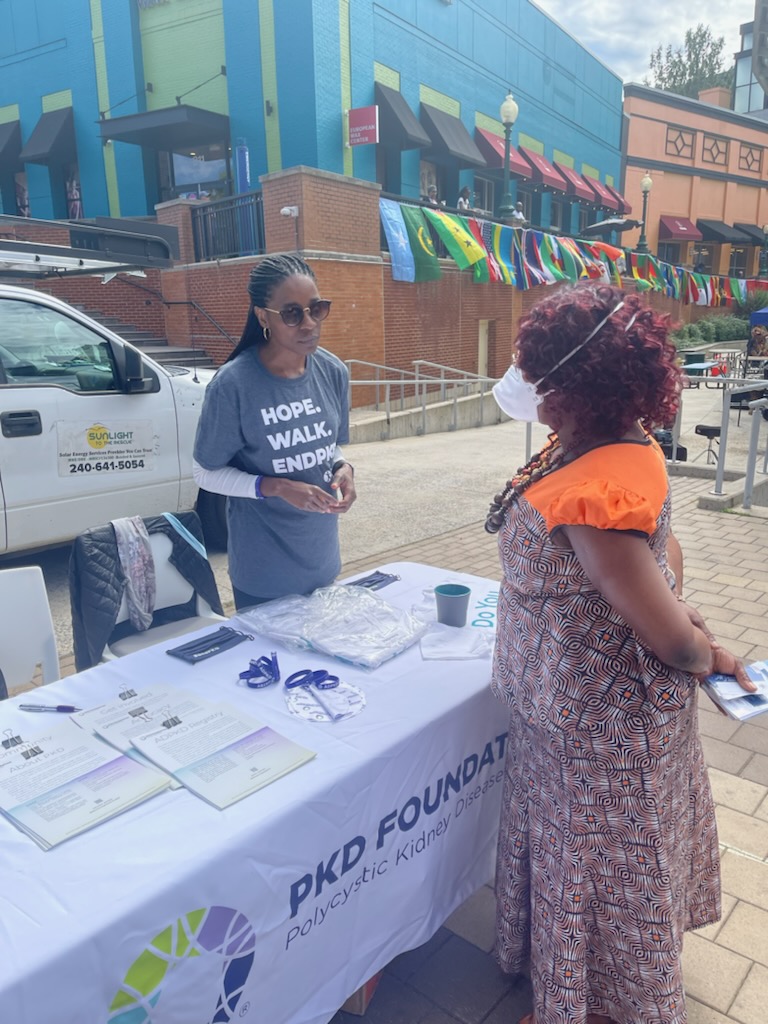Tatiana Mangwi spreading the word about PKD at Panafest.
### Why did you decide to become a volunteer and what drew you to the Peer Ambassador role?
**Tatiana:** Volunteering is a way for me to not feel helpless and help in my effort to bring a way for me not to feel helpless and help in my effort to bring the effort of bringing awareness to the disease and find a cure. Being a Peer Ambassador meant I could reach out to people like me and other minorities, something that is so needed because of the disparities that affect POC.
**Alyssia:** I believe awareness can help bring opportunities and a community to those with this condition. Through volunteering, I can support this effort.
### What’s your favorite part about the role?
**Tatiana:** I think my favorite part of being a Peer Ambassador is finding ways to reach as many people as possible. Making the choice to volunteer has given me so much hope and strength. That’s what I hope to inspire.
**Alyssia:** I’ve connected with individuals and families with PKD that I would never have met before.
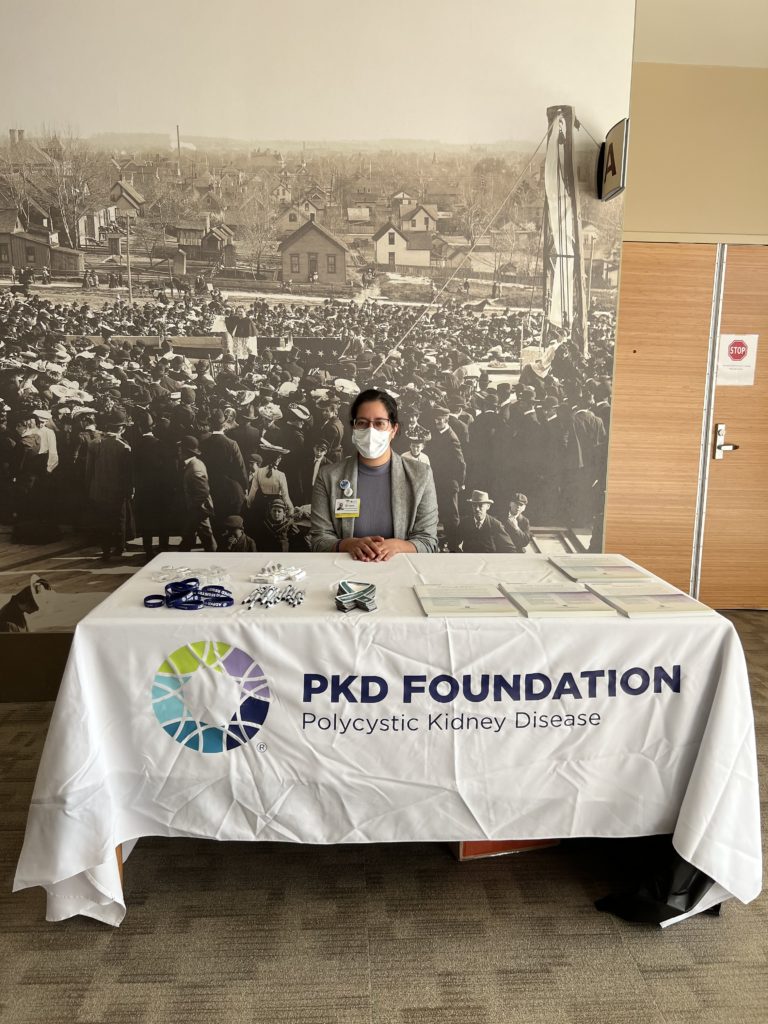Peer Ambassador Alyssia Gomez is ready to share facts about PKD at a Trinity Health Systems event at her local hospital.
### Can you tell us about the recent events you attended as an Ambassador?
**Tatiana:** We had an educational booth at the[ Panafest Festival](http://panafestusa.org) in Silver Spring, Maryland. It was my first event, but I learned that many people didn’t know about the disease, so hopefully I can do more events and spread the word.
Alyssia: At an event at my local hospital, I was able to meet a family who had PKD that was passed down by generations. And I was also able to give resources to the hospital.
### What goals do you have for this volunteer program?
**Tatiana:** My goal is to do more educational events and hopefully inspire more minorities with this disease to talk and share their experience.
**Alyssia:** To one day reach larger audiences. This will ensure PKD is better known and others with the condition are supported.
### How can others get involved?
**Tatiana:** There are so many ways to get involved. You can donate, volunteer with one of the PKDF communities in your area, or simply educate yourself on the disease to better support loved ones affected by PKD.
**Alyssia:** Support those who are presenting and give them platforms to do so.
Ready to get involved? [Learn more](https://pkdcure.org/wp-content/uploads/Peer-Ambassadors-Role-Description-1.pdf) or [**apply now**](https://docs.google.com/forms/d/e/1FAIpQLSei2tc5s38VZRGEPyAlk95tAbqvJ3hlweqDkZZyxgn0jXsHaw/viewform) to join the Peer Ambassadors program! Curious about other Peer Ambassadors? Check out Peer Ambassador Patrice Adams’s [vlog on Youtube](https://www.youtube.com/channel/UCUDRtyo4O--j8UFk3WGoGUQ) to see what she’s up to.
**Resource Categories:** Advocacy, Communities, Education, Living with PKD
**Global Categories:** Advocacy, Communities, Education, Living with PKD
---
### [My Living Donor Journey: Craig Gile](https://pkdcure.org/resources/my-living-donor-journey-craig-gile/)
**Published:** April 26, 2022
**Author:** fiftyandfifty
**Content:**
**Published on April 26, 2022** \| For 30 years, Klee Kleber and Craig Gile have been friends. Like the estimated 600,000 adults in the United States, Klee has autosomal dominant polycystic kidney disease (ADPKD). And Craig’s remained a steadfast friend on his journey with PKD. Together, they’ve even walked side by side at the Walk for PKD. Early in 2021, Klee mentioned that his kidney function was beginning to deteriorate; a transplant was needed. In order to understand the transplant process, Craig asked him questions. He quickly realized the wait for a transplant from a deceased donor can be extremely long. Generally, too long. So, Craig asked Klee about the [living donor](https://pkdcure.org/living-with-pkd/transplant/about-donating-your-kidney/) program—was it something he could do? Surprised, Klee said, “Well, yes, it is. If you’d be willing to try.” On December 16, 2021, Craig officially became a living donor to Klee.
Today, Craig’s sharing his story in becoming a living donor.
### **Deciding to Become a Living Donor**
I asked many friends \[who were doctors\] about the process, including a family member who’s a nephrologist. The feedback I received was that it’s a wonderful program, can be life-altering for the recipient, and that, if anything, they over-screen to ensure donors don’t put themselves into health jeopardy by signing up. When people ask me how I decided to do this, I tell them in some regards it’s selfish. I didn’t know how I’d live with myself watching my good friend’s health deteriorate knowing I could’ve at least looked into how I could help.
My family and friends have been remarkably supportive of me doing this. When we told our three sons I was looking to donate, my wife, Maureen, said something that still makes me choke up when I think about it. “The lesson from this is that you should live your life in such a way that if something like this were to happen to you, someone would offer to do this for you.”
### **The Living Donor Process**
The screening process was thorough, entailing multiple blood tests and a full work-up at the transplant center. They did a great job of explaining the process and answering all of our questions. I’ve been fortunate to have good health and that, plus the fact that I exercise regularly and have a pretty healthy diet, made me a good candidate for donation. I’m very happy I was in a position to donate my kidney. Klee has been a great friend for a long time (and would remain one regardless), but there’s certainly a new bond between the two of us and our families.
### **Thankful for Living Donors**

*“*PKD is a ‘doom disease.’ What I mean is, it’s usually diagnosed early in life and follows a consistent and depressing path, affecting multiple generations within families. I always knew that I would end up like my father, whose experience I saw firsthand. The medical community perpetuated this sense of doom since there were no treatments that could alter the disease’s course. It was ‘straight to dialysis’ and the end of a normal life for me and my family.
As my kidney function failed, every thought my wife, Brigid, and I had was against this backdrop of doom. The sinking feeling that planning for the future is futile. The only real hope was obtaining a kidney transplant. However, with a 10-year wait for a deceased-donor transplant, the only practical way forward was having someone step up to be a living donor.
Thankfully, my younger brother, Joe, generously donated in 2016 and gave me a new lease on life. Unfortunately, the transplant process is full of uncertainty. In 2018, that kidney went through a rejection, eventually failing in 2021. The sense of doom returned…but not for long. Before Brigid and I even started the process of finding another donor, Craig offered to give me and my family this new gift of life. Through all the medical testing and uncertainty around the transplant process, Craig was stalwart that *“this is going to get done.”* Even as my wife and I’d falter and start thinking about worst-case outcomes, Craig’s, and his wife, Maureen’s, positivity would pull us back on track and give us hope. That support meant the world to us. I feel fully recovered from surgery and I have a new life to live thanks to Craig and his family. We’re blood brothers now!*“*
##### ***—Klee Kleber, Transplant Recipient***
### **Post-Transplant Life**
Now, it’s been a few months since the surgery. Were it not for a small scar below my belly button, I wouldn’t know that we’d done this. The recovery process did take a few weeks, but really wasn’t bad at all. I had a lot of quality couch/TV binge time.
If not for my relationship with Klee, I would’ve been unaware of the opportunity to donate a kidney. I guess I kinda knew it happened, but I assumed the deceased organ system took care of supplying the organs. I’d like to help in any way I can to increase awareness of this opportunity and all that the process entails.
---
#### Every April is [National Donate Life Month](https://www.donatelife.net/) (NDLM). NDLM features an entire month of activities to help encourage Americans to register as organ, eye, and tissue donors and to honor those who’ve saved lives through the gift of donation. **Interested in learning more about becoming a living donor?** Find out more, [here](https://pkdcure.org/living-with-pkd/transplant/about-donating-your-kidney/).
**Resource Categories:** Transplantation
**Global Categories:** Transplantation
---
### [Securing the U.S. Organ Procurement and Transplantation Network Act Becomes Law](https://pkdcure.org/resources/securing-the-u-s-organ-procurement-and-transplantation-network-act-becomes-law/)
**Published:** October 5, 2023
**Author:** fiftyandfifty
**Content:**
**Published on October 3, 2023** \| On Friday, September 22, 2023, President Biden signed the [Securing the U.S. Organ Procurement and Transplantation Network Act (P.L. 118-140)](https://www.congress.gov/118/plaws/publ14/PLAW-118publ14.pdf) into law. Through this law, we’ll modernize and improve the Organ Procurement and Transplantation Network (OPTN).
The PKD Foundation was among several kidney care stakeholder organizations that endorsed the bill. Without the help of several elected officials, this historic measure never would’ve reached the president’s desk. Thank you to Representatives Larry Bucshon, M.D. (R-IN-08), Robin Kelly (D-IL-02), and Senators Ben Cardin (D-MD), Todd Young (R-IN), and Bill Cassidy, M.D. (R-LA) for shepherding this reform.
“As dedicated advocates for the PKD Community, the PKD Foundation is pleased to see the passage of the Securing the U.S. Organ Procurement and Transplantation Network Act. We hope to channel this momentum and continue working with our advocacy partners and Congress to make the Living Donors Protection Act law.”
–*Susan Bushnell, PKD Foundation President and CEO*
##### **Securing the U.S. Organ Procurement and Transplantation Network Act Background**
The OPTN is responsible for coordinating and managing the nation’s organ procurement, allocation, and transplantation efforts to increase access to donor organs for patients with end-stage organ failure. Since 1987, only one entity could administer and manage the OPTN— United Network for Organ Sharing (UNOS), a private nonprofit. This was through a contract with the Health Resources and Services Administration (HRSA).
In 2022, The Senate Finance Committee conducted an oversight hearing on UNOS. Following the hearing, they released a report citing areas for improvement in UNOS operations. The report revealed that 70 deaths from 2010 to 2020 were caused by operational failures within OPTN. Additionally, they cited significant areas of improvement pertaining to organ patient safety risks, outdated information technology, testing procedures, and processing. In response, the HRSA announced the [Organ Transplantation Network Modernization Initiative](https://www.hrsa.gov/optn-modernization) earlier this fall, setting off a wave of reform measures that would improve accountability, transparency, equity, and functionality in the OPTN.
As part of a broader effort to improve health outcomes, Congress introduced the Securing the U.S. Organ Procurement and Transplantation Network Act to support the more than 100,000 Americans on the organ transplant waiting list. With the current OPTN contract expires on September 30, which made these proposed changes of imminent importance to the Congress and the HRSA.
##### **What You Need to Know**
Firstly, the Securing the U.S. Organ Procurement and Transplantation Network Act ends the current UNOS monopoly by allowing the HRSA to open up bidding on new OPTN contracts by broadening eligibility criteria and the types of awards HRSA can grant to different organizations. This encourages new bidders with specialized expertise to participate, fostering innovation and modernization in the transplant system. Furthermore, the new law removes the $7 million funding limit for those OPTN contracts.
Additionally, the law establishes separate boards for the OPTN and OPTN contractors to promote transparency, accountability and oversight.
Finally, the OPTN contract requires the Government Accountability Office to create a report about the fees paid by users (likely related to organ transplants). This allows Congress to get a clearer picture of how the OPTN is currently funded. Also, the report will provide information on where the money comes from and how it’s used in the OPTN.
##### **Organ Procurement and Transplantation Network Act Impact on the Kidney Community**
Each day, 17 people die while waiting for an organ transplant, and of those, 12 are waiting for a kidney.
While we continue leading efforts to find a cure for PKD, transplantation remains the gold standard for treatment. Because of this new law, a more efficient organ procurement process that connects more patients with available organs is possible. By removing unnecessary barriers and increasing transparency and accountability, this law will save lives.
---
Start making your own impact on the PKD community today. Become a [PKD advocate](https://pkdcure.org/how-you-can-join-the-advocacy-champions-network/) and join the Advocacy Champions Network, [apply by **October 15**](https://go.pkdcure.org/l/886163/2021-04-23/27z3d).
**Resource Categories:** Advocacy, Education, Living Post-Transplant, Transplantation
**Global Categories:** Advocacy, Education, Living Post-Transplant, Transplantation
---
### [Running a Marathon for PKD](https://pkdcure.org/resources/running-a-marathon-for-pkd/)
**Published:** March 30, 2021
**Author:** fiftyandfifty
**Content:**
Published on March 30, 2021 \| What comes to mind when you think of ways to raise awareness of PKD? Attending the Walk for PKD, posting kidney facts on social media? As the spring weather settles in, there’s another active way to support awareness—[running a marathon for PKD](https://pkdcure.org/fundraise-way-kansas-father-runs-honor-son-raise-money-pkd-research/). And Heather Gillis is a veteran at running for PKD
### **How did you get involved with the PKD Foundation?**
**Heather:** We got involved with the PKD Foundation after our son, Bowen, died in 2011. We wanted to give meaning and purpose to his life, so we began raising money and awareness for the Foundation by hosting silent auction banquets and running races.

### **What made you decide to run a marathon for PKD?**
**Heather:** To raise money for the Foundation in honor of our son, Bowen, and to get closer to finding a cure.
### **Have you run a marathon for PKD before? If so, what was the experience like?**
**Heather:** I ran the NYC Marathon in 2014. We’ve also created our own races in which we raised money. We formed a team that ran the 2012 Arizona half Ironman, run in relay teams, and I’ve also and a half marathon in Alaska.
### **During the pandemic, has it been hard to train for a marathon? What are your tips?**
**Heather:** Yes and no. We live near a trail system so I have easy access to run outside. However, I do live in Colorado at 6,500 feet elevation, and the weather has been cold and with lots of snow. I’ve been doing core workout training and have access to a treadmill. My tips are to stay on a routine/schedule, do meal planning to get adequate nutrition, find a friend or two to train with and keep you accountable, and to create a good training program/schedule that fits your level of experience.
### **Are there other PKD awareness events you take part in besides marathons for PKD?**
**Heather:** I’ve participated in a few of the PKD walks, I’ve attended the National Convention in Kansas City before and met other parents with children who have PKD. I am also a part of a Facebook group of mothers who have lost a child to PKD.
### **Anything else you’d like to share?**
**Heather:** This will be my second time running the Chicago Marathon and my fifth overall marathon. When I was 24 years old, I participated in Chicago for the first time in 2000. Chicago was the first marathon I participated in and I didn’t really know what I was doing. I didn’t run another marathon (San Diego, California) until after our son died in 2013.
To my surprise, I qualified for the Boston Marathon and was accepted in 2013 to run. This was the year of the Boston bombings. We were standing only a block away from where the first bombs went off. The experience was surreal and life-changing. I knew I had to keep running and not let fear stop me. The next year I signed up for the NYC Marathon (2014), and I was so glad I did. It was an amazing experience to meet other runners running for PKD. Running has been a way for me to heal, spread awareness, raise money for PKD, and honor our son’s life.
**Resource Categories:** ADPKD, ARPKD, Run for PKD
**Global Categories:** ADPKD, ARPKD, Walk for PKD
---
### [Xenotransplantation: Animal to Human Transplants](https://pkdcure.org/resources/xenotransplantation-animal-to-human-transplants/)
**Published:** May 17, 2022
**Author:** fiftyandfifty
**Content:**
**Published on May 17, 2022** \| Each year, tens of thousands of patients need organ transplants. However, the supply of available organs is much smaller than the demand. In order to combat the tremendous shortage of organs available for transplantation, researchers are working on a non-human solution. Recently, there’s been progress by generating pigs suitable to support pig-to-human organ transplants. A process called **xenotransplantation**.
### **The Basics of Xenotransplantation**
#### What is it?
In short, xenotransplantation is grafting organs from animals into people.
#### Why do we need it?
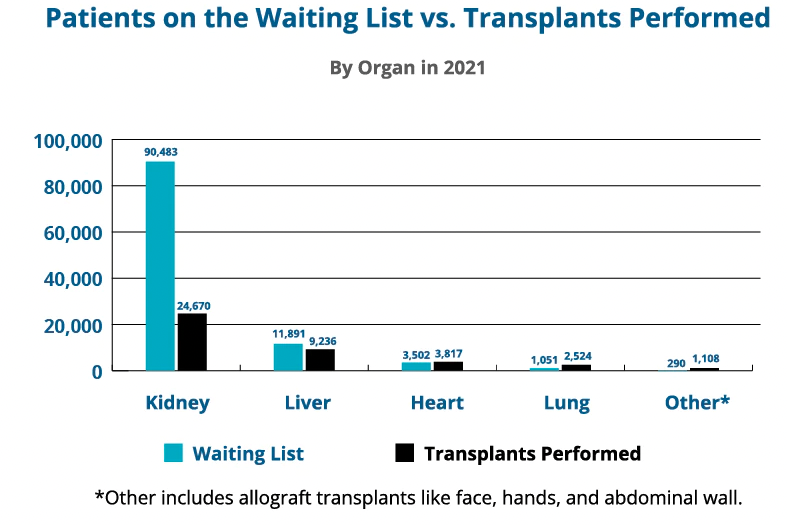
*Statistics provided by organdonor.gov.*
In 2021, there were 90,483 people on the [kidney transplant](https://connect.pkdcure.org/transplantation/) waiting list. But according to the [Health Resources & Services Administration](https://www.organdonor.gov/learn/organ-donation-statistics), only 26,470 kidney transplants were performed (less than one third). Furthermore, they note that approximately 106,000 people in the US are on the organ donation waiting list—**83% of whom are waiting for a kidney transplant**. There’s a huge gap between organs needed and organ availability.
So, how do we approach filling the organ gap? One approach is xenotransplantation. In the last nine months, there have been four examples of xenotransplantation of organs from pigs to humans. Three separate kidney studies and one heart study. These represent the first ever examples of xenotransplantation of pig organs.
### **The History of Xenotransplantation**
Research to understand the barriers of using xenotransplantation to address the human donor organs shortage has a long history. It can actually be traced back to the early 1900’s. By the early 1960’s, prior to the development of dialysis and the development of processes for obtaining deceased donor organs, several chimpanzee-to-human kidney transplants were attempted. Additionally, baboon-to-human kidney, heart, and liver transplants, were attempted. At the time, physician scientists expected that kidneys from closely related, nonhuman sources would respond similarly to human kidneys following transplantation into humans.
Given challenges and ethical concerns associated with using primates for this research, efforts transitioned to evaluating pigs as donor animals.
#### So, Why Pigs?
Since the 1990’s, pigs have been the animal of choice for xenotransplantation research for several reasons:
- Pig organs (particularly kidney and heart) function very similarly to human kidneys and hearts.
- In terms of kidneys, the kidney function measures in pigs and humans are very similar.
- Their organs are similar in size to humans.
- Pigs have a long life expectancy (~30 years). Meaning there’s hope that a pig-to-human transplant would be long-lived in the human recipient.
- Pigs reproduce relatively rapidly and have a large litter size providing the potential to produce a large supply of organs (eg. pigs are a scalable species to produce donor organs).
- They can be raised in environments free from pathogens (eg. viruses or bacteria that could potentially infect humans). This prevents the risk of transferring pig viruses into the recipient.Z
### **Overcoming Barriers**
In order to make xenotransplantation viable, we need to overcome several barriers. The first major barrier is that after transplantation of the pig organ, our immune system rapidly recognizes the organ as foreign and attacks it. This leads to immediate (eg. acute) rejection. Secondly, if drugs are used to suppress the immune response, the cells that line the blood vessels of the pig organ lack the factors needed to keep human blood from clotting within them. This causes blood clots to form within the donated organ leading to organ death.
Over the last 30+ years, researchers worked to find solutions to these barriers. Through research they identified:
- Critical factors on the pig organs recognized by the human immune system that lead to acute rejection
- Missing factors from the pig organs to maintain flow of human blood through the pig organ;
- Factors present in our tissues that help prevent our immune systems from attacking self
All these advances were necessary to define what would be needed for a pig organ to potentially survive in a human. However, scientists still needed to be able to engineer pigs with all necessary genetic changes from which one could obtain organs potentially suitable for xenotransplantation.
#### Genes and Xenotransplantation
Until recently, the tools to extensively genetically engineer pigs to make the necessary changes weren’t available. Gene editing technology has advanced to enable scientists to make substantial changes to pig genome. Therefor, making genetically engineering pigs potentially suitable for xenotransplantation. Scientists engineered pigs to produce organs compatible with the human immune and blood clotting systems. This is often called the “10-gene pig” in the news.
So, what does that mean? They removed genes from pigs that make the pig organs less pig-like to make them more human like. In the examples of pig-to-human kidney transplants, 10 genetic changes were made in the pigs. Three genes were removed from the pig that would trigger the human immune system and cause immediate rejection. Accordingly, a fourth gene was removed to prevent the pig organ from growing too large after transplantation. Altogether, six human genes were added to the pig to prevent the recipient’s immune system from attacking the organ and to prevent blood clots from forming in the organ.
### **Recent Experiments of Xenotransplantation**
Extensive testing has been done on genetically modified pig kidneys in pig-to-primate transplant studies. However, it’s a big jump to go from transplanting pig organs in primates to transplanting pig organs into humans. Importantly, there have been several medical interventions that looked promising in primates but had a different response in humans.
So, before proceeding to clinical studies, researchers conducted an intermediate experiment to obtain data in a human system without risking the life of a patient. Through consultation with ethicists, researchers decided that performing xenotransplants in brain-dead individuals (on life-support) would be an appropriate approach to understanding if pig-to-human kidney transplant is feasible. The same qualifying factors in identifying a deceased organ donor candidate were used in these studies. However, once a family consented to allowing their family member to participate, they could no longer qualify as a deceased donor in the future.
**Thank you to the families who donated a loved one for these experiments. Because of you, incredible advancements in science were made possible.**
### **Milestones in Kidney Xenotransplantation**
At [NYU Langone Health,](https://nyulangone.org/news/nyu-langone-health-performs-second-successful-xenotransplantation-surgery) a surgical team wanted to evaluate if an organ from a 10-gene pig would be protected from acute rejection and clot formation when attached to a brain-dead person on life support. Twice they attached a pig kidney to blood vessels in the thigh of the person to monitor survival of the organ and sample the tissue. Their goal was to understand how it responds to exposure to the human system.
Both experiments were successful. The organ survived and didn’t show signs of rejection through the planned 54-hour follow-up period and produced urine demonstrating the kidney functioned.
At the [University of Alabama, Birmingham](https://www.uab.edu/news/xenotransplant#:~:text=Researchers%20in%20UAB's%20Heersink%20School,%2C%20importantly%2C%20did%20not%20reject.), a surgical team wanted to evaluate if the tests they developed to properly cross-match a pig organ with a human recipient worked. Cross-matching is the donor matching process used to determine if a donor and patient are a suitable match. **This resulted in the first pig-to-human kidney transplant.**
They transplanted two kidneys obtained from a 10-gene pig into a brain-dead recipient on life support. Replicating the full clinical transplant process, the pig organs replaced the deceased organ donor. Much like the other experiment, this resulted in another success—the organ survived. Through the three day, follow-up period, it showed no signs of rejection and produced urine demonstrating the kidney functioned.
The success of both studies is a major milestone in the field of transplantation. Studies like these bridge critical knowledge gaps and obtain safety/feasibility data to support a clinical trial in humans with kidney failure. With their findings, xenotransplantation advances as a potential approach to filling the organ shortage gap.
### **What’s Next?**
I**n conclusion, it’s likely that more experiments like these will be conducted to provide additional feasibility and safety data, closing the remaining gaps in knowledge before moving to clinical studies.** There will need to be significant collaboration between research teams and the FDA. First, they’ll need to determine if enough is known to move to living people. Secondly, they’ll need to develop appropriate study protocols.
For example, ***how should patients be selected for such trials? What needs to be done to properly protect a patient who participates in such a study?***
The research teams that conducted these studies hope to transition to clinical studies in living patients in 1-2 years. As these studies progress, the path to faster transplantation becomes more likely.
**Resource Categories:** Research
**Global Categories:** Featured, Research
---
### [Spring PKD Advocacy Days Elevate Community's Needs](https://pkdcure.org/resources/spring-pkd-advocacy-days-elevate-communitys-needs/)
**Published:** May 8, 2024
**Author:** fiftyandfifty
**Content:**
**Published on May 8, 2024** \| This spring, the PKD Foundation and local advocates brought the needs of the polycystic kidney disease (PKD) community to Capitol Hill. Through two events, these passionate advocates elevated PKD-centric policies to Congress and called for vital research funding to improve the lives of people with PKD.
### **National Kidney Month Hill Day**
Determined to power change during National Kidney Month, PKD Foundation executive leadership went to Washington D.C. on March 20.
PKD Foundation President and CEO Susan Bushnell was joined by Vishal Patel, M.D., the Foundation’s Scientific Advisory Panel chair, and Advocacy Champions Gregory Mainolfi and Sean Piccirilli. Together, they advocated for policies to advance PKD research, treatment, and care across 13 congressional meetings.
**
*“This National Kidney Month, the Foundation wanted to meet directly with lawmakers in the nation’s capital to discuss how they can support the estimated 600,000 families affected by PKD. The discussions revealed a bipartisan resolve to meet PKD patient needs through dedicated research funding and legislative measures to facilitate lifesaving transplants and enhance PKD care.”*
##### **—Susan Bushnell, PKD Foundation President and CEO**
### **Virtual Advocacy Day**
On April 9, we had our largest Virtual Advocacy Day yet. This year, 107 PKD advocates, representing 29 states and Washington D.C., participated in 121 meetings. Compared to 2023, participation increased by 15 advocates and 11 meetings. Thanks to the commitment of the PKD Foundation community.
Because of PKD Foundation advocates, Representative Shri Thanedar is now a co-sponsor of the Living Donor Protection Act and Representative Eleanor Holmes Norton is cosponsoring the Living Organ Donor Tax Credit Act. Thank you to the PKD Foundation community for your commitment to creating change.
**
*“Meeting with Congress and their staff on Virtual Advocacy Day has been educational, empowering, and moving as they listen to the priorities that are so important and our stories about PKD life. They will remember us because of our Advocacy Champions stories and the strength we have in the face of polycystic kidney disease.”*
##### **—Jeannie Brown, PKD Foundation Advocacy Champion**
### 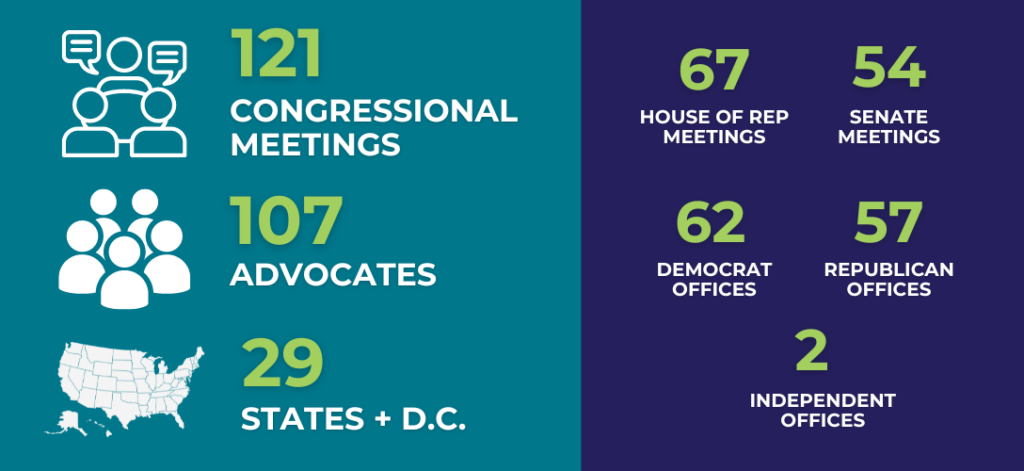
### **What topics did we discuss during these PKD advocacy days?**
Both Hill Day and Virtual Advocacy Day 2024 focused on three topics: **research funding**, the **Living Donor Protection Act**, and the **Living Organ Donor Tax Credit Act.**
#### **[Congressionally Directed Medical Research Program (CDMRP), Peer Reviewed Medical Research Program (PRMRP)](https://cdmrp.health.mil/prmrp/default)**
The CDMRP, PRMRP is one of the PKD Foundation’s top policy priorities. In total, the program provides $370 million in funding for a select list of disease topics. Every year, the Foundation submits over 40 appropriations requests to ensure PKD remains on the list of designated topics. Because of our advocacy efforts, PKD researchers are eligible to compete for the $370 million in available federal funding.
#### **[Living Donor Protection Act (S.1384/H.R.2923)](https://pkdcure.org/advocacy/living-donor-protection-act/#:~:text=Living%20Donor%20Protection%20Act%20of%202021%20%28S.&text=It%20will%20do%20this%20in,and%20protecting%20against%20increased%20premiums)**
Living donors show an incredible act of humanity in giving a part of themselves to another. This is also critical to PKD patients who experience improved outcomes when receiving a kidney from a living donor rather than a deceased donor. With a transplant, patients typically no longer face the burdensome requirements of dialysis, nor its potential complications.
To support living donors, the Living Donor Protection Act would prohibit insurance companies from denying or limiting life, disability, or long-term care insurance and from charging higher premiums to living donors. Additionally, it would ensure that living organ donors can use time granted through the Family Medical Leave Act (FMLA) to recover from donation. Transplant surgery is a major operation and comes with risks for complications just like any other. Both donors and recipients need time to recoup after surgery.
#### **[Living Organ Donor Tax Credit Act (H.R. 6171)](https://pkdcure.org/new-legislation-offers-5000-tax-credit-to-living-organ-donors/)**
There are over 90,000 individuals on the kidney transplant waitlist. In the United States, most kidney transplants come from deceased kidney donors. In 2023, just 6,290 kidneys were transplanted from living donors.
How will the Living Organ Donor Tax Credit Act help? In order to remove financial barriers for prospective organ donors, the act provides a $5,000 refundable tax credit to cover costs associated with living organ donation. For example, travel, lodging, medical fees, etc.
By helping eliminate financial barriers that could deter potential living donors, this legislation can save lives.
### **Interested in advocacy?**
Though Mini Day and Virtual Advocacy Day are over, PKD advocacy never stops. Join the [Advocacy Champions Network](https://pkdcure.org/advocacy/acn/) or sign up for [Advocacy Alerts](https://p2a.co/rpqRAYS) to further change year-round.
*The PKD Foundation Virtual Advocacy Day 2024 is made possible by a grant from Otsuka Pharmaceutical, Inc.*
**Resource Categories:** Advocacy, PKD News
**Global Categories:** Advocacy, Featured, PKD News
---
### [Why Did the FALCON Clinical Trial End?](https://pkdcure.org/resources/why-did-the-falcon-clinical-trial-end/)
**Published:** May 25, 2023
**Author:** fiftyandfifty
**Content:**
**Published on May 23, 2023** \| On May 10, the ongoing FALCON clinical trial was terminated early. FALCON is a Phase 3 clinical study evaluating the effectiveness and safety of bardoxolone methyl (an oral investigational drug) in patients with ADPKD. The study aimed for 850 participants to be studied for two years. But why was the study terminated early?
## **The FALCON Clinical Trial Precursor: AYAME**
AYAME was also a Phase 3, multi-center, randomized, double-blind, placebo-controlled trial to evaluate the efficacy and safety of bardoxolone. However, this clinical trial studied patients with diabetic kidney disease. Over three to four years, 1,013 patients were treated with 5 to 15 mg of bardoxolone or a placebo.
### AYAME Study Objectives
Primarily, the endpoint of the study was time to onset of a ≥ 30% decrease in estimated Glomerular Filtration Rate (eGFR) from baseline or onset of end-stage kidney disease (ESKD). Secondly, was time to onset of a > 40% decrease in eGFR from baseline or onset of ESKD.
In May 2023, Reata Pharmaceuticals’ strategic collaborator, Kyowa Kirin Co., announced results from the AYAME study after meeting it’s primary and secondary endpoints. Despite reaching those endpoints, **it resulted in no separation in the occurrence of ESKD events between the two study groups.** It didn’t appear that the drug impacted the timing of ESKD onset or time to the set decrease in eGFR.
## **How AYAME Results Impacted FALCON Clinical Trial**
In the AYAME study, there was no imbalance in adverse events and no significant safety issues were identified in patients receiving bardoxolone. Similarly, no safety issues were identified by the Data Monitoring Committee (DMC) as of February 2023 in the FALCON clinical trial.
However, based on the AYAME results and lack of evidence that the bardoxolone-treated groups saw a difference from the placebo groups, Reata and Kyowa Kirin decided to discontinue the clinical development of bardoxolone.
*“From a patient perspective, it’s important to remember that the trial was stopped because it failed to meet a pre-specified endpoint, not because of safety concerns. In our experience, ADPKD patients tolerated the medication well. We hope that some of these patients will consider participating in other trials in the future, as we believe there are many potentially interesting therapies on the horizon.”*
##### **—Neera Dahl, M.D., Ph.D, Adjunct Professor of Medicine, Yale University**
**Thank you** to all the investigators, clinical site staff, patients, families, and patient advocacy organizations for their tremendous efforts and participation in Reata’s clinical trial development. And thank you for your contribution toward the advancement of chronic kidney disease research.
### What Can We Do Now?
Though this isn’t the result we were hoping for, there are many ongoing studies in PKD. By participating, you can help investigators determine whether another drug might positively impact PKD. Find ongoing clinical trials in your area through our [Act Alert program](https://pkdcure.org/research-medical-professionals/clinical-trial-awareness-program/). Check out all ongoing clinical trials for PKD [here](https://clinicalstudies.pkdcure.org/questions/).
**Resource Categories:** Research
**Global Categories:** Research
---
### [What It's Like Being a Family Caregiver](https://pkdcure.org/resources/what-its-like-being-a-family-caregiver/)
**Published:** November 14, 2022
**Author:** fiftyandfifty
**Content:**
**Published on November 14, 2022** \| In November, we celebrate [National Family Caregivers Month](https://www.caregiveraction.org/national-family-caregivers-month). Family caregivers are a crucial pillar of our healthcare system, proving necessary care to their loved ones. Jennifer Visda knows firsthand what life is like as a [family caregiver](https://connect.pkdcure.org/caregivers/). As she cares for her husband, Rob, who has PKD, she’s seen all the ups, downs, stresses, and rewards that come with being a caregiver. For those wondering, here’s what life is like a caregiver in a PKD family.
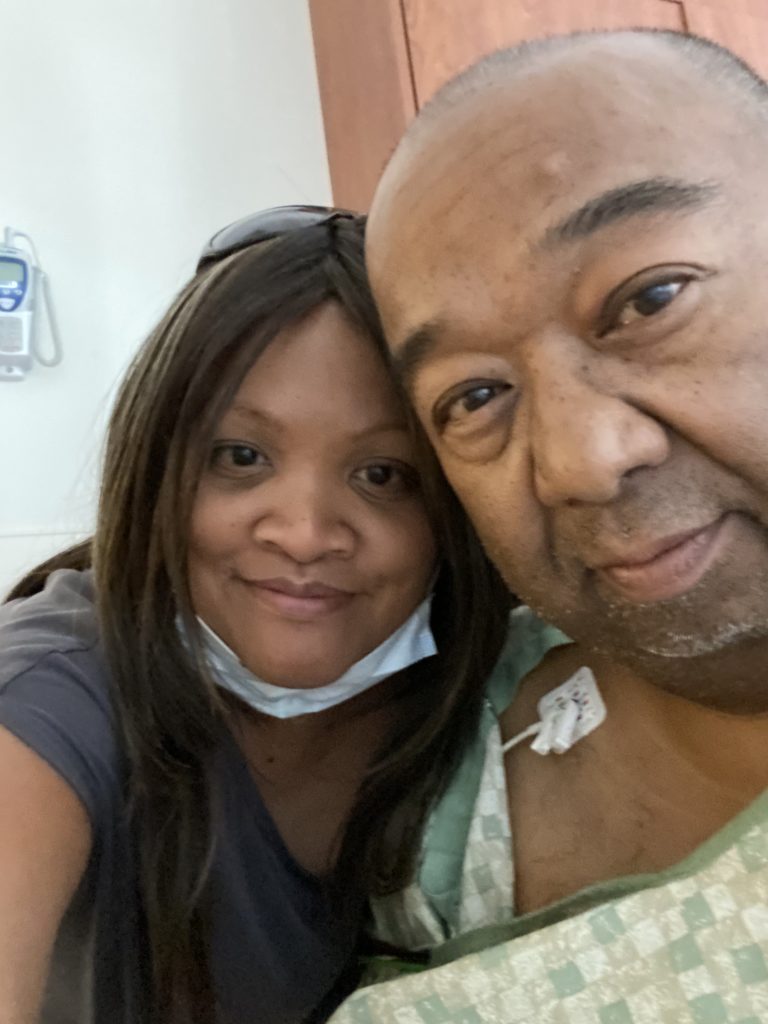
## **What does an average day look like as a family caregiver?**
As a family caregiver, my days are hectic but balanced. I work Monday through Thursday, but remotely. We have a responsible pre-teen who is pretty independent— making his meals when he’s hungry, walking to school (unless it’s super cold or raining then I drive him.) After I get off work, aside from cleaning up and cooking dinner, we do dialysis in the evening for a little over three hours. Sounds seamless but we do have our unexpected bad days. From power outages while he is on treatment, high arterial or venous readings out of nowhere which can affect completing dialysis that can lead to missing some time off for work, etc.
When it comes to medical appointments, our goal is schedule them on Rob’s days off from work but we can’t get it how we want it all the time. When that happens, we take FMLA. We pray hard daily for smooth days and a kidney transplant to happen, not only for Rob, but for many on the waiting list, and a cure for PKD.
## **How have things changed since Rob’s diagnosis?**
We do our best to not let PKD change our lives. We keep living life as safely as we can and maintaining healthy eating habits that consist of low to no salt foods. Rob continues to work and stays physically active as much as his body allows. When he’s tired from dialysis and his body needs to recover, he takes a break to restore. As his caregiver, I’m truly grateful to have the work/life balance. I work for a great company where I’m fortunate to work remotely. It helps me balance family life especially since we do home dialysis five days a week.
## **Being a family caregiver can often be stressful, how do you unwind and stay positive?**
As a caregiver, the way I stay positive is taking a deep breath and taking on things as they come; one day at a time. Caregiving is stressful but caregivers need care too. I’ve learned to have self-care days with friends, exercising, going for long walks, etc. I find that when I take time for myself, I can recharge and build strength to what lies ahead.
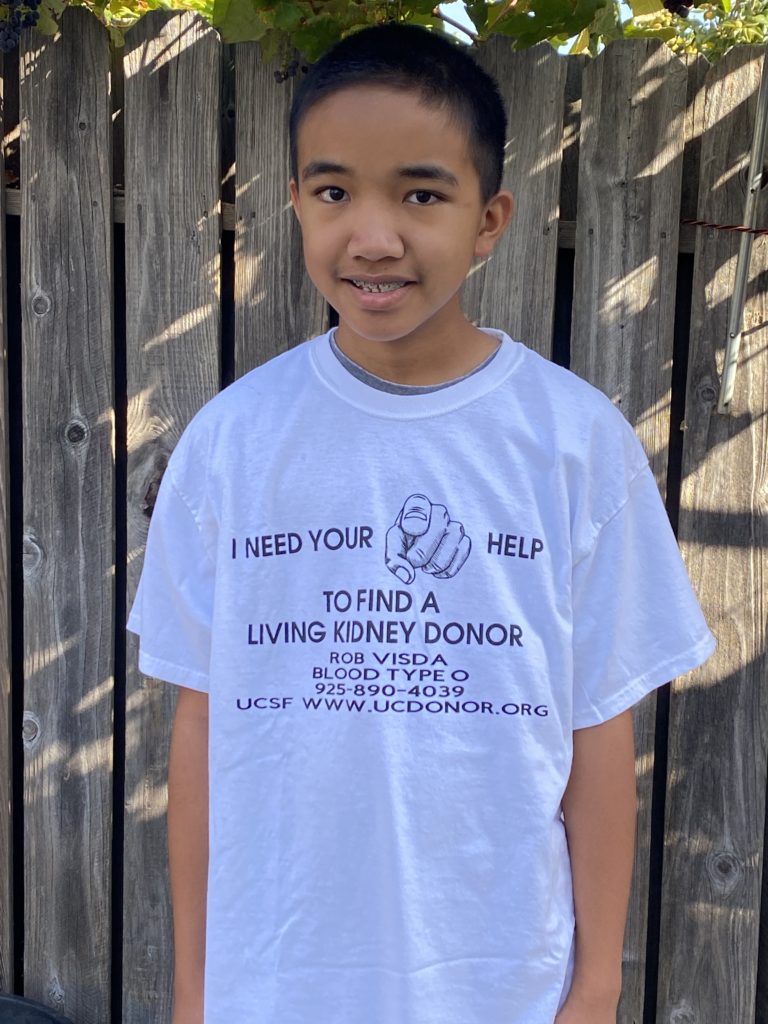
## **How has the PKD Foundation helped you on your family’s journey with PKD?**
The PKD Foundation has helped our family’s journey by simply being informative. I didn’t know too much about PKD. My husband knew he inherited the disease from his mom’s side of the family. She was on dialysis for one month, but was able to get a transplant from a family member. I tried to do my research through family members on his side, but I wasn’t getting enough information.
With my husband still on the transplant waiting list, I needed to know how we could take care of his health. I needed to find a source where I could reference for information. What truly helped me on the website was [reading other people’s stories](https://connect.pkdcure.org/voices-of-pkd/), those facing the same battle. There were many times my husband felt like no one knew what he was going through.
### **National Family Caregivers Month**
As we celebrate National Family Caregivers Month, there are few things the Caregiver Action Network (CAN) encourages eve
- Raise awareness of family caregiver issues
- Celebrate the efforts of family caregivers
- Educate family caregivers about self-identification
- Increase support for family caregivers
**If you’re a family caregiver looking for PKD resources**, check out our [resource library](https://resources.pkdcure.org/). And for those days when you’re just needing a sympathetic ear, our [peer mentors](https://pkdcure.org/peermentors/) and [HOPE Line](https://connect.pkdcure.org/hope-line/) are here to listen and support you. While being a family caregiver can be stressful, know that you’re not alone.
**Resource Categories:** Caregivers, Family Life
**Global Categories:** Caregivers, Family Life
---
### [Walk for PKD Ambassador Spotlight: Larianne Austin](https://pkdcure.org/resources/walk-for-pkd-ambassador-spotlight-larianne-austin/)
**Published:** August 9, 2022
**Author:** fiftyandfifty
**Content:**
**Published on August 9, 2022** \| The 2022 Walk for PKD is nearly here! As we countdown the days until our first Walk events, we’re highlighting another member of our community who makes these events possible. Helping lead the Sacramento Walk for PKD, is Walk Ambassador Larianne Austin.
## **What brought you to the PKD Foundation?**
**Larianne:** PKD has affected my family five generations. My grandmother spent almost 17 years on dialysis. My dad and two uncles have received life-saving kidney transplants. I have PKD, as does my daughter, sister, niece, and cousin.
## **Of all the volunteer options at the PKDF, what made you become a Walk Ambassador?**
**Larianne:** Since 2008, I’ve volunteered and participated as a team captain for the Sacramento Walk for PKD. I enjoy event planning, so when the previous Walk Ambassador stepped down I decided to step up.
## **What’s your favorite part about being a Walk Ambassador?**
**Larianne:** Walk Day for sure! I love seeing families come together to share stories, offer encouragement, and raise awareness, all with a common goal…to end PKD!
## **What should people attending the Walk for the first time know about the event?**
**Larianne:** That it’s an event for all—patients, caregivers, family, and friends, joining efforts to raise awareness and money to find a cure for PKD.
## **Do you have a favorite Walk memory?**
**Larianne:** A few years ago, a woman walked up to the registration area in tears. Her teenage son had just been diagnosed with PKD and she thought it was a death sentence. I introduced her to our Community Ambassador, Julia Adams, who’s daughter received a kidney transplant at age 22. After talking with Julia, she walked away feeling hopeful and encouraged. The following year, the family showed up with a team of close to 100 people. One of the many times I’ve witnessed the power of community and connection at the Walk.
## **What advice do you have for those who want to become a volunteer?**
**Larianne:** Don’t be afraid to jump in! The PKD Foundation provides all the tools (and amazing support) to make the job easier. And remember, volunteers don’t have the time, they have the heart!
**Interested in becoming a Walk for PKD Ambassador?** [Email ](mailto:walkforpkd@pkdcure.org)our team to see if there are volunteer openings in your area. You can also checkout this other [Walk Ambassador spotlight](https://pkdcure.org/walk-for-pkd-ambassador-spotlight-felicia-berenson-reinhardt/) to learn more. And while not everyone has the time to become a volunteer, we hope you’ll just us at your local Walk! Register today at [walkforpkd.org](https://walkforpkd.org/). As you fundraise and grow your Walk team, we’re here to support you every step of the way.
**Resource Categories:** Communities, Donate, Walk for PKD
**Global Categories:** Communities, Donate, Walk for PKD
---
### [Walk for PKD Ambassador Spotlight: Felicia Berenson-Reinhardt](https://pkdcure.org/resources/walk-for-pkd-ambassador-spotlight-felicia-berenson-reinhardt/)
**Published:** July 14, 2022
**Author:** fiftyandfifty
**Content:**
**Published on July 14, 2022** \| With the Walk for PKD being our biggest awareness event, Walk for PKD Ambassadors are an essential role. They’re responsible for planning and executing their local Walk for PKD with support from PKD Foundation staff. This volunteer role raises important financial support and plans an event that brings their local PKD community together. Their contribution helps us as work toward realizing our vision of ending PKD. To dive into this role more, Felicia Berenson-Reinhardt is sharing what it’s like to be a Walk Ambassador.

### **What brought you to the PKD Foundation?**
When my mom was diagnosed with PKD in 2015, after going into renal failure, we were shocked. We knew nothing about a family history or anything. And I felt incredibly helpless. In 2019, I found the Hudson Valley Walk for PKD and finally felt like I had a way to do something to help.
### **Of all the volunteer options at the PKD Foundation, what made you become a Walk for PKD Ambassador?**
I saw a post on one of the social media pages stating that the Hudson Valley Walk needed an Ambassador. I was worried that if I didn’t step up, the Walk would not take place. Unfortunately, we lost my mom to complications from PKD at the end of September of 2021, and that strengthened my need and drive to do more.
### **What’s your favorite part about being a Walk Ambassador?**
I’ve only been in the position since June, so I am still learning everything that the position entails. So far, I’m really enjoying meeting other members of the PKD community and working with Foundation staff.
### **Do you have a favorite Walk memory?**
We did our first in-person Walk for PKD in 2019, and it was an incredible experience. After being diagnosed, I felt very alone. Going to the Walk and feeling like a part of a community for the first time, made me feel supported.
### **Why is it important for people to raise awareness of PKD?**
I think that it’s important for people to raise awareness about PKD because it still feels like a relatively unknown disease. I didn’t know anything about it prior to my mom’s diagnosis. And I don’t think I’m alone in that. There still isn’t a cure for PKD and even the treatment options are limited. At least we have Jynarque. But by raising awareness of the disease, maybe there will be more research done. By raising awareness until there’s a cure, those of us PKD warriors, either personal or on behalf of family, can know that there is a network of support. No one will have to feel alone.
### **What advice do you have for those who want to become a volunteer?**
Just do it. I was a bit apprehensive about the time commitment, but it’s been such a rewarding experience.
**Interested in becoming a Walk for PKD Ambassador?** We’re recruiting for the following communities:
- [Charlotte](https://pkdcure.org/community/charlotte/)
- [Chicago – ](https://pkdcure.org/community/chicago/)Looking for a Co-Walk Ambassador
- [Indianapolis](https://pkdcure.org/community/indianapolis)
- [Las Vegas](https://pkdcure.org/community/las-vegas/)
- [Nebraska](https://pkdcure.org/community/nebraska)
- [North Texas](https://pkdcure.org/community/north-texas)
- [Oklahoma](https://pkdcure.org/community/oklahoma)
- [Portland](https://pkdcure.org/community/portland)
- [San Antonio](https://pkdcure.org/community/san-antonio/) — Recruiting for 2023
- [South Florida](https://pkdcure.org/community/south-florida)
- [St. Louis](https://pkdcure.org/community/st-louis/)
While not everyone has the time to become a volunteer, we hope you’ll just us at your local Walk! Register today at [walkforpkd.org](https://walkforpkd.org/).
*The Walk for PKD is support by our generous sponsor, Otsuka America Pharmaceutical, Inc.*
**Resource Categories:** Communities, Donate, Walk for PKD
**Global Categories:** Communities, Donate, Walk for PKD
---
### [Understanding Trials on Ketogenic Diet Interventions for PKD](https://pkdcure.org/resources/understanding-trials-on-ketogenic-diet-interventions-for-pkd/)
**Published:** November 20, 2023
**Author:** fiftyandfifty
**Content:**
**Published on November 20, 2023** \| Each year, the PKD Foundation funds research grants and fellowships to increase understanding of the genetic and pathological processes involved in PKD and to accelerate the development of potential therapies for PKD patients. [In 2020](https://pkdcure.org/research/2020-grants/), that included Roman-Ulrich Müller, M.D., a researcher investigating the ketogenic diet and PKD.
In 2019, studies in animal models of [autosomal dominant polycystic kidney disease](https://pkdcure.org/what-is-adpkd/) (ADPKD) showed the extremely positive effects of a ketogenic diet. [This finding](https://pubmed.ncbi.nlm.nih.gov/31631001/) attracted a lot of attention among nephrologists, scientists, and patients. The change in diet inhibited both cyst growth and the loss of kidney function. A great scientific success. Several questions were quickly raised. Firstly, should all patients with ADPKD now eat a ketogenic diet? And secondly, what does that even mean? Until now, data in humans or from clinical studies was lacking. However, similar to the approval of drugs, these are an essential step before medical recommendations can be made.
Recently published in the renowned [*Cell Reports Medicine*](https://www.cell.com/cell-reports-medicine/fulltext/S2666-3791(23)00477-9?_returnURL=https%3A%2F%2Flinkinghub.elsevier.com%2Fretrieve%2Fpii%2FS2666379123004779%3Fshowall%3Dtrue), the KETO-ADPKD study addressed this issue. This study was conducted in the translational nephrology unit at the University Hospital of Cologne.
So, what are the key takeaways of this study from Dr. Müller’s point of view? Let’s dive in.
## **Ketogenic Diet—What is It?**
The ketogenic diet leads to a metabolic change in which ketone bodies are formed as a metabolic product, hence the name. In a nutshell, in order to achieve this metabolic shift, the amount of carbohydrates (i.e. sugar) is significantly reduced and the amount of fat in the diet is greatly increased. This involves avoiding classic bread or desserts, and consuming more olive oil or fatty fish instead, for example.
## **Is a Ketogenic Diet Feasible for Patients with ADPKD in everyday life?**
Dietary changes aren’t always easy. This was an important question in the KETO-ADPKD study. Feasibility was measured using questionnaires, and the ketone bodies in the blood and breath were also determined. The bottom line? Yes. This diet was indeed feasible over the three-month period studied. However, there were some hurdles that to overcome in everyday life. For instance, eating in a restaurant requires more planning.
## **Did the ketogenic diet have an effect on kidney growth in KETO-ADPKD?**
Normally, polycystic kidneys continue growing over time. With the study’s control group, participants who continued eating as usual, this was also the case. On the ketogenic diet, the kidney volume decreased. However, this difference was not statistically significant. The effect could also be a coincidence, so that question doesn’t have a clear answer yet.
## **What did KETO-ADPKD show regarding kidney function?**
Over time, kidney function continuously decreases in ADPKD. This was also seen in the control group. In contrast, kidney function increased over the course of the three months on a ketogenic diet. This result was statistically significant, so we assume there was a real effect. However, KETO-ADPKD only studied the diet for three months. We don’t know yet whether this would be beneficial in the longer term.
## **Were there any side effects?**
The only side effect reported more frequently by participants were symptoms of the so-called “keto flu.” This is a well-known phenomenon. In the first few days of the dietary change, participants experienced symptoms similar to an infection, such as headaches or tiredness. These symptoms can also appear in those not affected by ADPKD starting a ketogenic diet. After a few days, the effect passes.
In addition, some patients showed an increase in cholesterol levels (blood lipid levels). Whether this has negative consequences under a ketogenic diet, will need clarification. The duration of KETO-ADPKD was certainly still too short to make a statement about kidney stones. In other studies on ketogenic diets in patients not affected by ADPKD, they occurred more frequently. Data on both aspects will need to be collected in future studies over a longer period of time.
## **Should patients with ADPKD now follow a ketogenic diet?**
All patients should discuss dietary changes with the physician and dietician, as the answer depends on a wholistic view of their health and disease state. Although the results from KETO-ADPKD are promising, they aren’t yet sufficient to make a general recommendation on a ketogenic diet for ADPKD. This will require a study with a larger number of participants (e.g. 200-300, currently only 63 participants), over two to three years (currently only three months) at several centers. Such a study is actively being planned. However, acquiring the relevant amount of funding is a challenge.
Such a multi-center study is necessary to clarify whether a positive effect of the ketogenic diet is really achieved in the long term and whether it’s safe for patients with ADPKD over many years. Regardless, the data from KETO-ADPKD is already helping us in advising and caring for patients who decide to change their diet on their own.
If you’re interested in learning more about Dr. Müller’s study, read the full article [here](https://www.cell.com/cell-reports-medicine/fulltext/S2666-3791(23)00477-9?_returnURL=https%3A%2F%2Flinkinghub.elsevier.com%2Fretrieve%2Fpii%2FS2666379123004779%3Fshowall%3Dtrue).
*\*The PKD Foundation does not give medical advice. You should not rely on this information as a substitute for, nor does it replace, professional medical advice, diagnosis, or treatment. If you have any concerns or questions about your health, you should always consult with your physician or other healthcare professionals.*
**Resource Categories:** Diet, Family Life, Living with PKD, Recipes, Staying Healthy
**Global Categories:** Diet, Family Life, Living with PKD, Recipes, Staying Healthy
---
### [Understanding Robotic Bilateral Nephrectomy](https://pkdcure.org/resources/understanding-robotic-bilateral-nephrectomy/)
**Published:** June 18, 2024
**Author:** fiftyandfifty
**Content:**
**Published on June 18, 2024** \| Patients with polycystic kidney disease (PKD), may know the surgical procedure, bilateral nephrectomy. A surgical procedure to remove both kidneys. But have you heard of robotic bilateral nephrectomy?
Traditionally, a bilateral nephrectomy is done through open surgery or laparoscopy. However, significant advancements in robotic bilateral nephrectomy show potential benefits, such as reduced blood loss, shorter hospital stays, and fewer complications.
In 2023, [Amit Gupta, M.D.](http://www.bevhillsurology.com/), authored [a paper explaining the technique](https://www.ncbi.nlm.nih.gov/pmc/articles/PMC10560624/#:~:text=The%20robotic%20approach%20to%20bilateral,even%20for%20very%20large%20kidneys.) and clinical experiences with robotic bilateral nephrectomy in patients with autosomal dominant polycystic kidney disease (ADPKD).
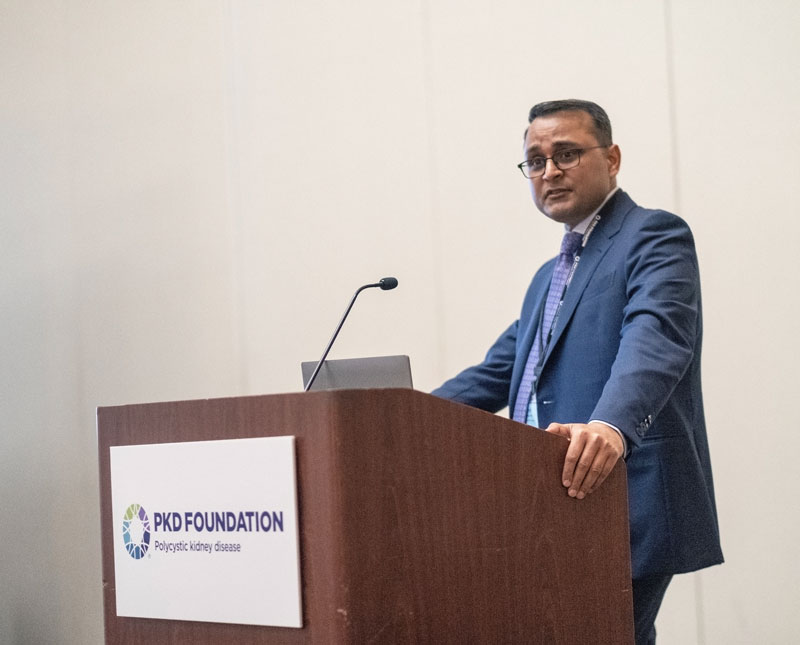
### **Understanding Nephrectomy**
Historically, bilateral native nephrectomy has been a challenging procedure for patients with ADPKD, sometimes associated with significant blood loss, complications, and long hospital stays. Due to these risks, the timing and necessity of this surgery have been debated among healthcare professionals. Some suggest minimizing open native nephrectomy whenever possible and using alternative methods such as laparoscopy.
While minimally invasive laparoscopic techniques can improve outcomes, they also have limitations, especially for extremely large kidneys. These limitations include longer operating times and a higher likelihood of converting to open nephrectomy.
### **The Case for Robotic Bilateral Nephrectomy**
In the paper, Dr. Gupta details a robotic technique for simultaneous bilateral nephrectomy using the[ Da Vinci Xi and Single Port systems](https://www.intuitive.com/en-us). The study authors also reviewed 14 cases (from January 2020 to present) that used this technique. They looked at several data points, including:
- Blood loss during surgery
- Transfusion rate
- Surgical complications
- Length of Stay
- Time from nephrectomy to transplant
#### **Advantages and Conclusions**
Through the robotic approach, doctors saw decreased blood loss (median 75 cc), short hospital stays (median three days), and low complication rates compared to open and laparoscopic techniques. Even large polycystic kidneys experienced successful procedures, with the largest removed kidney measuring 32 cm. Despite the large size of many polycystic kidneys, no case required pivoting to open nephrectomy.
“Robotic nephrectomy should be the standard of care for PKD patients and made accessible to all.”
##### **—[Amit Gupta, M.D.](http://www.bevhillsurology.com/), Beverly Hills Urology**
A robotic bilateral nephrectomy may be a promising option for ADPKD patients needing native nephrectomy. Even for significantly enlarged kidneys, it might allow for an alternative, minimally invasive approach. Ultimately, the timing and necessity of bilateral native nephrectomies for ADPKD should be tailored to each patient’s individual needs in close consultation with their care team.
---
Interested in learning more? Check out all our content on [nephrectomies](https://resources.pkdcure.org/resources/nephrectomy-surgery-understanding-risks-and-benefits/) and the [PKD treatment pipeline](https://pkdcure.org/what-is-pkd/latest-research/pipeline/).
**Formats:** Newly Diagnosed
**Resource Categories:** ADPKD, Research
**Global Categories:** ADPKD, Research
---
### [Should You Enroll Your Child in a Clinical Study?](https://pkdcure.org/resources/should-you-enroll-your-child-in-a-clinical-study/)
**Published:** September 13, 2022
**Author:** fiftyandfifty
**Content:**
**Published on September 13, 2022** \| At the age of 5, Ian Jones (name changed for privacy) was diagnosed with ARPKD. During a routine trip to his pediatrician, his mother mentioned that Ian was having a lot of trouble staying dry at night. Tests revealed that he had cysts on his kidneys. There was no family history of the disease, and Ian’s parents had never heard of PKD.
As research into PKD ramps up, there are increasing opportunities to enroll children in [clinical studies](https://clinicalstudies.pkdcure.org/), says Ashima Gulati, M.D., Ph.D., a pediatric nephrologist at Children’s National Hospital in Washington, D.C., where Ian follows up in the Inherited and Polycystic Kidney Diseases Program. “Choosing to participate is understandably a difficult decision for many families, and parents should feel free to ask as many questions as they want to make an informed decision,” Dr. Gulati says.
Now 9 years old, Ian’s parents enrolled him in an ARPKD clinical study. In order to learn about what went into their family’s decision, We talked to Ian’s mother, Alixandria.
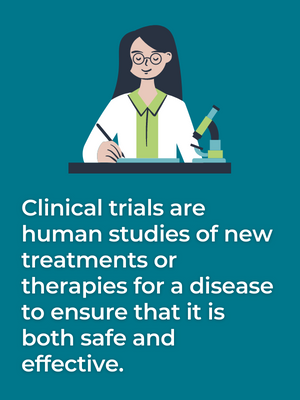
## **What made you decide to have your son participate in a clinical study?**
**Alixandria:** Ian’s diagnosis was devastating for me. I struggled with the fact that ARPKD is degenerative and has no treatment or cure. The only way I knew how to move forward was to get involved. I joined the PKD Foundation and connected with other parents on Facebook.
Through these contacts, I found out about the first clinical study we would participate in. I feel it’s important to do what we can to advance research toward finding treatments and eventually a cure.
## **Did you involve Ian in the decision?**
**Alixandria:** We want Ian to feel empowered to take ownership of his body and health. When the opportunity to participate in a study came up, I explained to him that the doctors are trying to find new medicines for him and kids like him with ARPKD. If he participated, we would be helping the doctors.
## **What were your main concerns about enrolling him in a clinical study?**
**Alixandria:** Prior to discovering Ian’s ARPKD, I didn’t personally know anyone who had participated in a clinical study. I was afraid of what I didn’t know, so I started asking questions. The study team did such a great job of addressing my concerns and answering Ian’s questions that we were really excited for him to participate.
## **What advice do you have for parents thinking about enrolling their children in a clinical study?**
**Alixandria:** If there is a clinical study that you may be interested in, contact the research team and ask questions. The answers may help you make your decision and alleviate some common fears. I would also suggest talking to your medical team. They are on this journey with you, and it’s important to have an open dialogue with them. Lastly, trust yourself. You know what is right for you and your family.
There’s a lot to consider before joining a clinical study. To learn more about clinical studies, this helpful [list of FAQs](https://pkdcure.org/research-medical-professionals/clinicaltrialfaqs/) can get you started. When you’re ready, you can sign up for our Accelerating Clinical Trials (ACT) Alert program. Through ACT Alerts, you’ll receive emails about studies in your area. Additionally, alerts are separated into [ARPKD](https://go.pkdcure.org/l/886163/2021-08-02/3765w) and [ADPKD](https://go.pkdcure.org/l/886163/2020-10-29/49bx) studies. Together, we can further PKD research and help #endPKD.
---
**Want to see more articles like this?** Read the full issue of our magazine, *PKD Life*, and subscribe to future issues **[here](https://pkdcure.org/pkdlife/)**. If you’re interested in ARPKD, you’ll also find more ARPKD-related articles in our summer issue.
*This blog post is sponsored by Reata America Pharmaceuticals, Inc., a proud sponsor of the 2022 Walk for PKD.*
**Resource Categories:** ARPKD, Family Life, Research, Young Children
**Global Categories:** ARPKD, Family Life, PKD Parents, Research, Young Children
---
### [RideForPKD: Part 2](https://pkdcure.org/resources/rideforpkd-part-2/)
**Published:** June 21, 2022
**Author:** fiftyandfifty
**Content:**
**Published on June 21, 2022** \| A PKD patient, advocate, and PKDF volunteer, Glenn Frommer organized the RideForPKD to raise $500,000 for PKD research. [On May 1](https://pkdcure.org/rideforpkd-part-i/), Glenn Frommer kicked off his journey across the country. And after nearly two months on the road, we’re checking in with him to hear the highlights and challenges of biking for a cause.
### **How has this first part of your RideForPKD journey been?**
**Glenn:** The first quarter of the RideForPKD has been an amazing experience. So far, we’ve completed 25 days of riding, totaling 1,437 miles of riding and 68,000 feet of climbing over 90 hours in the saddle. The highs have been phenomenal: meeting researchers at University of California Santa Barbara (UCSB) and University of Southern California (USC), having successful fundraising events, meeting new donors in diners and campgrounds, riding with friends (both old and new), closing in on our fundraising goal, and seeing some of the most beautiful parts of the country in California, Arizona, and Utah.
We’ve also faced challenges along the way as well. With the RV, logistics, road conditions, and weather conditions all presenting interesting obstacles that my wife Beth and I have had to overcome. On balance, the opportunity to help build our community and raise money for the PKD Foundation’s research program have far outweighed the hurdles we’ve encountered.
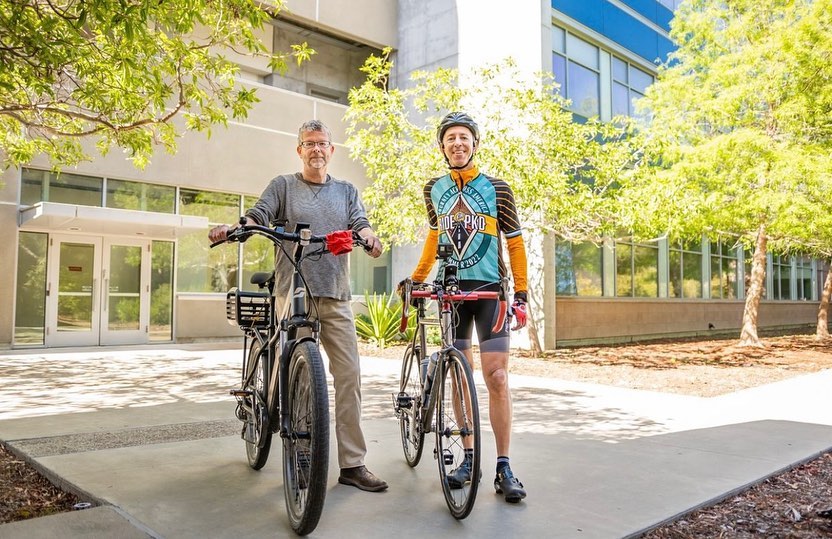
### **What highlights have you had so far?**
**Glenn:** From a riding perspective, riding the Pacific Coast Highway from San Francisco to Newport Beach and riding into and through the Grand Canyon have both been incredibly beautiful, awesome experiences. More importantly, the meetings we had with Dr. Weimbs and his teams at UCSB and Santa Barbara Nutrients, with Dr. Chung and her team at USC, and the great fundraising event we had at the beautiful home of our friends’ in Irvine, California were definite highlights. It gave us a chance to hear about new and promising research programs as well as sharing our message and raising awareness of PKD in the broader community.
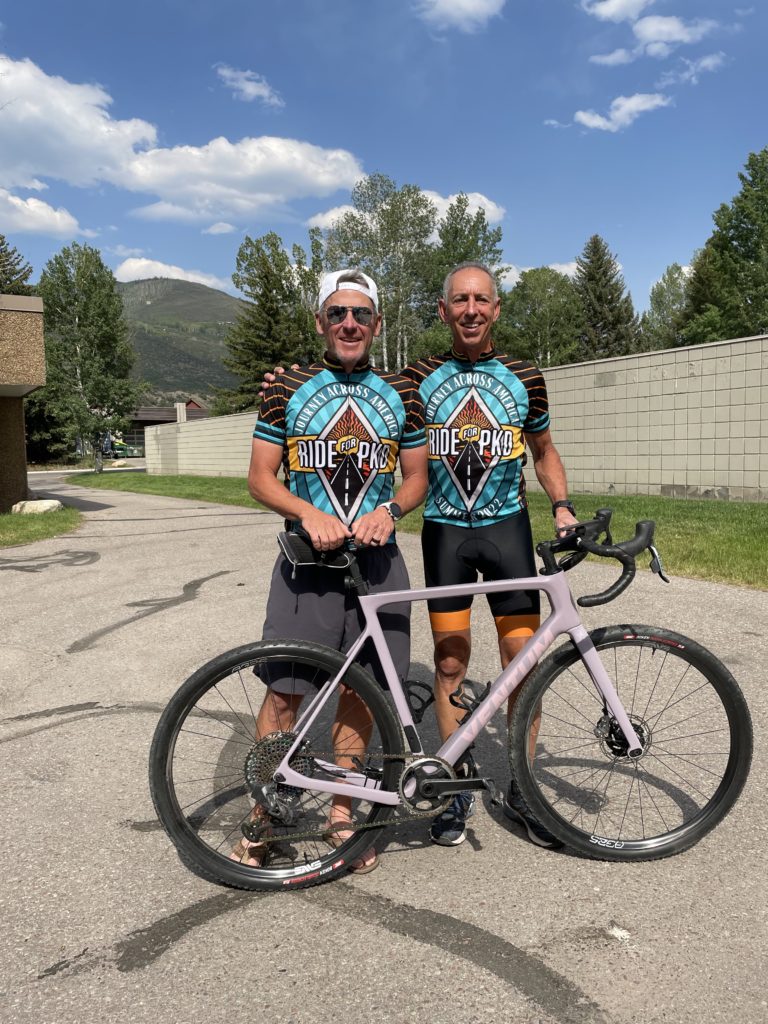I had a great meeting with former professional road racing cyclist, Lance Armstrong, during a stop in Aspen, Colorado. I was inspired by Lance’s success with Livestrong, where he leveraged his passion for cycling to raise money and awareness for cancer, to do the same for PKD. As a result, Lance was generous with his time and energy to discuss the RideForPKD.
Lastly, we’ve met phenomenally caring and charitable people along the way. I met 12-year-old Linkin, a member of the Navajo Nation, in a motel courtyard in Cameron, Arizona. He gave me five, single dollar bills and told me that I needed it more than he did. I met Tim and Tiffany from Dallas—at a campground in Williams, Arizona—who, within 15 minutes of meeting Beth and I, decided to generously support the cause and made a donation on the spot. And I’ve met countless people in diners and RV campgrounds who saw our banner on the side of the RV, and gave $20, $50, or $100 bills to our cause. I’ve been blown away by people’s caring and generosity.
### **You were able to stop in Los Angeles to meet with the PKD community and local PKD researchers. What was that experience like? Did you learn anything new?**
 Glenn with researchers at the Weimbs Laboratory
**Glenn:** There were three main takeaways from our time with the research teams at UCSB and USC.
1. Learning about research programs.
2. Introducing the researchers to PKD patients, like me, who are hoping to benefit one day from their important efforts.
3. Thanking the researchers for their tireless work to better understand the causes and develop potential treatments to help our community.
The work at UCSB to understand how altering the biochemical environment in our bodies can retard, and even reverse, the growth of cysts is exciting, making our bodies less hospitable to cyst growth. The work as USC, a novel mRNA approach to improve the delivery and effectiveness of existing drug therapies, appears to be a potential winner by taking drugs that work well in rodent models and figuring out a way to deliver them in a targeted and concentrated form to our kidneys without causing side effects in other organs.
And as impressive as the technical work is, the passion of the leaders and researchers at the labs is truly inspiring to our community. It gives us hope that one day there will be more effective treatments and a cure to #endPKD. I found it interesting that all of the researchers told me that they often don’t have a chance to meet patients like me, so I would encourage others to connect with their local research universities to make a personal connection.
### **What’s been the most challenging part of the RideForPKD so far?**
**Glenn:** On any given day, there are 1,000 moving parts to having a successful day: RV, campgrounds, logistics, roads, weather, bikes, supplies, fundraising, digital tools, and merchandise. While 99% of these parts are fine, the 1% of parts that don’t work well means that we’re dealing with many challenges every day. We’ve dealt with RV issues, campgrounds not having space, unexpected road closures (for 100s of miles), horrendous desert heat and vicious 50-mph crosswinds, no shoulders and rude drivers, bike malfunctions, and days on end without cell or Wi-Fi service. We’ve learned from every experience and not allowed the challenges to distract us from our mission to support the PKD community.
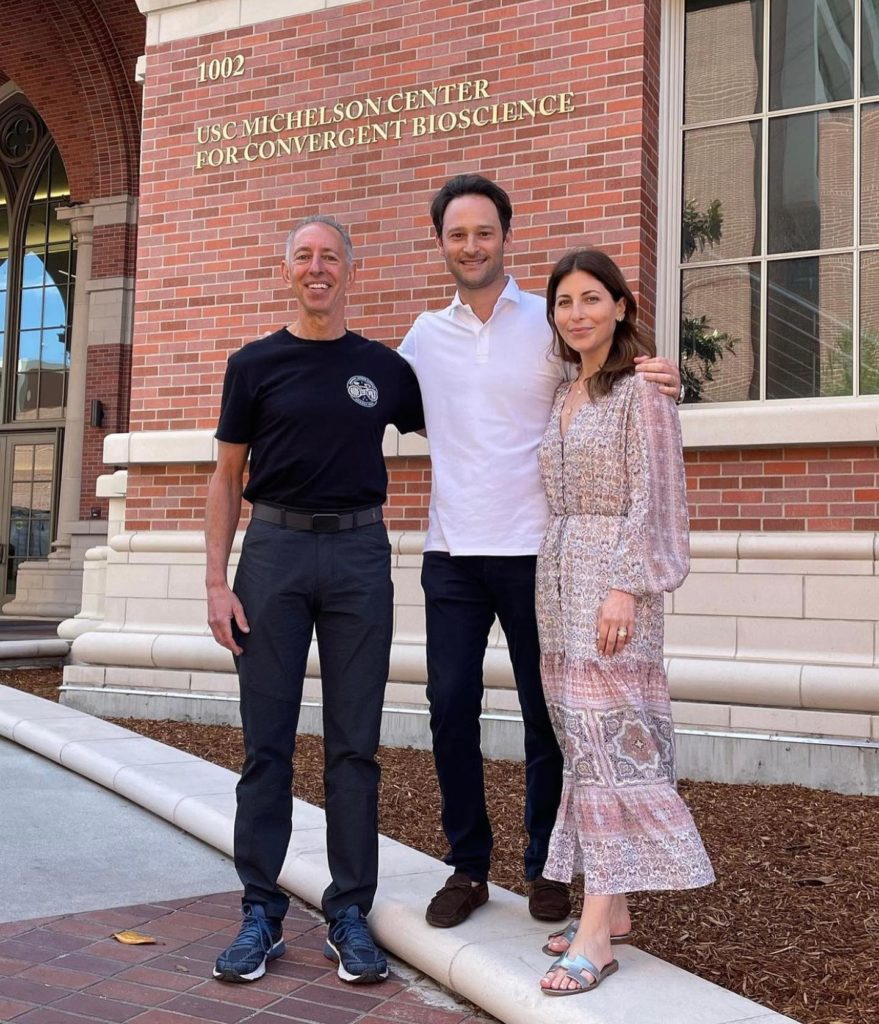
### **What are you most looking forward to in this next leg of the RideForPKD?**
**Glenn:** As we exit the beautiful Southwest and head through the mountains of Utah and Colorado for the next quarter of the RideForPKD, I’m looking forward to both the natural beauty of our country and the great events we have planned in Colorado. We’ll ride with dozens of friends, have a homecoming with our local friends in Vail, Colorado, and we’ll meet with researchers and the local Denver Community of the PKDF at CU Anschutz Medical Center. The month of June will be full of great events leading into our ride to Kansas City in early July. Once in KC, we’ll have multiple meetings at the PKDF headquarters and at KUMC where we’ll be joined by local members of the KC Community and congressional representatives.
I’m also looking forward to surpassing our initial fundraising goal of $500,000 and raising even more funds for the Foundation. There are so many ways members of the PKD Foundation can support us. We have great RideForPKD merchandise on sale, people can make a donation, or you can look at our schedule and meet us for an event or to ride. The second month of the Ride promises to be every bit as epic as the first. Follow us on our social pages for daily video updates and weekly recaps.
#### Follow Glenn’s journey across the country on [Instagram](https://www.instagram.com/rideforpkd2022/) and checkout his route on his [website](https://www.rideforpkd.org/).
**Resource Categories:** Communities, Donate, Fundraise Your Way
**Global Categories:** Communities, Donate, Fundraise Your Way
---
### [Research Spotlight: Laura Onuchic, M.D.](https://pkdcure.org/resources/research-spotlight-laura-onuchic-m-d/)
**Published:** June 28, 2022
**Author:** fiftyandfifty
**Content:**
**Published on June 28, 2022** \|
## Laura Onuchic, M.D., **Yale School of Medicine**
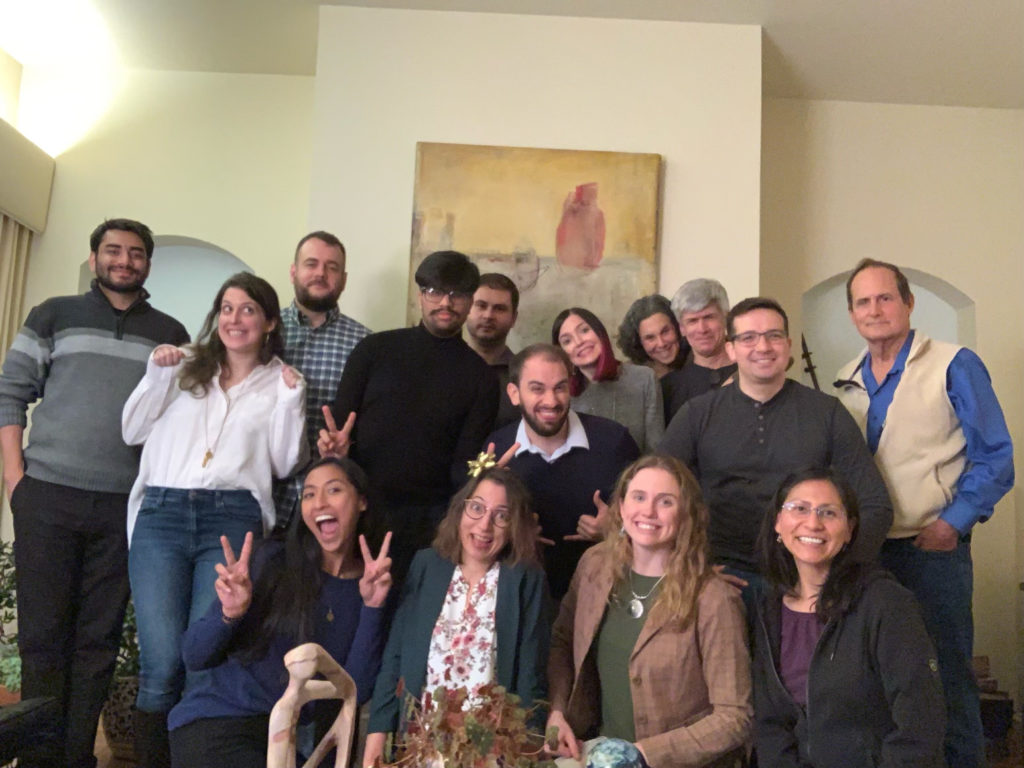
### How did you first get involved in PKD research?
**Laura Onuchic:** The fight against PKD has been a part of my life for as long as I can remember. Both my parents are incredible medical doctors in my home-country, Brazil. More specifically, my father is a physician-scientist in nephrology who’s made substantial contributions to the PKD field, including the identification of the *PKHD1* gene (responsible for ARPKD) during the early stages of his career. His approach to research and to patient care has always been incredibly inspiring. In fact, my sister and I are also nephrologists and my younger brother is now in internal medicine (and I married a nephrologist as well)! When I was growing up, I recall listening to stories about large families affected by PKD and all the suffering this disease caused.
From a personal perspective, it’s motivating to fight a disease that affects so many families alongside my own family. When I reached the point of my career where I myself was responsible for these patients, I realized that, from the clinical perspective, our options to help these families were still rather limited. At the time, I was finishing my clinical nephrology fellowship in the largest hospital complex in Latin America (Hospital das Clínicas da Universidade de São Paulo) and had the opportunity of meeting Dr. Michael Caplan, chair of cellular and molecular physiology at Yale University and a leader in the PKD field, who offered me a postdoctoral position at his laboratory.
I’ve now been part of Dr. Caplan’s laboratory for three years, and I’m extremely excited about the progress we’ve made with this research and how it could impact the lives of many patients in the future.
### What are you currently working on?
**Laura Onuchic:** I’m working on opening the doors to the exploration of gene therapy approaches in PKD. The vast majority of Autosomal Dominant Polycystic Kidney Disease (ADPKD) cases are caused by a genetic mutation in the *PKD1* gene, which consequently encodes a defective polycystin-1 (PC1) protein. In my current project, we expressed the C-terminal tail of PC1 (a segment that represents only 5% of the total PC1 protein) in PC1-deficient ADPKD pre-clinical mouse models. We showed that this was sufficient to significantly slow disease progression and preserve kidney function.
### What would you like the patient community to know about your research?
**Laura Onuchic:** Not a day goes by where we don’t have our patients in mind as we conduct our research. They motivate us to be better professionals, and their involvement with the medical and scientific communities is inspiring. I really trust that we have made major progress over the past couple years. I’d like the patient community to know that we will work harder and harder every day in the hopes of eventually transitioning these pre-clinical findings to patient care and treatments for PKD.
### Do you have a personal connection to PKD?
**Laura Onuchic:** I don’t have any close friends or family affected by PKD. I do, however, feel a strong personal connection to PKD from my family and my work in the Caplan laboratory in the sense that we’re all working together toward a treatment and support one another in the “fight against PKD.” During my clinical work, I connected and learned so much from the patients and families that battled PKD alongside me. One of the strongest connections I’ve ever had with any patient was with a 34-year-old elementary school teacher back in Brazil who suffered from an aggressive form of ADPKD. We became extremely close and, to this day, she is still an inspiration to me.
### What excites you most about this research?
**Laura Onuchic:** This answer is easy— the translational potential that this project presents is extremely hopeful! The idea that we may eventually be capable of delivering the C-terminal tail of polycystin-1 using gene therapy strategies and that this could eventually suppress cyst formation in patients is groundbreaking.
### What are some of your personal interests outside of research?
**Laura Onuchic:** I’m a huge sports fan! In fact, I was a ranked collegiate swimmer back in Brazil. As a Brazilian, I also watch a lot of soccer, but American sports have grown on me over the past couple years. I also love to travel and I’m particularly passionate about ecotourism. I’ve backpacked all around South America, Central America, and have already seen quite a bit of North America as well. Having the chance to appreciate magnificent wildlife and interact with local communities has been an extremely enriching experience.
---
Did you enjoy Dr. Laura Onuchic’s story? Want to learn more about others funded by the PKDF? Find them [here](https://pkdcure.org/funded-research/)! And check out other recent [researcher spotlights](https://pkdcure.org/researcher-spotlight-xiangqin-cui-ph-d/).
**Resource Categories:** ADPKD, Research
**Global Categories:** ADPKD, Research
---
### [Research Spotlight: Harold Aukema, Ph.D.](https://pkdcure.org/resources/research-spotlight-harold-aukema-ph-d/)
**Published:** July 19, 2022
**Author:** fiftyandfifty
**Content:**
**Published on July 19, 2022** \|
### Harold Aukema, Ph.D., **University of Manitoba** (Co-Funded by PKD Foundation of Canada)
### How did you first get involved in PKD research?
**Harold Aukema:** When I was a graduate student, our lab acquired one of the first models of PKD and I was excited about the potential of diet to have an impact on disease progression. So, when given the opportunity to work on a diet and PKD study in these mice, I jumped at it and I’ve been working in PKD research off and on ever since.
### What are you working on currently?
**Harold Aukema:** I’m currently working on a project that was recently funded by the PKD Foundation and the PKD Foundation of Canada on the effect of whole foods compared to processed foods, and plant-based compared to animal-based foods on progression of kidney disease in models of PKD. Interestingly, one of the models we are using is the same one I started my research on.
### What would you like the patient community to know about your research?
**Harold Aukema:** I’m grateful for the opportunity given by the PKD Foundations to study this topic and believe that our results will provide pre-clinical data (it will still need to be tested in people) of whether individuals with PKD should consume more whole foods or more plant-based foods. There is much interest in this, but direct proof in PKD is still missing.
### Do you have a personal connection to PKD?
**Harold Aukema:** No, it started as an interesting research question and the interest has stayed with me ever since.
### What excites you most about this research?
**Harold Aukema:** I believe that no matter the results, it will help guide future dietary recommendations for PKD.
### What are some of your personal interests outside of research?
**Harold Aukema:** Reading, hiking, traveling, cycling.
---
Did you enjoy Dr. Aukema’s story? Want to learn more about others funded by the PKDF? To learn more, find bios for all our funded researchers [here](https://pkdcure.org/funded-research/)! And check out other recent [researcher spotlights](https://pkdcure.org/research-spotlight-laura-onuchic-m-d/).
**Resource Categories:** ADPKD, Research
**Global Categories:** ADPKD, Research
---
### [Preparing for a Kidney Transplant](https://pkdcure.org/resources/preparing-for-a-kidney-transplant/)
**Published:** January 19, 2023
**Author:** fiftyandfifty
**Content:**
**Published on January 17, 2023** \| If you have PKD, your nephrology team may one day recommend that you be evaluated for a [kidney transplant](https://connect.pkdcure.org/transplantation/). Here’s what New Orleans nephrologists Zohreh Soltani, M.D., of Ochsner Medical Center, and Siddhartha Bajracharya, M.D., of University Medical Center, recommend you do beforehand to get the best possible outcome.
### **Don’t wait until you need a transplant to start thinking about it**
About 60% of people with PKD will have kidney failure by age 70. The earlier you get a transplant, the better the result. Start getting your affairs organized before you get to renal failure. Line up a living donor just in case, make sure you have a support system for at-home care after surgery, and get your finances and health insurance in order so that if or when that day comes, you’ll be ready for action.
### **Go for screening tests**
Once the referral is made, you will be directed to a transplant program. Then you’ll be seen by a surgeon, nephrology pharmacists, a social worker, a financial counselor, and transplant coordinators. Not only will you get a comprehensive medical evaluation, but the team will also check to see that you have appropriate financial backing, that you are psychologically prepared (good medication and followup care compliance), and that you have solid care support at home. After that, the selection committee will meet to determine whether you are a good candidate.
### **Don’t despair if you’re turned down**
Patients are not good candidates if there’s an absolute contraindication for transplant such as active infection, untreated malignancy, active substance abuse, documented noncompliance with medications, or insufficient social support. “However, if they resolve all the contraindications over time, the patient can be reconsidered for transplant,” Dr. Soltani says.
### **Look for a living donor**
“Most transplant physicians prefer living donors whenever possible, as that kidney typically will last longer,” says Dr. Bajracharya. Also, there’s a nationwide shortage of donations from deceased donors, which can make the wait time up to seven years. Your living donor will have to go through the same screening process to ensure that they are a match and suitable for donation. Don’t give up if no one you contact is a match. You may be eligible for a living donor paired exchange (your donor gives to a stranger, and that stranger’s donor gives to you) or a Never Ending Altruistic Donor (NEAD) chain, which is when an altruistic non-directed donor steps in to donate a kidney and begins a chain of kidney transplants. A living donor, or donors, are willing to donate to someone waiting for a kidney, but they’re incompatible with their intended recipient and agree to donate to someone else also waiting for a kidney transplant.
### **Register for a deceased donor if you don’t have a living donor**
In the United States, most kidney transplants come from deceased kidney donors. Donor organs are matched to waiting recipients through a national registry called the Organ Procurement and Transplantation Network (OPTN). This registry is operated by the United Network for Organ Sharing (UNOS). Your team will guide you through the process, but you can also [learn more here](https://pkdcure.org/living-with-pkd/transplant/types-of-donation/).
### **Common Myths About Kidney Transplants**
1. **Transplants are a cure:** For as long as you have a transplanted kidney, you will have to take medications and follow up with your nephrologist. PKD impacts more than the kidneys, the risk of [liver cysts](https://pkdcure.org/what-is-adpkd/what-are-the-related-health-complications/) or cerebral aneurysm still exist.
2. **You’ll only need one transplant in your life:** The average transplant lasts 10-12 years. Depending on your age, you may have to have more than one.
3. **You can’t get a transplant because you’re not on dialysis:** Physicians prefer that patients get a preemptive transplant, if possible.
More than 100,000 people are waiting for a kidney transplant in the United States. It’s important to educate yourself and your family about transplantation as early as possible to be prepared.
**Want to see more articles like this?** Read the full issue of our magazine, *PKD Life*, and subscribe to future issues **[here](https://pkdcure.org/pkdlife/)**.
**Resource Categories:** ADPKD, ARPKD, Dialysis, Education, Transplantation
**Global Categories:** ADPKD, ARPKD, Dialysis, Education, Transplantation
---
### [Planning an Emergency PKD Diet on World Kidney Day](https://pkdcure.org/resources/planning-an-emergency-pkd-diet-on-world-kidney-day/)
**Published:** March 9, 2023
**Author:** fiftyandfifty
**Content:**
**Published on March 9, 2023** \| Today is World Kidney Day. Each year, the World Kidney Day Joint Steering Committee selects a topic to highlight awareness of kidney health around the world. For 2023, they chose the topic, “[preparing for the unexpected, supporting the vulnerable](https://www.worldkidneyday.org/2023-campaign/).” Their aim is to raise awareness of the impact disastrous events have on people living with kidney disease. So, where do you start in creating a plan should you find yourself in a crisis? An emergency PKD diet plan should be on your list.
## **Why is it important to have an emergency PKD diet plan?**
When it comes to a crisis situation, such as the COVID-19 pandemic or a natural disaster, your access to dialysis treatments may be delayed. In some cases, the buildup of toxins, such as potassium, phosphorus, urea, and fluids, can be life-threatening, especially for patients who no longer urinate at all, says Beverly Whittet, R.N., a certified dialysis nurse with the national [Kidney Community Emergency Response (KCER) Program](http://kcercoalition.com/). As an organization, KCER provides assistance to End Stage Renal Disease (ESRD) Networks, kidney organizations, and other groups to ensure timely and efficient disaster preparedness, response, and recovery for the kidney community.
The KCER Program website uses the “[Centers for Medicare & Medicaid Services 3-Day Emergency Diet Plan](https://www.hsag.com/globalassets/esrd/emergency-preparedness/kcer_-3-day-emergency-diet_final_508.pdf)” that provides adequate nutrition in the event of an emergency, as well as limits the amount of fluid and waste accumulated. “It isn’t a substitute for dialysis or the renal diet. And it is only intended to be followed for three days or fewer in an emergency situation,” Whittet says.
## **Here’s what the first day of this emergency PKD diet plan looks like.**
### Emergency Breakfast
- 1/2 cup milk OR mix 1/4 cup evaporated milk with 1/4 cup distilled water, from sealed containers
- 1 serving of cereal (No bran. No granola. No cereal with dried fruits and nuts.)
- 1 tablespoon sugar, optional 1/2 can (2 ounces) fruit, drained
### Emergency Lunch
- 2 slices of white bread
- 2 tablespoons unsalted peanut butter or almond butter
- 2 tablespoons jelly or sugar-free jelly
- 1/2 cup canned fruit, drained
- 1/2 cup (4 ounces) water or other recommended beverage
### Emergency Dinner
- 2 slices of white bread
- 1/2 can (2 ounces) chicken with 2 tablespoon mayonnaise
- 1/2 cup vegetables, drained
- 1/2 cup cranberry juice
*(Three optional snacks are not included with these recipes.)*
## **Raising Awareness Beyond World Kidney Day**
While World Kidney Day is just one day that spreads kidney health awareness, we’re spreading awareness all month long. As we celebrate [National Kidney Month](https://pkdcure.org/kidneymonth), there are countless ways our PKD community can raise awareness of PKD and kidney health. For instance, sharing your PKD journey with [Voices of PKD](https://connect.pkdcure.org/voices-of-pkd/) can help others find comfort in knowing there are others who understand what they’re experiencing. Also, consider posting [PKD and kidney facts](https://resources.pkdcure.org/resources/pkd-facts/) or an [“I Am” story](https://www.instagram.com/pkdfoundation/) on social media. The more people who learn about PKD, the larger our support and resources grow to find a cure.
*\*The PKD Foundation does not give medical advice. You should not rely on this information as a substitute for, nor does it replace, professional medical advice, diagnosis, or treatment. If you have any concerns or questions about your health, you should always consult with your physician or other healthcare professionals.*
**Want to see more articles like this?** Read the full issue of our magazine, *PKD Life*, and subscribe to future issues **[here](https://pkdcure.org/pkdlife/)**.
**Resource Categories:** ADPKD, ARPKD, Diet, Family Life, Staying Healthy
**Global Categories:** ADPKD, ARPKD, Diet, Family Life, Staying Healthy
---
### [PKD-Friendly Summertime Salad](https://pkdcure.org/resources/pkd-friendly-summertime-salad/)
**Published:** July 26, 2022
**Author:** fiftyandfifty
**Content:**
**Published on July 26, 2022** \| Summer is in full swing and it seems like all over the country people are experiencing heat waves. How about a refreshing salad to beat the heat? This recipe for a PKD-friendly summertime salad from our cookbook, [*Cooking Well*](https://pkdcure.org/living-with-pkd/nutrition/), is low in sodium, low in protein, and reduces acid! It’s sure to be a hit at your next backyard barbecue.

#### **Ingredients**
**Salad**
- 6 cups spring lettuce mix, loosely packed
- 2 cups seedless grapes, halved
- 1 avocado, peeled, pitted, and diced
- 1/2 cup goat cheese, crumbled (or cheese of your choosing)
- 1/2 cup walnuts, toasted and chopped
- 1/4 cup red onion, thinly sliced
**Creamy Poppy Seed Dressing**
- 3 tablespoons apple cider vinegar
- 1/4 cup sugar
- 1 tablespoon onion, finely chopped
- 1/8 teaspoon dry mustard
- 1/8 teaspoon salt
- 3 tablespoons light mayonnaise
- 1 tablespoon freshly squeezed orange juice
- 3 tablespoons vegetable oil
- 1/2 teaspoon poppy seeds
#### **Cooking instructions**
1. Combine vinegar, sugar, onion, dry mustard, salt, mayonnaise, and orange juice in a food processor.
2. Process to blend well.
3. With processor still on, add vegetable oil in a steady stream and continue processing until incorporated.
4. Add poppy seeds and pulse briefly until just blended.
5. Transfer to airtight container and refrigerate until ready to use.
6. Add salad ingredients to a bowl.
7. Drizzle with vinaigrette, toss to combine.
#### **Nutritional Information (per serving)**
Servings: 6 Serving size: 1/6 of recipe
Calories: 305
Fat: 22.1 g
Carbohydrates: 24 g
Protein: 6 g
Dietary Fiber: 3.9 g
Calcium: 85 mg
Phosphorus: 123 mg
Sodium: 185 mg
Potassium: 457 mg
*Maintaining a healthy lifestyle is important to everyone living with PKD. Nutritional requirements can vary from person to person and change depending on kidney function. We hope you enjoy this recipe, but alter the ingredients to meet your specific dietary needs.*
*The PKD Foundation does not give medical advice. You should not rely on this information as a substitute for, nor does it replace, professional medical advice, diagnosis, or treatment. If you have any concerns or questions about your health, you should always consult with your physician or other healthcare professionals.*
We hope you enjoyed this PKD-friendly blackberry cobbler recipe! For more [PKD-friendly recipes](https://pkdcure.org/holiday-pkd-friendly-blackberry-cobbler/), check out our cookbook, [*Cooking Well*](https://pkdcure.org/living-with-pkd/nutrition/).
**Resource Categories:** ADPKD, ARPKD, Diet, Family Life, Recipes, Staying Healthy
**Global Categories:** ADPKD, ARPKD, Diet, Living with PKD, Staying Healthy
---
### [PKD-Friendly Recipe: Creamy Carrot Thyme Soup](https://pkdcure.org/resources/pkd-friendly-recipe-creamy-carrot-thyme-soup/)
**Published:** December 6, 2022
**Author:** fiftyandfifty
**Content:**
**Published on December 08, 2022** \| As the weather grows colder and we settle into the holiday season, it’s time for soup. This recipe for a creamy carrot and thyme soup from our cookbook, [*Cooking Well*](https://pkdcure.org/living-with-pkd/nutrition/), is low in sodium, low in protein, high in fluids, and reduces acid! Whether it’s for a holiday party or just a night in, it’s sure to warm you up.

#### **Ingredients**
- 3 pounds baby carrots or carrot chunks, peeled
- 8 cups low-sodium vegetable or chicken broth (see page 108 for recipe)
- 2 sprigs fresh thyme
- 1/2 teaspoon ground ginger
- 1/3 cup honey
- 1/3 cup heavy cream
- Pepper to taste
#### **Cooking instructions**
1. Combine the carrots, stock and thyme in a pot.
2. Bring to a boil, reduce the heat to low and simmer for 45 minutes to 1 hour.
3. Remove from heat and transfer the soup in 2 batches to a blender.
4. Puree the soup completely.
5. Stir in the honey and cream.
6. Add pepper, as desired.
7. Serve while warm.
#### **Nutritional Information (per serving)**
Servings: 12 Serving size: 1 cup
- Calories: 100
- Fat: 2.6 g
- Carbohydrates: 17 g
- Protein: 3 g
- Dietary Fiber: 3.2 g
- Calcium: 50 mg
- Phosphorus: 65 mg
- Sodium: 433 mg
- Potassium: 393 mg
*Maintaining a healthy lifestyle is important to everyone living with PKD. Nutritional requirements can vary from person to person and change depending on kidney function. We hope you enjoy this recipe, but alter the ingredients to meet your specific dietary needs.*
We hope you enjoyed this PKD-friendly soup recipe! For more [PKD-friendly recipes](https://pkdcure.org/holiday-pkd-friendly-blackberry-cobbler/), check out our cookbook, [*Cooking Well*](https://pkdcure.org/living-with-pkd/nutrition/).
*\*The PKD Foundation does not give medical advice. You should not rely on this information as a substitute for, nor does it replace, professional medical advice, diagnosis, or treatment. If you have any concerns or questions about your health, you should always consult with your physician or other healthcare professionals.*
**Resource Categories:** ADPKD, ARPKD, Diet, Family Life, Recipes, Staying Healthy
**Global Categories:** ADPKD, ARPKD, Diet, Living with PKD, Staying Healthy
---
### [PKD-Friendly Recipe: 7 Layer Dip](https://pkdcure.org/resources/pkd-friendly-recipe-7-layer-dip/)
**Published:** September 27, 2022
**Author:** fiftyandfifty
**Content:**

**Published on September 27, 2022** \| The heat is fading and fall activities are popping up. Whether it’s for a football game, movie night, or fall potluck, we can all use another PKD-friendly snack option. This recipe for a seven-layer dip from our cookbook, [*Cooking Well*](https://pkdcure.org/living-with-pkd/nutrition/), is low in sodium, low in protein, and reduces acid! The joy in this dish is how much you can personalize it to your taste.
#### **Ingredients**
- 1, 15-ounce can low-sodium refried black beans
- 3 ripe avocados, peeled and pitted
- 1 tablespoon fresh lemon juice
- 1 tablespoon light mayonnaise
- 1/2 cup low-fat sour cream
- 2 tablespoons fresh cilantro, chopped
- 3 tablespoons low-sodium taco seasoning
- 2 medium bell peppers, any color, diced
- 1/2 cup of your favorite low-sodium cheese, shredded
- 2-3 cups shredded lettuce
- 1/2 cup diced plum tomato
- 1/2 cup diced onion
#### **Healthy Tips**
Substitute the Homemade Salt-Free Mexican Spice Mix (on page 103 of *Cooking Well*) for the low-sodium taco seasoning, and make your own light mayonnaise with the recipe on page 104. For low-sodium cheese, we suggest Monterey jack or low-sodium versions of cheddar or pepper jack. You can also mix a blend for variety.
#### **Cooking instructions**
1. Spread ingredients in 9” x 11” baking pan.
2. Layer 1: refried black beans
3. Layer 2: Mash together: 3 ripe avocados, lemon juice and mayonnaise
4. Layer 3: Mix sour cream, cilantro and low-sodium taco seasoning
5. Layer 4: bell peppers
6. Layer 5: shredded cheese
7. Layer 6: shredded lettuce
8. Layer 7: diced plum tomato and onion
#### **Nutritional Information (per serving)**
Servings: 15 Serving size: About 4 bites
Calories: 305
Fat: 22.1 g
Carbohydrates: 24 g
Protein: 6 g
Dietary Fiber: 3.9 g
Calcium: 85 mg
Phosphorus: 123 mg
Sodium: 185 mg
Potassium: 457 mg
To finish this dish, serve with raw vegetables such as baby carrots, broccoli florets and cauliflower florets, salt-free tortilla chips, or tortillas cut into triangles. This recipe easy to mix and match to your palate.
*Maintaining a healthy lifestyle is important to everyone living with PKD. Nutritional requirements can vary from person to person and change depending on kidney function. We hope you enjoy this recipe, but alter the ingredients to meet your specific dietary needs.*
*The PKD Foundation does not give medical advice. You should not rely on this information as a substitute for, nor does it replace, professional medical advice, diagnosis, or treatment. If you have any concerns or questions about your health, you should always consult with your physician or other healthcare professionals.*
We hope you enjoyed this PKD-friendly seven-layer dip recipe! For more [PKD-friendly recipes](https://pkdcure.org/holiday-pkd-friendly-blackberry-cobbler/), check out our cookbook, [*Cooking Well*](https://pkdcure.org/living-with-pkd/nutrition/).
**Resource Categories:** ADPKD, ARPKD, Diet, Family Life, Recipes, Staying Healthy
**Global Categories:** ADPKD, ARPKD, Diet, Living with PKD, Staying Healthy
---
### [PKD Genetic Testing: What to Know](https://pkdcure.org/resources/pkd-genetic-testing-what-to-know/)
**Published:** June 14, 2022
**Author:** fiftyandfifty
**Content:**
**Published on June 14, 2022 \|** With polycystic kidney disease, there is a **50% chance** of passing the disease to children. Due to the high chance of passing PKD to future generations, many have questions about **genetic testing**. To better understand the role of genetic testing in people with ADPKD, we sought advice from an expert.
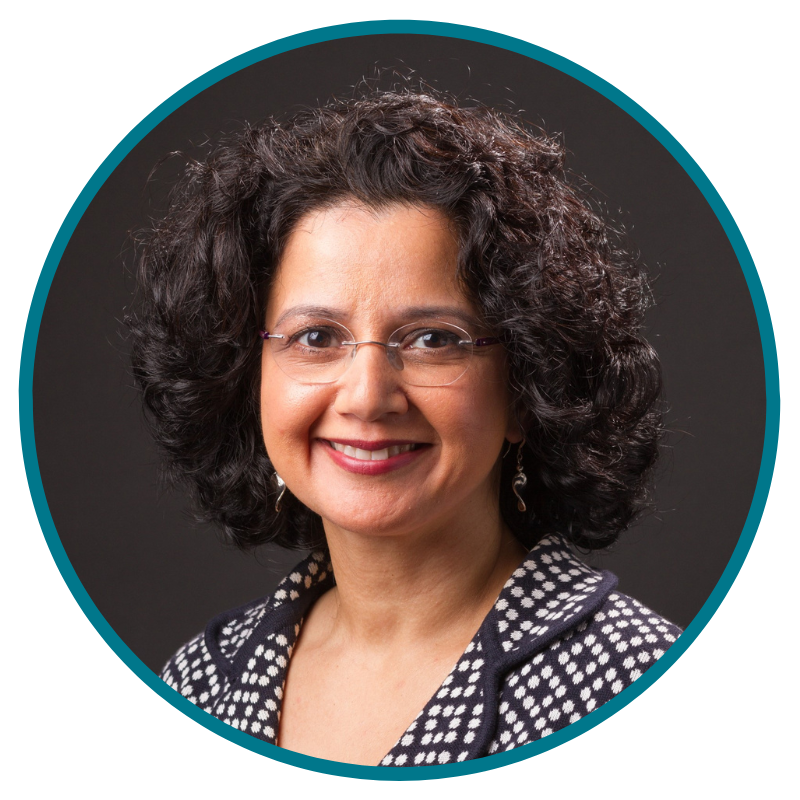
Neera Dahl, M.D., Ph.D., is the director of the Nephrology Clinical Trials Program at Yale School of Medicine in New Haven, Connecticut. Her expertise is in the diagnosis and management of inherited kidney disease, with a focus on ADPKD and other cystic kidney diseases that mimic ADPKD.
### **Why is genetic testing important for people with ADPKD?**
ADPKD is primarily diagnosed on clinical grounds. When we see a patient who has a family history of the disease and then look at their imaging and see cysts in the kidneys, we typically make the diagnosis. But it may still be important to consider genetic testing because there are other inherited diseases that can cause cysts but that have a very different risk for end-stage kidney disease (ESKD).
For instance, autosomal dominant polycystic liver disease (ADPLD) also causes liver and kidney cysts. But we think the mutations that cause ADPKD (but not ADPLD) are those responsible for the progression to kidney failure. So, genetic testing may be important to provide information about the likely course of the disease.
### **Are there any other reasons for doing testing?**
The other times to look at genetic testing is if someone in the family had a very different disease course than others. For instance, if your parent was in their 70s when they developed ESKD, but you’re 30 and already facing dialysis, then you may benefit from genetic testing to find out what’s behind that. Or if you have liver fibrosis (scarring) rather than cysts, that could be related to a mutation in some other gene besides PKD1 or PKD2, which cause ADPKD.
We also recommend testing for the 10% to 15% of patients with ADPKD who have no known family history. It’s important to make a genetic diagnosis to ensure that we’re dealing with ADPKD and not something that looks like it.
### **How does genetic testing affect treatment decisions?**
Right now, our treatments are based on the risk of progression. Those at highest risk are the ones treated most aggressively and who may benefit from tolvaptan. However, the genetic diagnosis can also be very helpful in assessing the risk of progression based on the specific mutation and some clinical features.
### **Are there any negatives to doing genetic testing?**
Our genetic information is protected by the Genetic Information Nondiscrimination Act. Genetic testing results cannot be used to determine medical insurance costs or availability. However, the law doesn’t protect against discrimination for life or disability insurance, which may require a review of all your medical information.
### **Is testing being used to tailor treatments?**
Yes, and that’s one of the really exciting parts of where the field is going. There are therapies in development that will increase the expression of polycystin-1 or -2 proteins, which are defective or missing in ADPKD. Going forward, we may be doing genotyping (genetic testing) to determine which families will benefit from which therapies.
### **Where does preimplantation genetic testing come in?**
This is something we discuss with all our young patients, because if one parent has ADPKD, they have a 50% chance of having a child with the disease. In preimplantation genetic testing, in vitro fertilization occurs, and before the embryo or embryos are implanted, they’re genetically tested for evidence of ADPKD. Those embryos without the genetic mutation are implanted. This allows the couple the opportunity to feel they’re doing everything they can to prevent the disease in the next generation.
---
**Want to see more articles like this?** Read the full issue of our magazine, *PKD Life*, and subscribe to future issues **[here](https://pkdcure.org/pkdlife/)**. Also, be sure to **[register for PKDCON 2022 ](https://pkdcure.org/conference/)**to attend Dr. Dahl’s session, “Understanding Polycystic Liver Disease.”
**Resource Categories:** ADPKD, Research
**Global Categories:** Research
---
### [PKD and Common GI Issues](https://pkdcure.org/resources/pkd-and-common-gi-issues/)
**Published:** January 11, 2022
**Author:** fiftyandfifty
**Content:**
**Published on January 11, 2021** \| When you have PKD, your kidneys aren’t the only organs involved. Many people also have issues with their digestive systems. These are just a few links between PKD and common GI issues.
#### **Liver Cysts**
About 80% of people with PKD develop liver cysts, says Seth Goldberg, M.D., associate professor of medicine in the Division of Nephrology at Washington University School of Medicine, and it’s more common in women, thanks to estrogen.
“The good news,” says Dr. Goldberg, “is that these cysts do not cause the liver to shut down; they’re more structural, and they have no effect on liver function.” Many people might not even know they have liver cysts, because they can be symptomless and are often only discovered on routine CT scans. Dr. Goldberg says it’s extraordinarily rare to see a patient with liver cysts develop liver failure that requires a liver transplant. Sometimes, however, a patient will experience discomfort.
### Common GI Issues with PKD You Should Talk to Your Doctor About
#### **Really full after even small meals.**
Known as “early satiety,” this sensation is often experienced because the liver and kidneys are taking up more space in your abdomen, leaving your stomach less room to expand after you eat something.
#### **Pain, tenderness, or swelling.**
Large cysts can be filled with up to 590 cubic centimeters of fluid (about the amount of a 20-ounce soda bottle), Dr. Goldberg says. Such cysts can be uncomfortable, cause your liver to become distended, and leave you with tender spots on your abdomen. If so, your doctor may recommend that a particularly large cyst be drained, a procedure in which a radiologist locates the cyst with ultrasound and uses a needle to remove the fluid. “In most cases, the cyst does come back, but it can take years to recur, so this is a fairly durable treatment,” Dr. Goldberg says.
#### **Lower back pain.**
An expanded liver could be pressing against your back and causing you lower back pain.
---
**Want to see more articles like this?** Read the full issue of our magazine, *PKD Life*, and subscribe to future issues [here](https://pkdcure.org/pkdlife/). You may also enjoy this recent article on [PKD and UTIs](https://pkdcure.org/the-best-ways-to-prevent-utis/).
**Resource Categories:** ADPKD, Diet, Education, Living with PKD, Staying Healthy
**Global Categories:** Diet, Education, Living with PKD, Staying Healthy
---
## Centers of Excellence
### [The Kidney Institute Houston, TX](https://pkdcure.org/centers/the-kidney-institute-houston-tx/)
**Published:** March 6, 2025
**Author:** Sarah Lundak
**Content:**
The Kidney Institute is a mixed private practice and academic clinic serving The Texas Medical Center, North Houston, Northwest Houston and The Woodlands. We have nephrologists experienced in up to date management of polycystic kidney disease who can serve patients in all of these geographic areas. Most of our team hold positions as faculty members of The Houston Methodist, Baylor College of Medicine, and the Texas A&M School of Medicine. We have established a strong network of additional subspecialists with experience with and interest in managing polycystic kidney disease to assist in next level care.
[Go to Website](https://www.kidneydocs.org/)
**Types of Center:** Centers of Excellence
---
### [CORE Kidney at UCLA Health](https://pkdcure.org/centers/ucla-pkd-program-under-core-kidney-program-at-ucla/)
**Published:** July 28, 2020
**Author:** Caitlin Lasky
**Content:**
UCLA PKD Program was established in 2010 with one goal – to fulfill the unmet need in care for ADPKD patients. At that time, what was quite obvious to Dr Rastogi and his team at UCLA that the care for a ADPKD patient was fragmented. PKD program was established to provide true comprehensive integrated care where all aspects of ADPKD and kidney disease were addressed by a team with special interest in ADPKD. 13 years on, we have one of the largest programs globally with patients coming from all walks and corners of the world. We work very closely with other sub-specialties making sure there is true coordination of care. Please below some of the specialties that participate in our PKD program. Besides clinical care, we are heavily focused on clinical research, outreach and education – the CORE principles of the UCLA CORE Kidney program at UCLA which the PKD program is a part of. Patient advocacy and support is one of our major strengths with our ambassadors matched to appropriate patients, there stage and needs. We also recently established the Reproductive Nephrology Program at UCLA to address the family planning needs for patients with ADPKD. We serve as local, regional, national and international resources for HCPs, patients and their families. Our program was also instrumental in helping other programs establish themselves as well Dedicated team with appointments offered in a very reasonable time – both in-person and tele-medicine Sub-specialties offered – genetics, hepatology, radiology, cardiology, neurosurgery, transplant, dialysis, reproductive endocrinology, pain management, pediatrics, and psychiatry. Supportive services – support groups, dietitian, psychologists and kidney educators All specialties available if needed like oncology, gastroenterology, rheumatology, dermatology, pulmonology and infectious diseases Two dedicated hospitals – Ronald Reagan UCLA Medical Center and UCLA Santa Monica Hospital.
[Go to Website](https://www.uclahealth.org/programs/core-kidney/clinical-programs/genetics/adpkd-autosomal-dominant-polycystic-kidney-disease)
**Medical Center Categories:** Affiliated kidney transplant center, Cardiologists, Dermatologist, Dieticians or Nutritionists, Genetic testing and counseling center, Hemodialysis, High-risk pregnancy obstetricians, Home hemodialysis, Interventional radiologist (familiar with cyst aspiration), Liver specialists with expertise in PKD (or PLD specialists), Mental health specialists, Neurosurgeon/neurologists (familiar with aneurysm screening and treatment), Participation in current clinical studies, Peritoneal dialysis, Prescribes Tolvaptan, Social workers, Urologists
**Types of Center:** Centers of Excellence
---
### [Munson Healthcare Kidney and Hypertension Specialists](https://pkdcure.org/centers/munson-healthcare-kidney-and-hyptertension-specialists/)
**Published:** March 6, 2025
**Author:** Sarah Lundak
**Content:**
Munson Healthcare serves people across 29 counties of Northern Michigan, and most of the region’s 590,000 residents receive their medical care at Munson Healthcare facilities. Munson Kidney and Hypertension Specialists is the only nephrology practice in our local community, and our practice also provides outreach across Northern Michigan as well. Munson Healthcare Kidney and Hypertension Specialists manages patient care with the widest variety of nephrology services in northern Michigan. Conditions we treat include chronic kidney disease, kidney stone prevention, inherited and cystic kidney disease, resistant hypertension, immunologic disorders affecting kidneys, electrolyte and acid/base disorders, post kidney transplant, acute kidney injury, and end stage kidney disease. Dialysis services from our team include inpatient, outpatient, and home dialysis. Our expert team of nephrologists and nurse practitioners are accepting new patient referrals.
[Go to Website](https://providers.munsonhealthcare.org/location/munson-healthcare-kidney-hypertension-specialists/loc0000110702)
**Types of Center:** Partner Clinics
---
### [Tufts Medical Center](https://pkdcure.org/centers/pkd-center-at-tufts-medical-center/)
**Published:** October 20, 2019
**Author:** Caitlin Lasky
**Content:**
At the Center for Polycystic Kidney Disease at Tufts Medical Center, our goal is to give patients a lifetime of individualized care. Our team treats patients with both autosomal dominant polycystic kidney disease (ADPKD) and the less common autosomal recessive polycystic kidney disease (ARPKD). Drs. Gordon, Perrone and Miskulin work closely with our colleagues to provide seamless care for all aspects of your condition. In addition, we collaborate with specialists throughout Tufts MC to evaluate and manage complications such as kidney stones, brain aneurysms and liver cysts. Most importantly, we understand what it’s like to live with PKD. We are here to address all of your needs, from pain management and genetic counseling to providing access to promising new drug therapies. Dr. Gordon and his team have extensive experience in the use of tolvaptan, both in clinical trials and as a prescription drug and can determine whether this medication is an option for you.
[Go to Website](https://www.tuftsmedicine.org/services-treatments/nephrology/polycystic-kidney-disease)
**Medical Center Categories:** Affiliated kidney transplant center, Cardiologists, Dermatologist, Dieticians or Nutritionists, Genetic testing and counseling center, Hemodialysis, High-risk pregnancy obstetricians, Home hemodialysis, Interventional radiologist (familiar with cyst aspiration), Liver specialists with expertise in PKD (or PLD specialists), Mental health specialists, Neurosurgeon/neurologists (familiar with aneurysm screening and treatment), Participation in current clinical studies, Peritoneal dialysis, Prescribes Tolvaptan, Social workers, Urologists
**Types of Center:** Centers of Excellence
---
### [Comprehensive Kidney Care Center at Rady Children's](https://pkdcure.org/centers/comprehensive-kidney-care-center-at-rady-childrens/)
**Published:** March 6, 2025
**Author:** Sarah Lundak
**Content:**
Rady Children’s Comprehensive Kidney Care Center treats children and young adults up to 21 years of age with kidney disease. We offer a full array of services along the age continuum, from prenatal counseling and initial diagnosis to renal replacement therapy, to the transition to adult nephrology services. Providers treat a variety of genetic causes of cystic kidney disease, including autosomal dominant polycystic kidney disease, autosomal recessive polycystic kidney disease, HNF1B-associated cystic kidney disease and other less common forms of genetic cystic kidney disease.
[Go to Website](https://www.rchsd.org/programs-services/nephrology/)
**Types of Center:** Pediatric Clinics
---
### [Emory University Hospital](https://pkdcure.org/centers/the-emory-clinic/)
**Published:** November 4, 2019
**Author:** Caitlin Lasky
**Content:**
Emory Clinic at Emory University has been involved in all major studies that changed the care of PKD patients. The clinic has seen more than 2000 patients and offers all aspects of care for PKD patients, ranging from Nephrology care, urology services, interventional radiology center, Pain management, nutritional services, Hepatology services, kidney, hemodialysis, peritoneal dialysis, transplant services and ongoing research projects.
[Go to Website](https://med.emory.edu/departments/medicine/divisions/renal-medicine/research/index.html)
**Medical Center Categories:** Affiliated kidney transplant center, Cardiologists, Dermatologist, Dieticians or Nutritionists, Genetic testing and counseling center, Hemodialysis, High-risk pregnancy obstetricians, Home hemodialysis, Interventional radiologist (familiar with cyst aspiration), Liver specialists with expertise in PKD (or PLD specialists), Mental health specialists, Neurosurgeon/neurologists (familiar with aneurysm screening and treatment), Participation in current clinical studies, Peritoneal dialysis, Prescribes Tolvaptan, Social workers, Urologists
**Types of Center:** Centers of Excellence
---
### [Nephrology Associates, PA (DE)](https://pkdcure.org/centers/nephrology-associates-pa-de/)
**Published:** March 12, 2025
**Author:** Sarah Lundak
**Content:**
Nephrology associates is the largest and most comprehensive nephrology practice operating across the entire state of Delaware. Our group comprises a network of skilled nephrologists, and healthcare professionals, providing top-notch kidney care to patients in every corner of the state. With clinics strategically located throughout the state, we ensure that patients have easy access to our services, regardless of their geographic location. Our extensive network of clinics enables us to serve both urban and rural communities effectively. Our group offers a wide range of services, from preventive kidney health screenings to advanced treatments for chronic kidney disease, kidney transplant evaluations and management, interventional nephrology and dialysis care.
[Go to Website](https://www.delawarekidney.com/)
**Types of Center:** Partner Clinics
---
### [Columbia University Medical Center](https://pkdcure.org/centers/columbia-university-medical-center-nephrology/)
**Published:** November 18, 2019
**Author:** Caitlin Lasky
**Content:**
Our mission is to improve the health of patients with kidney disease and find a cure. Our faculty members are world-renowned and our division is consistently among the highest-ranked programs nationally. We offer comprehensive clinical services, cutting edge research and innovative training programs. Our nephrology division has many unique programs including our Precision Medicine Initiative, The Center for Glomerular Diseases, The Transplant Center, The Hypertension Center and The O’Brien Urology Center that are redefining the science and practice of Nephrology for the 21st century.
[Go to Website](https://columbianephrology.org/pkd/)
**Medical Center Categories:** Affiliated kidney transplant center, Cardiologists, Dermatologist, Dieticians or Nutritionists, Genetic testing and counseling center, Hemodialysis, High-risk pregnancy obstetricians, Home hemodialysis, Interventional radiologist (familiar with cyst aspiration), Liver specialists with expertise in PKD (or PLD specialists), Mental health specialists, Neurosurgeon/neurologists (familiar with aneurysm screening and treatment), Peritoneal dialysis, Prescribes Tolvaptan, Social workers, Urologists
**Types of Center:** Centers of Excellence
---
### [University of Vermont](https://pkdcure.org/centers/university-of-vermont/)
**Published:** March 14, 2025
**Author:** Shayla
**Content:**
University Clinic with 10 providers, 3 nurses, 1 dietitian, 2 research coordinators, co-located with renal transplant service (2 surgeons, 2 transplant nephrologists).
**Types of Center:** Centers of Excellence
---
### [Dallas Nephrology Associates](https://pkdcure.org/centers/dallas-nephrology-associates/)
**Published:** March 6, 2025
**Author:** Sarah Lundak
**Content:**
Dallas Nephrology Associates (DNA) is a national leader in creating person-centered value-based care in Nephrology, with a focus on innovation and patient choice. For over 50 years, DNA has been a trusted source of information and education resulting in quality kidney care. Our healthcare team, consisting of over 100 physicians and 25 advanced practitioners, play a vital role in fulfilling our collective goal of delivering exemplary healthcare services to our patients. DNA offers the entire spectrum of nephrology care from the office management of CKD patients, to 24/7 coverage of hospitals, dialysis clinics, as well as management of the dialysis accesses of dialysis patients through our 2 vascular centers. DNA serves as Medical Director of 4 transplant programs in DFW, and our team of 20 transplant-trained physicians is the largest in the country.
At DNA, we deliver comprehensive healthcare management to patients diagnosed with polycystic kidney disease (PKD), ensuring they receive a thorough understanding of the complexities associated with inherited disorders.
[Go to Website](https://www.dneph.com/)
**Types of Center:** Centers of Excellence
---
### [University of Chicago](https://pkdcure.org/centers/uchicago-medicine-duchossois-center-or-advanced-medicine/)
**Published:** August 20, 2020
**Author:** Caitlin Lasky
**Content:**
The PKD Center resides within the University of Chicago and University of Chicago Medicine (UCM) and is a national and international referral clinic for patients with autosomal dominant polycystic kidney disease or ADPKD. The UCM clinic has been in existence for more than seven years and provides specialized services to patients with ADPKD with access to both pediatric and adult nephrologists, experienced and trained in the management of ADPKD. The clinic provides support from a kidney trained dietician with extensive experience in ADPKD, a genetic counselor with extensive experience in hereditary kidney disorders and specifically in ADPKD, two nurses certified in tolvaptan management, three medical assistants and a social worker to assist with medical insurance issues and referral for home and in-center dialysis. Medical staff provide ADPKD patient scheduling in radiology (i.e. MR, CT, ultrasound and PET imaging) and interventional radiology (i.e. patients with abdominal pain, cyst infections, bleeding, intracranial aneurysms and vascular access preparation). Surgical professionals experienced in complications related to polycystic liver disease, urolithiasis, renal cell carcinoma, intracranial aneurysms, kidney and liver transplantation are a part of the PKD Center as well as specialized pain clinics for those who with pain-related complications of ADPKD. Wait times for an appointment are typically no longer than 2 weeks and PKD center navigators are in place to help with referrals to the appropriate sub-specialty clinic. Research coordinators and a clinical research center are onsite to provide patients with the latest opportunities to participate in clinical research studies and clinical trials focusing on improving the lives of individuals with ADPKD.
[Go to Website](https://medicine.uchicago.edu/sections/nephrology/)
**Medical Center Categories:** Affiliated kidney transplant center, Cardiologists, Dermatologist, Dieticians or Nutritionists, Genetic testing and counseling center, Hemodialysis, High-risk pregnancy obstetricians, Home hemodialysis, Interventional radiologist (familiar with cyst aspiration), Liver specialists with expertise in PKD (or PLD specialists), Mental health specialists, Neurosurgeon/neurologists (familiar with aneurysm screening and treatment), Participation in current clinical studies, Peritoneal dialysis, Prescribes Tolvaptan, Social workers, Urologists
**Types of Center:** Centers of Excellence
---
### [University of Texas Southwestern Medical Center](https://pkdcure.org/centers/university-of-texas-southwestern-medical-center/)
**Published:** March 3, 2021
**Author:** Caitlin Lasky
**Content:**
A comprehensive PKD Clinic which offers MRI for TKV assessment, a broad range of subspecialists, access to nutrition consultation, transplant/dialysis options, and clinical trials.
[Go to Website](https://utswmed.org/conditions-treatments/polycystic-kidney-disease/)
**Medical Center Categories:** Affiliated kidney transplant center, Cardiologists, Dermatologist, Dieticians or Nutritionists, Genetic testing and counseling center, Hemodialysis, High-risk pregnancy obstetricians, Interventional radiologist (familiar with cyst aspiration), Mental health specialists, Neurosurgeon/neurologists (familiar with aneurysm screening and treatment), Participation in current clinical studies, Peritoneal dialysis, Prescribes Tolvaptan, Social workers, Urologists
**Types of Center:** Centers of Excellence
---
### [South Texas Renal Care Group](https://pkdcure.org/centers/south-texas-renal-care-group/)
**Published:** March 6, 2025
**Author:** Sarah Lundak
**Content:**
Nephrology, Vascular Surgery, Imaging Center, ASC/OBL for HD access placement and care
[Connect with your local San Antonio PKD Community Here](https://go.pkdcure.org/SanAntonio-STRCG)
[Go to Website](https://www.texaskidneycare.com/)
**Types of Center:** Partner Clinics
---
### [University of Texas Health San Antonio](https://pkdcure.org/centers/university-of-texas-health-san-antonio/)
**Published:** March 14, 2025
**Author:** Shayla
**Content:**
The University of Texas Health Science Center at San Antonio, also known as UT Health San Antonio, is a leading academic health center with a mission to make lives better through excellence in advanced academics, life-saving research and comprehensive clinical care. Our UT Health San Antonio Polycystic Kidney disease (PKD) clinic is located on the 4th floor of the large UT Medical Arts and Research Center (MARC) multispecialty facility in the San Antonio Medical Center. We offer onsite laboratory, imaging, dietician/nutrition and pharmacy services. Every patient at UT Health San Antonio benefits from our multi-disciplinary approach with on-site access to more than 25 sub-specialists. Our board-certified nephrologists have expertise in the diagnosis and treatment of polycystic kidney disease and its complications. They are knowledgeable in both ADPKD (autosomal dominant polycystic kidney disease) and ARPKD (autosomal recessive polycystic kidney disease). Our comprehensive approach to PKD includes a thorough hour-long initial assessment which typically includes laboratory, imaging studies and genetic testing. We will assess your current level of kidney function, discuss prognosis, and over the first few visits formulate a plan for intervention including but not limited to: drug therapy, lifestyle modifications, dietary considerations and plans for monitoring. While PKD has no known cure, our goal is to delay progression of kidney disease with evidence-based assessment, treatment and management with the most up to-date therapeutic options available. With advanced kidney disease, we are fervent advocates for pre-emptive kidney transplant and have a strong relationship our affiliated University Transplant Center. We have a special interest in pediatric-to-adult transitions in PKD care. Let us partner with you on your journey with PKD.
[Connect with your local San Antonio PKD Community Here](https://go.pkdcure.org/SanAntonio-UTHSA)
[Go to Website](https://lsom.uthscsa.edu/nephrology/)
**Types of Center:** Partner Clinics
---
### [Cleveland Clinic Foundation, Department of Kidney Medicine](https://pkdcure.org/centers/cleveland-clinic/)
**Published:** November 21, 2019
**Author:** Caitlin Lasky
**Content:**
Cleveland Clinic’s Glickman Urological and Kidney Institute, recognized worldwide for excellence in patient care, teaching and research, merges the urology and nephrology programs. This consolidation of disciplines allows us to better serve patients in the prevention, diagnosis and treatment of kidney disease while we continue to provide high-quality patient care and carry on innovative research in all aspects of urology. Cleveland Clinic is ranked as one of the nation’s top hospitals by U.S. News & World Report.
[Go to Website](https://my.clevelandclinic.org/services/polycystic-kidney-disease-treatment#featured-provider-panel)
**Medical Center Categories:** Affiliated kidney transplant center, Cardiologists, Dermatologist, Dieticians or Nutritionists, Genetic testing and counseling center, Hemodialysis, High-risk pregnancy obstetricians, Home hemodialysis, Interventional radiologist (familiar with cyst aspiration), Liver specialists with expertise in PKD (or PLD specialists), Mental health specialists, Neurosurgeon/neurologists (familiar with aneurysm screening and treatment), Participation in current clinical studies, Peritoneal dialysis, Prescribes Tolvaptan, Social workers, Urologists
**Types of Center:** Centers of Excellence
---
### [Mass General Brigham](https://pkdcure.org/centers/mass-general-brigham/)
**Published:** March 6, 2025
**Author:** Sarah Lundak
**Content:**
The Mass General Brigham (MGB) Kidney Genetics & PKD Clinic specializes in the care of individuals with genetic and familial kidney disorders, with a special focus on polycystic kidney disease (PKD). Our clinic provides comprehensive diagnostic evaluation and clinical care to those with known or suspected PKD and other inherited kidney diseases. We have offices at 2 locations: Brigham and Women’s Hospital (BWH) and Massachusetts General Hospital (MGH). Our team consists of kidney physicians with expertise in PKD and genetics, a genetic counselor, renal nurses and practice assistants who work together to coordinate care, facilitate genetic testing and provide detailed teaching to patients and families. We created the MGB PKD Clinical Network, a multidisciplinary team of providers with expertise in PKD and its complications. This network includes liver specialists, transplant surgeons, urologists, neurosurgeons, interventional radiologists, renal nutritionists, reproductive specialists, obstetricians and pain specialists. For our patients who need renal replacement therapy, we coordinate dialysis planning and access, and work closely with the MGB Kidney Transplant team for timely, safe and effective transplant planning. We have a close partnership with the MGB for Children Pediatric Nephrology Clinic and the Boston Children’s Hospital’s Kidney Genetics Clinic, to facilitate the transition from pediatric to adult PKD care, and to coordinate family care. Finally, our institution is involved in cutting-edge research in the field of PKD and kidney genomics, and home to the Harvard PKD Center for polycystic kidney disease research.
[Go to Website](https://www.brighamandwomens.org/)
**Types of Center:** Centers of Excellence
---
### [Vanderbilt University Medical Center](https://pkdcure.org/centers/vanderbuild-university-medical-center/)
**Published:** January 23, 2020
**Author:** Caitlin Lasky
**Content:**
Our clinic is proud of our Patient-Centered approach to polycystic kidney disease care. We work closely with patients and their referring Providers to ensure that all patients with ADPKD receive high quality, cuttingedge counseling and care for their condition. Our multidisciplinary team ensures that patient preferences, goals and options are managed in a comprehensive way, limiting the burden of this disease on patients and their loved ones.
**Medical Center Categories:** Affiliated kidney transplant center, Cardiologists, Dermatologist, Dieticians or Nutritionists, Genetic testing and counseling center, Hemodialysis, Home hemodialysis, Interventional radiologist (familiar with cyst aspiration), Liver specialists with expertise in PKD (or PLD specialists), Mental health specialists, Neurosurgeon/neurologists (familiar with aneurysm screening and treatment), Participation in current clinical studies, Peritoneal dialysis, Prescribes Tolvaptan, Social workers, Urologists
**Types of Center:** Centers of Excellence
---
### [Ochsner Medical Center](https://pkdcure.org/centers/ochsner-medical-center/)
**Published:** February 26, 2025
**Author:** Sarah Lundak
**Content:**
We evaluate patients with polycystic kidney disease in the clinic, arrange brain imagine for aneaurysm screening and genetic testing if indicated, and order Tolvaptan through the REMS program for patients with Mayo Clinic class 1C and above.
[Go to Website](https://www.ochsner.org/services/nephrology)
**Types of Center:** Partner Clinics
---
### [Mayo Clinic (Florida)](https://pkdcure.org/centers/mayo-clinic-pkd-center-2/)
**Published:** December 5, 2019
**Author:** Caitlin Lasky
**Content:**
Mayo Clinic Florida PKD center has established a multidisciplinary holistic integrative clinic for ADPKD patients to provide the latest advances in the management of ADPKD and other inherited renal diseases. The Mayo Clinic Florida PKD center is committed to bring innovation and advance the standard of care of ADPKD patients by providing such a holistic approach and providing comprehensives services including genetic testing and counseling, life coaching and emotional support, pain control and cyst reduction interventions, individualized approach in predicting onset of kidney failure and navigating the challenges of kidney failure, kidney transplantation including kidney and liver transplantations, specialized surgeries such as cyst aspiration/foam sclerotherapy, nephrectomy and partial hepatectomy, neurosurgical advances in management of intracranial aneurysms, advanced imaging techniques and biomarkers, innovation in delivering healthcare and bridge the gap in the limited healthcare access of underserved areas, biomarkers discovery, drug and novel therapeutics discovery. The Mayo Clinic Florida campus has multiple PKD champions in the various specialties to deliver comprehensive care including nephrology, hepatology, kidney and liver transplant, radiology, interventional radiology, general surgery, hepatobiliary surgery, urology, pain medicine, cardiology, interventional cardiology, neurosurgery, integrative medicine, social work, nutrition, psychology and psychiatry. Furthermore, the Mayo Clinic Florida PKD center is leading and participating in multiple PI-initiated and industry-initiated multicenter clinical trials, and leading international initiative in advancing the clinical research and healthcare delivery for ADPKD patients.
[Go to Mayo Clinic Polycystic Kidney Disease (PKD) Resource Center](https://mcpress.mayoclinic.org/polycystic-kidney-disease/)
[Go to Website](https://www.mayoclinic.org/diseases-conditions/polycystic-kidney-disease/care-at-mayo-clinic/mac-20352828)
**Medical Center Categories:** Affiliated kidney transplant center, Cardiologists, Dermatologist, Dieticians or Nutritionists, Genetic testing and counseling center, Hemodialysis, Home hemodialysis, Interventional radiologist (familiar with cyst aspiration), Liver specialists with expertise in PKD (or PLD specialists), Mental health specialists, Neurosurgeon/neurologists (familiar with aneurysm screening and treatment), Participation in current clinical studies, Peritoneal dialysis, Prescribes Tolvaptan, Social workers, Urologists
**Types of Center:** Centers of Excellence
---
### [University of Miami](https://pkdcure.org/centers/university-of-miami/)
**Published:** March 14, 2025
**Author:** Shayla
**Content:**
The ADPKD Clinic of the University of Miami provides comprehensive, multidisciplinary, and individualized care for patients and families affected by ADPKD. Clinical services are provided at the UHealth and JMH outpatient clinics of the Katz Family Division of Nephrology and the UHealth/JMH Miami Transplant Institute (MTI). UHealth clinics are located at the Diabetes Research Institute and the Lennar Foundation Medical Center, part of the University of Miami Health System. JMH clinics are located at Jackson Memorial Hospital and the Miami Transplant Institute. The ADPKD clinic provides comprehensive diagnostic and therapeutic services with the support of an integrated care team comprised of key specialists with expertise in ADPKD, including Nephrologists, Hematologists, Cardiologists, Geneticists, Interventional Radiologists, and Pain Management specialists. For the past 3 years, we have maintained a clinic dedicated to the treatment of patients receiving Jynarque (tolvaptan). Our clinic also serves to provide second opinion and consultation to community providers who are engaged with us as partners in ADPKD care. The ADPKD clinic is devoted to ensuring that patients and families receive optimal, evidence-based care and the opportunity to participate in clinical trials and access cutting-edge therapies through a personalized treatment approach. The ADPKD Clinic strives to provide patients and families with a patient-focused, comprehensive experience devoted to optimizing the care, quality of life, and outcomes of patients affected by ADPKD.
[Go to Website](https://umiamihealth.org/treatments-and-services/nephrology/polycystic-kidney-disease/)
**Types of Center:** Centers of Excellence
---
### [SSM Saint Louis University Hospital](https://pkdcure.org/centers/saint-louis-university/)
**Published:** March 14, 2025
**Author:** Shayla
**Content:**
SSM Saint Louis University Hospital Polycystic Kidney Diseases (PKD) center brings together ADPKD-focused specialists from many disciplines of care to manage the complexities that ADPKD patients face at every stage of disease. Our ADPKD expert nephrologists see patients in both outpatient and hospital settings and work with pediatric nephrologists, radiologists, hematologists, pain specialists, genetic counselors, dietitians, urologists, cardiologists, transplant surgeons, liver surgeons, neurologists, neurosurgeons, psychiatrists and social workers to provide comprehensive care for ADPKD patients. We have research programs targeted toward different ADPKD patient stages that are designed to improve health across many dimensions of this challenging condition.
[Go to Website](https://www.ssmhealth.com/nephrology/)
**Types of Center:** Centers of Excellence
---
### [Beth Israel Deaconess Medical Center](https://pkdcure.org/centers/beth-isreal-deaconess-medical-center/)
**Published:** October 5, 2019
**Author:** Caitlin Lasky
**Content:**
1000 bed Harvard-affiliated academic medical center with an active outpatient clinic for all disciplines.
[Go to Website](https://www.bidmc.org/patient-and-visitor-information/patient-portal)
**Medical Center Categories:** Affiliated kidney transplant center, Cardiologists, Dermatologist, Dieticians or Nutritionists, Genetic testing and counseling center, Hemodialysis, High-risk pregnancy obstetricians, Home hemodialysis, Interventional radiologist (familiar with cyst aspiration), Liver specialists with expertise in PKD (or PLD specialists), Mental health specialists, Neurosurgeon/neurologists (familiar with aneurysm screening and treatment), Participation in current clinical studies, Social workers, Urologists
**Types of Center:** Centers of Excellence
---
### [Montefiore Medical Center](https://pkdcure.org/centers/montefiore-medical-center/)
**Published:** June 21, 2021
**Author:** Caitlin Lasky
**Content:**
The ADPKD program at Montefiore is a patient and physician support program that supports patients with ADPKD who are taking Jynarque as well as assisting nephrologists in managing ADPKD. We help nephrologists identify patients who are appropriate candidates for Jynarque, provide extensive patient education on ADPKD and Jynarque, enroll patients in the Jynarque REMS, oversee prescription of this medication and monitor patients on therapy. We work closely with other specialties to manage conditions associated with ADPKD as well as provide ongoing Chronic Kidney Disease (CKD) care up through and including CKD education, pre-ESRD education, kidney transplant referral and referral to dialysis care of all home and incenter modalities.
[Go to Website](https://montefioreeinstein.org/patient-care/services/nephrology)
**Medical Center Categories:** Affiliated kidney transplant center, Cardiologists, Dermatologist, Dieticians or Nutritionists, Genetic testing and counseling center, Hemodialysis, High-risk pregnancy obstetricians, Home hemodialysis, Interventional radiologist (familiar with cyst aspiration), Liver specialists with expertise in PKD (or PLD specialists), Mental health specialists, Neurosurgeon/neurologists (familiar with aneurysm screening and treatment), Peritoneal dialysis, Prescribes Tolvaptan, Urologists
**Types of Center:** Partner Clinics
---
### [Reliant Medical Group](https://pkdcure.org/centers/reliant-medical-group/)
**Published:** March 13, 2025
**Author:** Shayla
**Content:**
We are a community based kidney disease clinic with locations throughout central Massachusetts. Our group consists of 4 full time kidney specialists and 3 nurses. In addition to treating all type of chronic kidney disease, we are also experts in treating resistant hypertension and electrolyte disorders. In terms of our ADPKD program: All of our doctors are certified to prescribe tolvaptan, and we partner with Natera to offer low cost genetic testing to our patients when needed.
[Go to Website](https://reliantmedicalgroup.org/medical-services/nephrology/)
**Types of Center:** Partner Clinics
---
### [University of California San Diego](https://pkdcure.org/centers/university-of-california-san-diego/)
**Published:** March 14, 2025
**Author:** Shayla
**Content:**
UCSD Nephrology has multiple clinical sites in San Diego County and beyond. The two sites listed above are in close proximity to the two UCSD Hospitals and cater to the majority of patients. Nephrologists with expertise and interest in ADPKD are present at these locations during 5 half day clinic sessions per week. These sites also have onsite RN, LVN trained in the specifics of ADPKD, include patient navigation, referrals for testing, enrollment for REMS, prior authorization approval and rapid turn around time for patient correspondence. Given the proximity to the hospital, imaging and subspecialty care including pain management, urology, hepatology, infectious disease, and neurosurgery are also located at the same location as nephrology. This allows for ADPKD patients with complex needs to be seen at one location.
[Go to Website](https://health.ucsd.edu/specialties/kidney/Pages/polycystic.aspx/)
**Types of Center:** Centers of Excellence
---
### [University of Southern California Keck School of Medicine](https://pkdcure.org/centers/keck-medical-center-of-usc/)
**Published:** July 21, 2021
**Author:** Caitlin Lasky
**Content:**
The USC Keck PKD Clinic, under the auspices of the Keck School of Medicine of USC, Division of Nephrology and Hypertension, will provide and help coordinate comprehensive clinical care and support for patients with a suspected or confirmed diagnosis of polycystic kidney disease. We will also facilitate patient and practitioner participation in PKD clinical trials and other PKD research projects with the overall goal of improving the lives of patients afflicted with PKD.
[Go to Website](https://internalmedicine.usc.edu/specialties/nephrology/cystic-and-interstitial-diseases-clinic/)
**Medical Center Categories:** Affiliated kidney transplant center, Cardiologists, Dermatologist, Dieticians or Nutritionists, Genetic testing and counseling center, Hemodialysis, High-risk pregnancy obstetricians, Home hemodialysis, Interventional radiologist (familiar with cyst aspiration), Liver specialists with expertise in PKD (or PLD specialists), Mental health specialists, Neurosurgeon/neurologists (familiar with aneurysm screening and treatment), Participation in current clinical studies, Peritoneal dialysis, Prescribes Tolvaptan, Social workers, Urologists
**Types of Center:** Centers of Excellence
---
### [University of Kansas Health System](https://pkdcure.org/centers/university-of-kansas-medical-center-pkd-cinic/)
**Published:** October 5, 2019
**Author:** Caitlin Lasky
**Content:**
The University of Kansas Health System’s nephrology department has 11 nephrologists with vast expertise in inpatient, outpatient clinic, and dialysis care. Two nephrologists are experts in PKD. The department has a specific clinic dedicated to PKD patients. PKD Clinic is every Thursday afternoon from 1-5 pm. This clinic offers diagnosis, prognosis, and treatment of PKD. There is a complete continuum of kidney care in this clinic if patients progress with chronic kidney disease management and dialysis education. The general nephrology clinic works closely with the University of Kansas Transplant Center to get patients listed for transplant if needed.
[Go to Website](https://www.kansashealthsystem.com/care/conditions/polycystic-kidney-disease)
**Medical Center Categories:** Affiliated kidney transplant center, Cardiologists, Dermatologist, Dieticians or Nutritionists, Genetic testing and counseling center, Hemodialysis, High-risk pregnancy obstetricians, Home hemodialysis, Interventional radiologist (familiar with cyst aspiration), Liver specialists with expertise in PKD (or PLD specialists), Mental health specialists, Neurosurgeon/neurologists (familiar with aneurysm screening and treatment), Participation in current clinical studies, Peritoneal dialysis, Prescribes Tolvaptan, Social workers, Urologists
**Types of Center:** Centers of Excellence
---
### [Partners in Nephrology and Endocrinology (PINE) - Washington](https://pkdcure.org/centers/partners-in-nephrology-and-endocrinology-pine-washington/)
**Published:** March 12, 2025
**Author:** Sarah Lundak
**Content:**
PINE a leading nephrology and endocrinology group in the western Pennsylvania. For more than 35 years, our team has provided advanced treatment of kidney and endocrine diseases. We have over 30 providers, across more than 18 convenient locations in Allegheny, Butler, Lawrence, Washington counties.
**Types of Center:** Partner Clinics
---
### [Partners in Nephrology and Endocrinology (PINE) - Jefferson Hills](https://pkdcure.org/centers/partners-in-nephrology-and-endocrinology-pine-jefferson-hills/)
**Published:** March 12, 2025
**Author:** Sarah Lundak
**Content:**
PINE a leading nephrology and endocrinology group in the western Pennsylvania. For more than 35 years, our team has provided advanced treatment of kidney and endocrine diseases. We have over 30 providers, across more than 18 convenient locations in Allegheny, Butler, Lawrence, Washington counties.
**Types of Center:** Partner Clinics
---
### [Partners in Nephrology and Endocrinology (PINE) - Carroll](https://pkdcure.org/centers/partners-in-nephrology-and-endocrinology-pine-carroll/)
**Published:** March 12, 2025
**Author:** Sarah Lundak
**Content:**
PINE a leading nephrology and endocrinology group in the western Pennsylvania. For more than 35 years, our team has provided advanced treatment of kidney and endocrine diseases. We have over 30 providers, across more than 18 convenient locations in Allegheny, Butler, Lawrence, Washington counties.
**Types of Center:** Partner Clinics
---
### [Yale University](https://pkdcure.org/centers/yale-university/)
**Published:** March 14, 2025
**Author:** Shayla
**Content:**
The Yale Inherited Kidney Disease Program offers advanced care for patients with cystic kidney diseases, including ADPKD, ARPKD, and polycystic liver disease. Co-led by Dr. Stefan Somlo and Dr. Maryam Gondal, the program provides comprehensive evaluation, diagnosis, and risk prognostication with access to coordinated subspecialty and tertiary care through Yale Medicine and Yale New Haven Hospital.
Patients benefit from expert genetic consultation and access to phase 1, 2, and 3 clinical trials in ADPKD. The program collaborates closely with hepatology, transplantation, pediatrics, and genetics teams. The adult nephrology team includes Drs. Whitney Besse, Marcelo Orias, and Aldo Peixoto, while pediatric nephrology care is led by Drs. Jill Warejko and Christine Crana, ensuring expert, multidisciplinary PKD care.
[Go to Website](https://medicine.yale.edu/intmed/nephrol/programs/)
**Types of Center:** Centers of Excellence
---
### [Mayo Clinic (Rochester)](https://pkdcure.org/centers/mayo-clinic-pkd-center/)
**Published:** October 5, 2019
**Author:** Caitlin Lasky
**Content:**
The Mayo Clinic Pirnie Translational Polycystic Kidney Disease Center is a collaborative, multidisciplinary hub where PKD investigators work closely with Mayo Clinic clinicians and scientists. The team’s expertise spans adult and pediatric nephrology, urology, hepatology, liver surgery, cardiovascular and neurovascular diseases, pain medicine, diagnostic and interventional radiology, kidney and liver transplantation, dialysis, physiology, molecular biology, genetics, and reproductive medicine.
This integrated approach helps accelerate the development of promising therapies, moving them swiftly from the lab through clinical trials and into patient care. The center is dedicated to improving outcomes for patients with PKD and related disorders.
The Mayo Clinic Rochester COE offers a wide range of services, including innovative treatments and opportunities to participate in clinical trials.
[Go to Mayo Clinic Polycystic Kidney Disease (PKD) Resource Center](https://mcpress.mayoclinic.org/polycystic-kidney-disease/)
[Go to Website](https://www.mayoclinic.org/diseases-conditions/polycystic-kidney-disease/symptoms-causes/syc-20352820)
**Medical Center Categories:** Affiliated kidney transplant center, Cardiologists, Dermatologist, Dieticians or Nutritionists, Genetic testing and counseling center, Hemodialysis, High-risk pregnancy obstetricians, Home hemodialysis, Interventional radiologist (familiar with cyst aspiration), Liver specialists with expertise in PKD (or PLD specialists), Mental health specialists, Neurosurgeon/neurologists (familiar with aneurysm screening and treatment), Participation in current clinical studies, Peritoneal dialysis, Prescribes Tolvaptan, Social workers, Urologists
**Types of Center:** Centers of Excellence
---
### [Mayo Clinic Children's (Rochester)](https://pkdcure.org/centers/mayo-clinic-childrens-center-rochester-2/)
**Published:** March 20, 2025
**Author:** Sarah Lundak
**Content:**
The Mayo Clinic Pediatric Cystic Kidney Disease Clinic is part of the Mayo Clinic Pirnie Translational Polycystic Kidney Disease Center, a collaborative and multidisciplinary center that includes PKD investigators working alongside Mayo Clinic clinicians and scientists with expertise in pediatric and adult nephrology, urology, hepatology, surgery, cardiovascular and neurovascular diseases, pain medicine, diagnostic and interventional radiology, kidney and liver transplantation, dialysis, physiology, molecular biology, genetics and reproductive medicine. This team approach means that promising therapies and biomarkers discovery move more quickly from the lab through clinical trials and into clinical practice to benefit patients with PKD and related disorders, conditions that can have devastating and life-threatening complications. The Mayo Clinic Pirnie Translational Polycystic Kidney Disease Center offers a broad variety of services including innovative therapies and opportunities to enroll in clinical trials.
[Go to Mayo Clinic Polycystic Kidney Disease (PKD) Resource Center](https://mcpress.mayoclinic.org/polycystic-kidney-disease/)
[Go to Website](https://www.mayoclinic.org/diseases-conditions/polycystic-kidney-disease/symptoms-causes/syc-20352820)
**Types of Center:** Pediatric Centers of Excellence
---
### [University of Michigan Medicine - Mott Children's Hospital](https://pkdcure.org/centers/university-of-michigan-medical-mott-childrens-hospital/)
**Published:** March 6, 2025
**Author:** Sarah Lundak
**Content:**
Patients with ADPKD are currently either seen by a Pediatric Nephrologist in a dedicated Pediatric Nephrology-Genetics (Mott Hospital) or in a General Nephrology clinic (outreach clinics). This Nephrology-Genetics clinic (Mott Hospital) is run by a Pediatric Nephrologist in combination with a genetic counselor. Our clinic is supported by dietitians and social workers. We have easy access to other pediatric and adult subspecialties, Radiology for imaging, and a state-of-the art laboratory.
[Go to Website](https://www.mottchildren.org/ped-kidney-disease)
**Types of Center:** Pediatric Clinics
---
### [UCSF Benioff Children's Hospital](https://pkdcure.org/centers/ucsf-benioff-childrens-hospital/)
**Published:** March 6, 2025
**Author:** Sarah Lundak
**Content:**
The UCSF Pediatric Kidney Clinic specializes in caring for young patients, ranging from infants to teens, with PKD. We have the expertise and technologies to offer the most advanced treatments. Children with end-stage kidney failure have access to our state-ofthe-art Pediatric Dialysis Unit as well as our Kidney Transplant Program. Patients receive care from a team of experts that includes nephrologists, transplant surgeons, urologists, nurses, social workers, and nutritionists, all of whom have training and experience in meeting the unique needs of children with PKD.
[Go to Website](https://www.ucsfbenioffchildrens.org/clinics/kidney-clinic/)
**Types of Center:** Pediatric Clinics
---
### [Riley Hospital for Children](https://pkdcure.org/centers/riley-hospital-for-children/)
**Published:** March 6, 2025
**Author:** Sarah Lundak
**Content:**
Riley Hospital for Children offers pediatric Nephrology clinic for patients with cystic kidney diseases, providing comprehensive care for children diagnosed with conditions such as polycystic kidney disease (PKD) and other cystic kidney disorders. We have multidisciplinary team of pediatric nephrologists, genetic counselors, dietitians, and social workers, ensuring holistic and personalized treatment plans. Services include advanced diagnostic evaluations, genetic testing, kidney function monitoring, and long-term management strategies to support kidney health and overall well-being. The clinic also provides access to clinical trials and cutting-edge therapies, offering hope for improved outcomes.
[Go to Website](https://www.rileychildrens.org/departments/nephrology-kidney-diseases)
**Types of Center:** Pediatric Clinics
---
### [The Inherited Kidney Diseases Program at the Children’s Hospital of Philadelphia (CHOP)](https://pkdcure.org/centers/the-inherited-kidney-diseases-program-at-the-childrens-hospital-of-philadelphia-chop/)
**Published:** March 6, 2025
**Author:** Sarah Lundak
**Content:**
The CHOP Inherited Kidney Diseases (IKD) program is a “one-stop shop” that provides diagnostics and clinical management for infants and children afflicted with polycystic kidney disease and other single gene disorders of kidney structure and function. The care team is centered in Nephrology, and includes expertise from hepatology, endocrinology, genetics, nutrition, and psychology. A patient navigator guides families through clinic visits, connects them with the right specialists, and serves as a point of contact for families before and after visits.
[Go to Website](https://www.chop.edu/services/inherited-kidney-diseases-ikd-program)
**Types of Center:** Pediatric Centers of Excellence
---
### [Cleveland Clinic Children's](https://pkdcure.org/centers/cleveland-clinic-childrens/)
**Published:** November 21, 2019
**Author:** Caitlin Lasky
**Content:**
We provide primary and consultative care and treatment to children and adolescents with all forms of kidney disease, administered by a team of renal specialists from the joint nephrology/urology clinic. In addition, our Transplant Center has extensive experience with pediatric kidney transplantation, offering living-related and deceased donor renal transplantation services.
[Go to Website](https://my.clevelandclinic.org/pediatrics/departments/nephrology)
**Medical Center Categories:** Affiliated kidney transplant center, Cardiologists, Dermatologist, Dieticians or Nutritionists, Genetic testing and counseling center, Hemodialysis, High-risk pregnancy obstetricians, Home hemodialysis, Interventional radiologist (familiar with cyst aspiration), Liver specialists with expertise in PKD (or PLD specialists), Mental health specialists, Neurosurgeon/neurologists (familiar with aneurysm screening and treatment), Participation in current clinical studies, Peritoneal dialysis, Prescribes Tolvaptan, Social workers, Urologists
**Types of Center:** Pediatric Centers of Excellence
---
### [Children's National Hospital, Inherited and Polycystic Kidney Diseases Program](https://pkdcure.org/centers/childrens-national-hospital/)
**Published:** October 24, 2019
**Author:** Caitlin Lasky
**Content:**
Within the Division of Nephrology, we have created a center of excellence focused on PKD and other Inherited renal diseases.
The Children’s National Inherited and Polycystic Kidney Disease (IPKD) program is a “one-stop shop” that provides patients with comprehensive care for every facet of their disease. The care team is centered in Nephrology, and includes expertise from hepatology, endocrinology, genetics, nutrition, and psychology. A patient navigator guides families through clinic visits, connects them with the right specialists, and serves as a point of contact for families before and after visits.
[Go to Website](https://www.childrensnational.org/get-care/health-library/polycystic-kidney-diseases)
**Medical Center Categories:** Affiliated kidney transplant center, Cardiologists, Dieticians or Nutritionists, Genetic testing and counseling center, Hemodialysis, High-risk pregnancy obstetricians, Liver specialists with expertise in PKD (or PLD specialists), Mental health specialists, Participation in current clinical studies, Peritoneal dialysis, Social workers, Urologists
**Types of Center:** Pediatric Centers of Excellence
---
### [University of Oklahoma](https://pkdcure.org/centers/ou-health-sciences-center-hereditary-kidney-disease-clinic/)
**Published:** October 24, 2019
**Author:** Caitlin Lasky
**Content:**
All aspects of PKD specific care
[Go to Website](https://www.ouhealth.com/find-a-doctor/benjamin-cowley-jr-md/)
**Medical Center Categories:** Affiliated kidney transplant center, Cardiologists, Dermatologist, Dieticians or Nutritionists, Genetic testing and counseling center, Hemodialysis, High-risk pregnancy obstetricians, Home hemodialysis, Interventional radiologist (familiar with cyst aspiration), Mental health specialists, Neurosurgeon/neurologists (familiar with aneurysm screening and treatment), Peritoneal dialysis, Prescribes Tolvaptan, Social workers, Urologists
**Types of Center:** Partner Clinics
---
### [University of New Mexico](https://pkdcure.org/centers/university-of-new-mexico/)
**Published:** March 6, 2025
**Author:** Sarah Lundak
**Content:**
General nephrology clinic consists of 9 providers, 1 RN, 1 MA. We provide services for CKD stage 1-5, pre-dialysis care including RRT preparation, specialized clinics for glomerular diseases, polycystic kidney diseases, onco-nephrology, hypertension, electrolyte imbalances, and pediatric-to-adult transitions. We provide care for anemia in kidney disease including Epogen/Retacrit injections.
[Go to Website](https://unmhealth.org/services/kidney-care/)
**Types of Center:** Partner Clinics
---
### [University of California Irvine](https://pkdcure.org/centers/university-of-california-irvine-medical-center/)
**Published:** April 16, 2020
**Author:** Caitlin Lasky
**Content:**
nephrology clinic. UC-Irvine health system with access to other specialists within one organization. If we become a partner Clinic we can work to funnel all division neprhology patients to one clinic and further promote excellent and comprehensive PKD care
[Go to Website](https://www.ucihealth.org/medical-services/nephrology)
**Medical Center Categories:** Affiliated kidney transplant center, Cardiologists, Dermatologist, Dieticians or Nutritionists, Genetic testing and counseling center, Hemodialysis, High-risk pregnancy obstetricians, Home hemodialysis, Interventional radiologist (familiar with cyst aspiration), Liver specialists with expertise in PKD (or PLD specialists), Mental health specialists, Neurosurgeon/neurologists (familiar with aneurysm screening and treatment), Participation in current clinical studies, Peritoneal dialysis, Prescribes Tolvaptan, Social workers, Urologists
**Types of Center:** Partner Clinics
---
### [The Ohio State University](https://pkdcure.org/centers/the-ohio-state-university/)
**Published:** March 14, 2025
**Author:** Shayla
**Content:**
We offer comprehensive multi-disciplinary care for ADPKD. We work closely with radiology to obtain kidney volume measurements to assess patients’ risk for disease progression. We prescribe and monitor Tolvaptan therapy.
[Go to Website](https://wexnermedical.osu.edu/kidney-care/nephrology-clinics/polycystic-kidney-disease/)
**Types of Center:** Partner Clinics
---
### [The Kidney and Hypertension Center (KHC)](https://pkdcure.org/centers/the-kidney-and-hypertension-center-khc/)
**Published:** March 6, 2025
**Author:** Sarah Lundak
**Content:**
KHC is the premier and largest nephrology group covering Cincinnati metropolitan area providing comprehensive nephrology care including preventive kidney health screenings to advanced treatments for chronic kidney disease, kidney transplant evaluations and management (with expertise in native nephrectomies), interventional nephrology (comprehensive dialysis access care and pd catheter placemen) and dialysis care (in center and home dialysis). Our PKD clinic provide comprehensive PKD care with multidisciplinary approach involving genetic testing with counselling, advanced imaging, and use of new PKD therapies.
[Go to Website](https://khccares.com/conditions/polycystic-kidney-disease-pkd/)
**Types of Center:** Partner Clinics
---
### [Rockford Nephrology Associates](https://pkdcure.org/centers/rockford-nephrology-associates/)
**Published:** March 14, 2025
**Author:** Shayla
**Content:**
Comprehensive Nephrology Care by 10 Board Certified Nephrologists and support staff
[Go to Website](https://www.rockfordnephrology.org/)
**Types of Center:** Partner Clinics
---
### [Renal Associates of Baton Rouge, LLC](https://pkdcure.org/centers/renal-associates-of-baton-rouge-llc/)
**Published:** March 6, 2025
**Author:** Sarah Lundak
**Content:**
Areas of treatment: Nephrology – The study of the function and diseases of the kidney and related organs. Problem Hypertension – We help individuals whose blood pressure readings are chronically above the normal range. Chronic Kidney Disease – We diagnose and treat anemia associated with chronic kidney disease which can improve quality of life and appears to have cardiovascular benefits. Electrolyte disorders – Renal Associates’ providers also manage disturbances in the body’s ability to properly handle sodium, potassium calcium, and magnesium. Hemodialysis and Peritoneal dialysis – Renal Associates’ providers manage the care of patients receiving hemodialysis and peritoneal dialysis treatments, servicing over 23 outpatient units.
Ancillary Services: Clinical Research in partnership with Frenova Renal Research, Chronic Care Management Services, Onsite Imaging Services, Onsite phlebotomy and laboratory services, and vascular access center.
[Go to Website](https://www.renalassociates.com/)
**Types of Center:** Partner Clinics
---
### [North Carolina Nephrology Associates](https://pkdcure.org/centers/north-carolina-nephrology-associates/)
**Published:** March 14, 2025
**Author:** Shayla
**Content:**
We are a full service nephrology clinic based in Wake County, NC. We offer ADPKD treatment (Jynarque), genetic testing, and clinical research opportunities.
[Go to Website](https://www.med.unc.edu/medicine/nephrology-hypertension/patient-care/appointments/adult-nephrology/)
**Types of Center:** Partner Clinics
---
### [Mount Sinai Hospital](https://pkdcure.org/centers/icahn-school-of-medicine-at-mount-sinai/)
**Published:** August 24, 2020
**Author:** Caitlin Lasky
**Content:**
The Mount Sinai Hospital is ranked 12th for Nephrology by *U.S. News & World Report*. The Mount Sinai Hospital provides expert diagnosis and treatment of all forms of kidney disease. We coordinate your care with other doctors and design a personalized plan to treat your kidney problems.
Along with our excellent hospitals and convenient medical practices throughout New York City, Mount Sinai Health System includes the [Icahn School of Medicine at Mount Sinai](https://icahn.mssm.edu/). At the School, our doctors research the causes of and new ways to prevent and treat kidney disease. We offer you direct access to our [clinical trials](https://www.mountsinai.org/care/nephrology/research) so you can be treated with promising new medications early. Our generous National Institutes of Health research budget supports our [nephrology studies](https://icahn.mssm.edu/about/departments/medicine/nephrology/research) for your benefit. In addition, we educate doctors and staff through our [nephrology training program](https://icahn.mssm.edu/education/residencies-fellowships/list/msh-nephrology-fellowship)—one of the largest in the United States.
[Go to Website](https://icahn.mssm.edu/)
[ADPKD Podcast](https://urldefense.proofpoint.com/v2/url?u=https-3A__open.spotify.com_show_3JI8dqRZ4cMejq25LmvKO2-3Fsi-3DthrlYLcTQ7qCCmXt6WYs2g&d=DwMFAg&c=shNJtf5dKgNcPZ6Yh64b-ALLUrcfR-4CCQkZVKC8w3o&r=iRvnNQeWo3jhW1xWFoS-8g2CZyVHRjD8ExyvMHkZTRo&m=53_KKWtp3V8lhVTmh4s6ubUkIzwUeWkkUejV7t4v21bjzhTjMNxPB12gNQ13OL5m&s=L5htu3yNXFBAV_psjYwf58EakD7_n9P0R8SpRi4m2uU&e=)
**Medical Center Categories:** Affiliated kidney transplant center, Cardiologists, Dermatologist, Dieticians or Nutritionists, Genetic testing and counseling center, Hemodialysis, High-risk pregnancy obstetricians, Home hemodialysis, Interventional radiologist (familiar with cyst aspiration), Liver specialists with expertise in PKD (or PLD specialists), Mental health specialists, Neurosurgeon/neurologists (familiar with aneurysm screening and treatment), Peritoneal dialysis, Prescribes Tolvaptan, Social workers, Urologists
**Types of Center:** Partner Clinics
---
### [Nephrology Associates of Mobile, P.A.](https://pkdcure.org/centers/nephrology-associates-of-mobile-p-a/)
**Published:** March 12, 2025
**Author:** Sarah Lundak
**Content:**
Nephrology Associates of Mobile offers the following medical services: In Center Hemodialysis, Dialysis: Peritoneal, Home Hemodialysis, Nocturnal Dialysis, “Working Shift” Dialysis, Dialysis Access Procedures (At Mobile Vascular Labs, LLC), Anemia Management, Post-Transplant Care Nephrology Associates of Mobile treats the following conditions: Chronic Kidney Disease, Acute Kidney Inury, End State Renal Disease, Kidney Transplant Care, Anemia, Proteinuria (loss of protein in the urine), Hematuria (blood in the urine), Resistant or Difficult to Treat Hypertension, Blood Mineral or Electrolyte Disorders, Kidney Stones (usually only recurrent stone formers), Polycystic Kidney Disease, and Other Cystic Kidney Disorders
[Go to Website](https://www.mykidneydoc.net/)
**Types of Center:** Partner Clinics
---
### [Nephrology and Hypertension Specialists (GA)](https://pkdcure.org/centers/nephrology-and-hypertension-specialists-ga/)
**Published:** March 14, 2025
**Author:** Shayla
**Content:**
Nephrology and Hypertension Specialists excels in providing advanced kidney and hypertension care so you can focus on the good things in life. We are a group of compassionate healthcare professionals providing excellent care for all patients with kidney and associated diseases including polycystic kidney disease. We have access to a regional hospital with advanced testing techniques and easy access to tertiary hospitals in Atlanta, and Nashville.
[Go to Website](https://www.daltonkidneydocs.net/)
**Types of Center:** Partner Clinics
---
### [Loma Linda University Health](https://pkdcure.org/centers/loma-linda-university-health/)
**Published:** March 6, 2025
**Author:** Sarah Lundak
**Content:**
We provide the following services: Diagnostic services, Genetic counselling and testing, Blood pressure management, Pain management, Dietary and nutrition counselling, Clinical trials Interventional therapies, Dialysis and transplant consultation, Support groups and counselling, Medication management including Tolvaptan
[Go to Website](https://lluh.org/services/nephrology/polycystic-kidney-disease-clinic)
**Types of Center:** Partner Clinics
---
### [Gundersen Health System](https://pkdcure.org/centers/gundersen-health-system/)
**Published:** March 12, 2025
**Author:** Sarah Lundak
**Content:**
Whether you have a new kidney problem or are actively managing kidney disease, you want the best treatment and specialist. We are committed to helping you prevent the progression of the disease. Offering: Apheresis, Inpatient dialysis in our La Crosse hospital Outpatient, consultations, Outpatient hemodialysis in Onalaska, Prairie du Chien, Tomah and Viroqua, Home dialysis/Peritoneal dialysis on our La Crosse Campus or at your home.
[Go to Website](https://www.gundersenhealth.org/services/nephrology-renal-dialysis)
**Types of Center:** Partner Clinics
---
### [Greater Hartford Nephrology](https://pkdcure.org/centers/greater-hartford-nephrology/)
**Published:** March 6, 2025
**Author:** Sarah Lundak
**Content:**
We offer comprehensive PKD that includes diagnosis, imaging, genetic testing and treatment.
[Go to Website](https://www.ghneph.com/)
**Types of Center:** Partner Clinics
---
### [George Washington University](https://pkdcure.org/centers/george-washington-university/)
**Published:** March 12, 2025
**Author:** Sarah Lundak
**Content:**
In our multidisciplinary clinic, a group of highly talented physicians will work together to implement preventive strategies and provide the state of treatment where needed. We will also use cutting edge genetic tests and imaging techniques to prognosticate the disease progression and implement preventive treatments aimed at slowing the growth of the cysts. Our team includes experts in Nephrology, Radiology, Genetics, Hepatology, Nutrition, Pain management, Urology and Neurosurgery.
[Go to Website](https://gwdocs.com/specialties/kidney-disease-hypertension)
**Types of Center:** Partner Clinics
---
### [Froedtert and the Medical College of Wisconsin](https://pkdcure.org/centers/froedtert-and-the-medical-college-of-wisconsin/)
**Published:** March 6, 2025
**Author:** Sarah Lundak
**Content:**
Our nephrologists are up to date on the newest guidelines of care for PKD. Our clinic is familiar with tolvaptan prescription protocols for patients who would benefit. We also have a world-class transplant program within our institution, which is important to provide timely, holistic care.
[Go to Website](https://www.froedtert.com/kidney-disease/conditions/polycystic-kidney-disease)
**Types of Center:** Partner Clinics
---
### [Dallas Renal Group](https://pkdcure.org/centers/dallas-renal-group/)
**Published:** March 12, 2025
**Author:** Sarah Lundak
**Content:**
PKD Clinic for newly diagnosed patients offering genetic testing along with treatment/REMS monitoring.
[Go to Website](https://dallasrenalgroup.com/)
**Types of Center:** Partner Clinics
---
### [Commonwealth Nephrology Associates](https://pkdcure.org/centers/commonwealth-nephrology-associates/)
**Published:** March 12, 2025
**Author:** Sarah Lundak
**Content:**
Commonwealth Nephrology Associates specializes in the care of patients with all causes of chronic kidney disease. As one of the most common renal genetic diseases, we have a large population of polycystic kidney disease patients and work to minimize kidney disease and cyst progression using our knowledge of the latest advances in management. Each of our clinics is established strategically in geographic areas to serve the local populations and integrate with the local providers and healthcare systems to organize all necessary testing and referrals. We also spend time with patients and their families to help them understand the implications of this diagnosis and risks to their other family members. We perform personalized office evaluations and examinations as well as review of imaging, labs, prognosis, and options for management in each of our locations (Framingham, Marlborough, Wellesley, Norfolk, Westwood, Quincy, Weymouth, Dorchester, Attleboro, Hyannis, Mashpee).
[Go to Website](https://www.bostonkidney.com/)
**Types of Center:** Partner Clinics
---
### [Columbia Nephrology](https://pkdcure.org/centers/columbia-nephrology/)
**Published:** March 6, 2025
**Author:** Sarah Lundak
**Content:**
Columbia Nephrology is a comprehensive nephrology clinic that consists of 20 physicians and 11 physician extenders. We have convenient clinic locations across the greater Columbia area. Our clinics offer all aspects of nephrology care which includes acute and chronic kidney disease management, treatment of glomerular conditions, hypertension management along with dialysis and ongoing management of kidney transplant recipients. The clinic additionally offers dialysis access placement and ongoing maintenance of accesses. To make the convenient for our patients, an in-house laboratory is available along with education classes that are schedule through out the month.
[Go to Website](https://columbianephrology.com/)
**Types of Center:** Partner Clinics
---
### [CHI Health Creighton University Medical Center - Bergan Mercy](https://pkdcure.org/centers/chi-health-creighton-university-medical-center-bergan-mercy/)
**Published:** March 6, 2025
**Author:** Sarah Lundak
**Content:**
Our clinic offers a multidisciplinary approach, we are dedicated to improving patient outcomes through early intervention, patient education, and ongoing support, ensuring our patients receive the highest standard of care at every stage of their kidney disease journey.
[Go to Website](https://www.chihealth.com/services/nephrology)
**Types of Center:** Partner Clinics
---
### [University of Colorado Anschutz Medical Campus](https://pkdcure.org/centers/university-of-colorado-denver/)
**Published:** March 14, 2025
**Author:** Shayla
**Content:**
The Renal Division at the University of Colorado is consistently ranked within the top kidney programs in the U.S. Our nationally – and internationally – recognized healthcare professionals specialize in treating patients with a wide variety of kidney diseases, end-stage kidney disease, kidney transplant evaluation and post-transplant care, immune-mediated kidney disease, hypertension, kidney stones and polycystic kidney disease.
[Go to Website](https://medschool.cuanschutz.edu/renal/)
**Types of Center:** Centers of Excellence
---
### [University of Maryland School of Medicine](https://pkdcure.org/centers/university-of-maryland-medical-center-baltimore-pkd-center/)
**Published:** October 4, 2019
**Author:** Caitlin Lasky
**Content:**
The inherited kidney disease clinic at the University of Maryland provides comprehensive and compassionate care for patients with all forms and stages of genetic cystic kidney and liver disease(s). Our on site services include transplant surgery and nephrologist, urology, radiology, interventional radiology, hepatology and neuroradiology/neurosurgery. The University of Maryland is home to a cutting edge translational research program in PKD spanning both basic lab investigation and clinical trials. We have recruited participants for all of the major clinical trials in ADPKD.
[Go to Website](https://www.umms.org/ummc/health-services/kidney/disease/pkd/)
**Medical Center Categories:** Affiliated kidney transplant center, Cardiologists, Dermatologist, Dieticians or Nutritionists, Genetic testing and counseling center, Hemodialysis, High-risk pregnancy obstetricians, Home hemodialysis, Interventional radiologist (familiar with cyst aspiration), Liver specialists with expertise in PKD (or PLD specialists), Neurosurgeon/neurologists (familiar with aneurysm screening and treatment), Participation in current clinical studies, Peritoneal dialysis, Prescribes Tolvaptan, Social workers, Urologists
**Types of Center:** Centers of Excellence
---
### [Washington University School of Medicine](https://pkdcure.org/centers/washington-university-school-of-medicine/)
**Published:** March 21, 2025
**Author:** Sarah Lundak
**Content:**
The Division of Nephrology at Washington University School of Medicine is at the cutting edge of research on cystic diseases affecting the kidney at both the basic science level and in clinical applications by translating these discoveries to patient care. Our REMS-certified physicians possess extensive expertise in prescribing tolvaptan and monitoring its use to slow progression of ADPKD in qualified patients.
[Go to Website](https://nephrology.wustl.edu/patient-care/clinics/polycystic-kidney-disease-clinic/)
**Types of Center:** Centers of Excellence
---
### [University of Pennsylvania](https://pkdcure.org/centers/university-of-pennsylvania/)
**Published:** November 14, 2019
**Author:** Caitlin Lasky
**Content:**
At Penn Medicine’s Polycystic Kidney Disease (PKD) Clinic, we provide complete care, diagnosis and treatment for autosomal dominant polycystic kidney disease (ADPKD). We treat patients with PKD in collaboration with multiple specialists throughout Penn Medicine including Cardiology, Urology, Interventional Radiology, End-Stage Kidney Disease programs and Transplantation, Gastroenterology, Hepatology, Neurosurgery, Medical Genetics, Pain Clinic, Stone Clinic and Maternal-Fetal Medicine Clinic. We participate in clinical research involving PKD patients as well.
[Go to Website](https://www.pennmedicine.org/for-patients-and-visitors/find-a-program-or-service/kidney/polycystic-kidney-disease-pkd-clinic)
**Medical Center Categories:** Affiliated kidney transplant center, Cardiologists, Dermatologist, Dieticians or Nutritionists, Genetic testing and counseling center, Hemodialysis, High-risk pregnancy obstetricians, Home hemodialysis, Interventional radiologist (familiar with cyst aspiration), Liver specialists with expertise in PKD (or PLD specialists), Mental health specialists, Neurosurgeon/neurologists (familiar with aneurysm screening and treatment), Participation in current clinical studies, Peritoneal dialysis, Prescribes Tolvaptan, Social workers, Urologists
**Types of Center:** Centers of Excellence
---
### [University of North Carolina at Chapel Hill](https://pkdcure.org/centers/university-of-north-carolina-chapel-hill/)
**Published:** March 3, 2021
**Author:** Caitlin Lasky
**Content:**
We have a collaborative clinic environment, incorporating services of nephrologists, advanced practice providers, nurses, dieticians, CKD educators, and coordinators who provide specialty nephrology care, including the care of patients with genetic disorders such as ADPKD. Nephrologists experienced in the care of polycystic kidney disease work with a a team of radiologists, genetic counselors, hepatologists, interventional radiologists, urologists, and a renal dietician to provide world class specialized care.
[Go to Website](https://www.med.unc.edu/medicine/nephrology-hypertension/patient-care/appointments/adult-nephrology/)
**Medical Center Categories:** Affiliated kidney transplant center, Cardiologists, Dermatologist, Dieticians or Nutritionists, Genetic testing and counseling center, Hemodialysis, High-risk pregnancy obstetricians, Home hemodialysis, Interventional radiologist (familiar with cyst aspiration), Liver specialists with expertise in PKD (or PLD specialists), Mental health specialists, Neurosurgeon/neurologists (familiar with aneurysm screening and treatment), Peritoneal dialysis, Prescribes Tolvaptan, Social workers, Urologists
**Types of Center:** Centers of Excellence
---
### [University of Michigan Medical Center](https://pkdcure.org/centers/university-of-michigan-medical-center/)
**Published:** March 6, 2025
**Author:** Sarah Lundak
**Content:**
We are a general nephrology clinic with expertise in managing patients with PKD, including available multi-specialty consultation and tolvaptan therapy.
[Go to Website](https://www.uofmhealth.org/conditions-treatments/kidney/inherited-kidney-conditions)
**Types of Center:** Centers of Excellence
---
### [University of California San Francisco](https://pkdcure.org/centers/ucsf-nephrology/)
**Published:** November 4, 2019
**Author:** Caitlin Lasky
**Content:**
This is a comprehensive nephrology clinic embedded in the UCSF Nephrology Faculty Practice. We have a dedicated focus on care for patients with PKD and other genetic conditions. Multiple providers and staff are available to serve the needs of patients.
[Go to Website](https://www.ucsfhealth.org/clinics/polycystic-kidney-disease-pkd-center-of-excellence)
**Medical Center Categories:** Affiliated kidney transplant center, Cardiologists, Dermatologist, Dieticians or Nutritionists, Genetic testing and counseling center, Hemodialysis, High-risk pregnancy obstetricians, Home hemodialysis, Interventional radiologist (familiar with cyst aspiration), Liver specialists with expertise in PKD (or PLD specialists), Neurosurgeon/neurologists (familiar with aneurysm screening and treatment), Participation in current clinical studies, Peritoneal dialysis, Prescribes Tolvaptan, Social workers, Urologists
**Types of Center:** Centers of Excellence
---
### [The Rogosin Institute](https://pkdcure.org/centers/the-rogosin-institute/)
**Published:** November 1, 2019
**Author:** Caitlin Lasky
**Content:**
The Jack J. Dreyfus Outpatient Clinic at the Rogosin Institute is the primary site for new patient and follow-up patient visits. It is located at the NewYork-Presbyterian/Weill Cornell can1pus. Available services include collection of blood and urine samples and intravenous infusions of medications and fluids. Referrals are provided to consultants and services that are on-campus, including advanced kidney disease education and care, home and in-center dialysis, transplant medical and surgical specialists, and imaging facilities. The Susan R. Knafel PKD Center is a major component of our outpatient clinic. ADPKD patients have access to all of the above offerings, as well as a behavioral health program focused on the care of patients with chronic kidney disease. We also offer emotional support services and monthly patient PKD meet-ups with the local chapter of the PKD Foundation. ADPKD-specific research programs, including a large ADPKD Repository, have been ongoing for more than 20 years.
[Go to Website](https://rogosin.org/specialties/kidney-disease/polycystic-kidney-disease/)
**Medical Center Categories:** Affiliated kidney transplant center, Cardiologists, Dermatologist, Dieticians or Nutritionists, Genetic testing and counseling center, Hemodialysis, High-risk pregnancy obstetricians, Home hemodialysis, Interventional radiologist (familiar with cyst aspiration), Liver specialists with expertise in PKD (or PLD specialists), Mental health specialists, Neurosurgeon/neurologists (familiar with aneurysm screening and treatment), Participation in current clinical studies, Peritoneal dialysis, Prescribes Tolvaptan, Social workers, Urologists
**Types of Center:** Centers of Excellence
---
### [Swedish Medical Center](https://pkdcure.org/centers/swedish-center-for-comprehensive-care/)
**Published:** December 5, 2019
**Author:** Caitlin Lasky
**Content:**
Polycystic Disease Program -Polycystic kidney disease (PKD) is a complex condition that can impact patinet health in many ways. To manage PKD properly, patients need more than a nephrologist. pateints need a team of doctors and nurses with adequate expertise in PKD working together. At Swedish, our goal is to give patients comprehensive, individualized care. Our team includes leading experts in managing PKD, including, but not limited to: Adult and pediatric nephrologists A transplant nephrologist A nephrology nurse(patient navigator) A liver specialist Surgeons Interventional radiologists All have vast experience in managing this complex disease. Most importantly, we understand what it is like to live with PKD. We stride to address ADPKD pateints needs, from pain management and family counseling to providing access to promising new drug therapies. In our comprehensive approach to treat PKD, we address multiple disease aspects, including the physical and psychosocial burden. We start with individualized recommendations for dietary changes, water intake and lifestyle modifications, followed by medical treatment. Dr. Amro, director of the program, is a national expert in PKD. He and his team have extensive experience in PKD management, and can offer patients access to cutting edge new therapies. Treatments may include: Diet and lifestyle modification Counseling and family support Genetic counseling and testing Medications including tolvaptan and octreotide Interventional radiology (drains cysts in kidney and liver) Screening and treatment of brain aneurysms which can occur in patients with PKD Surgical approach including nephrectomy (kidney removal) and cysts reduction in selected cases Supporting kidney transplant and dialysis, including home dialysis for patients with advanced disease. Swedish polycystic kidney center is a site for multiple clinical trials in ADPKD.
[Go to Website](https://www.swedish.org/services/polycystic-kidney-disease)
**Medical Center Categories:** Affiliated kidney transplant center, Cardiologists, Dermatologist, Dieticians or Nutritionists, Genetic testing and counseling center, Hemodialysis, High-risk pregnancy obstetricians, Home hemodialysis, Interventional radiologist (familiar with cyst aspiration), Liver specialists with expertise in PKD (or PLD specialists), Mental health specialists, Neurosurgeon/neurologists (familiar with aneurysm screening and treatment), Participation in current clinical studies, Peritoneal dialysis, Prescribes Tolvaptan, Social workers, Urologists
**Types of Center:** Centers of Excellence
---
### [St. Luke's Clinic - Kidney and Hypertension](https://pkdcure.org/centers/st-lukes-clinic-kidney-and-hypertension/)
**Published:** March 13, 2025
**Author:** Shayla
**Content:**
The team at St. Luke’s Clinic – Kidney and Hypertension provides comprehensive care that focuses on early diagnosis and treatment of chronic kidney disease and hypertension, including extensive patient education programs and advancing nephrology care through clinical research.
[Go to Website](https://www.stlukesonline.org/communities-and-locations/facilities/clinics/st-lukes-clinic-kidney-and-hypertension-meridian)
**Types of Center:** Centers of Excellence
---
### [Nephrology Associates of Tidewater](https://pkdcure.org/centers/nephrology-associates-of-tidewater/)
**Published:** March 14, 2025
**Author:** Shayla
**Content:**
The clinic is a teaching clinic for Fellows of the Nephrology training program at EVMS. The clinic focuses on ADPKD, Fabry disease, APOL1 and other congenital kidney diseases. We offer all aspects of care from diagnosis, treatment, clinical trials, dialysis, and transplantation.
[Go to Website](https://nephrologyoftidewater.com/dnakidney/)
**Types of Center:** Centers of Excellence
---
### [Medical University of South Carolina](https://pkdcure.org/centers/medical-university-of-south-carolina/)
**Published:** February 7, 2020
**Author:** Caitlin Lasky
**Content:**
The Medical University of South Carolina (MUSC) Division of Nephrology provides comprehensive treatment for all forms of kidney disease. Physicians in the Division see clinical patients at Ashley River Tower, University Hospital, the Ralph H. Johnson VA Medical Center, and outreach locations in West Ashley, East Cooper, and North Charleston.
There are a total of nine special (intensive) care units and nine station acute dialysis units under the medical direction of Division of Nephrology Faculty. Our MUSC [kidney and kidney-pancreas transplantation programs](https://muschealth.org/medical-services/transplant) offer a patient-centered approach and are designed to support you before, during, and after kidney transplant surgery. The renal transplant program performs nearly 300 transplants per year, ranking it in the top 10 most active transplant programs nationally.
In 2018, the MUSC Health Nephrology team was ranked 46th in the *U.S. News & World Report* list of best nephrology programs, placing it in the top 1% of programs nationwide.
[Go to Website](https://medicine.musc.edu/departments/dom/divisions/nephrology)
**Medical Center Categories:** Affiliated kidney transplant center, Cardiologists, Dermatologist, Dieticians or Nutritionists, Genetic testing and counseling center, Hemodialysis, High-risk pregnancy obstetricians, Home hemodialysis, Interventional radiologist (familiar with cyst aspiration), Liver specialists with expertise in PKD (or PLD specialists), Mental health specialists, Neurosurgeon/neurologists (familiar with aneurysm screening and treatment), Participation in current clinical studies, Peritoneal dialysis, Prescribes Tolvaptan, Social workers, Urologists
**Types of Center:** Centers of Excellence
---
### [Mayo Clinic (Arizona)](https://pkdcure.org/centers/mayo-clinic-arizona/)
**Published:** January 23, 2020
**Author:** Caitlin Lasky
**Content:**
Mayo Clinic’s top-ranked team of kidney and hypertension specialists (nephrologists) diagnose and treat more than 30,000 adults and children each year, including those with serious, complex or rare conditions.
The Mayo Clinic Division of Nephrology and Hypertension is one of the largest and most respected kidney (renal) and high blood pressure (hypertension) practices in the world. It includes more than 60 subspecialized experts committed to improving people’s lives by providing comprehensive, multidisciplinary medical and surgical care, including kidney transplant and living-donor kidney transplants.
[Go to Mayo Clinic Polycystic Kidney Disease (PKD) Resource Center](https://mcpress.mayoclinic.org/polycystic-kidney-disease/)
[Go to Website](https://www.mayoclinic.org/diseases-conditions/polycystic-kidney-disease/care-at-mayo-clinic/mac-20352828)
**Medical Center Categories:** Affiliated kidney transplant center, Cardiologists, Dermatologist, Dieticians or Nutritionists, Genetic testing and counseling center, Hemodialysis, Home hemodialysis, Interventional radiologist (familiar with cyst aspiration), Liver specialists with expertise in PKD (or PLD specialists), Mental health specialists, Neurosurgeon/neurologists (familiar with aneurysm screening and treatment), Participation in current clinical studies, Peritoneal dialysis, Prescribes Tolvaptan, Social workers, Urologists
**Types of Center:** Centers of Excellence
---
### [Geisinger Clinic](https://pkdcure.org/centers/geisinger-nephrology/)
**Published:** October 25, 2019
**Author:** Caitlin Lasky
**Content:**
We have an innovative, population-health based ADPKD clinic. Besides usual referrals to our tertiary care center, we have built electronic health record tools to detect diagnoses of ADPKD and direct marketing for the clinic and education to any identified patients along with their nephrologists. We inform patients about the FDA approval for tolvaptan to slow progression of kidney disease and also encourage them and their family members to come in for appropriate screening for nonrenal manifestations of ADPKD. Once patients come to clinic, we offer the whole spectrum of ADPKD care: evaluation for treatment with tolvaptan; cardiovascular risk reduction with BP control, starting ACEi/ARB, and other risk assessments; screening for nonrenal manifestations like heart valve disorders, brain aneurysms, etc where appropriate. We also provide counseling and genetic/imaging-based ADPKD screening for children and relatives, pediatric nephrology evaluation of early onset PKD and lifestyle/ risk factor modification to delay onset of kidney disease. Finally, patients with advanced kidney disease receive early evaluation and early referral for kidney transplant with the goal of pre-emptive kidney transplant. In addition, our ADPKD researchers are at the forefront of ADPKD genetic research. Our team frequently identifies potential clinical trials for which patients may be eligible and refers patients to clinical sites. We are actively engaged in several clinical trials at Geisinger although no ADPKD-specific trials at this time. However, we are currently investigating the feasibility of participating in the Falcon trial and are open to participating in future trials.
[Go to Website](https://pkdcure.org/medical_center/geisinger-nephrology/)
**Medical Center Categories:** Affiliated kidney transplant center, Cardiologists, Dermatologist, Dieticians or Nutritionists, Genetic testing and counseling center, Hemodialysis, High-risk pregnancy obstetricians, Home hemodialysis, Interventional radiologist (familiar with cyst aspiration), Liver specialists with expertise in PKD (or PLD specialists), Mental health specialists, Neurosurgeon/neurologists (familiar with aneurysm screening and treatment), Participation in current clinical studies, Peritoneal dialysis, Prescribes Tolvaptan, Social workers, Urologists
**Types of Center:** Centers of Excellence
---
### [University of Iowa Hospitals and Clinics](https://pkdcure.org/centers/university-of-iowa/)
**Published:** December 28, 2019
**Author:** Caitlin Lasky
**Content:**
Comprehensive ADPKD care including experts in clinical PKD, clinical experts in Genetics of PKD, dedicated genetic counselor, kidney seq testing over over 330 renal specific genes through the Iowa Institute of Human genetics including ciliopathies and tubulointerstitial diseases expert radiologists with experience in measuring total kidney volume, PKD expert pharmacisit whith experience in prescribing Tolvaptan and monitoring labs through the REMS protocol, referral to hepatology expert in cystic liver diseases, referral base to transplant center at the University of Iowa, referral base to peritoneal dialysis, home hemodialysis, or incenter dialysis.
**Medical Center Categories:** Affiliated kidney transplant center, Cardiologists, Dermatologist, Dieticians or Nutritionists, Genetic testing and counseling center, Hemodialysis, High-risk pregnancy obstetricians, Home hemodialysis, Interventional radiologist (familiar with cyst aspiration), Liver specialists with expertise in PKD (or PLD specialists), Mental health specialists, Neurosurgeon/neurologists (familiar with aneurysm screening and treatment), Participation in current clinical studies, Peritoneal dialysis, Prescribes Tolvaptan, Social workers, Urologists
**Types of Center:** Centers of Excellence
---
### [University of Texas Health Science Center at Houston, McGovern Medical School](https://pkdcure.org/centers/university-of-texas-health-science-center-at-houston-mcgovern-medical-school/)
**Published:** March 6, 2025
**Author:** Sarah Lundak
**Content:**
We are dedicated to providing specialized medical attention and comprehensive care for individuals diagnosed with Adult Polycystic Kidney Disease (APKD). Our services include personalized consultations and advanced diagnostic tools, Treatment includes the management of symptoms, slowing disease progression, and addressing complications such as hypertension and pain, as well as genetic counseling, patient education programs, and research and innovations.
**Types of Center:** Partner Clinics
---
### [El Paso Kidney Specialists](https://pkdcure.org/centers/el-paso-kidney-specialists/)
**Published:** March 6, 2025
**Author:** Sarah Lundak
**Content:**
Our center’s mission is to provide dedicated and individualized comprehensive care for adults with ADPKD in the El Paso TX and Eastern New Mexico Region.
**Types of Center:** Partner Clinics
---
### [University of Alabama at Birmingham](https://pkdcure.org/centers/uab-polycystic-kidney-disease-at-the-kirklin-clinic/)
**Published:** October 4, 2019
**Author:** Caitlin Lasky
**Content:**
UAB PKD Clinic offers access to comprehensive medical care through the UAB Health System.
**Medical Center Categories:** Affiliated kidney transplant center, Cardiologists, Dermatologist, Dieticians or Nutritionists, Genetic testing and counseling center, Hemodialysis, High-risk pregnancy obstetricians, Home hemodialysis, Interventional radiologist (familiar with cyst aspiration), Liver specialists with expertise in PKD (or PLD specialists), Mental health specialists, Neurosurgeon/neurologists (familiar with aneurysm screening and treatment), Participation in current clinical studies, Peritoneal dialysis, Prescribes Tolvaptan, Social workers, Urologists
**Types of Center:** Centers of Excellence
---
### [Thomas Jefferson University Hospital](https://pkdcure.org/centers/thomas-jefferson-university-hospital/)
**Published:** March 6, 2025
**Author:** Sarah Lundak
**Content:**
Established in 2018, Jefferson’s PKD clinic is housed within the Division of Nephrology. The main goals of the Jefferson PKD clinic are to delay the need for renal replacement therapy, collaborate with other organizations to find treatments and a cure, and to ultimately improve the lives of those the disease affects. The clinic provides state-of-the-art care, with individualized management plans for each patient based on family history, gene mutations and lifestyle. The PKD registry was established in October 2020 and has recruited most of the PKD patient population that are currently seen at Jefferson’s Center City office. The goal of the registry is to study the impact of lifestyle, including diet and exercise, on disease progression.
**Types of Center:** Centers of Excellence
---
### [SUNY Downstate Health Sciences University](https://pkdcure.org/centers/suny-downstate-health-sciences-university/)
**Published:** March 13, 2025
**Author:** Shayla
**Content:**
UHB Nephrology clinic offers comprehensive services to ADPKD patients referred from primary care providers in the community with suspected cystic kidney diseases detected on a routine ultrasound of the abdomen, or a CT Scan, or patients who have a family history of ADPKD, or have CKD with cysts. This clinic is open 7 days a week with Nephrology services available Mondays, Tuesdays and Fridays from 1 PM to 5 PM. Options for other days to support the needs of our patients on other days is also available as either in person or tele-health services. All other services relevant to ADPKD patients such the availability of a Hepatologist, GI services, Urology, General surgery, Cardiology, primary care services, Neurology services, Neuroradiology services and radiology services, are all available in the same clinic on some specific days 6 days a week. We offer genetic testing for CKD and for all cystic kidney diseases. In complicated genetic test results requiring further interpretation, and guidance from genetic counsellers or if it involves assessment of families across generations, or when it involves whole genome testing we partcipate collaboratively with Columbia University in such special circumstances. Our Neprhologits have had a long term relationship with Nephrologists from Columbia University in such instances. All Nephrologists are also medical directors at several affiliated dialysis clinics which offer in-center hemodialysis, home hemodialysis and Peritoneal Dialysis for such patients should the need arise. UHB Downstate Hospital is also home to the only Kidney Transplant services in Brooklyn and currently performing over 140 transplants per year. Our transplant center is the only transplant center in Brooklyn, Queens and Staten Island. The transplant clinic is fully staffed with many transplant surgeons, NP’s, PA’s and seasoned nursing staff. Our team of Nephrologists offer diagnostic and therapeutic services for the management of ADPKD and are all REMS certified to prescribe medications approved for ADPKD to slow the growth of renal cysts. This clinic is home to several Nephrology clinical trials and is actively following several patients with ADPKD that would be willing to participate in new trials, when available. We have a full time dedicated clinical coordinator to actively enroll and help follow such patients longitudinally. We have a an entire Department dedicated to offering all services for NIH sponsored basic and clinical sciences trials as well as pharmaceutical sponsored clinical trials from the College of Medicine. We have post graduate scientists who can create and maintain registries. Our group is enthusiastic to participate in further clinical trials to understand the reasons for progression of CKD in some patients and those who do not respond to AVP antagonists, so as to help prevent these patients going onto dialysis, thus offering hope to our patients who are living with the fear of this disease and its burden day in and day out. SUNY Downstate Health Sciences University is home to SUNY Downstate Medical School, School of Public Health, Nursing school, and several other allied health care professional schools. These schools offer graduate, post graduate and technical training in several categories of sciences beneficial to patients with ADPKD.
**Types of Center:** Partner Clinics
---
### [Indiana University School of Medicine](https://pkdcure.org/centers/indiana-university-school-of-medicine/)
**Published:** March 14, 2025
**Author:** Shayla
**Content:**
Large multidisciplinary outpatient center in a tertiary care, academic medical center.
**Types of Center:** Centers of Excellence
---
### [University of Wisconsin Madison](https://pkdcure.org/centers/university-of-wisconsin-kidney-clinic/)
**Published:** January 9, 2020
**Author:** Caitlin Lasky
**Content:**
The UW PKD Clinic was established in 2016 to help provide state-of-the-art patient care to individuals with PKD in Wisconsin and neighboring areas. The clinic also aimed to form the backbone of UW PKD research program and learner education in PKD. The current PKD-focused providers at our clinic include Dr. Gauri Bhutani, Dr. Micah Chan, Courtney Boyer NP and Tyler Gorman PA. All of the providers have several years of experience in care of PKD patients. Our offerings encompass all different aspects of care of PKD patients. (1) We offer evidence based diagnosis of PKD and PKD sub-type including dedicated renal imaging and genetic testing. (2) Management of hypertension, diet and cardiovascular risk for all our PKD patients is based on PKD-focused scientific evidence. (3) We also offer semi-automated kidney volume measurements to allow best prognostication of ADPKD and Tolvaptan treatment is available for patients who are at high risk of progression or already progressing fast. We have protocols in place for various aspects of tolvaptan treatment to help make this process smooth for our patients. (4) Multi-disciplinary providers focused on care of extrarenal manifestations of PKD are readily available within our UW system. (5) Our dedicated nurses and medical assistants are closely involved in care of our PKD patients and have gotten to know them very well over the years. We also have a nurse coordinator available to help patients with the difficult transition to dialysis and transplantation. (6) For patients interested in or eligible for research, we guide to on-site or off-site research as appropriate. We have been a site for PKD clinical trials over last several years. (7) Finally, we have also generated learner interest in PKD. Dr. Bhutani has mentored 4 medical students and 1 resident over last 5 years in PKD-related projects which have been presented at Americal Society of Nephrology and Association of University Radiologists national meetings.
**Medical Center Categories:** Affiliated kidney transplant center, Cardiologists, Dermatologist, Dieticians or Nutritionists, Genetic testing and counseling center, Hemodialysis, High-risk pregnancy obstetricians, Home hemodialysis, Interventional radiologist (familiar with cyst aspiration), Mental health specialists, Neurosurgeon/neurologists (familiar with aneurysm screening and treatment), Participation in current clinical studies, Peritoneal dialysis, Prescribes Tolvaptan, Social workers, Urologists
**Types of Center:** Centers of Excellence
---
## FAQs
### [I don’t see my place of care listed in the PKD Foundation Centers of Excellence Program. How can my clinic become part of the COE Program?](https://pkdcure.org/blog/faq/i-dont-see-my-place-of-care-listed-in-the-pkd-foundation-centers-of-excellence-program-how-can-my-clinic-become-part-of-the-coe-program/)
**Published:** July 1, 2025
**Author:** Shayla
**Content:**
If your clinic or provider is not currently listed in the PKD Foundation COE Program, it may simply mean that they have not yet applied. The COE Program is a voluntary application-based initiative. We encourage you to share information about the program with your care team—they may be interested in joining. You can use [this handout](https://pkdcure.org/wp-content/uploads/2025/07/2025_CentersofExcellence_Flyer_Updated.pdf "https://pkdcure.sharepoint.com/:b:/s/PKDFoundation/EVN41pGFXYNJvZk9ma3CnB4BrPfOKsBTyyw622ZHNS7qSQ?e=YHwkSQ") to introduce the program to your provider and encourage them to apply.
**FAQ Types:** Centers of Excellence
**Global Categories:** Centers of Excellence
---
### [Participant Engagement module](https://pkdcure.org/blog/faq/participant-engagement-module/)
**Published:** September 24, 2025
**Author:** Sarah Lundak
**Content:**
*5-10 minutes*
This module asks about your experience with the ADPKD Registry so far, what you like and don’t like, your opinions on the newsletter and Registry dashboard, etc.
**FAQ Types:** ADPKD Registry (What to Expect)
---
### [Social Determinants of Health module](https://pkdcure.org/blog/faq/social-determinants-of-health-module/)
**Published:** September 24, 2025
**Author:** Sarah Lundak
**Content:**
*5-10 minutes*
This module asks about your education, household income, employment, language, community type, access to food, housing/utilities, and transportation.
The information from this module will be used to help researchers identify social determinants of health areas that need support with the purpose of improving outcomes and access for all ADPKD patients.
**FAQ Types:** ADPKD Registry (What to Expect)
---
### [Patient-Centered Insights on Treatment Adherence and Social Determinants of Health study](https://pkdcure.org/blog/faq/patient-centered-insights-on-treatment-adherence-and-social-determinants-of-health-study/)
**Published:** September 24, 2025
**Author:** Sarah Lundak
**Content:**
*5-10 minutes*
This module asks about your demographics, place of care, treatments for ADPKD, and barriers to treatment adherence.
The information collected in this module will be used in a greater study run by the PKD Foundation research team in comparison to non-Registry users that complete the same survey via. Survey Monkey.
**FAQ Types:** ADPKD Registry (What to Expect)
---
### [Can I send a donation via check?](https://pkdcure.org/blog/faq/can-i-send-a-donation-via-check/)
**Published:** February 13, 2025
**Author:** Sarah Lundak
**Content:**
To send a check to the PKD Foundation, please make the check payable to “PKD Foundation” and mail it to:
PKD Foundation
PO Box 871847
Kansas City, MO 64187
**FAQ Types:** Donors
---
### [Where can I find more information about the ARPKD Patient Database?](https://pkdcure.org/blog/faq/where-can-i-find-more-information-about-the-arpkd-patient-database/)
**Published:** May 27, 2025
**Author:** fiftyandfifty
**Content:**
[Download a flyer](https://pkdcure.org/wp-content/uploads/2024/11/uab-hrfdcc-core-a-infographic.jpg) for more information and to learn how to participate in [the online database](https://arpkdb.org/).
**FAQ Types:** CTA FAQs, Patients
---
### [What specific research initiatives or projects does the PKD Foundation currently support?](https://pkdcure.org/blog/faq/what-specific-research-initiatives-or-projects-does-the-pkd-foundation-currently-support/)
**Published:** November 27, 2024
**Author:** fiftyandfifty
**Content:**
Since the Foundation’s establishment in 1982, it has invested nearly $60 million in dedicated PKD research, clinical and scientific grant awards, fellowships, and scientific meetings. The Foundation’s financial commitment over the years has seen results on a local, national, and even global level, including initiating funding for young investigators from around the world, supporting innovative research ideas, and providing seed funding to allow researchers worldwide to apply for larger National Institutes of Health and Department of Defense grants.
Our research team has also led the launch of the nation’s largest patient-powered ADPKD Registry and brings together multiple research stakeholders in the PKD Outcomes Consortium. In 2022, the Foundation launched the PKD Centers of Excellence program, to ensure access to PKD-specialized care and accelerate the translation of research studies to the clinic.
Together, these programs form a research continuum that spans from pre-clinical basic science to clinical trials to translational efforts to maximize efforts toward our goal to end PKD.
**FAQ Types:** Clinician & Research
---
### [How does the COE program ensure consistent and high-quality care across participating centers?](https://pkdcure.org/blog/faq/how-does-the-coe-program-ensure-consistent-and-high-quality-care-across-participating-centers/)
**Published:** November 27, 2024
**Author:** fiftyandfifty
**Content:**
**Progress Reports**
Designation as an PKD Center of Excellence, Pediatric Center of Excellence, Pediatric Clinic, or Partner Clinic is valid for three years. Clinics must participate in a review if there have been any changes to their clinic director and they must reapply at the end of their designation term if they wish to remain designated within the COE program..
In any year in which an unsatisfactory progress report is submitted or upon failure to deliver the services or adhere to the terms and conditions delineated in the letter of designation, the PKD Foundation reserves the right to suspend the Center of Excellence designation and any applicable grant funding until such time as identified deficiencies have been satisfactorily addressed. Said deficiencies must be resolved within 90 days of suspension or the PKD Center of Excellence designation will be revoked.
[Learn more](/research/coe-locations/clinic-designation/)
**FAQ Types:** Centers of Excellence
---
### [Where can I find additional resources?](https://pkdcure.org/blog/faq/where-can-i-find-additional-resources/)
**Published:** November 27, 2024
**Author:** fiftyandfifty
**Content:**
You can find additional resources by visiting our [resource library](/resources/).
**FAQ Types:** CTA FAQs
---
### [What is ARPKD?](https://pkdcure.org/blog/faq/what-is-arpkd/)
**Published:** November 29, 2024
**Author:** fiftyandfifty
**Content:**
- [Diagnosis](/about-the-disease/arpkd/diagnosis/)
- [Related health complications](/about-the-disease/arpkd/what-are-the-related-health-complications-with-arpkd/)
- [Symptoms](/about-the-disease/arpkd/what-are-the-symptoms-2/)
- [Causes](/about-the-disease/arpkd/what-causes-arpkd/)
**FAQ Types:** ARPKD
---
### [What is PKD?](https://pkdcure.org/blog/faq/what-is-pkd/)
**Published:** November 29, 2024
**Author:** fiftyandfifty
**Content:**
- [Kidney 101](/about-the-disease/adpkd/kidney-101/)
- [Parents of children with PKD](/for-parents/)
- [What are cysts?](/about-the-disease/adpkd/what-are-cysts/)
**FAQ Types:** ARPKD
---
### [What resources and support does the PKD Foundation provide to COE?](https://pkdcure.org/blog/faq/what-resources-and-support-does-the-pkd-foundation-provide-to-coe/)
**Published:** November 27, 2024
**Author:** fiftyandfifty
**Content:**
Clinicians in the COE Network have access to an exclusive resource page that includes peer-to-peer education, continuing medical education opportunities, and more. We also host quarterly virtual meetings for clinic directors, offering clinicians nationwide the opportunity to connect with peers, share insights, and engage in valuable mentorship opportunities within the COE Program.
**FAQ Types:** Centers of Excellence
---
### [How does participation in the COE program impact patient outcomes?](https://pkdcure.org/blog/faq/how-does-participation-in-the-coe-program-impact-patient-outcomes/)
**Published:** November 27, 2024
**Author:** fiftyandfifty
**Content:**
PKD Centers of Excellence provide comprehensive, multidisciplinary clinical service for families affected by PKD in the United States. Services are centered around an organized PKD clinic in which an individual’s clinical care needs are defined, plans are made to fulfill those needs, and follow-up is provided to continuously optimize clinical management.
**FAQ Types:** Centers of Excellence
---
### [Are there any clinical trials or research studies available for PKD patients?](https://pkdcure.org/blog/faq/are-there-any-clinical-trials-or-research-studies-available-for-pkd-patients/)
**Published:** November 27, 2024
**Author:** fiftyandfifty
**Content:**
Yes, there are ongoing clinical trials and research studies investigating potential treatments and therapies for PKD. Our Accelerating Clinical Trials (ACT) Alerts can help keep you updated by email about ongoing ADPKD and ARPKD studies seeking participants.
Sign Up for [ACT Alerts](https://go.pkdcure.org/l/886163/2021-08-02/3765w)
**FAQ Types:** Patients
---
### [How can I stay informed about the latest developments in PKD research and treatments?](https://pkdcure.org/blog/faq/how-can-i-stay-informed-about-the-latest-developments-in-pkd-research-and-treatments/)
**Published:** November 27, 2024
**Author:** fiftyandfifty
**Content:**
The PKD Foundation and other reputable organizations provide reliable information and updates about PKD research, treatments, clinical trials, and patient resources. You can subscribe to our newsletters, follow us on social media, and attend educational events to stay informed and empowered in managing your PKD journey.
Sign Up for [ACT Alerts](https://go.pkdcure.org/l/886163/2021-08-02/3765w)
**FAQ Types:** Patients
---
### [ADPKD impact scale](https://pkdcure.org/blog/faq/adpkd-impact-scale/)
**Published:** November 28, 2024
**Author:** fiftyandfifty
**Content:**
*5-10 minutes*
This module asks you about your personal experience with PKD over the past two weeks.
Your answers will help us understand how physical, emotional, and fatigue impact your PKD.
**FAQ Types:** ADPKD Registry (What to Expect)
---
### [How do I find up to date information on treating PKD?](https://pkdcure.org/blog/faq/how-do-i-find-up-to-date-information-on-treating-pkd/)
**Published:** November 27, 2024
**Author:** fiftyandfifty
**Content:**
Get the latest information on treating PKD with [UpToDate](https://pkdcure.org/research/research-medical-professionals/).
**FAQ Types:** CTA FAQs
---
### [Where can I find more information about the Centers of Excellence Program?](https://pkdcure.org/blog/faq/where-can-i-find-more-information-about-the-centers-of-excellence-program/)
**Published:** November 29, 2024
**Author:** fiftyandfifty
**Content:**
Discover more about PKD Foundation [Centers of Excellence](/research/centers-of-excellence/) and download information you can share with your care team.
**FAQ Types:** ARPKD
---
### [What is ADPKD?](https://pkdcure.org/blog/faq/what-is-adpkd/)
**Published:** November 29, 2024
**Author:** fiftyandfifty
**Content:**
- [Diagnosis](/about-the-disease/adpkd/diagnosis/)
- [Related health complications](/about-the-disease/adpkd/what-are-the-related-health-complications/)
- [Stages](/about-the-disease/adpkd/what-are-the-stages-of-adpkd/)
- [Symptoms](/about-the-disease/adpkd/what-are-the-symptoms/)
- [Causes](/about-the-disease/adpkd/what-causes-adpkd/)
- [Treatment](/about-the-disease/living-with-pkd/tolvaptan/)
**FAQ Types:** ARPKD
---
### [How can I connect with other PKD patients and find support?](https://pkdcure.org/blog/faq/how-can-i-connect-with-other-pkd-patients-and-find-support/)
**Published:** November 27, 2024
**Author:** fiftyandfifty
**Content:**
Connecting with other PKD patients and support groups can provide valuable emotional support, practical advice, and resources for managing the challenges of living with PKD. The PKD Foundation has [local communities](/get-connected/community/) across the country where you can find support and education from those who understand what you’re going through. We also have two virtual communities specifically for young adults with PKD and for parents with children with PKD. Additionally, our PKD Connect Peer Mentors can provide you resources, guidance, motivation, and emotional support.
[About Our Communities](/get-connected/community/)
**FAQ Types:** Patients
---
### [Where can I find more information about the Centers of Excellence?](https://pkdcure.org/blog/faq/where-can-i-find-more-information-about-the-centers-of-excellence/)
**Published:** November 27, 2024
**Author:** fiftyandfifty
**Content:**
Learn more about the [Centers of Excellence](https://pkdcure.org/research/centers-of-excellence/) Program.
**FAQ Types:** CTA FAQs
---
### [What if I have other questions?](https://pkdcure.org/blog/faq/what-if-i-have-other-questions/)
**Published:** December 3, 2024
**Author:** fiftyandfifty
**Content:**
For questions regarding your company’s program policies, please contact your employer’s HR department. Much of the necessary information is also available on your company intranet.
For questions about obtaining a tax receipt or submitting and verifying a matching gift request or a volunteer grant, please [email us](mailto:data@doublethedonation.com).
**FAQ Types:** Matching Gift
---
### [What are the program’s goals, and how will this benefit the PKD community?](https://pkdcure.org/blog/faq/what-are-the-programs-goals-and-how-will-this-benefit-the-pkd-community/)
**Published:** December 6, 2024
**Author:** fiftyandfifty
**Content:**
- Improving the lives of patients with ADPKD and their families through patient-centered care.
- Encouraging disease-specific management strategies.
- Identifying and recognizing gaps in clinical care to improve ADPKD outcomes.
- Providing comprehensive, multidisciplinary clinical services.
- Developing and maintaining mentoring relationships between recognized PKD experts and less experienced nephrologists and community specialists.
- Improving health equity across communities and the nation.
- Increasing awareness of ADPKD and forming relationships with patient communities.
- Advancing research.
**FAQ Types:** Finding Care
---
### [How does this fit with the PKD Foundation’s research focus?](https://pkdcure.org/blog/faq/how-does-this-fit-with-the-pkd-foundations-research-focus/)
**Published:** December 6, 2024
**Author:** fiftyandfifty
**Content:**
While improving lives today, the Centers of Excellence will drive research advancements and quality care by:
- Increasing research opportunities, collaboration, mentorships, communication, and education.
- Leveraging collective resources to accelerate translational research (turning scientific discoveries into new treatments).
**FAQ Types:** Finding Care
---
### [What should I do if there is not a clinic near me?](https://pkdcure.org/blog/faq/what-should-i-do-if-there-is-not-a-clinic-near-me/)
**Published:** December 6, 2024
**Author:** fiftyandfifty
**Content:**
If there is not a Center of Excellence near you, please share this document with your nephrologist. We accept applications on a yearly basis.
**FAQ Types:** Finding Care
---
### [What types of medical services do Centers of Excellence provide?](https://pkdcure.org/blog/faq/what-types-of-medical-services-do-centers-of-excellence-provide/)
**Published:** December 6, 2024
**Author:** fiftyandfifty
**Content:**
A Center of Excellence will offer diagnostic and therapeutic services with identified staff responsible for most services in each of the following disciplines:
Core specialists may include:
- Nephrology
- Radiology
- Nutrition
- Hepatology
- Genetics
- Pain management
- Patient navigation services
Non-core specialists may include:
- Pediatric nephrologists
- Kidney nutritionists/dieticians
- Urologists
- Cardiologists
- Liver surgeons
- Neurosurgeons/neurologists
- Obstetricians (high-risk pregnancy specialization)
- Psychologists/psychiatrists
- Social workers
- Transplant surgeons
**FAQ Types:** Finding Care
---
### [How do Centers of Excellence work?](https://pkdcure.org/blog/faq/how-do-centers-of-excellence-work/)
**Published:** December 6, 2024
**Author:** fiftyandfifty
**Content:**
Centers of Excellence provide comprehensive, multidisciplinary clinical services for families affected by ADPKD. Services are coordinated through the center to define an individual’s clinical care needs. Plans are then made to fulfill those needs, and follow-up is provided to continually optimize clinical management. Patient navigator(s) provide the first point of contact and coordinate your care.
**FAQ Types:** Finding Care
---
### [What is the difference between a Center of Excellence and a Partner Clinic?](https://pkdcure.org/blog/faq/what-is-the-difference-between-a-center-of-excellence-and-a-partner-clinic/)
**Published:** December 6, 2024
**Author:** fiftyandfifty
**Content:**
Providers are categorized as Centers of Excellence or Partner Clinics based on the level of services offered.
Centers of Excellence provide the broadest range of services and expertise.
Partner Clinics include, at a minimum, a nephrologist interested in specialized management of ADPKD. Partner Clinics are part of the overall mentorship and educational network.
Pediatric Clinics include, at a minimum, a pediatric nephrologist with experience in the specialized management of PKD in children.
**FAQ Types:** Finding Care
---
### [How are PKD Centers of Excellence chosen?](https://pkdcure.org/blog/faq/how-are-pkd-centers-of-excellence-chosen/)
**Published:** December 6, 2024
**Author:** fiftyandfifty
**Content:**
The selection process is rigorous, based on requirements established by the PKD Foundation. After institutions apply, they’re reviewed by a PKD Foundation expert panel, including clinician and patient stakeholders.
**FAQ Types:** Finding Care
---
### [How is this information obtained?](https://pkdcure.org/blog/faq/how-is-this-information-obtained/)
**Published:** December 3, 2024
**Author:** fiftyandfifty
**Content:**
We partner with a company called Double the Donation. If you see anything that should be changed, please email Double the Donation’s team.
**FAQ Types:** Matching Gift
---
### [Can my company’s matching gift be applied to a participant, team, or event?](https://pkdcure.org/blog/faq/can-my-companys-matching-gift-be-applied-to-a-participant-team-or-event/)
**Published:** December 3, 2024
**Author:** fiftyandfifty
**Content:**
Absolutely! Matching gifts are a great opportunity to boost participants’ fundraising totals.
**FAQ Types:** Matching Gift
---
### [I didn’t find my company on the search page](https://pkdcure.org/blog/faq/i-didnt-find-my-company-on-the-search-page/)
**Published:** December 3, 2024
**Author:** fiftyandfifty
**Content:**
It’s still possible that your employer will match your donation, even if you don’t find your company on our list. Check with your company’s HR manager and ask if your donation can be matched.
**FAQ Types:** Matching Gift
---
### [What are volunteer grant programs?](https://pkdcure.org/blog/faq/what-are-volunteer-grant-programs/)
**Published:** December 3, 2024
**Author:** fiftyandfifty
**Content:**
Volunteer grant programs (also referred to as volunteer matching programs or “Dollars for Doers”) are corporate giving programs in which companies provide monetary donations to organizations where employees volunteer regularly.
For example, if you volunteered as a team captain and spent time raising awareness and funds for the Walk for PKD, your employer may donate cash for that volunteer time.
Each company has specific guidelines for its volunteer grant programs. Use the search tool to see if your company offers this benefit and to find everything you need to submit your volunteer time.
Contact your company’s HR department for more information. If you already volunteer with us, it’s an easy way to provide us with additional financial support.
**FAQ Types:** Matching Gift
---
### [I made a donation a few months ago. Can I still apply for a matching gift?](https://pkdcure.org/blog/faq/i-made-a-donation-a-few-months-ago-can-i-still-apply-for-a-matching-gift/)
**Published:** December 3, 2024
**Author:** fiftyandfifty
**Content:**
Yes! It’s not too late to apply for a matching gift. Many companies allow employees to submit match requests up to one year following the date of the donation.
**FAQ Types:** Matching Gift
---
### [How do I request a matching gift?](https://pkdcure.org/blog/faq/how-do-i-request-a-matching-gift/)
**Published:** December 3, 2024
**Author:** fiftyandfifty
**Content:**
Requesting a matching gift is normally a five-minute process that you, the donor, must initiate. You can do this by filling out and submitting a paper form provided by your employer or through an electronic submission process.
There are typically three steps:
1. **Donate**
Make your donation and save your tax receipt. Many matching programs will allow for up to one year after you’ve made your donation to request a corporate match.
2. **Search**
Using the search tool, find out if your company offers a matching gift program and review the guidelines. No results? Contact your HR department directly to ask if they offer a matching gift program.
3. **Match**
There are two common ways to submit a matching gift request:
- Click on the company’s intranet link provided in the search results, log in, and submit your request electronically.
- Download your company’s matching gift verification form using the link provided in the search results. Print it, fill it out, and send it to us. We’ll take care of the rest!
**FAQ Types:** Matching Gift
---
### [What is a matching gift?](https://pkdcure.org/blog/faq/what-is-a-matching-gift/)
**Published:** December 3, 2024
**Author:** fiftyandfifty
**Content:**
Employee matching gift programs are corporate giving programs.
For example, let’s say your company’s matching gift policy has a minimum gift requirement of $25 and matches at a 1:1 ratio. If you donate $100 to the PKD Foundation and submit your matching gift form, your company will write a check for $100. This doubles your gift for a total of $200!
Gifts from employee spouses and retirees may also qualify for a match.
Use the search tool above to see if your company will match your gift. It’s a quick and easy way to double your contribution.
**FAQ Types:** Matching Gift
---
### [Where can I find more resources?](https://pkdcure.org/blog/faq/where-can-i-find-more-resources/)
**Published:** November 29, 2024
**Author:** fiftyandfifty
**Content:**
Search by keyword or select a topic to access reports, read articles, and watch webinars on ARPKD, ADPKD, and more.
[Resource page](/resources/)
**FAQ Types:** ARPKD
---
### [Experience with liver cysts](https://pkdcure.org/blog/faq/experience-with-liver-cysts/)
**Published:** November 28, 2024
**Author:** fiftyandfifty
**Content:**
*5-10 minutes*
This module asks about your medical history with liver cysts.
Make sure you know:
- How your liver cysts were discovered.
- Issues you believe to be due to liver cysts.
- Medication you’re taking for your liver cysts.
**FAQ Types:** ADPKD Registry (What to Expect)
---
### [Healthcare access and utilization](https://pkdcure.org/blog/faq/healthcare-access-and-utilization/)
**Published:** November 28, 2024
**Author:** fiftyandfifty
**Content:**
*10-15 minutes*
This module asks about your experience accessing care for your PKD.
We’ll ask about:
- The clinicians who manage your disease
- The challenges you may have faced affording and accessing:
- Medications
- Procedures
- Dialysis and transplant services
- Other medical costs
**FAQ Types:** ADPKD Registry (What to Expect)
---
### [Diet and lifestyle](https://pkdcure.org/blog/faq/diet-and-lifestyle/)
**Published:** November 28, 2024
**Author:** fiftyandfifty
**Content:**
*5-10 minutes*
This module asks about your diet and lifestyle.
We’ll ask about:
- Any dietary supplements you take (ex: fish oil, folic acid)
- Alcohol and caffeine consumption (coffee, tea, and soda)
- How much water you drink on an average day
- Your exercise habits
- Food you exclude from your diet (ex: meat, eggs, salt)
**FAQ Types:** ADPKD Registry (What to Expect)
---
### [Family history](https://pkdcure.org/blog/faq/family-history/)
**Published:** November 28, 2024
**Author:** fiftyandfifty
**Content:**
*~25 minutes*
This module asks about your family history of ADPKD.
It should take about 25 minutes depending on your familiarity with your family’s experience with PKD.
**FAQ Types:** ADPKD Registry (What to Expect)
---
### [Vascular outcomes](https://pkdcure.org/blog/faq/vascular-outcomes/)
**Published:** November 28, 2024
**Author:** fiftyandfifty
**Content:**
*5-15 minutes*
This module asks about your experience with brain, chest, or abdominal aneurysms.
Make sure you know:
- How your aneurysm was diagnosed or screened for (if applicable).
- The size of your aneurysm and treatment methods (if applicable).
- Your family history of aneurysms.
**FAQ Types:** ADPKD Registry (What to Expect)
---
### [Pain and discomfort scale](https://pkdcure.org/blog/faq/pain-and-discomfort-scale/)
**Published:** November 28, 2024
**Author:** fiftyandfifty
**Content:**
*5-10 minutes*
This module asks about your experience with pain over the past seven days.
Your answers help us understand your PKD pains.
Note: *If you are a transplant patient and have had your PKD kidneys removed, this survey may not apply to you.*
**FAQ Types:** ADPKD Registry (What to Expect)
---
### [Core questionnaire](https://pkdcure.org/blog/faq/core-questionnaire/)
**Published:** November 28, 2024
**Author:** fiftyandfifty
**Content:**
*10-15 minutes*
This module asks about your personal medical history.
Please make sure you know your:
- Most recent kidney function lab values (creatinine and eGFR).
- Year of diagnosis.
- Name of your physician and medical center.
- Month and year you began medication for high blood pressure (if applicable).
**FAQ Types:** ADPKD Registry (What to Expect)
---
### [Where can I find resource articles?](https://pkdcure.org/blog/faq/where-can-i-find-resource-articles/)
**Published:** November 28, 2024
**Author:** fiftyandfifty
**Content:**
From resources to research, we’ve consolidated years of information so you can easily find the information and answers you need.
View our [Resources](/resources/?job_types=arpkd,pkd-in-children).
**FAQ Types:** CTA FAQs
---
### [Should I limit the physical activity of a child who has ADPKD?](https://pkdcure.org/blog/faq/should-i-limit-the-physical-activity-of-a-child-who-has-adpkd/)
**Published:** November 28, 2024
**Author:** fiftyandfifty
**Content:**
There is no information to support limiting physical activity in any child simply because they have ADPKD. It’s possible that children with large kidneys and/or large cysts may have more episodes of blood in the urine if they play contact sports such as football. However, each child should be evaluated by a doctor on an individual basis.
**FAQ Types:** Lifestyle
---
### [Are sports dangerous to my kidneys?](https://pkdcure.org/blog/faq/are-sports-dangerous-to-my-kidneys/)
**Published:** November 28, 2024
**Author:** fiftyandfifty
**Content:**
In general, most sports don’t affect kidney function. With the unique nature of PKD, where kidneys are enlarged and cysts can rupture, there are some simple precautions to take and issues to consider. Contact sports where the kidneys may be traumatized (flank/side or lower back impact) should either be avoided or protective pads should be worn. Examples of these types of sports include football, rugby, basketball, hockey, and particularly boxing or kickboxing. Horseback riding and cross-country biking are other sports with repetitive impact that could potentially cause issues with your kidneys. There’s no evidence that these activities worsen renal function, but they can result in pain and/or blood appearing in the urine.
**FAQ Types:** Lifestyle
---
### [What kind of exercise is best?](https://pkdcure.org/blog/faq/what-kind-of-exercise-is-best/)
**Published:** November 28, 2024
**Author:** fiftyandfifty
**Content:**
There is no one best kind of exercise. The key is to find an activity that is comfortable for you and you enjoy doing. Generally, PKD patients can do any activity they want unless they get blood in the urine or it causes back, flank, or abdominal pain. The exercises that are least jarring to the kidneys include walking, swimming, and biking.
Be sure to talk with your doctor before starting an exercise regimen, as they may have guidance about what will be most effective for you or what to avoid. Remember, always stay well hydrated when exercising, and do your best to be active on a regular basis.
**FAQ Types:** Lifestyle
---
### [Is there ongoing research into PKD treatments?](https://pkdcure.org/blog/faq/is-there-ongoing-research-into-pkd-treatments/)
**Published:** November 27, 2024
**Author:** fiftyandfifty
**Content:**
Yes, there is ongoing research into polycystic kidney disease (PKD) focused on developing more effective therapies and treatments to slow disease progression, manage symptoms, and ultimately find a cure. Researchers are exploring various approaches, including targeted medications to inhibit cyst growth, gene therapy to correct genetic mutations, and innovative surgical techniques. Clinical trials are also underway to evaluate the safety and efficacy of potential treatments for PKD. These research efforts offer hope for improved outcomes and quality of life for individuals living with PKD in the future.
**FAQ Types:** About the Disease, Newly Diagnosed
---
### [What lifestyle changes can help manage PKD?](https://pkdcure.org/blog/faq/what-lifestyle-changes-can-help-manage-pkd/)
**Published:** November 27, 2024
**Author:** fiftyandfifty
**Content:**
Several lifestyle changes can help manage PKD and promote overall health:
1. **Maintain a healthy diet:** Consuming a balanced diet low in sodium, saturated fats, and cholesterol can help manage blood pressure and reduce the risk of complications such as cardiovascular disease. Focus on incorporating fruits, vegetables, whole grains, lean proteins, and healthy fats into your meals.
2. **Stay hydrated:** Drinking an adequate amount of water can help flush toxins from your body and prevent kidney stones, a common complication of PKD. Aim to drink plenty of water throughout the day, and limit consumption of caffeinated and alcoholic beverages.
3. **Manage blood pressure:** High blood pressure is a common complication of PKD and can accelerate kidney damage. Work with your healthcare provider to monitor and manage your blood pressure through medication, lifestyle modifications, and regular check-ups.
4. **Maintain a healthy weight:** Excess weight can strain the kidneys and worsen PKD symptoms. Aim to achieve and maintain a healthy weight through a combination of regular physical activity and a nutritious diet.
5. **Exercise regularly:** Engaging in regular physical activity can help improve cardiovascular health, manage weight, and reduce stress. Choose activities that you enjoy and aim for at least 30 minutes of moderate-intensity exercise most days of the week.
6. **Quit smoking:** Smoking can worsen kidney function and increase the risk of complications associated with PKD. If you smoke, quitting can significantly improve your overall health and reduce the progression of kidney disease.
7. **Manage stress:** Chronic stress can negatively impact overall health and exacerbate PKD symptoms. Incorporate stress-reducing activities such as meditation, yoga, deep breathing exercises, or hobbies that you enjoy into your daily routine.
By implementing these lifestyle changes, individuals with PKD can help manage their condition, reduce the risk of complications, and improve overall quality of life. It’s important to work closely with healthcare providers to develop a personalized treatment plan that addresses individual needs and concerns.
**FAQ Types:** About the Disease, Newly Diagnosed
---
### [Is there a risk of passing PKD on to my children?](https://pkdcure.org/blog/faq/is-there-a-risk-of-passing-pkd-on-to-my-children/)
**Published:** November 27, 2024
**Author:** fiftyandfifty
**Content:**
Yes, there is a risk of passing on PKD on to your children if you have the genetic mutation associated with the condition. PKD is an inherited disorder caused by genetic mutations, and if one or both parents have PKD, there is a chance that their children may inherit the mutated gene and develop the disease. However, the severity of PKD and the likelihood of passing it on can vary depending on the specific genetic mutations involved. Genetic counseling can help assess this risk and provide guidance for individuals and families affected by PKD.
**FAQ Types:** About the Disease, Newly Diagnosed
---
### [Can PKD affect other organs besides the kidneys?](https://pkdcure.org/blog/faq/can-pkd-affect-other-organs-besides-the-kidneys-2/)
**Published:** November 27, 2024
**Author:** fiftyandfifty
**Content:**
Yes, PKD can affect other organs besides the kidneys. It can lead to the development of cysts in other organs such as the liver, pancreas, spleen, and intestines. Additionally, PKD may be associated with certain cardiovascular conditions such as heart valve abnormalities and brain aneurysms. Regular monitoring and management are essential to address potential complications affecting other organs in individuals with PKD.
**FAQ Types:** About the Disease, Newly Diagnosed
---
### [What complications can arise from PKD?](https://pkdcure.org/blog/faq/what-complications-can-arise-from-pkd/)
**Published:** November 27, 2024
**Author:** fiftyandfifty
**Content:**
PKD can lead to several complications, including high blood pressure, kidney stones, urinary tract infections, kidney failure, cyst infections, liver cysts, brain aneurysms, and heart valve abnormalities. Prompt medical attention and proactive management are essential to address these potential complications and maintain overall health.
**FAQ Types:** About the Disease, Newly Diagnosed
---
### [Can PKD be cured?](https://pkdcure.org/blog/faq/can-pkd-be-cured-2/)
**Published:** November 27, 2024
**Author:** fiftyandfifty
**Content:**
Currently, there is no cure for PKD. However, various treatments can help manage symptoms and slow the progression of the disease. Research efforts continue to explore potential therapies and interventions aimed at finding a cure for PKD in the future.
**FAQ Types:** About the Disease, Newly Diagnosed
---
### [Is PKD hereditary?](https://pkdcure.org/blog/faq/is-pkd-hereditary/)
**Published:** November 27, 2024
**Author:** fiftyandfifty
**Content:**
Yes, PKD is hereditary. It is caused by genetic mutations that are passed down from parents to their children.
**FAQ Types:** About the Disease, Newly Diagnosed
---
### [Are there any support groups for individuals with PKD and their families?](https://pkdcure.org/blog/faq/are-there-any-support-groups-for-individuals-with-pkd-and-their-families/)
**Published:** November 27, 2024
**Author:** fiftyandfifty
**Content:**
Yes, there are multiple ways PKD patients and families can find support. Through our PKD Communities, people can find opportunities to learn, connect, act, and ensure no one faces PKD alone.
There are three types of communities:
- **Local Communities:** based on geographical location
- **PKD Thrive:** for young adults with PKD
- **PKD Parents:** for parents of children with ADPKD and ARPKD
You can also find support through our PKD Connect Peer Mentors program. PKD Connect Peer Mentors provide resources, guidance, motivation, share their own experiences with PKD, and emotional support to an individual impacted by PKD.
If you need immediate support, call our HOPE Line at (844) 753-4673. Our team is available Monday through Friday from 8 a.m. – 5 p.m. (CT) to answer your questions and direct you to resources.
**FAQ Types:** About the Disease
---
### [How is PKD treated?](https://pkdcure.org/blog/faq/how-is-pkd-treated/)
**Published:** November 27, 2024
**Author:** fiftyandfifty
**Content:**
PKD is managed through various treatments aimed at addressing symptoms and slowing disease progression. Treatment may include lifestyle changes, medication to manage complications like high blood pressure and pain, and interventions such as cyst drainage or surgery in severe cases. Regular monitoring by healthcare professionals is crucial to tailor treatment plans and provide optimal care for individuals with PKD.
**FAQ Types:** About the Disease
---
### [What specialized services and expertise does a COE offer?](https://pkdcure.org/blog/faq/what-specialized-services-and-expertise-does-a-coe-offer/)
**Published:** November 27, 2024
**Author:** fiftyandfifty
**Content:**
- Nephrology
- Radiology
- Hepatology
- Genetics
- Pain
- Patient navigator services, as well as others
[Learn more](/research/coe-locations/clinic-designation/)
**FAQ Types:** Centers of Excellence
---
### [What criteria are used to designate a center as a PKD Foundation COE?](https://pkdcure.org/blog/faq/what-criteria-are-used-to-designate-a-center-as-a-pkd-foundation-coe/)
**Published:** November 27, 2024
**Author:** fiftyandfifty
**Content:**
- Multiple experienced ADPKD nephrologists (nurse practitioners, physicians assistants, and advanced practice providers may also be considered)
- Trained in tolvaptan Risk Evaluation and Mitigation Strategy (REMS) program with experience managing patients on the therapy
- Access to core care team members onsite/on campus as listed above in “COE Care Team Expectations”
- Workflow in place for measurement of total kidney volume by institutional radiology provider(s)
- Participation in clinical research for ADPKD
[Learn more](/research/coe-locations/clinic-designation/)
**FAQ Types:** Centers of Excellence
---
### [What is the process for disseminating research findings to the scientific community?](https://pkdcure.org/blog/faq/what-is-the-process-for-disseminating-research-findings-to-the-scientific-community/)
**Published:** November 27, 2024
**Author:** fiftyandfifty
**Content:**
We are committed to providing resources for medical professionals to educate and empower their patients with PKD to manage and improve their health. To provide medical professionals with in-depth information about various aspects of PKD, we have teamed up with UpToDate, an evidence based, peer reviewed online information resource.
[Learn more](/research/research-medical-professionals/)
**FAQ Types:** Clinician & Research
---
### [How does the PKD Foundation engage with the research community?](https://pkdcure.org/blog/faq/how-does-the-pkd-foundation-engage-with-the-research-community/)
**Published:** November 27, 2024
**Author:** fiftyandfifty
**Content:**
The PKD Foundation engages with the research community in several ways.
- Through our researcher newsletter, researchers can opt-in to receive notifications about funding opportunities (funding from the PKD Foundation and external partners), educational opportunities, events, ongoing research, and more.
- For researchers seeking participants for clinical trials, studies can be submitted to us for consideration and promotion through our ACT Alerts program.
- Through the PKD Outcomes Consortium (PKDOC), the PKD Foundation collaborates with the Critical Path Institute, representatives of the pharmaceutical industry, PKD clinicians, and the U.S. Food and Drug Administration (FDA). Together, they facilitate clinical trial development for PKD therapies by establishing a clear regulatory pathway for the pharmaceutical industry to evaluate the effectiveness of potential treatments.
**FAQ Types:** Clinician & Research
---
### [What resources does the PKD Foundation provide to support research efforts?](https://pkdcure.org/blog/faq/what-resources-does-the-pkd-foundation-provide-to-support-research-efforts/)
**Published:** November 27, 2024
**Author:** fiftyandfifty
**Content:**
Learn all about our research efforts [here](/research/).
**FAQ Types:** Clinician & Research
---
### [What funding opportunities are available for researchers, and what are the application requirements and deadlines?](https://pkdcure.org/blog/faq/what-funding-opportunities-are-available-for-researchers-and-what-are-the-application-requirements-and-deadlines/)
**Published:** November 27, 2024
**Author:** fiftyandfifty
**Content:**
In 2022, we awarded new research funding to 11 outstanding PKD researchers. In 2023, we’ve increased that number to 13! The goal of the Research Grant and Fellowship Programs is to fund critical research to increase understanding of the genetic and pathological processes involved in PKD and to accelerate the development of potential therapies for PKD patients.
[Learn more](/research/grants/research-funding/)
**FAQ Types:** Clinician & Research
---
### [How can I learn more about the research conducted using the ADPKD Registry?](https://pkdcure.org/blog/faq/how-can-i-learn-more-about-the-research-conducted-using-the-adpkd-registry/)
**Published:** November 27, 2024
**Author:** fiftyandfifty
**Content:**
The PKD Foundation regularly updates participants on research findings, clinical trials, and other relevant developments through newsletters, emails, and educational materials. You can also visit the PKD Foundation’s website or contact them directly for more information about ongoing research projects and how you can get involved.
**FAQ Types:** The ADPKD Registry
---
### [Can I withdraw from the ADPKD Registry at any time?](https://pkdcure.org/blog/faq/can-i-withdraw-from-the-adpkd-registry-at-any-time/)
**Published:** November 27, 2024
**Author:** fiftyandfifty
**Content:**
Yes, participation in the Registry is entirely voluntary. You can choose to withdraw at any time without any obligation. Simply contact the PKD Foundation to request withdrawal and your information will be promptly removed from the Registry.
**FAQ Types:** The ADPKD Registry
---
### [What are the benefits of joining the ADPKD Registry?](https://pkdcure.org/blog/faq/what-are-the-benefits-of-joining-the-adpkd-registry/)
**Published:** November 27, 2024
**Author:** fiftyandfifty
**Content:**
By joining the ADPKD Registry, you become part of a community dedicated to advancing PKD research and improving patient care. You gain access to the latest information we’re learning in the Registry and valuable resources, like the Personal Impact Calendar and Care Summary, that you can share with your healthcare team to inform your care plan.
Additionally, you may have the opportunity to participate in clinical trials and research studies, potentially accessing cutting-edge treatments and contributing to the development of new therapies.
**FAQ Types:** The ADPKD Registry
---
### [Is my information in the ADPKD Registry kept confidential?](https://pkdcure.org/blog/faq/is-my-information-in-the-adpkd-registry-kept-confidential/)
**Published:** November 27, 2024
**Author:** fiftyandfifty
**Content:**
Yes, protecting the privacy and confidentiality of Registry participants is of utmost importance. The PKD Foundation adheres to strict privacy protocols and guidelines to ensure that all information collected is securely stored and only accessible to authorized personnel for research purposes.
**FAQ Types:** The ADPKD Registry
---
### [What information is collected in the ADPKD Registry?](https://pkdcure.org/blog/faq/what-information-is-collected-in-the-adpkd-registry/)
**Published:** November 27, 2024
**Author:** fiftyandfifty
**Content:**
The Registry collects a wide range of information, including demographic data, medical history, PKD symptoms, genetic information (if available), and details about past and current treatments. This information helps researchers gain insights into the disease’s progression, treatment outcomes, and potential risk factors.
**FAQ Types:** The ADPKD Registry
---
### [How do I join the ADPKD Registry?](https://pkdcure.org/blog/faq/how-do-i-join-the-adpkd-registry/)
**Published:** November 27, 2024
**Author:** fiftyandfifty
**Content:**
It’s secure and easy to participate in the ADPKD Registry. After visiting the PKD Foundation’s website, joining the Registry involves three steps:
1. Create an online account
2. Agree to an informed consent
3. Complete the core questionnaire
This can all be done online and from the comfort of your own home on your computer, tablet, or mobile phone.
**FAQ Types:** The ADPKD Registry
---
### [Who can join the ADPKD Registry?](https://pkdcure.org/blog/faq/who-can-join-the-adpkd-registry/)
**Published:** November 27, 2024
**Author:** fiftyandfifty
**Content:**
U.S. residents of all ages with a diagnosis of autosomal dominant polycystic kidney disease (ADPKD) are invited to join the Registry. Patients under the age of 18 may also join with the assistance (assent) of a parent or legal guardian.
If you do not have an official diagnosis but have a family history and suspect that you have PKD, you’re welcome to join and will need to agree to notify Registry staff of your diagnosis if/when it becomes available.
**FAQ Types:** The ADPKD Registry
---
### [What is the ADPKD Registry?](https://pkdcure.org/blog/faq/what-is-the-adpkd-registry/)
**Published:** November 27, 2024
**Author:** fiftyandfifty
**Content:**
The ADPKD Registry is a collection of individuals with autosomal dominant polycystic kidney disease (ADPKD). The purpose of the Registry is to create a patient network that includes at least 5,000 people with ADPKD who contribute data on their health and other topics.
This data will inform new research to improve ADPKD patient outcomes, learn more about the patient journey, and discover unmet medical needs. We collect data most relevant to your ADPKD diagnosis, its major symptoms and management, as well as key demographic data (no personally identifiable information is shared).
The ADPKD Registry keeps information in one place making it easier for researchers to utilize the information while still protecting the privacy of those participating.
**FAQ Types:** The ADPKD Registry
---
### [Where can I find additional support and resources for living with PKD?](https://pkdcure.org/blog/faq/where-can-i-find-additional-support-and-resources-for-living-with-pkd/)
**Published:** November 27, 2024
**Author:** fiftyandfifty
**Content:**
There are numerous resources available for individuals living with PKD, including support groups, educational materials, online forums, and organizations such as the PKD Foundation. Through our website, you’ll find educational blogs, webinars, and more to help you better understand PKD. Our local PKD Communities, PKD Connect Peer Mentors, and HOPE Line can connect you with others who understand your experience and provide valuable support and encouragement.
**FAQ Types:** Living with PKD
---
### [Can I still have children if I have PKD?](https://pkdcure.org/blog/faq/can-i-still-have-children-if-i-have-pkd/)
**Published:** November 27, 2024
**Author:** fiftyandfifty
**Content:**
Yes, many individuals with PKD can still have children. However, it’s essential to discuss family planning with your healthcare provider, as there may be genetic implications to consider. Genetic counseling can provide valuable information about the risk of passing PKD to future generations and options for family planning.
**FAQ Types:** Living with PKD
---
### [Are there any dietary restrictions I should follow with PKD?](https://pkdcure.org/blog/faq/are-there-any-dietary-restrictions-i-should-follow-with-pkd/)
**Published:** November 27, 2024
**Author:** fiftyandfifty
**Content:**
While there are no specific dietary restrictions for PKD, it’s generally recommended to follow a balanced diet low in sodium and high in fruits, vegetables, and whole grains. Limiting caffeine and protein intake may also be beneficial in managing certain symptoms.
**FAQ Types:** Living with PKD
---
### [How can I manage the pain associated with PKD cysts?](https://pkdcure.org/blog/faq/how-can-i-manage-the-pain-associated-with-pkd-cysts/)
**Published:** November 27, 2024
**Author:** fiftyandfifty
**Content:**
Pain management strategies for PKD may include over-the-counter or prescription pain medications, heat therapy, gentle exercise, relaxation techniques, and in some cases, procedures such as cyst drainage or surgery to reduce cyst size and alleviate discomfort.
**FAQ Types:** Living with PKD
---
### [What are some common symptoms of PKD that I should watch out for?](https://pkdcure.org/blog/faq/what-are-some-common-symptoms-of-pkd-that-i-should-watch-out-for/)
**Published:** November 27, 2024
**Author:** fiftyandfifty
**Content:**
Common symptoms of PKD include abdominal or flank pain, high blood pressure, blood in the urine, frequent urinary tract infections, kidney stones, and kidney enlargement. However, it’s important to note that some individuals may experience no symptoms, especially in the early stages of the disease.
**FAQ Types:** Living with PKD
---
### [Can PKD affect other organs besides the kidneys?](https://pkdcure.org/blog/faq/can-pkd-affect-other-organs-besides-the-kidneys/)
**Published:** November 27, 2024
**Author:** fiftyandfifty
**Content:**
Yes, while PKD primarily affects the kidneys, it can also impact other organs, such as the liver, pancreas, and blood vessels. It’s essential to work closely with your healthcare provider to monitor any potential complications and manage them promptly.
**FAQ Types:** Living with PKD
---
### [How often should I have my kidney function checked?](https://pkdcure.org/blog/faq/how-often-should-i-have-my-kidney-function-checked/)
**Published:** November 27, 2024
**Author:** fiftyandfifty
**Content:**
It’s essential to have regular monitoring of your kidney function, typically through blood tests and urine tests. Your healthcare provider will determine the frequency of these tests based on your individual health status and the progression of your PKD.
**FAQ Types:** Living with PKD
---
### [What lifestyle changes can I make to manage PKD effectively?](https://pkdcure.org/blog/faq/what-lifestyle-changes-can-i-make-to-manage-pkd-effectively/)
**Published:** November 27, 2024
**Author:** fiftyandfifty
**Content:**
Adopting a healthy lifestyle is crucial in managing PKD. This includes maintaining a balanced diet low in sodium, staying hydrated, exercising regularly, avoiding smoking and excessive alcohol consumption, managing stress, and getting regular check-ups with your healthcare provider.
**FAQ Types:** Living with PKD
---
### [Can PKD be passed down to my children?](https://pkdcure.org/blog/faq/can-pkd-be-passed-down-to-my-children/)
**Published:** November 27, 2024
**Author:** fiftyandfifty
**Content:**
Yes, PKD is a genetic disorder and can be passed down from parent to child. If you have PKD, there is a chance that your children may inherit the condition. Genetic counseling can provide valuable information about the risk of passing PKD to future generations and options for family planning.
**FAQ Types:** Patients
---
### [How can I manage my PKD symptoms and improve my overall health?](https://pkdcure.org/blog/faq/how-can-i-manage-my-pkd-symptoms-and-improve-my-overall-health/)
**Published:** November 27, 2024
**Author:** fiftyandfifty
**Content:**
Managing PKD involves adopting a healthy lifestyle, including regular exercise, maintaining a balanced diet (low in sodium and high in fruits and vegetables), staying hydrated, avoiding smoking and excessive alcohol consumption, and managing stress. It’s also important to work closely with your healthcare team to monitor your kidney function and address any complications promptly.
**FAQ Types:** Patients
---
### [What treatments are available for PKD?](https://pkdcure.org/blog/faq/what-treatments-are-available-for-pkd/)
**Published:** November 27, 2024
**Author:** fiftyandfifty
**Content:**
While there is currently no cure for PKD, treatments focus on managing symptoms and complications to improve quality of life. This may include medications to control blood pressure, pain management techniques, dietary changes, delay cyst growth, and in some cases, surgical interventions such as cyst drainage or kidney transplantation.
**FAQ Types:** Patients
---
### [How is PKD diagnosed?](https://pkdcure.org/blog/faq/how-is-pkd-diagnosed/)
**Published:** November 27, 2024
**Author:** fiftyandfifty
**Content:**
PKD is often diagnosed through imaging tests, such as an ultrasound, MRI, or CT scans, which can detect the presence of cysts in the kidneys. Genetic testing may also be conducted to confirm a diagnosis, especially in cases where there is a family history of PKD.
**FAQ Types:** Patients
---
### [What are the common symptoms of PKD?](https://pkdcure.org/blog/faq/what-are-the-common-symptoms-of-pkd/)
**Published:** November 27, 2024
**Author:** fiftyandfifty
**Content:**
Common symptoms of PKD include abdominal or flank pain, high blood pressure, blood in the urine, frequent urinary tract infections, kidney stones, and kidney enlargement. However, symptoms can vary greatly person to person.
**FAQ Types:** Patients
---
### [How can I stay informed about the progress of PKD research and the impact of my donation?](https://pkdcure.org/blog/faq/how-can-i-stay-informed-about-the-progress-of-pkd-research-and-the-impact-of-my-donation/)
**Published:** November 26, 2024
**Author:** fiftyandfifty
**Content:**
We provide regular updates and communications to our donors, keeping you informed about the latest advancements in PKD research, patient stories, and how your support is making a difference. You can also visit our website and follow us on social media for ongoing updates and opportunities to engage with our community.
**FAQ Types:** Donors
---
### [Are there other ways to support the PKD Foundation besides monetary donations?](https://pkdcure.org/blog/faq/are-there-other-ways-to-support-the-pkd-foundation-besides-monetary-donations/)
**Published:** November 26, 2024
**Author:** fiftyandfifty
**Content:**
Yes. In addition to financial contributions, you can support the PKD Foundation by volunteering your time, participating in fundraising events, advocating for kidney health legislation, and spreading the word about our mission within your community and online networks.
**FAQ Types:** Donors
---
### [Can I donate in honor or memory of a loved one affected by PKD?](https://pkdcure.org/blog/faq/can-i-donate-in-honor-or-memory-of-a-loved-one-affected-by-pkd/)
**Published:** November 26, 2024
**Author:** fiftyandfifty
**Content:**
Absolutely. Many donors choose to make their contribution in honor or memory of a friend or family member impacted by PKD. Your donation can serve as a meaningful tribute while also supporting our efforts to improve the lives of those affected by this disease. Through an online donation, you can even have an email sent to your loved one letting them know you’ve made a gift in their name.
**FAQ Types:** Donors
---
### [How much of my donation goes to research and patient support?](https://pkdcure.org/blog/faq/how-much-of-my-donation-goes-to-research-and-patient-support/)
**Published:** November 26, 2024
**Author:** fiftyandfifty
**Content:**
We are committed to ensuring that the maximum amount of your donation directly supports research initiatives and patient support services. Our organization operates with transparency and accountability, allocating funds responsibly to advance our mission effectively.
**FAQ Types:** Donors
---
### [Can PKD be cured?](https://pkdcure.org/blog/faq/can-pkd-be-cured/)
**Published:** November 26, 2024
**Author:** fiftyandfifty
**Content:**
While there is currently no cure for PKD, ongoing research is making significant strides toward finding effective treatments and ultimately a cure. Your contribution plays a vital role in accelerating this progress.
**FAQ Types:** Donors
---
### [How does my donation help those with PKD?](https://pkdcure.org/blog/faq/how-does-my-donation-help-those-with-pkd/)
**Published:** November 26, 2024
**Author:** fiftyandfifty
**Content:**
Your donation fuels critical research efforts aimed at understanding the underlying mechanisms of PKD, developing effective treatments, and ultimately finding a cure. Additionally, your support enables us to provide essential resources and support services to individuals and families affected by PKD.
**FAQ Types:** Donors
---
## Voices
### [Shari Roten](https://pkdcure.org/blog/voice/shari-roten/)
**Published:** September 3, 2025
**Author:** Shayla
**Content:**
For my family, PKD has been part of our story for generations:
- My grandmother lost her life to PKD in 1946.
- My dad passed in 1963 from a brain aneurysm, a complication of weakened blood vessels linked to PKD.
- My brother received a transplant in 1996 and has defied the odds, living decades beyond the expected timeframe.
- My sister suffered a stroke in 1997, had a transplant in 2008, and fought bravely until her passing in March 2020—the very week our world shut down from COVID.
- My eldest child and two nieces live with this diagnosis today.
And me—I was diagnosed as a young girl in 1972. I’ve been blessed to raise four incredible children, but today, I live with stage four kidney failure. I am praying daily that I can stay as healthy as possible without needing dialysis or a transplant. My fight is for my children, their spouses, my grandchildren and great grandchildren, and my precious husband.
Tomorrow, on PKD Awareness Day, I stand in honor of my family’s journey, for
all who have battled, and for all who are still fighting. Will you take a moment to learn about PKD, share awareness, and hold space for the millions impacted worldwide?
**Global Categories:** Voices of PKD
---
### [Richard Tardiff](https://pkdcure.org/blog/voice/richard-tardiff/)
**Published:** July 31, 2026
**Author:** Shayla
**Content:**
I found out I had PKD when I went in to be tested for kidney stones 25 years ago. When I got the results, I was shocked. I’ve been pretty lucky through the years.
I have an awesome kidney specialist at Swedish Medical Center in Seattle, and I just take it one day at a time. I’ve always taken care of my body, and I’m going to be 70 years old next June. I stay away from sugar, and drink lots of water daily. I’m currently at stage 3.
Not sure what tomorrow will bring, but whatever happens, I’m just blessed for each day I’m here on this beautiful planet.
The PKD Foundation has supported me along my PKD journey by helping me understand and learn about this disease. It helps me stay focused and gives me hope that someday they’ll be a cure, if not in my lifetime, then for others.
**Global Categories:** Voices of PKD
---
### [Whitney Brown](https://pkdcure.org/blog/voice/whitney-brown/)
**Published:** July 31, 2026
**Author:** Shayla
**Content:**
I come from a family of PKD survivors. This disease has left a profound mark on my family tree, touching generation after generation with its relentless reach. Some of my earliest memories are of sitting beside my grandmother during her dialysis treatments. She faced many challenges with grace and strength but sadly passed away from kidney failure before I graduated high school. Her loss was the first of many.
My father and aunt also battled PKD. Thanks to the incredible generosity of organ donors within their communities, both received kidney transplants that gave them not just more time but better time. Their lives were enriched with travel, freedom from dialysis, and moments of joy that would have otherwise been impossible. We’ll never be able to fully express our gratitude to those donors. Their selflessness gave our loved ones the gift of life.
Both my father and aunt have since passed, and they leave behind four children, three of whom are now living with PKD. My brother has been on dialysis for five years, and the toll it’s taken on his health is growing. We’re currently searching for a donor kidney not only for him, but for my 20-year-old nephew, who went into kidney failure shortly after turning 18.
At 51, I feel incredibly fortunate to still have around 30% kidney function. I haven’t yet experienced major disruptions to my daily life, and I cherish every day that my kidneys continue to work. Each morning, I wake up with gratitude for the ability to live freely, for the time I’ve been given, and for hope that still burns bright.
My family has become passionate advocates for living kidney donations. We’ve seen firsthand how transformative it can be. I do everything I can to raise awareness about PKD—a disease that has taken so much from us, yet continues to unite us in strength, love, and hope. The PKD Foundation has been instrumental in providing education and support. I’m inspired by the advances in medicine and remain optimistic that a healthier future is within reach for my family and for others walking this same path.
**Global Categories:** Voices of PKD
---
### [Ashlee Whearley](https://pkdcure.org/blog/voice/ashlee-whearley/)
**Published:** July 31, 2026
**Author:** Shayla
**Content:**
In January of this year, my life changed. I was at work when I suddenly felt an intense pain in my left kidney. Because of my training and access to medical equipment, I decided to do an ultrasound on myself. My kidneys didn’t look the way they should.
That moment set me on a path of tests. First a CT scan, then another ultrasound, then an MRI. Each step brought me closer to an answer. I was diagnosed with polycystic kidney disease (PKD) at 28 years old.
Since then, everything about the way I live has shifted. I’ve already drastically changed my diet. I push myself to drink more water than ever. But it’s not just about food and hydration, it’s about the looming reality of living with a chronic disease that feels like a ticking time-bomb. I know what’s ahead of me. There will be a lifetime of doctor’s visits, constant monitoring, and heavy financial burdens that comes with managing a condition like this, and eventually dialysis and transplants.
But I am facing this. I remind myself that I am still here, still fighting, and still building a life beyond this diagnosis. PKD may shape my story, but it will never fully define me.
When I started looking online for a community, I came across a few organizations that help those in need; the PKD Foundation being one of them. They provided me with knowledge, helped me feel safe, but most importantly, helped me feel like I have a chance. I don’t feel so alone in this anymore. I am excited to participate in their events and to fully embrace this diagnosis with an open mind and heart.
**Global Categories:** Voices of PKD
---
### [Darlene Vandenbergh](https://pkdcure.org/blog/voice/darlene-vandenbergh/)
**Published:** October 14, 2019
**Author:** fiftyandfifty
**Content:**
My father was diagnosed with PKD in the 1990s when the only thing we knew about PKD was cysts on kidneys, dialysis, kidney transplant, that it was hereditary and that it affected many organs in the body. My dad lost his battle with PKD in 2001 after being on dialysis for five years.
One of the things we did not know was that aneurysms could occur in patients with PKD. In November 2016, my brother passed away from a massive brain hemorrhage at the age of 59. When he was brought to the hospital, he was in total renal failure, and there was nothing that could save him. My brother’s death was not in vain, he saved a young man with the donation of his liver, and he also saved mine.
Exactly six months after my brother’s death, I was diagnosed with a 6mm brain aneurysm. On July 26, 2017, I had brain surgery and returned to work 3 1/2 weeks later. Exactly one year after my brain surgery, I was diagnosed with PKD. I was not shocked by my test results, so I decided from that day on, I would do everything in my power to raise awareness for PKD.
I share my family’s story of heartbreak but also how to live with PKD and how positivity of the mind, persistence to never give up, and prayer play a key role in living with a disease where there is no cure. I decided to share my story today because the last 24 hours have been the most grueling hours I’ve ever had to stay calm and positive, not for me but for my daughter. We were waiting for her test results. She is PKD free and brain aneurysm free. My son is next.
**Categories:** Living with PKD, Transplantation
---
### [Sue Full](https://pkdcure.org/blog/voice/sue-full/)
**Published:** June 2, 2016
**Author:** fiftyandfifty
**Content:**
#### Sue Full
Sue Full talks about the honor of supporting her long-time friend, Nicole Harr. Sue became involved with the PKD Foundation after she found out Nicole had been diagnosed with polycystic kidney disease (PKD).
**Categories:** Transplantation
---
### [Adrienne Montgomery](https://pkdcure.org/blog/voice/adrienne-montgomery/)
**Published:** June 22, 2021
**Author:** fiftyandfifty
**Content:**
I was diagnosed when I was 26, and by accident. When I went to the ER for shortness of breath, it ended up being hypertension. I had to get a CT, and by chance, there were cystic kidneys. I have no family history of PKD. I remember looking PKD up online and my mom sent me a few books on it.
It was scary. I didn’t even know where to start. I found the PKD Foundation online and got involved.
I Helped with the Walk for PKD the next few years, attended a conference, and when I got into pharmacy school I gave a talk about PKD to my fellow classmates. I’m 41 now, and I’ve had multiple visits to the ER for hypertension, severe UTIs, and sometimes even hypokalemia. Five years ago, I got a craniotomy for a brain aneurysm that I had been watching for around nine years prior. I currently have normal renal function with enlarged kidneys, controlled hypertension, and was recently diagnosed with polycystic liver disease.
I’ve been on tolvaptan for over a year now and I’m very hopeful it works. My goal is always to educate and teach others about PKD, to continue learning about new research and medications that could make a difference for future generations of kids with PKD, both ADPKD and ARPKD.
**Categories:** Living with PKD
---
### [Kay Gilbert](https://pkdcure.org/blog/voice/kay-gilbert/)
**Published:** September 4, 2025
**Author:** Shayla
**Content:**
When my life partner told me that he had PKD, I said he could have one of my kidneys. He had no family history of PKD, and neither of us knew anything about it, so the first thing we did was get involved with the PKD Foundation.
Many years passed before he was ready for a transplant, and he was on dialysis part of that time. We got a house, got engaged, and, finally, I was able to donate my kidney to him 10 years ago. A few months later we got married. There have been challenges and adjustments—it’s been years since I’ve been in public without a mask to protect him—but the kidney is doing well. In hindsight, I’m so grateful that we were able to do the transplant and get him off dialysis before Covid hit.
When my husband first found out that he had PKD, his mother found the Foundation and told him about it, and he went to a conference (PKDCON). It was a great learning experience for him, and we went to the conference every year after that. We also took advantage of our local support group, which was a great way to learn from other patients at different stages of the disease.
We’ve remained active with the Foundation, supporting its conferences and lobbying Congress for research funding. We are grateful for everything we learned from the Foundation.
**Global Categories:** Voices of PKD
---
### [Scott Correa](https://pkdcure.org/blog/voice/scott-correa/)
**Published:** September 3, 2025
**Author:** Shayla
**Content:**
I received the gift of life on August 21, 2024. In 2014, I was diagnosed with PKD and joined the transplant list in 2021. It was the selfless act of a friend, who donated on my behalf, and a paired exchange through the National Kidney Registry, that made this possible. I encourage all of you living with PKD to never lose hope—miracles do happen!
The PKD Foundation was the first resource I turned to when I was diagnosed. It’s provided me with invaluable information on the progress to find a cure for this disease, as well as hope and inspiration to keep fighting.
**Global Categories:** Voices of PKD
---
### [Nouf AlDossari](https://pkdcure.org/blog/voice/nouf-aldossari/)
**Published:** September 3, 2025
**Author:** Shayla
**Content:**
When I was a baby, I was diagnosed with autosomal recessive polycystic kidney disease (ARPKD), a rare condition that affects my kidneys and liver. It was a challenging time for my family and me, and it changed our lives profoundly.
In 2002, my condition led to the need for a kidney and liver transplant. That moment was both an end and a hopeful new beginning. The recovery was tough, but it taught me a lot about strength and resilience. Now, I live with one kidney and manage my health with regular check-ups and medication.
Beyond managing my condition, I use my skills as a videographer to create content that brings joy and inspiration. My videos aim to uplift and connect with others, showing that even when life is tough, we can find reasons to smile and stay hopeful. The PKD Foundation inspired me to bring awareness in my country of Saudia Arabia. I hope my story and my work encourage others to face their challenges with courage and to find moments of lightness and inspiration in their own lives.
**Global Categories:** Voices of PKD
---
### [Steven Watson](https://pkdcure.org/blog/voice/steven-watson/)
**Published:** September 3, 2025
**Author:** Shayla
**Content:**
I was born with PKD. I inherited the disease along with my younger brother, David, from our father. My dad had two successful kidney transplants, the later was during Thanksgiving 2015.
I’ve been on dialysis since March of 2020, and I travel an hour from home three days a week for the lifesaving treatment. Sadly, as I was beginning my journey with dialysis, we lost my dad due to an infection. With his loss and Covid restrictions, I found it hard to deal and suffered from depression on top of everything else this disease has thrown at me. I’m on the transplant list, but due to a high antibodies count, I still remain in search of a match.
The PKD Foundation has been a great source for information and support, especially on its socials. I find comfort in reading other people’s testimonials and can relate to their journeys through this platform.
**Global Categories:** Voices of PKD
---
### [Martha Gallegos](https://pkdcure.org/blog/voice/martha-gallegos/)
**Published:** September 3, 2025
**Author:** Shayla
**Content:**
I’m 63 yrs old and I was diagnosed with PKD at the age of 45. I received a successful kidney transplant in October 2020 and have been doing very well since then. Living with this disease has taught me to always feel grateful. I always face each day with the mindset that I control this illness, it doesn’t control me. I make each day a beautiful day and make the best to enjoy my life. I feel very grateful that I’m still able to wake up with that mindset today.
My mother started dialysis a couple of years after she was diagnosed, at the age of 65, and received a kidney transplant after a year on dialysis. It was a great transplant, but she unfortunately passed away four months later due to other complications. My brother was also on dialysis for a year before my sister gave him the gift of life by donating one of her kidneys. It’s been 15 years and he’s started the process to get on the transplant list again. I also have a sister who’s at the same stage where she needs a kidney transplant and is being tested to be on the list as well.
Generation to generation this disease has been part of our family. The PKD Foundation supported me with information when I didn’t know where to turn.
**Global Categories:** Voices of PKD
---
### [Cathy Podgers](https://pkdcure.org/blog/voice/cathy-podgers/)
**Published:** September 3, 2025
**Author:** Shayla
**Content:**
I just passed the two-year mark (August 14) for my kidney transplant. My sister and I had one on the same day at Hamot Hospital in Erie, Pennsylvania. She was number 99 and I was number 100. My sister received a kidney from her daughter and I received a kidney from an unknown donor.
I have a brother who had a transplant three years ago and another sister who had hers in 2006. Two of my other brothers have PKD, as well as my father grandmother, aunt, cousins, brother-in-law, children, and grandchildren.
Eating right and exercising helps a great deal, especially after the transplant. When the doctor says your life will change, believe it. I thank God every day for the wonderful person who donated their kidney to me.
**Global Categories:** Voices of PKD
---
### [Kaylann Ryan](https://pkdcure.org/blog/voice/kaylann-ryan/)
**Published:** July 7, 2021
**Author:** fiftyandfifty
**Content:**
I am 38 years old and in stage 3 ADPKD. Three previous generations of my family also struggled with PKD (Papa Shorty, Nana, and my mom). None of them are with us anymore, but they taught me so much about how I will battle this disease and how to be an example to my twin boys. One of my brothers also has the disease and together we’ll have each other to lean on when times get tough.
I’m well researched and proud to advocate for myself and others. I take tolvaptan, exercise, eat healthily, etc.
With the things I can do to slow progression, I don’t hesitate to do them.
Of the list of things we want to give our children, PKD is not one of them, but if that day comes, I want them to have me as an example of how to educate, advocate, and fight this disease until we have a cure.
**Categories:** ADPKD, PKD Parents
---
### [John Burns](https://pkdcure.org/blog/voice/john-burns/)
**Published:** September 1, 2021
**Author:** fiftyandfifty
**Content:**
My name is John Burns. I’m 58 years old, and I was diagnosed with ADPKD when I was 43. No one else in my immediate family has the disease. I had a cerebral aneurysm rupture out of the blue which led to the diagnosis. I hadn’t heard of the disease before and I remember asking the doctor who delivered the news, “What was it that I could do to fix it?” Hearing that there isn’t a cure was difficult.
Since then, I’ve found out that all three of my adult children also have the disease. That was difficult to realize. I know in my brain there was nothing I could do to change that but my heart is heavy nonetheless. The reality is that every grandchild I will have has a 50% chance of contracting PKD. It’s the gift that keeps on giving. Still, I’ve had a wonderful life and will continue to do so while doing what I can to minimize PKD’s effects. I continue to travel and enjoy time with my two grandchildren. I recently started taking tolvaptan in hopes of slowing down the progression of the disease.
**Categories:** ADPKD, PKD Parents
---
### [Trish Kaiser](https://pkdcure.org/blog/voice/trish-kaiser/)
**Published:** September 1, 2021
**Author:** fiftyandfifty
**Content:**
My name is Trish Kaiser and my ADPKD diagnosis came in Fall 1999, just a few months before my eighth birthday. I still remember my mom taking my older brother and I to renal ultrasounds one day before school. My brother knew something was different when mine took longer. Our parents took me to pediatric nephrologist in New York City who suggested that I see her every two to three years to track its progression.
ADPKD caused my paternal grandmother’s renal failure, which led to dialysis three days a week and later a transplant. When she first received her diagnosis, her doctor told her it was genetic. My dad immediately got tested and found out he had it. A few years later, we found my uncle, aunt, and cousin also have PKD.
In November 2012, my dad went into kidney failure. To avoid going on dialysis, he spent the next 16 months following a holistic lifestyle. In February 2014, my mom reached out to New York-Presbyterian Hospital/Weill Cornell to inquire about their kidney transplant program. After learning how long the wait could be for a transplant, she asked a transplant coordinator if she could be tested to see if she could be his donor. Their operation was performed in May 2014.
As I approach my 30th birthday in four months, I’m incredibly grateful that my kidneys, creatinine and GFR levels, and blood pressure have all remained in the healthy range.
I wanted to share my and my family’s story as a message of hope. Each day I try to keep that positive mental attitude.
**Categories:** ADPKD, Transplantation
---
### [Rob Visda](https://pkdcure.org/blog/voice/rob-visda/)
**Published:** September 1, 2021
**Author:** fiftyandfifty
**Content:**
My husband’s name is Rob Visda. When he was diagnosed with PKD at 18, he was going through the process of enlisting in the Marines. He inherited the disease from his mom’s side of the family. Because of his diagnosis of PKD, he was not accepted into the service. Finding this out did not defeat the person he was at his young age but it did change his career path.
His kidneys failed after he started his career as a State of California correctional officer. He has now been on dialysis for five years. For his first year, he was doing his treatments in the center and now he does his dialysis at home. Home treatments allow him to work and provide for his family. When he’s tired from dialysis, he makes it a point to listen to his body instead of pushing his limits. I’m his care partner, and since the COVID-19 pandemic, I’ve been able to work from home which has made it less stressful on my part.
My husband is on the transplant list along with many others. He is O positive and can only receive a transplant from O. He recently graduated college from Devry University which was a true accomplishment for him. This was also his way of showing his son that even in the darkest of times, you can still achieve anything and everything.
**Categories:** ADPKD, Caregivers, Living with PKD, PKD Parents
---
### [Dawn Glover](https://pkdcure.org/blog/voice/dawn-glover/)
**Published:** September 1, 2021
**Author:** fiftyandfifty
**Content:**
My name is Dawn Glover and my dad died in 1970 of a ruptured brain aneurysm associated with PKD. He was only 34. I’m 64 and I was diagnosed in 1991 at the age of 34. My progression has been relatively slow, but my GFR is at 18 now so I’m beginning to notice a few changes. In addition to diverticulosis and hernias, often associated with PKD, I’m noticing mid-afternoon fatigue keeps me from doing everything I want to do. There are other small signs something is not right. I’ve been on the transplant list at Houston Methodist since December 2017, and I hope a suitable kidney will be found when I’m ready.
**Categories:** ADPKD
---
### [Tracey Looney](https://pkdcure.org/blog/voice/tracey-looney/)
**Published:** September 1, 2021
**Author:** fiftyandfifty
**Content:**
My name is Tracey Looney and I was in my early 20s when I was diagnosed with ADPKD. I’m now 47. PKD was passed down on my maternal side of the family. My grandmother died in 1988 at the age of 58. My mother died in 2008 at the age of 62 after a long battle through PD, multiple strokes, and a brain aneurysm. Within two months after her death, I found out I had a half-brother who also had ADPKD. To date, he is the only male in our family to have had this disease.
He was a transplant recipient, but unfortunately passed away a couple of years ago. He was in his early 50s. I’m so thankful to have met him and loved him for the short time we knew each other. My niece, his daughter, is getting ready to have her PD catheter placement done. My aunt (73) had her transplant six years ago. She’s the oldest living relative with ADPKD in our family and she’s been such an inspiration! Sadly, she was recently diagnosed with Leukemia and the prognosis isn’t optimistic. Due to her transplant, she is unable to receive chemo.
I began seeing a nephrologist in 2018 and was immediately offered the opportunity to take part in the tolvaptan program. I was doing great and feeling better than ever until my liver enzymes went through the roof and I was removed from the program. Needless to say, I was devastated.
Through all of the losses, I’ve chosen to stay positive. I refuse to let this disease define who I am.
**Categories:** ADPKD, Living with PKD
---
### [Paige Donna Myers](https://pkdcure.org/blog/voice/paige-donna-myers/)
**Published:** November 22, 2021
**Author:** fiftyandfifty
**Content:**
My name is Paige Donna Myers and I was diagnosed with PKD in 1993—I’d never heard of PKD ever! I come from The Republic of Trinidad and Tobago.
I started having kidney infections at the age of 19 that continued into my 20s. I was at a concert enjoying myself when I started to have kidney pain so I was taken to the emergency room. The nurse said I’d picked up a bug so I was given something for the pain and sent home. I was taken to a private facility the following day. The attending doctor recommend I get an IVP and a sonogram; the results showed that I had PKD. I was devastated! I was getting my singing and modeling career going and I was hoping to get into acting as well, but PKD said no.
As I got older I was experiencing more pain. I was told that there was nothing to be done for me, just treatment when I had an infection and that sucked— I had no information about this disease.
I kept getting pain that started to affect my life. Lots of ER visits, just antibiotics to help the infection, and it kept coming back. I eventually changed my nephrologist and she recommended I see someone for pain management, which helped some. I followed that up with two intervention radiology procedures for both my kidneys.
My nephrologist also introduced me to tolvaptan which has helped me some but my PKD journey continues. Thank you to the PKD Foundation.
**Categories:** ADPKD, Living with PKD
---
### [Robbie McCafferty](https://pkdcure.org/blog/voice/robbie-mccafferty/)
**Published:** November 22, 2021
**Author:** fiftyandfifty
**Content:**
My name is Robbie McCafferty. I’m 30 years old and I found out I had PKD in my early 20s. I’d been having sharp pains in my side for months. After finally reaching a breaking point at work, I went to the ER. The attending physician noted abnormal scans of my kidneys. Upon further medical care from a nephrologist in the area, I was diagnosed with ADPKD.
I work as a professional chef and have been cooking since I was 19. My wife and I live in Nashville, but we met in Pensacola, Florida, around the time of my diagnosis. She’s been a constant beacon of support through this entire experience. We moved here because of some opportunities I had in my career as a chef. It was easy for her to make the transition in her career as a hairstylist.
To me, living with PKD is about realizing how beautiful life is. This illness is not a burden. It allows me the gift of sharing the insights I’ve had through this entire ordeal. I’m blessed with having a support system that not everyone has. So it’s important for me to do what I can to help others get through it.
I maintain a formal knowledge of information related to PKD. I follow medical breakthroughs relating to the progression of my illness. I refuse to succumb to the idea that “nothing can be done”. Miracles happen every day.
**Categories:** ADPKD, Living with PKD
---
### [Jennifer Shareef](https://pkdcure.org/blog/voice/jennifer-shareef/)
**Published:** November 22, 2021
**Author:** fiftyandfifty
**Content:**
My name is Jenn and I was in my teens when I was diagnosed with ADPKD. My mother had renal failure and was placed on dialysis. My brother was tested to see if he was a match to donate a kidney. We found out he too had PKD, and so my mom had me tested to see if I had it. My mother had a transplant in 1997 but her body eventually rejected the transplant and she was placed back on dialysis. She passed away in 2007 while waiting for another kidney. My brother was placed on dialysis in 2017 but lost his fight in 2019 before he received a kidney.
In March 2021, my kidney function went to 17% and I immediately began the process of getting placed on the transplant list. In June 2021, my kidney function dropped to 13% and I changed my diet completely. So far, my kidney function has stayed at 13%. My late brother passed the gene to two out of five of his kids. My goal is to be their PKD role model—showing them how to take good care of themselves while living with PKD and how to keep off of dialysis as long as possible before receiving a transplant. My mom and my brother both are my push to be successful in this journey.
**Categories:** ADPKD
---
### [Denise Schmidt](https://pkdcure.org/blog/voice/denise-schmidt/)
**Published:** November 22, 2021
**Author:** fiftyandfifty
**Content:**
My name is Denise Schmidt and I’m a transplant recipient. PKD runs in my family. My mom had it along with her sister, and my two adult sons have it (both are on dialysis). They’re both getting tested to be added to the transplant list. My cousin had a transplant and his sister is also getting testing—neither had to do dialysis yet. I’ve had my new kidney since 2008. My husband was my donor. My mom received my brother’s kidney and it worked well until she passed away (but not from PKD).
**Global Categories:** Voices of PKD
**Categories:** ADPKD, PKD Parents
---
### [Megan Jones](https://pkdcure.org/blog/voice/megan-jones/)
**Published:** February 3, 2022
**Author:** fiftyandfifty
**Content:**
My name is Megan and I was born with PKD. In 1992 it was unheard of in my hometown. Doctors told my mom I wouldn’t make it to the age of 2.
When I was 6 months old, they finally had a diagnosis—PKD. I needed a right nephrectomy, for which I’d have to be at least 15 lbs, because it’s a risky surgery. I didn’t end up weighing 15lbs until I was a one-year-old, so they scheduled my surgery a little after my first birthday.
I had my right kidney removed. I have to take precautions every day to remain healthy, but I’m a survivor!
**Global Categories:** Voices of PKD
**Categories:** Living with PKD, PKD Youth
---
### [Vanessa Nieves](https://pkdcure.org/blog/voice/vanessa-nieves/)
**Published:** February 3, 2022
**Author:** fiftyandfifty
**Content:**
My name is Vanessa, and I’m 32 years old. I come from a long line of PKD survivors. My maternal grandfather was on dialysis for several years before passing away in the ’70s. At the time, they didn’t know it was PKD or anything hereditary. My mother and uncle went decades without knowing they carried this gene. It wasn’t until my uncle went into renal failure that he told my mom to get tested. She was shocked to find out that she also had the disease. They both had to get kidney transplants. At 18, she had my brother and I diagnosed. We too had PKD.
I was always an extremely active person, a professional dancer at one point, and I took my health seriously. However, I tend to suffer from sporadic kidney pain, hypertension, and I’ve suffered from two kidney infections in the past five years, one of which was this past Christmas Day, which sent me to the ER for several days.
As I recover now, taking my antibiotics and trying to control the pain, I think about the small changes I can make in my daily routine to potentially mitigate the risk of another infection. Perhaps I need even more water or maybe my diet needs some tweaking. We may go through life continuously thinking about things we might be able to do in order to have some control over this illness that we didn’t ask to receive.
I hope that sometime in the near future we have more medications that can ease this burden so that we can all live normal lives. Until then, let’s remain vigilant, determined, and strong together!
**Global Categories:** Voices of PKD
**Categories:** ADPKD, Living with PKD
---
### [Heidi Hammond](https://pkdcure.org/blog/voice/heidi-hammond/)
**Published:** February 3, 2022
**Author:** fiftyandfifty
**Content:**
My name is Heidi and I found out that I had PKD at the age of 18 when I had appendicitis—only months after my dad discovered he had PKD and received a kidney transplant. He was the “mutant” and the first generation to get it in our family.
For the last 12 years, it’s been easy to not worry about my health as my kidney function has been normal. I just had my second child, however, and found out that both he and my daughter have PKD. This was so discouraging, as we hoped for the best that it wouldn’t pass on, especially to both the children. We’re now moving forward with genetic testing and considering IVF to make sure our future children don’t have PKD.
While at times I feel very discouraged, I’m filled with hope for the future. I have much to be grateful for as my kidney function is still normal and my dad has had good health post kidney transplant as well. I believe that I can make the best out of this situation and that everything happens for a reason. I’m ready to finally take a proactive approach to my health and fight for a better future for me, my children, and everyone with PKD.
**Global Categories:** Voices of PKD
**Categories:** ADPKD, PKD Parents
---
### [Greg Zollner](https://pkdcure.org/blog/voice/greg-zollner/)
**Published:** February 3, 2022
**Author:** fiftyandfifty
**Content:**
My name is Greg Zollner and I was a nephrologist for 25 years. Twenty years ago, I diagnosed myself with polycystic kidney disease, during a routine demonstration of an ultrasound machine. I’m aware of the irony of a kidney doctor getting kidney disease, but I’ve since seen many doctors get the illness they specialize in treating. At that time, I knew of no one else in my family with PKD.
My renal function gradually declined and I retired in 2017. By 2020, I was facing the need for either dialysis or transplant. A colleague of mine who was also a good friend offered to donate his kidney, and testing showed that he was a match.
In October 2020, in the midst of the Covid-19 pandemic and before vaccinations were available, the fantastic team at the University of Pennsylvania took out my kidneys and placed the donor kidney in a 10-hour operation.
I’m now more than one-year post-transplant and the kidney is working fine. I don’t have an explanation for why I was so fortunate. I know many patients who suffered far more than I did. I remain grateful for the sacrifices of the many people who’ve supported me. My family and friends, colleagues, and neighbors have all been there for me. And of course, I’m profoundly grateful to my donor, Chris, for going above and beyond the call of friendship.
One of my daughters has PKD. I continue to be hopeful about a future in which research and medical advances result in new and better treatments for all forms of cystic kidney disease.
**Global Categories:** Voices of PKD
**Categories:** ADPKD, Transplantation
---
### [Michelle Leigh Watson](https://pkdcure.org/blog/voice/michelle-leigh-watson/)
**Published:** March 3, 2022
**Author:** fiftyandfifty
**Content:**
My name is Michelle Leigh Watson, and I was diagnosed with Polycystic Kidney Disease at 33. My father died from PKD at the age of 47. His mother, two of his sisters, and three of my cousins have died from this disease. Two of my living siblings are also diagnosed. Some of my family had cadaver transplants that lasted five years each, while other family members never received a transplant and passed away on dialysis.
I want people to know that living kidney donation is one of the best ways to survive. Relying on cadaver lists and dialysis is excruciating and doesn’t work for most people. I also want people to know that cysts from PKD can spread to any organ. In my family, some of us have had cysts spread to the liver, lungs, ovaries, and intestines.
How PKD affects each person, even from the same family, is different and unpredictable. Every person’s experience is valid. You aren’t alone in the fight to keep going. Having this unusual disease with limited treatment options is very hard. Without awareness and research funding, progress can’t be made.
**Global Categories:** Voices of PKD
**Categories:** Living with PKD
---
### [Patricia Mittlestadt](https://pkdcure.org/blog/voice/patricia-mittlestadt/)
**Published:** March 3, 2022
**Author:** fiftyandfifty
**Content:**
My name is Patricia Mittlestadt and I am 65 years young and on the kidney transplant waiting list. My dream is to receive a kidney before I go on dialysis, which is around the corner. I keep going from stage 4, to stage 5, then back to stage 4.
One of the hardest parts of this disease hit me in my early 40s. People with PKD can get brain aneurysms and unfortunately, I was one of them. I had great care— the big aneurysm was clipped and I was only left with a small one. About three months later, my husband noticed I was talking funny. The small aneurysms burst. We rushed to the hospital. This surgery left me with problems. I had to learn to walk and talk again, and I started having seizures.
After lots of therapy, I can talk and walk, still with some cognitive problems, but God is so good. I have a vagus nerve implant for seizures now and they’re under control.
My husband, Billy, has been such a strong support system. I know God’s plan for me is to get a transplant. I would love to travel again, but right now I’m trying to learn all I can about PKD and stay informed. I hope to get a living donor. I try to get everyone I can to become a donor. I tell them “don’t take your organs to heaven cause we need them here.”
**Global Categories:** Voices of PKD
**Categories:** Living with PKD, Transplantation
---
### [Caryn Becker](https://pkdcure.org/blog/voice/caryn-becker/)
**Published:** March 3, 2022
**Author:** fiftyandfifty
**Content:**
My name is Caryn Becker and when I was a teenager, I found out my dad had ADPKD. He let his kidney function drop until his creatinine was 14! He was very sick and eventually went on dialysis. My dad received a kidney transplant a year later. We were so excited! The transplant allowed my dad to visit me in Austria, where I was an exchange student. Unfortunately, his new kidney failed two years later. He was on hemodialysis for a total of 14 years. Even after his kidneys failed, my dad worked for 10 years and was a top salesman at his firm. His work ethic taught me to never give up.
Fast forward to my early 30s when I found out I had ADPKD. I had an ultrasound of my kidneys because I wanted to know my fate. I was devastated. A year later, my dad passed away from sepsis. A staph infection occurred at the graft in his shoulder, damaged his heart valve, and eventually took over his body. My PKD diagnosis and my dad’s death led to depression, so I sought help.
When I met my husband, things started looking up. We got married and I had a child. It took 17 years from my diagnosis for my kidney function to reach 20%. What a full life I had in between!
Because of my pregnancy, I had high antibodies and had trouble finding a living donor match. That turned into a blessing when I was matched with a deceased donor who had the same antibodies as me. I was only on the waitlist 11 months before I had my kidney transplant. I hope that my kidney transplant lasts many years to come!
**Global Categories:** Voices of PKD
**Categories:** ADPKD, Dialysis, Living with PKD, Transplantation
---
### [Jane Brann](https://pkdcure.org/blog/voice/jane-brann/)
**Published:** March 3, 2022
**Author:** fiftyandfifty
**Content:**
My name is Jane. My father, whose PKD was a “mutation,” died at the age of 35, before either dialysis or transplants were developed. I was diagnosed with PKD at the age of 22.
I closely watched my diet and blood pressure until the age of 52 when one of my unaffected sisters donated a kidney to me. (Another of my sisters had a kidney donated to her by a first cousin.) Unfortunately, PKD moved into my liver. After two years on the waiting list, I was fortunate enough to receive a liver, donated by an unknown family. I just celebrated my 14-year kidney anniversary and eight-year liver anniversary.
I’m blessed and grateful for the research, organ donors, and surgeons who’ve given me the chance to witness my children get married and start their own families. I hope that there will be a cure for PKD and that others will consider donating the gift of life.
**Global Categories:** Voices of PKD
**Categories:** ADPKD, Transplantation
---
### [Brian Buenaventura](https://pkdcure.org/blog/voice/brian-buenaventura/)
**Published:** March 3, 2022
**Author:** fiftyandfifty
**Content:**
I’ve been struggling with this disease for 10 years already after being diagnosed in early 2012. I continued my life, but in 2018 my labs hit high so I started dieting extremely and exercise regularly. It’s really hard to beat this disease. I’ve gone in and out of the hospital and now I’m on dialysis (which I started last February.)
I can eat meat now and some foods that I really like, compared to before when I was eating a matchbox size of meat only in a meal. It scares me whenever my BP went low during HD. I love my family so much, I have two daughters and a very caring wife.
**Global Categories:** Voices of PKD
**Categories:** ADPKD
---
### [Robert Attebery](https://pkdcure.org/blog/voice/robert-attebery/)
**Published:** March 7, 2022
**Author:** fiftyandfifty
**Content:**
My name is Robert Attebery and I’m a 60-year-old enrolled member of the Karuk tribe in Northern California. I was diagnosed with PKD a few years back. My mother died at 75 of a burst aneurysm from complications of PKD. I’m at stage 3 right now operating at about a 40% GFR. I am our tribe’s enrollment officer, a traditional singer and dancer, and have been the priest in our annual spring salmon ceremony 12 times. I also co-parent a seven-year-old all while treating music like a second job. I’m trying to be an inspiration to people by being able to do all of this, all while battling the symptoms of PKD.
**Global Categories:** Voices of PKD
**Categories:** Living with PKD
---
### [Karen Dellinger](https://pkdcure.org/blog/voice/karen-dellinger/)
**Published:** May 11, 2022
**Author:** fiftyandfifty
**Content:**
My name is Karen Dellinger and my father had PKD. So we, his children, decided to be tested to possibly give him a kidney. It was then we found that my older sister had the same disease, as it’s hereditary. Once my father found out one of his children had PKD, he refused to accept any of our kidneys as he wanted them preserved for my sister. He ended up getting a cadaver kidney, giving the gift of life for 15 years.
When my sister was 40, her kidneys failed. I gave her one of my kidneys and she was blessed with great quality of life for another 21 years. Giving her that kidney was as special to me as it was to her. There’s no greater feeling than being able to change someone’s quality of life for the better.
Unfortunately, my sister contracted sepsis and she passed away last September. Both of her boys have PKD. Her oldest son, now 41, needed a transplant. My son gave him a kidney on May 1.
This is an awful disease that we need to spread awareness about so that they can find a cure. It has affected my family all of my life and it will continue to affect my family. My sister’s younger son will also possibly need a transplant. If so, my younger son will step up to the plate for him. Our family is too aware of what a terrible disease this is and how it has impacted our lives.
**Global Categories:** Voices of PKD
**Categories:** Caregivers, Transplantation
---
### [Maggie Sessler](https://pkdcure.org/blog/voice/maggie-sessler/)
**Published:** May 11, 2022
**Author:** fiftyandfifty
**Content:**
My name is Maggie Sessler and my husband, Mike, and I have been together for 21 years. Mike was diagnosed with PKD at the age of 25. His dad, Keith, passed away in 2007 from a stroke awaiting his second kidney transplant. I donated my love a kidney 11 years ago. The doctors were amazed at how perfect of a match we were. We’ve been through a lot: donating my husband a kidney (and all the testing I went through to give him the gift of life), my husband‘s TESE surgery, going through three and a half rounds of IVF (giving myself about 1,500 shots. The end result was a miscarriage.)
Through the pain and heartache, my rainbow baby girl was born. I’ve been told by many that our life story should be a Hallmark movie. God had answered and healed many years of pain and prayers! My daughter, Vivianne Rose, was born with PKD. She’s a beautiful healthy six-year-old. I recently wrote a book based on my daughter called, Rose and Her Special Kidneys. We hope sharing our story helps others in similar situations.
**Global Categories:** Voices of PKD
**Categories:** PKD Parents, Transplantation
---
### [Dawn Gignac](https://pkdcure.org/blog/voice/dawn-gignac/)
**Published:** May 11, 2022
**Author:** fiftyandfifty
**Content:**
My name is Dawn Gignac and I recently found out that I have PKD. My brother had it and it came from our dad. My two nieces have it and two of their children also have it. I was so scared when I found out. I talked to my niece and felt better when she explained things to me. So far, I’m okay. I pray they find a cure in the near future.
**Global Categories:** Voices of PKD
---
### [Jan Maxwell](https://pkdcure.org/blog/voice/jan-maxwell/)
**Published:** May 11, 2022
**Author:** fiftyandfifty
**Content:**
My name is Jan Maxwell and all of my father’s children inherited PKD. My father died at age 43 because there was so little progress regarding surviving on dialysis. Kidney transplants weren’t yet an option. My sister, Susan, received her new kidney from an altruistic donor within a year of being told to start looking. My brother, Brian, found his donor within a month from a close friend who happened to be an excellent match.
And now it’s my turn. I’ve been searching for four years with the help of friends and family using social media, taglines on emails, and word of mouth. In addition, the Washington Nationals baseball team let me have an event during a game to distribute cards telling my story to the 35,000 fans in attendance that day.
I feel wonderful despite a low eGFR score. I’ve spent the past three becoming a trauma-informed, certified transitional life and divorce coach to work with survivors of intimate partner violence. I earned certifications in many areas of coaching to support my clients to the fullest. I even earned my accreditation from the International Coaches Federation, the parent organization for coaches worldwide. All this is to say, I don’t think of myself as a sick person. I go into patient mode only when I have to go for lab work or checkups. Otherwise, I’m living my life to the fullest.
My story has taken a slight detour. I was recently told by my nephrologist that it was time to surgically construct a fistula in my arm in order to receive dialysis if I don’t find a donor soon. I’m thankful that dialysis is available to me, but based on my siblings’ experiences finding their donors, I never expected to need it. I’m sharing my story to encourage others who are waiting for a donor. Despite my situation, it’s possible to find a donor and though not my first choice, dialysis is available to keep us going.
**Global Categories:** Voices of PKD
**Categories:** Dialysis, Living with PKD
---
### [Stephanie Blumenthal](https://pkdcure.org/blog/voice/stephanie-blumenthal/)
**Published:** May 11, 2022
**Author:** fiftyandfifty
**Content:**
My name is Stephanie Blumenthal. When my creatinine started to go way up, my family and I began our search for a kidney. Some friends came forward and offered to be a donor, others included my need at the bottom of their email. My husband was friends with a journalist who published it on their website.
I’m from Massachusetts and picked New York Presbyterian Weill Cornell as my hospital for the transplant. Jesse, a postal worker from West Virginia, was driving through New York when he saw my request and decided to respond. In January 2020, he was tested and was declared a match. The operation was delayed until July because of the pandemic. A year-and-a-half ago, Jesse became my kidney donor.
Jesse is my hero. I often remind myself of what he once said to me, “if I can help someone, I will try to.”
**Global Categories:** Voices of PKD
**Categories:** Transplantation
---
### [Dawn Glover](https://pkdcure.org/blog/voice/dawn-glover-2/)
**Published:** June 2, 2023
**Author:** fiftyandfifty
**Content:**
My name is Dawn Glover. My father died of a ruptured brain aneurysm associated with PKD when he was only 34 years old. I was diagnosed in my early 30s, after being hospitalized for an abscessed cyst. I’m now 65 and on dialysis. I’ve been waitlisted for a kidney for five years and might still have a long wait, as the typical wait at the center where I’m listed is seven years. I cannot travel more than four hours from the transplant center, and I’m tied to my small town by a Mon-Wed-Fri dialysis schedule. I cannot even visit my grandchildren who live out of state.
My life has been put on hold by this disease. In addition to the gradual loss of kidney function, I suffer from conditions associated with PKD including diverticulosis, multiple hernias, and bone loss.
**Global Categories:** Voices of PKD
**Categories:** ADPKD, Dialysis
---
### [Nica Lorber](https://pkdcure.org/blog/voice/nica-lorber/)
**Published:** June 2, 2023
**Author:** fiftyandfifty
**Content:**
I am Nica Lorber, almost everyone on my Dad’s side of my family has PKD. My grandma and aunt died from it. My dad, other aunt, and cousin have all had transplants. At 47, my PKD hasn’t progressed too bad, but I know a transplant may be something to consider in my future.
I learned recently, when I got heat exhaustion from mountain biking, that PKD can affect my body’s ability to cool off after exercise. I asked my doctor the difference between heat exhaustion and over-exertion. He said they’re similar in that you’re body can’t cool off. I realized I had been having mild versions of this for years. With this new information, I’m more careful not to overdo it when I exercise, and to avoid exercising when it’s hot out. Otherwise, I try to meet my doctor’s recommendation of drinking a gallon and a half of water a day. But I often fail to meet that target.
Overall, PKD hasn’t affected me too much yet. I do feel like it’s starting to make my stomach stick out a little, which can be uncomfortable. I’ve noticed if I gain even a tiny amount of weight, my clothes can feel uncomfortable. I’ve tried to address that by staying fit and eating as healthy as possible. I’m thankful I’ve had a slower progression of the disease than my other family members. But I also hope a cure is found in my lifetime.
**Global Categories:** Voices of PKD
**Categories:** ADPKD, Living with PKD
---
### [Simone Molter](https://pkdcure.org/blog/voice/simone-molter/)
**Published:** June 2, 2023
**Author:** fiftyandfifty
**Content:**
I’m Simone Molter and I live in Hamburg, Germany. Since I was a child, I’ve known that I have ADPKD. My father did hemodialysis at home and did his best to show us that having ADPKD isn’t a reason to stay at home.
Every year I write down some challenges and goals for my life to realize my dreams, push my limits, and get outside my comfort zone. It’s made me happier with myself. My mind is getting stronger and my resilience is growing. For a long time, I didn’t understand why I did all these things with such energy and effort. Now I know that some of my challenges were the way my mind compensates for having ADPKD. My inner fight is being afraid I can’t accomplish all my dreams before I have to go on dialysis. Staying strong in your mind isn’t as easy as it looks, but I try to give every day to do my best.
I always live by my motto, “Your only limit is you.” Three years ago, I started mountaineering because hiking was a kind of meditation for me and I dreamt of climbing an 8000er peak, the best case is Everest. Now, I’m at Manaslu Basecamp in Nepal, the eighth-highest mountain in the world, and waiting for the summit push! It’s not easy (i.e. to acclimate because of the medication I have to take), but I’m sure there is a way to reach my dream.
**Global Categories:** Voices of PKD
**Categories:** ADPKD, Living with PKD
---
### [Rachel Hurford](https://pkdcure.org/blog/voice/rachel-hurford/)
**Published:** June 2, 2023
**Author:** fiftyandfifty
**Content:**
My name is Rachel Hurford and PKD has affected my family for as long as I can remember. My grandad had PKD, and though my grandma donated her kidney to him, he still suffered complications after the donation and sadly passed away. My dad was also diagnosed with PKD. For many years, this didn’t affect him— until it did. His whole diet/way of life changed. I wanted to donate my kidney to him, but unfortunately, when I went for tests, I too was diagnosed with PKD. My dad narrowly avoided dialysis and was so lucky to receive a kidney donation from my cousin.
The process of building up to a transplant was massive. The diet changes my dad had to make to keep certain levels in line were a complete lifestyle change. After two years, my cousin successfully donated her kidney to my dad and so far everything is as it should be for a new kidney.
PKD needs more awareness because of how it affects families in their day-to-day life. There is light, there is hope, but there is still no cure. I am stage 1 with two yearly checks to see how my GFR is. Let’s bring more awareness to this disease. Time is of the essence and with more funding, the more research, the more treatments, and hopefully, a cure.
**Global Categories:** Voices of PKD
**Categories:** ADPKD, Transplantation
---
### [Greg Schulmeister](https://pkdcure.org/blog/voice/greg-schulmeister/)
**Published:** June 2, 2023
**Author:** fiftyandfifty
**Content:**
It’s been a year since my kidney transplant— and wow, what a difference a year can make. It’s nice being able to enjoy life again, even the little things are enjoyable. Before my transplant, I had pain every day and wondered if I was going to be able to do much of anything.
When I was 30, I was diagnosed with ADPKD, just about the same time my mother went in for a kidney transplant with the same disease. She’s now 26 years kidney strong. I’m now 56 and my problems started around 45. There was mild pain at first, but over the years it became worse. When I was 50, I started calling out from work and was put on low sodium, low protein, low cholesterol, and low potassium diet. The pain was constant, making everyday things hard to do. I reached Stage 5 when my kidney function was down to 14% and got approved for the Nation Kidney Transplant list, knowing it could be up to an eight-year wait. After this, I started posting on social media looking for a living donor.
I was very fortunate to find a donor. Anyone who donates life is a true hero. Seven months later, I had my transplant and six months after that my non-working kidneys were removed. I also have two children, one with ADPKD. He’s 21 and the cysts are just forming, with no symptoms as of yet. I know there are still challenges to overcome, but as of now, it’s nice to be part of my family and all we do.
**Global Categories:** Voices of PKD
**Categories:** ADPKD, Transplantation
---
### [Jeannie Brown](https://pkdcure.org/blog/voice/jeannie-brown/)
**Published:** June 2, 2023
**Author:** fiftyandfifty
**Content:**
I am Jeannie Brown and I was diagnosed at 21 with PKD. There are six generations on my maternal side who’ve had or currently have this disease. I grew up educated in what PKD was and what the future may hold for me. I always felt lucky that I knew so much and at the time, the unknowns were few.
Suddenly, at 48, I was on emergency dialysis. Fast forward to now, I’m 55. I still feel blessed that I knew what PKD was, but now, the unknowns are many. I’ve had four brain aneurysms, years of dialysis, spleen and liver surgeries, a kidney transplant, and a double nephrectomy. My native kidneys weighed approximately 21 pounds when they were removed.
I’ve learned that life is a journey and adventure. Some days aren’t as good as others but I choose to keep believing I’m one of the lucky ones. I have a daughter and a 6-year-old granddaughter who have PKD. I want to be a light for them and advocate for those who go through their own unknowns.
The Foundation has been a guide through my story since 2001. They’ve supported me, educated me, answered question after question, gave me advice, and friendship. I’ll always be grateful!
**Global Categories:** Voices of PKD
**Categories:** Dialysis, Living with PKD
---
### [Patsy Parkin](https://pkdcure.org/blog/voice/patsy-parkin/)
**Published:** June 2, 2023
**Author:** fiftyandfifty
**Content:**
My sons, Donald, David, and Daniel were born on June 21, 1978. They’re perhaps the largest triplets born in the U.S. (a total of 22 lbs., 22 oz., or 23 lbs., 6 oz)—larger than the current record holders in the Guinness Book of Records. Their grandfather, Loyal Parkin, their father, Don, and three of his siblings died from PKD. Numerous nephews and nieces have been afflicted, several receiving kidney transplants.
In their early 40s, Donny, Dave, and Dan were all diagnosed with the disease. Donny has been on dialysis for the past year and is now qualified for a transplant. Sadly, Dave and Dan were recently killed in a traffic accident on their way back from medical testing in Denver. While this isn’t an inspirational, happy-ending story by any means, it’s an example of the devastating effects of PKD on one family and another reason financial and medical donations are so important.
**Global Categories:** Voices of PKD
**Categories:** PKD Parents
---
### [Ro Felicia](https://pkdcure.org/blog/voice/ro-felicia/)
**Published:** July 17, 2024
**Author:** Shayla
**Content:**
I went undiagnosed my whole life until I started checking my health records. I felt as if my body was breaking down. My health records showed my kidney function had declined—it had been declining for years. No doctor ever told me that something was wrong with my kidneys. I realized something was wrong.
I switched providers and became persistent that a nephrologist see me. I waited five months to be scanned for PKD, finally receiving the diagnosis at 37 years old. I was at stage 3b. Within 1.5 years later, I’m now in stage 4 and started taking tolvaptan.
No one in my family has PKD. I’m not married, and I don’t have any children. I’m the first one to have it. I have a hernia, an aneurysm, liver cysts, ovarian cysts, and high blood pressure associated with PKD. I’m angry that I wasn’t diagnosed sooner. Now I’m preparing for dialysis and a kidney transplant.
**Global Categories:** Voices of PKD
**Categories:** ADPKD, Living with PKD
---
### [Delilah Rivera](https://pkdcure.org/blog/voice/delilah-rivera/)
**Published:** July 17, 2024
**Author:** Shayla
**Content:**
I walk for polycystic kidney disease (PKD) because it’s profoundly affected my family. I walk for my dad, my cousins (Wanda and Nana), and my uncle (Junior), all of whom have battled the challenges of this disease. I also walk for myself because I believe in a better future and a cure for PKD.
By raising awareness and funds through walking, I hope to support research efforts and ultimately find a cure for this debilitating condition. Together, we can make a difference and improve the lives of those impacted by PKD.
**Global Categories:** Voices of PKD
**Categories:** ADPKD
---
### [Paolo Ramirez](https://pkdcure.org/blog/voice/paolo-ramirez/)
**Published:** July 17, 2024
**Author:** Shayla
**Content:**
On February 15, 2024, a day after Valentine’s Day, I received the gift of love and life: live organ transplant, a kidney. Thanks to God and the unconditional love of my lovely wife and soul mate, Isa, who without the slighted hesitation said, “My kidney is for you!”
Nine months ago, the race started, and with the hands of the Lord, miracles happened. We were one of those “one in a million” cases, being 100% compatible. Today, we’re extremely happy. I feel reborn! Thank you to the Miami Transplant Institute at Jackson Health, where they do around 440 transplants a year. Thank you to the family and friends who gave us their support, prayers, and positive energy. Thank you for caring for our sons, who were afraid and nervous seeing their parents in the hospital. We love you so much!
We all have our battles; let’s not silence them. Let’s search for the tools and words of encouragement to not give up. We should always battle through them and triumph. And if you can donate our organs when you pass, you could potentially give life, hope, and great happiness to up to eight people and their families counting on them. Become an organ donor; we won’t leave with anything anyway!
**Global Categories:** Voices of PKD
**Categories:** Transplantation
---
### [Sara DornBrook](https://pkdcure.org/blog/voice/sara-dornbrook/)
**Published:** July 22, 2024
**Author:** Shayla
**Content:**
My husband, Miles, and I met when we were just teenagers and had family members suffering from PKD. We knew quite a bit about the disease. When he was 23, he went to the doctor for allergy issues, and they discovered that he had high blood pressure. At 23, that is uncommon. He knew instantly that he had PKD.
He battled PKD complications for about 15 years, going into the hospital a few times a year from ruptured cysts and infection. Things took a turn for the worse in 2020. His kidney function started dropping rapidly and went from 17% to 4%. Mid-year, they decided to start the transplant process. After many long days of testing, we learned that I was a match! We were super excited as this meant we could start the process and he could skip having to get a fistula put in his arm.
Although we were excited, the kids didn’t take it well. They were so used to dad being sick, but when they realized both of their parents would be having surgery, they bawled. It’s hard to even think about or see the videos popping up with them crying when we came home. We assured them that everything would work out and that we were going to let God take over. The surgery happened in January 2021. He’s doing great, despite recently discovering that he’s a diabetic. The meds he takes unfortunately can cause this to happen. It was quite an adjustment at first but he’s doing well with the many lifestyle changes.
2020 was awful for everyone, but I’m thankful that this is the year surgery happened. Miles was unable to do much that year, but at least I was able to be home extra and our family didn’t miss out on even more. Now he jokes that he married me for my kidney. I joke back and say that I was just “running out of birthday ideas.”
**Global Categories:** Voices of PKD
**Categories:** Caregivers, Transplantation
---
### [Merari Agiular](https://pkdcure.org/blog/voice/merari-agiular/)
**Published:** July 22, 2024
**Author:** Shayla
**Content:**
I’m 25 years old and I was diagnosed with PKD in March 2024. PKD runs in my family: my grandfather passed away from it, my dad has it, and most of my paternal aunts have it as well. The week of my diagnosis I was severely depressed and scared since I’ve watched family members pass away from PKD. Finding other members of the PKD community and connecting with them made me feel less anxious and lonely.
Two weeks after my diagnosis, I changed my diet and my lifestyle. It makes me feel better knowing I’m doing everything I can for a slower progression. The PKD Foundation has helped me find resources and a community of people who understand what I’m going through. My heart goes out to everyone living with PKD like myself. The journey isn’t easy, and I hope we soon find a cure.
**Global Categories:** Voices of PKD
**Categories:** Just Diagnosed
---
### [Mike Reposa](https://pkdcure.org/blog/voice/mike-reposa/)
**Published:** July 22, 2024
**Author:** Shayla
**Content:**
PKD has affected my family for generations. My father was diagnosed in his early 30s and eventually went on dialysis at age 50. He did dialysis for about a year before having a transplant. Sadly, he died young from stroke complications, the day before his 60th birthday. I have three brothers and a sister, all older than me, and I was the only one diagnosed. I was 23.
It slowly progressed and I dealt with the extreme discomfort for years. Kidney stones, burst cysts, etc. Despite the effort of my nephrologist, I had to start dialysis at the age of 45. I remained on dialysis for seven years (about 4,700 hours and almost 2,000 needle sticks.) I was careful on my restrictive diet and stayed in pretty good shape throughout. I have a great support network of family and friends, and I was able to drive myself to dialysis and continued working 35-50 hours a week.
In October 2023, I received a phone call at 12:20 a.m.—they had a matching kidney from a cadaver at Mass General Hospital in Boston for me. I lived on Cape Cod and was able to get there within an hour and a half. Once there, they gave me dialysis and then I was prepped for surgery. Three hours later, I woke up and the surgery was successful! I was released from the hospital three days later.
The next week was tough—I needed 24-hour supervision—so I stayed with my sister and her family. I was sick from the pain meds and stopped taking them on that Sunday. I had to do dialysis three times that week, but it was shorter than usual. Sometimes it’s needed to jumpstart the new kidney. After about four days I felt way better.
The pain is pretty much gone, and I feel great. Lots of meds for now but they’ll ween me off some of them slowly. Eventually, I’ll just be on immunosuppressant drugs for the rest of my life. Lots of appointments and bloodwork. Monitoring of weight, blood pressure, temperature, heart rate, and urine output.
The team I have at MGH are unmatched and so on top of everything. I can’t thank them enough for this new life and I’m looking forward to getting my 15 hours a week back and eventually being able to travel. I think staying positive and just keeping a good attitude is what helped me the most. I never let it define me.
Although I’m not out of the woods yet, I’m feeling positive and hope that someday I can thank my donor family. Good luck to anyone who is going through this and thank you for letting me share my story.
**Global Categories:** Voices of PKD
**Categories:** Dialysis, Transplantation
---
### [Courtney Josephson](https://pkdcure.org/blog/voice/courtney-josephson/)
**Published:** July 24, 2024
**Author:** Shayla
**Content:**
Before my diagnosis, I was a healthy 20-year-old. My only problems were balancing college and part-time work. I’d just finished my last semester of college when I began feeling ill. A serious kidney infection had been brewing and I had no idea.
I checked myself into the emergency department two days before graduation. The radiologist told me about the infection and then about an incidental finding of multiple cysts on my kidneys. His exact words were, “too many to count.” Seeing as I have no family history of any genetic kidney disease, I thought that it would be a relatively benign case.
The first thing that changed was limits to the types of medications I can take (i.e.: no Ibuprofen). Next, was the addition of a blood pressure medication at age 23. Then the premature birth of my daughter, caused by complications of PKD, at 25. Finally at 26, I received the diagnosis of rapidly progressing ADPKD and polycystic liver disease.
Most days, I can handle the fact that I’m actively working against my body. I take a regimen of medications. I drink over a gallon of water daily. I follow a low-sodium diet. And I keep up with regular monitoring through blood draws and imaging. There are days I miss salty snacks and heavily processed foods. There are also days where the thought of my eventual transplant looms in my mind. It’s days like those that led me to the PKD Foundation site. Reading other’s stories and having a local PKD Community helps me know I’m not actually alone.
**Global Categories:** Voices of PKD
**Categories:** ADPKD, Living with PKD
---
### [Shery Fogel](https://pkdcure.org/blog/voice/shery-fogel/)
**Published:** July 24, 2024
**Author:** Shayla
**Content:**
I turned 40 and seven days later I was on dialysis. I didn’t know I had PKD until one day I went to see my primary care physician about a headache. She did labs, called me while I was walking in Wal-Mart, and said I needed to redo the labs because my numbers were crazy. When I went back, the lab tech told me to stay there until the doctor could talk to me. It was a whirlwind after that.
We assume I inherited PKD from my mother’s father. When I was three, he passed away from a heart attack. I spent 18 months on dialysis. I averaged that I was in the hospital for a week every six weeks with something wrong related to my kidneys.
Luckily, I received a cadaver kidney and I’m 15+ years post-transplant. Now, I try to keep my weight under control with a variety of exercises: Zumba, Silver Sneakers, tai chi, swimming, and most recently, granny Basketball. I have two sons. One is currently on dialysis, and the other is showing signs of PKD but won’t go get it checked. The PKD Foundation has helped me with articles on staying healthy pre- and post-transplant.
**Global Categories:** Voices of PKD
**Categories:** Dialysis, Transplantation
---
### [Avril Somervile](https://pkdcure.org/blog/voice/avril-somervile/)
**Published:** July 24, 2024
**Author:** Shayla
**Content:**
I walk for my beloved twin sister, Sheryl (Shay) Letang. After coming down with flu-like symptoms (possibly COVID), she succumbed to renal failure on April 8, 2020. Sheryl was diagnosed with PKD shortly after having her daughter and received a kidney after four years of dialysis. Unfortunately, the kidney began to fail months before her transition, and Sheryl’s name was again on the waitlist for a kidney.
I walk for Sheryl because she was my rock, my go-to, my best friend, and my encouragement. She was my everything. Finding a cure means a better quality of life for patients and that others won’t have to say goodbye so soon.
**Global Categories:** Voices of PKD
**Categories:** Caregivers
---
### [Lee Casati](https://pkdcure.org/blog/voice/lee-casati/)
**Published:** August 1, 2024
**Author:** Shayla
**Content:**
I was diagnosed at 25 years old. I was managing high blood pressure, but also experienced back problems and kidney stones. After extensive testing, a nephrologist diagnosed me with PKD. Thanks to medication, I lived a normal life as a father, husband, insurance broker, and little league coach for decades.
At 63, my glomerular filtration rate (GFR) started to plummet. My kidneys were rapidly growing, and my chest cavity was under tremendous pressure. I joined the waitlist for kidney transplant in 2016. My miracle kidney came from my son, Nicholas, the only one of our four children unaffected by PKD. Nicholas’ kidney allowed me to have more healthy years to enjoy with our family. As for Nicholas, he recovered well and is raising his own family in Eastern Wisconsin.
Now in my 70s, I’m dedicated to making connections and building a community that supports kidney health and organ donation awareness. I help plan Donate Life Month celebrations in West Bend, stay active with several kidney-related nonprofit organizations, maintain an organ donation display at my local DMV, and I’m a regular volunteer with National Kidney Foundation of Wisconsin and Kidney Early Evaluation Program (KEEP) screenings.
When someone asks why they should become a donor, I tell them, “It’s going to be life-changing for everybody. As they say, you can’t take your organs to heaven, so you might as well use them on earth, right? You only need one kidney to function, and if you can create more miracles, more miracles are needed!”
**Global Categories:** Voices of PKD
**Categories:** Transplantation
---
### [Frances Silva](https://pkdcure.org/blog/voice/frances-silva/)
**Published:** August 1, 2024
**Author:** Shayla
**Content:**
I walk for PKD because I want to do my part to help fight and put an end to PKD. I also want to raise awareness of this little know disease. My own personal story began in 1997. When my family doctor ran a CT scan, multiple cysts were found on both my kidneys. I was referred to a nephrologist who definitively stated that nothing was wrong. But with my gut and the research I’d done, I knew he was wrong.
It took me six more years of seeing various nephrologists in different states to find one who confirmed my suspicions—I had PKD. The diagnosis didn’t make me feel any better. There is no cure, but I was assured I wasn’t crazy in my feelings. Fortunately, at that time, I experienced no symptoms. I was at a steady and safe Stage 3 for all those years. Then in 2020, I experienced a UTI. My family doctor put me on medications, which unbeknown to me was a “deadly triangle” of medications, causing further kidney function decline.
Now I’m in Stage 5 kidney disease or end-stage renal disease. My nephrologist is recommending I go forward with dialysis or a transplant. Neither is a cure, but a treatment with serious side effects. Through a whole food, plant-based, low protein diet, I hope to delay the inevitable for as long as possible.
This is my second year \[2023\] in a row participating in the Walk Your Way for PKD because PKD is a serious, insidious, life-threatening kidney disease. I’m asking friends and family for support. Any amount, small or large, will be appreciated. I’m one of 600,000 Americans suffering from PKD. This story is just one of so many. Sometime soon, I may need to ask for someone to donate a kidney to me. I hope I can find a living donor but that will be challenging. There is no cure for PKD, but fundraising will help us find one. This is why I walk for PKD and why I donate to it regularly.
**Global Categories:** Voices of PKD
**Categories:** ADPKD, Living with PKD
---
### [Steve Baum](https://pkdcure.org/blog/voice/steve-baum/)
**Published:** August 8, 2024
**Author:** Shayla
**Content:**
We’ve been active with the PKD Foundation for the last 13+ years since my PKD/PLD double transplant. The Foundation has been especially helpful to my younger siblings with its research and information.
**Global Categories:** Voices of PKD
**Categories:** ADPKD
---
### [Shaunna Butler](https://pkdcure.org/blog/voice/shaunna-butler/)
**Published:** August 8, 2024
**Author:** Shayla
**Content:**
At 28 weeks pregnant with my son, Rayne, I lost all amniotic fluid. Between hospital visits and bedrest, I delivered him at 33 weeks. He spent the next nine weeks in the NICU—three of those weeks he was intubated. We weren’t sure that he was going to make it. At the time, his kidneys weren’t the issue; it was his lungs. His blood pressure was always high.
At three months old, we did a routine follow-up with a nephrologist. After multiple ultrasounds and genetic testing, he was diagnosed with ARPKD at five months old. Our families have no known history of PKD, so this was all new to us. He’s now 16 months old with high blood pressure, but we have our answers, and we’re learning and advocating more every day for him.
Thank you to the PKD Foundation for building a community and network to meet new people and opening opportunities for research and hope for our baby!
**Global Categories:** Voices of PKD
**Categories:** ARPKD, PKD Parents
---
### [Lisa Baxter](https://pkdcure.org/blog/voice/lisa-baxter/)
**Published:** August 8, 2024
**Author:** Shayla
**Content:**
I got PKD from my father. I have six siblings on dialysis, two aunts, an uncle, and a mother-in-law. I travel all around the world sharing my story and giving out resources that can help others with this journey. After 12 years of dialysis, I received a kidney that I call, “Hannah.”
Through the PKD Foundation, I’m able to do the Walk for PKD. They also have local PKD Communities and give out great info that keeps me up to date. They’ve stuck with me through my journey. I’ve made new friends and my family is bigger. Stay healthy, happy, and encouraged. We’re all in this together.
**Global Categories:** Voices of PKD
**Categories:** Transplantation
---
### [Angela Culp](https://pkdcure.org/blog/voice/angela-culp/)
**Published:** August 1, 2024
**Author:** Shayla
**Content:**
I was diagnosed with PKD at age 30; the fourth generation in my family. My father and grandmother were on dialysis for many years. My great grandmother had PKD, and without access to dialysis, passed away at age 43. I was the same age when I had kidney failure and needed to begin dialysis. Dialysis can be very difficult, but I tried reminding myself that it was the treatment keeping me alive.
I received a kidney transplant in 2018. At the time of my transplant, I was on peritoneal dialysis five nights a week for 8-10 hours. I received a kidney from a deceased donor. The decision to be an organ donor is truly an act of love. Organ donors are heroes. I’m a mom and a wife and determined to never let PKD defeat me. I received the gift of life six years ago and this year \[2024\] I’m competing ballroom dancing at the Transplant Games of America. I’m competing in honor of my donor, donor family, and in memory of my family with PKD before me.
There is no cure for PKD. Transplant is a lifesaving treatment but not a cure. It is my hope to bring awareness of the miracle of organ donation and my hope is ultimately for a cure for PKD someday.
**Global Categories:** Voices of PKD
**Categories:** Transplantation
---
### [Jennifer Tompkins Kirshenbaum amplifies voices of those living with PKD by particpating in an in-district meeting](https://pkdcure.org/blog/voice/jennifer-tompkins-kirshenbaum-amplifies-voices-of-those-living-with-pkd-by-particpating-in-an-in-district-meeting/)
**Published:** October 4, 2016
**Author:** fiftyandfifty
**Content:**
From left to right: Walk Coordinator Angi Ulrich, Volunteer Chapter Coordinator Kim Beger and her husband, Nate Beger, and Volunteer Education Coordinator Jennifer Tompkins Kirshenbaum and her husband, Matt Kirshenbaum.
During the legislative year, the PKD Foundation sends alerts of when to contact our senators and congress representatives to vote for specific bills. I would always send an e-mail to my Senators and Senator Deb Fischer would always respond. At the [PKD Foundation Conference](https://pkdcure.org/convention/) in June 2016, Karen Thurber, former Florida Representative, encouraged us to make an appointment with our representatives so that they can get to know the PKD Foundation and the PKD community. She also told us that meeting with the staff of the senators can be just as effective.
On August 10, 2016, the Nebraska Chapter of PKD Foundation met with Denise Barrett, Outreach Representative, from the Office of U.S. Senator Deb Fischer. We presented a 10 slide PowerPoint that explained PKD, showed pictures of a PKD kidney and liver, described the cost of dialysis and transplantation, and discussed three local newspaper PKD stories. In the PowerPoint, we also asked the Senator to join the Congressional Kidney Caucus and Rare Disease Caucus, to vote for 21st Century Cures, support the National Institute of Health (NIH) and to join us at our PKD walk on October 8th.
Kim, Jennifer, Denise Barrett and Jay Weingarten
Denise was very enthusiastic to learn everything about PKD, having been a kidney donor for her sibling. It was a meaningful meeting filled with emotional personal stories shared by the Nebraska Chapter. Denise said she would be honored to share our information with the Senator and to deliver our requests.
Thank you, PKD Foundation, for providing the tools, resources and support to educate our representatives.
*Jennifer Tompkins Kirshenbaum is a Volunteer Education Coordinator for the PKD Foundation.*
**Categories:** Living with PKD
---
### [Nick Attanasio](https://pkdcure.org/blog/voice/nick-attanasio/)
**Published:** November 22, 2021
**Author:** fiftyandfifty
**Content:**
My name is Nick Attanasio. I’m 42 and I have stage 4 ARPKD. I was diagnosed when I was 14 after my father had his first kidney removed. They were monitoring his blood pressure after surgery and decided to test mine. When it kept coming back high, I was diagnosed with PKD.
Since diagnosis, I’ve worked hard to get awareness for this disease out. I work for a university and my students have been incredible when it comes to advocating and fundraising for PKD research. I do what I can to keep myself healthy, like eating right and exercising.
I don’t feel that this disease defines me in any way, I’m not ashamed or fearful of it. I actually consider myself pretty darn lucky. I have a really good life and this is just one of those speed bumps that make you stronger.
**Categories:** ARPKD
---
### [Jean Sommer](https://pkdcure.org/blog/voice/jean-sommer/)
**Published:** July 7, 2021
**Author:** fiftyandfifty
**Content:**
I was diagnosed with PKD and PLD in 2001, and three months later my sister was diagnosed. My sister, brother, and I inherited PKD from our mother, who never knew she had PKD. She died from complications after brain aneurysm surgery in 1986.
Polycystic liver disease (PLD) is a complication of PKD which severely impacted my life with chronic pain, a deformed spine, and an inability to bend. I was unable to participate in activities with my family, and it was hard to find clothing. I participate in two PLD clinical studies which gave me relief. Also, I had 13 cyst aspiration sclerosis surgeries.
On May 28, 2016, I became septic and my organs were shutting down. The doctors were able to turn my life around with a cocktail of IV antibiotics, plasma, and fluids. A few days later, I developed encephalopathy, a brain disease. I had a 33% chance of surviving, 33% chance of brain damage, and 33% chance of death. I’m so lucky to be alive without brain damage.
During the onset of encephalopathy, I put on over 65 pounds of fluid (edema) within a few days. The doctors said I would become septic again and needed a liver transplant. The doctors thought the edema wouldn’t go away until after a liver transplant. I needed 24-hour care in the hospital (21 days total) and at-home until the end of July when the edema was down enough and I was stronger.
On August 11, 2016, I received a liver transplant. My life has forever changed. I’m thankful to the donor’s family for the gift they gave me.
**Categories:** Living with PKD, Transplantation
---
### [Lauren Thompson](https://pkdcure.org/blog/voice/lauren-thompson/)
**Published:** July 7, 2021
**Author:** fiftyandfifty
**Content:**
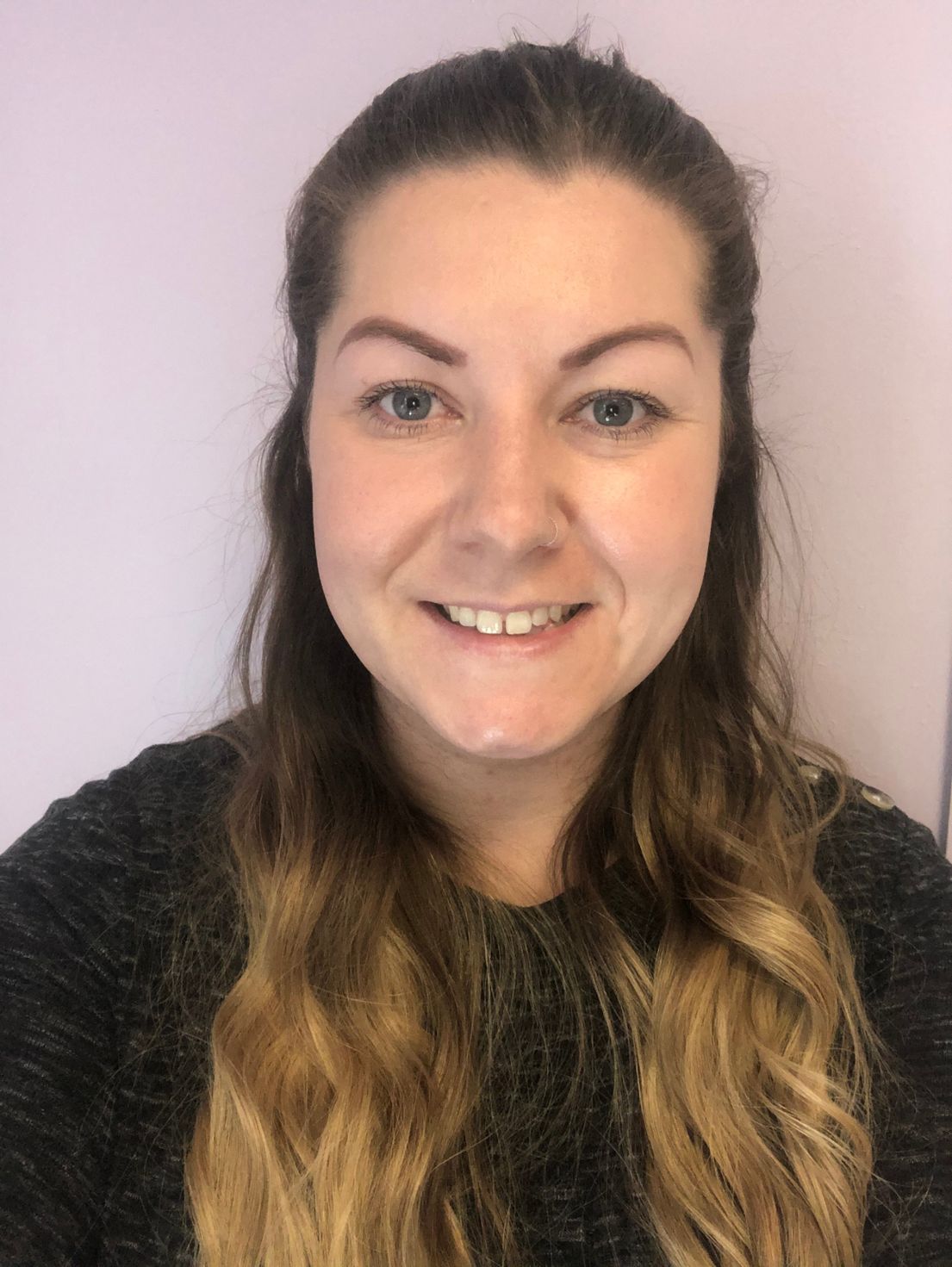I was diagnosed in 2019 as I was turning 27. I was feeling really tired all of the time. I thought it might be work and burn out, but requested a blood test by the GP. My bloods showed reduced function of my gfr, a later ultrasound confirmed my diagnosis of PKD.
I was devastated, crying, and didn’t want it to be true because of the thoughts in my head awaiting me—dialysis when I’m older. However, I’m staying positive, and hopefully, by the time I reach that point, medical intervention will have advanced.
My dad has PKD, his mum had PKD, and I know one of my cousins does too. It’s very much within our family.
It hasn’t stopped me from doing anything I want, I just listen to my body if I ache! I hold down a full-time job and live a happily married life!
**Categories:** Just Diagnosed
---
### [Stephanie Fehrmann](https://pkdcure.org/blog/voice/stephanie-fehrmann/)
**Published:** July 7, 2021
**Author:** fiftyandfifty
**Content:**
I was diagnosed with PKD when I was 7 or 8 after my dad was diagnosed with PKD. Being diagnosed so young was strange because I didn’t really understand what it meant. Now I do.
As a young adult, I always tried to be healthy. I ate lots of kale and always got my full eight hours of sleep, but when my dad died a few years ago at age 60, I took more control of my health. After bursting into tears in my PCP’s office, she referred me to a nephrologist (I cried during my first appointment with her, too. What can I say, I’m emotional!). Ever since then, I’ve been seeing my nephrologist every four to six months. In September, I’m participating in a two-year clinical trial that the PKD Foundation contacted me about. I have a blood pressure machine at home, I try not to eat too much meat, and I do my best to avoid stress, which is hard as a business owner. But I try!
I do all this because I want to live to be older than 60. I don’t want my life to be half over. I want to be around longer for the people who love me, longer than my dad was around for me.
That’s the scariest thing about this disease. The unknown. Wondering how many years I have left. But, I’m hopeful. I’m hopeful that with the help of my nephrologist and the rest of my healthcare team (and through the good work of the PKD Foundation) I can slow the progression and avoid dialysis altogether.
I’m very lucky that I was diagnosed young, and I hope that I’ll be lucky enough to grow old, too.
**Categories:** Living with PKD, PKD Youth
---
### [Haley McNamara](https://pkdcure.org/blog/voice/haley-mcnamara/)
**Published:** July 1, 2021
**Author:** fiftyandfifty
**Content:**
My name is Haley McNamara and I’m a 28 year-old Southern California native currently working in the sports industry at Major League Soccer. I recently moved back to California after being in NYC for five years when my PKD took a downhill turn.
I was diagnosed with ADPKD before birth—doctors could see cysts forming on my kidneys in my mom’s ultrasound. It’s always been something I’ve dealt with. My whole adult life, I’ve been privately and anxiously awaiting the inevitability of dialysis and kidney failure. It was an extremely heavy burden through my college years as a student-athlete on the women’s diving team at UCLA, and as I’ve progressed through my professional career.
I’ve seen first-hand the toll, both mentally and physically, the disease takes on someone. Five years ago, I watched the same disease take the life of my best friend in the world, my mom, slowly and very painfully.
On December 11, 2020, the moment I had dreaded unfortunately became my new reality. I ended up in the emergency room in critical health and I’ve proceeded to go through hemodialysis and peritoneal dialysis (PD) training. While PD is a stable option, it’s extremely isolating and distressing to go through on a daily basis.
As I await a potential live donor match and continue my outreach, I’m focusing my efforts on advocacy and awareness for PKD and other young adults living with kidney disease.
**Categories:** ADPKD, Dialysis, Living with PKD
---
### [Karen Kessler](https://pkdcure.org/blog/voice/karen-kessler/)
**Published:** June 22, 2021
**Author:** fiftyandfifty
**Content:**
I inherited my PKD from my father’s side of the family. My grandfather died of kidney failure in his late 30’s when my father was about 19 years old. My father was diagnosed young, and his kidneys failed at age 38 when he began hemodialysis. Growing up, my sisters and I knew all about PKD and that we had a chance of inheriting the disease. My father died at age 49 after a brain aneurysm burst; I was only 21 years.
A year later, after my mother also died (from a cancerous brain tumor), my younger sister was diagnosed with PKD. At that point, I saw a nephrologist to be evaluated, even though I had no symptoms yet. Getting diagnosed early helped me to learn more about the disease and how to slow down its progression before having to cope with declining function. I grew up feeling like home hemodialysis was a way of life for our family so it’s probably less frightening for me than people who didn’t see how it can be okay. My younger sister died at age 43, so I’m the only one left in our family with PKD. I’ve outlived the others—I’m 54 years old and in stage 4.
I see how medical science has vastly improved with each generation, and I’m proud to have been in two rounds of the tolvaptan trials that brought this first treatment to PKD patients. Hopefully, there will be a cure.
**Categories:** Living with PKD
---
### [Alyssia Gomez](https://pkdcure.org/blog/voice/alyssia-gomez/)
**Published:** June 22, 2021
**Author:** fiftyandfifty
**Content:**
My name is Alyssia and I was diagnosed with PKD at the age of 20. My diagnosis came when I was serving in the US Army Reserves and I had an unexplained abdominal pain during our exercise. I’d became very discouraged but in the last four to five years since diagnosis, I’ve tried to stay positive. I hope all who suffer with this condition can find peace. Thank you, PKD Foundation, for spreading awareness!
**Categories:** Living with PKD
---
### [Janice Lucas](https://pkdcure.org/blog/voice/janice-lucas/)
**Published:** June 22, 2021
**Author:** fiftyandfifty
**Content:**
My aunt was diagnosed in the early ’70s and the hospital in Seattle asked my cousins and siblings to get tested. I was eight months pregnant at the time and I couldn’t travel to participate. My aunt and my dad were the only two siblings of five who had the disease, and only two cousins were found to have PKD at the time. Fast forward about 25 years, I was diagnosed with PKD. I have two children who have it and so far one granddaughter.
**Categories:** Living with PKD
---
### [Paulette Meaney](https://pkdcure.org/blog/voice/paulette-meaney/)
**Published:** March 29, 2021
**Author:** fiftyandfifty
**Content:**
My husband was diagnosed with PKD in 2008. His kidney function declined significantly over the years, and in June 2020 he was referred for a transplant. Thank God I was a great kidney match. I was able to donate my kidney to him on November 11, 2020, before he ever needed dialysis! No more exhaustion, fatigue, nausea, and brain fog for him.
Our recovery has been uneventful. To see the immediate transformation in my husband, there is nothing like it! I’m grateful every day for his good health, and now, great kidney function.
**Categories:** Caregivers, Living with PKD, Transplantation
---
### [Lainie E.](https://pkdcure.org/blog/voice/lainie-e/)
**Published:** March 29, 2021
**Author:** fiftyandfifty
**Content:**
I represent the third generation of ADPKD in my family—I was diagnosed in my early 20s. Those in my family who are no longer with us, passed away due to complications of the disease, but my father received the first transplant in our family four years ago. He’s doing well.
Although I’ve experienced recurring kidney infections and pregnancy complications, such as preeclampsia, I’m blessed to have good kidney function at this time. Despite the struggles and sadness this disease can bring, there’s so much to celebrate with the advocacy for organ transplantation and the success of tolvaptan. We’re grateful to the medical professionals in the research field who work tirelessly to bring these advancements to patients!
**Categories:** ADPKD
---
### [Kaylee Gunn](https://pkdcure.org/blog/voice/kaylee-gunn/)
**Published:** March 26, 2021
**Author:** fiftyandfifty
**Content:**
When I was 32 weeks pregnant with my first child, we found out he had cystic kidneys. We were told to expect the worst. If he lived through birth, he may not have fully developed lungs. He may need dialysis immediately. He may need a transplant in the first year.
Our son is now five, and although his disease impacts our daily lives, he’s thriving. He hasn’t needed dialysis and he was born with full lung development! A kidney transplant is definitely in his future, but we’re taking it one step at a time.
He was diagnosed with ARPKD; it’s never shown up in either my family or my husband’s.
**Categories:** ARPKD, Caregivers, PKD Parents
---
### [Ashlee Olando](https://pkdcure.org/blog/voice/ashlee-olando/)
**Published:** March 15, 2021
**Author:** fiftyandfifty
**Content:**
We found out that my unborn daughter had a cyst in her right kidney. It was then that they questioned who she’d received it from, and we discovered that my husband had ADPKD. He was never screened for it even though his mother is Stage 3 ADPKD, and his sister is Stage 1 ADPKD. My now five-year old is Stage 1 ADPKD. My other daughter, who is almost one, will be screened sometime this year to see if she also has ADPKD.
This past February, we lost my husband’s uncle. He was Stage 5 ADPKD and passed away at the age 56. My husband and mother-in-law are planning on trying the ADPKD medication to see if it will help. If it helps, we can have options for when my daughters grow up.
**Categories:** ADPKD, PKD Parents
---
### [Rachel Homewood and Bennett Homewood](https://pkdcure.org/blog/voice/rachel-homewood-and-bennett-homewood/)
**Published:** March 15, 2021
**Author:** fiftyandfifty
**Content:**
My two-year old son, Bennett, was unexpectedly born with ARPKD. It’s been a long journey so far. *NICU stay, surgery, meds, blood draws, blood pressure checks, and many doctor appointments.* Despite everything he’s gone through and will continue to go through, this little guy continues inspiring those around him with his enthusiasm for life. I’m proud to be his mom and I hope to bring awareness to this devastating disease.
**Categories:** ARPKD, PKD Parents
---
### [Corey Morgan](https://pkdcure.org/blog/voice/corey-morgan/)
**Published:** March 10, 2021
**Author:** fiftyandfifty
**Content:**
I found out I had PKD when I was seven weeks pregnant with my daughter. It wasn’t the best news—and then I found out my unborn child could also have PKD. After she was born, we ran tests and it confirmed that she and I share the same disease. It was hard to swallow, but it strengthened our bond.
My dad had PKD and is a transplant survivor, as well as a few other family members. I hope to bring awareness, and to not look at this in a negative light so that more can be done to help find a cure.
**Categories:** ADPKD, PKD Parents
---
### [Holly Blaine](https://pkdcure.org/blog/voice/holly-blaine/)
**Published:** September 17, 2020
**Author:** fiftyandfifty
**Content:**
I found out I had PKD in October 2015 when I was 29 years old. I was going to become a living donor for my father who also has PKD. I had an initial ultrasound, and followed up with my doctor. She then informed me that I also have PKD. I was devastated just knowing that I couldn’t help my father and worried for my own health. My father is now 58 years old and on dialysis three days a week, four hours at a time. He found out he had PKD in 2008 when he was 47. I’m trying to help him find a donor, while also trying to eat healthy and take care of myself to help slow the progression of my disease. I hope I can help spread awareness and that someday there will be a cure.
**Categories:** ADPKD, Caregivers, Dialysis, Living with PKD
---
### [Greta Ellis](https://pkdcure.org/blog/voice/greta-ellis/)
**Published:** August 10, 2020
**Author:** fiftyandfifty
**Content:**
My father died at age 39—I was only 13 years old. We were unaware he had PKD until after his death. Looking back, he had all the outward signs (large belly, high blood pressure).
I began having problems with constant kidney infections during my thirties. I still vividly remember the almost unbearable back pain. I started dialysis in 2004, and spent nearly 13 years on hemodialysis. Four hour sessions, three days a week. I gained significant weight with my two pregnancies and I lost 80 pounds to get placed on the transplant list.
I also had a bilateral nephrectomy in 2008. I became stronger and more energetic after the removal of my kidneys. I embarked on a fitness routine where I worked out on my non-dialysis days. I joined a gym and started Zumba classes. My weight continued improving and so did my mobility.
However, my progress on the transplant list was stagnant here in South Texas. So, after waiting here for eight years, I registered in a new region and was transplanted in less than a year on October 30, 2017. I’m almost three years post-op and enjoying every moment. I’ve been blessed and highly favored, and I thank God for every day in this journey.
**Categories:** ADPKD, Dialysis, Living with PKD, Transplantation
---
### [John Ventresca](https://pkdcure.org/blog/voice/john-ventresca/)
**Published:** July 8, 2020
**Author:** fiftyandfifty
**Content:**
Several years after I was diagnosed was when I started to feel the effects of PKD. The first issue I noticed was fatigue, and also over time, I noticed more and more back pain. In the afternoon I would notice getting a little drowsy and I would attribute feeling a little run down to just being busy with family, chasing around my kids, working full time, everything going on, but then I realized it just was the effects of the PKD were increasing over time. I started having a little more back pain and just kind of being sore.
I worked most of the time at a desk job, and I thought maybe this is just sort of typical, but I realized this is probably connected to the PKD also. My kidneys were growing, really getting bigger. The cysts were growing, and this probably was a real connection to the back pain. So, with my nephrologist I would talk about kind of the fatigue and some of these symptoms. I learned that fatigue can be part of your change in your white blood count and different things can change, and that can kind of lead to fatigue and some of these things.
[Hear more of John’s story.](https://pkdcure.org/patient-perspectives/#ventresca)
**Categories:** ADPKD, Living with PKD
---
### [David Birkley](https://pkdcure.org/blog/voice/david-birkley/)
**Published:** July 8, 2020
**Author:** fiftyandfifty
**Content:**
It was the year 2000. A longtime friend of mine noticed that I had sudden weight loss and recommended that I go see a doctor, which I did. My mother had PKD, and I felt it was a good time to get checked. Through testing they found, via ultrasound, that I had had PKD, and I started with a nephrologist. They were monitoring my daily dietary intake and blood pressure and things, and I kept track of everything pretty thoroughly for about four years, five years, and I moved, and in that time period I let my health kind of slide.
Didn’t pay attention to the nephrologist or my doctor at the time because I was young and thought I’m going to be okay. I lived with it pretty much normally for ten years with just high blood pressure being really the only side effect. I had occasional kidney stones. I had some stomach pain, but I led a normal life. I was very healthy. I was mountain biking, hiking, climbing mountains, doing what I do or going to work every day, traveling. So, my life was normal.
[Hear more of David’s story.](https://pkdcure.org/patient-perspectives/#birkley)
**Categories:** ADPKD, Dialysis, Living with PKD, Transplantation
---
### [Kate Williams](https://pkdcure.org/blog/voice/kate-williams/)
**Published:** July 8, 2020
**Author:** fiftyandfifty
**Content:**

My name’s Kate. I have PKD, and my son, Owen, has PKD. So, finding out that first day, everything was really kind of a blur. Our doctor explained what PKD was and then said please don’t go home and Google this, because there’s a lot of information, and most of it is really scary. We were in that fearful place of still not knowing how he would be when he was born, if he was going to survive, if his kidneys were going to be functioning well.
We really ran the gamut after that…of crying and being scared and not knowing what was going to happen, trying to figure out how much information to share with our family and friends and how to share that information and even thinking forward to do we want to have any more children after this, what are the chances that another child could have PKD and then the idea that it might not be fair to try to have another baby, that we could go through the whole process again and lose a baby or that my body might not handle it. I’m really thankful that we ended up changing our minds on that later, because we have two beautiful boys, and we’re really lucky that for a long time we were not sure that we would try again.
[Hear more of Kate’s story.](https://pkdcure.org/patient-perspectives#williams)
**Categories:** ADPKD, Living with PKD, PKD Parents
---
### [Samuel Spencer](https://pkdcure.org/blog/voice/samuel-spencer/)
**Published:** June 5, 2020
**Author:** fiftyandfifty
**Content:**
I was 12 when I was diagnosed with PKD. It turns out my genes mutated, so I’m the only one in my family with the disease. Today, I’m 28. I didn’t really think much about the disease until this year when I started taking tolvaptan. Now that I’m married with a one-year-old at home, I think about it a lot more. I think about how I want to walk my little girl down the aisle one day.
I know we’re all given one life, and I sometimes feel down about how mine will be more challenging or shorter than other’s. But how can I compare? I’ve been given so much! These are the things I think about. I’m grateful others out there are sharing and studying how to #endPKD. Press on!
**Categories:** ADPKD, Living with PKD, PKD Youth
---
### [Diana Hartley](https://pkdcure.org/blog/voice/diana-hartley/)
**Published:** November 11, 2019
**Author:** fiftyandfifty
**Content:**
My husband, Tim, was diagnosed in 2002. In March of 2018, he was eligible to begin the transplant process. He was placed on the list about a year ago and received his new kidney from a living donor on August 19, 2019. Luckily, he never had to start dialysis.
Now just a little over two weeks since surgery, I am thrilled to share how well he is doing. His kidney function numbers are fantastic and he feels better than he has in years!
The PKD Foundation has been a reliable source of information and education for us. We continue to pray a cure is found so others don’t have to endure the pain of PKD.
**Categories:** ADPKD, Transplantation
---
### [Jan Elf](https://pkdcure.org/blog/voice/jan-elf/)
**Published:** October 28, 2019
**Author:** fiftyandfifty
**Content:**
I was diagnosed with PKD when I was 40. My sister was also diagnosed near that time. She was six years older than me. She died five years ago from a stroke. I began dialysis when I was 59, I’m 61 now, and I’ve been on a transplant list for two years. My oldest daughter, my son, and possibly my twin grandsons also have the disease. My youngest daughter hasn’t been tested yet. She’s 28 and pregnant with her first baby. It’s so tragic how this disease affects generations of families, but I’m hopeful I’ll receive a kidney from a perfect donor.
**Categories:** ADPKD, Living with PKD
---
### [Amber-lee Kate Petersen](https://pkdcure.org/blog/voice/amber-lee-kate-petersen/)
**Published:** October 1, 2019
**Author:** fiftyandfifty
**Content:**

My name is Amber-lee Kate Petersen, 18 years old, and I live in South Africa. In my final year of high school, I fell incredibly ill. I experienced excruciating pain in my abdomen area. I was kept in a hospital for more than two days, and to be frank, the pain was gone, and I just wanted to leave. The results came back, and doctors told me I have ADPKD (a genetic disorder which causes cysts to grow on enlarged kidneys which eventually decreases the function of it). At that stage, I lost hope because I didn’t know what we were dealing with, and all I thought was “kidney failure” and “death.” It was scary, to say the least. This year (2019), I started the medication to maintain my blood pressure. It’s a difficult journey knowing that I am classified as a “chronic” patient. I did not handle things very well, but this is what I have learned:
1. It is not our fault, our genes wanted to be different because we are different, but that makes us unique! It’s not your parent’s fault!
2. It’s not a death sentence, I continue living my life, I only watch what I feed my body.
3. It’s a blessing in disguise, I have learned to appreciate life at a younger age.
4. It made me realize genetic counseling is really important to know exactly how everything works.
5. I will probably need a kidney transplant when I’m older, but that is a battle for the future.
6. A strong support system includes a psychologist. Don’t give up hope, there are millions out there fighting the same battle. YOU ARE NOT ALONE!”
**Categories:** PKD Youth
---
### [Christopher Nuzzo](https://pkdcure.org/blog/voice/christopher-nuzzo/)
**Published:** August 12, 2019
**Author:** fiftyandfifty
**Content:**
My name is Christopher and I have polycystic kidney disease. I am 20 years old and go to school at Manhattan College to study media production. I always knew my family had a history with PKD because my grandmother had gotten a successful transplant years before. My grandma has always been so strong and has consistently led an active lifestyle, so I never knew the extent of what the disease could do. When I was 10-years-old my mother went into renal failure. Her kidneys were so enlarged that they had to perform emergency surgery to remove them and the doctors referred to them as “the twins.” Watching my mother struggle while she was on dialysis for the next nine months was the hardest thing, but she fought hard until she received a kidney from a live donor on Easter. Nine years later, I was diagnosed with polycystic kidney disease at the age of 19. I am the only one of my four other cousins to have gotten the disease, but I haven’t let it stop me. I regulate my blood pressure and I lead a very active lifestyle rowing on my school’s crew team. I know that there are many options for me going forward and I am hopeful for future research into this disease.
**Categories:** Living with PKD
---
### [Jerry Petersheim](https://pkdcure.org/blog/voice/jerry-petersheim/)
**Published:** August 12, 2019
**Author:** fiftyandfifty
**Content:**

PKD started with my grandfather, who died from the disease at the age of 49. He and my grandmother had twelve children, of whom six had PKD. Three aunts died around the age of 50 without the availability of dialysis. A fourth aunt was on hemodialysis for about 20 years. A fifth aunt had two unsuccessful transplants and died around the age of 50. Since that time, kidney transplant technology has progressed dramatically.
My father, younger than most of the others, was on hemodialysis for eight years and had a successful transplant that lasted for 24 years. He was my mentor and showed me how to live a full, productive life with PKD.
About a year before kidney failure, I was proactive in getting on the transplant organ list and had a fistula inserted in my arm for the preparation of hemodialysis. In my mid-50s, I had kidney failure and began dialysis and had treatments for four and a half years until a kidney became available. Three years ago, I had a successful transplant. I continued to work full-time. Since I traveled for work, I continued to travel while on dialysis and had over 30 treatments at outside centers across the U.S. and Europe. One key action that I took was to follow a strict diet and liquid intake, which made a difference in how I felt. After the transplant, my energy level increased significantly, and today, I feel wonderful and live a full life.
**Categories:** Dialysis, Transplantation
---
### [Tilia Sanchez](https://pkdcure.org/blog/voice/tilia-sanchez/)
**Published:** August 12, 2019
**Author:** fiftyandfifty
**Content:**

My name is Tilia, and I have Stage 5 PKD. I was diagnosed when I was about 13 years old and did not know I would be at this stage of my disease at this age. My life consists of many, many doctor visits, unexpected hospitalizations. I’ve had many blood transfusions and lost days with my family. My grandmother had the disease and passed away, and my mother passed away from this disease six years after a successful transplant. Seeing and living with someone go through dialysis, for many many years was overwhelming and sad. Now I am waiting for a transplant surgery date, as I have a living donor. I have three beautiful daughters who also have this disease, unfortunately. I have had good days and bad days, but I try to make the best of them all, though it can be hard. I know that my lifestyle will be better after transplantation, but I am hopeful that one day there can be a cure for this terrible disease.
**Categories:** Living with PKD
---
### [Mike Balles](https://pkdcure.org/blog/voice/mike-balles/)
**Published:** August 12, 2019
**Author:** fiftyandfifty
**Content:**

I was diagnosed with ADPKD at thirty-five. While my mom knew her siblings had kidney issues, she thought she did not, since she had no symptoms. It took twenty years for my kidney function to gradually decline. I had a few episodes of cysts popping and kidney stones, and a week’s hospitalization for pain, but I didn’t experience the daily pain that many go through. In 2008, with my function around 20-25 percent, my nephrologist said it was time to start the transplant process.
Though I’m about the most introverted person around, I opened up to some people close to us from church for support. I started a CaringBridge blog about the pre-transplant process, which allowed family and friends to know that I was open to a living donor, though I was trying to prepare mentally for dialysis if needed. I remember and treasure the five people who offered to be donors. My wife was the one who ended up being my hero. August 18, 2008, was our date at Northwestern Memorial in Chicago.
During the first eighteen months after the transplant, my nephrologist said I wasn’t a “poster child” for transplantation. I experienced BK virus, CMV virus, a year-long case of shingles, and kidney function lower than expected. Things improved after that, and now these are “the good old days” that I am blessed to enjoy. Thanks to my wife’s sacrifice, I’m able to work, help lead a computer volunteer team at church, and we attended our only son’s wedding earlier this spring! We just set up our trust and wills recently, with the PKD Foundation in part of the trust.
**Categories:** ADPKD, Transplantation
---
### [Gregory Ofiara](https://pkdcure.org/blog/voice/gregory-ofiara/)
**Published:** June 7, 2019
**Author:** fiftyandfifty
**Content:**
I have survived Polycystic Kidney Disease for nineteen years. Having family support has been critical to my health; my brother-in-law, a better match than my family, was my living donor. His kidney donation was the most meaningful gift I’ve ever received.
Ofiara Clan then and now
I am a fourth generation Ofiara with PKD and the only one who has lived past seventy. Now, I want to link the past to the present. My goal is to trace the entry of the Ofiara Clan from immigration (the 1880s) to now, and I hope other members of the Ofiara clan will pick up and continue this idea of connection across time.
If you are a descendant of any Ofiara, I would love to hear from you. If you are not a descendant but have PKD, I would still love to hear from you. We all have a story to tell! Email me at **pkdclanofiara42@gmail.com** and tell me yours.
**Categories:** Living with PKD
---
### [Kim March](https://pkdcure.org/blog/voice/kim-march/)
**Published:** June 4, 2019
**Author:** fiftyandfifty
**Content:**
I was diagnosed with ADPKD at 15 years old following a snowmobiling accident that caused me to rupture a cyst. I am currently 31 years old, working as a firefighter/EMT and going to nursing school while working hard to raise my 10-year-old son. My family has an extensive history of PKD with my mom, aunt, and grandmother, who all have received transplants. Also, my brother and I are affected by the disease. As a younger person, the prospect of PKD depressed me. I felt helpless and flawed.
Kim March in firefighting gear
As I’ve grown older, I have become dedicated not only to not allowing my condition to dictate my life and what I can and cannot do but also to help others who may be suffering as well. PKD has helped foster my compassion for others and the human condition.
**Categories:** ADPKD, Living with PKD
---
### [Taylor Stearns](https://pkdcure.org/blog/voice/taylor-stearns/)
**Published:** December 17, 2018
**Author:** fiftyandfifty
**Content:**
Taylor and her mother
PKD has caused my family so much hardship. Growing up, I watched my mother suffer as her health declined. She was always in so much pain, never wanting to leave the house because she was so uncomfortable. Finally, at age 41 she was put on dialysis, and she was beginning to manage her symptoms better. About a month or so later, a massive aneurysm we didn’t know about ruptured in her brain, and after nine long days in the Neuro ICU, we decided to put her on comfort care, knowing her wishes. It was the hardest thing I’ve ever had to do.
I was diagnosed at age 12. I’m now 22 years old and have felt completely alone. My mother is gone, and I am left to devour any research I can to try to avoid the same fate. Before her passing, I didn’t even know aneurysm development was common in patients with PKD. So far my kidneys have caused me only a little trouble (I’ve had a few cyst bursts, which are painful but manageable). My biggest concern right now is my high blood pressure, which I will hopefully be able to control with natural methods before resorting to a lifetime of medications. I’m so happy to have found a community here and look forward to using my voice and helping bring awareness to PKD. Together we will find a cure!
**Categories:** ADPKD, Living with PKD
---
### [Reina Stevens](https://pkdcure.org/blog/voice/reina-stevens/)
**Published:** December 17, 2018
**Author:** fiftyandfifty
**Content:**
PKD runs in my family. My grandmother ultimately passed as a result of complications with the disease. My mother was diagnosed but it was very well managed until 2006. Within 6 months her kidney function dropped to under 10%. Her best friend Carolyn offered to donate and they began the process together. She was a perfect match and after months of testing the transplant was scheduled for November 2007. Three days before the surgery, the doctors identified a problem in Carolyn’s renal artery that would likely cause my mother to reject the kidney. Everyone was devastated and she had to go on dialysis. Thankfully, another one of her amazing friends offered to donate and was an ideal match as well. The procedure was a huge success and 10 years later my mom’s kidneys function is impeccable. I too have been diagnosed and I can only hope that I have friends as generous and caring as she does should the time comes for me to need a kidney.
**Categories:** ADPKD, Dialysis, Living with PKD, Transplantation
---
### [Kristen Simms](https://pkdcure.org/blog/voice/kristen-simms/)
**Published:** December 17, 2018
**Author:** fiftyandfifty
**Content:**
Kristen’s children, Eli and Presley
My name is Kristen Simms. I am a 26-year-old military wife living in Northern Virginia with two children affected by ARPKD: a four-year-old boy, Elijah and a one-year-old girl, Presley. With our firstborn son, Eli, we had no idea that he had PKD. It was found after birth and later diagnosed as ARPKD. This came as a huge shock because no one in the family had ever been diagnosed, much less heard of ARPKD. With our second born child, Presley, we were able to keep an eye out on her ultrasound and although she was delivered four weeks premature, was perfectly healthy. Both children suffer from high blood pressure but this is usually controlled with oral medications.
Having these two miracle babies has given me the strength to be the best mom I can be and be a support for other military families who go through the same thing. Our nephrologists often pass along my information to parents with newly diagnosed ARPKD babies to help support and answer questions for them.
Being a military family, our children’s father is often gone and unable to be there for procedures and appointments, leaving the bulk of it on me. Our family has become incredibly supportive and involved with learning about PKD and we are so blessed for every day we get with these angels.
**Categories:** ARPKD, Caregivers, PKD Parents, PKD Youth
---
### [Nicole Cardin](https://pkdcure.org/blog/voice/nicole-cardin/)
**Published:** December 13, 2018
**Author:** fiftyandfifty
**Content:**
Nicole and her granddaughter
My paternal grandmother, Helen, is the first that we know of who had autosomal dominant polycystic kidney disease (ADPKD) in the family. We only figured it out when others in the family started to get diagnosed and we realized that it must have been the cause of her kidney failure in her early 60’s. My dad and both of his brothers were diagnosed and all had transplants in their early 60’s. The kidney my dad’s identical twin brother, Bill, received did not work and had to be removed. He then spent many years on dialysis. He passed away this year and his precious smile and amazing sense of humor is missed every day.
I am 55 and was diagnosed just before turning 50. My primary care physician said that I did not need a nephrologist yet and that she would monitor my kidney function yearly. I decided that I wanted to be proactive and sought out a good nephrologist, and I am so glad that I did!
Nicole with team members at the 2018 Sacramento Walk for PKD
While it is true that there is little that can be done at this stage, I knew there were still important things I could do. I was determined to be a test case for the family and set out to do all that I could instead of just waiting around for my kidneys to fail. My nephrologist, Dr. Thornton, noticed that my blood pressure was slightly elevated, something that my primary care doctor had not thought important, and put me on a low dose of blood pressure meds. I now have a BP cuff at home and check it regularly. I am an avid exerciser and have found that keeping my weight in a good healthy range can be beneficial not only to my kidney function but also if/when I need a transplant. I also learned to always keep well hydrated and to limit my caffeine intake.
When Dr. Thornton realized I wanted to do more to prevent kidney function decline, he told me about the many clinical drug trials that are available. I attempted to sign up for the Tolvaptan study in San Francisco but was denied. In June I was accepted for a Metformin trial with the University of Denver. It is going well and whether I have the real drug or the placebo, it is still moving the study forward. Where there is progress, there is hope.
Nicole with fellow committee members at Corks for a Cure fundraiser
These studies are expensive to run, and as soon as I was introduced to the PKD Foundation I knew I wanted to help with their fundraising. I contacted the Sacramento Chapter and connected with some amazing people! We started an annual event called Corks for a Cure, an evening of fine California wines, silent auction and great fun. It has been such a blessing to be connected with these dedicated people and working for a common goal, to end PKD! Our fourth annual event will be March 2, 2019.
We don’t yet know if my three children or nine grandchildren have PKD, but I desperately want to be part of the solution for them! Will you join me?
**Categories:** ADPKD, Living with PKD
---
### [Taylor Karlo](https://pkdcure.org/blog/voice/taylor-karlo/)
**Published:** December 11, 2018
**Author:** fiftyandfifty
**Content:**
Taylor at one of her volleyball games
My name is Taylor Karlo, I’m 17 years old and I’m a senior at Olentangy Liberty High School in Powell, Ohio. I am also a volleyball player and I’m committed to the University of Saint Francis to continue my volleyball career. I live with my mom, Heather, my dad, Andy, my brother Brenden, and my adorable dog Joey. We moved to Ohio when I was five and we are originally from Livonia, Mich., so we are Michigan fans at heart.
PKD is relevant to our family because I unfortunately have it. My PKD story is sort of unique because I am the only one in my family who has it. This is uncommon because this disease is passed down genetically 90% of the time, and I’m part of the 10% where PKD develops as a genetic mutation in your body.
Team T at the 2018 Central Ohio Walk for PKD
As soon as I heard about the Central Ohio Walk for PKD, I knew I wanted to join and try to get as many people possible to come. I had an amazing time at the Walk and couldn’t thank my friends and family enough for supporting me. “Team T” was so big and well known that all the volunteers knew who we were, which was awesome to think that we made an impact.
Taylor at one of her volleyball games
Without all the support from my friends, family, teammates, and coaches, there would be no way I could have raised the amount of money that I did. We first set our goal to $2,000 and somehow passed it within two days, so we bumped it up to $5,000 and we passed that, too! Everyone I know was so generous to help me support this cause by donating money, and we even had a PKD volleyball game fundraiser at my school. By the time the Walk came around, we were just shy of $10,000. Next year I hope more people can come join us as we walk to find a cure for PKD.
Do you want to help make an impact like Taylor and her team? When you help us reach our $2 million goal by Dec. 31, 100% of your donation goes on to fund PKD research! Donate today.
**Categories:** ADPKD, Living with PKD
---
### [Debra Dai](https://pkdcure.org/blog/voice/debra-dai/)
**Published:** November 27, 2018
**Author:** fiftyandfifty
**Content:**
Debra and her eldest daughter
My name is Debra and I’m from New York. I was diagnosed at the age of 22 during my pregnancy with my first child. At the time, my mother had PKD and was going through a difficult time. She was on dialysis, received a transplant from a non-related donor and, unfortunately, her transplanted kidney failed immediately. She returned to dialysis and within three months passed away at 48 years old from a brain aneurysm. Now, here I am 30 years later at age 52, and my GFR is at 18. I hope to get a preemptive kidney transplant.
I have four beautiful adult children, of which three have PKD. The guilt I live with knowing I gave my children this horrible disease is unimaginable. My oldest daughter does not have PKD and insisted on being tested to see if she was a match for me. We went through the evaluation and she is a match. My nephrologist is monitoring me closely and I hope to avoid dialysis and go straight for the transplant when my doctor says I’m ready.
I am symptomatic, meaning I experience abdominal pain, back pain, headaches, high blood pressure, umbilical hernia, fatigue, etc., but I don’t let it stop me from living my life! I’m alive, I have a beautiful family that I adore, I keep smiling and I will try not to give in to the disease. I’ve learned how to deal with the symptoms. I work five days a week, I enjoy going out with my family and friends, and I love to cook and bake (it’s my therapy). I live what I consider to be a normal life.
My husband had cancer last year and had such a positive and uplifting attitude in his battle, and he truly inspired me to do the same. The past few years have been tough on our family with sickness, but our love is so strong and gets us through all the challenges we are facing on our journey. I pray every day that my kids and all the wonderful families that have this unfortunate disease will benefit from a cure someday.
**Categories:** ADPKD, Living with PKD
---
### [JoAnn Villanueva](https://pkdcure.org/blog/voice/joann-villanueva/)
**Published:** October 23, 2018
**Author:** fiftyandfifty
**Content:**
JoAnn and Suzanne’s story in the Daily Southtown
I write my PKD story on the 14th anniversary of my kidney transplant! I have two sisters, no brothers. I come from a LARGE Irish Catholic family (all raised in Chicago). Like other PKD families, many of my family members have been afflicted (five generations).
My mother and my younger sister both had transplants. I was told I did not have PKD. However, I collapsed in kidney failure and started dialysis within 24 hours. I knew my wait on the transplant list would be long! We all know the odds of a family member not having PKD is 50-50. In my family, though, our Irish genes are strong and so is the PKD gene. My “Diamond in the RUFF” was my own sister, Suzanne Ruff! She did not have PKD but hated hospitals, needles and even the sight of blood! But “She did it!” Suzanne saved my life and gave me the opportunity to see my daughters get married, and the birth of my grandsons.
More importantly, she made it possible for me to volunteer with the PKD Foundation to advocate, educate, bring awareness and support all PKD patients, family members and caregivers in every way possible! #ENDPKD
**Categories:** ADPKD, Living with PKD, Transplantation
---
### [Lisa Towler](https://pkdcure.org/blog/voice/lisa-towler/)
**Published:** August 24, 2018
**Author:** fiftyandfifty
**Content:**
Lisa Towler
This month marks 26 years ago I found out I had PKD. It was the second week of my senior year of high school. I’m adopted and several years ago I found some information about my mother’s family. A total of 5 members including myself have been diagnosed with PKD. I’m the only one alive and beating the odds.
**Categories:** ADPKD, Living with PKD
---
### [Rob Herman](https://pkdcure.org/blog/voice/rob-herman/)
**Published:** May 9, 2018
**Author:** fiftyandfifty
**Content:**
Rob (left) with his family.
PKD runs in my my mom’s side of the family. It has been devastating to us. My grandfather died from a major stroke caused by PKD. My mom had a major stroke that left her a vegetable at age 35 from PKD. She died at 50. My older sister recently died from a major stroke at age 56.
I had scoliosis surgery when I was 14. I had a kidney transplant in 2009. Fought rejection. I had emergency diverticulitis surgery in 2015 resulting in an ostomy. I also had a clostridium difficile (C Diff) transfer in 2015 from my wife. In addition, I’ve had four different hernia surgeries over many years.
I also had emergency surgery to cut a hole in my peritoneal cavity to allow ascites/fluid to flow from my new kidney into the cavity for absorption, but it hasn’t worked, so doctors regularly must drain on average 5 liters of fluid from me. No one in Portland, OR, or the Mayo clinics in Minnesota and Arizona, know why. I ended up having a double nephrectomy in 2016. I was in the hospital for a week with a fever of 104 degrees.
My ascites continues to this day, as well as my migraines. My wife was treated in 2014 with radiation for a brain tumor. Our daughter, Kaley, had surgery at age 5 for a brain cyst. She just recently was diagnosed with PKD at 13. We also did genetic DNA testing and she is the *first person ever* to be found with an extra “T” gene in her sequencing. Doctors do not know exactly what that means to her and her future. Please pray.
It has been a very difficult road for us, but we are also determined to help find a cure for PKD. If we all do our part to build awareness, and raise money, we will END PKD. Please consider becoming an organ donor and encourage everyone you know!
**Categories:** ADPKD, Living with PKD, Transplantation
---
### [Cheryl Flothe](https://pkdcure.org/blog/voice/cheryl-flothe/)
**Published:** February 1, 2018
**Author:** fiftyandfifty
**Content:**
Cheryl and her husband, Glenn, on her first outing after her kidney transplant in 2007
PKD runs in my family through my maternal grandfather’s side—he, his dad, sister, brothers and cousins had/have the disease. Most who came before died with no chance of dialysis or transplants. My mom and uncle died in their early 60s and my brother died in his early 50s. My sister and I both received transplants that have lasted over 10 years, so far. My husband, Glenn, was not a match to be my donor, so we participated in a paired donor transplant with a pair of cousins. One cousin donated to me, while Glenn donated a kidney to her cousin. My 46-year-old daughter is on dialysis and waiting for a transplant, and two of her three adult children have PKD. It’s time to find a cure!!!
**Categories:** ADPKD, Living with PKD, PKD Parents, Transplantation
---
### [Glenna Frey](https://pkdcure.org/blog/voice/glenna-frey/)
**Published:** January 30, 2018
**Author:** fiftyandfifty
**Content:**
Glenna with her husband and children.
I donated my kidney to a stranger April 2017. I have been a nephrology nurse for over 30 years and understand the challenges of living on dialysis. Also, my husband and daughter have polycystic kidney disease. My husband received a kidney transplant over 16 years ago from my niece, who was 20 at the time. I was going to participate in a paired match program if he needed another kidney some day (we are not compatible). Since he is doing well, I decided to give my kidney to a stranger and participated in an Advanced Donation program. I listed my husband and daughter, so that if they need a kidney in the future, one of them can be placed in the paired match program to receive one. My passion now is to increase public awareness of living kidney donation.
**Categories:** Caregivers, Transplantation
---
### [Melissa Justice](https://pkdcure.org/blog/voice/melissa-justice/)
**Published:** December 13, 2017
**Author:** fiftyandfifty
**Content:**
Abigail Musser
My daughter, Abigail Musser, was 86 days old when she passed away in July of 2017. She was a twin birth, born at 33 weeks. We found out about her diagnosis while I was 20 weeks pregnant and never expected that the worst in our lives was to come.
She quickly lost amniotic fluid and her kidneys were growing rapidly in size. After she was born, she was quickly rushed to the ER where she spent many long days and nights. Her lungs were collapsed and she was on an oscillator. She was too small to survive a transplant.
Eventually, I sat down with her doctors and had to make the hardest decision of my life. Due to the huge size in her kidneys and cysts, she was having several altercations. We made the decision to withdraw her health and have the breathing tubes removed.
God gained an angel, and we now do tons of research and hope to find a cure so others hopefully won’t have to go through this very traumatic event.
**Categories:** PKD Parents
---
### [Noelia Canfara](https://pkdcure.org/blog/voice/noelia-canfara/)
**Published:** December 6, 2017
**Author:** fiftyandfifty
**Content:**
I was diagnosed with polycystic kidney and liver disease 17 years ago. Since then, I have had several surgeries both on my kidneys and liver to deroof cysts and alleviate symptoms, but my kidneys continued to grow and decline in function.
On Nov. 1, 2016, my brother, the only one out of five siblings who didn’t inherit the PKD gene from our dad, saved my life by becoming a living kidney donor and agreeing to participate in an exchange donation. He was not a match for me, so he donated to someone in Washington DC, and in return I received my healthy kidney from someone in New York. When my very tired and oversized kidneys failed, I had to start peritoneal dialysis. My antibodies are quite high, so finding a match was truly a miracle. I had a double nephrectomy at time of transplant so my new kidney could fit just right and I could finally be relieved from carrying polycystic kidneys.
My family and I been participating in the Walk for PKD every year since 2004 and will continue to do so because we wish for no more family members to have to suffer the effects of PKD. I feel beyond blessed and thankful to be alive and healthy again, and to be able to see my children grow every day and be with my husband. I recently even returned to work full time in social services, which is something I love but had to give up when I started dialysis. Thank you for letting me share my PKD story.
**Categories:** ADPKD, Dialysis, Transplantation
---
### [Selina Borg](https://pkdcure.org/blog/voice/selina-borg/)
**Published:** December 6, 2017
**Author:** fiftyandfifty
**Content:**
Selina and her mom visiting with her dad in the hospital.
I am the fourth generation to be diagnosed with PKD in my family. I got my diagnosis in 2010 when I was 22. My dad, Roland, was diagnosed at the age of 42, and six months ago, at the age of 50, he got a kidney transplant! We were very grateful. Even though we have been through many difficult times, my dad and our family do not lose hope. To have an incurable disease can sometimes feel unbearable, but it can also make you humble and strong, just like my dad!
**Categories:** ADPKD, Transplantation
---
### [John Vallarelli](https://pkdcure.org/blog/voice/john-vallarelli/)
**Published:** October 31, 2017
**Author:** fiftyandfifty
**Content:**
John Vallarelli
I was diagnosed in 1993. Initially hospitalized for diverticulitis, I had a CAT scan and the next morning, seven doctors showed up to my room and told me I have PKD. Was I shocked? No; surprised, yes. My mom had it, too, and was doing ok.
Several weeks later, as my wife is pregnant with our daughter, her ultrasounds saw a larger than normal kidney. I knew right then it was that gene. After our daughter’s birth, we took blood from her, my mom and me and genetic testing proved what we already suspected.
Today I have 55% function with no issues. There are challenges, yes, but nothing is insurmountable. Our daughter Rachel, I hope and pray that treatments will be found in her lifetime. For my wife, she has the burden of having both of us affected, she is the tough one!
**Categories:** ADPKD, Living with PKD, PKD Parents
---
### [Renata Mendes](https://pkdcure.org/blog/voice/renata-mendes/)
**Published:** October 31, 2017
**Author:** fiftyandfifty
**Content:**
Renata Mendes
I was diagnosed 10 years ago. I had low back pain for some weeks, so I went to emergency and they sent me to an orthopedist. After a few days taking orthopedist pills and still dealing with back pain, I went back to emergency after blood started appearing in my urine. In emergency they did a belly ultrasound and told me that I need to do a surgery to remove something that appeared in my kidneys. Since my blood test was okay, they sent me in the next day to a urologist to make surgery arrangements. This urologist was not sure about surgery, but had no idea how to translate my kidneys ultrasound. So after passing my ultrasound off to different urologists, finally they sent me to a nephrologist that gave me a PKD diagnosis. Nobody in family has it. They say my case is a genetic mutation.
**Categories:** ADPKD, Living with PKD
---
### [Tracey Barbour](https://pkdcure.org/blog/voice/tracey-barbour/)
**Published:** October 31, 2017
**Author:** fiftyandfifty
**Content:**
Tracey and her husband the morning of their transplant surgeries.
I found out I had PKD 10 years and 5 months ago, one month after I got married. A routine blood test showed I had a raised level of creatinine. I didn’t even know what creatinine was. It was 1.8. They sent me for a 24 hour urinalysis, which led them to send me for an ultrasound. No one else in my family has this disease. I even went for genetic testing to confirm (we were considering pregnancy at the time). 10 years later, my creatinine is 4.99 and my GFR 9. I am so blessed to say that I recently received a kidney transplant from my husband. So far, everything is going well! I am extremely lucky to have avoided dialysis by receiving a living donor kidney when I did.
**Categories:** ADPKD, Transplantation
---
### [Chris Dwyer](https://pkdcure.org/blog/voice/chris-dwyer/)
**Published:** October 31, 2017
**Author:** fiftyandfifty
**Content:**
Chris’s scars from getting cysts drained.
I found out last year by accident. I had an arthrogram done for a torn hip labrum. Two days later the orthopedic surgeon called and let me know that I had an extensive tear of the labrum and that they had also found a large mass in my abdomen. I was ordered to get a CT scan the next day as they thought I had cancer. It ends up that I have PKD, which I had never heard of. Looking back, I’d had symptoms for some time – lots of back pain that I thought was muscular. It ends up that I had multiple cysts on both of my kidneys. I had surgery this July to have cysts removed from my left kidney, the largest one of which they drained 3 liters from before removing it. It had actually pushed many of my organs out of place and caused a good deal of discomfort. The back pain is now gone in my left side, but my right side still bothers me.
**Categories:** ADPKD, Living with PKD
---
### [Skyla Tanner](https://pkdcure.org/blog/voice/skyla-tanner/)
**Published:** October 31, 2017
**Author:** fiftyandfifty
**Content:**
Skyla with her husband and children.
I have a disease. I don’t like the way those words sound. So, I don’t speak of it often. In fact, many days I ignore it. Even when my body is screaming loud with signs and symptoms.
It’s been 10 years since I was diagnosed. Adult onset, they call it. I was more than a full-time student in college, working 2 jobs in 2 different states, and starting to fall head-over-heels for my tall, dark, and handsome. And I mean, falling fast. So much, that I took every opportunity available to travel from Mississippi to Ohio to be together.
One trip was unforgettable. He made it a trip that I’d always remember, but so did PKD. It was jam-packed with adventure! From broadway and a riverboat cruise to horseback riding and a Cleveland Indians baseball game, we made the most of every minute together! Perhaps, where our love of travel and exploring new cities began.
Somewhere in the midst of fancy and fun, PKD interrupted. Knives stabbing me in the back. Fever. Vomiting. Barely able to walk, practically crawling up the stadium ramp to the baseball game. Forcing myself to ignore the symptoms long enough and finally succumbing to the pain, I found myself in the floor of a hotel bathroom in the fetal position crying out for help. For answers. For relief.
The flight back home was nothing shy of an adventure itself. From three unexpected gate changes in Atlanta airport (need I say more?) to a delayed flight to walking outside and climbing the air stairs to board the plane, I was certain the torture was some sort of payback for the fits I’d given my parents as a child.
But that’s not all. Due to bad weather the turbulence made the flight more like a roller coaster ride and took longer than expected. I tried to keep my composure but when I’d had all I could take, I pulled out the tray-table in front of me where I buried my face in my arms and began to sob uncontrollably. The gentleman seated next to me, tapped me on the shoulder multiple times asking if I were alright and if he could help in someway. Unable to talk through the pain and give a verbal response, each time I shook my head ‘no’ with my face still buried in the tray-table.
Ever so slowly approaching my destination, my mom found herself face-to-face with airport security when she couldn’t get an explanation for the flight delay that was transporting her precious and very sick cargo.
I landed myself in a hospital room for an extended stay where pain medicine kept me comfortable and the tests provided a life-changing diagnosis. There was a severe infection, stones, along with hundreds of cysts covering my very enlarged kidneys. No explanation other than genetics. No treatment. No cure.
I was released. Then, went home and sat behind a computer screen and a search engine that sentenced me to a shortened life ending in kidney failure with dialysis and a spot on a transplant list as the only options to prolong it.
It’s been a decade since I married that tall, dark, and handsome man who is still taking me on adventures and keeping our life together a constant surprise! We’ve been blessed with three beautiful and healthy children. We’re living the American Dream together. It’s truly a wonderful life that we live.
I turned 30 this year. It was a tough birthday. But not for the typical reasons. I had thoughts that normal people don’t have until age 40. Am I already over the hill? Is it possible that I’ve already lived half my life? Or more? I didn’t want to think those thoughts but it’s reality. It’s a life with Stage 2 PKD.
**Categories:** ADPKD, Living with PKD
---
### [Esmeralda Juarez](https://pkdcure.org/blog/voice/esmeralda-juarez/)
**Published:** October 31, 2017
**Author:** fiftyandfifty
**Content:**
Esmeralda Juarez
I’ve had PKD for over 13 years, but by God’s amazing grace I received a kidney transplant in 2006. I had to go through dialysis for three months. I’ve learned to live with it, but it’s very hard for me to know that two of my children have it as well. I pray daily that a cure will be found so my kids don’t have to go through what I’ve been through.
**Categories:** ADPKD, Dialysis, Transplantation
---
### [Colleen Clark](https://pkdcure.org/blog/voice/colleen-clark/)
**Published:** October 31, 2017
**Author:** fiftyandfifty
**Content:**
Colleen’s husband, Bob.
My husband was diagnosed with PKD in his mid-50s and we were sent to Emory University Hospital in Atlanta. Remarkably, his doctor was Arlene Chapman, a world-renown specialist and scientist. At that time, they only recommended that he cut back on protein. As the disease progressed, his kidneys became enlarged, his GFR dropped and he was put on a transplant list. When Dr. Chapman became a full-time scientist, we began seeing a nephrologist near home in Macon, GA. He was very knowledgeable about this disease and sent us to Mayo in Jacksonville (where we should have been all along).
My husband was put on the Florida transplant list. We learned later that Emory took him off the Georgia transplant list at that time. He was also on a special list of people who had (or had had) hepatitis. There is a stigma in this country about donating organs, I guess. Not one of our relatives offered to give my husband a kidney. The one offer we had, a friend in Arizona, did the bloodwork, etc. and Emory dropped the ball.
My husband had his kidneys removed at Mayo after he had been on dialysis for about 6 months. After that, he was on dialysis almost a year. At one checkup at Mayo, the tests showed “something” on his heart and we were sent back to Macon to check this out. He subsequently had 3 valve replacements. This enlarged heart and the valve problem happened within a 7-month period, from the last Mayo evaluation which showed a normal size heart.
I’ll always wonder if the dialysis caused this problem, and I’ll never understand why the PKD Foundation (or someone!) didn’t do an investigation, since knowing this might save lives in the future.
Although we had done every single thing the doctors had recommended, all the special diets, it still came down to this. Still no donor.
After the heart surgery (which we had done here in Macon upon the recommendation of our local cardiologist), my husband never completely recovered. Due to unskilled practices in rehab and a blatant over-prescribed amount of Coumadin, he subsequently had to have nasal surgery to stop a bleed. His first time back at dialysis after all this, the staff couldn’t get his blood pressure up enough to perform dialysis. He was sent back to the hospital.
I believe because there were so many specialists involved, there was a breakdown in communication. When his liver started failing, the heart surgeon (spokesman for the group?) recommended we call in Hospice. Later I learned that the other specialists (nephrologist and electro-cardiologist) were shocked to learn these facts.
My husband lived one week at home with Hospice. He was the strongest person I’ve ever known. I guess this is how he survived all these problems, then lived an entire week with no kidneys and no dialysis
The one good thing about his tragic death was the fact that all seven of our children and fifteen grandchildren (and yes, some great-grandbabies) were able to spend time with him in our home for that entire week. He could only hear, but they all talked to him and kept him company during this time. I can’t praise Hospice enough for their care, although my daughter and daughter-in-law administered meds.
I also highly praise Mayo Clinic in Jacksonville, and the Gabriel House which was our home many, many weeks. In retrospect, I believe we should have had the heart surgery there, but God knew what he was doing all along and it is what it is.
My children and I could not have made this journey without our faith. “Daddy Bob” left us all to be with his Lord on December 10, 2013.
**Categories:** Caregivers
---
### [Brittany Russo](https://pkdcure.org/blog/voice/brittany-russo/)
**Published:** October 31, 2017
**Author:** fiftyandfifty
**Content:**
Brittany’s daughter, Savvy.
We found out my daughter Savvy had ADPKD at the age of one. My husband also has ADPKD, as well as his father and sister. I was very frightened for Savvy and I still worry every day how this will affect her. She currently has hypertension, but her cysts and kidney function are stable. To say this disease affects the whole family is more than true. It affects the way you live, eat, and simply view life. We are thankful for every day.
**Categories:** Caregivers, PKD Parents
---
### [Sherry Sbraccia](https://pkdcure.org/blog/voice/sherry-sbraccia/)
**Published:** October 31, 2017
**Author:** fiftyandfifty
**Content:**
Sherry’s son and daughter.
I am 39 years old, and up until recently, I never gave a second thought to my kidneys and had never heard of PKD. That all changed a couple of years ago. Me and my family were vacationing in Florida when my son came down with food poisoning. He was 12 at the time. We ended up in the hospital to check for appendicitis. Everything came back clear, but when we got home to Michigan, he ended up back in the hospital with food poisoning. At that point, they did a CAT scan. All things were fine except he had multiple cysts on both of his kidneys, a total incidental finding. That was the first time I heard the term polycystic kidney disease.
We were given a dire outlook with the nephrologist saying he could be on dialysis by age 40. Being sent home with this bombshell, I of course started researching everything I could about PKD. I decided to take my son to the best doctors at U of M. There, we were given all the information we needed and much better treatment and advice, but we still didn’t know how this could have happened. There are no members in the family with PKD. We had never even heard of this disease before.
With nowhere to turn we decided we should all get our kidneys checked. I was first. Surprisingly, I was told I too had PKD. I was in shock. This led to my parents getting tested, which came back negative. I still and never will understand how I got this genetic mutation. I found out this year that my daughter also has PKD. We are lucky in knowing and finding out we have it in the fact none of us are symptomatic and we can try to be as preventative as possible!
I have hope that there will be a treatment soon and that we will never have to suffer the pains of this disease. It breaks my heart to know my kids may have to deal with some tough times and decisions, especially if they have children. It frustrates me constantly that this disease picked me to mutate in! I think about all the people with this disease who have symptoms and suffer. We just have learned to live ultrasound and hope everything stays stable and this disease will never show its face.
**Categories:** Caregivers, PKD Parents
---
### [Cynthia Conway](https://pkdcure.org/blog/voice/cynthia-conway/)
**Published:** October 31, 2017
**Author:** fiftyandfifty
**Content:**
I found out I had polycystic kidneys in 1995. I’ve been doing dialysis three times a week for five years. I have three grown children who also have PKD. My firstborn is 47 and his three kids also have the disease. I have three more grandchildren but I’m not sure if they have it or not. None of my siblings have this disease. My parents suffer from other diseases, but not PKD. I’m 66 years old and I pray they will have a way to stop the cysts or develop a way to avoid dialysis. I’ve seen one invention where the artificial kidney is in the process of being tested in California. I just pray that it won’t be so expensive that no one can afford it.
**Categories:** ADPKD, Dialysis, Living with PKD
---
### [Margery Garcia](https://pkdcure.org/blog/voice/margery-garcia/)
**Published:** October 31, 2017
**Author:** fiftyandfifty
**Content:**
Margery, her husband and her son.
I was born and raised in the Philippines. My mom and dad are both Filipinos. I moved to USA in 2008 to work as an occupational therapist. I work in pediatrics now but I used to work in a geriatric setting five years ago. I’ve met many people with kidney diseases, some with PKD. It was hard to watch what they go through, like dialysis and kidney transplants.
In July of 2016, we had an early birthday party for my son. I started to feel flank pain on my left. The following day, the pain increased and I saw blood in my urine. I thought I just had an infection. I endured the pain. The next day, I made an appointment with my primary doctor. She was about to see me at 6:30pm. At around 6:20, while in the examine room, the pain was unbearable. I have a high pain tolerance in general and the kind of pain I had at that time was intense. I demanded for an ambulance to take me to the emergency room.
After taking a urine test and a CAT scan at the hospital, the ER attending told me she saw cysts and referred me to a nephrologist. A sonogram, kidney x-ray and urine cytology confirmed that I have polycystic kidney disease. Nobody in my family has it. An MRA revealed that I also have aneurysm in my brain and that is secondary to PKD.
Four years ago, I embraced a very healthy and active lifestyle. My eating habits are very healthy. I exercise three to six times a week. I participate in obstacle course races. It was such a shock to know that I have PKD. I think I am very young, my son is just 6 years old. We are just starting our lives here in America. I got a stable job and bought a house. I have a strong faith in God. I know He can make miracles, but I cannot deny that some days are hard. My nephrologist told me how this disease might progress 10, 20, 30 years from now. It is hard to imagine the possibilities. I pray to see my son graduate college, get a job, get married and have kids. Sometimes, when I pray, I ask God if I will ever see those days come. I am not certain of what my future will look like, but I trust the One who created me. I believe that He will be with me in this journey.
Today, all the more, I live my life to the fullest. I choose joy instead of fear. I declare joy over sadness. I thank God despite what I have. I believe in miracles. I know one day, there will be a cure.
**Categories:** ADPKD, Living with PKD
---
### [Mark Simowitz](https://pkdcure.org/blog/voice/mark-simowitz/)
**Published:** October 16, 2017
**Author:** fiftyandfifty
**Content:**
Mark Simowitz
I am 58 years old and I am the first in my family to have PKD. I found out in 2005 while taking my college-age son to see his orthopedic doctor. I asked the doctor to look at my back since I was experiencing lower back pain. The doctor had me get an MRI and by chance caught part of my kidney in the MRI image. The doctor called me and asked me to come in the next day. Imagine my surprise when he stated that I had more than back issues.
I was a little upset as my regular family doctor had been prescribing maximum strength 800 mg Ibuprofen for years to control my back-pain issue. The orthopedic doctor reviewed my records from my family doctor and told me that my blood work from years earlier indicated there was something wrong with my kidney function. My family doctor never mentioned anything to me about kidney issues. I have been seeing a nephrologist for 12 years now.
This year I went through the process to be placed on the transplant list. My younger brother is going to be my donor, but our blood types differ so we may have to do a cross match. I never thought about PKD until I started experiencing some side effects this year. I have suffered through two separate battles with gout and constantly fight nerve pain in my feet and hands.
I often wonder if some of the things I was exposed to in the 80’s and 90’s when I was a young Union ironworker may have caused me to develop PKD. As an ironworker, I performed ironwork in a lead refinery, a quartz refractory, a Chevron plant where they used to make agent orange and I worked at the old uranium ore processing plant in Weldon Springs, MO, where I was exposed slightly (according to the Government).
I have three adult children ranging from ages 30 to 37, and so far, none of them have PKD.
**Categories:** ADPKD, Living with PKD, Transplantation
---
### [Amber Paxton](https://pkdcure.org/blog/voice/amber-paxton/)
**Published:** October 6, 2017
**Author:** fiftyandfifty
**Content:**
I was diagnosed with ADPKD through ultrasound in September 2016 at age 22. My father had recently been diagnosed as well, following kidney issues, and his lack of a relationship with his father made him unaware of the disease. My grandfather lives on dialysis at 0% kidney function. My father and I are still at 100% function, but are waiting for imminent deterioration.
Although it has been a burden to bear, my diagnosis has taught me about self-discipline and living a healthy lifestyle to better the quality of my life. Sometimes I’m fearful when I think of the pain I’ll have to face in the future, but I know I’m a tough cookie and I have to be strong if I want this life to be worth living—and it is! My diagnosis has revamped my outlook on life, and rather than let it keep me down, I get up and tell myself this disease can’t stop me, it won’t stop me, and I never let it put a damper on how I enjoy life.
Someday I will most likely receive a kidney transplant, years from now. At first, diagnosis can be scary, even heartbreaking. It’s up to you to rise above whatever diagnosis you may have and live your life to the fullest regardless. PKD doesn’t mean your life is over! I’m living proof of that.
**Categories:** ADPKD, Living with PKD, Transplantation
---
### [Carol Soha](https://pkdcure.org/blog/voice/carol-soha/)
**Published:** October 6, 2017
**Author:** fiftyandfifty
**Content:**
I am lucky when it comes to PKD. I didn’t start to go into failure until my early 60s, and then before going into complete failure, I received a kidney from a living donor. This donor was John, my daughter’s friend’s husband. Once he heard of my need, he proceeded to go through the testing process and everything worked out beautifully. I know I’m lucky in many ways. Hopefully my daughters will be lucky, too. In the meantime, though, I volunteer for the PKD Foundation and will keep donating until we find treatments and a cure.
**Categories:** ADPKD, Living with PKD, Transplantation
---
### [Sharon Tomlin](https://pkdcure.org/blog/voice/sharon-tomlin/)
**Published:** September 14, 2017
**Author:** fiftyandfifty
**Content:**
Sharon’s nephew, Daniel, and his children, as he awaits a transplant.
My husband’s family has a long history of PKD. My husband, age 72 now, is one of the fortunate ones and received a kidney transplant over 23 years ago from a non-related accident victim from another state. He has never had a rejection episode and we feel so blessed. Our son just received a kidney transplant three years ago from a step-nephew who matched him 100 percent. This disease is so prevalent in our family, our daughter and two grandchildren have also been diagnosed. Fortunately thus far they have not encountered problems, and only God knows what will happen down the line.
We feel so blessed, yet we are sad because we have two nephews who have been on the list for a kidney transplant for the past five years and both have been on dialysis during that time. They are still young. Both have families and work everyday despite their illness. Both of my husband’s brothers also received kidney transplants. One passed away due to another problem but his transplant never failed. His older brother has had two transplants. The first one failed after about 15 years, and his diabetes made things even more serious. God was with him and he received another transplant about one year after the loss of the first one. He was on dialysis that year as he waited.
We really are blessed in our own family that neither my husband nor my son had to wait a long time on a kidney and received their transplants within months of needing to go on dialysis. They never had to endure that, and for that we are thankful.
My husband’s father, uncle, and also his maternal grandmother had PKD before transplants were really available and they all suffered so much, never having gone on dialysis either. My husband has two cousins who also received kidney transplants. We just pray that more people understand the illness, how it can devastate families, and how very much donors are needed.
I wanted to share our family story and pray that others who are affected and waiting on transplants can soon receive them. We pray every day for a cure. It is such a devastating and disabling illness.
**Categories:** Caregivers
---
### [Laranico Wood](https://pkdcure.org/blog/voice/laranico-wood/)
**Published:** September 14, 2017
**Author:** fiftyandfifty
**Content:**
When I was diagnosed a few years ago, all I could think of was that I’d have to go on dialysis. My dad has PKD and he’s on dialysis. My doctor told me if my dad is on dialysis 9 times out of 10, I’ll have to do the same. I wish a cure could be found for this horrible disease. So many people don’t know about PKD, or they think you could’ve prevented it. I always have to explain to people that it’s hereditary. I wish I could go on disability because sometimes the pain is unbearable, and I have severe migraines because of the disease.
**Categories:** ADPKD, Dialysis, Living with PKD
---
### [Nancy Salkeld](https://pkdcure.org/blog/voice/nancy-salkeld/)
**Published:** September 8, 2017
**Author:** fiftyandfifty
**Content:**
Nancy and her sons
In 1996, during exploratory surgery for endometriosis (which would not be confirmed until 15 laters), my surgeon found three fourths of my liver to be covered with cysts. I went through a battery of tests and found that I had cysts on both kidneys, as well, and I was given the diagnosis of ADPKD.
Neither side of my family had ever heard of PKD, let alone had it or any kind of kidney disease. After I was diagnosed, though, my mother was tested and confirmed that she had PKD, too. I was 33, my mom was 62. We have no knowledge of anyone else in our family having PKD. Twenty-one years later, we are still both here.
My PLD is more prevalent than my PKD. I have no problems other than some pain now and then and the fact that my liver is 3 times the normal size. I may have to begin charging admission each time I see a new doctor and they want their colleagues or med students to “feel my liver” because they are so amazed. I do see a nephrologist and liver specialist for annual testing. In October I will be 55, and my disease has not progressed to require anything like transplant or dialysis. My nephrologist is hopeful that I won’t even need dialysis later in life. I am very lucky, I know.
I have two sons, aged 23 and 25. They are my biggest concerns regarding this disease. I struggle everyday wondering if five years, 10 years or 15 years from now, I’m going to get a call from them saying, “Mom, I have PKD.” No parent wants to see their child sick, no matter how old they are. I do not bemoan my own health, I bemoan the fact that I may have given PKD to my sons and there’s nothing I can do about it. What is worse is that if they get it and need a transplant and I would be a match, I cannot give them a kidney.
I try to advocate on behalf of all PKD patients, help raise awareness, donate to help fund research and be my sons’ #1 support system if that time comes that they hear the words, “You have PKD”. No one should have to hear those words and then know that it is incurable.
**Categories:** ADPKD, Living with PKD
---
### [Cynthia Christiansen](https://pkdcure.org/blog/voice/cynthia-christiansen/)
**Published:** August 28, 2017
**Author:** fiftyandfifty
**Content:**
I participate in the Walk for PKD in memory of my father! He passed from complication of PKD eight years after his kidney transplant. I also walk with the hope to find a cure to support my advancing disease and my children.
**Categories:** ADPKD, Living with PKD
---
### [Mary Suydam](https://pkdcure.org/blog/voice/mary-suydam/)
**Published:** August 28, 2017
**Author:** fiftyandfifty
**Content:**
I have ADPKD. I was blessed to receive a life-giving transplant nearly 6 years ago that gave me a second chance at life.
I walk for my mother, who passed away way before her time.
I walk for all the PKD patients who wait for a transplant.
I walk for my children, so that there may be a cure for PKD in their lifetime.
**Categories:** ADPKD, Living with PKD, Transplantation
---
### [Jacque English](https://pkdcure.org/blog/voice/jacque-english/)
**Published:** August 21, 2017
**Author:** fiftyandfifty
**Content:**
I was diagnosed with PKD in 2003. I manage my disease with blood pressure medication and regular trips to my nephrologist. My kidneys are getting larger and my function is beginning to decline. Seven years ago this August, my mom passed away from complications from PKD. She battled PKD for years and finally received a life-saving kidney transplant from her sister in 2001. I miss my mom every day. I know she would have loved meeting her grandchildren and that she would’ve been proud to know how much we’re doing to fight PKD. My mom and I walked in her last Walk for PKD in 2009. We had planned to walk in 2010 but she passed away the month before the event. I’m inspired by her memory and my daughters’ future to volunteer in any way I can to support the PKD Foundation’s work to end PKD.
**Categories:** ADPKD, Just Diagnosed, Living with PKD, Transplantation
---
### [Emily Stoll](https://pkdcure.org/blog/voice/emily-stoll/)
**Published:** August 21, 2017
**Author:** fiftyandfifty
**Content:**
At my summer family reunion vacation this year, I organized a Party for the PKD Foundation that was sponsored through a Thrivent Financial Action Grant. Through the grant, I got $250 that I used to purchase refreshments for the party, and then about 45 adults and 15 kids (all my extended family) got together to celebrate. I collected money from the attendees (and my brother donated directly), for a total of $500 that we are sending to the Foundation!
I found out that I have PKD just about a year and a half ago, and given that I am the first in my family to have PKD (due to a mutation) I’ve extensively relied upon pkdcure.org and the PKD Foundation to educate myself about what to expect. I’m so thankful for the Foundation’s optimistic, but realistic educational materials; and since I have 3 kids (with another on the way) I am very supportive and excited about the research that the Foundation supports as well.
My hope is that this year’s party is just the first of many annual events to come. I’d encourage other folks to find programs like the Thrivent Action Grant to help set up their own fundraisers as well! It was not a whole lot of work, and it was a lot of fun. Most importantly, we get to support the PKD Foundation!
**Categories:** ADPKD, Just Diagnosed, Living with PKD
---
### [Lisa Mohr](https://pkdcure.org/blog/voice/lisa-mohr/)
**Published:** August 21, 2017
**Author:** fiftyandfifty
**Content:**
My father, Will, and his two brothers had PKD. Will died in 1980 when I was only 17, and I have very few memories of him other than him being sick. He and my mother, Audra, had four children.
My oldest brother, Mark, does not have PKD. My other brother, Walkin’ Jim Stoltz, had PKD and lost his battle with it in 2010. He received a transplant in 2004 and was able to have a few healthy years but fought two different types of cancer on top of PKD. My sister Sue has PKD and had a transplant in 2004, too. Her kidney is doing wonderfully, but she has many other health issues.
Then there’s me, the baby in the family. I have PKD and was blessed to make it into my 50’s before my kidneys failed. It may seem like it didn’t really have an impact on my life then, until recently. However, this disease had an impact on me at a very young age. I spent hours in the hospital waiting room, my dad constantly in and out of the hospital. Much of my younger years revolved around his illness. The other impact is that I had to learn to deal with loss at a very young age. When you lose a parent, even in your teens, it profoundly affects who you are and how you look at things.
As my kidneys failed, they also grew and caused pain. I went in to have the cysts slit open to make more room in my abdomen. While they were doing that, they cut my renal artery, thus starting my journey toward transplantation. It was very serious and they started me on dialysis right away. I was in the hospital/rehab for a month.
The most amazing thing was that my friends and family started getting tested to be my kidney donor. Eight months later, I received a call in the middle of the night that they had a perfect match for me. I was so shocked and so excited. Over night my life changed and I felt so much better. My deceased donor, Tony, is my hero. I live on with thoughts of him in my heart and I am motivated to live my best life in his memory.
Last November I had my native kidneys removed. I was finally going to be pain free! After several setbacks with infection, an ulcer from the daily pills and being in the hospital again for a month, I am on my way to gaining my health back.
Being on track toward recovery hasn’t diminished the impact this terrible disease can have, though. While my daughters were being tested to see if they could give me a kidney, both of them were diagnosed with PKD. My son has not been tested yet, and I am apprehensive to learn if he will be diagnosed, too.
Finding out your children have a chronic disease that has no treatment is life changing. I was devastated of course, but it also gave me motivation to contact the PKD Foundation and join in the fight to end PKD.
**Categories:** ADPKD, Living with PKD, Transplantation
---
### [Stephanie Smetana](https://pkdcure.org/blog/voice/stephanie-smetana/)
**Published:** August 21, 2017
**Author:** fiftyandfifty
**Content:**
My earliest memory of my mom suffering the effects of PKD was of her laying on our couch crying in pain as another cyst had burst. My mom is not a crier. I never got to meet my maternal grandmother and I have lost several aunts and uncles to this disease. My mom was on dialysis for many years before she got her second chance at life, I am forever grateful to the man who believed in donating his organs. My mom got to see me graduate college, be there on my wedding day, and is now a wonderful Nana to my 2-year-old son. In 2006 I was diagnosed with PKD and this year have experienced my own hemorrhagic and infected cysts. I pray my son does not have PKD! My sister was diagnosed a few years ago, too, and I was really hoping she would not have it, but we will battle this disease together and fight for a better life for future generations.
**Categories:** Dialysis, Living with PKD, Transplantation
---
### [Patti Ruffin](https://pkdcure.org/blog/voice/patti-ruffin/)
**Published:** August 21, 2017
**Author:** fiftyandfifty
**Content:**
Seeing five family members suffer from PKD has given me the passion to carry on the legacy that they couldn’t because they ran out of time. I can’t control the fact that I have PKD, but I can control how I live with PKD. After two years on dialysis due to my disease, a generous coworker came forwarded to donate her kidney to me in 2005. I have been blessed with this new lease on life and retirement; and I knew I needed to step up as the volunteer San Antonio Walk for PKD Coordinator. The San Antonio community has opened their hearts—and their checkbooks—to help fight PKD, and I am grateful for the chance to raise awareness with the medical and lay communities in the area. My husband, Mark, has stepped out as the Volunteer PKD Chapter Coordinator for San Antonio. When people ask me why we volunteer, we have three words: best paycheck ever. A Cure is Our Finish Line.
**Categories:** ADPKD, Dialysis, Transplantation
---
### [Maureen Bickings](https://pkdcure.org/blog/voice/maureen-bickings/)
**Published:** August 21, 2017
**Author:** fiftyandfifty
**Content:**
PKD is not be allowed to beat me! Diagnosed in my thirties with a husband, 3 children and life in full swing, I was terrified! Life changed, not abruptly at first, but slowly. Over the span of a few years I grew tired and became pained and a faint memory of who I used to be. Then, with one last quick descent, I’m now stage 5 and more fearful than I thought possible. Not for me but for my family, would this story become their story too? How can we stop our future generations from hurting and fear? Research and awareness are key to our survival and to stop the progression. I will not stop nor bow to this disease! Every family deserves a better outcome.
**Categories:** ADPKD, Living with PKD
---
### [Gene Okun](https://pkdcure.org/blog/voice/gene-okun/)
**Published:** August 17, 2017
**Author:** fiftyandfifty
**Content:**
### **Gene Okun**
Meet Gene Okun! Gene has PKD, and so did his father. Since his diagnosis, Gene’s kidneys have grown big (doctors say they may be the world’s largest) and dumb (functioning at only 18 percent). Currently in search of a living donor, Gene is passionate about educating others about PKD and raising awareness on the importance of finding treatments and a cure. We sat down with Gene to hear more of his story:
**PKD Foundation (PKDF): What is your relationship to PKD?**
**Gene**: My father struggled with PKD and my sister Tina and I had to watch his health deteriorate under the daily strain of dialysis. Dad was informed that dialysis was likely his only option, and that simply wasn’t true. I am determined, with the support of my sister, family and so many others, to find a living donor who I can call my hero. I have more life to live, and many great things left to do.
**PKDF: What has been your experience with PKD?**
**Gene**: I was in my early 30s when I was diagnosed with PKD. I had spent many years earlier in life getting stronger and bigger as a power lifter and body builder – unfortunately, I can’t say growing bigger kidneys was on my list of dream accomplishments. Speaking of big, my kidneys might just be the biggest doctors have ever seen in a PKD patient. I haven’t had a kidney transplant yet, and if I don’t find a living donor soon, I will have to go on dialysis, which I would rather avoid. I ultimately want to live a life that honors my father.
**PKDF: What have been the biggest challenges in living with PKD?**
**Gene**: I have had many challenges living a normal, functional, independent life due to PKD. I love seeing my family, being active, traveling and running my company that provides sustainable renewable energy. The disease limits me physically to a major extent, affecting all aspects of my life, including exercise, personal relationships, work and day-to-day functionality. These are all things we take for granted when we are in good health.
**PKDF: What would you like other people to know about PKD?**
**Gene**: Kidney issues are not to be taken lightly. When my dad was struggling through PKD and on dialysis, he had to be wary of how much water he drank and the types and amounts of food he ate. For years, he had to endure the long days and confines of a dialysis chair. It’s a truly debilitating disease, which is why we need to work hard at raising awareness and finding treatments and a cure.
**PKDF: How do you plan to bring awareness to this disease?**
**Gene**: With the help and support of my sister, family and others, I am launching [BigDumbKidneys.com](https://bigdumbkidneys.com/). This site has been developed not only to spotlight my specific situation and search for a living kidney donor, but also to raise awareness, inform others about PKD and let those living with PKD know that they are not alone. Life is about helping one another, and I intend to use my experience to help others who also are fighting PKD and waiting for a donor. There is hope for those who need a living kidney donor. The challenge is that many people do not know where to start. We developed the site so that others can see what we have done to bring awareness to PKD and the success of those that have received a kidney along with the amazing stories of their living donors, the “Heroes” that have unselfishly decided to save another’s life.
*For more of Gene’s story, visit [bigdumbkidneys.com](https://bigdumbkidneys.com/) or follow along on [Facebook ](https://www.facebook.com/bigdumbkidneys/)and [Instagram](https://www.instagram.com/bigdumbkidneys/) @BigDumbKidneys.*
---
### [David Baron](https://pkdcure.org/blog/voice/david-baron/)
**Published:** August 17, 2017
**Author:** fiftyandfifty
**Content:**
### **David Baron, Ph.D.**
I am often dumbfounded by the rapid advances made in molecular biology and genetics since my graduate school days in the 1970’s. It’s all I can do to keep up, but it is the kind of work that is gratifying and it certainly won’t hurt if I can play even a small role in bringing new therapies to PKD patients who need them. And it’s not just the science that energizes me–it’s also providing education and advocacy, and working with highly motivated people of all stripes, whether they are scientists, physicians, patients or hard working individuals, who share our common goal to be part of the solution to mitigate the effects of PKD.As Thanksgiving approaches, I am grateful that I will be able to be with my wife and close friends. I am also grateful for the opportunity the PKD Foundation has provided me to work toward treatments and eventually cures for autosomal dominant polycystic kidney disease (ADPKD) and autosomal recessive polycystic kidney disease (ARPKD).
I have not highlighted nearly enough my gratitude to my donor, Sandra, during the seven years (with hopefully many more to come) since she said, ”If we’re a match, my kidney is your kidney.” Less than ten words that were heartfelt and said without hesitation–never have I received a more significant gift. She is a veterinary pathologist and knew better than most what donating a kidney means.
I am thankful for my family, my friends, my donor and friend, and I have to say that I’m also grateful that I can still marvel at the intricacies of cells and that curious structure, the cilium, that has been around since virtually the beginning of life on earth. My wish this Thanksgiving is that we will decipher the cilium and the roles of polycystin 1, polycystin 2 and fibrocystin, and in the process find treatments and ultimately a cure for PKD.
*Dr. Baron is the Chief Scientific Officer at the PKD Foundation.*
---
### [Tom MacAulay](https://pkdcure.org/blog/voice/tom-macaulay/)
**Published:** August 17, 2017
**Author:** fiftyandfifty
**Content:**
### **Pedaling to Cure PKD**
Last month, friends Thomas MacAulay, Bill King, Mike Bizal, Ed Williams, Art Berger, and Chuck Mattioni set out on an 18-day biking Tour down the Pacific Coast Highway from Seattle to San Diego to raise awareness for PKD. This epic journey, which covered 1,800 miles and inspired others to donate over $10,000 toward PKD research, was ultimately made in memory of lives lost too soon to PKD. We recently spoke with Tom MacAulay about his experience on the Tour de PCH and his inspiration to take the ride.
**PKD Foundation**: How has PKD affected you?
**Tom MacAulay**: My grandson, Bowen Thomas Gillis, was born with PKD. Bowen only lived a short time, 13 days. He passed away five years ago but [he greatly impacted our family and faith in learning how to cope with loss](http://support.pkdcure.org/site/TR/Run/RunforPKD?px=1097980&pg=personal&fr_id=1471). Like me, his mother and father, Heather and Mac Gillis, have also done multiple fundraising events.
**PKDF**: What inspired you to bike the Tour de PCH?
**PKDF**: How would you describe your experience with your fellow bikers along the way?
**TM**: Ed, Chuck and Art rode cross-country four years ago and they wanted to do another long-distance tour. The rest of us signed up for the adventure. It was really Art’s idea to ride to support a cause. PKD was on my mind because of how it had impacted our family, but Art was inspired by how his neighbor Connie had been affected by PKD, too. Connie lost her daughter, Amy, to PKD 23 years ago. She generously sponsored our bike jerseys, which have Amy and Bowen’s initials encircled in hearts on the front.
**PKDF**: How do you plan to continue to fundraise post-Tour?
**TM**: As a group we all got along great. All sorts of people were interested in hearing what we were doing and why, like other bikers and people that we would run into in restaurants and hotels. Definitely check out Art’s [day 14 post on his blog](https://www.crazyguyonabike.com/doc/page/?o=tS&page_id=477689&v=2i). We ran into a California state trooper whose family was impacted by PKD. We also ran into a man named Ron outside of the grocery store and he listen to our story and went to the site to donate $100 after reading about PKD. Also very touching was Sue, a woman we ran into at a grocery store. She did not have much to spare but gave us three dollars to donate to PKD research. At another grocery store we ran into a couple who spotted our jerseys and came up and talk to us about PKD—the man had had a transplant and his whole family has been affected by the disease.
**TM**: We will continue to wear our jerseys, spreading awareness and opportunities for people to donate.
**PKDF**: What advice would you give to someone who is thinking about fundraising for the Foundation?
**TM**: Definitely use social media to get the word out, it’s a good networking tool.
Learn how you can use your unique ideas and events to fundraise for the PKD Foundation at [DIY for PKD](https://pkdcure.org/get-involved/events/diy/).
*The [Pedaling to Cure PKD Team](https://www.facebook.com/PedalingToCurePKD/) includes Art Berger, Ed Williams, Thomas MacAulay, Bill King, Mike Bizal and Chuck Mattioni, all of whom are avid bikers. The group ranges in age from 41 to 68, with most of them still working with flexible schedules that allowed for the Tour. While Tom MacAulay does not belong to a PKD Chapter, he has supported his daughter, Heather, in Run for PKD events over the last five years.*
**Categories:** ADPKD, Living with PKD
---
### [Nicole Harr](https://pkdcure.org/blog/voice/nicole-harr-2/)
**Published:** August 17, 2017
**Author:** fiftyandfifty
**Content:**
### **My best friend is giving me the gift of life**
It’s official: I have a living donor.
There have been very few times in my life that so few words have held such tremendous meaning and have brought such profound change to my life. I have said these words with tears flowing and I have said them while jumping up and down laughing with friends. No matter what the circumstance, there is still a part of me that hears the words but cannot believe what I am saying. My best friend is willing to save my life and give me the opportunity to feel well again so I can live life to the fullest.
Sue and I have been friends since meeting on the soccer field 19 years ago. Our children have literally grown up together. One day, while watching our children practice, I casually mentioned that I have PKD. In that moment, Sue became an advocate for all PKD patients and their families and friends. After many conversations over 19 years, you would think it would be easy to say thank you, but I have yet to come up with the words to express my gratitude. In the weeks that I have had to contemplate what this means to me, I believe that living my best life will demonstrate my gratitude for this gift.
As soon as I made it onto the transplant wait list, Sue began her evaluation—a process that took about eight months. To protect the donor, the transplant center does not share information about donor evaluations with the recipient. I was aware of the process because she shared information with me. We knew the call was coming because we knew that all of the required tests were complete and that her team had met to review her records. There was no way to anticipate what the outcome would be or how we would react. The living donor coordinator contacted Sue first and then he called me. The moment my phone rang, I knew that Sue already knew the outcome, and she knew that I was about to find out. What do you do when you get a call and find out that you are receiving the gift of life? I saw the call coming in, stepped out of a meeting, answered the phone, walked back in and sat down like I hadn’t just been told the biggest news of my life. That five-minute conversation was the most surreal moment I have ever experienced.
Being able to share this news with my husband, my children, family and friends has been a stunning experience. The joy that we have shared is just the beginning of living the rest of my life filled with a gratitude that I could never have imagined. I am fortunate to have an amazing support system of family, friends and so many fellow PKD patients who have shared their journey with me and given heartfelt encouragement throughout this process.
As we prepare for surgeries that will change us forever, we continue to celebrate this gift and look forward to the future with much anticipation and gratitude.
*To hear more about Nicole, how she learned about her PKD diagnosis and how she got involved with the PKD Foundation, visit [Voices of PKD](https://pkdcure.org/get-involved/voices-of-pkd/).*
**Categories:** ADPKD, Living with PKD
---
### [Paul Chapman](https://pkdcure.org/blog/voice/paul-chapman/)
**Published:** August 17, 2017
**Author:** fiftyandfifty
**Content:**
### **Hiking to end PKD: Paul Chapman**
When someone you love has been affected by PKD, one of the most powerful ways you can help fight for them is by raising funds toward research. Whether you donate by yourself, host an event or take on a challenge that inspires others to give to your cause, your efforts can help the Foundation as we work toward our vision that one day no one will suffer the full effects of this disease. Earlier this year, we spoke with Paul Chapman, who is determined to help eradicate PKD, about his epic plans for fundraising in 2017:
**PKD Foundation (PKDF): How are you planning to fundraise to help end PKD? Paul Chapman (PC):** Beginning in June this year, I plan on thru-hiking the Appalachian Trail. The Trail is nearly 2,200 miles and goes through fourteen states from Georgia to Maine. My plan is to utilize the resources of the different PKD Foundation Chapters along the trail to help spread the word of my adventure in their region. I will also give updates on my six-month-long journey on my [YouTube channel](http://youtube.com/c/BlessingOfAdventure) and on my [Facebook page](http://facebook.com/fatunclepaul). All of these will direct people to my [fundraising page](http://support.pkdcure.org/site/TR?px=1385832&fr_id=1762&pg=personal), where they may donate to the cause.
**PKDF:** **Where are you in the process of your fundraising? PC:** My fundraising page went live at the end of January, so I have already received a few donations. I just started to promote my page through various social media platforms. My goal is to raise $25,000 by the end of my six-month hike. That may seem a bit crazy, but I believe in thinking big.
**PKDF:** **What is your relationship with PKD? PC:** My grandfather died of PKD when my mother was ten years old—and that was before the kidney dialysis machine was invented. She and all her siblings had PKD. Two of them, including my mother, were blessed to eventually receive a kidney transplant. One of my brothers and most of my cousins has the disease and are either on dialysis or has had a transplant. I am one of the few people in my family that did not inherit PKD.
**PKDF:** **What has been your experience with PKD? PC:** I don’t have the disease, but I’ve seen its effects up close. Despite the physical, emotional and financial challenges, my parents provided us with a great example of how to cope with the hardships.
**PKDF:** **Why is fundraising for the PKD Foundation important to you?**
**PC:** Since I don’t have PKD, I feel a tremendous obligation to use my time and energy to help find a cure. I have been morbidly obese most of my life and recently embarked on my own journey to lose weight and get healthy. How selfish it would be to not inherit PKD, but still lose kidney function due to an unhealthy lifestyle. Fundraising for the PKD Foundation inspires me to live my life to the fullest.
**PKDF:** **What advice would you give to someone who is thinking about fundraising to help end PKD? PC:** Do it! Don’t be afraid to set your goals high. Learn how to use every social media platform possible to reach as many people as you can. Also, reach out to the PKD Foundation. They are very helpful and supportive.
**Categories:** ADPKD, Living with PKD
---
### [Peggy Krusell](https://pkdcure.org/blog/voice/peggy-krusell/)
**Published:** August 17, 2017
**Author:** fiftyandfifty
**Content:**
### **Why I Walk: Meeting milestones to fund research**
This year in the National Capital Chapter, one team is celebrating some major milestones in their contributions to the Walk for PKD. We recently sat down with team captain Peggy Krusell to learn more about these amazing achievements and why the Walk is so important to her and her family:

**PKD Foundation (PKDF)**: What is your family history with the Walk for PKD?
**Peggy Krusell (PK)**: My husband, Eric, and I have been involved with the Walk for PKD for 10 years this spring, and in that time we’ve raised over $100,000 with the wonderful support of our friends and family. We feel very good about that.
**PKDF**: Who will be participating with you in the Walk this year?
**PK**: Eric and I will attend the actual event, but we have over 50 friends and family who will participate virtually all across the country. People come in and out, but the number usually rounds out around there.

**PKDF**: How has PKD affected your family?
**PK**: PKD runs in my husband’s family. He’s lost his grandmother, his mother, and one of his sisters, Phyllis, to the disease. Phyllis was quite young, only 58 when she passed from complications with PKD. Eric has PKD as well, but he has been very lucky. Six years ago, his other sister, Wendy, donated him a kidney and he had a successful transplant.
**PKDF**: Why do you fundraise and Walk for PKD?
**PK**: This disease is generational, so for Eric and I, participating in the Walk is important in terms of the next generation: our children, their children, Phyllis’s children, and so on. We fundraise because we believe that funding critical research is one of the most important ways to fight PKD.

**PKDF**: How do you believe participating in the Walk will make a difference in the fight to end the disease?
**PK**: Using the Walk to fundraise and put money toward research is the biggest difference I believe we can make as individuals. Another important way individuals can contribute to the cause is to get involved in advocacy. I can’t stress enough how crucial advocating for federal funding is—to call you congressman and push for our fair share of research money. It doesn’t cost you a nickel and it’s so easy. The PKD Foundation has great information put together on their website to help volunteers advocate toward advancing research.
Peggy was delighted to learn that starting this year, 100% of Walk donations will go to PKD research to help bring treatments to patients faster.
To learn more about the Walk for PKD, please visit [walkforpkd.org](http://walkforpkd.org/). Registration for fall Walk for PKD events opens in May.
**Categories:** Living with PKD
---
### [Beth Leven](https://pkdcure.org/blog/voice/beth-leven/)
**Published:** August 17, 2017
**Author:** fiftyandfifty
**Content:**
### **Volunteer Appreciation: Beth Leven**
In honor of Volunteer Appreciation Week, we put together a special Q&A between an experienced Coordinator and a new Coordinator. Beth Leven, Austin Walk Coordinator, has been involved in the PKD Foundation’s volunteer leadership for the past 15 years in both the Boston and Austin Chapters. In this week’s blog, she answers questions from Parker Burns, Salt Lake City Walk Coordinator, who is helping jumpstart a brand new Walk for PKD in his Chapter:

**Parker Burns**: How did you get started with volunteering for the PKD Foundation?
**Beth Leven**: I found out about the PKD Foundation in Massachusetts and attended a seminar in 2002, back when I was on dialysis. My mom volunteered with the National Kidney Foundation (NKF) in the 70’s and that instilled volunteerism in me. After my transplant in 2005, I wanted to get more involved and give back in some way, so I offered to help with the Walk for PKD. The following year, I was “elected” Walk Coordinator. I have now led 10 Walks between Boston and Austin.
**PB**: What is your favorite thing about volunteering?
**BL**: Giving my time and energy to a cause I am so passionate about and expecting nothing in return but feeling rewarded with the outcome.

**PB**: What is your favorite memory from a Walk?
**BL**: The first year I volunteered in Boston, I changed how we did things a bit and it was a huge success. We doubled our fundraising from the year before. I love Walk day! It is when all your hard work pays off. It is always great when you see so many PKD families together who inspire each other. I also love it when people meet and have a yearly reunion, sharing their tales of the past year. As an aside, the worst memory of a Walk was the year I didn’t walk with my team. I’d had knee surgery and walking would have been too much. That year I felt like I missed the most important part of the event – sharing the whole experience with the other walkers. It emphasized that for me, it’s all about the Walk itself.
**PB**: Has the Walk changed over the years, and if so, how?
**BL**: I don’t think it has changed that much, but it has grown tremendously since I first started in 2006. The Foundation is more organized with better support for the Walks and Coordinators.

**PB**: What would you say is the most important aspect of the Walk for a new Coordinator to focus on?
**BL**: Walker participation and fundraising. In the years that I ran the Walk in Boston and now in Austin, we have always reached out to captains and registrants with a letter of welcome. I think it gives them a little boost and incentive. It introduces them to the local people and lets them know they can reach out with questions.
**PB**: If you could offer advice to yourself, back when you first started volunteering, what would it be?
**BL**: Set priorities and be organized. Keep records and spread sheets of who you talked to and when. Make lists and more lists. Delegate so you don’t have to do it all yourself. If your Walk is small and you don’t have much help, do only what you can, without expecting too much of yourself. Have fun working for a great cause, and when it’s run its course (for you), don’t be afraid to pass the baton to the next volunteer. All the organizing you did will make for an easy transition.

**Categories:** ADPKD, Living with PKD
---
### [The Phelps Family](https://pkdcure.org/blog/voice/the-phelps-family/)
**Published:** August 17, 2017
**Author:** fiftyandfifty
**Content:**
### **The Phelps Family**
During National Kidney Month in March, Ashley Phelps and her husband Michael sat down for an open discussion about her ADPKD diagnosis, how it affects their family, and what the future holds for their two sons:
**Michael**: How did it make you feel to be diagnosed?
**Ashley**: I was petrified. I had never heard of PKD and with all the negative information on the Internet, it was scary. There are scary photos and stories of scary outcomes out there. I had a 5-year-old, a newborn and a scary diagnosis. The word overwhelming is a great way to describe it.
**M**: What would you recommend to other PKD patients when dealing with doctors and hospitals?
**A**: You are your greatest advocate. Be up front with the doctors about exactly what you’re feeling, even if it’s out of your comfort zone to be blunt. Many doctors do not know very much about PKD, so tell them what works best for you! Take someone with you that will help you be up front. Definitely check with the PKD Foundation website to guide you in the right direction of doctors and hospitals.
**M**: What do you feel PKD has taken away from you?
**A**: I was diagnosed at the young age of 28. I am now 35, but I feel 65 most days. I feel like my youthfulness has been taken from me. It’s sometimes hard to keep up with my kids or clean the house or do the last load of laundry, so when I have “good days,” I try to take advantage of them as much as possible.
**M**: How do you deal with the pain on a daily basis?
**A**: Most days I am a six or seven on the pain scale. I have pain medication, but cannot always take it right away due to day-to-day activities. I try to focus on what I am doing and counting down the minutes until I can get relief, which may not be until the end of the day. This often times makes me irritable because I am so miserable. I consider myself lucky to have such an understanding family.
**M**: What can we do as a family to help you deal with PKD?
**A**: I would say to be understanding and forgiving. Most days are rough for me, so just understanding that I have rough days and forgiving me if I am crabby or grumpy because of the pain is helpful. Also, to remember that I don’t want to feel this way and that I often get frustrated because the pain constantly reminds me of my diagnosis.
**Ashley**: How did you feel when I was diagnosed?
**Michael**: I was very worried and upset initially, and then that turned to anger, but I was determined to find a solution to our problem.
**A**: What scares you the most about my diagnosis?
**M**: I’m scared of the idea that they will find a treatment, but not a cure for PKD, or that your body will reject the new kidney. I’m also scared that our kids might one day be diagnosed with PKD.
**A**: How are you so positive with everything we have going on? Even on my worst days?
**M**: I believe that you are one of the strongest people I have ever met. We will do whatever it takes to get you a new kidney, even if you have to have more than one kidney transplant in your lifetime.
**A**: How can other spouses be helpful to their loved ones with PKD?
**M**: Be supportive. Remain strong for them. Don’t sweat the small stuff. Stay positive. Be an advocate for them. Don’t take no for an answer. Ask as many questions as possible and learn as much as you can about PKD. Go to the doctor appointments with them. Never panic, even when you get discouraging news.
**A**: If one or both of our boys have PKD, how will you handle their diagnosis?
**M**: I will deal with it when the time comes. I do not worry about things we cannot control. If it happens, we will do what it takes to help them manage it until they need a new kidney. I will help them understand what PKD is and make them feel comfortable and show them you can live and even thrive with PKD.
To learn more about the Phelps’ story, [watch our special Kidney Month video series](https://pkdcure.org/awareness/kidney-month-series-give-hope).
**Categories:** ADPKD, Living with PKD
---
### [Alex Coglianese](https://pkdcure.org/blog/voice/alex-coglianese/)
**Published:** August 17, 2017
**Author:** fiftyandfifty
**Content:**
### **Why I Walk: Alex Coglianese**
The PKD Foundation has been a landmark in Alex Coglianese’s life for as long as she can remember. Born the same year as the Foundation’s establishment, she recalls her beloved father, Fred, a PKD patient himself, being one of the organization’s very first supporters. From mailings sent to their home, to hearing her father on the phone with other Foundation supporters, to the annual donations her family would make, PKD was quite simply always a part of her vocabulary.
When Alex was in elementary school, her father’s kidneys failed, and “dialysis” was a new word added to her vocabulary. During these years, she watched as her dad had to undergo surgery and had to cut favorite foods like orange juice and bananas from his diet. He dramatically lost weight and developed a gray complexion. The impact was immediate, her family’s daily schedule shifting to revolve around Fred’s care, a new “normal” settling in. In reflecting on that time now, Alex admits, “Before I even hit double digits, I knew more about PKD and dialysis than most adults.”
Later in her elementary school years, Alex’s father received the amazing gift of life: a kidney transplant, thanks to an anonymous donor family in Pennsylvania who lost a loved one in an auto accident. Within hours of the transplant, Alex recalls her father’s complexion restoring to his natural color, and the simple joy of being able to drink orange juice again. Dialysis was a thing of the past, her family forever thankful for the new lease on life Fred had been given.
Periodic rejection episodes, however, would find Fred in and out of the hospital throughout Alex’s adolescence. Her medical vocabulary kept growing as she learned the names of all of the anti-rejection medications her father was taking and started doing her homework on a hospital tray table in Fred’s room. Those bedside lessons made their mark, and Fred got to see Alex graduate from high school.
In 2001, just two days before Alex’s birthday, her father succumbed to a variety of medical complications stemming from his PKD diagnosis. As she sat at her father’s wake on her 19th birthday, the PKD Foundation in its 19th year, as well, Alex decided that she would take a more active role with the organization in honor of him. Having been through the highs of highs and the lows of lows of the PKD journey, Alex knew there were so many families like her own that were in need of the support and education that she could provide.
In September of 2001, Alex joined the New Jersey Chapter of the PKD Foundation and took to participating in the annual Walk for PKD. She helped form Team FerdNinfAnne, in loving memory of her father, and two of his three sisters, Ninfa and Anne. Alex walks in their honor every year.
She eventually stepped up to co-coordinate the event, and fundraises largely through email and text message efforts. She vouches, “Technology is one of my most significant tools in raising awareness and raising funds for the Walk, from email blasts to Twitter and Instagram—these platforms are my greatest fundraising allies.” As such, Alex has also taken quickly to the new fundraising tools on the Walk for PKD web page, which she says are “amazing for creating excitement, enthusiasm and team building for the Walk.”
Alex finds that one of the biggest, most rewarding challenges as a volunteer for the PKD Foundation is being a source of encouragement for others. As a Chapter Coordinator for the New Jersey Chapter, she makes every effort to make connections with her Chapter members, serving as a conduit to network them to one another and sharing in their experiences. In addition, she advises those who are thinking about participating in the Walk to not be afraid to fundraise. “People often find it difficult to ask others for donations,” she says, “but it is amazing to see what a short, heartfelt email or a thoughtful posting on a personal page can generate by way of donations from family, friends and colleagues!”
**Categories:** Living with PKD
---
### [Paige Trischler](https://pkdcure.org/blog/voice/paige-trischler/)
**Published:** August 17, 2017
**Author:** fiftyandfifty
**Content:**
### **Paige Trischler**
“Each day I am thankful for
Nights that turned into mornings
Friends turned into family
Dreams that turned into reality
And likes that turned into loves…”
-Anonymous
Those four lines sum up my motto on life. I am thankful that nights turn into mornings because if I did something wrong the previous day, I have a chance to make it right. I don’t let one bad thing ruin something as beautiful as a new day. Each day, you should live your life to the fullest and be thankful for what you have.
I am thankful for the group of friends I have. My friends have been there for me ever since my diagnosis. My friends are my ‘chosen’ family. I chose them because they keep me strong when I think I cannot be strong. Family isn’t always blood. It can also be people that you get along with almost all the time. Yes, you will have your disagreements, but that is what happens in families.
I am thankful for the activities I participate in at school. This is my first year as a member of the bandfront at my school. When I started band, I wasn’t sure what I got myself into. When band practices started, it was hot outside. The temperature was in the 90s. Our practices started at the beginning of July. We practiced 4-6 hours a day. When we started drills and the dances to the music, though, I instantly loved it. When band camp started, it was fun, but then the homesickness started setting in. When members of the band found out that I was homesick, they all helped me through the week. Despite being homesick, I loved being at camp with all my friends. The week turned out to be one of my best memories of this school year thus far. I am thankful for the memories and friendships I made during band season!
The truth about dreams is they don’t always come true, but when they do it it’s the best feeling in the world—I know this from experience. I’ve been trying to make the honor roll on my report card for quite some time, and I finally achieved my goal and made the grades. I was very proud of myself when I saw what I accomplished. I’ve been working at this for a long time, and it is what I am most thankful for this season!
I do not allow PKD to define who I am. However, I am thankful for my struggle, because without it I wouldn’t stumble across my strengths.
**Categories:** ADPKD, Living with PKD
---
### [Nell Gustavson](https://pkdcure.org/blog/voice/nell-gustavson/)
**Published:** November 1, 2016
**Author:** fiftyandfifty
**Content:**
Nell (right) and Liz
**Finding hope and new life through a long-lost family bond**
I was diagnosed with PKD in 1987 at the age of 27. This was not a big surprise for me, especially since my father, grandmother and aunt all had the disease. The surprise was who donated a kidney to me—my niece, Liz, whom my older sister had placed for adoption at birth!
After years of searching, Liz found us, her birth family, when she was 30 years old. We had no knowledge of her whereabouts until then. When Liz met my sister, her husband and their son–her half brother–she described it as special, like old friends seeing one another after a long absence. After being told of our family medical history and that I would eventually need dialysis or a kidney, Liz immediately said she wanted to be my donor. On April 23, 2010, she was!
Since the transplant occurred before I had to begin dialysis, I did not face many of the challenges that other PKD patients sometimes experience. The transplant has allowed me to do things I never thought possible, like running. I participate in many 5K and 8K runs now, and was part of a 5-man team in a marathon. I never miss an opportunity to wear my PKD shirts at these events!
Although Liz lives in another state, she and I had the opportunity to get to know one another prior to the transplant and we formed a wonderful relationship. Our bond has become even stronger since the transplant. I tell her she is always with me and that I love her with all my kidney!
I have participated in PKD and Alabama Kidney Foundation Walks in an effort to raise awareness for PKD. I was also part of a panel discussion for an Alabama Organ Center conference where I had the opportunity to educate health professionals about PKD and the importance of organ donation. Liz wrote a book about being adopted and how much her life has changed since finding her birth family.
You never know where life will lead you and what surprises may await you. I’m just grateful that Liz found the path that led to me!
**Categories:** ADPKD, Dialysis, Living with PKD, Transplantation
---
### [Honoring baby Helen's memory through fundraising](https://pkdcure.org/blog/voice/honoring-baby-helens-memory-through-fundraising/)
**Published:** October 27, 2016
**Author:** fiftyandfifty
**Content:**

Voices of PKD: Kristen Neary
On May 24, 2002, my husband Keith and I welcomed our first daughter, Helen Grace into the world. She was perfect on the outside and let out a cry after being born. This was a sound we were so relieved to hear. When I was seven months pregnant, we were given the devastating news that Helen was affected with ARPKD and her chance of survival was slim. We found doctors who understood our need for hope and helped us plan for her birth and the necessary medical interventions she would need. Sadly, Helen’s case of ARPKD was very severe and her lungs were not able to fully develop. We shared 34 precious hours with Helen in the NICU where she met many family and friends. In her short life, she taught us so much.
Losing Helen was devastating but we knew we needed to live life to its fullest to honor her. We also decided to have an annual picnic in her memory. We invite friends and family to come to our house and enjoy food and fun and ask them to donate to the PKD Foundation Walk For a Cure. Over the past 14 years we have raised close to $150,000. We hope someday a cure will be found!
**Categories:** ADPKD, PKD Parents
---
### [Remembering baby Lauren in honor of Pregnancy and Infant Loss Remembrance Day](https://pkdcure.org/blog/voice/remembering-baby-lauren-in-honor-of-pregnancy-and-infant-loss-remembrance-day/)
**Published:** October 18, 2016
**Author:** fiftyandfifty
**Content:**
Voices of PKD: Megan Kuck
In February 2005, my husband and I had a second ultrasound to help us determine the gender of our second child. During the ultrasound, the tech went quiet and told us that she would be right back. In just a few moments, the room was filled with doctors and nurses. Our baby was definitely a girl, and there was something very wrong.
It took weeks and multiple visits to specialists to try to get some answers and a plan of care. We were not given many answers, so we did our own research and found the possible diagnosis of autosomal recessive polycystic kidney disease (ARPKD), which we had never heard of. I was told that she had a “text-book case” and that it was fatal.
On April 14, 2005, our precious angel baby, Lauren Elizabeth, was born weighing 8 pounds, 9 ounces. She received the best care available, but her oxygen level wasn’t good, even with a ventilator. I got to hear her cry and see her beautiful eyes once. We were able to hold her and be with her for most of her 3 hours and 33 minutes on this earth. Several months later we finally received the official diagnosis that she had had ARPKD.
**Categories:** ADPKD, PKD Parents
---
### [Highfill family keeps their babies' memories alive at the Walk for PKD](https://pkdcure.org/blog/voice/highfill-family-keeps-their-babies-memories-alive-at-the-walk-for-pkd/)
**Published:** October 17, 2016
**Author:** fiftyandfifty
**Content:**
Voices of PKD: Lauren Highfill
We have lost two babies to polycystic kidney disease (PKD). Ironically they both passed away on July 21st (one year apart). It makes remembering this sad day a little easier to have it all on one day! I suppose the biggest way we honor our boys is by participating in the Walk for PKD every year. We really enjoy raising money and awareness for this illness. Before the loss of our first child, we had never even heard of PKD. We certainly understand the importance of sharing our story.
This year our four-year-old son was the second highest fundraiser at the Tampa Walk! He was beaming with pride when he accepted the trophy. He certainly feels his two older brothers watching over him. As I watched him receive his award, I was overwhelmed thinking about how much we have been through to get to that moment. My heart was so full of love. I am so thankful for the PKD Foundation for providing our family with a way to keep our story alive and providing us a way to honor our sweet boys each year.
**Categories:** ADPKD, PKD Parents
---
### [Spreading kindness in honor of baby Juniper's memory](https://pkdcure.org/blog/voice/spreading-kindness-in-honor-of-baby-junipers-memory/)
**Published:** October 14, 2016
**Author:** fiftyandfifty
**Content:**
Voices of PKD: Mandy Wakely
On December 10, 2008 my daughter Juniper Isabelle Wakely was born. Twenty minutes later, she died in my arms from autosomal recessive polycystic kidney disease (ARPKD). Even with all the planning I’d done in preparation for my first child, I had not planned for that. I’d never heard of ARPKD before that day, and those five little letters blindsided me and completely changed the course of my life. Despite being so sick, Juniper was the most beautiful little creature I’d ever seen. Her death is the most painful thing I’ve ever been through, but her life was the most precious gift I was ever given.
As her mother, I have the privilege and the responsibility of telling Juniper’s story and living to let her shine through me. One way I do this is by doing as many random acts of kindness in her honor as I can. A random act of kindness is a small thing, but so powerful and sweet, just like Juniper. I can’t think of a better way to honor my girl than that. ARPKD may have taken my daughter from the world, but my daughter still makes the world a sweeter place, in her own way.
If you’d like to spread a little kindness in honor of Juniper Wakely, please visit [Sweet Juniper’s Facebook page](https://www.facebook.com/sweetjuniper08/?fref=ts) and request your own Sweet Juniper cards to hand out when you do your random acts of kindness.
**Categories:** ADPKD, PKD Parents
---
### [Solving two problems at once](https://pkdcure.org/blog/voice/solving-two-problems-at-once/)
**Published:** June 3, 2016
**Author:** fiftyandfifty
**Content:**
Through the PKD Foundation’s vehicle donation program, the Beger family was able to solve two problems at once: they got rid of the car they didn’t need, and were able to provide funds for the Foundation.
## Vehicle donation was the best choice for the Beger family
It was decision time. Either sink more money into the car or let it go.
Kim Beger decided to let it go.
“We live in Nebraska and our son, Xavier, was going to be moving back from California,” Kim said. “The car he was driving needed a lot of repairs to be road worthy and it just wasn’t worth it.
“I thought, ‘No way—we’ll donate it to the PKD Foundation.'”
Kim’s husband Nathan has PKD. He’s the youngest of six siblings and four of them are living with PKD. Nathan’s mother also had the disease.
“His mother had a transplant in the early 80s, but she was allergic to the anti-rejection drugs and ended up going on dialysis for the next 19 years,” explained Kim.
“She never really talked about it, so we didn’t have a lot to go on when Nathan was diagnosed in 1996.”
Beger says all four siblings have received transplants. Nathan received a cadaver kidney in 2006 and Kim donated a kidney to one of his brothers in 2007.
It was during conversations with Nathan’s nephrologist about his transplant that the Beger family learned about the PKD Foundation.
“I Googled ‘PKD Foundation’ on a Friday and attended a meeting that Sunday,” shared Kim. “It was a very positive experience and there was a diverse group of people there—those in their 50s and 60s who had been living with the disease symptom free and people at every stage of the transplant process.”
Since then, Kim has helped revitalize the Nebraska Chapter and she and Nathan have stepped into Co-coordinator roles. She said it “feels really good” to know she’s helping support the Foundation with her family’s vehicle donation.
“The company who handled it is very easy to work with and very nice,” she continued. “It couldn’t have been easier.
“I would encourage people to definitely do it if they have an old vehicle without much of a resale value. We solved two problems at once: we got rid of a car we didn’t need, and we’re providing funds for the PKD Foundation.”
[Learn more about vehicle donation](#)
---
### [Kriste Lewis fulfills her dreams and lives her best life with PKD](https://pkdcure.org/blog/voice/kriste-lewis-fulfills-her-dreams-and-lives-her-best-life-with-pkd/)
**Published:** June 2, 2016
**Author:** fiftyandfifty
**Content:**
Kriste and her family at the New Orleans Walk for PKD.
*It was always on Kriste Lewis’s bucket list to try out to be an NFL cheerleader. As she approached her 40th birthday, she decided to give herself a gift and fulfill a lifetime dream by trying out to be a New Orleans Saintsation. Kriste made the team in 2014, competing against women mostly ages 18 to 28. And in April of this year, Kriste made the team for the third year in a row!*
Kriste is one of only two NFL cheerleaders in her 40s. Her age isn’t the only thing that sets her apart. Kriste has PKD. And it has been a big part of her motivation.
> “Having PKD had a lot to do with me auditioning,” Kriste said. “I didn’t want to waste a day. I don’t want to let any time go.”
Kriste was diagnosed 15 years ago while pregnant with her first son, Jake, during a routine ultrasound. The ultrasound tech got really quiet and asked if she had kidney problems in her family.
“At this time, I knew my mom and twin uncles had PKD,” Kriste said. “I knew immediately what it was. I had PKD too.” At the time, she didn’t worry, thinking it wouldn’t affect her until her 50s, and she was only 26. “I tried not to worry about it. I thought I had time and was more focused on having a baby,” she said. “I didn’t follow up with a doctor about it at all.”
Three years later, after having her second son, Rob, she had issues with kidney stones that put her in the ER. Her interaction with the ER doctor was a wake-up call and he said she needed to see a nephrologist. Kriste went to see a general practitioner, who told her that her kidneys weren’t an issue yet, and with no treatment or a cure, there was nothing he could do.
“I didn’t stop there,” she said. “My mom was on dialysis at the time, so I went straight to a nephrologist. I knew that was the right move with my family history.”
Her nephrologist visit was successful, and Kriste has been taking blood pressure medication for the last 10 years. Around the same time, Kriste’s mom had a transplant.
“That had a huge impact on me,” Kriste said. “I was holding my two babies watching my mom lay in a hospital bed, and thinking about how I could lose her. Or be next. Or that my children could have it as well. At this time, I knew my mom and twin uncles had PKD. I knew immediately what it was. I had PKD too.”
This was a turning point for Kriste. “I knew I wanted to be strong. So if it was my turn to receive a transplant, I wanted my body to be the best shape it could be. My body already fights my kidneys every day, it shouldn’t have to fight me too. I wanted to give my body the tools it needs to be as healthy as possible.”
Kriste with former Board of Trustees member, Mike Haggard, who organized Kidney Casino for a Cure with his wife, Bekki, and sister Becky McCarron.
Having trouble getting the weight off after her second child, Kriste started slow with a Yoga DVD while her children napped. As they got older, she joined exercise classes and made more of a commitment to physical fitness, working as a fitness instructor the past few years.
“I had been a teacher, then a stay-at-home mom and was now a fitness instructor,” Kriste said. Kriste strongly encourages PKD patients to take the best care of themselves they can.
“Even though I am 10 years older than when I first visited a nephrologist, my blood pressure and creatinine numbers have improved,” Kriste said. “My lifestyle and commitment to health matter. I encourage everyone, make a change and live your healthiest life. Exercise doesn’t have to be torture. Don’t give kidney disease a leg up!”
Once Kriste made the team, she immediately garnered national recognition. With appearances on Good Morning America, ESPN, The Doctors, and The Steve Harvey Show, Kriste has helped to raise national awareness of PKD. Kriste also attends local events to support the Foundation.
“I honestly had no idea that anyone would be interested in my story, but just being able to share about PKD with people, I think has really been a blessing for me,” Kriste said. “I encourage others to take what they are given and give back. People come up to me at games and tell me they are a kidney donor or their mom is on dialysis, and being able to relate and connect with them is magical. Find your blessing in an unusual place and give back!”
**Categories:** ADPKD, Living with PKD
---
### [Grammy nominated artist co-produces album to benefit the PKD Foundation](https://pkdcure.org/blog/voice/grammy-nominated-artist-co-produces-album-to-benefit-the-pkd-foundation/)
**Published:** June 2, 2016
**Author:** fiftyandfifty
**Content:**
Grammy nominated artist Jeff Lorber knows all to well the impact PKD has on families.
Grammy nominated keyboardist/composer/producer, Jeff Lorber, and guitarist, Chuck Loeb team up to co-produce BOP, a one-of-a-kind traditional bebop album that brings together world-class musicians.
Jeff Lorber is a kidney transplant recipient who knows all too well the impact PKD can have on a family.
“I have seen firsthand the toll PKD can take on families. While parents have a 50 percent chance of passing the disease to each of their children, in my family the transmission rate has been pretty much 100 percent. My mother had PKD, I have it, my two sisters, two daughters, three nieces and nephews all have PKD,” said Jeff.
“I am fortunate that my wife, Mink, gave me her kidney. This November (2014) will be the tenth anniversary of my transplant and I have been very lucky. I am grateful every day for that. My sister Betty was able to get a transplant also. But, my mom died relatively young and my sister, Susan, died of a brain aneurysm, a PKD-related event, at age 46.”
Education and support from the PKD community helped Jeff manage the balance between his disease and living the life of an musician.
“There is a learning curve to finding out about the disease, but the PKD Foundation was an excellent source of information. Before my transplant I suffered from anemia, which leaves you in a state of low energy which doesn’t work well for someone in my profession (touring recording artist and producer). I met a few people through the organization that helped me get more of a “real life” understanding of the disease and what to expect. One of them became a very close friend, unfortunately he died a few years ago from PKD,” he said.
[](http://itun.es/us/0F5n6)Proceeds from BOP will benefit the PKD Foundation.
> “My hope is for treatments to be available for the younger members of my family with PKD. I am committed to the fight to end PKD and this is why I support the PKD Foundation. I truly appreciate what the PKD Foundation is doing to fund research to find treatments and a cure and raise awareness.”
[Purchase your copy of BOP on iTunes](http://itun.es/us/0F5n6). Proceeds from the album benefit the PKD Foundation and its mission to find treatments and a cure for PKD.
Jeff Lorber is famous for launching the career of Kenny G and his productions and collaborations with such greats as Dave Koz, Janet Jackson, Lalah Hathaway and Miles Davis. He is one of the most sought after producers and performers in Jazz!
**Categories:** ADPKD, Living with PKD, Transplantation
---
### [Young scientist on mission to find alternative to his own transplant](https://pkdcure.org/blog/voice/young-scientist-on-mission-to-find-alternative-to-his-own-transplant/)
**Published:** June 2, 2016
**Author:** fiftyandfifty
**Content:**
At 17 years old, Demetri Maxim is already a prize-winning scientist, budding inventor and patent holder, Olympic ski team hopeful, avid cyclist and drummer.
If Demetri Maxim has anything to say about it, he could be the solution to his own problem.
Demetri has PKD.
He’s also a prize-winning scientist, budding inventor and patent holder, Olympic ski team hopeful, avid cyclist and drummer. And oh, by the way, he’s 17 years old.
PKD doesn’t define Demetri, but it explains his single-minded focus on finding a cure. When he was 7 he watched his mother nearly die of the disease until she received a life-saving transplant. His great-grandfather died in his 60s from PKD.
As the great-great-great grandson of Sir Hiram Maxim, inventor of the first portable automatic machine gun and the captive flying machine amusement ride, it’s easy to see where Demetri got his intellectual curiosity.
“Hiram was certainly the ‘wow’ of the family,” Demetri said. “One of the things that I admire about him is that he stopped working on something if it continued to fail. He would always work through problems when he could, but he wasn’t afraid to give up and try something else if nothing was working. This has really helped me with my work and allowed me to discover things as fast as I have been.”
He started young. At 14 he sought a mentor and began laying plans to pursue a career in kidney disease research.
At 15 and 16 he landed summer research lab jobs at Tufts and Harvard universities. His work has paid off in numerous accolades, prizes and scholarships. He’s a two-time winner of the Maine State Science Fair where his projects focused on creating a device to non-invasively detect early stage kidney transplant rejection and a new method to grow kidney tissue from patient skin cells to eliminate the need for transplantation altogether. These days he’s focused on a different approach – finding a genetic therapy to prevent the disease through vaccination.
Demetri is a two-time winner of the Maine State Science Fair with projects focused on kidney transplantation.
Outside the lab, he holds dual citizenships in the United States and Cyprus, and hopes to represent the Mediterranean country in the 2022 Winter Games.
Until recently, Demetri was silent about his diagnosis.
> “I was originally hesitant to open up about my disease because I thought that it would influence some people’s perceptions of me, but recently I’ve started talking about it pretty openly because I want to connect with others who have the disease so we can work together to find a cure.”
He and his family have participated in PKD walks and he plans to get more involved in PKD Foundation chapter activities to meet others with the disease.
Next?
Graduate from high school next year, then pursue a medical degree or Ph.D. in college where he’ll continue his research work and keep skiing.
“My parents and most of my friends don’t understand how there are enough hours in the day to do the things that I do,” said Demetri, who avoids social media because of the time it takes away from his research. “I think taking the time to have fun and enjoy life is just as important as working hard in the lab.”
With any luck, his persistence will pay off before he needs a kidney transplant of his own.
**Categories:** ADPKD, Living with PKD, Transplantation
---
### [Transplant Games provide a way to honor organ donation](https://pkdcure.org/blog/voice/transplant-games-provide-a-way-to-honor-organ-donation/)
**Published:** June 2, 2016
**Author:** fiftyandfifty
**Content:**
JoAnn Villanueva and her sister, Janice Gill, train for their swimming event.
The Transplant Games of America is a multi-sport festival event for individuals who have undergone life-saving transplant surgeries. Competition events are open to living donors, organ transplant recipients, bone marrow recipients, and a limited number of corneal and tissue transplant recipients. More than an athletic event, the Transplant Games of America highlight the critical importance of organ, eye, and tissue donation, while celebrating the lives of organ donors and recipients.
The Transplant Games of America are special to sisters JoAnn Villanueva and Suzanne Ruff, and their entire family. JoAnn has PKD, and Suzanne does not. In 2004, Suzanne donated her kidney to JoAnn. “The Games started as a way to show the world that transplants work,” Suzanne said. “It is a celebration of life as donors and recipients come together.”
Their first experience with the Games came in 1994 when their mother, Joan Gill, participated and won the bronze medal in golf in her age group. Joan received a transplant in 1988 after ten years on dialysis from PKD.
Then, in 1996, Suzanne and JoAnn’s sister, Janice Gill, competed in the Transplant Games along with their mother Joan. Janice also has PKD and received a transplant in 1995 the day before she was scheduled to start dialysis. She won a gold medal in the long jump, even though she had a cast on her leg from a stress fracture.
In 2000, Joan carried the flag for the State of Illinois team into the arena at Epcot where the Games were held, as the team member with the oldest transplanted organ.
> “As a kidney recipient, I would encourage people to participate to show donor families and living donors that their gift of life has given us the opportunity to do what we dream about,” JoAnn said. “It is a way to honor the donor family. My mother and sister received kidneys from deceased donors. It is a great way to show our gratitude and say thank you.”
As a thank you to Suzanne, JoAnn swam in the 2006 games. She was nervous, but she did it. “It was the only reason I got in the pool,” she said. “She went into surgery for me, I can swim for her. It was easier to appear in a swimsuit than to honor someone who saved your life. But I had to show Suzanne what she did for me. It is another way to say thank you.”
In 2010, living donors were allowed to compete and Suzanne ran in the 5k.
JoAnn and Suzanne strongly encourage people to participate in the Transplant Games. “It doesn’t matter if you place first or last,” Suzanne said. “The cheers around you are as loud for last as they are for first. You don’t have to be an incredible athlete to participate. Being in front of the fans cheering you on is the best way to show gratitude and that organ donation works.
Suzanne writes about her family’s battle with PKD and specifically, the 2006 Transplant Games, in her book, The Reluctant Donor. Purchase the book here and 20 percent of sales will go to the PKD Foundation.
**Categories:** ADPKD, Living with PKD, Transplantation
---
### [Brightening the future for PKD families](https://pkdcure.org/blog/voice/brightening-the-future-for-pkd-families/)
**Published:** June 2, 2016
**Author:** fiftyandfifty
**Content:**
Brianna was diagnosed with PKD at just 11 years old, making her the youngest in a family full of PKD.
The spring, for many, signals a new start and a perfect time to set new goals for the rest of the year. For 21-year-old Brianna Rodgers of Grapevine, Texas, 2014 is her year to make a difference in the PKD community. “I just want to take the opportunity to do something good,” she said.
Flashback one-decade – Rodgers was diagnosed with polycystic kidney disease (PKD) at just 11 years old, making her the youngest person in a family full of PKD patients to deal with the disease.
“I didn’t really understand the disease back then like I do now,” Rodgers said. “What I noticed was that before I had been really active and involved with cheerleading and other sports. It was a big part of who I was. When I was diagnosed, I kind of had to figure out who I was without those things.”
When Rodgers later attended college, she met the man who would become her husband. Bringing up PKD to him, Rodgers said, was something she worried about. Still, she knew it was important to let him know about the disease from the very beginning.
Bringing up PKD to her future husband was something Brianna worried about but knew was very important.
“It was a make or break kind of deal,” Rodgers said. “I mean, we’re talking about your whole life here. I deal with the disease every day, and I knew that by telling him, I would be making him deal with it too. That’s a very real reality.”
That reality has followed Rodgers and her husband as they have started their lives together and considered growing their family.
“Family is a huge part of our lives,” Rodgers said. “I wasn’t always certain about my career, but I always wanted to be a mom no matter what. If our children have PKD, we’ll deal with it then. If not, it’s a blessing.”
This year, Rodgers aims to contribute to the fight against PKD in whatever way she can. She hopes to be involved in a study or drug trial, and recently became a Jamberry Nails Consultant with the intention to donate the funds raised to the PKD Foundation. Her motivation, Rodgers said, stems from her hope to brighten the future for PKD families, including her own.
“By the time my husband and I have children, I want to be able to tell them that there is a treatment,” Rodgers said. “I want to be able to let them know that they won’t have to face the same frustrations that I have had to face.”
No matter what the future holds, Rodgers’ outlook remains strongly grounded in the present, where making the most of each moment is a philosophy she will carry with her through the rest of the year and into the years ahead.
> “When you have a lifelong disease, you have to decide how you are going to let it affect you,” Rodgers said. “I could wallow in self pity, but why? It’s my one life. I’m not going to waste a moment.”
**Categories:** ADPKD, Living with PKD
---
### [Kissing for a cause](https://pkdcure.org/blog/voice/kissing-for-a-cause/)
**Published:** June 2, 2016
**Author:** fiftyandfifty
**Content:**
For Karli and Cuyler Franzke, an age-old wedding tradition turned into an opportunity to raise funds to support the PKD Foundation.
Every wedding is a little different – some couples jump over brooms, break glasses or wear blue. For Karli and Cuyler Franzke, an age-old wedding tradition turned into an opportunity to raise funds to support the PKD Foundation. Several weeks before her wedding, Karli and her mother hatched a plan that they kept secret until the big day arrived.
At the wedding reception, when guests began to clink their glasses to signal the bride and groom to share a kiss, Karli stood up and made an unexpected announcement. They would kiss for the crowd, but in exchange for donations to the PKD Foundation. Because of her close relationship with her cousin Brandon and his father Joe, both of whom are diagnosed with the disease, “PKD Kisses,” seemed like a perfect idea.
“My cousin Brandon was the first person to donate. He literally sprinted to the basket with money in his hand!” Karli said. “You could tell the whole family was surprised, and a little emotional. It was heartwarming to see.”
Karli and Cuyler’s kisses raised more than $400 in donations for the PKD Foundation.
While Karli and Cuyler’s kisses raised more than $400 in donations for the PKD Foundation, they also raised invaluable awareness to everyone who was present in the audience, many of whom had never heard of polycystic kidney disease before.
“We had several people come up and ask us questions about PKD after Karli made her announcement,” Brandon’s mother Lonnie Loritz said. “It was very much a way to spread awareness.”
While the newly wedded couple is typically the focus of a wedding reception, Karli feels that supporting her family and the fight against PKD on her special day couldn’t have been more important.
> “Our family is really tightknit, and any way we can help them, we’re going to do that,” Karli said. “I didn’t give it a second thought.”
The family hopes “PKD Kisses” will become a new tradition for future weddings, where both funds and awareness are raised for PKD.
“When you’re asking for donations for an organization, it makes such a difference to people when you are linked on a personal level,” Karli said.
 “And it makes it fun to donate. Everyone wanted us to kiss anyway, so why not get paid for it?”
Like Karli, you too can make your wedding or momentous occasion even more meaningful by incorporating ways to support the PKD Foundation. Ask for gifts to the Foundation in lieu of wedding presents. Instead of party favors, make a gift to help end PKD. Or, start new wedding traditions like Karli’s, and help make a difference in the lives of millions affected by PKD.
[Learn more about how to use your wedding to raise funds for PKD](https://pkdcure.org/donate/wedding-gifts/).
**Categories:** ADPKD
---
### [A family tree of PKD](https://pkdcure.org/blog/voice/a-family-tree-of-pkd/)
**Published:** June 2, 2016
**Author:** fiftyandfifty
**Content:**
Barbara had no idea that PKD would impact her right when she was starting a family of her own.
Polycystic kidney disease is a family disease. Like freckles and blue eyes, there’s a chance that a parent will pass it along to their child. Though Barbara Meskin’s family had passed along PKD for many generations, she had no idea that the family disease would impact her right when she was starting a family of her own.
“I shouldn’t have been surprised,” Barbara said. “But I was.”
Initially Barbara was going in to receive an ultrasound as a screening procedure for an insurance policy. At the time she was pregnant with her second child. The ultrasound confirmed her fear that she too had PKD, and the even more immanent fear that she could pass it on to the child she was carrying.
“One of the hardest things was knowing that it wasn’t going to end with me,” Barbara said.
Barbara was not a stranger to the effects of PKD. She remembers growing up with her grandmother being on dialysis before she passed away, and her father’s diagnosis when she was a teenager.
“My father never really talked about his disease,” Barbara said. “As a teenager, I didn’t really realize how sick he was. It was after his transplant I realized how bad it must have been because he was so much happier.”
Barbara’s father with his grandkids.
For Barbara, the diagnosis of PKD left her feeling helpless and unsure of what was to come for the future of both herself and her children. This feeling motivated her to take action.
“When you’re diagnosed with the disease, but you’re otherwise healthy, all you feel like you can do is just wait to become sick,” Barbara said. “But I had all of this energy to do something about it, to fix it.”
Barbara and her Walk for PKD team, “Kidney Kammandos.”
Barbara soon discovered the PKD Foundation’s website during her research about the disease. She soon became involved in the Walk for PKD and began fundraising with her parents, husband, siblings and children, creating her own united front against the family disease.
“Participating in the walk was the first time I really took ownership of my disease,” Barbara said. “It was a big step because I hadn’t told many people. Especially when you’re healthy, you don’t want people to think that you’re not anymore. But I finally felt empowered, instead of victimized, by the disease.”
Becoming more active and involved with the fight against PKD has allowed Barbara to take charge of her situation and fight for a more positive future for her family, and other families, who share the same struggles and dreams for a future without PKD.
> “Finding a way to raise funds and share my story has helped so much,” Barbara said. “Making a difference in the future of PKD for me and my children has let me take control of the disease.”
**Categories:** ADPKD
---
### [A heart of gold](https://pkdcure.org/blog/voice/a-heart-of-gold/)
**Published:** June 2, 2016
**Author:** fiftyandfifty
**Content:**
A Heart of Gold stopped beating,
Two shining eyes at rest.
God broke our hearts to prove
He only takes The Best.
God knows you had to leave us,
But you did not go alone ~
For part of us went with you,
The day He took you home.
To some you are forgotten,
To others just the past.
But to us who loved and lost you,
Your memory will always last.
**By Trisha Muldoon**
**About Sami Lynn**
In October 2008, my husband Jason and I found out that we were expecting our first child. In March 2009, we found out that we were having a girl, due mid July 2009. At that same appointment our doctor said that he thought she had PKD. Two days later we went to see the specialist who told us that there was no sign of anything wrong with her kidneys. I continued to have appointments and in June 2009 my husband and I went back to the specialist. At this appointment, he informed us that I had no amniotic fluid and now he saw something wrong with her kidneys. I was sent home to pack a bag and then head to the hospital. My wonderful and beautiful daughter Samantha “Sami” Lynn Muldoon was born at 12:53 p.m on Tuesday June 9, 2009.
She was six weeks and one day early, weighing 5 lbs. 4 oz and 17 inches long. She was transferred to the Children’s Hospital in Los Angeles. A couple of hours later, I went to the NICU to watch them load her up to be taken to Children’s, hoping that she would make the trip and make it through the rest of the night. Sami spent the next 140 days at Children’s with us driving down every day to see her.
During her stay there she endured a lot. We found out that she had ARPKD.
She had surgery at 13 days to put in her dialysis catheter, surgery to have her first kidney removed at 15 days, surgery to remove her second kidney at 58 days, CT scans, MRIs, MRAs, EKGs, ECHOs, EEGs, SIN-T scans, an upper GI scan and another surgery at 129 days to have her g-tube put in. Through all this she had been ventilated three times and it was found that she had had three 3 strokes. I got to hold her for the first time on July 7, 2009 at 28 days old.
On Tuesday October 27, 2009 Sami Lynn finally got to come home. For the next 9 months, she was in and out of the hospital, even spending her first birthday in the PICU.
On August 9, 2010, Sami Lynn was again taken to the nearby hospital for slowed, deep breathing. Within 45 minutes of getting to the hospital, Sami stopped breathing. They quickly tried to intubate her, but she went into cardiac arrest. They did CPR for 20 minutes before finally using the defibrillator on her to jump-start her heart. Once she was stable and her stats and heart rate were normal, they called Children’s to have her transported there.
Even though all tests showed no damage, it was obvious that Sami Lynn had some brain damage from the lack of oxygen while trying to be intubated and from going into cardiac arrest. Each time they took her off her pain and sedation meds she would have uncontrolled leg movements and twitching, she would clench up her arms, hands and shoulders and she would stop breathing and make the machine work for her.
We always told Sami Lynn that when she was tired and done fighting we would understand and we would make sure to make her comfortable. On Sunday August 15, 2010, I asked Sami three times what she wanted and all three times she stopped breathing and made the machine work for her. That day, my husband and I had to make the hardest decision a parent should never have to make. We decided that we didn’t want her to suffer anymore and we decided to do what we believe she wanted: to pull her ventilator tube and let her body do what it wanted to do.
That afternoon, we called family and friends and told them to come down to the hospital tomorrow to say their goodbyes. At 6 p.m. after almost everyone had left my husband and I said our goodbyes and told her how much we loved her. At 6:38 p.m. we had the doctors remove her ventilator tube. My husband and I sat on the bed with Sami Lynn between us so that both of us could hold her. Within 10 minutes Sami Lynn had flat lined. The doctor was about to pronounce her when she took another breath and continued to breath. Her Dad and I laid in her bed with her until 12:10 a.m. My husband watched as Sami Lynn’s stats and heart rate started to drop. He bent down kissed her forehead and told her that it was okay and that she could go be comfortable. Sami Lynn never took another breath. She died very peacefully in her Dad’s arms on Tuesday August 17, 2010 at 12:15 a.m. at 434 days old.
**About the Walk for PKD and PKD Foundation**
I became involved in the Walk for PKD and the PKD Foundation after Sami Lynn passed away. After she passed, I started doing more research on PKD to see what I could find and how I could help other with ARPKD. I came across the PKD Foundation at that point and joined the Virtual Walk (we didn’t have a walk in my area at the time). I couldn’t imagine not have the PKD Foundation a part of my life now.
Being asked to be the Seattle Walk Coordinator this year was a blessing for me. I have always tried to do what I can in honor of Sami Lynn and I thought that this would be the perfect way. I always believed that Sami was sent to me for a reason and after she passed, it was my job to pass on her strength and her ability to teach others. Being asked to be the Walk Coordinator was my way of passing on the information that I learned and to be able to learn more about PKD to pass on to others as I believe Sami would want me to do.
Raising money for the PKD Foundation through the Walk is important to me because it means having the funds to help find a treatment or cure. Every dollar I raise makes me feel that when a treatment or cure is found, I was a part of that. And, hopefully one day, I will be a part of making sure that no other child has to go through what my Sami Lynn had to go through.
The PKD Foundation has had a big impact on not just me but my family as well. It is a time for us to help others. My husband and I raise our 11-year-old nephew (we have had him for 9 years) and this is a great way for him to learn to help others and also to remember his sister. The Foundation has brought us together more as a family when it comes to PKD and Sami Lynn. The Foundation has also been a great teacher to me in regards to PKD. Before Sami Lynn was born, I didn’t know anything about it. In fact, I didn’t know there was such a thing as PKD. With the Foundation, I was able to learn what PKD was and where I can turn to for help and support. To me, the PKD Foundation is one big family there to help and support one another.
**In closing**
> One of the biggest things that I learned through all this is not to take your life for granted. Do what you can when you can; don’t wait.
Sami had a hard 14 months but through it she went to the zoo, went to a Dodgers game, went to Disneyland and California Adventure and got to watch her big brother play soccer and baseball. Sami taught us to live each day and fight for what we want. I love you Sami Lynn.
A Heart of Gold stopped beating,
Two shining eyes at rest.
God broke our hearts to prove
He only takes The Best.
God knows you had to leave us,
But you did not go alone ~
For part of us went with you,
The day He took you home.
To some you are forgotten,
To others just the past.
But to us who loved and lost you,
Your memory will always last.
**Categories:** ARPKD, Dialysis, Living with PKD
---
### [Serving as a voice for young people with PKD](https://pkdcure.org/blog/voice/serving-as-a-voice-for-young-people-with-pkd/)
**Published:** June 2, 2016
**Author:** fiftyandfifty
**Content:**
Now a college freshman, Kerilyn was diagnosed with PKD at just 13 years old.
The average teen is more concerned with school, friends and a ride home from volleyball practice than the health of their renal system. For Kerilyn Benoit, health is at the forefront of her worries. At just 13 years old, Kerilyn was diagnosed with polycystic kidney disease (PKD) after an ultrasound for an abdominal cyst turned out to be more serious. Doctors detected cysts on Kerilyn’s kidneys, and with knowledge of her family history with the disease, it was quickly determined that she too had PKD.
Being a young adult dealing with a recently diagnosed disease did not prove easy for Kerilyn. She found herself feeling set apart from her friends and classmates, and unable to participate in hobbies she once enjoyed.
“I used to like to play sports, like volleyball, but with the disease, I couldn’t play as much as I wanted to because I had to avoid any kind of blow to my lower half,” Kerilyn said. “I had to be the person cheering on the sidelines instead.”
Even though she felt isolated from her peers because of her disease, Kerilyn decided to make the most out of her situation and become a positive influence to those around her, despite the adversity she faced.
“I felt different after I was diagnosed because kids didn’t treat me the same,” Kerilyn said. “My best friend at the time even told me she didn’t want to be my friend because I had a disease. As I got older, I realized I had to put my health first, and I made better friends who supported me in that.”
Having experienced the struggles of being a young person with PKD, Kerilyn wants to be a voice for others who share her situation.
> “Kids with PKD have to know that they aren’t alone in the fight. So many other patients will fight with them and be positive influences in their life. And that’s important; you have to surround yourself with positive influences when you’re facing a disease.”
Kerilyn draws most of her strength, support and optimism from her family.
When she was a senior in high school, Kerilyn presented her senior project on the PKD Foundation, for which she raised more than $700.
“The PKD Foundation has given me such a sense of support and hope,” Kerilyn said. “When I sent them the money I had raised through my senior project, they sent me a thank you note back telling me that my money had gone towards research. That made me realize I can make such a difference. I can give the Foundation support, and they can help give me and my family solutions for our futures.”
Kerilyn says her family is where she draws the most of her strength, support and optimism through her fight against PKD. Kerilyn’s father was diagnosed with the disease as a child, as well as many members on his side of the family. Kerilyn is the youngest member of her family to be fighting the disease.
“The whole family comes together,” Kerilyn said. “Even though we each have different levels of kidney function, we’re still fighting the same fight together. We support each other, and know that we’re not ever alone.”
Kerilyn is now a freshman in college pursuing her degree in nursing. She hopes to use her career to one day help the PKD Foundation in its efforts to raise funds, develop treatments, and one day find a cure for all those affected by PKD.
“No one battles PKD alone,” Kerilyn said. “We are one family standing together.”
**Categories:** ADPKD, Living with PKD, PKD Youth
---
### [Taking a stand to change family history](https://pkdcure.org/blog/voice/taking-a-stand-to-change-family-history/)
**Published:** June 2, 2016
**Author:** fiftyandfifty
**Content:**
When Candi started seeing family members affected by the disease, she took matters into her own hands.
> I didn’t want my uncle to be taken away so I just stepped in and helped.
Many families carry genetic burdens of disease. Illnesses like breast cancer or chronic issues such as high blood pressure are frequently attributed to family history. For Candi Zitzka, her family’s burden has been the debilitating disease of polycystic kidney disease (PKD). When Candi started seeing family members affected by the disease, she took matters into her own hands and decided to give an incredible gift: her kidney.
Candi’s first introduction to the disease came a little over a year ago when her second cousin, Kenny, was diagnosed with PKD. She did not fully grasp all the details of the illness, but upon finding out that he would need a kidney, she and her mother immediately went to get tested for compatibility to donate. Both women received incompatible results, but Candi’s mother, unwilling to give up, signed up for a program called Pay It Forward at Loyola Hospital. Candi’s mother then donated her kidney to a stranger with whom she was a match, in return for someone donating one to Kenny. The surgeries were successful and thankfully Kenny and Candi’s mother are both healthy and well today.
Two months after the surgery for her cousin, Candi was faced with another relative seriously affected by PKD. This time is was her Uncle Dave who was fighting failure in both of his kidneys. The dialysis left him looking drained at family parties. Determined, Candi again went to get tested as a possible kidney donor for her uncle. Miraculously, she was a match. “When I got the call that I was a direct match I almost fell off my chair!” Candi said. “What are the odds of that happening?”
However, despite the green light from the doctors who confirmed her compatibility, Candi’s uncle was extremely reluctant to agree because she was so young and healthy. “He fought me day after day,” she said.
On September 19, newlywed Candi went into surgery and gave her uncle a second chance at life.
But in the end, Candi won the fight and convinced her uncle to undergo the surgery with her two months after her wedding. On September 19, newlywed Candi went into surgery and gave her uncle a second chance at life. The surgery was one of the best transplants her surgeon had seen. “He said he had never seen a donated kidney turn so pink and start working so fast,” Candi said.
After the transplant, it didn’t take Candi long to get back on their feet. “I am perfectly healthy,” she said. “I live my life as I was everyday before my surgery. We are buying a house, planning a vacation and wanting to start a family soon. I live a normal life.” And her uncle is a totally new person, she said. “The fact that I see my uncle and cousin at family parties and they’re laughing and cracking jokes, that makes this whole thing worth it.”
Since the surgery, Candi has been doing all she can to spread awareness about PKD and organ donation. After hearing about the PKD Foundation from Kenny, who participates in the annual Walk for PKD, she decided to start a fundraiser. After planning and promoting the event, Candi raised $1,200 and sent it to the PKD Foundation.
In the future, Candi plans to continue her involvement with the Foundation and in the fight against the disease, which has affected so many of her loved ones. She also encourages others to explore organ donation. “If you can help somebody, do it,” she said. “Don’t do it to be in the spotlight—do it from your heart because it’s something you want to do. Do it so another person can be happy and healthy again.”
**Categories:** ADPKD, Caregivers, Transplantation
---
### [A curvy road to diagnosis](https://pkdcure.org/blog/voice/a-curvy-road-to-diagnosis/)
**Published:** June 2, 2016
**Author:** fiftyandfifty
**Content:**
LeeAnn Hujanen went through a dramatic turn of events that led to her PKD diagnosis on April 11, 2013. Adopted as a child, LeeAnn was unsure of her biological medical history, and didn’t know PKD ran in her biological family. In 1999, while she was pregnant with her oldest daughter, the ultrasound tech noticed spots on her kidney. Her obstetrician said not to worry about it, and that they would keep an eye on it. So LeeAnn put the kidney spots out of her mind.
Then about three years ago, LeeAnn was in a bad car accident. Stopped at a stoplight, an SUV going 65 miles per hour ran into the back of LeeAnn’s car. Amazingly, she was able to kick the door of her car open and squeeze out of it. The first responder on the scene surveyed the damage and told her she was lucky to walk away from the accident. She suffered from whiplash bruising and minor cuts and scrapes, but she had her life.
Not long after the accident, LeeAnn started noticing back pain. Attributing it to the crash, she went to the doctor’s office, where they recommended an MRI to test for nerve damage. The tests results showed something very unexpected: polycystic kidney disease (PKD). “I was attributing the back pain to the crash, not even thinking about the spots they found on my kidneys so long ago,” LeeAnn said.
After the initial shock of the diagnosis, LeeAnn asked the doctor what she should do. After learning there was no cure, she was told to quit smoking, reduce the sodium in her diet and take painkillers. Unsatisfied, LeeAnn set up an additional appointment at the University of Minnesota Medical Institute. “I wanted a doctor who would take an active role in helping me get better,” she said. In addition to searching for a supportive doctor, she also started reading everything she could about PKD. That is how she came across the PKD Foundation and pkdcure.org, where she was able to read more about the disease and its effects.
The hardest part of PKD is the pain, LeeAnn says. The pain—which she describes as similar to passing kidney stones—can drop her to her knees. Although that pain makes it hard to get out of bed sometimes, LeeAnn powers through it. A nursing assistant with two jobs and a mother of three, LeeAnn has a full plate. During the work day, she helps care for patients with various medical needs. Outside of work she enjoys spending time with her kids and gardening. She does not let the pain keep her from doing the things she loves.
Sharing her story and raising awareness about the disease is key for LeeAnn.
> “If my story can help somebody else get diagnosed, or help them learn to live with the disease, I want to share it,” she said.
LeeAnn’s hope for the future is that there will be medication for PKD, so patients will not be so reliant on painkillers. “The more we discover about this disease, the better off society will be as a whole.”
**Categories:** ADPKD, Living with PKD
---
### [Lumps and bumps: One family's remarkable transplant journey](https://pkdcure.org/blog/voice/lumps-and-bumps-one-familys-remarkable-transplant-journey/)
**Published:** June 2, 2016
**Author:** fiftyandfifty
**Content:**
Jean Bost’s successful transplant was just the beginning of her family’s journey.
**By Stephanie Bost**
> My family’s transplant journey began 15 years ago with my grandmother Jean, who was just days away from beginning dialysis to combat the devastating renal failure caused by PKD.
In 1997, she received a phone call that would change her life. Transplant doctors discovered that a perfectly matched kidney had been found and Jean received her gift of life that same day. For our family, which includes her husband, Harry, three children, two daughters-in-law and four grandchildren, that day brought a huge sigh of relief, but our family’s transplant journey was just beginning.
In 2010, Jean’s oldest son, Jeff, began to experience symptoms of renal failure and started the long process of getting on the kidney transplant list himself. Jeff and his siblings had known for many years that all three of them had the same disease as their mother. Jeff’s wife, Kathy, was tested to be a living donor for Jeff and amazingly was a close match. The transplant took place in 2011.
However, recovery did not bring as big a sigh of relief this time. As Jeff and Kathy were in the hospital, Jeff’s younger brother, Bob, was also going through his testing to be put on the kidney transplant list. Just nine months after Jeff’s transplant, Bob received a kidney from his wife, Courtney, in 2012. The same surgeons performed the transplant on both husband and wife pairs. Jean, Jeff and Bob continue to have regular blood tests to check that their new kidneys are functioning properly and they are all on extensive anti-rejection medication regimens. Our two living donors, Kathy and Courtney, are both doing very well post-operatively and we continue to be grateful for them, as well as the donor who gave this gift of life to Jean.
Our family is truly blessed to have had three successful kidney transplants, but as we look towards the future, there are more hurdles ahead. Jean’s youngest daughter, Cheryl, also has PKD and is currently experiencing the symptoms of kidney failure. She has completed the last of her testing and was recently put on the transplant list. Unlike Jeff and Bob, Cheryl does not have a living donor at this point. She has a hard to match blood type, O-negative, which has prevented many of her close friends and willing donors from meeting matching requirements.
As we continue to hope and pray for the health of this generation, the next generation is trying to be proactive about treatment options. Three of Jean’s four grandchildren have been diagnosed with the disease. Getting in on the early clinical trials of potential medications and seeing doctors early on about general health habits will hopefully give the next generation a better outlook. We have learned so much from each of our experiences dealing with this disease, but probably the most resonant is the need of a loving and caring support system. We have benefited from each other’s experience, either as a donor, a recipient or a child of parents with kidney failure.
**Categories:** ADPKD, Living with PKD, Transplantation
---
### [Never lose hope](https://pkdcure.org/blog/voice/never-lose-hope/)
**Published:** June 2, 2016
**Author:** fiftyandfifty
**Content:**
Carol received a kidney transplant through a paired kidney donation.
Never lose hope.
That’s Carol Mainolfi’s advice to anyone who is waiting for a kidney transplant. She would know – she received one after three years on dialysis and one failed transplant.
“I feel like a different person,” said Carol, who received a kidney through a paired kidney exchange last June. “I am slowly getting my life back. I’m appreciating the freedom from dialysis and a second chance at life.”
Since the 1980s, Carol’s health had always been up and down, with frequent urinary tract infections (commonly known as a UTI) leaving her hospitalized on more than one occasion. At the time, her doctor told her she had sponge-like kidneys that were susceptible to infections and were symptomatic to UTIs. He had also told Carol her kidneys were large, most likely because “she was tall.”
Fast forward to 1994, the day before her son Gregory was born. During a routine ultrasound, cysts were discovered on his kidneys. One week later, both Carol and her son were diagnosed with polycystic kidney disease (PKD).
Prior to her diagnosis, Carol had never heard of PKD. She’s been unable to find history of the disease anywhere in her family, leading her to believe it was a spontaneous mutation.
Carol, a fulltime second grade teacher, began to feel the symptoms of renal failure in 2007. Her doctor told her there would be a day when she’d just know \[it was time to go on dialysis\]. “For me, that day came before the new school year started,” said Carol. “Reality set in and I just knew – it was time.”
After starting dialysis in August 2009, she immediately got on the transplant waiting list. Several relatives and friends, including her husband Matt, tested to be a match. Unfortunately, no one was.
It was then the Mainolfis decided to join the paired kidney exchange program at the University of Maryland Medical Center. A paired exchange, also known as a “kidney swap,” occurs when a living kidney donor is incompatible with the recipient, and exchanges kidneys with another donor/recipient pair.
Matt wanted to be a part of the process from the get-go. “He always knew he was going to be the one to fix it,” said Carol. “He’s the fixer of the family.”
However, there was one concern. Their only child had PKD – which meant one day, he would most likely need a kidney transplant. Matt has the same blood type as his son, and would probably be a good match. So there was a choice: either donate a kidney to help Carol or donate a kidney directly to Gregory.
“It took a lot of soul searching,” recalls Carol.
Carol and Matt recently celebrated their 24th wedding anniversary and Carol’s one-year transplant anniversary.
Ultimately, they determined that Gregory would need a kidney later in life, so he had more time. They decided to continue as planned in the paired kidney exchange program.
In November 2010, Carol received a kidney, but a blood clot formed and it had to be removed the next day. Carol and Matt were told this happened to less than one percent of the population.
“All was falling into place so well. Losing the kidney was heartbreaking.”
Carol was forced to go back onto dialysis and wait another two years before a new match was found. She received another kidney on June 12, 2012. Matt donated his kidney to another recipient on August 28.
Carol believes it takes a special person to do what her kidney donor and her husband did. “They made this possible,” said Carol.
And because of Matt’s selflessness, they’ll not only celebrate their 24th wedding anniversary this summer, but also Carol’s one-year transplant anniversary.
“I’m so blessed that Matt came along on this journey with me. He helped save my life – and a life of another.”
Today, Carol is feeling better than ever and credits her strong support system. “My biggest challenge was dialysis, and what it took from my daily life,” recalls Carol. “It was nice to have people in my life that cared and supported me. It made all the difference.”
Carol and Matt are now sharing their experiences, hoping to help and educate PKD patients and others going through dialysis. They recently became the new Chapter Coordinators for the Baltimore Chapter of the PKD Foundation. “We always felt it was our calling to help, but we were never able to do it in the past,” said Carol. “Now is the perfect time.”
Through her own experience, she tells people to always remain positive, that giving up is not an option.
> “Your time will come. Maybe not tomorrow, or next month, or next year – but it will come. Never lose hope.”
[Learn more about kidney donation](https://pkdcure.org/living-with-pkd/transplant/types-of-donation/)
**Categories:** ADPKD, Dialysis, Living with PKD, Transplantation
---
### [A mother's love](https://pkdcure.org/blog/voice/a-mothers-love/)
**Published:** June 2, 2016
**Author:** fiftyandfifty
**Content:**
Sara is an accomplished musician, songwriter and Broadway performer.
Sara Mann is no stranger to the center stage. As an accomplished musician, songwriter and Broadway performer, she has taken her rightful place in that arena on a number of occasions. When she and her husband, Alex, learned they were pregnant with twins, they were overjoyed to learn two new stars would soon be making their big debut. What they didn’t know at the time was that a disease they had never heard of, autosomal recessive polycystic kidney disease (ARPKD), would steal the spotlight from what would have otherwise been the happiest day of their lives.
In 2010 Sara was working as a backup singer for Miley Cyrus and the current star of the hit NBC series SMASH, Katherine McPhee. She was living her dream as a musician in Hollywood with a track record of success in the music business and had just learned she and her husband were expecting twins.
“I’ll admit when I found out I was having two babies I was terrified. I mean, you’re talking to a girl who has been on a diet since she hit puberty. Of course, I was also afraid of the normal ‘I’m having twins’ stuff. Like, ‘How can we afford this,’ ‘How do I hold two at once,’ ‘How can I love two,’ ‘How am I going to breastfeed two’ etc. All of that quickly disappeared though when I started to feel them move around inside of me.”
**But her fears were quickly recaptured by what she attributes to a mother’s intuition.**
“Only one of them moved inside of me. The other one was very still. Once in a while he would twist a little and turn- but for the most part he was still and I knew something didn’t seem right.”
Her doctor reassured her that everything was normal and they chalked it up to the lack of space available to multiples in the womb. For the next several months, Sara had what she describes as a textbook pregnancy. She continued joining artists on stage while preparing for her next big gig – a first-time mom to twins.
In between tour bus rides and sound checks, Sara and Alex did all the things soon-to-be parents do.
> “We had finished the nursery. We had two cribs, red and blue bumpers, boy and girl clothes all neatly folded away in their drawers. Rows of blue blankets and pink spit up cloths. The car seats were in the car, the huge double stroller was put together and sitting in our living room. We had two swings, two bouncy chairs, and two babies. We were ready to do this.”
Sara and her husband Alex found out one of their twins, Myles, had ARPKD after an emergency c-section.
**And then everything changed in the blink of an eye.**
At her 36 week ultrasound, the perinatologist noticed one of the twins, her baby boy, had enlarged kidneys. Having no idea what this meant for them, Sara didn’t panic at first. Then, an emergency c-section was ordered and a diagnosis of a disease they had never heard of was made, autosomal recessive polycystic kidney disease (ARPKD).
“What normally would be a sigh of relief (Thank God they are taking these heavy creatures out of me!) turned into a flood of tears and Google searches. We didn’t know if he was going to live or die when he came out.”
The next morning, the twins, Ruby and Myles, were born. While Ruby rested peacefully next to her mother, more than 20 doctors and nurses fought to help little Myles pull through. Several hours later Sara and Alex were given the news they feared most and went to say goodbye to their son.
“Alex and I passed him back and forth as he opened his eyes a few times, squeezed a finger and went in and out of consciousness. We whispered sweet words to him. Telling him how strong he was and how much we loved him and that we’d meet him in heaven one day. He took his last little breath somewhere around 4 a.m. It was the longest and worst night of my life.”
Nearly a year later, Sara and Alex have a healthy little girl and the memory of their sweet baby boy to carry with them.
As a musician, Sara has the opportunity to channel powerful emotions into her work and really capture the essence of what a song means and how people are moved by the lyrics. When she thought about how her work relates to what she has been through, she knew she wanted to do something big to honor her experience and pay tribute to her son’s life and his memory.
“It has been difficult for me to sing since we lost Myles. I would try and sing lullabies to Ruby and tears would just start streaming down my face. Even looking at her alone in her crib brought back memories of her twin.”
[](http://itunes.apple.com/us/album/lullabies/id617170971?wdId=32800)All proceeds from Sara Mann’s “Lullabies” album benefit the PKD Foundation.
In early 2012, Sara began working on a lullaby album which is [now available on iTunes](http://itunes.apple.com/us/album/lullabies/id617170971?wdId=32800). The album is an exceptional selection of songs infused with her spellbinding vocals., a mother’s endless love and support for the PKD Foundation’s mission. Through her partnership with the PKD Foundation, she hopes to raise awareness about ARPKD and bring comfort to the families who have been affected by it.
“Making this record seemed like a cathartic and healthy thing to do, to get me singing again and help me heal. Hopefully, it can help other parents as well just knowing I am singing from the same heart as theirs.”
We are pleased to introduce our new friend Sara Mann to the PKD Community. Her story is proof that on the road to healing, a mother’s love carries on for Myles.
“Lullabies” is now available for [download on iTunes](http://itunes.apple.com/us/album/lullabies/id617170971?wdId=32800). All proceeds benefit the PKD Foundation and its mission to find treatments and a cure for this devastating disease.
For more information on Sara, visit her website [saramann.net](http://saramann.net).
**Categories:** ARPKD, Living with PKD, PKD Parents
---
### [Sharing a kidney and a lifetime of love](https://pkdcure.org/blog/voice/sharing-a-kidney-and-a-lifetime-of-love/)
**Published:** June 2, 2016
**Author:** fiftyandfifty
**Content:**
Aside from sharing many of the things that husbands and wives share, Larry and Jan share something very special in common: a kidney.
> My husband is the best. He took those marriage vows to heart, in sickness and in health, only thanks to him I’m not sick anymore!
Larry and Jan Blaylock first met when they were teachers at the same school. Now married for nearly thirty years, they enjoy spending time together gardening and cheering for their favorite team, the University of Kansas Jayhawks. Aside from sharing many of the things that husbands and wives share, Larry and Jan share something very special in common: a kidney.
Jan suffered from PKD and knew it was only a matter of time before she would need a kidney transplant. PKD was prevalent in her family; her Mother died at age 50 from the disease, and Jan’s two brothers also had it. When Jan reached stage four of the disease, it was her younger brother, currently on a waiting list for a kidney, who first gave her the idea of considering a living donor. Jan and Larry decided to undergo testing to find out if Larry was a compatible transplant match.
The results came with a flood of relief and happiness: their blood was compatible and their tissues were a match. “Receiving that phone call was the happiest day of my life, aside from when we were married and when our children were born!” said Jan. Larry’s kidney meant she would not have to start dialysis. It also meant so much more. “One of the things I first thought after the transplant was how excited I was to be healthy at both my kids’ weddings,” Jan said.
For Larry, the results brought a feeling of peace. “I always had a feeling that it would work out this way,” said Larry. “Sometimes I wonder, maybe we were brought together for this reason.”
Larry donated one of his kidneys to Jan on May 24, 2012. When they came home after surgery, they recovered together with the help of a great support system of friends and family nearby who helped take care of them as they healed. Larry and Jan have two grown children, a daughter who does not have PKD and a son who does.
Due to the huge impact PKD has had on their family, Larry and Jan are passionate about both raising awareness of the disease, and also promoting the importance of organ donation. “Even if you find out you’re not a match for a family member, why stop there?” said Larry. “We can live with one kidney. I would encourage people to explore live kidney donation.”
Due to the huge impact PKD has had on their family, Larry and Jan are passionate about raising awareness and promoting organ donation.
Larry and Jan appreciate how the PKD Foundation is spreading awareness, and also boosting connections within the PKD community. “Growing up, I never knew anyone who had PKD like me,” Jan said. “I recently connected with a sorority sister of mine through the Foundation. I didn’t even know she had PKD!”
Along with forming a good support group, Jan’s advice for other PKD patients is to stay as healthy as you can. Staying active and eating right helped her feel better overall. Larry’s advice for spouses of PKD patients is to keep a positive attitude and do whatever it takes to support your spouse.
It’s a big year for Larry and Jan as they are celebrating their 30-year anniversary and watch both their son and daughter walk down the aisle. Thanks to the successful transplant, they are more excited than ever for the future.
**Categories:** ADPKD, Transplantation
---
### [Shar Carlyle](https://pkdcure.org/blog/voice/shar-carlyle/)
**Published:** June 2, 2016
**Author:** fiftyandfifty
**Content:**
I have been a PKD Foundation Chapter member for 14 years. I have been to Washington D.C. three times representing kidney patients from California on a number of fronts, both with the PKD Foundation and with NKF. But I’m getting tired now. I invite you younger folks to pick up the reins. Let’s continue to do clinical trials and find a cure. When I first learned I had PKD it was 1982 after my father died from complications of PKD. I was told there’d be a cure in 20 years. Since then I lost my youngest brother to PKD. Through my volunteer work I have met hundreds of other people whose parents, children, aunts and uncles, spouses and partners have died from PKD complications. Too many people have suffered and died from PKD, and I have seen it first hand in my work through Kidney Community Education.
We need to continue to partner with businesses to accelerate drug development, and research. I myself was blessed to receive a living donor transplant in 2005, from Sally Reif, a living altruistic donor. Sally, a mother of three and a member of the US National Guard. We found each other online through [MatchingDonors.com](http://matchingdonors.com). My brother Dave had a living donor transplant three months before me, so I had a guide. I am grateful every day for what Sally did for me. It opened up a whole new chapter in my life, one in which I have been able to help other people see their transplant day. Since my transplant I have spent thousands of hours helping others in need of a transplant get the information they need. Quite a few have reached their transplant day! Since his transplant, my brother David created MatchGrid software for paired donation currently in use by several hospitals. His collaboration with hospitals has helped to save many lives. If you or a loved one are affected by PKD, please join us. Donate money. Go to Capitol Hill. Contact your legislators. Enlist your contacts. We need more of you to get involved. We need all of us to make it happen.
Sincerely,
Shar Carlyle
Recipient of a Gift of Life
**Categories:** ADPKD, Living with PKD, Transplantation
---
### [Felipe Saint-Martin](https://pkdcure.org/blog/voice/felipe-saint-martin/)
**Published:** June 2, 2016
**Author:** fiftyandfifty
**Content:**
I am PKD, this is my relationship with the disease. It’s written on my genes as much as everything. By the time I was eight years old, I figured it out that my mother had the same thing that my grandmother died from. The thought of my mother’s death became a huge weight in my life, I thought of it all the time. When I was 15 years old, I lost my mother from heart attack during a dialysis session. I was supposed to visit her the day before she died but I missed the ride with my father.
I had been with my mom at every stage of her disease, from dialysis to a transplant attempt. I was constantly anxious and I wanted to be around her all the time. I couldn’t focus on anything and I was never a good student. By 15 I was alone, I had to become my own mentor.
Suffering the full affects of PKD is something beyond imaginable for someone that doesn’t have this disease. It’s not just a disease. It’s a destiny that follows and predicts the outcome of anyone from a family that carries the disease.
**Categories:** ADPKD, Dialysis, Living with PKD
---
### [Heather Gillis](https://pkdcure.org/blog/voice/heather-gillis/)
**Published:** June 2, 2016
**Author:** fiftyandfifty
**Content:**
When a child passes away, there are no words that can take away the pain of a parent’s loss. It is unimaginable to think of a child dying, but in many people’s lives this is their reality, especially in those affected with autosomal recessive polycystic kidney disease (ARPKD), which affects 1 in 20,000 children.
This became a reality in the lives of our family three years ago, when our son Bowen lost the fight to this disease after 13 days. We had no idea that Bowen was going to be born with ARPKD. After he passed away, we were devastated, heartbroken and left with a lot of questions unanswered. Even though we were only able to hold Bowen in our arms for a short while, he will hold a place in our hearts forever. Bowen may not physically be here with us, but the love we have for him still exists.
**Categories:** ARPKD, PKD Parents
---
### [Scott Peppet](https://pkdcure.org/blog/voice/scott-peppet/)
**Published:** June 2, 2016
**Author:** fiftyandfifty
**Content:**
My mother died from PKD complications at 61, after having two kidney transplants. Her kidneys failed around age 50, and she had a very rough decade after that. She was constantly in and out of the hospital. I was in my 20s, and it was very hard to watch her suffer. I definitely realized that neither dialysis nor transplantation is a “cure” for PKD. During that time, also I found out I had inherited PKD.
My parents were PKD Foundation donors, and after my mom died, I became involved as a volunteer, and later joined the Board of Trustees, eventually serving as vice chair and chair.
Until I got involved in the PKD Foundation, I didn’t know anyone else with PKD except myself and my mom. Through the Walk for PKD, the National Convention, and other Foundation events, I met many people who have PKD or have it in their family. It was a very powerful experience to meet others living with PKD—and either doing well, which was inspirational, or doing poorly, which was motivating.
I give to the PKD Foundation because I want to help the scientific community find an effective treatment. This disease causes a lot of suffering. Dialysis and transplantation work for some, but they are not great options for everyone. I give for myself, my family, and all PKD patients, so that we can find ways to limit the harms of this disease.
I know I am making a difference by giving to the Foundation. In 2000 when my mom died, there were no clinical studies for PKD. I myself am in the tolvaptan trial right now, and in the last decade there have been dozens of clinical studies related to PKD. The PKD Foundation plays a critical role in moving this science forward. I hope people recognize the progress the Foundation has made and the role it has played in putting this disease on the map. That is why I make giving to the PKD Foundation a priority.
**Categories:** ADPKD, Living with PKD, Transplantation
---
### [Rachel Kunstadt](https://pkdcure.org/blog/voice/rachel-kunstadt/)
**Published:** June 2, 2016
**Author:** fiftyandfifty
**Content:**
Dana Aber performs at Broadway Sings for PKD.
My father has PKD, and in the summer of 2012, he was dying from complications of PKD. My dad had been on dialysis since 1999 and it took a toll on his heart. He was waiting for a transplant but things looked bleak. He was in and out of the hospital and it was a hard time for me and my family.
In an effort to cope with the reality of losing my dad and to do something positive, I decided to use my profession as a musical theatre writer and producer to spread awareness and raise money for the PKD Foundation. I organized the first Broadway Sings for PKD in 2012, and eight days before the concert, we got the call about my dad’s new heart! After heart and kidney transplants, he is much better health.
Broadway Sings for PKD is a concert that features Broadway performers singing new musical theatre songs by emerging musical theatre writers. With three total concerts so far, we have raised close to $5,000 to raise funds for the PKD Foundation. It means a lot to me to raise money for PKD. The PKD Foundation has been a support system for me and my family, especially during my father’s transplants and his recovery. PKD is a disease that affects so many people, but so few know about it. Raising money for the PKD Foundation means that I’m doing my part to help end this terrible disease and educate others about it.
**Categories:** ADPKD, Living with PKD, Transplantation
---
### [Sean Kenny](https://pkdcure.org/blog/voice/sean-kenny/)
**Published:** June 2, 2016
**Author:** fiftyandfifty
**Content:**
My son Patrick has ARPKD, he was diagnosed at 20 weeks during a sonogram. I didn’t know what PKD was at the time. Like most people, you don’t know about it until it happens to you or a loved one. Patrick is considered “the miracle baby” after what we were told was going to happen shortly after his birth. To this day, people say that is the boy we were praying for! Patrick is now 14-years-old and like any other kid, big and strong. My wife Maureen looked for information about PKD and found the PKD Foundation. Through the Foundation, we tried to learn as much as we could about PKD. After regularly receiving communications from the Foundation, I thought it was time to step up and help the people who are helping people with PKD. In 2014, we will have our Third Annual PKD Foundation Paddy Plunge.
The idea for this came when my nephews and I went to support a plunge for another cause, but when we got there it was more expensive than what I had on me. We decided to just go down a few blocks and dive on our own. On the way home, I thought “why not plunge for PKD?” The following year, we did just that. We always hold it the Saturday before Superbowl Sunday, so it will be on Feb. 2 this year.
The feeling of raising money for PKD in the way that we do makes it fun and well worth it, a little sacrifice for a huge reward. People talk about and remember our event since it is unique. I wish I had a dollar for every person that said they have always wanted to try a plunge. It is a great way to bring family and friends together to have some laughs and funny memories while raising money for a great cause.
**Categories:** ARPKD, PKD Parents
---
### [Cyrilla Haverkamp](https://pkdcure.org/blog/voice/cyrilla-haverkamp/)
**Published:** June 2, 2016
**Author:** fiftyandfifty
**Content:**
Cyrilla decided to hike the Camino de Santiago or “The Way of Saint James” as a way to honor her grandmother and other family members who have died from PKD.
My grandmother died in 1961 at the age of 56 from Polycystic Kidney Disease and in June of 2013, I turned 56. As a way to honor her memory and the many family members who have died from PKD I decided to hike the Camino de Santiago. The Camino de Santiago or “The Way of Saint James” is a pilgrimage to the Cathedral of Santiago de Compostela in northwestern Spain. Legend has it that the remains of the apostle Saint James lie buried in the Cathedral. The Camino has existed as a pilgrimage for over 1000 years. We chose to hike the Camino Frances. The Camino Frances starts in St. Jean Pied de Port, France and ends 500 miles later in Santiago De Compostela.
My husband Randy and I started our hike at St. Jean Pied de Port, France on September 21st and spent our first day crossing over the Pyrenees into Roncesvalles, Spain. One of the most beautiful sites we hiked past on that first day was the Vierge d’Orisson near the top of the Pyrenees.
Vierge d’Orisson
Some of the other highlights were Alto del Perdon, the “Height of Forgiveness” that features a wrought iron representation of medieval pilgrims with their heads bent into the west wind. The inscription on the monument reads “Where the path of the wind crosses that of the stars.”
The highest point on the hike at 1,500 meters was the Cruz de Ferro, a simple iron cross on top of a mound of rocks left by pilgrims on their journey to Santiago. Tradition is to leave a stone from your homeland as a symbol of your journey. Seeing the cross and the stones in this windswept and beautiful setting was a powerful experience.
Alto de Perdon
Later, we had a steep hike out of Villafranca, but were rewarded with a walk through an amazing chestnut forest. Hiking out of O’Cebreiro in the mountains of Galicia, we saw a change in the weather as we approached the western coast of Spain. We spent several days hiking in rain and fog.
The last 100 km passed quickly as we neared Santiago. Our Camino ended at the Cathedral of Santiago de Compostela where we attended the Pilgrim’s Mass and viewed the relics of St. James. After presenting our “pilgrim passports” at the Pilgrim Office, we received our Compostela, a document still written in Latin that confirms our completion of the pilgrimage to Santiago.
Cruz de Ferro
I felt very proud and overwhelmed to receive my Compostela. I know that I am very blessed to be able to make such a Pilgrimage. I spent so much of my time on this journey thinking of my family and the hardships they have faced due to PKD. I am able to trace PKD back to my great grandfather who died at age 52 in 1916. My grandmother died at age 56 in 1961. She was not able to receive dialysis as it was a new concept at that time in treating PKD.
My mother died at age 72 after many years on dialysis. What is extraordinary is that she came from a true autosomal dominant family. She was one of twelve siblings. Of the twelve siblings exactly six had PKD and they were all female. They have all passed away from PKD, except for one aunt.
Due to the large number of offspring from the six women, PKD is rampant in my extended family. I am one of four siblings. My older brother and I have PKD. My brother was blessed to receive a kidney from a younger brother and is doing quite well. I have four children and my three sons have been diagnosed with PKD.
My sons and I have all participated in clinical trials the last few years. We are fortunate to be near The Children’s Hospital and The University of Colorado Health in Denver. Both hospitals have strong and friendly research departments.
Over the years since my diagnosis I have relied on the PKD for education via newsletters and conferences. I have attended many conferences and especially enjoyed those in Washington, DC. I particularly remember lobbying my congressman.
I set up a Facebook page that chronicled our hike with updates and photos. I asked them to consider making a donation to the PKD Foundation to help further research. I was so pleased with the outpouring of donations and encouragements during our hike.
**Categories:** ADPKD, Living with PKD
---
### [Zac Haas](https://pkdcure.org/blog/voice/zac-haas/)
**Published:** June 2, 2016
**Author:** fiftyandfifty
**Content:**
My daughter Anabel was diagnosed with PKD around 20 weeks gestation. We were taken aback regarding the possibility of a serious, life-altering condition. Many emotions went through our minds and affected my entire family emotionally and physically.
Anabel is now one year old and thriving.
For her first birthday, we invited 50 friends and family members to celebrate with us. Instead of bringing gifts, we asked our guests for donations to the PKD Foundation. We wanted to encourage a gift that could change the lives of many people forever instead of opening gifts that would only last a short period. Anabel already has an abundance of toys and clothes from her older sister and grandparents who spoil her!
We raised nearly $2,000 for the PKD Foundation. We are fortunate to be able to have the best case scenario with one normal kidney and one affected by PKD. It is important to us to raise money for those not dealing with the best case scenario and raise funds for the PKD Foundation to find treatments and a cure.
**Categories:** ADPKD, PKD Parents
---
### [Gayle Sellars](https://pkdcure.org/blog/voice/gayle-sellars/)
**Published:** June 2, 2016
**Author:** fiftyandfifty
**Content:**
Gayle Sellars passed away in March of 2013, leaving behind a strong legacy of advocacy and passion for finding treatments and a cure for polycystic kidney disease (PKD).
Gayle first found out about PKD when her mother, Marilyn Zubo, was diagnosed with autosomal dominant PKD (ADPKD) while Gayle was 19. Gayle found out she too had PKD when she was 24 years old. “Gayle was always a very smart, determined and forceful person,” Marilyn said. “She was a champion for our family and for those who live with the challenges of PKD everyday.”
Marilyn had a transplant 10 years ago and is in good health. But, Gayle knew life would be better for her mother if she didn’t have to worry about insurance and the cost of anti-rejection drugs. Gayle’s passion inspired her to attend United on the Hill for the first time in 2009 and she attended every year after, fighting hard to inform representatives of the impact PKD has not only on the individual, but the family as well. It was very important to Gayle to find a cure for PKD, not only for herself, but for her mother, daughters, brothers, nieces, nephews and for all those who suffer from this disease. She felt very strongly that in order to gain more funding for PKD she needed to inform and educate our members of Congress about PKD through United on the Hill.
Last year, Gayle attended United on the Hill with her husband Ronnie and teenage daughters Allison and Jessica. Through her willingness to take action, Gayle showed her daughters how they too can make a difference through her trip to the Hill to raise awareness and advocate for PKD.
Connie Lolli, a longtime friend of Gayle’s, attended United on the Hill with her in 2010, and it was a trip she will never forget. “I have seen Gayle deal with PKD for all of these years, however it wasn’t until she asked me to attend United on the Hill with her that I began to grasp what exactly she was dealing with and fighting for,” Connie said. “I hope that people will remember Gayle not for her disease but for the extraordinary woman she was. She has been a great role model for her daughters as well as mine.”
**Categories:** ADPKD, Living with PKD, Transplantation
---
### [Dale Filsell](https://pkdcure.org/blog/voice/dale-filsell/)
**Published:** June 2, 2016
**Author:** fiftyandfifty
**Content:**
I was diagnosed with PKD in 2005 after an MRI on my back. Once I found out PKD was genetic, my mom and sister were tested and diagnosed as well. My grandmother died from PKD, although no one knew the exact kidney complication at the time. My Uncle Victor died two years later, awaiting a kidney transplant after undergoing a radical nephrectomy and subsequent dialysis. After 21 years in the military, I am now on my ninth assignment, working at Lackland-Kelly Air Force Base in San Antonio. I support the PKD Foundation because we need an organization to fight for PKD and bring as much exposure to this disease as possible. I support the Foundation’s continued fight on Capitol Hill to get research funding so we can discover treatments and a cure for this disease.
**Categories:** ADPKD, Dialysis, Living with PKD
---
### [Jana Cox](https://pkdcure.org/blog/voice/jana-cox/)
**Published:** June 2, 2016
**Author:** fiftyandfifty
**Content:**
I volunteer for the PKD Foundation not only for my daughter who has autosomal recessive PKD (ARPKD), but all of the children out there that have this terrible disease. A relatively rare form of PKD, ARPKD affects approximately 1 in 20,000 children, and often causes death in the first month of life. It is my hope that one day there will be a cure for ARPKD so that no other child will have to experience what my child has had to endure. If my efforts in volunteering can help make a positive change in the future of one child and their family, my time will have been well spent.
**Categories:** ARPKD, PKD Parents
---
### [John Jennings](https://pkdcure.org/blog/voice/john-jennings/)
**Published:** June 2, 2016
**Author:** fiftyandfifty
**Content:**
I am a National Guardsman and Army veteran and had just finished two deployments in Saudi Arabia when I was diagnosed with PKD in 1995. At the time, my only symptom was high blood pressure. Eleven years later, those symptoms began to worsen. I was slated to deploy to Afghanistan with the National Guard, but I couldn’t go due to low kidney function. In 2011, I went on the kidney transplant list and began preparing for dialysis. On November 7, I received a kidney transplant, avoiding dialysis by a week and-a-half. Currently, dialysis and kidney transplantation are the only treatment options for PKD. Our hope is that while research continues on PKD, that we can help get the word out about all the people in dire need of transplants. We hope that by sharing our story and our time that we can help many other families.
**Categories:** ADPKD, Living with PKD, PKD Parents
---
### [Karyn Waxman](https://pkdcure.org/blog/voice/karyn-waxman/)
**Published:** June 2, 2016
**Author:** fiftyandfifty
**Content:**
I can honestly say that the satisfaction I receive staying actively engaged as a volunteer in the PKD Foundation’s mission to find treatments and a cure for PKD far outweighs the work element by a long shot. Whether it’s rolling up my sleeves to organize a fundraising event, networking to raise PKD awareness, or simply empathizing with a fellow patient, I know that my participation is meaningful, purposeful and appreciated. The overall experience is empowering and optimistic…a feeling I greatly prefer to the fear and dread that accompanied my PKD diagnosis 13 years ago. Whatever I can do for my ailing kidneys ultimately helps my heart.
**Categories:** ADPKD, Living with PKD
---
### [Eric Myszka](https://pkdcure.org/blog/voice/eric-myszka/)
**Published:** June 2, 2016
**Author:** fiftyandfifty
**Content:**
I recently lost my mother to a long hard fight with PKD and the lack of public awareness of the disease always amazed me. I decided to volunteer with the goal to build awareness and provide support to those who are currently fighting the disease in the Chicago area. There is a lot of potential in Chicago to help the Foundation find treatments and a cure for PKD.
**Categories:** ADPKD, Living with PKD
---
### [Christina Prieto](https://pkdcure.org/blog/voice/christina-prieto/)
**Published:** June 2, 2016
**Author:** fiftyandfifty
**Content:**
Christina is the Volunteer Chapter Coordinator for the PKD Foundation’s San Antonio Chapter.
When I was younger, I knew my dad had an illness but I didn’t really understand what PKD was. He is one of 11 children, and we were always told it was a spontaneous mutation and he was the only one in his family with PKD. I found out I had PKD when I was 12. Both of my younger sisters have PKD too. As for the 50 percent chance of getting the disease, I guess each of us was on the wrong side of the coin.
When my dad started dialysis is when it really started to scare me because I knew I may be on dialysis one day too. My mother has been an amazing support to our family as we live with PKD, and she encouraged us to do the San Antonio Walk for PKD together. It was so comforting to be around others in the PKD community. I felt like I could finally breathe, knowing I was not alone. It was a sense of relief knowing there was someone else out there going through the same thing. The PKD Foundation provided me with a support system.
I was lucky enough to meet a woman who had just donated a kidney to her sister at my first Walk for PKD. My dad was still on dialysis and I was having a hard time coping with it. She showed so much love toward my family at a time when we really needed it. I didn’t know it at the time but some years later we would meet again, and she would be the reason why I became a PKD Foundation volunteer.
The PKD Foundation provides such a large network of friends, many of whom are going through our same struggles — you can’t find that type of support system just anywhere. After rupturing a cyst two years ago, I spoke with fellow PKD Foundation volunteers and we shared our stories with one another. Talking with them is what helped me get through it.
Christina and her sisters don’t let PKD stop them from living life to the fullest.
I’m happy to say that PKD has never stopped me. My parents were big on letting us live our lives to the best of our abilities rather than treating us as if we were fragile or breakable. My parents encouraged a proper diet and exercise as a recipe for success. I played sports in middle and high school and picked up taekwondo in my late 20s as a way of bonding with my youngest sister, who happens to be a third degree black belt. It was during taekwondo practice that I took a punch to my kidney, which led to the ruptured cyst. Of course everything is with limit—and while I practiced taekwondo, it was very clear that no one was allowed to hit in my kidney region, the punch was an accident. I have started running again as of a few months ago as a lower impact way of exercising. I don’t ever want people to think that you can’t do all of the things you want to do just because you have PKD.
I volunteer for and support the PKD Foundation because I live with PKD and the impact it has on my family. Both of my sisters are living with PKD and though my father has had a transplant, it still impacts our family. I think it’s important to always have an understanding of the changes that are happening in our PKD community.
I am now the San Antonio Chapter Coordinator. I am also involved in the San Antonio Walk for PKD. I speak Spanish, so I have been able to reach out to those that need help. We had a large team of about 80 people with many Spanish speakers, and I was able to help them register and join us to Unite to Fight PKD.
The PKD Foundation gives me such a sense of belonging and I knew I wanted to volunteer. I knew I had to go all in. With the PKD Foundation, I don’t feel like just a number and I know others understand what I am going through.
**Categories:** ADPKD, Dialysis, Living with PKD, Transplantation
---
### [Stan and Suzi Munro](https://pkdcure.org/blog/voice/stan-and-suzi-munro/)
**Published:** June 2, 2016
**Author:** fiftyandfifty
**Content:**
#### Stan and Suzi Munro
Stan the toothpick man shares how his incredible art helped him and his wife Suzi tackle the day-to-day challenges of polycystic kidney disease.<https://vimeo.com/84963008?loop=0>
**Categories:** Living with PKD
---
### [Nicole Harr](https://pkdcure.org/blog/voice/nicole-harr/)
**Published:** June 2, 2016
**Author:** fiftyandfifty
**Content:**
#### Nicole Harr
Nicole Harr describes the emotions of being diagnosed with polycystic kidney disease (PKD) and the impact it has on her family. The PKD Foundation provides her information and support as she lives with PKD.<https://vimeo.com/74149225?loop=0>
**Categories:** ADPKD, Living with PKD
---
### [Sue Mehl](https://pkdcure.org/blog/voice/sue-mehl/)
**Published:** June 2, 2016
**Author:** fiftyandfifty
**Content:**
#### Sue Mehl
Sue Mehl shares how polycystic kidney disease (PKD) has affected her family and how she is hopeful for a treatment or a cure for future generations.<https://vimeo.com/74149223?loop=0>
**Categories:** Living with PKD
---
### [Mike Pickett: Fighting the good fight for himself and his daughter](https://pkdcure.org/blog/voice/mike-pickett-fighting-the-good-fight-for-himself-and-his-daughter/)
**Published:** June 2, 2016
**Author:** fiftyandfifty
**Content:**
Mike Pickett plays golf for a living, so organizing a golf tournament to memorialize his mother, Mary, seemed the natural thing to do to honor her and to raise awareness for PKD.
Though Mary quietly battled PKD most of her life, she taught her son to always “fight the good fight” as she did, until she passed away in December 2014.
Even so, finding out three years ago that he and his daughter, Ella, 9, inherited PKD, rocked Mike’s world.
“I freaked out. I’d had a couple of kidney stones, but I thought those were common. My mother never discussed her PKD. As a parent of a child with PKD, it was hard to deal with the fact that I passed on this life-threatening disease to my child.”
Out of his heartache came an ephiphany.
“I realized that we should all be living each day as if it’s our last. I look at life differently now. My mother taught us all to never give up in anything we do. I’m passing that mindset and legacy onto my children. It’s given me a lot of peace in the face of a difficult situation.”
Though he’s a well-known golf professional in Highland Heights, Ohio, Mike, 34, had never attempted to organize an event on the scale of the Inaugural Mary Pickett Memorial Charity Invitational event in August. He was anxious about how it would go.
“The moment I sent out the initial appeal email about the fundraiser, I was bombarded with replies from people wanting to sign up and sponsor. It was incredible.”
The sold-out event also included a banquet, hole contests, and an “ultimate dream” raffle for foursome rounds of golf at 12 of the region’s most exclusive golf courses, generously donated through Mike’s many contacts in the golfing community. In all, the tournament raised $15,000. Mike has a 5-year plan to grow the annual event, with a fundraising target of $250,000 in mind.
“I’ve learned that people don’t participate in charity tournaments for the golf, or because of PKD, but because they care about me and my family and want to help. It’s overwhelming.”
[Get started with your DIY event](https://pkdcure.org/get-involved/events/diy/)
**Categories:** ADPKD, Living with PKD, PKD Parents
---
### [Laverne Duvall's Gift: A Legacy for Future Generations](https://pkdcure.org/blog/voice/laverne-duvalls-gift-a-legacy-for-future-generations/)
**Published:** June 2, 2016
**Author:** fiftyandfifty
**Content:**
Laverne, center, with her family when she was crowned Miss Budweiser in 1956.
PKD is a disease that often devastates many members in one family. It’s not unusual for several siblings to battle PKD together. This was the case with the Duvall sisters. In 1965, Mary Ann Duvall wrote a heartfelt letter to her sister Laverne letting her know she was diagnosed with PKD. Mary Ann asked Laverne and their other sister, Ruth, to also get tested. The results revealed that all three sisters had inherited the genetic condition from their father, who passed away from PKD.
Laverne passed away on May 4, 2013, and left behind wonderful memories of a woman not held back by her disease. Laverne worked for Anheuser-Busch her entire career, even serving as Miss Budweiser in 1956. She was a lifelong learner and traveler who was able to travel the world before her PKD made it impossible. She loved to sing, participating in the Anheuser-Busch chorus and St. Louis German singing society, the Liederkranz Club.
Laverne was determined to change the legacy of future generations of Duvalls, as well as countless others suffering from PKD. This was made clear by her bequest of nearly $1.7 million to the PKD Foundation, the largest estate gift the Foundation has ever received. Because of her generous gift, the PKD Foundation can continue to work toward treatments and a cure for the disease that significantly impacted Laverne’s family.
[LEARN MORE ABOUT ESTATE GIFT PLANNING](http://plannedgiving.pkdcure.org)
**Categories:** ADPKD, Dialysis, Living with PKD, Transplantation
---
### [Giving for a better future](https://pkdcure.org/blog/voice/giving-for-a-better-future/)
**Published:** June 2, 2016
**Author:** fiftyandfifty
**Content:**
Harold’s Walk for PKD team, Ivan’s Investors for a PKD Cure.
During the estate planning process, Harold Saul determined it was important for him to include a contribution to the PKD Foundation in his will for the benefit of future generations.
Not only does Harold have PKD, but he is the third in his family to have undergone dialysis and a kidney transplant. Before his transplant, Harold had to have surgery to remove his kidneys – over 50 pounds of diseased kidneys. Due to his history, he’s been involved with the PKD Foundation during several stages of his life. “At first I was involved with the Foundation because my family had PKD. Then I was diagnosed, endured dialysis and received a kidney transplant in June of 2012,” said Harold. “It is very important to me to raise awareness both about PKD, and also the importance of organ donation.”
Harold has been a passionate advocate of the PKD Foundation for over 25 years. An attorney in Tampa, Florida, he served on the Board of Trustees from 1998-2007. He has also led many teams for the Walk for PKD, which for the past several years have been among the top national fundraisers. Like so many who walk, Harold named his team (“Ivan’s Investors for a PKD Cure”) in memory of a loved one, his father, who passed away in 2007.
For Harold, including the PKD Foundation in his will represents his commitment to a brighter future. “I know the good work the Foundation does and the advances in research they have made. Over the years I’ve seen a significant improvement in the lifestyles of PKD patients. My contribution signifies hope for future generations.”
[LEARN MORE ABOUT ESTATE GIFT PLANNING](http://plannedgiving.pkdcure.org)
**Categories:** ADPKD, Dialysis, Living with PKD, Transplantation
---
### [Young couple joins Founders’ Annual Giving Society to help move the needle](https://pkdcure.org/blog/voice/young-couple-joins-founders-annual-giving-society-to-help-move-the-needle/)
**Published:** June 2, 2016
**Author:** fiftyandfifty
**Content:**
Dustin Williams and Bailey Jackson have been married for two and a half years. Both are getting ready to turn 25, and they have already become members of the PKD Foundation’s Founders’ Annual Giving Society.
In 2014, they became Foundation Partners after attending the PKD National Convention in June 2014. “I was blown away after interacting with the researchers being funded by the PKD Foundation through the Research Grants Program,” Dustin said. “I really enjoyed learning more about what they do and seeing their passion. That inspired us to give and become Foundation Partners. Being a part of a giving society is what moves the needle. Also, we set it up as a recurring gift, so payments are spread out over a year.”
Bailey knew in high school her mom was sick and had PKD, but in 2010 when she went on the transplant list, she realized how serious PKD could be. Finding out several years later she also had PKD was hard for her and Dustin.
“My brother and I decided to get tested in 2014,” Bailey said. “We found out we both have PKD. My brother found out first, and as the older sister, it was really emotional for me. But, I am grateful we have been able to go through it together.”
“For us, even though we knew it was a possibility, it was harder to find out Bailey had PKD than we had anticipated,” Dustin said. “Before her diagnosis, we thought we were mentally prepared, but it was more emotional than we expected. We are still processing the impact of her PKD diagnosis.”
Dustin and Bailey are the Walk Coordinators for the Nashville Walk for PKD for the second year in a row. As Walk Coordinators in 2014, it was their first time to make a significant donation to the PKD Foundation. “We wanted to demonstrate how invested we are in what the PKD Foundation is doing and have our gift make a difference,” Dustin said.
“It is important to us to have a sustaining commitment to an organization we believe in,” Bailey said. “It is easy to say I donate to this organization, but having a commitment is another level. I have aunts, cousins and now children of cousins who PKD will impact. It is such a familial disease for me. I look at this as an investment in the future of my family. If there aren’t treatments or a cure for us, then I want them for our next generations and years to come. Giving to the PKD Foundation and being a Foundation Partner makes me feel like I am doing something for those I love and care about.”
> “We may not be able to give as much as some donors, but we can be involved and show our commitment at our level,” Dustin said.
“We really believe in the PKD Foundation and love having the chance to be a part of it,” Bailey said.
[Learn more about Foundation Partners](https://pkdcure.org/donate/foundation-partners/)
**Categories:** ADPKD, Living with PKD, Transplantation
---
### [Living donor gives again, donates vehicle](https://pkdcure.org/blog/voice/living-donor-gives-again-donates-vehicle/)
**Published:** June 2, 2016
**Author:** fiftyandfifty
**Content:**
Eight years ago, Bev Benson donated one of her kidneys to her mother who has PKD. Now, she’s made another huge donation, this time to the PKD Foundation, to help others suffering from the disease.
“Having two vehicles was more of a hassle for us than anything,” Bev recalls. Rather than trying to sell her 2007 Toyota Prius, she decided to donate it to the PKD Foundation.
In addition to her mother, Bev’s brother and sister also have PKD. Bev’s connection to the disease has brought her to appreciate the PKD Foundation and the advocacy it does to secure research.
“I’ve just been impressed with the PKD Foundation – it not only does the diligent work by raising awareness in Washington D.C. and getting more money, it is also great at putting money where its mouth is, which is used toward research and raising awareness of this disease…I think there are very few patient advocacy organizations who do all of that,” Bev says.
> “I’m proud to know my donation is providing support to an organization that really does a lot for the patient population, like my family.”
Another bonus for Bev? The process to donate her vehicle was simple.
“It was very easy. Once I knew who to contact, I got in touch with that company and set up a date for them to come get the car. They coordinated everything. They gave me a receipt and once the car sells, they will give me all the info I need for a tax write off,” Bev explained.
To others considering vehicle donation, Bev wants to say: “If you’re thinking of donating to a charity that you care about and is going to get the most amount of money from the vehicle donation, PKD Foundation is one of the top. I looked at a couple other organizations and by far, the percentage of the money that goes to the charity was more for PKD Foundation. A lot of places get 60 to 75 percent, but it was 80 percent for PKD Foundation, and it was important to us that the charity got the greatest amount of proceeds from the sale.”
“I like supporting an organization that takes your concerns to heart and uses money in the best way possible – to make the world a better place for patients with PKD.”
Like Bev, you can also donate your vehicle, designate funds to the PKD Foundation and help make a difference in the lives of millions affected by polycystic kidney disease. Learn more about the program by calling CARS at 855.9PKD.CAR (855.975.3227). They will accept any type of vehicle including cars, trucks, vans, SUVs and more, anywhere in the U.S.
[Learn more about vehicle donation](https://pkdcure.org/donate/vehicle-donation/)
**Categories:** ADPKD, Living with PKD, Transplantation
---
### [Jill Riester](https://pkdcure.org/blog/voice/jill-riester/)
**Published:** June 2, 2016
**Author:** fiftyandfifty
**Content:**
When Jill Riester found out she had PKD, she was a 23-year-old newlywed just home from a military stint in Germany with her United States Army husband…and she was absolutely shocked.
No one else in her family had been diagnosed with PKD, and Jill’s doctor was of little comfort. He photocopied a few paragraphs from a medical book describing what was known about PKD at the time and discouraged her from having children.
“It’s the only way to end PKD,” he said.
Jill strongly disagreed, switching doctors and doing everything she could over the next 30 years to end PKD in a more proactive way – through research and education.
Jill was quick to find the PKD Foundation and become involved as a Kansas City Chapter volunteer, Walk for PKD coordinator and support group leader. While she was volunteering, her husband Bill helped by encouraging his military peers to designate the PKD Foundation as their charity of choice for the Combined Federal Campaign. This national campaign allows government personnel to donate a portion of their salary to select nonprofits across the nation.
“I remember the year they added PKD to the list of charities you can donate to,” says Jill. “It was wonderful because then our donations were going to something close to our hearts.”
Finding treatments and a cure for PKD has been a cause close to Jill’s heart – and her family’s – since her diagnosis, but it was really in 2002 that the disease began to take its toll.
PKD wasn’t only compromising her kidneys; it was affecting her liver as well. Jill was forced to have a liver resection – the most difficult of the eight surgeries she’s had over the years due to PKD.
In 2003, Jill needed a hernia repair, and in 2005, she had a nephrectomy to make room for the new kidney doctors knew she’d one day need. Just months later, she went on dialysis.
That summer, at the Lake of the Ozarks with her college sorority sisters, everyone realized how dire Jill’s situation had become. All of her friends tested to be a donor, but no one was a match.
Jill’s sister was also tested, and while they seemed to be a solid match, she was eventually ruled out. Jill’s sister had PKD too.
Finally, after months on dialysis, Jill received a call. Her good friend’s husband, Bruce, volunteered. He felt a calling from God that made him sure he would be a good match. And he was.
“I refer to it as the best day ever,” she says.
Jill’s body responded perfectly to the new kidney, and Bruce recovered with ease.
> “It’s been life changing,” says Jill. “There’s just no way you can ever thank a person enough for putting his life on the edge for you.”
Jill (middle right) thanks Bruce (middle left) every year on the anniversary of her kidney transplant.
That doesn’t stop Jill from thanking Bruce each and every year on the anniversary of her transplant. Last year, she sent him a collage of photos celebrating all the amazing things she’s been able to do since her transplant – watching her son get married and both her children graduate from college.
And while Jill is living life with health and hope, it’s her children she fights for now.
Neither has been tested or diagnosed with PKD, but Jill is clearly aware that each has a 50 percent chance of inheriting the disease.
“Anyone who has children knows how close they are to our hearts; you would do anything to keep them from going down the same path,” she says. “That’s where my heart is – funding this research to find a cure.”
Finding that cure is why Jill and her husband, now retired but still working for the Army as an advisor and contractor, continue to push family, friends and everyone working for the government to choose the PKD Foundation as their charity of choice for the Combined Federal Campaign.
“It’s at the tip of our fingers,” says Jill. “We’re so close to finding a cure.”
**If you are a federal employee or serve in the military, please designate PKD Foundation (#10317) when participating in the Combined Federal Campaign (CFC).**
Thank you for helping us find treatments and a cure to end PKD.
[Learn more about giving through the CFC](https://pkdcure.org/donate/workplace-giving/)
**Categories:** ADPKD, Transplantation
---
### [Workplace giving proves to be a convenient way to give](https://pkdcure.org/blog/voice/workplace-giving-proves-to-be-a-convenient-way-to-give/)
**Published:** June 2, 2016
**Author:** fiftyandfifty
**Content:**
## Janice Wightman supports the PKD Foundation through payroll deduction
Janice Wightman doesn’t just donate to fight PKD through her employer. It’s also where she found her kidney donor, Diane.
Stuck at an airport with a friend and colleague from work, she began to open up about having PKD and at some point in the future needing a transplant or to go on dialysis.
Years later Janice updated Diane that she was starting the transplant screening process and was shocked at her co-worker’s response.
“She offered to be tested to find out if she was a compatible donor,” Janice says. “I really agonized over it because donating a kidney isn’t something you should enter into lightly.”
Turns out, Diane was a very good match. A 51-year-old cancer survivor of 19 years, she was cleared medically and the transplant took place May 23, 2012.
“I would learn later that Diane decided right there in the airport to be a donor,” Janice explains. “Diane told me she prayed and asked God to show her how she could give more and be of service. She believed being my donor was her answer.”
Janice was diagnosed with PKD at age 44. Her grandmother lost her life to PKD when Janice was a one-year old. Her father died before being diagnosed, but clearly had the gene to pass on. She’s the oldest of four siblings, and she has another brother who also has PKD. Janice has two children, and her daughter has PKD as well.
“The first thing I did when I found out I had PKD was start educating myself,” Janice explains. “I wanted to do everything I could to manage this disease.”
Janice is a big believer that research is the answer to ending PKD and that’s why she gives through her employer’s workplace giving program.
> “I’ve given continuously to the PKD Foundation since I was diagnosed,” she says. “At my work, we get an annual invitation to have our donations matched to an approved organization.
“It’s so easy and convenient, and I receive an annual statement from the Foundation of how much has been contributed.”
Janice says she values her connection to the PKD Foundation because she likes staying on top of the latest in research and appreciates the opportunity to meet others living with PKD.
Check with your human resources department to see if they offer a workplace giving program like Janice’s. Workplace giving through payroll deduction is an easy and efficient way to make tax-deductible donations to the PKD Foundation. Your personal contribution funds research grants, provides new education materials and elevates patients’ voices through advocacy and awareness.
[Learn more about workplace giving](https://pkdcure.org/donate/workplace-giving/)
**Categories:** ADPKD, Transplantation
---
### [Richard Pearson](https://pkdcure.org/blog/voice/richard-pearson/)
**Published:** June 2, 2016
**Author:** fiftyandfifty
**Content:**
Richard Pearson (middle left with hat and sunglasses) with his Walk for PKD team, Pearson’s Poly Psychos.
Richard Pearson had always known about his family’s PKD genetic history. His great grandmother died from PKD complications, and his mother, Doris, spent most her of adult life worrying about being diagnosed with the disease and passing it to her children. There was a sense of relief when she was diagnosed at the age of 75. She thought perhaps that meant her children would have a much less aggressive, dormant form of PKD. Unfortunately, that wasn’t the case for Richard and his brother. Both were diagnosed with PKD as adults and received kidney transplants before their 60th birthdays.
“My mother always felt great guilt for passing on the PKD gene to our family,” says Richard. “She would have liked the opportunity to help stop the disease.”
After Doris passed away in May, 2012, at age 89, Richard decided to do something that would honor her life, as well as pave the way for a brighter future – a future without polycystic kidney disease.
Instead of donating flowers, he and his family asked people to make a gift to the PKD Foundation in memory of their mother.
“I know she would have been pleased,” says Richard. “This is an investment for the future – for our children and grandchildren.”
For Richard and his family, tribute giving is a way to help make a difference in the lives of millions affected by PKD.
[Learn more about tribute giving](https://pkdcure.org/donate/tribute/)
**Categories:** ADPKD
---
### [For Brock Nelson, it's all about increasing his ability to donate to a cause he is passionate about](https://pkdcure.org/blog/voice/for-brock-nelson-its-all-about-increasing-his-ability-to-donate-to-a-cause-he-is-passionate-about/)
**Published:** June 2, 2016
**Author:** fiftyandfifty
**Content:**
After developing a spontaneous mutation of polycystic kidney disease (PKD) five years ago, Brock is currently a PKD Foundation Board of Trustees member and donor. Among the many reasons he chooses to support the organization, Brock says, “The Foundation is critical for helping to develop research to better understand the disease and potential treatments for the disease, to fund fellowships to encourage more people to get involved with PKD research and to educate patients about the disease.”
One method of support Brock chooses year after year is donating his appreciated securities – investments that have increased in value from the time they were purchased. Stocks and mutual funds are examples of appreciated securities and Brock’s preferred form of charitable donation.
> “By taking advantage of the double tax benefits that come with stock giving, I am able to increase the amount I give to the Foundation,” Brock says.
That’s right, there is more than one attractive federal tax benefit that comes along with donating stock, and you get more bang for your buck when you choose this route. To get this straight, let’s look at an example:
Let’s assume you originally bought stock for $10,000 and now it’s worth $50,000, which means you have a capital gain of $40,000. If you decide to sell your stock and cash in on the securities, you will have to pay a capital gains tax on that increased value ($40,000). Say your combined capital gains rate is 25 percent – you would owe $10,000 in taxes. You’re left with $40,000 to donate out of your own pocket.
However, if you choose to directly donate your appreciated stock, the $50,000 will be transferred to the PKD Foundation, you won’t pay a single penny of capital gains tax and you’ll receive a charitable tax deduction for the full $50,000, just the same as if you made a cash donation.
So, donate that stock like Brock does and you will:
1. Avoid the capital gains tax
2. Enjoy a charitable income tax deduction for the market value of the gift
3. Provide additional support to the PKD Foundation
For those considering making a gift from appreciated securities instead of income, Brock says, “Stock giving is a very effective and easy way to donate to the Foundation. It takes only slightly more effort than writing a check, but allows you to donate more to the Foundation than you otherwise would be able to if you were to donate cash.”
Brock includes that making a stock gift to the Foundation is as easy as filling out a one-page form and handing it to your stock broker. Keep in mind, though, that you must hold the stock for at least one year to qualify.
[Learn more about gifts of stock](https://pkdcure.org/donate/stocks-and-bonds/)
---
Favorable tax laws allow the full-market value to be considered as a tax-deductible contribution (versus cost) of a stock or appreciated security (held for more than one year) when gifted to a public charity, like the PKD Foundation. You may also avoid capital gains tax on these appreciated securities (held for more than one year) when you gift them to a charitable organization.
Read more about gifts of stock in our Estate Planning Guide. To receive your free copy, email Jackie Hancock Jr., CFRE at <jackieh@pkdcure.org>.
**Categories:** ADPKD
---
## Glossary
### [Zebrafish](https://pkdcure.org/blog/glossary/zebrafish/)
**Published:** June 29, 2016
**Author:** fiftyandfifty
**Content:**
The zebrafish is a simple model for studying vertebrate development and genetics and is a means of understanding how not only fish, but all vertebrates including humans, develop from the moment that sperm fertilizes an egg.
**Categories:** A to Z definitions
---
### [Autosomal dominant polycystic kidney disease (ADPKD)](https://pkdcure.org/blog/glossary/autosomal-dominant-polycystic-kidney-disease-adpkd/)
**Published:** June 29, 2016
**Author:** fiftyandfifty
**Content:**
Autosomal dominant polycystic kidney disease; the more common form of PKD, it occurs in approx. 1 in 500 live births.
**Categories:** A to Z definitions
---
### [Angiotensin](https://pkdcure.org/blog/glossary/angiotensin/)
**Published:** June 29, 2016
**Author:** fiftyandfifty
**Content:**
A powerful constrictor of blood vessels; it stimulates the production of aldosterone.
**Categories:** Living with PKD
---
### [Angiotensinogen](https://pkdcure.org/blog/glossary/angiotensinogen/)
**Published:** June 29, 2016
**Author:** fiftyandfifty
**Content:**
A substance in the blood that forms a hormone called angiotensin.
**Categories:** Living with PKD
---
### [ARBs](https://pkdcure.org/blog/glossary/arbs/)
**Published:** June 29, 2016
**Author:** fiftyandfifty
**Content:**
Angiotensin receptor blockers (ARBs); a group of drugs commonly used to treat hypertension in PKD patients.
**Categories:** Living with PKD
---
### [Autosomal recessive polycystic kidney disease (ARPKD)](https://pkdcure.org/blog/glossary/autosomal-recessive-polycystic-kidney-disease-arpkd/)
**Published:** June 29, 2016
**Author:** fiftyandfifty
**Content:**
Autosomal recessive polycystic kidney disease; occurs in approx. 1 in 20,000 live births.
**Categories:** Living with PKD
---
### [Arteriovenous (AV) graft](https://pkdcure.org/blog/glossary/arteriovenous-av-graft/)
**Published:** June 29, 2016
**Author:** fiftyandfifty
**Content:**
A looped, plastic tube that connects an artery to a vein.
**Categories:** Living with PKD
---
### [Arteriovenus (AV) fistula](https://pkdcure.org/blog/glossary/arteriovenus-av-fistula/)
**Published:** June 29, 2016
**Author:** fiftyandfifty
**Content:**
A surgically-created connection from an artery to a vein.
**Categories:** Living with PKD
---
### [Aspirate](https://pkdcure.org/blog/glossary/aspirate/)
**Published:** June 29, 2016
**Author:** fiftyandfifty
**Content:**
To draw fluid by suction.
**Categories:** Living with PKD
---
### [Bladder](https://pkdcure.org/blog/glossary/bladder/)
**Published:** June 29, 2016
**Author:** fiftyandfifty
**Content:**
A muscular sac in the pelvis that collects urine.
**Categories:** Living with PKD
---
### [Blood pressure](https://pkdcure.org/blog/glossary/blood-pressure/)
**Published:** June 29, 2016
**Author:** fiftyandfifty
**Content:**
A measurement of the force of the blood as it flows through the body.
**Categories:** Living with PKD
---
### [Blood type](https://pkdcure.org/blog/glossary/blood-type/)
**Published:** June 29, 2016
**Author:** fiftyandfifty
**Content:**
A classification of blood based on the presence or absence of antigens on the surface of red blood cells; there are four major blood types – A, B, AB, and O; your blood type must be compatible with a potential kidney donor.
**Categories:** Living with PKD
---
### [Blood type incompatible](https://pkdcure.org/blog/glossary/blood-type-incompatible/)
**Published:** June 29, 2016
**Author:** fiftyandfifty
**Content:**
A transplant option that allows you to receive a kidney from a living donor who has an incompatible blood type; specialized medical treatment is required before and after transplant to prevent rejection.
**Categories:** Living with PKD
---
### [Blood urea nitrogen (BUN)](https://pkdcure.org/blog/glossary/blood-urea-nitrogen-bun/)
**Published:** June 29, 2016
**Author:** fiftyandfifty
**Content:**
A measure of kidney function; urea nitrogen is the waste product of dietary protein, so if the urea nitrogen builds up in the blood, it is a sign of decreased kidney function.
**Categories:** Living with PKD
---
### [Caffeine](https://pkdcure.org/blog/glossary/caffeine/)
**Published:** June 29, 2016
**Author:** fiftyandfifty
**Content:**
A substance found in coffee, tea, soft-drinks, etc.; it is generally considered best for PKD patients to limit caffeine intake to less than 200-250 mg daily.
**Categories:** A to Z definitions
---
### [Calcium](https://pkdcure.org/blog/glossary/calcium/)
**Published:** June 29, 2016
**Author:** fiftyandfifty
**Content:**
A mineral that the body needs for strong bones and teeth. Calcium may form stones in the kidney.
**Categories:** Living with PKD
---
### [Calcium oxalate](https://pkdcure.org/blog/glossary/calcium-oxalate/)
**Published:** June 29, 2016
**Author:** fiftyandfifty
**Content:**
A common type of crystal that can lead to kidney stones.
**Categories:** Living with PKD
---
### [Carrier](https://pkdcure.org/blog/glossary/carrier/)
**Published:** June 29, 2016
**Author:** fiftyandfifty
**Content:**
An individual who carries one copy of a recessive gene like that for ARPKD; they do not have the disease but can pass the mutation on to their offspring.
**Categories:** Living with PKD
---
### [Cell proliferation](https://pkdcure.org/blog/glossary/cell-proliferation/)
**Published:** June 29, 2016
**Author:** fiftyandfifty
**Content:**
Cell growth.
**Categories:** Living with PKD
---
### [Chorionic villus sampling (CVS)](https://pkdcure.org/blog/glossary/chorionic-villus-sampling-cvs/)
**Published:** June 29, 2016
**Author:** fiftyandfifty
**Content:**
A test used in prenatal diagnosis of chromosomal abnormalities in which a sample of chorionic villi is removed from the placenta for testing.
**Categories:** Living with PKD
---
### [Chronic pain](https://pkdcure.org/blog/glossary/chronic-pain/)
**Published:** June 29, 2016
**Author:** fiftyandfifty
**Content:**
Pain that is constant over a long time; long-term pain.
**Categories:** A to Z definitions
---
### [Computed tomography (CT)](https://pkdcure.org/blog/glossary/computed-tomography-ct/)
**Published:** June 29, 2016
**Author:** fiftyandfifty
**Content:**
A screening test that may involve radiation or iodinated contrast dye, which can be toxic to kidneys.
**Categories:** Living with PKD
---
### [Congenital hepatic fibrosis (CHF)](https://pkdcure.org/blog/glossary/congenital-hepatic-fibrosis-chf/)
**Published:** June 29, 2016
**Author:** fiftyandfifty
**Content:**
A liver abnormality common in children with ARPKD; it may lead eventually lead to enlargement of the liver and spleen.
**Categories:** Living with PKD
---
### [Creatinine](https://pkdcure.org/blog/glossary/creatinine/)
**Published:** June 29, 2016
**Author:** fiftyandfifty
**Content:**
A waste product of muscle metabolism; the level of creatinine in the blood is a measure of kidney function.
**Categories:** Living with PKD
---
### [Creatinine clearance](https://pkdcure.org/blog/glossary/creatinine-clearance/)
**Published:** June 29, 2016
**Author:** fiftyandfifty
**Content:**
A test to calculate approximately how much actual kidney function you have.
**Categories:** Living with PKD
---
### [Crossmatch](https://pkdcure.org/blog/glossary/crossmatch/)
**Published:** June 29, 2016
**Author:** fiftyandfifty
**Content:**
A blood test that tells you what antibodies you have in your body.
**Categories:** Living with PKD
---
### [Cyclic AMP (cAMP)](https://pkdcure.org/blog/glossary/cyclic-amp-camp/)
**Published:** June 29, 2016
**Author:** fiftyandfifty
**Content:**
Signalling molecule in cells that form tubules in the kidneys; abnormalities can lead to cyst formation.
**Categories:** Living with PKD
---
### [Cystitis](https://pkdcure.org/blog/glossary/cystitis/)
**Published:** June 29, 2016
**Author:** fiftyandfifty
**Content:**
A UTI with infection in the bladder.
**Categories:** Living with PKD
---
### [Diastolic pressure](https://pkdcure.org/blog/glossary/diastolic-pressure/)
**Published:** June 29, 2016
**Author:** fiftyandfifty
**Content:**
The bottom/second number of the blood pressure reading; it measures the pressure when the heart is relaxing between beats.
**Categories:** Living with PKD
---
### [Direct mutation analysis/DNA sequencing](https://pkdcure.org/blog/glossary/direct-mutation-analysis-dna-sequencing/)
**Published:** June 29, 2016
**Author:** fiftyandfifty
**Content:**
A type of DNA testing requires only a single sample from the person being tested. An analysis of the DNA sequences of the *PKD1* and *PKD2* genes is performed.
**Categories:** Living with PKD
---
### [Directed donation](https://pkdcure.org/blog/glossary/directed-donation/)
**Published:** June 29, 2016
**Author:** fiftyandfifty
**Content:**
The most common type of living donation; when a living donor names the person who will receive their organ.
**Categories:** Living with PKD
---
### [Diverticula](https://pkdcure.org/blog/glossary/diverticula/)
**Published:** June 29, 2016
**Author:** fiftyandfifty
**Content:**
Outpouchings on the large intestine.
**Categories:** Living with PKD
---
### [Diverticulitis](https://pkdcure.org/blog/glossary/diverticulitis/)
**Published:** June 29, 2016
**Author:** fiftyandfifty
**Content:**
Can occur when diverticuli rupture or become infected.
**Categories:** Living with PKD
---
### [DNA testing](https://pkdcure.org/blog/glossary/dna-testing/)
**Published:** June 29, 2016
**Author:** fiftyandfifty
**Content:**
A way to find out if you have a PKD gene. See also [gene linkage testing](/resource/gene-linkage-testing/) and [direct mutation analysis](/resource/direct-mutation-analysisdna-sequencing/).
**Categories:** Living with PKD
---
### [Echocardiogram](https://pkdcure.org/blog/glossary/echocardiogram/)
**Published:** June 29, 2016
**Author:** fiftyandfifty
**Content:**
An ultrasound of the heart.
**Categories:** Living with PKD
---
### [End-stage renal disease (ESRD)](https://pkdcure.org/blog/glossary/end-stage-renal-disease-esrd/)
**Published:** June 29, 2016
**Author:** fiftyandfifty
**Content:**
When normal kidney function declines and needs to be replaced by dialysis or transplantation; also known as kidney failure; typically considered to occur when GFR is at 10 or less.
**Categories:** Living with PKD
---
### [Erythropoietin](https://pkdcure.org/blog/glossary/erythropoietin/)
**Published:** June 29, 2016
**Author:** fiftyandfifty
**Content:**
Also called EPO; a hormone made in the kidney that tells the bone marrow to make red blood cells; if your kidneys fail or are removed, you must be given EPO via blood transfusions or a synthetic supplement.
**Categories:** Living with PKD
---
### [Estimated post-transplant survival score (EPTS)](https://pkdcure.org/blog/glossary/estimated-post-transplant-survival-score-epts/)
**Published:** June 29, 2016
**Author:** fiftyandfifty
**Content:**
A percentile score that ranges from zero to 100 and is assigned to each potential transplant recipient; the score is based on how long you will need a functioning kidney as compared to all other transplant candidates on the list.
**Categories:** Living with PKD
---
### [Gadolinium](https://pkdcure.org/blog/glossary/gadolinium/)
**Published:** June 29, 2016
**Author:** fiftyandfifty
**Content:**
A special dye used to improve visualization in MRIs.
**Categories:** Living with PKD
---
### [Gene linkage testing](https://pkdcure.org/blog/glossary/gene-linkage-testing/)
**Published:** June 29, 2016
**Author:** fiftyandfifty
**Content:**
A type of DNA testing that can determine if you have PKD with 99 percent probability in those with a family history. It requires samples from several family members and looks for “markers” in the DNA. A detailed family history is also required.
**Categories:** Living with PKD
---
### [Glomerular filtration rate (GFR)](https://pkdcure.org/blog/glossary/glomerular-filtration-rate-gfr/)
**Published:** June 29, 2016
**Author:** fiftyandfifty
**Content:**
The test used to check how well the kidneys are working; it estimates how much blood passes through the glomeruli each minute. Glomeruli are the tiny filters in the kidneys that filter waste from the blood.
**Categories:** Living with PKD
---
### [Glomerulus](https://pkdcure.org/blog/glossary/glomerulus/)
**Published:** June 29, 2016
**Author:** fiftyandfifty
**Content:**
A small tuft of blood capillaries in the kidney, responsible for filtering out waste products.
**Categories:** Living with PKD
---
### [Hematuria](https://pkdcure.org/blog/glossary/hematuria/)
**Published:** June 29, 2016
**Author:** fiftyandfifty
**Content:**
Blood in the urine.
**Categories:** Living with PKD
---
### [Hemodialysis (Hemo)](https://pkdcure.org/blog/glossary/hemodialysis-hemo/)
**Published:** June 29, 2016
**Author:** fiftyandfifty
**Content:**
A procedure that removes extra fluid, electrolytes and waste from blood using a dialysis machine.
**Categories:** Living with PKD
---
### [Hernia](https://pkdcure.org/blog/glossary/hernia/)
**Published:** June 29, 2016
**Author:** fiftyandfifty
**Content:**
Occurs when the contents of a body cavity bulge out of the area where it is normally contained. Two types of hernia, inguinal and umbilical, are more common in those with PKD.
**Categories:** Living with PKD
---
### [Human leuocyte antigens (HLA)](https://pkdcure.org/blog/glossary/human-leuocyte-antigens-hla/)
**Published:** June 29, 2016
**Author:** fiftyandfifty
**Content:**
Markers that let your immune system know which cells belong to your body and which do not; used in tissue typing.
**Categories:** Living with PKD
---
### [Hypertension](https://pkdcure.org/blog/glossary/hypertension/)
**Published:** June 29, 2016
**Author:** fiftyandfifty
**Content:**
High blood pressure; it affects about 60-70 percent of PKD patients and begins early in the course of the disease.
**Categories:** Living with PKD
---
### [Inactivating mutation](https://pkdcure.org/blog/glossary/inactivating-mutation/)
**Published:** June 29, 2016
**Author:** fiftyandfifty
**Content:**
A change in the DNA that leads to a reduced or complete loss of function of a protein.
**Categories:** Living with PKD
---
### [Intercranial aneurysm](https://pkdcure.org/blog/glossary/intercranial-aneurysm/)
**Published:** June 29, 2016
**Author:** fiftyandfifty
**Content:**
An aneurysm that occurs in the blood vessels of the brain.
**Categories:** Living with PKD
---
### [Kidney Allocation System (KAS)](https://pkdcure.org/blog/glossary/kidney-allocation-system-kas/)
**Published:** June 29, 2016
**Author:** fiftyandfifty
**Content:**
The system that allocates deceased kidney donations to waiting recipients.
**Categories:** Living with PKD
---
### [Kidney donor profile index (KDPI)](https://pkdcure.org/blog/glossary/kidney-donor-profile-index-kdpi/)
**Published:** June 29, 2016
**Author:** fiftyandfifty
**Content:**
A percentile score that ranges from zero to 100 and is assigned to each available deceased kidney; the score is associated with how long the kidney is likely to function as compared to other kidneys, based on information about the donor.
**Categories:** Living with PKD
---
### [Kidney stones](https://pkdcure.org/blog/glossary/kidney-stones/)
**Published:** June 29, 2016
**Author:** fiftyandfifty
**Content:**
Kidney stones can be painful and occur more often in PKD patients than in the general population. Dr. Arlene Chapman, Dr. Bharathi Reddy and Dr. Anna Zisman will help you understand what kidney stones are, why they happen and what can be done to treat them.
**Categories:** Living with PKD
---
### [Lithotripter](https://pkdcure.org/blog/glossary/lithotripter/)
**Published:** June 29, 2016
**Author:** fiftyandfifty
**Content:**
A machine that uses ultrasound waves to treat large kidney stones.
**Categories:** Living with PKD
---
### [Lithotripter](https://pkdcure.org/blog/glossary/lithotripter-2/)
**Published:** June 29, 2016
**Author:** fiftyandfifty
**Content:**
A machine that uses ultrasound waves to treat large kidney stones.
**Categories:** A to Z definitions
---
### [Liver function tests](https://pkdcure.org/blog/glossary/liver-function-tests/)
**Published:** June 29, 2016
**Author:** fiftyandfifty
**Content:**
Blood tests that help determine how well the liver is functioning.
**Categories:** Living with PKD
---
### [Living donation](https://pkdcure.org/blog/glossary/living-donation/)
**Published:** June 29, 2016
**Author:** fiftyandfifty
**Content:**
When a living person chooses to donate their kidney (or other organ) to someone who needs a transplant.
**Categories:** Living with PKD
---
### [Magnesium](https://pkdcure.org/blog/glossary/magnesium/)
**Published:** June 29, 2016
**Author:** fiftyandfifty
**Content:**
A mineral in the body that is important for metabolism; a deficiency has been associated with high blood pressure.
**Categories:** Living with PKD
---
### [Magnetic resonance arteriogram (MRA)](https://pkdcure.org/blog/glossary/magnetic-resonance-arteriogram-mra/)
**Published:** June 29, 2016
**Author:** fiftyandfifty
**Content:**
A type of MRI used to visualize the blood vessels in the brain to screen for aneurysms; it is similar to an MRI scan but does not use contrast dye or radiation.
**Categories:** Living with PKD
---
### [Magnetic resonance imaging (MRI)](https://pkdcure.org/blog/glossary/magnetic-resonance-imaging-mri/)
**Published:** June 29, 2016
**Author:** fiftyandfifty
**Content:**
A screening test that uses a powerful magnetic field, radio frequency pulses and a computer to produce detailed pictures of the inside of the body.
**Categories:** Living with PKD
---
### [Microscopic hematuria](https://pkdcure.org/blog/glossary/microscopic-hematuria/)
**Published:** June 29, 2016
**Author:** fiftyandfifty
**Content:**
Small amounts of blood in the urine.
**Categories:** Living with PKD
---
### [Mitral valve prolapse (MVP)](https://pkdcure.org/blog/glossary/mitral-valve-prolapse-mvp/)
**Published:** June 29, 2016
**Author:** fiftyandfifty
**Content:**
Occurs when the valve between your heart’s left upper chamber (left atrium) and the left lower chamber (left ventricle) doesn’t close properly.
**Categories:** Living with PKD
---
### [Mutation](https://pkdcure.org/blog/glossary/mutation/)
**Published:** June 29, 2016
**Author:** fiftyandfifty
**Content:**
An unintended change or typo in a person’s genetic code.
**Categories:** Living with PKD
---
### [National Institutes of Health (NIH)](https://pkdcure.org/blog/glossary/national-institutes-of-health-nih/)
**Published:** June 29, 2016
**Author:** fiftyandfifty
**Content:**
The agency of the U.S. government primarily responsible for biomedical and health-related research.
**Categories:** Living with PKD
---
### [National Organ Procurement and Transplantation Network (OPTN)](https://pkdcure.org/blog/glossary/national-organ-procurement-and-transplantation-network-optn/)
**Published:** June 29, 2016
**Author:** fiftyandfifty
**Content:**
The national registry where donor organs are matched to waiting recipients.
**Categories:** Living with PKD
---
### [Neonatal period](https://pkdcure.org/blog/glossary/neonatal-period/)
**Published:** June 29, 2016
**Author:** fiftyandfifty
**Content:**
The first month of life of a newborn.
**Categories:** Living with PKD
---
### [Nephrectomy](https://pkdcure.org/blog/glossary/nephrectomy/)
**Published:** June 29, 2016
**Author:** fiftyandfifty
**Content:**
A surgical procedure to remove one or both kidneys.
**Categories:** Living with PKD
---
### [Nephrogenic Systemic Fibrosis (NSF)](https://pkdcure.org/blog/glossary/nephrogenic-systemic-fibrosis-nsf/)
**Published:** June 29, 2016
**Author:** fiftyandfifty
**Content:**
A rare but serious complication that can arise from the use of gadolinium.
**Categories:** Living with PKD
---
### [Nephrologist](https://pkdcure.org/blog/glossary/nephrologist/)
**Published:** June 29, 2016
**Author:** fiftyandfifty
**Content:**
A doctor who specializes in kidneys.
**Categories:** Living with PKD
---
### [Nephrons](https://pkdcure.org/blog/glossary/nephrons/)
**Published:** June 29, 2016
**Author:** fiftyandfifty
**Content:**
Tiny filters in the kidney made of thin blood vessels; each kidney has about one million nephrons.
**Categories:** Living with PKD
---
### [Neuroradiologist](https://pkdcure.org/blog/glossary/neuroradiologist/)
**Published:** June 29, 2016
**Author:** fiftyandfifty
**Content:**
The type of surgeon who repairs aneurysms.
**Categories:** Living with PKD
---
### [Non-directed donation](https://pkdcure.org/blog/glossary/non-directed-donation/)
**Published:** June 29, 2016
**Author:** fiftyandfifty
**Content:**
When a living donor does not name a specific person to receive their organ; also called altruistic donation.
**Categories:** Living with PKD
---
### [Non-inactivating mutation](https://pkdcure.org/blog/glossary/non-inactivating-mutation/)
**Published:** June 29, 2016
**Author:** fiftyandfifty
**Content:**
A change in the DNA that does not lead to a loss of function of a protein.
**Categories:** Living with PKD
---
### [Non-truncating mutation](https://pkdcure.org/blog/glossary/non-truncating-mutation/)
**Published:** June 29, 2016
**Author:** fiftyandfifty
**Content:**
A change in the DNA that does not truncate or shorten the protein.
**Categories:** Living with PKD
---
### [NSAIDs](https://pkdcure.org/blog/glossary/nsaids/)
**Published:** June 29, 2016
**Author:** fiftyandfifty
**Content:**
Non-steroidal anti-inflammatory drugs like aspirin or ibuprofen; these are not advisable for PKD patients to take.
**Categories:** Living with PKD
---
### [Paired donation](https://pkdcure.org/blog/glossary/paired-donation/)
**Published:** June 29, 2016
**Author:** fiftyandfifty
**Content:**
A transplant option for candidates who have a living donor who is medically able, but cannot donate a kidney to their intended candidate because they are incompatible (i.e. poorly matched); consists of two or more kidney donor/recipient pairs whose blood types are not compatible; the two recipients trade donors so that each recipient can receive a kidney with a compatible blood type.
**Categories:** Living with PKD
---
### [Pain clinic](https://pkdcure.org/blog/glossary/pain-clinic/)
**Published:** June 29, 2016
**Author:** fiftyandfifty
**Content:**
A clinic or office that uses biofeedback and supports groups to help manage pain.
**Categories:** A to Z definitions
---
### [Peritoneal dialysis (PD)](https://pkdcure.org/blog/glossary/peritoneal-dialysis-pd/)
**Published:** June 29, 2016
**Author:** fiftyandfifty
**Content:**
A type of dialysis that removes extra fluid, electrolytes and waste using the lining of the abdominal cavity.
**Categories:** Living with PKD
---
### [Peritoneum](https://pkdcure.org/blog/glossary/peritoneum/)
**Published:** June 29, 2016
**Author:** fiftyandfifty
**Content:**
The abdominal cavity.
**Categories:** Living with PKD
---
### [Polycystic kidney disease (PKD)](https://pkdcure.org/blog/glossary/polycystic-kidney-disease-pkd/)
**Published:** June 29, 2016
**Author:** fiftyandfifty
**Content:**
Polycystic kidney disease; a genetic disease which causes uncontrolled growth of cysts in the kidneys. There are two forms of PKD: ADPKD and ARPKD.
**Categories:** Living with PKD
---
### [PKD1](https://pkdcure.org/blog/glossary/pkd1/)
**Published:** June 29, 2016
**Author:** fiftyandfifty
**Content:**
The gene that provides instructions for the polycystin-1 protein; a mutation of the *PKD1* gene will cause a person to have ADPKD.
**Categories:** Living with PKD
---
### [PKD2](https://pkdcure.org/blog/glossary/pkd2/)
**Published:** June 29, 2016
**Author:** fiftyandfifty
**Content:**
The gene that provides instructions for the polycystin-2 protein; a mutation of the *PKD2* gene will cause a person to have ADPKD.
**Categories:** Living with PKD
---
### [PKHD1](https://pkdcure.org/blog/glossary/pkhd1/)
**Published:** June 29, 2016
**Author:** fiftyandfifty
**Content:**
The gene that codes for ARPKD.
**Categories:** Living with PKD
---
### [Polycystin](https://pkdcure.org/blog/glossary/polycystin/)
**Published:** June 29, 2016
**Author:** fiftyandfifty
**Content:**
A protein that is encoded by the *PKD1* and *PKD2* genes; regulates many important tubular cell functions.
**Categories:** Living with PKD
---
### [Polycystin-1](https://pkdcure.org/blog/glossary/polycystin-1/)
**Published:** June 29, 2016
**Author:** fiftyandfifty
**Content:**
The protein that is coded by the *PKD1* gene.
**Categories:** Living with PKD
---
### [Polycystin-2](https://pkdcure.org/blog/glossary/polycystin-2/)
**Published:** June 29, 2016
**Author:** fiftyandfifty
**Content:**
The protein that is coded by the *PKD2* gene.
**Categories:** Living with PKD
---
### [Portal hypertension](https://pkdcure.org/blog/glossary/portal-hypertension/)
**Published:** June 29, 2016
**Author:** fiftyandfifty
**Content:**
An abnormality in the liver which can impede the return of blood from the intestine to the liver; it can lead to distention and increased pressure in the veins around the esophagus, the stomach, and the intestine. This can rupture, leading to possibly life-threatening gastro-intestinal bleeding. In addition, portal hypertension can cause spleen enlargement and hypersplenism resulting in low red blood cell, white blood cell and platelet counts.
**Categories:** Living with PKD
---
### [Positive crossmatch](https://pkdcure.org/blog/glossary/positive-crossmatch/)
**Published:** June 29, 2016
**Author:** fiftyandfifty
**Content:**
A transplant option that allows you to receive a kidney from a living donor who does not match you due to antibodies; specialized medical treatment is required before and after transplant to prevent rejection; this type of donation is only considered when no other option is available.
**Categories:** Living with PKD
---
### [Potassium](https://pkdcure.org/blog/glossary/potassium/)
**Published:** June 29, 2016
**Author:** fiftyandfifty
**Content:**
A substance essential to all living cells found in most foods; supplements should not be taken without consultation by your doctor or dietitian.
**Categories:** Living with PKD
---
### [Preemptive transplantation](https://pkdcure.org/blog/glossary/preemptive-transplantation/)
**Published:** June 29, 2016
**Author:** fiftyandfifty
**Content:**
Having a transplant before dialysis is required.
**Categories:** Living with PKD
---
### [Pre-implantation genetic diagnosis (PGD)](https://pkdcure.org/blog/glossary/pre-implantation-genetic-diagnosis-pgd/)
**Published:** June 29, 2016
**Author:** fiftyandfifty
**Content:**
A form of early genetic diagnoses that uses vitro fertilization; eggs harvested from a mother are fertilized in a laboratory with the father’s sperm then the fertilized embryos are tested for ARPKD; embryos that are diagnosed as free of the disorder are then placed in the uterus with the intent to initiate a pregnancy.
**Categories:** Living with PKD
---
### [Proteinuria](https://pkdcure.org/blog/glossary/proteinuria/)
**Published:** June 29, 2016
**Author:** fiftyandfifty
**Content:**
Protein in the urine.
**Categories:** Living with PKD
---
### [Pyelonephritis](https://pkdcure.org/blog/glossary/pyelonephritis/)
**Published:** June 29, 2016
**Author:** fiftyandfifty
**Content:**
A urinary tract infection (UTI) when the infection is in the kidney.
**Categories:** Living with PKD
---
### [Red blood cells (RBCs)](https://pkdcure.org/blog/glossary/red-blood-cells-rbcs/)
**Published:** June 29, 2016
**Author:** fiftyandfifty
**Content:**
RBCs in the urine is called hematuria.
**Categories:** Living with PKD
---
### [Regurgitation](https://pkdcure.org/blog/glossary/regurgitation/)
**Published:** June 29, 2016
**Author:** fiftyandfifty
**Content:**
When blood leaks back to the top part of the heart caused by mitral valve prolapse (MVP).
**Categories:** Living with PKD
---
### [Renal dietitian](https://pkdcure.org/blog/glossary/renal-dietitian/)
**Published:** June 29, 2016
**Author:** fiftyandfifty
**Content:**
A dietitian with special knowledge and experience in kidney disease.
**Categories:** Living with PKD
---
### [Renin](https://pkdcure.org/blog/glossary/renin/)
**Published:** June 29, 2016
**Author:** fiftyandfifty
**Content:**
An enzyme produced in the kidneys.
**Categories:** Living with PKD
---
### [Sonogram](https://pkdcure.org/blog/glossary/sonogram/)
**Published:** June 29, 2016
**Author:** fiftyandfifty
**Content:**
See [ultrasound](/resource/ultrasound/).
**Categories:** Living with PKD
---
### [Renin-angiostensin-aldosterone system](https://pkdcure.org/blog/glossary/renin-angiostensin-aldosterone-system/)
**Published:** June 29, 2016
**Author:** fiftyandfifty
**Content:**
A hormone system in the body that regulates blood pressure and fluid balance.
**Categories:** Living with PKD
---
### [Satiety](https://pkdcure.org/blog/glossary/satiety/)
**Published:** June 29, 2016
**Author:** fiftyandfifty
**Content:**
Feeling full; a common side effect of severe polycystic liver disease (PLD).
**Categories:** Living with PKD
---
### [Sclerose](https://pkdcure.org/blog/glossary/sclerose/)
**Published:** June 29, 2016
**Author:** fiftyandfifty
**Content:**
To harden.
**Categories:** Living with PKD
---
### [Sex chromosomes](https://pkdcure.org/blog/glossary/sex-chromosomes/)
**Published:** June 29, 2016
**Author:** fiftyandfifty
**Content:**
The chromosomes that contain genes that determine gender.
**Categories:** Living with PKD
---
### [Spontaneous mutation](https://pkdcure.org/blog/glossary/spontaneous-mutation/)
**Published:** June 29, 2016
**Author:** fiftyandfifty
**Content:**
A mutation that arises naturally and is not inherited from parents; also called a “de novo.”
**Categories:** Living with PKD
---
### [Systolic pressure](https://pkdcure.org/blog/glossary/systolic-pressure/)
**Published:** June 29, 2016
**Author:** fiftyandfifty
**Content:**
The top/first number of the blood pressure reading; it measures the pressure when the heart is pumping.
**Categories:** Living with PKD
---
### [Therapeutic coil](https://pkdcure.org/blog/glossary/therapeutic-coil/)
**Published:** June 29, 2016
**Author:** fiftyandfifty
**Content:**
A device surgically placed in an aneurysm to repair it.
**Categories:** Living with PKD
---
### [Total kidney volume (TKV)](https://pkdcure.org/blog/glossary/total-kidney-volume-tkv/)
**Published:** June 29, 2016
**Author:** fiftyandfifty
**Content:**
The total volume your kidney holds and is typically measured by MRI.
**Categories:** Living with PKD
---
### [Truncating mutation](https://pkdcure.org/blog/glossary/truncating-mutation/)
**Published:** June 29, 2016
**Author:** fiftyandfifty
**Content:**
A change in the DNA that can truncate or shorten the protein.
**Categories:** Living with PKD
---
### [Tuberous sclerosis complex](https://pkdcure.org/blog/glossary/tuberous-sclerosis-complex/)
**Published:** June 29, 2016
**Author:** fiftyandfifty
**Content:**
A rare, multi-system genetic disease that causes benign tumors to grow in the brain and on other vital organs such as the kidneys, heart, eyes, lungs and skin; can affect infants who have ADPKD.
**Categories:** Living with PKD
---
### [Tubules](https://pkdcure.org/blog/glossary/tubules/)
**Published:** June 29, 2016
**Author:** fiftyandfifty
**Content:**
The filtering part of the kidney.
**Categories:** Living with PKD
---
### [Ultrasound](https://pkdcure.org/blog/glossary/ultrasound/)
**Published:** June 29, 2016
**Author:** fiftyandfifty
**Content:**
The most common and least costly screening method for PKD; a screening method that uses sound waves to develop images of the inside of the body.
**Categories:** Living with PKD
---
### [United Network for Organ Sharing (UNOS)](https://pkdcure.org/blog/glossary/united-network-for-organ-sharing-unos/)
**Published:** June 29, 2016
**Author:** fiftyandfifty
**Content:**
The organization that sets transplantation policy and who operates NOTA (see National Organ Procurement and Transplantation Network).
**Categories:** Living with PKD
---
### [Ureters](https://pkdcure.org/blog/glossary/ureters/)
**Published:** June 29, 2016
**Author:** fiftyandfifty
**Content:**
The tubes from the kidneys to the bladder.
**Categories:** Living with PKD
---
### [Urethra](https://pkdcure.org/blog/glossary/urethra/)
**Published:** June 29, 2016
**Author:** fiftyandfifty
**Content:**
The tube that goes from the bladder to the outside.
**Categories:** Living with PKD
---
### [Uric acid](https://pkdcure.org/blog/glossary/uric-acid/)
**Published:** June 29, 2016
**Author:** fiftyandfifty
**Content:**
A common type of crystal that can lead to kidney stones.
**Categories:** Living with PKD
---
### [Urinalysis](https://pkdcure.org/blog/glossary/urinalysis/)
**Published:** June 29, 2016
**Author:** fiftyandfifty
**Content:**
An analysis of the urine to determine the type of bacteria that is causing infection.
**Categories:** Living with PKD
---
### [Urinary tract infection (UTI)](https://pkdcure.org/blog/glossary/urinary-tract-infection-uti/)
**Published:** June 29, 2016
**Author:** fiftyandfifty
**Content:**
Commonly called a UTI, an infection caused by bacteria in the bladder, kidneys, or cysts.
**Categories:** Living with PKD
---
### [Urine](https://pkdcure.org/blog/glossary/urine/)
**Published:** June 29, 2016
**Author:** fiftyandfifty
**Content:**
Liquid by-product of the body secreted by the kidneys.
**Categories:** Living with PKD
---
### [Urine citrate](https://pkdcure.org/blog/glossary/urine-citrate/)
**Published:** June 29, 2016
**Author:** fiftyandfifty
**Content:**
A substance that prevents formation of kidney stones; it may be decreased in some PKD patients.
**Categories:** Living with PKD
---
### [Venous catheter](https://pkdcure.org/blog/glossary/venous-catheter/)
**Published:** June 29, 2016
**Author:** fiftyandfifty
**Content:**
A tube inserted into a vein in your neck, chest, or groin area; not intended for long-term use.
**Categories:** Living with PKD
---
### [White blood cells (WBCs)](https://pkdcure.org/blog/glossary/white-blood-cells-wbcs/)
**Published:** June 29, 2016
**Author:** fiftyandfifty
**Content:**
WBCs are typically present in the urine in small numbers; large numbers in the urine could suggest a UTI.
**Categories:** Living with PKD
---
### [Urine collection (24-hour)](https://pkdcure.org/blog/glossary/urine-collection-24-hour/)
**Published:** June 29, 2016
**Author:** fiftyandfifty
**Content:**
A test done in combination with the blood creatinine test to determine kidney function, called creatinine clearance and is an approximation of glomerular filtration rate (GFR).
**Categories:** Living with PKD
---
### [ACE inhibitors](https://pkdcure.org/blog/glossary/ace-inhibitors/)
**Published:** June 29, 2016
**Author:** fiftyandfifty
**Content:**
Angiotensin converting enzyme (ACE) inhibitors; a group of drugs commonly used to treat hypertension in PKD patients.
**Categories:** Living with PKD
---
### [Aldosterone](https://pkdcure.org/blog/glossary/aldosterone/)
**Published:** June 29, 2016
**Author:** fiftyandfifty
**Content:**
A hormone that causes the body to retain salt and lose potassium.
**Categories:** Living with PKD
---
### [Amniocentesis](https://pkdcure.org/blog/glossary/amniocentesis/)
**Published:** June 29, 2016
**Author:** fiftyandfifty
**Content:**
A test used in prenatal diagnosis of chromosomal abnormalities in which a small amount of amniotic fluid, which contains fetal tissues, is sampled from the amniotic sac surrounding a developing fetus, and the fetal DNA is examined for genetic abnormalities.
**Categories:** Living with PKD
---
### [Amniotic fluid](https://pkdcure.org/blog/glossary/amniotic-fluid/)
**Published:** June 29, 2016
**Author:** fiftyandfifty
**Content:**
The protective fluid contained in the amniotic sac of a pregnant female; the fluid is partially supplied by fetal urine which is produced by the fetal kidneys; in ARPKD, poor prenatal renal function causes a reduction in this fluid.
**Categories:** Living with PKD
---
### [Aneurysm](https://pkdcure.org/blog/glossary/aneurysm/)
**Published:** June 29, 2016
**Author:** fiftyandfifty
**Content:**
An outpouching in a blood vessel which can leak or rupture.
**Categories:** Living with PKD
---
### [Angiogram](https://pkdcure.org/blog/glossary/angiogram/)
**Published:** June 29, 2016
**Author:** fiftyandfifty
**Content:**
Procedures that utilize contrast dye injected into the blood vessels in order to clearly visualize them; it is typically used when an aneurysm is suspected or to look for blockages in heart vessels.
**Categories:** Living with PKD
---
### [Autosomes](https://pkdcure.org/blog/glossary/autosomes/)
**Published:** June 29, 2016
**Author:** fiftyandfifty
**Content:**
A chromsome that is not a sex chromosome; most cells in our body have 22 sets of autosomes.
**Categories:** Living with PKD
---
## Global Blocks
### [Community Pages - Walk, COE, Registry](https://pkdcure.org/global-block/community-pages-walk-coe-registry/)
**Published:** January 29, 2026
**Author:** Sarah Lundak
---
### [Global](https://pkdcure.org/global-block/global/)
**Published:** October 22, 2025
**Author:** fiftyandfifty
---
### [Headline test](https://pkdcure.org/global-block/headline-test/)
**Published:** October 22, 2025
**Author:** fiftyandfifty
---
### [Card Block Global](https://pkdcure.org/global-block/card-block-global/)
**Published:** October 22, 2025
**Author:** fiftyandfifty
---
### [Wysiwyg Global](https://pkdcure.org/global-block/wysiwyg-global/)
**Published:** October 22, 2025
**Author:** fiftyandfifty
---
### [Card and wysiwyg global](https://pkdcure.org/global-block/card-and-wysiwyg-global/)
**Published:** October 22, 2025
**Author:** fiftyandfifty
---
### [A new card block](https://pkdcure.org/global-block/a-new-card-block/)
**Published:** October 22, 2025
**Author:** fiftyandfifty
---
## Venues
### [Andover Country Club](https://pkdcure.org/venue/andover-country-club/)
**Published:** October 1, 2026
**Author:** Shayla
---
### [Hope 216 Conference Room](https://pkdcure.org/venue/hope-216-conference-room/)
**Published:** October 1, 2026
**Author:** Shayla
---
### [Griffis Faculty Club](https://pkdcure.org/venue/griffis-faculty-club/)
**Published:** September 29, 2026
**Author:** Shayla
---
### [BJ's Restaurant & Brewhouse - The Rim](https://pkdcure.org/venue/bjs-restaurant-brewhouse-the-rim/)
**Published:** September 28, 2026
**Author:** Shayla
---
### [Sutton Place Park](https://pkdcure.org/venue/sutton-place-park/)
**Published:** September 16, 2026
**Author:** Shayla
---
### [UM Newman Alumni Center](https://pkdcure.org/venue/um-newman-alumni-center/)
**Published:** August 24, 2026
**Author:** Sarah Lundak
---
### [Dragon's Tale Brewery](https://pkdcure.org/venue/dragons-tale-brewery/)
**Published:** July 28, 2026
**Author:** Shayla
---
### [43800 Garfield Road, Clinton Township, MI](https://pkdcure.org/venue/43800-garfield-road-clinton-township-mi/)
**Published:** April 29, 2026
**Author:** Sarah Lundak
---
### [Caveat NYC](https://pkdcure.org/venue/caveat-nyc/)
**Published:** April 8, 2026
**Author:** Shayla
---
### [Health Sciences Research Facility (HSRF) II Auditorium](https://pkdcure.org/venue/health-sciences-research-facility-hsrf-ii-auditorium/)
**Published:** April 6, 2026
**Author:** Shayla
---
### [University of Utah Health](https://pkdcure.org/venue/university-of-utah-health/)
**Published:** March 17, 2026
**Author:** Shayla
---
### [South LA Cafe](https://pkdcure.org/venue/south-la-cafe/)
**Published:** March 10, 2026
**Author:** Shayla
---
### [Hastings Auditorium, Hoffman Medical Cancer Research Building (located in Lobby)](https://pkdcure.org/venue/hastings-auditorium-hoffman-medical-cancer-research-building-located-in-lobby/)
**Published:** March 3, 2026
**Author:** Shayla
---
### [Revere Hotel Boston Common](https://pkdcure.org/venue/revere-hotel-boston-common/)
**Published:** February 5, 2026
**Author:** Shayla
---
### [43800 Garfield Road](https://pkdcure.org/venue/43800-garfield-road/)
**Published:** January 29, 2026
**Author:** Shayla
---
### [Walker Ranch Senior Center, Classroom 1](https://pkdcure.org/venue/walker-ranch-senior-center-classroom-1/)
**Published:** January 20, 2026
**Author:** Shayla
---
### [Chicago Marriott Oak Brook Chicago, IL](https://pkdcure.org/venue/chicago-marriott-oak-brook-chicago-il/)
**Published:** January 16, 2026
**Author:** Shayla
---
### [Hilton Garden Inn Arlington / Courthouse Plaza](https://pkdcure.org/venue/hilton-garden-inn-arlington-courthouse-plaza/)
**Published:** January 13, 2026
**Author:** Shayla
---
### [Chicago Marriott Oak Brook](https://pkdcure.org/venue/chicago-marriott-oak-brook/)
**Published:** December 23, 2025
**Author:** Sarah Lundak
---
### [Community Room of OCA Mocha Cafe](https://pkdcure.org/venue/community-room-of-oca-mocha-cafe/)
**Published:** December 18, 2025
**Author:** Shayla
---
### [Indiana Donor Network Headquarters](https://pkdcure.org/venue/indiana-donor-network-headquarters/)
**Published:** November 12, 2025
**Author:** Shayla
---
### [The Quarry Village - Kendra Scott](https://pkdcure.org/venue/the-quarry-village/)
**Published:** September 30, 2025
**Author:** Shayla
---
### [Morgan's MAC Conference Room A](https://pkdcure.org/venue/morgans-mac-conference-room-a/)
**Published:** August 28, 2025
**Author:** Sarah Lundak
---
### [James Island County Park, Stono Shelter](https://pkdcure.org/venue/james-island-county-park-stone-shelter/)
**Published:** July 15, 2025
**Author:** Shayla
---
### [Various Kansas City Area Library Locations](https://pkdcure.org/venue/various-kansas-city-area-library-locations/)
**Published:** July 17, 2025
**Author:** Shayla
---
### [Carmel Clay Library - Main, Meeting Room C](https://pkdcure.org/venue/carmel-clay-library-main-meeting-room-c-2/)
**Published:** July 1, 2025
**Author:** Shayla
---
### [University Health Texas Diabetes Institute - Teaching Kitchen](https://pkdcure.org/venue/university-health-texas-diabetes-institute-teaching-kitchen/)
**Published:** June 23, 2025
**Author:** Sarah Lundak
---
### [USC Keck Medical Center, Hastings Auditorium](https://pkdcure.org/venue/usc-keck-medical-center-hastings-auditorium/)
**Published:** May 6, 2025
**Author:** Shayla
---
### [Carmel Clay Library - Main Meeting Room C](https://pkdcure.org/venue/carmel-clay-library-main-meeting-room-c/)
**Published:** May 5, 2025
**Author:** Sarah Lundak
---
### [Panera Bread](https://pkdcure.org/venue/panera-bread/)
**Published:** May 2, 2025
**Author:** Sarah Lundak
---
### [Mayo Clinic Hospital](https://pkdcure.org/venue/mayo-clinic-hospital/)
**Published:** May 2, 2025
**Author:** Sarah Lundak
---
### [Lakewood National Golf Club](https://pkdcure.org/venue/lakewood-national-golf-club/)
**Published:** March 24, 2025
**Author:** Sarah Lundak
---
### [Washington, D.C.](https://pkdcure.org/venue/washington-d-c/)
**Published:** February 10, 2025
**Author:** Sarah Lundak
---
### [Virtual](https://pkdcure.org/venue/virtual/)
**Published:** February 10, 2025
**Author:** Sarah Lundak
---
## Organizers
### [Luke Ingemi](https://pkdcure.org/organizer/luke-ingemi/)
**Published:** October 1, 2026
**Author:** Shayla
---
### [Mark & Patti Ruffin](https://pkdcure.org/organizer/mark-patti-ruffin/)
**Published:** September 28, 2026
**Author:** Shayla
---
### [RSTPKDEducation@mayo.edu](https://pkdcure.org/organizer/rstpkdeducationmayo-edu/)
**Published:** September 14, 2026
**Author:** Shayla
---
### [Oscar Howe](https://pkdcure.org/organizer/oscar-howe/)
**Published:** July 30, 2026
**Author:** Shayla
---
### [Linda Lebowitz](https://pkdcure.org/organizer/linda-lebowitz/)
**Published:** April 9, 2026
**Author:** Shayla
---
### [Neha Jaeel & Tennille Leak-Johnson](https://pkdcure.org/organizer/neha-jaeel-tennille-leak-johnson/)
**Published:** April 6, 2026
**Author:** Shayla
---
### [Linda Lebowitz & Thais Fliatt](https://pkdcure.org/organizer/linda-lebowitz-thais-fliatt/)
**Published:** March 10, 2026
**Author:** Shayla
---
### [Anita Farrell](https://pkdcure.org/organizer/anita-farrell/)
**Published:** March 10, 2026
**Author:** Shayla
---
### [Tony Bodak](https://pkdcure.org/organizer/tony-bodak/)
**Published:** February 19, 2026
**Author:** Shayla
---
### [Michele Karl](https://pkdcure.org/organizer/michele-karl/)
**Published:** February 10, 2026
**Author:** Shayla
---
### [Risa Simon & Masara Azooz](https://pkdcure.org/organizer/risa-simon-masara-azooz/)
**Published:** February 10, 2026
**Author:** Shayla
---
### [Lara Macklin & Linda Herman](https://pkdcure.org/organizer/lara-macklin-linda-herman-3/)
**Published:** February 5, 2026
**Author:** Shayla
---
### [Robyn Busch](https://pkdcure.org/organizer/robyn-busch/)
**Published:** January 22, 2026
**Author:** Shayla
---
### [Dean Lotito](https://pkdcure.org/organizer/dean-lotito/)
**Published:** January 20, 2026
**Author:** Shayla
---
### [Mark Ruffin](https://pkdcure.org/organizer/mark-ruffin/)
**Published:** January 20, 2026
**Author:** Shayla
---
### [Patrick Meade](https://pkdcure.org/organizer/patrick-meade/)
**Published:** January 13, 2026
**Author:** Shayla
---
### [Elizabeth Pruzinsky & Theresa Hardnet](https://pkdcure.org/organizer/elizabeth-pruzinsky-theresa-hardnet-2/)
**Published:** December 18, 2025
**Author:** Shayla
---
### [Patty Kelley](https://pkdcure.org/organizer/patty-kelly/)
**Published:** October 2, 2025
**Author:** Shayla
---
### [Kristee Rosen](https://pkdcure.org/organizer/kristee-rosen/)
**Published:** December 18, 2025
**Author:** Shayla
---
### [Andrew Smith](https://pkdcure.org/organizer/andrew-smith/)
**Published:** December 18, 2025
**Author:** Shayla
---
### [Nicole Harr](https://pkdcure.org/organizer/nicole-harr/)
**Published:** November 14, 2025
**Author:** Shayla
---
### [Lara Macklin & Linda Herman](https://pkdcure.org/organizer/lara-macklin-linda-herman-2/)
**Published:** October 2, 2025
**Author:** Shayla
---
### [Michele Karl and Dani Buckner](https://pkdcure.org/organizer/michele-karl-and-dani-buckner/)
**Published:** September 30, 2025
**Author:** Shayla
---
### [Elizabeth Pruzinsky & Theresa Hardnet](https://pkdcure.org/organizer/elizabeth-pruzinsky-theresa-hardnet/)
**Published:** September 23, 2025
**Author:** Shayla
---
### [Marilyn Carson](https://pkdcure.org/organizer/marilyn-carson/)
**Published:** September 12, 2025
**Author:** Shayla
---
### [Jean Sommer](https://pkdcure.org/organizer/jean-sommer-2/)
**Published:** September 12, 2025
**Author:** Shayla
---
### [Korri Anderson](https://pkdcure.org/organizer/korri-anderson/)
**Published:** July 17, 2025
**Author:** Shayla
---
### [Betsy Pruzinsky](https://pkdcure.org/organizer/betsy-pruzinsky/)
**Published:** July 17, 2025
**Author:** Shayla
---
### [Darien & Josie DaCosta](https://pkdcure.org/organizer/darien-josie-dacosta/)
**Published:** July 17, 2025
**Author:** Shayla
---
### [Kate Williams](https://pkdcure.org/organizer/kate-williams/)
**Published:** July 15, 2025
**Author:** Shayla
---
### [Cathy McVey](https://pkdcure.org/organizer/cathy-mcvey/)
**Published:** July 15, 2025
**Author:** Shayla
---
### [Janet Gitterman & Natalie Perrone-Zidziunas](https://pkdcure.org/organizer/janet-gitterman-natalie-perrone-zidziunas/)
**Published:** July 15, 2025
**Author:** Shayla
---
### [Kathy Malmloff Daniels](https://pkdcure.org/organizer/kathy-malmloff-daniels/)
**Published:** July 1, 2025
**Author:** Shayla
---
### [Sea Krob](https://pkdcure.org/organizer/sea-krob/)
**Published:** June 26, 2025
**Author:** Shayla
---
### [Linda Lebowitz & Thias Fliatt](https://pkdcure.org/organizer/linda-lebowitz-thias-fliatt/)
**Published:** June 26, 2025
**Author:** Shayla
---
### [Lara Macklin & Linda Herman](https://pkdcure.org/organizer/lara-macklin-linda-herman/)
**Published:** June 24, 2025
**Author:** Shayla
---
### [Jean Sommer](https://pkdcure.org/organizer/jean-sommer/)
**Published:** June 3, 2025
**Author:** Shayla
---
### [Michele Karl & Dani Buckner](https://pkdcure.org/organizer/michele-karl-dani-buckner/)
**Published:** May 15, 2025
**Author:** Shayla
---
### [Elizabeth (Betsy) Pruzinsky](https://pkdcure.org/organizer/elizabeth-betsy-pruzinsky/)
**Published:** May 15, 2025
**Author:** Shayla
---
### [Linda Lebowitz & Thais Flaitt](https://pkdcure.org/organizer/linda-lebowitz-thais-flaitt/)
**Published:** May 15, 2025
**Author:** Shayla
---
### [Dwight Odland](https://pkdcure.org/organizer/dwight-odland/)
**Published:** May 6, 2025
**Author:** Shayla
---
### [Sophie Palopoli](https://pkdcure.org/organizer/sophie-palopoli/)
**Published:** April 24, 2025
**Author:** Shayla
---
### [Test Organizer](https://pkdcure.org/organizer/test-organizer/)
**Published:** October 7, 2024
**Author:** fiftyandfifty
---
## Events
### [Navigating the Emotional Impact of Caregiving Webinar](https://pkdcure.org/event/navigating-the-emotional-impact-of-caregiving-webinar/)
**Published:** October 8, 2026
**Author:** Shayla
**Excerpt:** In honor of National Family Caregivers Month, this webinar will recognize the dedication, challenges, and unique experiences of those providing care to loved ones with PKD, and offer practical, caregiver-centered information and resources to help caregivers feel supported and empowered.
**Content:**
In honor of National Family Caregivers Month, this webinar will recognize the dedication, challenges, and unique experiences of those providing care to loved ones with PKD, and offer practical, caregiver-centered information and resources to help caregivers feel supported and empowered.
We’ll explore caregiving tools, local and community support resources, strategies for protecting caregiver well-being, and opportunities to advocate for themselves and their loved ones. The webinar will also highlight the importance of recognizing caregivers as essential members of the care team and creating space for their needs, experiences, and voices.
**Global Categories:** 2026, Communities, Webinar
---
### [Northeast Ohio Community Meeting](https://pkdcure.org/event/northeast-ohio-community-meeting-3/)
**Published:** October 8, 2026
**Author:** Shayla
**Excerpt:** Research Update
**Content:**
**Research Update**
Join the Northeast Ohio Community, along with members of the Central Ohio, Cincinnati/Dayton, and Indianapolis communities, for a virtual PKD research update with Vanessa Westerfield, Director of Research Programs at the PKD Foundation.
Vanessa will share an overview of current developments in PKD research, highlight areas of progress, and discuss where research is headed next.
Whether you’re new to the PKD community or have been following research for years, this is an opportunity to learn more about the work underway to advance PKD care and treatment, connect with others across the region, and ask your questions about PKD research.
**Global Categories:** Communities, Northeast Ohio
---
### [Detroit Community Meeting](https://pkdcure.org/event/detroit-community-meeting-17/)
**Published:** October 1, 2026
**Author:** Shayla
**Excerpt:** Join us for our upcoming community meeting via video conference!
**Content:**
Join us for our upcoming community meeting via video conference!
Share your journey and hear from others within the PKD community who understand what you are experiencing. We’ll share resources to help you manage living with PKD.
**Global Categories:** Communities, Detroit
---
### [San Francisco Community Meeting](https://pkdcure.org/event/san-francisco-community-meeting-2/)
**Published:** October 1, 2026
**Author:** Shayla
**Content:**
Join us for our upcoming community meeting via video conference! Share your journey and hear from others within the PKD community who understand what you are experiencing. We’ll share resources to help you manage living with PKD.
**Global Categories:** Communities, San Francisco
---
### [Treadstone Invitational Golf Event](https://pkdcure.org/event/treadstone-invitational-golf-event/)
**Published:** October 1, 2026
**Author:** Shayla
**Excerpt:** Please join us for the 2nd annual event.
**Content:**
Please join us for the 2nd annual event.
**Global Categories:** Communities, New England
---
### [Yale University COE Event](https://pkdcure.org/event/yale-university-coe-event/)
**Published:** October 1, 2026
**Author:** Shayla
**Excerpt:** Yale ADPKD Patient Symposium for Patients and Providers
**Content:**
**Yale ADPKD Patient Symposium for Patients and Providers**
On behalf of the Yale PKD COE, it is our pleasure to invite you to a symposium dedicated to the latest clinical evidence, diagnostic strategies, and emerging therapies in autosomal dominant polycystic kidney disease (ADPKD). This program brings together leading nephrologists, sub-specialists and researchers to share practical insights on PKD diagnosis, risk stratification, extrarenal manifestations, family considerations, and treatment approaches for patients with ADPKD.
This symposium is intended for both patients and families, and clinicians involved in the care of patients with ADPKD. We hope you will join us for an expert-led discussion, case-based learning, and collegial exchange.
**Global Categories:** Communities, Connecticut
---
### [NYC Community COE Event](https://pkdcure.org/event/nyc-community-coe-event/)
**Published:** September 29, 2026
**Author:** Shayla
**Excerpt:** Susan R. Knafel Polycystic Kidney Disease Center Open House for Patients and Families
**Content:**
**Susan R. Knafel Polycystic Kidney Disease Center Open House for Patients and Families**
Click [here](https://pkdcure.org/wp-content/uploads/2026/09/PKD-Open-House.pdf) for more info.
*Please enter at 1300 York Ave Entrance*
**Global Categories:** Communities, New York
---
### [Pittsburgh Community Meeting](https://pkdcure.org/event/pittsburgh-community-meeting-8/)
**Published:** September 29, 2026
**Author:** Shayla
**Excerpt:** Join us for our upcoming community meeting via video conference!
**Content:**
Join us for our upcoming community meeting via video conference!
Share your journey and hear from others within the PKD community who understand what you are experiencing. We’ll share resources to help you manage living with PKD.
**Global Categories:** Communities, Pittsburgh
---
### [San Antonio Community Meeting](https://pkdcure.org/event/san-antonio-community-meeting-3/)
**Published:** September 28, 2026
**Author:** Shayla
**Excerpt:** Join us for a casual San Antonio PKD Community Meet & Greet!
**Content:**
Join us for a casual **San Antonio PKD Community Meet & Greet!**
Connect with others living with PKD and learn about local support, educational opportunities, and ways to stay connected with the PKD community.
Whether you’re new to the PKD community or have been involved for years, we’d love to see you!
**Please note:** This gathering will be held at a restaurant, and attendees will be responsible for purchasing their own food and beverages.
**Please RSVP by Saturday, Nov. 7**
**Global Categories:** Communities, San Antonio
---
### [Seattle and Portland Community Meeting](https://pkdcure.org/event/seattle-and-portland-community-meeting-7/)
**Published:** September 28, 2026
**Author:** Shayla
**Excerpt:** Join us for our upcoming community meeting via video conference!
**Content:**
Join us for our upcoming community meeting via video conference!
Share your journey and hear from others within the PKD community who understand what you are experiencing. We’ll share resources to help you manage living with PKD.
**Global Categories:** Communities, Portland, Seattle
---
### [Milwaukee Community Meeting](https://pkdcure.org/event/milwaukee-community-meeting-13/)
**Published:** September 28, 2026
**Author:** Shayla
**Excerpt:** Serving the PKD Community Across Wisconsin
**Content:**
**Serving the PKD Community Across Wisconsin**
Join us for our upcoming community meeting via video conference!
Share your journey and hear from others within the PKD community who understand what you are experiencing. We’ll share resources to help you manage living with PKD.
**The Milwaukee Community is proud to support and welcome people impacted by PKD from across Wisconsin.**
**Global Categories:** Communities, Milwaukee
---
### [New Jersey Community Meeting](https://pkdcure.org/event/new-jersey-community-meeting-14/)
**Published:** September 28, 2026
**Author:** Shayla
**Excerpt:** Finding Balance: Supporting Mental Health with Chronic Kidney Disease
**Content:**
**Finding Balance: Supporting Mental Health with Chronic Kidney Disease**
Living with chronic kidney disease, such as PKD, can affect more than your physical health. Join us to discuss common challenges, coping strategies, and ways to build resilience. Whether you are newly diagnosed, have been living with PKD for many years, or care for someone with PKD, join us for a discussion led by Stephanie Donahue, N.P from the Rogosin Institute, a PKD Foundation Center of Excellence. Hear from others and connect with a community that understands.
**Global Categories:** Communities, New Jersey
---
### [COE | Columbia | NYC Together for PKD](https://pkdcure.org/event/coe-columbia-nyc-together-for-pkd/)
**Published:** September 16, 2026
**Author:** Shayla
**Excerpt:** Lace up your walking shoes and join us at Sutton Place Park for a fun morning of community, connection, and awareness! This event brings New York City together, uniting hospitals, medical centers, and advocacy organizations from across the city in support of the PKD community.
**Content:**
Lace up your walking shoes and join us at Sutton Place Park for a fun morning of community, connection, and awareness! This event brings New York City together, uniting hospitals, medical centers, and advocacy organizations from across the city in support of the PKD community.
Together, we’ll stroll along the scenic East River Esplanade, from East 53rd to East 71st Street, before returning to Sutton Place Park (East 56th–57th Street), the hub of the event. Stop by our check-in station, meet healthcare professionals, browse educational and community resources, and connect with other individuals and families on their PKD journey.
More than anything, this is a chance for the PKD community to come together: patients, caregivers, researchers, and neighbors, all walking side by side. Whether you’re walking, learning, or simply spending time with the community, there’s something for everyone to enjoy!
**Global Categories:** Communities, New York
---
### [COE | Mayo Rochester | 2026 Updates in PKD](https://pkdcure.org/event/coe-mayo-rochester-2026-updates-in-pkd/)
**Published:** September 14, 2026
**Author:** Shayla
**Content:**
**Mayo Rochester Video Conference**
*2026 Updates in PKD*
A patient-centered education event designed to help people with PKD feel informed and prepared throughout their journey. Hear from experts about diagnosis and early treatment, emerging PKD therapies, strategies for building confidence and capacity to manage your health, and transplant options for PKD patients.
Dr Ranine Ghamrawi- Diganosis and Initial Treatment
Dr Neera Dahl- Future PKD Treatments
Kasey Boehmer, Ph.D, M.P.H. Capacity Coaching
Dr Naim Issa, Transplant Options with PKD
**Global Categories:** Communities
---
### [COE | University of MD | Research Reflections: Voices of Clinical Trial Participants](https://pkdcure.org/event/coe-university-of-md-research-reflections-voices-of-clinical-trial-participants/)
**Published:** September 9, 2026
**Author:** Shayla
**Excerpt:** Research Reflections: Voices of Clinical Trial Participants University of Maryland PKD Clinic
**Content:**
Join us for an informative conversation with people who have participated in PKD clinical research trials. Hear about their experiences, learn what it’ s really like to take part in a clinical trial, and gain insights from those who have been through it firsthand. There will be an opportunity to ask the panel questions at the end of the webinar.
**Global Categories:** Communities
---
### [Indianapolis Community Meeting](https://pkdcure.org/event/indianapolis-community-meeting-5/)
**Published:** September 3, 2026
**Author:** Shayla
**Excerpt:** Join us for an in person meeting focused on connection, conversation and learning.
**Content:**
Join us for an in person meeting focused on connection, conversation and learning.
The Indianapolis PKD community is invited to share your experiences, needs and ideas with our Center of Excellence. This is an opportunity to provide meaningful feedback about what matters most to people living with PKD and help shape how patients and families are supported in the future.
**YOU’LL HAVE THE OPPORTUNITY TO:**
Share what you need from a PKD Center of Excellence
Tell us what’s working and where there are opportunities to do better
Connect with others in the PKD community.
Judith Maddatu, MD is a board-certified nephrologist with deep experience in polycystic kidney disease.
Hear from Dr. Maddatu about the latest therapies and treatments currently being studied in clinical trials
Your experiences matter. Your questions matter. Your voice can help make PKD care better for everyone.
**Global Categories:** Communities, Indianapolis
---
### [New York City Community Meeting](https://pkdcure.org/event/new-york-city-community-meeting-11/)
**Published:** August 28, 2026
**Author:** Shayla
**Excerpt:** Meet & Greet with Mount Sinai Partner Clinic: Advances in PKD Care & Diagnosis Updates
**Content:**
***Meet & Greet with Mount Sinai Partner Clinic: Advances in PKD Care & Diagnosis Updates***
Join us for a welcoming and informative community meeting with Priya Deshpande, MD. She’ll introduce the Mount Sinai HPKD Foundation Partner Clinic and share how they support people living with PKD.
Dr. Deshpande will also explain recent updates to how autosomal dominant polycystic kidney disease (ADPKD) is diagnosed, based on the 2025 KDIGO Guidelines.
There will be plenty of time to ask questions and connect. Whether you’re newly diagnosed, supporting someone with PKD, or just want to learn more, you’re warmly invited to join us.
**Global Categories:** Communities, New York
---
### [2026 Giving Tuesday](https://pkdcure.org/event/2026-giving-tuesday/)
**Published:** August 27, 2026
**Author:** Sarah Lundak
---
### [PKD Applied Underwriters Invitational Golf Event 2026](https://pkdcure.org/event/pkd-applied-underwriters-invitational-golf-event-2026/)
**Published:** August 24, 2026
**Author:** Sarah Lundak
**Excerpt:** Join us at the Lakewood National Golf Club on October 26, 2026 for the PKD Applied Underwriters Invitational Golf Event, to raise funds to help end PKD!
**Content:**
Since 2001, the PKD Foundation’s signature golf event has driven impact on and off the course*—*raising more than $2.3 million to fuel groundbreaking PKD research and vital education programs that improve the lives of those affected by polycystic kidney disease.
Now proudly known as the **PKD Applied Underwriters Invitational**, we invite you to join us for an unforgettable day at the stunning **Lakewood National Golf Club in Lakewood Ranch**. Together, we’ll continue our mission to fund research and accelerate progress to **END PKD**.
**This year is especially meaningful as we celebrate the 25th anniversary of this beloved golf tradition**—25 years of community, commitment, and driving hope forward for everyone impacted by PKD.
**Global Categories:** Communities
---
### [2026 Miami Casino Night](https://pkdcure.org/event/2026-miami-casino-night/)
**Published:** August 24, 2026
**Author:** Sarah Lundak
**Excerpt:** Enjoy an evening of gaming, live music, drinks and hors d'oeuvres for a cause. Proceeds benefit the PKD Foundation, whose mission is to give hope by funding research, advocating for patients and building a community for all impacted by PKD.
**Content:**
**About the Event**
Enjoy an evening of gaming, live music, drinks and hors d’oeuvres for a cause. Proceeds benefit the PKD Foundation, whose mission is to give hope by funding research, advocating for patients and building a community for all impacted by PKD.
*100% of every dollar raised through this year’s Kidney Casino for a Cure will go to support research for treatments and a cure for PKD.*
**Event Details**
Cocktails at 7:00 p.m.
Casino opens at 8:00 p.m.
**Global Categories:** Communities
---
### [Pittsburgh Community Meeting](https://pkdcure.org/event/pittsburgh-community-meeting-7/)
**Published:** August 20, 2026
**Author:** Shayla
**Excerpt:** Learn About the Pittsburgh Walk for PKD
**Content:**
***Learn About the Pittsburgh Walk for PKD***
The Walk for PKD is more than a walk—it’s a chance to come together, connect with others, and make a difference for everyone impacted by PKD.
Join us for a Community Meeting to learn more about the Pittsburgh Walk for PKD and the many ways you can be part of it. Whether you’re interested in walking, forming a team, volunteering, fundraising, or simply learning more, we’ll share what you need to know to get started.
Come connect with others in the PKD community, ask questions, and discover a way to get involved that’s right for you. We’d love to see you there!
**Global Categories:** Communities, Pittsburgh
---
### [National Capital Community Meeting](https://pkdcure.org/event/national-capital-community-meeting-10/)
**Published:** August 18, 2026
**Author:** Shayla
**Excerpt:** Join us for our upcoming community meeting via video conference!
**Content:**
Join us for our upcoming community meeting via video conference!
Share your journey and hear from others within the PKD community who understand what you are experiencing. We’ll share resources to help you manage living with PKD.
**Global Categories:** Communities, National Capital
---
### [St. Louis Community Meeting](https://pkdcure.org/event/st-louis-community-meeting-13/)
**Published:** August 18, 2026
**Author:** Shayla
**Excerpt:** Walk Training and Gathering Volunteers
**Content:**
***Walk Training and Gathering Volunteers***
Join the St. Louis Community on September 14 for our “Walk Training and Gathering Volunteers” virtual meeting to help us get ready for the 2026 St. Louis Walk for PKD (taking place October 4, 2026).
During our meeting, we’ll discuss what it’s like to volunteer at the St. Louis Walk for PKD and how you can get involved. This event is a great opportunity to connect with the PKD community and drive donations to help end PKD.
We’re still gathering Walk volunteers. If you’ve considered helping out, now is the time to take action!
**Global Categories:** Communities, St. Louis
---
### [Seattle and Portland Community Meeting](https://pkdcure.org/event/seattle-and-portland-community-meeting-6/)
**Published:** August 18, 2026
**Author:** Shayla
**Excerpt:** Join us for our upcoming community meeting via video conference!
**Content:**
Join us for our upcoming community meeting via video conference!
Share your journey and hear from others within the PKD community who understand what you are experiencing. We’ll share resources to help you manage living with PKD.
***Two opportunities to join our virtual chat – you pick the date that works for you***
**Saturday, Sept 5th, 2026**
**10-11 AM (PT)**
Or
**Tuesday, Sept 8th, 2026**
**7-8PM (PT)**
**Global Categories:** Communities, Portland, Seattle
---
### [Seattle and Portland Community Meeting](https://pkdcure.org/event/seattle-and-portland-community-meeting-5/)
**Published:** August 18, 2026
**Author:** Shayla
**Excerpt:** Join us for our upcoming community meeting via video conference!
**Content:**
Join us for our upcoming community meeting via video conference!
Share your journey and hear from others within the PKD community who understand what you are experiencing. We’ll share resources to help you manage living with PKD.
***Two opportunities to join our virtual chat – you pick the date that works for you***
**Saturday, Sept 5th, 2026**
**10-11 AM (PT)**
Or
**Tuesday, Sept 8th, 2026**
**7-8PM (PT)**
**Global Categories:** Communities, Portland, Seattle
---
### [PKD Thrive Community Meeting - August meeting canceled](https://pkdcure.org/event/pkd-thrive-community-meeting-6/)
**Published:** July 28, 2026
**Author:** Shayla
**Excerpt:** SoCal PKD Coffee & Connect
**Content:**
**PLEASE NOTE: THIS MEETING HAS BEEN CANCELED. We apologize for any inconvenience and appreciate your understanding. Please continue to check our event calendar for information about upcoming PKD Thrive meetings.**
**Global Categories:** Communities, PKD Thrive
---
### [PKD Awareness Day 2026](https://pkdcure.org/event/pkd-awareness-day/)
**Published:** August 7, 2026
**Author:** Sarah Lundak
---
### [New Jersey Community Meeting](https://pkdcure.org/event/new-jersey-community-meeting-13/)
**Published:** August 4, 2026
**Author:** Shayla
**Excerpt:** Join us for our upcoming community meeting via video conference!
**Content:**
**Join us for our upcoming community meeting via video conference!**
Share your journey and hear from others within the PKD community who understand what you are experiencing. We’ll share resources to help you manage living with PKD.
**Global Categories:** Communities, New Jersey
---
### [San Francisco Community Meeting](https://pkdcure.org/event/san-francisco-community-meeting/)
**Published:** July 30, 2026
**Author:** Shayla
**Excerpt:** Welcome Back! San Francisco Community Kickoff
**Content:**
**Welcome Back! San Francisco Community Kickoff**
It’s been a while, and we’re excited to reconnect and welcome Oscar Howe, our new San Francisco PKD Connect Ambassador.
This first meeting is all about reconnecting and building a strong local community. You’ll have the chance to meet others affected by PKD, share your experiences, and help shape what you’d like this community to become.
We’re also honored to welcome Dr. Meyeon Park, Director of the UCSF PKD Foundation Center of Excellence, for an informal Q&A. Bring your questions and hear the latest about PKD care and research.
Whether you’re living with PKD, caring for a loved one, a family member, researcher, healthcare professional, or simply interested in learning more, you’re welcome here. We look forward to meeting you and building this community together.
**Global Categories:** Communities, San Francisco
---
### [Wisconsin Community Meeting](https://pkdcure.org/event/wisconsin-community-meeting/)
**Published:** July 30, 2026
**Author:** Shayla
**Excerpt:** Serving the PKD Community Across Wisconsin
**Content:**
**Serving the PKD Community Across Wisconsin**
Join us for our upcoming community meeting via video conference!
Share your journey and hear from others within the PKD community who understand what you are experiencing. We’ll share resources to help you manage living with PKD.
**Global Categories:** Communities, Milwaukee
---
### [New York City Community Meeting](https://pkdcure.org/event/new-york-city-community-meeting-10/)
**Published:** July 28, 2026
**Author:** Shayla
**Excerpt:** Exploring Living Donation: An Introduction to the National Kidney Registry
**Content:**
**Exploring Living Donation: An Introduction to the National Kidney Registry**
Join us for an informal conversation with Yaredly Hernandez from the National Kidney Registry (NKR). You’ll learn how the NKR supports people who want to donate a kidney, as well as those who are waiting for a transplant.We’ll walk through programs like paired exchange and the voucher system so you can better understand the options available.
There will be time for questions and open discussion. Whether you’re curious about living donation, considering donating, or exploring transplant options, you’re warmly invited to join us.
**Global Categories:** Communities, New York
---
### [Cooking with PKD: A Plant-Based Approach](https://pkdcure.org/event/cooking-with-pkd-a-plant-based-approach/)
**Published:** June 23, 2025
**Author:** Sarah Lundak
**Excerpt:** University Health Texas Diabetes Institute - Teaching Kitchen
**Content:**
Cooking with PKD: A Plant-Based Approach is a four-part cooking series focusing on increasing participants’ understanding and skills in preparing plant-based healthy meals with a focus on dietary concerns of people affected by PKD.
Each session will be a one-hour chef-led interactive cooking session that will be live streamed and recorded for participants who are not able to participate in person, and wish to participate from home.
***Session topics include:***
- Intro to a plant-based diet, shopping on a budget
- Cooking low sodium, high potassium meals
- Cooking plant-based traditional Mexican food
- Cooking for the holidays
We encourage participants to attend all four sessions as each session will build on knowledge from the prior session.
Participants who complete all four in-person sessions will receive a $10 gift card incentive. \*In-person cooking sessions are limited to 16 participants; chef instruction, cooking supplies, and food are provided free of charge. Spanish translation is available.
***Space is limited!***
**Meet our Speakers**
**Ashley Garcia-Everett, M.D.**
Clinical Associate Professor \| UT Health San Antonio School of Medicine
Medical Director \| UT Health San Antonio PKD Partner Clinic
**Christiane Meireles, Ph.D., RDN, L.D.**
Clinical Assistant Professor \| UT Health San Antonio School of Nursing
**Dion Turner, RDN, L.D., DipACLM**
Professional Plant-Based Cooking
**Global Categories:** Communities, San Antonio
---
### [National Capital Community Meeting](https://pkdcure.org/event/national-capital-community-meeting-9/)
**Published:** July 21, 2026
**Author:** Shayla
**Excerpt:** Targeting GLP-1 to Slow PKD Progression
**Content:**
**Targeting GLP-1 to Slow PKD Progression**
Join both the Baltimore and National Capital Communities to learn about an exciting new area of PKD research. Dr. Kristen Nowak will share updates on an ongoing clinical trial at the University of Colorado, including what researchers are studying and what it could mean for people living with PKD.
**Please Note:**
*This program is for educational purposes only. The PKD Foundation does not endorse or recommend any investigational therapy, medication, research study, or specific treatment approach. Information shared in this meeting should not be considered medical advice and should not replace a conversation with your nephrologist or a qualified member of your healthcare team.*
**Global Categories:** Communities, National Capital
---
### [Twin Cities Community Meeting](https://pkdcure.org/event/twin-cities-community-meeting-4/)
**Published:** July 7, 2026
**Author:** Shayla
**Excerpt:** Planning meeting for 2026 Twin Cities PKD Walk for a Cure
**Content:**
**Planning meeting for 2026 Twin Cities PKD Walk for a Cure**
Join us for an exciting community gathering as we make our final preparations for the upcoming Walk for PKD! This meeting is a great opportunity to connect with others in the local PKD community, learn what to expect on Walk day, and help ensure our event is a success.
We hope you’ll join us as we come together to prepare for an inspiring and meaningful event.
**Global Categories:** Communities, Twin Cities
---
### [Seattle and Portland Community Meeting](https://pkdcure.org/event/seattle-and-portland-community-meeting-4/)
**Published:** July 7, 2026
**Author:** Shayla
**Excerpt:** Join us for our upcoming community meetings via video chat!
**Content:**
**Join us for our upcoming community meetings via video chat!**
Share your journey and hear from others within the PKD community who understand what you are experiencing. We’ll share resources to help you manage living with PKD.
**Global Categories:** Communities, Portland, Seattle
---
### [Seattle and Portland Community Meeting](https://pkdcure.org/event/seattle-and-portland-community-meeting-3/)
**Published:** July 7, 2026
**Author:** Shayla
**Excerpt:** Join us for our upcoming community meetings via video chat!
**Content:**
**Join us for our upcoming community meetings via video chat!**
Share your journey and hear from others within the PKD community who understand what you are experiencing. We’ll share resources to help you manage living with PKD.
**Global Categories:** Communities, Portland, Seattle
---
### [Detroit Community Meeting](https://pkdcure.org/event/detroit-community-meeting-16/)
**Published:** July 7, 2026
**Author:** Shayla
**Excerpt:** Join us for our upcoming community meeting via video conference!
**Content:**
**Join us for our upcoming community meeting via video conference!**
Share your journey and hear from others within the PKD community who understand what you are experiencing. We’ll share resources to help you manage living with PKD.
**Global Categories:** Communities, Detroit
---
### [Baltimore Community Meeting](https://pkdcure.org/event/baltimore-community-meeting/)
**Published:** June 16, 2026
**Author:** Shayla
**Excerpt:** Targeting GLP-1 to Slow PKD Progression
**Content:**
**Targeting GLP-1 to Slow PKD Progression**
Join us to learn about an exciting new area of PKD research. Dr. Kristen Nowak will share updates on an ongoing clinical trial at the University of Colorado, including what researchers are studying and what it could mean for people living with PKD.
**Global Categories:** Baltimore, Communities
---
### [St. Louis Community Meeting](https://pkdcure.org/event/st-louis-community-meeting-12/)
**Published:** July 1, 2026
**Author:** Shayla
**Excerpt:** Finding a Living Donor: Community Conversation
**Content:**
**Finding a Living Donor: Community Conversation**
Finding a living donor can bring up many questions and emotions and everyone’s path to transplant is different. Join others in the PKD community for an open conversation about the journey. Share experiences, exchange ideas and connect with people who understand what it is like to search for a living donor.
**Global Categories:** Communities, St. Louis
---
### [PKDCON Continued: Your Questions Answered](https://pkdcure.org/event/pkdcon-continued-your-questions-answered/)
**Published:** June 5, 2026
**Author:** Shayla
**Excerpt:** Join us for an exclusive post-PKDCON webinar designed to continue the conversation and address the questions that matter most to you.
**Content:**
**Join us for an exclusive post-PKDCON webinar designed to continue the conversation and address the questions that matter most to you.**
Do you have questions that weren’t answered during a PKDCON session? In this webinar, leading PKD experts will answer attendee-submitted questions from topics reviewed at PKDCON, along with new questions that have emerged since the event. Questions will be collected during registration and throughout the webinar, and the discussion will be moderated by a PKD Foundation staff member.
Whether you attended PKDCON or were unable to join us, this webinar offers an opportunity to gain deeper insights, hear expert perspectives, and stay connected to the PKD community.
**Speakers:**
Terry Watnick, M.D.
University of Maryland
Ashima Gulati, M.D., Ph.D.
Children’s National Hospital Inherited and Polycystic Kidney Disease Program
Priya Deshpande, M.D.
Mount Sinai Hospital
Chris Chen, Ph.D.
PKD Foundation
Melody Chang, MS, RD, LD, CSR
**Global Categories:** 2026, PKD Parents, Webinar
---
### [Milwaukee Community Meeting](https://pkdcure.org/event/milwaukee-community-meeting-12/)
**Published:** June 16, 2026
**Author:** Shayla
**Excerpt:** Join us for our upcoming community meeting via video conference!
**Content:**
**Join us for our upcoming community meeting via video conference!**
Share your journey and hear from others within the PKD community who understand what you are experiencing. We’ll share resources to help you manage living with PKD.
**Global Categories:** Communities, Milwaukee
---
### [New Jersey Community Meeting](https://pkdcure.org/event/new-jersey-community-meeting-12/)
**Published:** June 16, 2026
**Author:** Shayla
**Excerpt:** Join us for our upcoming community meeting via video conference!
**Content:**
**Join us for our upcoming community meeting via video conference!**
Share your journey and hear from others within the PKD community who understand what you are experiencing. We’ll share resources to help you manage living with PKD.
**Global Categories:** Communities, New Jersey
---
### [Detroit Community Meeting](https://pkdcure.org/event/detroit-community-meeting-15/)
**Published:** June 4, 2026
**Author:** Shayla
**Excerpt:** Join us for our upcoming community meeting via video conference!
**Content:**
**Join us for our upcoming community meeting via video conference!**
Share your journey and hear from others within the PKD community who understand what you are experiencing. We’ll share resources to help you manage living with PKD.
**Global Categories:** Communities, Detroit
---
### [St. Louis Community Meeting](https://pkdcure.org/event/st-louis-community-meeting-11/)
**Published:** June 4, 2026
**Author:** Shayla
**Excerpt:** Join us for our upcoming community meeting via video conference!
**Content:**
Join us for our upcoming community meeting via video conference!
Share your journey and hear from others within the PKD community who understand what you are experiencing. We’ll share resources to help you manage living with PKD.
**Global Categories:** Communities, St. Louis
---
### [South Florida Community Meeting](https://pkdcure.org/event/south-florida-community-meeting-3/)
**Published:** May 26, 2026
**Author:** Shayla
**Excerpt:** South Florida Community Meeting PKD Progression: What can I expect?
**Content:**
**South Florida Community Meeting PKD Progression: What can I expect?**
PKD progression looks different for everyone. Join us to explore how PKD can change over time, what factors may influence progression, and what patients and families can expect at different stages of PKD. Christopher Naranjo, DO, PKD Clinic Director from University of Miami, PKD Foundation Center of Excellence, will lead our discussion and answer your questions.
**Global Categories:** Communities, South Florida
---
### [Twin Cities Community Meeting](https://pkdcure.org/event/twin-cities-community-meeting-3/)
**Published:** May 26, 2026
**Author:** Shayla
**Excerpt:** Community Connection: Walk Updates & Ways to Get Involved
**Content:**
**Community Connection: Walk Updates & Ways to Get Involved**
Join us to connect with the PKD community and hear from Twin Cities Walk Ambassador, Brent Christensen, who will share updates about the upcoming walk, what to expect this year, and ways you can get involved. Learn about volunteer opportunities and ways to support the PKD community. Whether you’re joining for the first time or returning this year, we look forward to connecting with you.
**Global Categories:** Communities, Twin Cities
---
### [National Capital Community Meeting](https://pkdcure.org/event/national-capital-community-meeting-8/)
**Published:** May 21, 2026
**Author:** Shayla
**Excerpt:** Join us for our upcoming community meeting via video conference!
**Content:**
**Join us for our upcoming community meeting via video conference!**
Share your journey and hear from others within the PKD community who understand what you are experiencing. We’ll share resources to help you manage living with PKD.
**Global Categories:** Communities, National Capital
---
### [Seattle & Portland Community Meeting](https://pkdcure.org/event/seattle-portland-community-meeting-17/)
**Published:** May 21, 2026
**Author:** Shayla
**Excerpt:** Join us for our upcoming community meetings via video chat.
**Content:**
Join us for our upcoming community meetings via video chat.
Share your journey and hear from others within the PKD community who understand what you are experiencing. We’ll share resources to help you manage living with PKD.
**Global Categories:** Communities, Portland, Seattle
---
### [Seattle & Portland Community Meeting](https://pkdcure.org/event/seattle-portland-community-meeting-16/)
**Published:** May 21, 2026
**Author:** Shayla
**Excerpt:** Join us for our upcoming community meetings via video chat.
**Content:**
Join us for our upcoming community meetings via video chat.
Share your journey and hear from others within the PKD community who understand what you are experiencing. We’ll share resources to help you manage living with PKD.
**Global Categories:** Communities, Portland, Seattle
---
### [New York Community Meeting](https://pkdcure.org/event/new-york-community-meeting/)
**Published:** May 21, 2026
**Author:** Shayla
**Excerpt:** Advances in Kidney Transplant: How Donor Cells Are Changing the Future
**Content:**
**Advances in Kidney Transplant: How Donor Cells Are Changing the Future**
Join us to learn about exciting advancements in kidney transplantation using donor stem cells. This new approach, being studied through the UCLA Tolerance Program, looks at how donor cells may help the body accept a transplanted kidney more naturally. We’ll talk about how this treatment can be done months or even years after a transplant. The process involves adding special donor cells to the body so the immune system learns to recognize the new kidney as part of itself. This session will break down what this research means, how it works in simple terms, and how donor cell–based therapies may shape the future of kidney transplant
**Global Categories:** Communities, New York
---
### [San Antonio Community Meeting](https://pkdcure.org/event/san-antonio-community-meeting-2/)
**Published:** May 19, 2026
**Author:** Shayla
**Excerpt:** Updates & Pain Management in PKD
**Content:**
**Updates & Pain Management in PKD**
Join the San Antonio Community for our next community meeting, designed to bring patients, families, and caregivers together for connection and information. This session will include the latest updates from the PKD Foundation and the San Antonio community, followed by a presentation focused on pain management for individuals living with PKD. Christopher Yopp, M.D., MPH, assistant professor of Anesthesiology and Pain Medicine in the Department of Anesthesiology at PKD Foundation Partner Clinic, UT Health San Antonio will lead our discussion and answer your questions.
Participants will gain a better understanding of approaches to managing pain and have the opportunity to engage in discussion with others in the PKD community. Bring your questions!
**Meet our Guest Speaker**
Christopher A. Yopp, MD, MPH is an assistant professor of Anesthesiology and Pain Medicine in the Department of Anesthesiology at UT Health San Antonio.
He received his medical doctorate from the University of Iowa Carver College of Medicine in Iowa City, IA. He completed a master’s degree in Public Health- Infectious Diseases at University of California, Berkeley in Berkeley, California. His internship and residency were completed at the Medical College of Wisconsin in Milwaukee, Wisconsin, as was his fellowship in Pain Medicine.
Dr Yopp is board certified in Anesthesiology and Pain Medicine by the American Board of Anesthesiology. He has been involved with the development of a comprehensive pain service as the Medical College of Wisconsin and was the Director of Pain Simulation as well. He is interested in comprehensive approaches to both chronic and acute pain, team based simulation education, and state of the art approaches to pain therapy.
**Global Categories:** Communities, San Antonio
---
### [Pittsburgh Community Meeting](https://pkdcure.org/event/pittsburgh-community-meeting-6/)
**Published:** May 19, 2026
**Author:** Shayla
**Excerpt:** Join us for our upcoming community meeting via video conference!
**Content:**
Join us for our upcoming community meeting via video conference! Share your journey and hear from others within the PKD community who understand what you are experiencing. We’ll share resources to help you manage living with PKD.
**Global Categories:** Communities, Pittsburgh
---
### [PKD Thrive Community Meeting](https://pkdcure.org/event/pkd-thrive-community-meeting-5/)
**Published:** May 19, 2026
**Author:** Shayla
**Excerpt:** Come as you are with your favorite drink(s). We chat about life in general and talk about what's going on in our lives. A super casual meeting.
**Content:**
Come as you are with your favorite drink(s). We chat about life in general and talk about what’s going on in our lives. A super casual meeting.
**Global Categories:** Communities, PKD Thrive
---
### [Milwaukee Community Meeting](https://pkdcure.org/event/milwaukee-community-meeting-11/)
**Published:** May 19, 2026
**Author:** Shayla
**Excerpt:** Join us for our upcoming community meeting via video conference!
**Content:**
Join us for our upcoming community meeting via video conference! Share your journey and hear from others within the PKD community who understand what you are experiencing. We’ll share resources to help you manage living with PKD
**Global Categories:** Communities, Milwaukee
---
### [Northeast Ohio Community Meeting](https://pkdcure.org/event/northeast-ohio-community-meeting-2/)
**Published:** May 14, 2026
**Author:** Shayla
**Excerpt:** Come together with others in the Northeast Ohio PKD community for an informal virtual meet-up focused on connection and conversation.
**Content:**
**Come together with others in the Northeast Ohio PKD community for an informal virtual meet-up focused on connection and conversation.** There’s no formal presentation—just an opportunity to introduce yourself, hear from others, and be part of shaping this community. All are welcome, at any stage of the journey.
**Global Categories:** Communities, Northeast Ohio
---
### [PKD Parents Community Meeting](https://pkdcure.org/event/pkd-parents-community-meeting-10/)
**Published:** May 14, 2026
**Author:** Shayla
**Excerpt:** Join us for our upcoming community meeting via video conference!
**Content:**
**Join us for our upcoming community meeting via video conference!**
Share your journey and hear from others within the PKD community who understand what you are experiencing. We’ll share resources to help you manage living with PKD.
**Global Categories:** Communities, PKD Parents
---
### [National Capital Community Meeting](https://pkdcure.org/event/national-capital-community-meeting-7/)
**Published:** May 14, 2026
**Author:** Shayla
**Excerpt:** Join us for our upcoming community meeting via video conference!
**Content:**
**Join us for our upcoming community meeting via video conference!**
Share your journey and hear from others within the PKD community who understand what you are experiencing. We’ll share resources to help you manage living with PKD.
**Global Categories:** Communities, National Capital
---
### [New York City Community Meeting](https://pkdcure.org/event/new-york-city-community-meeting-9/)
**Published:** May 8, 2026
**Author:** Shayla
**Excerpt:** Protecting Your Kidneys through Nutrition: Everyday Steps that Make a Difference
**Content:**
**Protecting Your Kidneys through Nutrition: Everyday Steps that Make a Difference**
Join us for a practical conversation about how to help protect your kidney function and slow disease progression. We’ll walk through everyday habits that can make a difference, including managing salt (sodium), staying well hydrated, and eating the right amount of protein. We’ll also touch on limiting caffeine, understanding potassium and phosphorus based on your stage of disease, and following a heart-healthy approach to eating.
**Global Categories:** Communities, New York
---
### [New York City Community Meeting](https://pkdcure.org/event/new-york-city-community-meeting-8/)
**Published:** April 9, 2026
**Author:** Shayla
**Excerpt:** Community Fundraiser Debrief & Planning
**Content:**
Join us for our upcoming community meeting via video conference! Share your journey and hear from others within the PKD community who understand what you are experiencing. We’ll share resources to help you manage living with PKD.
**Global Categories:** Communities, New York
---
### [Detroit Community Meeting](https://pkdcure.org/event/detroit-community-meeting-14/)
**Published:** May 4, 2026
**Author:** Sarah Lundak
**Content:**
Join us for our upcoming community meeting via video conference! Share your journey and hear from others within the PKD community who understand what you are experiencing. We’ll share resources to help you manage living with PKD.
**Global Categories:** Detroit
---
### [Pittsburgh Community Meeting](https://pkdcure.org/event/pittsburgh-community-meeting-5/)
**Published:** May 4, 2026
**Author:** Sarah Lundak
**Content:**
Join us for our upcoming community meeting via video conference! Share your journey and hear from others within the PKD community who understand what you are experiencing.
**Global Categories:** Pittsburgh
---
### [Rogosin Advanced Research Series](https://pkdcure.org/event/rogosin-advanced-research-series/)
**Published:** April 22, 2026
**Author:** Sarah Lundak
**Excerpt:** To help answer your questions about clinical trials, the Rogosin Institute, a PKD Foundation Center of Excellence, launched the Rogosin Advanced Research Series.
**Content:**
To help answer your questions about clinical trials, the Rogosin Institute, a PKD Foundation Center of Excellence, launched the *Rogosin Advanced Research Series*. In this first webinar, James Chevalier, M.D., will deep dive into the clinical trial for corrector molecules.
**No registration is required for this webinar, simply click the link below to join.**
**About Corrector Molecules (The “Protein Fixer”):**
**How it works:** Think of your kidney cells like a factory that needs a specific instruction manual to produce polycystin proteins, which keep the kidneys healthy. In many people with PKD, the manual is slightly “mis-written with a typo,” causing the protein to fold into the wrong shape. Because it’s misfolded, the body can’t use the abnormal polycystin protein. Corrector molecules is a small molecule that works as a protein corrector. It finds those misfolded proteins and helps them fold into the correct shape so they can get back to work, helping your kidneys.
**Administration:** If you qualify, this medication is taken as an oral pill.
**Who Qualifies:** This is a highly specialized precision drug. Currently, it is only designed for patients with a very specific subset of *PKD1* gene variants. We estimate that less than 10% of the PKD population will qualify for this particular study based on their genetic profile.
**Webinar Details:**
**Topic:** Corrector Molecules and the Genetics of PKD
**Date:** Thursday, April 30th
**Time:** 7:00 PM – 8:30 PM
**Link to Join:** [Join our Cloud HD Video Meeting](https://nyph.zoom.us/j/98243197004) *(No registration required—just click to join!)*
**Your Privacy:** We want everyone to feel comfortable attending. Please note that participants will not be seen, but your screen name will be visible to the group. You will be able to ask questions during the session.
**Next Steps & Reminders:**
**Genetic Testing:** If you have not yet had your genetic testing done, please contact Susan for an appointment.
**Trial Eligibility:** You must be an active patient at Rogosin to join a Rogosin research trial. However, **this webinar is open to the public, so feel free to share the link with anyone in the broader PKD community who may want to learn more about the genetics of PKD and corrector molecules**.
**Questions?** If you have any questions, please reach out to Susan at 646-317-0715 or [SUA9031@nyp.org](mailto:SUA9031@nyp.org "mailto:SUA9031@nyp.org").
If you cannot make it live, we will record the presentation and upload it to our YouTube channel and Apple Podcasts.
**We will share the schedule for our upcoming farabursen webinar in the near future.**
**Global Categories:** Centers of Excellence, Research
---
### [Loma Linda PKD Nutrition Webinar](https://pkdcure.org/event/loma-linda-pkd-nutrition-webinar/)
**Published:** April 29, 2026
**Author:** Sarah Lundak
**Excerpt:** To help patients and families learn more about diet and PKD, Loma Linda University, a PKD Foundation Partner Clinic, is hosting a webinar.
**Content:**
Nutrition plays an important role in managing PKD. To help patients and families learn more about diet and PKD, Loma Linda University, a PKD Foundation Partner Clinic, is hosting a webinar.
Speakers from Loma Linda University, the Kidney Institute (Houston), the PKD Foundation, and Santa Barbara Nutrients will speak on a variety of different nutritional topics.
**PKD Foundation Disclaimer**
The information provided during this webinar is for **educational and informational purposes only**. The PKD Foundation does not endorse, recommend, or certify any specific therapies, nutritional supplements, diagnostic approaches, or commercial products. Please **consult with your nephrologist or qualified healthcare provider** before making any changes to your treatment plan, diet, or lifestyle.
**Global Categories:** Nutrition
---
### [Seattle + Portland Community Meeting](https://pkdcure.org/event/seattle-portland-community-meeting-15/)
**Published:** April 29, 2026
**Author:** Sarah Lundak
**Content:**
Join us for our upcoming community meeting via video conference!
Share your journey and hear from others within the PKD community who understand what you are experiencing. We’ll share resources to help you manage living with PKD.
***Two opportunities to join our virtual chat – you pick the date that works for you***
**Saturday, June 6th, 2026**
**10-11 AM (PT)**
Or
**Tuesday, June 16, 2026**
**7-8PM (PT)**
**Global Categories:** Communities, Portland, Seattle
---
### [Phoenix Community Meeting PKD Research Update with Chris Chen, Ph.D](https://pkdcure.org/event/phoenix-community-meeting-pkd-research-update-with-chris-chen-ph-d/)
**Published:** April 29, 2026
**Author:** Sarah Lundak
**Content:**
Join the Phoenix Community and the PKD Foundation’s Vice President of Research Programs, Chris Chen, Ph.D., for an informative virtual meeting about PKD research. He’ll provide an overview of the latest developments in PKD research and share insights on the direction of future studies. This is a great opportunity to learn about ongoing research initiatives, ask questions, and understand how these efforts are shaping the future of care and treatment for the PKD community.
**Global Categories:** Communities, Phoenix
---
### [Stronger Together: PKD Community Gathering](https://pkdcure.org/event/stronger-together-pkd-community-gathering/)
**Published:** April 29, 2026
**Author:** Sarah Lundak
**Excerpt:** The Detroit Community invites individuals and families affected by PKD to come together for an in-person gathering focused on connection.
**Content:**
The Detroit Community invites individuals and families affected by PKD to come together for an in-person gathering focused on connection. Join us to meet others, share experiences, and learn from one another.
Light refreshments will be provided.
---
### [Milwaukee Community Meeting](https://pkdcure.org/event/milwaukee-community-meeting-9/)
**Published:** March 24, 2026
**Author:** Sarah Lundak
**Excerpt:** Advancing PKD Research: Farabursen Clinical Trial
**Content:**
**Advancing PKD Research: Farabursen Clinical Trial**
Join us for our upcoming community meeting via video conference!
Share your journey and hear from others within the PKD community who understand what you are experiencing. In addition to our regular discussion, we’re pleased to welcome Anna Gaddy, MD from Froedtert, who will provide a brief update on Froedtert’s selection as a clinical trial site for farabursen, a promising new drug being studied for the treatment of PKD.
**Global Categories:** Communities, Milwaukee
---
### [Pittsburgh Community Meeting](https://pkdcure.org/event/pittsburgh-community-meeting-4/)
**Published:** April 14, 2026
**Author:** Shayla
**Excerpt:** Join us for our upcoming community meeting via video conference!
**Content:**
Join us for our upcoming community meeting via video conference!
Share your journey and hear from others within the PKD community who understand what you are experiencing. We’ll share resources to help you manage living with PKD.
**Global Categories:** Communities, Pittsburgh
---
### [Milwaukee Community Meeting](https://pkdcure.org/event/milwaukee-community-meeting-10/)
**Published:** April 14, 2026
**Author:** Shayla
**Excerpt:** Join us for our upcoming community meeting via video conference!
**Content:**
Join us for our upcoming community meeting via video conference!
Share your journey and hear from others within the PKD community who understand what you are experiencing. We’ll share resources to help you manage living with PKD.
**Global Categories:** Communities, Milwaukee
---
### [New Jersey Community Meeting](https://pkdcure.org/event/new-jersey-community-meeting-11/)
**Published:** April 14, 2026
**Author:** Shayla
**Excerpt:** Join us for our upcoming community meeting via video conference!
**Content:**
Join us for our upcoming community meeting via video conference!
Share your journey and hear from others within the PKD community who understand what you are experiencing. We’ll share resources to help you manage living with PKD.
**Global Categories:** Communities, New Jersey
---
### [2026 NYC Comedy for a Cure](https://pkdcure.org/event/2026-nyc-comedy-for-a-cure/)
**Published:** April 8, 2026
**Author:** Shayla
**Excerpt:** Join us for an afternoon of laughter in NYC, all in support of the PKD Foundation and its vision of ending polycystic kidney disease (PKD). Enjoy a lineup of talented comedians while helping raise awareness and funds for those affected by PKD.
**Content:**
Join us for an afternoon of laughter in NYC, all in support of the PKD Foundation and its vision of ending polycystic kidney disease (PKD). Enjoy a lineup of talented comedians while helping raise awareness and funds for those affected by PKD.
**Featuring: Sean Barry, Val Parker, and Kevin Turner**
**Doors open at 2:00 p.m.**
**Global Categories:** Communities, New York
---
### [Seattle and Portland Community Meeting](https://pkdcure.org/event/seattle-and-portland-community-meeting-2/)
**Published:** April 7, 2026
**Author:** Shayla
**Excerpt:** Join us for our upcoming community meeting via video conference!
**Content:**
Join us for our upcoming community meeting via video conference!
Share your journey and hear from others within the PKD community who understand what you are experiencing. We’ll share resources to help you manage living with PKD.
***Two opportunities to join our virtual chat – you pick the date that works for you***
**Saturday, May 9th, 2026**
**10-11 AM (PT)**
Or
**Tuesday, May 12, 2026**
**7-8PM (PT)**
**Global Categories:** Communities, Portland, Seattle
---
### [Seattle & Portland Community Meeting](https://pkdcure.org/event/seattle-portland-community-meeting-14/)
**Published:** April 7, 2026
**Author:** Shayla
**Excerpt:** Join us for our upcoming community meeting via video conference!
**Content:**
Join us for our upcoming community meeting via video conference!
Share your journey and hear from others within the PKD community who understand what you are experiencing. We’ll share resources to help you manage living with PKD.
***Two opportunities to join our virtual chat – you pick the date that works for you***
**Saturday, May 9th, 2026**
**10-11 AM (PT)**
Or
**Tuesday, May 12, 2026**
**7-8PM (PT)**
**Global Categories:** Communities, Portland, Seattle
---
### [PKD Parents Community Meeting](https://pkdcure.org/event/pkd-parents-community-meeting-9/)
**Published:** April 6, 2026
**Author:** Shayla
**Excerpt:** Join us for our upcoming community meeting via video conference!
**Content:**
Join us for our upcoming community meeting via video conference!
Share your journey and hear from others within the PKD community who understand what you are experiencing. We’ll share resources to help you manage living with PKD.
**Global Categories:** Communities, PKD Parents
---
### [2026 PKD Education Form University of Maryland Baltimore](https://pkdcure.org/event/2026-pkd-education-form-university-of-maryland-baltimore/)
**Published:** April 6, 2026
**Author:** Shayla
**Excerpt:** PKD1 Function and New Paths to ADPKD Therapies, PKD Research Updates (national and local), PKD and Diet: Practical
Tools for Everyday Eating, PKD in pediatrics.
**Content:**
**When:** Saturday, April 25th from 10am-1:30pm EST (breakout sessions for community building from 12:45-1:30pm following the talks by experts)
**Where:** Hybrid: Option to attend virtually or in-person (Baltimore, Maryland)
**If attending in person, location is:**
Health Sciences Research Facility (HSRF) II Auditorium
20 Penn St, Baltimore MD 21201
\*Parking cost will not be covered; there are garages and street parking available nearby for pay
The closest parking garage is the Pratt St. Garage, 646 W Pratt St, Baltimore MD 21201
**If attending virtually, use the Zoom link in the calendar invite that you receive when registering.**
**Topics:** PKD1 Function and New Paths to ADPKD Therapies, PKD Research Updates (national and local), PKD and Diet: Practical
Tools for Everyday Eating, PKD in pediatrics.
**Noted Speakers:** Dr. Gregory Germino, Dr. Stephen Seliger; Diana Bruen, MS, RD; Dr. Ashima Gulati; moderated by Dr. Terry Watnick and Dr. Valeriu Cebotaru
**What to expect:** 15-20 minute talks by experts on the topic, followed by 10-15 minutes of Q&A of each topic. After the talks end, we will offer breakout sessions for community building.
**Global Categories:** ADPKD, COE, Communities, Education, Nutrition, Research, Treatment
---
### [Detroit Community Meeting](https://pkdcure.org/event/detroit-community-meeting-13/)
**Published:** April 6, 2026
**Author:** Shayla
**Excerpt:** Join us for our upcoming community meeting via video conference!
**Content:**
Join us for our upcoming community meeting via video conference!
Share your journey and hear from others within the PKD community who understand what you are experiencing. We’ll share resources to help you manage living with PKD.
**Global Categories:** Communities, Detroit
---
### [New England Community Meeting](https://pkdcure.org/event/new-england-community-meeting-3/)
**Published:** April 6, 2026
**Author:** Shayla
**Excerpt:** PKD Care & Research Update: University of Vermont Medical Center
**Content:**
**PKD Care & Research Update: University of Vermont Medical Center**
Join us for the University of Vermont Medical Center, PKD Foundation Center of Excellence, 2026 Polycystic Kidney Disease Community Event. Participants will have the opportunity to meet our dedicated care team and learn about current and upcoming clinical research trials. Attendees will also learn about UVMMC’s partnership with Dartmouth Medical Center’s Kidney Transplant Program and how this collaboration supports comprehensive kidney care.
**Meet our Guest Speakers:**
**Nuria Pastor-Soler, MD**
Nephrologist
Associate Professor, Larner College of Medicine
Co-Director of the UVMMC Center of Excellence
Dr. Pastor’s expertise lies in providing medical care to individuals with kidney disease, dedicated to improving the health of individuals and our communities. Her current research focuses on discovering new treatments for polycystic kidney disease and exploring the experiences of individuals and families affected by kidney disease.
**Margaret Butler, APRN, NP-C, CNN-NP**
Co-director of the UVMMC PKD Center of Excellence
Ms. Butler’s experience lies in providing care for nephrology clinic patients and managing in-center hemodialysis at multiple satellite units across Vermont.
**Kenneth R. Hallows, M.D., Ph.D., F.A.S.N,** Nephrologist
Professor of Medicine, Larner College of Medicine
Robert F. & Genevieve B. Patrick Chair in Nephrology
Professor of Medicine
Network Division Chief of Nephrology.
Dr. Hallows’ scientific expertise and interests are in elucidating the molecular mechanisms by which transport proteins and kidney diseases are regulated by metabolic changes and kinases, especially the metabolic sensor AMP-activated protein kinase (AMPK). He has substantial experience in studying the regulation of various epithelial transport proteins. Recent work has focused on translational avenues related to bioenergetics and the role of AMPK as a therapeutic target in ADPKD. Current work spans the research spectrum from the pre-clinical level to clinical trial studies aimed at finding new therapies for ADPKD. Specifically, recent studies have involved testing the repurposing of FDA-approved drugs like metformin and bempedoic acid for ADPKD treatment with a focus on evaluating new disease biomarkers in urine. It is hoped that the identification of new biomarkers for ADPKD can be used to monitor disease progression, severity and response to various therapies.
**Richard J. Solomon MD**
Nephrologist
Patrick Professor of Medicine, Larner College of Medicine
Dr. Solomon been practicing Nephrology for over 50 years and was the Division of Nephrology director for 20 years. His special interests are hypertension and acute kidney injuries. He has been the primary clinical researcher in the Division of Nephrology for the past few decades. He started the PKD Center of Excellence and he is still involved in PKD research in collaboration with Drs. Hallows and Pastor-Soler
**Marios Prikis, MD, FACP, FEBTM**
Transplant Nephrologist
Professor of Medicine, Larner Colege of Medicine
Professior of Medicine, Dartmouth-Hitchcock Division of Transplant Surgery
Dr Marios Prikis has a multinational education and experience in the fields of Medicine, Nephrology, and Transplantation Medicine/Immunology. His research interests include utilization of innovative methods in transplantation diagnostics with donor derived cell free DNA and other markers of graft injury as well as measurement of renal reserve and glomerular filtration rate in living kidney donors.
**Global Categories:** Communities, New England
---
### [New England Community Meeting](https://pkdcure.org/event/new-england-community-meeting-2/)
**Published:** April 6, 2026
**Author:** Shayla
**Excerpt:** PKD Care & Research Update: University of Vermont Medical Center
**Content:**
**PKD Care & Research Update: University of Vermont Medical Center**
Join us for the University of Vermont Medical Center, PKD Foundation Center of Excellence, 2026 Polycystic Kidney Disease Community Event. Participants will have the opportunity to meet our dedicated care team and learn about current and upcoming clinical research trials. Attendees will also learn about UVMMC’s partnership with Dartmouth Medical Center’s Kidney Transplant Program and how this collaboration supports comprehensive kidney care.
**Meet our Guest Speakers:**
**Nuria Pastor-Soler, MD**
Nephrologist
Associate Professor, Larner College of Medicine
Co-Director of the UVMMC Center of Excellence
Dr. Pastor’s expertise lies in providing medical care to individuals with kidney disease, dedicated to improving the health of individuals and our communities. Her current research focuses on discovering new treatments for polycystic kidney disease and exploring the experiences of individuals and families affected by kidney disease.
**Margaret Butler, APRN, NP-C, CNN-NP**
Co-director of the UVMMC PKD Center of Excellence
Ms. Butler’s experience lies in providing care for nephrology clinic patients and managing in-center hemodialysis at multiple satellite units across Vermont.
**Kenneth R. Hallows, M.D., Ph.D., F.A.S.N,** Nephrologist
Professor of Medicine, Larner College of Medicine
Robert F. & Genevieve B. Patrick Chair in Nephrology
Professor of Medicine
Network Division Chief of Nephrology.
Dr. Hallows’ scientific expertise and interests are in elucidating the molecular mechanisms by which transport proteins and kidney diseases are regulated by metabolic changes and kinases, especially the metabolic sensor AMP-activated protein kinase (AMPK). He has substantial experience in studying the regulation of various epithelial transport proteins. Recent work has focused on translational avenues related to bioenergetics and the role of AMPK as a therapeutic target in ADPKD. Current work spans the research spectrum from the pre-clinical level to clinical trial studies aimed at finding new therapies for ADPKD. Specifically, recent studies have involved testing the repurposing of FDA-approved drugs like metformin and bempedoic acid for ADPKD treatment with a focus on evaluating new disease biomarkers in urine. It is hoped that the identification of new biomarkers for ADPKD can be used to monitor disease progression, severity and response to various therapies.
**Richard J. Solomon MD**
Nephrologist
Patrick Professor of Medicine, Larner College of Medicine
Dr. Solomon been practicing Nephrology for over 50 years and was the Division of Nephrology director for 20 years. His special interests are hypertension and acute kidney injuries. He has been the primary clinical researcher in the Division of Nephrology for the past few decades. He started the PKD Center of Excellence and he is still involved in PKD research in collaboration with Drs. Hallows and Pastor-Soler
**Marios Prikis, MD, FACP, FEBTM**
Transplant Nephrologist
Professor of Medicine, Larner Colege of Medicine
Professior of Medicine, Dartmouth-Hitchcock Division of Transplant Surgery
Dr Marios Prikis has a multinational education and experience in the fields of Medicine, Nephrology, and Transplantation Medicine/Immunology. His research interests include utilization of innovative methods in transplantation diagnostics with donor derived cell free DNA and other markers of graft injury as well as measurement of renal reserve and glomerular filtration rate in living kidney donors.
**Global Categories:** Communities, New England
---
### [Atlanta Community Meeting](https://pkdcure.org/event/atlanta-community-meeting/)
**Published:** April 6, 2026
**Author:** Shayla
**Excerpt:** Let’s Connect: Meet local volunteers and community
**Content:**
**Let’s Connect: Meet local volunteers and community**
Join the Atlanta Community for our upcoming virtual meeting and get to know your local volunteers. This is a chance to connect with others affected by PKD, share experiences, and start building your local community together.
**Global Categories:** Atlanta, Communities
---
### [St. Louis Community Support Meeting](https://pkdcure.org/event/st-louis-community-support-meeting/)
**Published:** April 6, 2026
**Author:** Shayla
**Excerpt:** Join us for our upcoming community meeting via video conference!
**Content:**
**Join us for our upcoming community meeting via video conference!**
Share your journey and hear from others within the PKD community who understand what you are experiencing. We’ll share resources to help you manage living with PKD.
**Global Categories:** Communities, St. Louis
---
### [National Capital Community Meeting](https://pkdcure.org/event/national-capital-community-meeting-6/)
**Published:** April 6, 2026
**Author:** Shayla
**Excerpt:** Join us for our upcoming community meeting via video conference!
**Content:**
**Join us for our upcoming community meeting via video conference!**
Share your journey and hear from others within the PKD community who understand what you are experiencing. We’ll share resources to help you manage living with PKD.
**Global Categories:** Communities, National Capital
---
### [PKDCON 2026](https://pkdcure.org/event/pkdcon-2026/)
**Published:** December 23, 2025
**Author:** Sarah Lundak
**Excerpt:** Reuniting the PKD Community in Person and Virtually
June 12 - 13, 2026
Register now!
**Content:**
**Reuniting the PKD Community in Person and Virtually**
**June 12 – 13, 2026**
Chicago Marriott Oak Brook
Chicago, IL (metro area)
Join us for the PKD Foundation’s premier education event, PKD Connect Conference (PKDCON), as we bring the PKD community together again—both online and in person! Taking place June 12-13, 2026, PKDCON 2026 is coming to the Chicago area.
**PKDCON isn’t just a conference—it’s an experience that brings education, empowerment, and hope to the PKD community.** It’s a chance to learn practical skills, discover helpful resources, and understand cutting-edge treatment research while connecting with others who remind us that no one has to experience PKD alone.
---
### [Chicago Community Meeting](https://pkdcure.org/event/chicago-community-meeting/)
**Published:** March 24, 2026
**Author:** Sarah Lundak
**Content:**
Join us as we bring together individuals and families affected by PKD in the Chicagoland area, along with clinicians and scientists who are passionate about advancing PKD care and research. We are creating space for connection, shared experiences, and building relationships between the PKD patient community and clinicians and researchers.
Through sharing personal stories and open discussion, we will have the opportunity to learn from one another, explore resources offered by the PKD Foundation, ask questions, and build supportive connections. Whether you are living with PKD, caring for someone who is, or working in PKD research or care, this meeting offers a welcoming space to connect and engage with others in the Chicagoland PKD community.
**Global Categories:** Chicago, Communities
---
### [Pittsburgh Community Meeting](https://pkdcure.org/event/pittsburgh-community-meeting-3/)
**Published:** March 24, 2026
**Author:** Shayla
**Excerpt:** Join us for our upcoming community meeting via video conference!
**Content:**
Join us for our upcoming community meeting via video conference!
Share your journey and hear from others within the PKD community who understand what you are experiencing. We’ll share resources to help you manage living with PKD.
**Global Categories:** Communities, Pittsburgh
---
### [Indianapolis Community Meeting](https://pkdcure.org/event/indianapolis-community-meeting-4/)
**Published:** March 17, 2026
**Author:** Shayla
**Excerpt:** Nutritional Strategies for PKD Patients
**Content:**
**Nutritional Strategies for PKD Patients**
***Virtual & In-Person***
Join the Indianapolis PKD community for an educational presentation focused on practical, evidence-based nutrition strategies for individuals living with Polycystic Kidney Disease (PKD).
Whether you are living with PKD, caring for someone who is, or supporting patients in a professional role, this session will provide valuable insights you can put into practice immediately.
How nutrition impacts kidney health in PKD
Key nutrients to monitor and why they matter
Practical dietary strategies to support long-term health
Common myths vs. evidence-based recommendations
Tips for building a sustainable, kidney-friendly eating plan
*Join us in person or virtually. Virtual link will be provided at registration.*
**Global Categories:** Communities, Indianapolis
---
### [Salt Lake City Community Meeting](https://pkdcure.org/event/salt-lake-city-community-meeting/)
**Published:** March 17, 2026
**Author:** Shayla
**Excerpt:** Center of Excellence Spotlight: Caring for Patients with PKD
**Content:**
**Center of Excellence Spotlight: Caring for Patients with PKD**
***Virtual & In-Person***
Join us for a community meeting to learn more about our PKD Center of Excellence and how we care for people living with polycystic kidney disease (PKD). The PKD Clinic Director, Stephen Sammons, MD, will share an overview of the program and the specialized care available to patients.
You will also hear from providers in Maternal Fetal Medicine and Urology, who work with PKD patients on important health needs such as pregnancy care and urologic conditions related to PKD.
This meeting is a chance to learn about the services available through the PKD Center of Excellence, hear from our specialists, and connect with others who support patients and families affected by PKD.
*Join us in person or virtually. Virtual link will be provided at registration.*
**Global Categories:** Communities, Salt Lake City
---
### [New Jersey Community Meeting](https://pkdcure.org/event/new-jersey-community-meeting-10/)
**Published:** March 17, 2026
**Author:** Shayla
**Excerpt:** PKD Care and Management - What You Need to Know
**Content:**
**PKD Care and Management – What You Need to Know**
Join us for an informative discussion lead by Simon Goral, MD, PKD Foundation Center of Excellence Clinic Director at University of Pennsylvania. Dr. Goral will share an overview of the KDIGO Guidelines for ADPKD and discuss the role of nutrition in management of PKD. We will also learn about upcoming clinical trials and patient care at the PKD clinic.
**Global Categories:** Communities, New Jersey
---
### [New York City Community Meeting Chat & Chew](https://pkdcure.org/event/new-york-city-community-meeting-chat-chew-2/)
**Published:** March 17, 2026
**Author:** Shayla
**Excerpt:** Join us for our upcoming community meeting via video conference!
**Content:**
Join us for our upcoming community meeting via video conference! Share your journey and hear from others within the PKD community who understand what you are experiencing. We’ll share resources to help you manage living with PKD.
**Global Categories:** Communities, New York
---
### [National Capital Community Meeting: PKD Research Update](https://pkdcure.org/event/national-capital-community-meeting-pkd-research-update/)
**Published:** March 12, 2026
**Author:** Shayla
**Excerpt:** Join the National Capital Community and the PKD Foundation's Vice President of Research Programs, Chris Chen, Ph.D., for an informative virtual meeting about PKD research. He'll provide an overview of the latest developments in PKD research and share insights on the direction of future studies.
**Content:**
Join the National Capital Community and the PKD Foundation’s Vice President of Research Programs, Chris Chen, Ph.D., for an informative virtual meeting about PKD research. He’ll provide an overview of the latest developments in PKD research and share insights on the direction of future studies.
This is a great opportunity to learn about ongoing research initiatives, ask questions, and understand how these efforts are shaping the future of care and treatment for the PKD community.
**Global Categories:** Communities, National Capital
---
### [New England Community Meeting: The Value of Genetic Testing in PKD](https://pkdcure.org/event/new-england-community-meeting-the-value-of-genetic-testing-in-pkd/)
**Published:** March 10, 2026
**Author:** Shayla
**Excerpt:** Please join Dr. Peter Czarnecki from Beth Israel Deaconess Medical Center, a PKD Center of Excellence, in a webinar that will explain how genetic testing is changing the landscape of PKD diagnosis, prognostication and treatment.
**Content:**
Please join Dr. Peter Czarnecki from Beth Israel Deaconess Medical Center, a PKD Center of Excellence, in a webinar that will explain how genetic testing is changing the landscape of PKD diagnosis, prognostication and treatment. Future treatments will depend more and more on the exact nature of genetic mutations, and a clinical trial with a novel mutation-specific therapy is already under way. There will be time for questions and discussion at the end of the webinar.
**Global Categories:** Communities, New England
---
### [New York City Community Meeting: Family Planning: Genetics, Nephrology, and Nutrition](https://pkdcure.org/event/new-york-city-community-meeting-family-planning-genetics-nephrology-and-nutrition/)
**Published:** March 10, 2026
**Author:** Shayla
**Excerpt:** Join our March Community meeting bringing together specialists in genetics, kidney health, and nutrition from Columbia University Medical Center, a PKD COE to support planning for a healthy pregnancy.
**Content:**
Join our March Community meeting bringing together specialists in genetics, kidney health, and nutrition from Columbia University Medical Center, a PKD COE to support planning for a healthy pregnancy. We will discuss genetic testing, kidney health and nutrition recommendations. Bring your questions!
**Global Categories:** Communities, New Jersey
---
### [Houston Community PKD Meeting: Progression: What can I expect?](https://pkdcure.org/event/houston-community-pkd-meeting-progression-what-can-i-expect/)
**Published:** March 10, 2026
**Author:** Shayla
**Excerpt:** PKD progression looks different for everyone. Join us to explore how PKD can change over time, what factors may influence progression, and what patients and families can expect at different stages of PKD.
**Content:**
PKD progression looks different for everyone. Join us to explore how PKD can change over time, what factors may influence progression, and what patients and families can expect at different stages of PKD.
Christopher Kwoh, MD, PKD Clinic Director from The Kidney Institute Houston, TX, PKD Foundation Center of Excellence, will lead our discussion and answer your questions.
**Global Categories:** Communities, Houston
---
### [PKD Thrive Community Meeting](https://pkdcure.org/event/pkd-thrive-community-meeting-4/)
**Published:** March 10, 2026
**Author:** Shayla
**Excerpt:** Join us for our upcoming community meeting! It is a peer support group and coffee talk for younger members in the SoCal/Los Angeles area to get together and share about our lives. People outside of the Gen Z / Millennial ish demographic are also welcomed to join.
**Content:**
Join us for our upcoming community meeting! It is a peer support group and coffee talk for younger members in the SoCal/Los Angeles area to get together and share about our lives. People outside of the Gen Z / Millennial ish demographic are also welcomed to join.
Frequent topics of conversation are meeting other people with PKD, sharing about similar life experiences with/without PKD. There will be general information and resources but the focus is just to meet other members in our community and share ourselves.
The next meeting will be August 8th in the afternoon in Montclair, CA.
Because the SoCal region is so expensive, this meeting will change locations to be able to include as many people as possible. At the meeting, please feel free to share possible meeting locations (making sure there are bathrooms, parking, affordable, and access to drinking water as a minimum).
**Global Categories:** Communities, PKD Thrive
---
### [PKD Parents Community Meeting](https://pkdcure.org/event/pkd-parents-community-meeting-8/)
**Published:** March 10, 2026
**Author:** Shayla
**Excerpt:** Join us for our upcoming community meeting via video conference!
**Content:**
Join us for our upcoming community meeting via video conference!
Share your journey and hear from others within the PKD community who understand what you are experiencing. We’ll share resources to help you manage living with PKD.
**Global Categories:** Communities, PKD Parents
---
### [PKD Advocacy in Action: What it Means and How to Get Involved](https://pkdcure.org/event/pkd-advocacy-in-action-what-it-means-and-how-to-get-involved/)
**Published:** March 9, 2026
**Author:** Shayla
**Excerpt:** Join us for an engaging webinar on how to advocate for the polycystic kidney disease (PKD) community locally and beyond.
**Content:**
**Join us for an engaging webinar on how to advocate for the polycystic kidney disease (PKD) community locally and beyond.**
This session will provide an overview of the PKD Foundation’s current legislative priorities, the state of PKD research funding, and highlights from Advocacy Day on Capitol Hill. Helping lead this discussion is the Foundation’s advocacy partner, CURA Strategies, a leading bipartisan strategic communications and public affairs agency.
Whether you’re new to advocacy or looking for ways to deepen your involvement, this webinar will offer practical insights and next steps for making an impact in the PKD community today and for generations to come.
**You’ll Learn About:**
What PKD advocacy is and why patient and family voices are essential to advancing policy, research, and awareness
Gain insight into the role CURA Strategies plays in helping us shape federal policy initiatives for PKD
Ways patients and families can get involved in advocacy, regardless of prior experience or comfort level
Current PKD legislative priorities and research funding, including key takeaways from Advocacy Day on Capitol Hill
**Who Should Attend?**
Patients, families, and caregivers affected by PKD
**Guest Speakers:**
**Scott Leezer**, Senior Vice President, Government Relations & Partner, CURA Strategies
**Patrick Meade**, Senior Manager, Government Relations, CURA Strategies
Advocacy Champion: **Cari Maxwell**
**Global Categories:** Advocacy, Communities
---
### [PKD Thrive Community Meeting](https://pkdcure.org/event/pkd-thrive-community-meeting-3/)
**Published:** March 3, 2026
**Author:** Shayla
**Excerpt:** Come as you are with your favorite drink(s). We chat about life in general and talk about what's going on in our lives. A super casual meeting.
**Content:**
Come as you are with your favorite drink(s). We chat about life in general and talk about what’s going on in our lives. A super casual meeting.
**Global Categories:** Communities, PKD Thrive
---
### [University of Southern California PKD Foundation Center of Excellence Educational Session](https://pkdcure.org/event/university-of-southern-california-pkd-foundation-center-of-excellence-educational-session/)
**Published:** March 3, 2026
**Author:** Shayla
**Excerpt:** Living Well with PKD: Nutrition, Lifestyle, and Pregnancy Considerations
**Content:**
**Living Well with PKD: Nutrition, Lifestyle, and Pregnancy Considerations**
Join us for an upcoming educational session hosted by USC, PKD Centers of Excellence, focused on practical lifestyle and nutrition considerations for people living with PKD, including topics related to pregnancy and family planning.
During this session, expert speakers will share general information to help patients and families better understand how everyday choices may positively impact PKD management.
We’re pleased to share this opportunity with our community and invite you to bring your questions and join the conversation!
Download the Flyer & RSVP (link to flyer attached)
**Global Categories:** Communities, Los Angeles
---
### [St. Louis Community Meeting](https://pkdcure.org/event/st-louis-community-meeting-10/)
**Published:** March 3, 2026
**Author:** Shayla
**Excerpt:** Meet Washington University School of Medicine: A PKD Foundation Center of Excellence
**Content:**
**Meet Washington University School of Medicine: A PKD Foundation Center of Excellence**
Join us as we welcome Seth Goldberg, M.D. from PKD Foundation Center of Excellence, Washington University School of Medicine. Dr. Goldberg will introduce the program and share how Washington University School of Medicine will support and serve the St. Louis PKD community through specialized care, research, and resources.
**Global Categories:** Communities, St. Louis
---
### [Milwaukee Community Meeting](https://pkdcure.org/event/milwaukee-community-meeting-8/)
**Published:** March 3, 2026
**Author:** Shayla
**Excerpt:** Join us for our upcoming community meeting via video conference!
**Content:**
Join us for our upcoming community meeting via video conference! Share your journey and hear from others within the PKD community who understand what you are experiencing. We’ll share resources to help you manage living with PKD.
**Global Categories:** Communities, Milwaukee
---
### [St. Louis Community Meeting](https://pkdcure.org/event/st-louis-community-meeting-9/)
**Published:** February 26, 2026
**Author:** Shayla
**Excerpt:** Join us as we welcome Seth Goldberg, M.D. from PKD Foundation Center of Excellence, Washington University School of Medicine.
**Content:**
**Meet Washington University School of Medicine: A PKD Foundation Center of Excellence**
Join us as we welcome Seth Goldberg, M.D. from PKD Foundation Center of Excellence, Washington University School of Medicine. Dr. Goldberg will introduce the program and share how Washington University School of Medicine will support and serve the St. Louis PKD community through specialized care, research, and resources.
**Global Categories:** Communities, St. Louis
---
### [PKD Parents Community Meeting: Tolvaptan Use in Pediatric ADPKD and ARPKD](https://pkdcure.org/event/pkd-parents-community-meeting-tolvaptan-use-in-pediatric-adpkd-and-arpkd/)
**Published:** February 26, 2026
**Author:** Shayla
**Excerpt:** Join us to learn about the use of tolvaptan to treat ADPKD and ARPKD in children.
**Content:**
In 2018, the U.S. Food and Drug Administration (FDA) approved tolvaptan as the first treatment for adult patients with ADPKD in the U.S. Join us to learn about the use of tolvaptan to treat ADPKD and ARPKD in children. Katherine Dell, M.D., Pediatric Nephrologist at PKD Foundation Pediatric Center of Excellence, Cleveland Clinic Children’s, will lead our discussion and answer your questions. Mara, a PKD parent, will join us to share her family’s experience participating in clinical trials and the impact it has had on their daughter’s journey with PKD..
**Global Categories:** Communities, PKD Parents
---
### [Seattle & Portland Community Meeting](https://pkdcure.org/event/seattle-portland-community-meeting-13/)
**Published:** February 26, 2026
**Author:** Shayla
**Excerpt:** Join us for our upcoming community meeting via video conference!
**Content:**
Join us for our upcoming community meeting via video conference! We have planned two opportunities to join us for support and conversation. Please choose the date that works best for you.
**Saturday, April 11th, 2026 at 10 AM** *or* **Tuesday April 14th, 2026 at 7 PM**
Share your journey and hear from others within the PKD community who understand what you are experiencing. We’ll share resources to help you manage living with PKD.
**Global Categories:** Communities, Portland, Seattle
---
### [Seattle & Portland Community Meeting](https://pkdcure.org/event/seattle-portland-community-meeting-12/)
**Published:** February 26, 2026
**Author:** Shayla
**Excerpt:** Join us for our upcoming community meeting via video conference!
**Content:**
Join us for our upcoming community meeting via video conference! We have planned two opportunities to join us for support and conversation. Please choose the date that works best for you.
**Saturday, April 11th, 2026 at 10 AM** *or* **Tuesday April 14th, 2026 at 7 PM**
Share your journey and hear from others within the PKD community who understand what you are experiencing. We’ll share resources to help you manage living with PKD.
**Global Categories:** Communities, Portland, Seattle
---
### [The 8th Annual CKD Summit](https://pkdcure.org/event/the-8th-annual-ckd-summit/)
**Published:** February 5, 2026
**Author:** Shayla
**Excerpt:** The PKD Foundation is a proud sponsor of the 8th Annual CKD Summit.
**Content:**
The PKD Foundation is a proud sponsor of the 8th Annual CKD Summit. This event stands as the leading forum for innovators navigating the complexities of kidney disease drug development. Bringing together a multidisciplinary community of experts, the summit addresses urgent unmet needs across both rare and common renal conditions, including autosomal dominant polycystic kidney disease (ADPKD), IgA nephropathy, C3 glomerulopathy, APOL1-associated nephropathy, cardiorenal syndromes, and transplant-related complications. With over 44 expert speakers and a program spanning discovery through to commercialization and access, attendees will gain strategic insights into target identification, adaptive trial design, regulatory alignment, and embedding the patient voice throughout the development lifecycle.
**March 16-18**
**Boston, MA**
**Global Categories:** ADPKD, ARPKD, Communities, Conference
---
### [St. Louis Community Meeting](https://pkdcure.org/event/st-louis-community-meeting-8/)
**Published:** February 24, 2026
**Author:** Shayla
**Excerpt:** Preparing for Dialysis: Options, Expectations, and Emotional Readiness
**Content:**
**Preparing for Dialysis: Options, Expectations, and Emotional Readiness**
This session will provide a comprehensive overview of end-stage kidney disease (ESKD) and the dialysis modalities available for treatment. We will review the pros and cons of each option, discuss what patients can expect, and explore the mental and psychological preparation involved in starting dialysis. Join us to understand options and gain practical knowledge to make informed decisions for the journey ahead.Join us for our upcoming community meeting via video conference!
**Meet Our Guest Speaker Kunal Malhortra, M.D.**
Dr. Kunal Malhotra is a distinguished nephrologist and an associate professor with the Division of Nephrology in the Department of Internal Medicine at Saint Louis University PKD Center of Excellence. He specializes in various kidney-related conditions like chronic kidney disease, dialysis care, and hypertension. Dr. Malhotra serves 18 and older patients with the utmost compassion, dignity, and respect, listening intently and offering his support and guidance. He volunteers with grassroots organizations to expand his reach and enjoys teaching medical students, residents, and fellows. He is also involved with the National Kidney Foundation, American Society of Nephrology, and the Missouri Kidney Program. Fun fact about Dr. Malhotra is that he enjoys cooking, traveling, CrossFit workouts, and outdoor activities with his family.
**Global Categories:** Communities, St. Louis
---
### [Northeast Ohio Community Meeting](https://pkdcure.org/event/northeast-ohio-community-meeting/)
**Published:** February 19, 2026
**Author:** Shayla
**Excerpt:** Introducing PKD Centers of Excellence: Cleveland Clinic and Cleveland Clinic Childrens - Learning How Comprehensive Care Supports Every Stage of PKD
**Content:**
**Introducing PKD Centers of Excellence: Cleveland Clinic and Cleveland Clinic Childrens – Learning How Comprehensive Care Supports Every Stage of PKD**
We’re excited to welcome a new volunteer and spotlight an important resource for people living with PKD in Northeast Ohio. This session introduces the PKD Center of Excellence at the Cleveland Clinic and shares how their care team supports individuals and families affected by Polycystic Kidney Disease at every stage. You’ll learn how a Center of Excellence brings together specialists, resources, and personalized care to help patients navigate PKD—from early diagnosis through more advanced stages—while focusing on quality of life and long-term support.
**Meet our new Northeast Ohio PKD Connect Ambassador, Tony Bodak, and hear from the Cleveland Clinic PKD Center of Excellence team, including**
Richard Fatica, MD, Clinic Director for the PKD Center of Excellence
Patient Navigator Mary Ann Sako, RN
Katherine Dell, MD, Clinic Director for the Pediatric PKD Center of Excellence
Xiangling Wang, MD, Renal Genetics Program Director at Cleveland Clinic
**Global Categories:** Communities, Northeast Ohio
---
### [National Kidney Month 2026](https://pkdcure.org/event/national-kidney-month-2026/)
**Published:** February 18, 2026
**Author:** Shayla
**Excerpt:** National Kidney Month is a time when communities across the country raise awareness about kidney disease.
**Content:**
**National Kidney Month** is a time when communities across the country raise awareness about kidney disease. This year, we’re focused on a new period of rapid discovery scientists are calling “a golden age” in PKD research. This progress brings real urgency—but treatments can’t move forward without sustained support behind them.
[Donate Today](https://support.pkdcure.org/campaign/771170/donate)
**Global Categories:** Austin, Baltimore, Birmingham, Charleston, Charlotte, Communities, Detroit, Hudson Valley, Indianapolis, Kansas City, Long Island, Los Angeles, Milwaukee, National Capital, New England, New Jersey, New York, Philadelphia, Phoenix, Pittsburgh, PKD Parents, Portland, San Antonio, Seattle, South Florida, St. Louis, Thrive, Twin Cities
---
### [World Kidney Day 2026](https://pkdcure.org/event/world-kidney-day-2026/)
**Published:** February 18, 2026
**Author:** Shayla
**Excerpt:** World Kidney Day is about raising awareness of the important role kidneys play in our health to help lessen the impact of kidney disease worldwide.
**Content:**
**World Kidney Day** is about raising awareness of the important role kidneys play in our health to help lessen the impact of kidney disease worldwide. This year, we’re focused on a new period of rapid discovery scientists are calling “a golden age” in PKD research. This progress brings real urgency—but treatments can’t move forward without sustained support behind them.
[Donate Today](https://support.pkdcure.org/campaign/771170/donate)
**Global Categories:** Austin, Baltimore, Birmingham, Charleston, Charlotte, Communities, Detroit, Hudson Valley, Indianapolis, Kansas City, Long Island, Los Angeles, Milwaukee, National Capital, New England, New Jersey, New York, Philadelphia, Phoenix, Pittsburgh, PKD Parents, Portland, San Antonio, Seattle, South Florida, St. Louis, Thrive, Twin Cities
---
### [New Jersey Community Meeting](https://pkdcure.org/event/new-jersey-community-meeting-9/)
**Published:** February 18, 2026
**Author:** Shayla
**Excerpt:** Join us for our upcoming community meeting via video conference!
**Content:**
Join us for our upcoming community meeting via video conference!
Share your journey and hear from others within the PKD community who understand what you are experiencing. We’ll share resources to help you manage living with PKD.
**Global Categories:** Communities, New Jersey
---
### [Seattle & Portland Community Meeting](https://pkdcure.org/event/seattle-portland-community-meeting-11/)
**Published:** February 12, 2026
**Author:** Shayla
**Excerpt:** Share your journey and hear from others within the PKD community who understand what you are experiencing.
**Content:**
Share your journey and hear from others within the PKD community who understand what you are experiencing. We’ll share resources to help you manage living with PKD.
**Global Categories:** Communities, Portland, Seattle
---
### [Seattle & Portland Community Meeting](https://pkdcure.org/event/seattle-portland-community-meeting-10/)
**Published:** February 12, 2026
**Author:** Shayla
**Excerpt:** Share your journey and hear from others within the PKD community who understand what you are experiencing.
**Content:**
Share your journey and hear from others within the PKD community who understand what you are experiencing. We’ll share resources to help you manage living with PKD.
**Global Categories:** Communities, Portland, Seattle
---
### [Indianapolis Community Meeting: Insights into Transplantation with Asif Sharfuddin, M.D.](https://pkdcure.org/event/indianapolis-community-meeting-indiana-donor-network-tour-2/)
**Published:** January 29, 2026
**Author:** Shayla
**Excerpt:** Please join the PKD community at The Indiana Donor Network on February 17 at 6pm for an information presentation and QA.
**Content:**
**Please join the PKD community at The Indiana Donor Network on February 17 at 6pm for an information presentation and QA.**
During this presentation, Dr. Sharfuddin will share insights into kidney transplantation, advancements in care, and considerations relevant to individuals and families affected by polycystic kidney disease (PKD). Following the presentation, attendees will have the opportunity to ask questions and engage in open discussion.
Dr. Sharfuddin is a Professor of Clinical Medicine, Medical Director of Kidney and Pancreas Transplantation, and a Transplant Nephrologist with IU Health. He also serves as a Staff Nephrologist and Transplant Physician at the VA Medical Center. With extensive clinical and academic experience, Dr. Sharfuddin brings a deep understanding of kidney disease, transplantation, and patient-centered care.
This session is designed to educate, empower, and support the PKD community by providing access to expert knowledge in a welcoming and accessible setting
**Global Categories:** Communities, Indianapolis
---
### [PKD Parents Community Meeting](https://pkdcure.org/event/pkd-parents-community-meeting-7/)
**Published:** February 10, 2026
**Author:** Shayla
**Excerpt:** Join us for our upcoming community meeting via video conference!
**Content:**
Join us for our upcoming community meeting via video conference!
Share your journey and hear from others within the PKD community who understand what you are experiencing. We’ll share resources to help you manage living with PKD.
**Global Categories:** Communities, PKD Parents
---
### [Phoenix Community Meeting: PKD Lunchtime Connect](https://pkdcure.org/event/phoenix-community-meeting-pkd-lunchtime-connect/)
**Published:** February 10, 2026
**Author:** Shayla
**Excerpt:** It’s a new year—let’s reconnect! Grab your lunch and join us for a virtual catch-up with fellow PKD patients.
**Content:**
It’s a new year—let’s reconnect! Grab your lunch and join us for a virtual catch-up with fellow PKD patients. This is a relaxed space to share experiences, listen, and support one another as we kick off the year together.
**Global Categories:** Communities, Phoenix
---
### [New York City Community Meeting: Shared Gifts: Kidney Donor Stories](https://pkdcure.org/event/new-york-city-community-meeting-shared-gifts-kidney-donor-stories/)
**Published:** February 5, 2026
**Author:** Shayla
**Excerpt:** Join us for a meaningful community conversation focused on the power of kidney donation.
**Content:**
Join us for a meaningful community conversation focused on the power of kidney donation. This meeting will feature real stories from kidney donors and recipients who will share their personal journeys—the challenges, the decisions, and the impact donation has had on their lives.
This is an opportunity to listen, ask questions, and connect with others who understand the journey.
**Global Categories:** Communities, New York
---
### [South Florida Community Meeting](https://pkdcure.org/event/south-florida-community-meeting-2/)
**Published:** February 5, 2026
**Author:** Shayla
**Excerpt:** Join us for our upcoming community meeting via video conference!
**Content:**
Join us for our upcoming community meeting via video conference!
Share your journey and hear from others within the PKD community who understand what you are experiencing. We’ll share resources to help you manage living with PKD.
**Global Categories:** Communities, South Florida
---
### [Detroit Community Meeting](https://pkdcure.org/event/detroit-community-meeting-12/)
**Published:** February 5, 2026
**Author:** Shayla
**Excerpt:** Join us for our upcoming community meeting via video conference!
**Content:**
Join us for our upcoming community meeting via video conference!
Share your journey and hear from others within the PKD community who understand what you are experiencing. We’ll share resources to help you manage living with PKD.
**Global Categories:** Communities, Detroit
---
### [Seattle & Portland Community Meeting](https://pkdcure.org/event/seattle-portland-community-meeting-8/)
**Published:** February 5, 2026
**Author:** Shayla
**Excerpt:** Join us for our upcoming community meeting via video conference!
**Content:**
Join us for our upcoming community meeting via video conference! We have planned two opportunities to join us for support and conversation. Please choose the date that works best for you.
**Saturday, March 14th, 2026 at 10-11 AM** *or* **Wednesday, March 18th, 2026 at 7 PM -8PM (PST)**
Share your journey and hear from others within the PKD community who understand what you are experiencing. We’ll share resources to help you manage living with PKD.
**Global Categories:** Portland, Seattle
---
### [Seattle & Portland Community Meeting](https://pkdcure.org/event/seattle-portland-community-meeting-9/)
**Published:** February 5, 2026
**Author:** Shayla
**Excerpt:** Join us for our upcoming community meeting via video conference!
**Content:**
Join us for our upcoming community meeting via video conference! We have planned two opportunities to join us for support and conversation. Please choose the date that works best for you.
**Saturday, March 14th, 2026 at 10-11 AM** *or* **Wednesday, March 18th, 2026 at 7 PM -8PM (PST)**
Share your journey and hear from others within the PKD community who understand what you are experiencing. We’ll share resources to help you manage living with PKD.
**Global Categories:** Portland, Seattle
---
### [Detroit Community Meeting](https://pkdcure.org/event/detroit-community-meeting-11/)
**Published:** January 29, 2026
**Author:** Shayla
**Excerpt:** Join us for our upcoming community meeting!
**Content:**
Join us for our upcoming community meeting!
Share your PKD journey and hear from others within the community who understand what you’re experiencing.
**Global Categories:** Communities, Detroit
---
### [Milwaukee Community Meeting](https://pkdcure.org/event/milwaukee-community-meeting-7/)
**Published:** January 29, 2026
**Author:** Shayla
**Excerpt:** Join us for our upcoming community meeting via video conference!
**Content:**
Join us for our upcoming community meeting via video conference!
Share your journey and hear from others within the PKD community who understand what you are experiencing. We’ll share resources to help you manage living with PKD.
**Global Categories:** Communities, Milwaukee
---
### [ISN-PKDF Webinar: Early Diagnosis and Risk Stratification in ADPKD](https://pkdcure.org/event/isn-pdkf-webinar-early-diagnosis-and-risk-stratification-in-adpkd/)
**Published:** January 16, 2026
**Author:** Shayla
**Excerpt:** This webinar will introduce the problem of CKDu, a form of chronic kidney disease primarily affecting young men in rural agricultural communities, with no identifiable link to common causes of CKD.
**Content:**
This webinar will introduce the problem of CKDu, a form of chronic kidney disease primarily affecting young men in rural agricultural communities, with no identifiable link to common causes of CKD. We aim to bring together the leading experts of the ISN International Consortium of CKDu Collaborators (i3C) to share their expertise with the kidney healthcare providers from the NIS and Russia Region. Our speakers will present an overview of the epidemiology, potential etiological factors, clinical spectrum, and management, as well as research methodologies applicable to assess CKDu prevalence. Autosomal Dominant Polycystic Kidney Disease (ADPKD) is the most common hereditary kidney disorder, yet general nephrologists often report uncertainty regarding optimal diagnosis, risk stratification, and timing of interventions. This webinar offers a practical, case-based learning experience designed to build confidence in these essential aspects of ADPKD care. Following a concise overview of the disease and highlights from the KDIGO 2025 Clinical Practice Guideline for the Evaluation, Management, and Treatment of ADPKD, attendees will engage in virtual grand rounds featuring real-world cases that illustrate key decision points in diagnosis, monitoring, treatment initiation, and referral.
Special attention will be given to use of tools such as the Mayo Imaging Classification (MIC), the PROPKD score, and genetic testing, as well as shared decision-making around therapies like tolvaptan. Participants will leave better equipped to identify rapid progressors, implement timely nephroprotective strategies, and coordinate multidisciplinary care.
**Global Categories:** 2026, ADPKD, Diagnosis, Webinar
---
### [Seattle & Portland Community Meeting](https://pkdcure.org/event/seattle-portland-community-meeting-7/)
**Published:** January 15, 2026
**Author:** Shayla
**Excerpt:** Join us for our upcoming community meeting via video conference!
**Content:**
Join us for our upcoming community meeting via video conference!
Share your journey and hear from others within the PKD community who understand what you are experiencing. We’ll share resources to help you manage living with PKD.
**Global Categories:** Communities, Portland, Seattle
---
### [Pittsburgh Community Meeting](https://pkdcure.org/event/pittsburgh-community-meeting-2/)
**Published:** January 22, 2026
**Author:** Shayla
**Excerpt:** Join us for our upcoming community meeting via video conference!
**Content:**
Join us for our upcoming community meeting via video conference!
Share your journey and hear from others within the PKD community who understand what you are experiencing. We’ll share resources to help you manage living with PKD.
**Global Categories:** Communities, Pittsburgh
---
### [New Jersey Community Meeting](https://pkdcure.org/event/new-jersey-community-meeting-8/)
**Published:** January 22, 2026
**Author:** Shayla
**Excerpt:** Join us for our upcoming community meeting via video conference!
**Content:**
Join us for our upcoming community meeting via video conference!
Share your journey and hear from others within the PKD community who understand what you are experiencing. We’ll share resources to help you manage living with PKD.
**Global Categories:** Communities, New Jersey
---
### [Baltimore Community Meeting: PKD Research in Maryland and Beyond](https://pkdcure.org/event/baltimore-community-meeting-pkd-research-in-maryland-and-beyond/)
**Published:** January 22, 2026
**Author:** Shayla
**Excerpt:** Join us to learn about PKD research occurring right here in the Baltimore area.
**Content:**
Join us to learn about PKD research occurring right here in the Baltimore area. We will hear from researchers Dr. Greg Germino, Deputy Director of the National Institute of Diabetes and Digestive and Kidney Diseases at the NIH and Patricia Outeda Garcia of the University of Maryland School of Medicine.
**Global Categories:** Baltimore, Communities
---
### [Detroit Community Meeting](https://pkdcure.org/event/detroit-community-meeting-10/)
**Published:** January 21, 2026
**Author:** Sarah Lundak
**Content:**
Join us for our upcoming community meeting via video conference! Share your journey and hear from others within the PKD community who understand what you are experiencing. We’ll share resources to help you manage living with PKD.
**Global Categories:** Communities, Detroit
---
### [New England Community Meeting: Key Information on Upcoming Clinical Trials in Your Area](https://pkdcure.org/event/new-england-community-meeting-key-information-on-upcoming-clinical-trials-in-your-area/)
**Published:** January 20, 2026
**Author:** Shayla
**Excerpt:** Join us for an informative session about clinical trials happening in your area.
**Content:**
**Key Information on Upcoming Clinical Trials in Your Area**
Join us for an informative session about clinical trials happening in your area. This meeting is open to anyone curious about current medical research in PKD or would like to learn more about what participation in clinical trials looks like. Craig Gordon, MD, MS, David Mikulis, MD and Ron Perrone, MD from Tufts Medical Center, PKD Foundation Center of Excellence, will lead our discussion.
Attendees will have the opportunity to ask questions and gain a better understanding of whether participating in a clinical trial may be right for them.
**Global Categories:** Communities, New England
---
### [St. Louis Community Meeting](https://pkdcure.org/event/st-louis-community-meeting-7/)
**Published:** January 20, 2026
**Author:** Shayla
**Excerpt:** Join us for our upcoming community meeting via video conference!
**Content:**
Join us for our upcoming community meeting via video conference!
Share your journey and hear from others within the PKD community who understand what you are experiencing. We’ll share resources to help you manage living with PKD.
**Global Categories:** Communities, St. Louis
---
### [San Antonio Community Meeting: Understanding Polycystic Liver Disease (PLD)](https://pkdcure.org/event/san-antonio-community-meeting-understanding-polycystic-liver-disease-pld/)
**Published:** January 20, 2026
**Author:** Shayla
**Excerpt:** Join us to hear a presentation on polycystic liver disease (PLD).
**Content:**
Join us to hear a presentation on polycystic liver disease (PLD). Dr. Eugenia Tsai will share an overview of PLD and lead a discussion around current approaches to monitoring and managing PLD, including lifestyle considerations, medical interventions, and surgical options. Bring your questions!
**Will will also provide community updates:**
-San Antonio Walk for PKD
-PKD Foundation Partner Clinics
-ADPKD Registry
-Clinical trials & research
**Meet our Guest Speaker**

Eugenia Tsai, MD
Transplant Hepatologist
Texas Liver Institute and UT
Health San Antonio.
Dr. Tsai completed her Internal Medicine residency at Montefiore Medical Center in Bronx, New York, followed by a Gastroenterology fellowship at Tulane Medical Center in New Orleans, Louisiana. She then completed a Transplant Hepatology fellowship at Mount Sinai Hospital in New York, New York. Dr Tsai’s interest within liver disease include management of nonalcoholic fatty liver disease (NAFLD), complications of cirrhosis, transplant medicine and nutrition in liver disease.
**Global Categories:** Communities, San Antonio
---
### [Milwaukee Community Meeting](https://pkdcure.org/event/milwaukee-community-meeting-6/)
**Published:** January 15, 2026
**Author:** Shayla
**Excerpt:** Join us for our upcoming community meeting via video conference!
**Content:**
Join us for our upcoming community meeting via video conference!
Share your journey and hear from others within the PKD community who understand what you are experiencing. We’ll share resources to help you manage living with PKD.
**Global Categories:** Communities, Milwaukee
---
### [New Jersey Community Meeting](https://pkdcure.org/event/new-jersey-community-meeting-7/)
**Published:** January 15, 2026
**Author:** Shayla
**Excerpt:** Join us for our upcoming community meeting via video conference!
**Content:**
Join us for our upcoming community meeting via video conference!
Share your journey and hear from others within the PKD community who understand what you are experiencing. We’ll share resources to help you manage living with PKD.
**Global Categories:** Communities, New Jersey
---
### [PKD Foundation In-Person Advocacy Day 2026](https://pkdcure.org/event/pkd-foundation-in-person-advocacy-day-2026/)
**Published:** January 13, 2026
**Author:** Shayla
**Excerpt:** As part of the PKD Foundation’s Hybrid Advocacy Days, we’re excited to invite members of the PKD Community to join us March 3 - 4, 2026, in Washington, D.C., to educate federal elected officials about how they can improve the lives of those with PKD.
**Content:**
As part of the PKD Foundation’s Hybrid Advocacy Days, we’re excited to invite members of the PKD Community to join us March 3 – 4, 2026, in Washington, D.C., to educate federal elected officials about how they can improve the lives of those with PKD.
If you can’t attend in person or prefer to advocate from home, we invite you to join the PKD patients, caregivers, and supporters who will be participating in **Virtual Advocacy Day** **on** **Thursday, March 5.**
**Global Categories:** Advocacy, Austin, Baltimore, Birmingham, Charleston, Charlotte, Communities, Detroit, Hudson Valley, Indianapolis, Kansas City, Long Island, Los Angeles, Milwaukee, National Capital, New Jersey, New York, Philadelphia, Phoenix, Pittsburgh, PKD Parents, PKD Parents, Portland, San Antonio, Seattle, South Florida, St. Louis, Thrive, Twin Cities
---
### [PKD Foundation Virtual Advocacy Day 2026](https://pkdcure.org/event/pkd-foundation-virtual-advocacy-day-2026/)
**Published:** January 13, 2026
**Author:** Shayla
**Excerpt:** We’re excited to invite the PKD community to participate in a nationwide Virtual Advocacy Day as part of the PKD Foundation’s Hybrid Advocacy Days.
**Content:**
We’re excited to invite the PKD community to participate in a nationwide **Virtual Advocacy Day** as part of the PKD Foundation’s Hybrid Advocacy Days.
This is an incredible opportunity to unite with others in urging Congress to support legislation that will improve quality of life for PKD patients.
**Global Categories:** Advocacy, Austin, Baltimore, Birmingham, Charleston, Charlotte, Communities, Detroit, Hudson Valley, Indianapolis, Kansas City, Long Island, Los Angeles, Milwaukee, National Capital, New Jersey, New York, Philadelphia, Phoenix, Pittsburgh, PKD Parents, PKD Parents, Portland, San Antonio, Seattle, South Florida, St. Louis, Thrive, Twin Cities
---
### [Seattle & Portland Community](https://pkdcure.org/event/seattle-portland-community/)
**Published:** January 13, 2026
**Author:** Shayla
**Excerpt:** Join us for our upcoming community meeting via virtual chat!
**Content:**
Join us for our upcoming community meeting via virtual chat! Share your journey and hear from others within the PKD community who understand what you are experiencing. We’ll share resources to help you manage living with PKD.
**Global Categories:** Communities, Portland, Seattle
---
### [National Capital Community Meeting: How Organs Are Matched: A Look Inside Organ Placement](https://pkdcure.org/event/national-capital-community-meeting-how-organs-are-matched-a-look-inside-organ-placement/)
**Published:** January 13, 2026
**Author:** Shayla
**Excerpt:** Join us to hear from, Gregory Mainolfi, Organ Placement Coordinator, about how donated organs are evaluated, matched, and allocated to recipients.
**Content:**
Join us to hear from, Gregory Mainolfi, Organ Placement Coordinator, about how donated organs are evaluated, matched, and allocated to recipients. Learn how placement teams work with transplant centers, navigate medical and logistical criteria, and help ensure every organ goes to the best possible match. This session offers a behind-the-scenes look at a critical part of the transplant journey.
**Global Categories:** Communities, National Capital
---
### [South Florida Community Meeting: Understanding the Transplant Evaluation Process](https://pkdcure.org/event/south-florida-community-meeting-understanding-the-transplant-evaluation-process-2/)
**Published:** December 18, 2025
**Author:** Shayla
**Excerpt:** Join us for a community discussion that breaks down the transplant evaluation journey—from referral to listing.
**Content:**
Considering a kidney transplant can feel overwhelming, and understanding what to expect during the evaluation process is an important first step. Join us for a community discussion that breaks down the transplant evaluation journey—from referral to listing. Learn what tests and assessments are involved, who makes up your transplant team, and how decisions are made. We’ll also talk about timelines, common challenges, and what you can do to prepare for a successful evaluation.
**Global Categories:** Communities, South Florida
---
### [Detroit Community Meeting](https://pkdcure.org/event/detroit-community-meeting-9/)
**Published:** December 18, 2025
**Author:** Shayla
**Excerpt:** Join us for our upcoming community meeting via video conference!
**Content:**
Join us for our upcoming community meeting via video conference!
Share your journey and hear from others within the PKD community who understand what you are experiencing. We’ll share resources to help you manage living with PKD.
**Global Categories:** Communities, Detroit
---
### [National Capital Community Meeting](https://pkdcure.org/event/national-capital-community-meeting-5/)
**Published:** December 18, 2025
**Author:** Shayla
**Excerpt:** Join us for our upcoming community meeting via video conference!
**Content:**
Join us for our upcoming community meeting via video conference!
Share your journey and hear from others within the PKD community who understand what you are experiencing. We’ll share resources to help you manage living with PKD.
**Global Categories:** Communities, National Capital
---
### [Baltimore Community Meeting: PKD Community and Conversation](https://pkdcure.org/event/baltimore-community-meeting-pkd-community-and-conversation/)
**Published:** December 18, 2025
**Author:** Shayla
**Excerpt:** Join us in person for PKD Community & Conversation on Saturday, January 10, 2026 from 10:30 am- 12:30 pm at the cozy OCA Mocha Café community meeting room.
**Content:**
Join us in person for PKD Community & Conversation on Saturday, January 10,
2026 from 10:30 am- 12:30 pm at the cozy OCA Mocha Café community meeting
room. Hosted by the University of Maryland PKD Center of Excellence, this
gathering is a wonderful chance to meet others in the Baltimore area in the PKD
community, share experiences, and enjoy meaningful conversation in a
welcoming space.
Sip something warm, lift your spirits, and ring in 2026 with new friends!We’d love
to see you there!
In case of inclement weather, this event will be rescheduled for 2/21/26 at 10:30
am\*
**Global Categories:** Baltimore, Communities
---
### [Twin Cities Community: Mayo Clinic PKD Center of Excellence Q&A](https://pkdcure.org/event/twin-cities-community-mayo-clinic-pkd-center-of-excellence-qa/)
**Published:** December 18, 2025
**Author:** Shayla
**Excerpt:** Join us for a special Q&A session with Dr. Neera Dahl, Medical Director of the Mayo Clinic Rochester PKD Center of Excellence.
**Content:**
Join us for a special Q&A session with Dr. Neera Dahl, Medical Director of the Mayo Clinic Rochester PKD Center of Excellence. Dr. Dahl and her team generously participate in our local Walk for PKD, helping to support our community. We’re incredibly fortunate to have a PKD Center of Excellence in our own community. Dr. Dahl and her team have consistently shared their time, expertise, and support with our Twin Cities community, and we’re grateful for the opportunity to learn from them. Bring your questions and take advantage of this chance to connect directly with the experts.
**Global Categories:** Communities, Twin Cities
---
### [South Florida Community Meeting: Understanding the Transplant Evaluation Process](https://pkdcure.org/event/south-florida-community-meeting-understanding-the-transplant-evaluation-process/)
**Published:** November 14, 2025
**Author:** Shayla
**Excerpt:** Join us for a community discussion that breaks down the transplant evaluation journey—from referral to listing. Learn what tests and assessments are involved, who makes up your transplant team, and how decisions are made.
**Content:**
Considering a kidney transplant can feel overwhelming, and understanding what to expect during the evaluation process is an important first step. Join us for a community discussion that breaks down the transplant evaluation journey—from referral to listing. Learn what tests and assessments are involved, who makes up your transplant team, and how decisions are made. We’ll also talk about timelines, common challenges, and what you can do to prepare for a successful evaluation.
**Global Categories:** Communities, South Florida
---
### [Pittsburgh Community Meeting](https://pkdcure.org/event/pittsburgh-community-meeting/)
**Published:** December 18, 2025
**Author:** Shayla
**Excerpt:** Join us for our upcoming community meeting via video conference!
**Content:**
Join us for our upcoming community meeting via video conference! Share your journey and hear from others within the PKD community who understand what you are experiencing. We’ll share resources to help you manage living with PKD.
**Global Categories:** Communities, Pittsburgh
---
### [Detroit Community Meeting](https://pkdcure.org/event/detroit-community-meeting-8/)
**Published:** December 18, 2025
**Author:** Shayla
**Excerpt:** Join us for our upcoming community meeting via video conference!
**Content:**
Join us for our upcoming community meeting via video conference!
Share your journey and hear from others within the PKD community who understand what you are experiencing. We’ll share resources to help you manage living with PKD.
**Global Categories:** Communities, Detroit
---
### [New York City Community Meeting: PKD Research Update](https://pkdcure.org/event/new-york-city-community-meeting-pkd-research-update/)
**Published:** December 18, 2025
**Author:** Shayla
**Excerpt:** Join the New York Community and the PKD Foundation's Vice President of Research Programs, Chris Chen, Ph.D., for an informative virtual meeting about PKD research.
**Content:**
Join us for an informative session with Dr. Chris Chen, Vice President of Research at the PKD Foundation, who will provide an overview of the latest developments in PKD research and share insights on the direction of future studies. This is a great opportunity to learn about ongoing research initiatives, ask questions, and understand how these efforts are shaping the future of care and treatment for the PKD community.
**Global Categories:** Communities, New York
---
### [Milwaukee Community Meeting](https://pkdcure.org/event/milwaukee-community-meeting-5/)
**Published:** December 18, 2025
**Author:** Shayla
**Excerpt:** Join us for our upcoming community meeting via video conference!
**Content:**
Join us for our upcoming community meeting via video conference!
Share your journey and hear from others within the PKD community who understand what you are experiencing. We’ll share resources to help you manage living with PKD.
**Global Categories:** Communities, Milwaukee
---
### [Seattle and Portland Community](https://pkdcure.org/event/seattle-and-portland-community/)
**Published:** December 17, 2025
**Author:** Shayla
**Excerpt:** Join us for our upcoming community meeting via virtual chat!
**Content:**
Join us for our upcoming community meeting via virtual chat!
Share your journey and hear from others within the PKD community who understand what you are experiencing. We’ll share resources to help you manage living with PKD.
**Global Categories:** Communities, Portland, Seattle
---
### [PKD Parents Community Meeting](https://pkdcure.org/event/pkd-parents-community-meeting-6/)
**Published:** November 3, 2025
**Author:** Shayla
**Excerpt:** Join us for our upcoming community meeting via video conference!
**Content:**
Join us for our upcoming community meeting via video conference! Share your journey and hear from others within the PKD community who understand what you are experiencing. We’ll share resources to help you manage living with PKD.
**Global Categories:** Austin, Birmingham, Charleston, Charlotte, Communities, Detroit, Hudson Valley, Indianapolis, Kansas City, Long Island, Los Angeles, Milwaukee, National Capital, New Jersey, New York, Philadelphia, Phoenix, PKD Parents, PKD Parents, Portland, San Antonio, Seattle, St. Louis, Twin Cities
---
### [You Do Good - Kendra Gives Back Event](https://pkdcure.org/event/you-do-good-kendra-gives-back-event/)
**Published:** September 30, 2025
**Author:** Shayla
**Excerpt:** Join us for a Kendra Gives Back Event
**Content:**
**Join us for a Kendra Gives Back Event**
Shop with Kendra Scott and 20% of your purchase will be donated back to **PKD Foundation** when mentioned at check out.
Can’t make it in store?
Shop at www.kendrascott.com and use code
GIVEBACK-KSHOA at checkout to give back!
Proceeds from this event will support the San Antonio Walk for PKD! If you have questions, please contact Mark Ruffin at: [SanAntonio@pkdcure.org](mailto:SanAntonio@pkdcure.org "mailto:SanAntonio@pkdcure.org")
\*Code is valid from 12am on 12/01/25 through 11:59pm on 12/08/25.\*
**Global Categories:** Communities, San Antonio
---
### [Research 101: How Clinical Trials and the ADPKD Registry Drive Progress](https://pkdcure.org/event/research-101-how-clinical-trials-and-the-adpkd-registry-drive-progress/)
**Published:** November 19, 2025
**Author:** Shayla
**Excerpt:** Join us for an educational webinar focused on helping patients and families understand the importance of PKD research participation.
**Content:**
**Overview:**
We’re planning an educational webinar focused on helping patients and families understand the importance of PKD research participation. The session will simplify the basics of clinical trials, outline what participation involves, and highlight how research drives new treatments and hope for the PKD community. It will also spotlight the role of the ADPKD Registry in connecting patients, data, and researchers to accelerate progress.
**Learning Objectives:**
Explain how clinical trials work and their role in developing PKD treatments
Describe the purpose and impact of the ADPKD Registry
Identify ways patients and families can get involved in research
**Speakers:**
Chris Chen, VP of Research Programs, PKD Foundation (Confirmed)
Stephen Seliger, MD, University of Maryland (Confirmed)
Tasha Vraspir, Patient Advocate (Pending)
**Global Categories:** 2025, Webinar
---
### [Giving Tuesday 2026](https://pkdcure.org/event/giving-tuesday-2026/)
**Published:** October 28, 2025
**Author:** Sarah Lundak
**Excerpt:** What moments mean the most to you? Birthdays, weddings, quiet evenings with loved ones? For families facing polycystic kidney disease, these moments are too often stolen by pain, hospital visits, and uncertainty.
**Content:**
On this day, your support can accelerate research and expand access to care, allowing families affected by PKD to focus more on living life and less on managing this disease.
Thanks to the generosity of the PKD Foundation Board of Directors, Giving Tuesday donations will be matched, dollar for dollar.
That means your donation will be doubled to help families experience fewer missed moments because of the impact of polycystic kidney disease.
---
### [Indianapolis Community Meeting: Indiana Donor Network Tour](https://pkdcure.org/event/indianapolis-community-meeting-indiana-donor-network-tour/)
**Published:** November 12, 2025
**Author:** Shayla
**Excerpt:** Join us for a unique opportunity to go behind the scenes at the Indiana Donor Network, where lives are transformed every day through the gift of organ and tissue donation.
**Content:**
Join us for a unique opportunity to go behind the scenes at the Indiana Donor Network, where lives are transformed every day through the gift of organ and tissue donation. During this guided tour, you’ll learn how the donation and transplant process works, meet professionals who coordinate these life-saving efforts, and see firsthand the incredible impact of donor generosity.
**What to expect:**
**5:30 – 6:00 PM**
Introduction to Indiana Donor Network and Donate Life Indiana & Tour
We will begin with a tour of the donor memorial, located just inside the main entrance.
**6:00 – 6:30 PM**
Indiana Donor Network’s Role in Kidney Recovery
A clinical team member will discuss the network’s role in the surgical recovery of kidneys and the matching process.
**6:30 – 7:00 PM**
Aftercare – Caring for Donor Families and Recipients
A glimpse into how they support the families of deceased donor heroes and our role in facilitating communication between donor families and recipients.
**Global Categories:** Communities, Indianapolis
---
### [Detroit Community Meeting](https://pkdcure.org/event/detroit-community-meeting-7/)
**Published:** November 10, 2025
**Author:** Shayla
**Excerpt:** Join us for our upcoming community meeting via video conference!
**Content:**
Join us for our upcoming community meeting via video conference!
Share your journey and hear from others within the PKD community who understand what you are experiencing. We’ll share resources to help you manage living with PKD.
**Global Categories:** Communities, Detroit
---
### [New Jersey Community Meeting](https://pkdcure.org/event/new-jersey-community-meeting-6/)
**Published:** November 10, 2025
**Author:** Shayla
**Excerpt:** Join us for our upcoming community meeting via video conference!
**Content:**
Join us for our upcoming community meeting via video conference!
Share your journey and hear from others within the PKD community who understand what you are experiencing. We’ll share resources to help you manage living with PKD.
**Global Categories:** Communities, New Jersey
---
### [PKD Educational Webinar and Q & A with Dr. Fouad Chebib](https://pkdcure.org/event/pkd-educational-webinar-and-q-a-with-dr-fouad-chebib-2/)
**Published:** November 4, 2025
**Author:** Shayla
**Excerpt:** Join Dr. Fouad Chebib, Director of the Mayo Clinic PKD Center of Excellence, for a live conversation exploring the latest breakthroughs in autosomal dominant polycystic kidney disease (ADPKD) care.
**Content:**
**Join Dr. Fouad Chebib, Director of the Mayo Clinic PKD Center of Excellence, for a live conversation exploring the latest breakthroughs in autosomal dominant polycystic kidney disease (ADPKD) care.**
You’ll hear about:
Emerging treatments and new science
Ongoing and upcoming clinical trials
Q&A with Dr. Chebib — your questions answered live
**Global Categories:** ADPKD, Centers of Excellence, Clinical Trials, COE
---
### [PKD Educational Webinar and Q & A with Dr. Fouad Chebib](https://pkdcure.org/event/pkd-educational-webinar-and-q-a-with-dr-fouad-chebib/)
**Published:** November 4, 2025
**Author:** Shayla
**Excerpt:** Join Dr. Fouad Chebib, Director of the Mayo Clinic PKD Center of Excellence, for a live conversation exploring the latest breakthroughs in autosomal dominant polycystic kidney disease (ADPKD) care.
**Content:**
**Join Dr. Fouad Chebib, Director of the Mayo Clinic PKD Center of Excellence, for a live conversation exploring the latest breakthroughs in autosomal dominant polycystic kidney disease (ADPKD) care.**
You’ll hear about:
Emerging treatments and new science
Ongoing and upcoming clinical trials
Q&A with Dr. Chebib — your questions answered live
**Global Categories:** ADPKD, Centers of Excellence, Clinical Trials, COE
---
### [National Capital Community Meeting](https://pkdcure.org/event/national-capital-community-meeting-4/)
**Published:** October 21, 2025
**Author:** Shayla
**Excerpt:** Understanding Kidney Transplantation
**Content:**
Join us for an informative discussion focused on kidney transplantation. Whether you’re considering a transplant, living with one, or supporting someone who is, this session will provide valuable insights into the process, preparation, and life after transplant. We’ll cover topics such as the transplant evaluation process, living and deceased donor options, post-transplant care, and the importance of maintaining your health after surgery. Attendees will also have the opportunity to share experiences, ask questions, and connect with others in the PKD community who have gone through or are preparing for transplant. Everyone is welcome — patients, family members, and caregivers.
**Global Categories:** Communities, National Capital
---
### [Seattle & Portland Community Meeting](https://pkdcure.org/event/seattle-portland-community-meeting-6/)
**Published:** October 21, 2025
**Author:** Shayla
**Excerpt:** Join us for our upcoming community meeting via virtual chat!
**Content:**
Join us for our upcoming community meeting via virtual chat! Share your journey and hear from others within the PKD community who understand what you are experiencing. We’ll share resources to help you manage living with PKD.
**Global Categories:** Communities, Portland, Seattle
---
### [Detroit Community Meeting](https://pkdcure.org/event/detroit-community-meeting-6/)
**Published:** October 9, 2025
**Author:** Shayla
**Excerpt:** Join us for our upcoming community meeting via video conference!
**Content:**
Join us for our upcoming community meeting via video conference! Share your journey and hear from others within the PKD community who understand what you are experiencing. We’ll share resources to help you manage living with PKD.
**Global Categories:** Communities, Detroit
---
### [Milwaukee Community](https://pkdcure.org/event/milwaukee-community/)
**Published:** October 7, 2025
**Author:** Shayla
**Excerpt:** Newest in PKD research and Treatment Options
**Content:**
Join us for an informative session featuring Anna Gaddy, MD, FASN, FNKF from the Medical College of Wisconsin, a PKD Foundation Partner Clinic. Dr. Gaddy will share the newest updates in PKD research and treatment options, followed by an interactive Q&A session. This is a great opportunity to learn from an expert, ask questions, and connect with others in the PKD community.
**Global Categories:** Communities, Milwaukee
---
### [Kidney Conversations: Voices of Transplant Recipients](https://pkdcure.org/event/university-of-maryland-center-of-excellence-kidney-conversations-voices-of-transplant-recipients/)
**Published:** September 16, 2025
**Author:** Shayla
**Excerpt:** University of Maryland, Center of Excellence
**Content:**
**University of Maryland, Center of Excellence**
Join us for a free live webinar where a panel of 5 kidney transplant recipients and a UMMC transplant coordinator share stories and perspectives, and answer questions related to the transplant experience.
[View Flyer](https://pkdcure.org/wp-content/uploads/2025/09/Kidney-Conversations_University-of-Maryland-Webinar.pdf)
**Global Categories:** COE
---
### [New Jersey Community Meeting](https://pkdcure.org/event/new-jersey-community-meeting-5/)
**Published:** October 3, 2025
**Author:** Shayla
**Excerpt:** Join us for our upcoming community meeting via video conference!
**Content:**
Join us for our upcoming community meeting via video conference! Share your journey and hear from others within the PKD community who understand what you are experiencing. We’ll share resources to help you manage living with PKD.
**Global Categories:** Communities, New Jersey
---
### [Seattle & Portland Community Meeting](https://pkdcure.org/event/seattle-portland-community-meeting-5/)
**Published:** October 2, 2025
**Author:** Shayla
**Excerpt:** Join us for our upcoming community meeting via video chat!
**Content:**
**Join us for our upcoming community meeting via video chat!**
Share your journey and hear from others within the PKD community who understand what you are experiencing. We’ll share resources to help you manage living with PKD.
**Global Categories:** Communities, Portland, Seattle
---
### [Twin Cities Community Meeting](https://pkdcure.org/event/twin-cities-community-meeting-2/)
**Published:** October 2, 2025
**Author:** Shayla
**Excerpt:** Beyond the Walk for PKD
**Content:**
**Let’s keep the momentum going!**
Join us as we come together to build on the energy from our recent Walk for PKD and start planning for next year. This will be a chance to hear updates, share your stories and contribute ideas to help shape the future of our Twin Cities Community.
**Global Categories:** Communities, Twin Cities
---
### [PKD Parents Community Meeting](https://pkdcure.org/event/pkd-parents-community-meeting-5/)
**Published:** September 30, 2025
**Author:** Shayla
**Excerpt:** Join us for a discussion with Dr. Paul Grimm, Pediatric Nephrologist at Stanford Medicine Children’s, to learn about the DISOT Study at Stanford.
**Content:**
**Join us for a discussion with Dr. Paul Grimm, Pediatric Nephrologist at Stanford Medicine Children’s, to learn about the DISOT Study at Stanford.** The DISOT (dual immune/solid organ transplant) study provides children with both stem cells and a kidney from the same donor—often a parent. This innovative approach allows the child to develop a new immune system that recognizes the kidney, enabling the body to accept the transplant without the need for long-term immunosuppressive medications. Please note: this study is not yet used for PKD.
**Global Categories:** Austin, Birmingham, Charleston, Charlotte, Communities, Detroit, Hudson Valley, Indianapolis, Kansas City, Long Island, Los Angeles, Milwaukee, National Capital, New Jersey, New York, Philadelphia, Phoenix, PKD Parents, Portland, San Antonio, Seattle, St. Louis, Thrive
---
### [You Do Good - Give Back Event](https://pkdcure.org/event/you-do-good-give-back-event/)
**Published:** September 30, 2025
**Author:** Shayla
**Excerpt:** Join us for a Kendra Gives Back Event.
**Content:**
**Join us for a Kendra Gives Back Event.**
Shop with Kendra Scott and 20% of your purchase will be donated back to **PKD Foundation** when mentioned at check out.
Can’t make it in store?
Shop at www.kendrascott.com and use code
GIVEBACK-HLIMU at checkout to give back!
\*Code is valid from 12am on 12/06/24 through 11:59pm on 12/07/24.\*
**Global Categories:** Communities, San Antonio
---
### [Detroit Community Meeting](https://pkdcure.org/event/detroit-community-meeting-5/)
**Published:** September 23, 2025
**Author:** Shayla
**Excerpt:** Join us for our upcoming community meeting via video conference!
**Content:**
Join us for our upcoming community meeting via video conference!
Share your journey and hear from others within the PKD community who understand what you are experiencing. We’ll share resources to help you manage living with PKD.
**Global Categories:** Communities, Detroit
---
### [National Capital Community Meeting](https://pkdcure.org/event/national-capital-community-meeting-3/)
**Published:** September 22, 2025
**Author:** Shayla
**Excerpt:** Join us for our upcoming community meeting via video conference!
**Content:**
Join us for our upcoming community meeting via video conference!
Share your journey and hear from others within the PKD community who understand what you are experiencing. We’ll share resources to help you manage living with PKD.
**Global Categories:** Communities, National Capital
---
### [PKD Parents Community Meeting](https://pkdcure.org/event/pkd-parents-community-meeting-4/)
**Published:** September 16, 2025
**Author:** Sarah Lundak
**Excerpt:** Pediatric hepatologist, Jaime Chu, MD from PKD Foundation Partner Clinic, Mount Sinai Hospital, to lead an important discussion on liver health in children affected by ARPKD and ADPKD.
**Content:**
Join us for our upcoming community meeting via video conference!
Pediatric hepatologist, Jaime Chu, MD from PKD Foundation Partner Clinic, Mount Sinai Hospital, to lead an important discussion on liver health in children affected by ARPKD and ADPKD.
The conversation will cover congenital hepatic fibrosis (CHF), common liver complications, and when liver transplantation may be considered. Bring your questions, and connect with other PKD parents navigating similar experiences.
**Global Categories:** Communities, Thrive
---
### [National Capital Community Meeting: The Journey of Living Donation: One Couple’s Experience](https://pkdcure.org/event/national-capital-community-meeting-the-journey-of-living-donation-one-couples-experience/)
**Published:** September 12, 2025
**Author:** Shayla
**Excerpt:** Join us for an inspiring PKD Community Meeting! We’ll hear from a living kidney donor who will share her powerful story of donating to her husband.
**Content:**
**Join us for an inspiring PKD Community Meeting!**
We’ll hear from a living kidney donor who will share her powerful story of donating to her husband. This conversation will highlight the impact of living donation, the journey through transplant, and the life-changing gift of living kidney donation. This is also a wonderful opportunity to connect with others in the PKD community, share experiences, and learn more about local resources and upcoming events.
**Global Categories:** Communities, National Capital
---
### [Seattle/Portland Community Meeting](https://pkdcure.org/event/seattle-portland-community-meeting-4/)
**Published:** September 12, 2025
**Author:** Shayla
**Excerpt:** Join us for our upcoming community meeting via video conference!
**Content:**
**Join us for our upcoming community meeting via video conference!**
Share your journey and hear from others within the PKD community who understand what you are experiencing. We’ll share resources to help you manage living with PKD.
**Global Categories:** Communities, Portland, Seattle
---
### [St. Louis Community Meeting](https://pkdcure.org/event/st-louis-community-meeting-6/)
**Published:** September 12, 2025
**Author:** Shayla
**Excerpt:** Kidney Transplant and Liver Transplant for PKD and PLD
**Content:**
Join us for an informative community meeting focused on kidney and liver transplant. Yasar Caliskan, MD and Chintalapati Varma, MD from PKD Foundation Center of Excellence, SSM Health University Hospital, will share information about the transplant process, evaluation, surgery, and recovery. This is a great opportunity to better understand what to expect when preparing for transplant surgery. Bring your questions
**Global Categories:** Communities, St. Louis
---
### [New York City Community Meeting: Understanding Aneurysms and Polycystic Liver Disease (PLD)](https://pkdcure.org/event/new-york-city-community-meeting-chat-chew/)
**Published:** July 24, 2025
**Author:** Shayla
**Excerpt:** Heedeok Han, MD from PKD Foundation Center of Excellence, Columbia University Medical Center, will join us to discuss what you need to know about aneurysms and polycystic liver disease.
**Content:**
Join us for our upcoming community meeting via video conference!
Heedeok Han, MD from PKD Foundation Center of Excellence, Columbia University Medical Center, will join us to discuss what you need to know about aneurysms and polycystic liver disease.
Share your journey and hear from others within the PKD community who understand what you are experiencing. We’ll share resources to help you manage living with PKD.
**Global Categories:** Communities, New York
---
### [New Jersey Community Meeting](https://pkdcure.org/event/new-jersey-community-meeting-4/)
**Published:** September 2, 2025
**Author:** Sarah Lundak
**Excerpt:** Join us for our upcoming community meeting via video conference! Share your journey and hear from others within the PKD community who understand what you are experiencing.
**Content:**
Join us for our upcoming community meeting via video conference! Share your journey and hear from others within the PKD community who understand what you are experiencing. We’ll share resources to help you manage living with PKD.
**Global Categories:** Communities, New Jersey
---
### [San Antonio Community Meeting](https://pkdcure.org/event/san-antonio-community-meeting/)
**Published:** August 28, 2025
**Author:** Sarah Lundak
**Excerpt:** Join us for our upcoming community meeting! Share your PKD journey and hear from others within the community who understand what you’re experiencing.
**Content:**
Join us for our upcoming community meeting! Share your PKD journey and hear from others within the community who understand what you’re experiencing.
**Global Categories:** Austin, San Antonio
---
### [Milwaukee Community Meeting](https://pkdcure.org/event/milwaukee-community-meeting-4/)
**Published:** August 28, 2025
**Author:** Sarah Lundak
**Excerpt:** Share your journey and hear from others within the PKD community who understand what you are experiencing. We'll share resources to help you manage living with PKD.
**Content:**
Share your journey and hear from others within the PKD community who understand what you are experiencing. We’ll share resources to help you manage living with PKD.
**Global Categories:** Milwaukee
---
### [New Jersey September Community Meeting](https://pkdcure.org/event/new-jersey-september-community-meeting/)
**Published:** August 28, 2025
**Author:** Sarah Lundak
**Excerpt:** Share your journey and hear from others within the PKD community who understand what you are experiencing. We'll share resources to help you manage living with PKD.
**Content:**
Join us for our upcoming community meeting via video conference!
Share your journey and hear from others within the PKD community who understand what you are experiencing. We’ll share resources to help you manage living with PKD.
**Global Categories:** New Jersey
---
### [Indianapolis Community Meeting](https://pkdcure.org/event/indianapolis-community-meeting-3/)
**Published:** August 28, 2025
**Author:** Sarah Lundak
**Excerpt:** Join us for our upcoming community meeting! Share your PKD journey and hear from others within the community who understand what you’re experiencing.
**Content:**
Join us for our upcoming community meeting! Share your PKD journey and hear from others within the community who understand what you’re experiencing.
**Global Categories:** Indianapolis
---
### [St. Louis Community Meeting: Walk Training & Gathering Volunteers](https://pkdcure.org/event/st-louis-community-meeting-walk-training-gathering-volunteers/)
**Published:** July 24, 2025
**Author:** Shayla
**Excerpt:** Join us on Monday, September 15 to help us get ready for the St. Louis Walk for PKD!
**Content:**
Join us on Monday, September 15 to help us get ready for the St. Louis Walk for PKD!
Whether you are a returning volunteer or just curious about getting involved, this community meeting is a great opportunity to connect with others, learn more about the event, and discover how you can help make this year’s Walk for PKD a success.
We’re still **GATHERING VOLUNTEERS**, so if you’ve ever thought about helping out, now is the time to jump in!
**Global Categories:** Communities, St. Louis
---
### [New York City Community Meeting](https://pkdcure.org/event/new-york-city-community-meeting-7/)
**Published:** August 21, 2025
**Author:** Sarah Lundak
**Excerpt:** Join us for our upcoming community meeting via video conference! Share your journey and hear from others within the PKD community who understand what you are experiencing. We'll share resources to help you manage living with PKD.
**Content:**
Join us for our upcoming community meeting via video conference! Share your journey and hear from others within the PKD community who understand what you are experiencing. We’ll share resources to help you manage living with PKD.
**Global Categories:** Communities, Hudson Valley, Long Island, New Jersey, New York, Philadelphia
---
### [PKD Parents Community Meeting](https://pkdcure.org/event/pkd-parents-community-meeting-3/)
**Published:** August 12, 2025
**Author:** Sarah Lundak
**Excerpt:** Join fellow PKD parents for an open conversation! We’ll share our stories and connect over the unique challenges and hopes of raising a child with PKD.
**Content:**
Join us for our upcoming community meeting via video conference!
Join fellow PKD parents for an open conversation! We’ll share our stories and connect over the unique challenges and hopes of raising a child with PKD.
We’ll also talk about ways to get involved in this fall’s Walk for PKD events — an opportunity to raise awareness, support research, and take steps toward a cure together.
Whether you have a child newly diagnosed with PKD or you have years of experience, we hope you will join us.
**Global Categories:** Birmingham, Charleston, Charlotte, Communities, Detroit, Hudson Valley, Indianapolis, Kansas City, Los Angeles, Milwaukee, New Jersey, New York, Phoenix, Portland, San Antonio, Seattle, St. Louis, Thrive
---
### [Seattle & Portland Community Meeting](https://pkdcure.org/event/seattle-portland-community-meeting-3/)
**Published:** July 24, 2025
**Author:** Shayla
**Excerpt:** Join us for our upcoming community meeting via video conference!
**Content:**
Join us for our upcoming community meeting via video conference!
Share your journey and hear from others within the PKD community who understand what you are experiencing. We’ll share resources to help you manage living with PKD.
**Global Categories:** Communities, Portland, Seattle
---
### [Charleston Community: Take PKD out to the Park](https://pkdcure.org/event/charleston-community-take-pkd-out-to-the-park/)
**Published:** July 15, 2025
**Author:** Shayla
**Excerpt:** Join us for an afternoon of fun, food, and fellowship with your PKD community.
**Content:**
Join us for an afternoon of fun, food, and fellowship with your PKD community.
This event is hosted by MUSC, PKD Foundation Center of Excellence and the PKD Foundation.
Catering provided.
**Global Categories:** Charleston, Communities
---
### [Kansas City Community Meeting: SupportEduSocial Tour of KC](https://pkdcure.org/event/kansas-city-community-meeting-supportedusocial-tour-of-kc/)
**Published:** July 17, 2025
**Author:** Shayla
**Excerpt:** Join us for a support/education/social meeting with the Kansas City PKD Community.
**Content:**
Join us for a support/education/social meeting with the Kansas City PKD Community. Familiarize yourself with resources right here in the metro:
Register for the Walk for PKD in September
Enroll in and learn about how the **ADPKD Registry** is shaping the future of PKD
Information about the **Jared Grantham Kidney Institute laboratory Tour**
**Clinical research trials** available
Pick any location convenient for you or join us virtually!
08/06: **Lenexa** Library, 8778 Penrose Lane
08/07: **Plaza** Library, 4801 Main Street
08/12: **Riverside** Library, 4510 NW Gateway Avenue
08/13: **Leawood** Library, 4700 Town Center Drive
08/19: **Wyandotte** West Library, 1737 N. 82nd Street
08/21: **Independence** MCP Library, 4505 Little Blue Parkway
**Global Categories:** Communities, Kansas City
---
### [Detroit Community Meeting](https://pkdcure.org/event/detroit-community-meeting-4/)
**Published:** July 17, 2025
**Author:** Shayla
**Excerpt:** Join us for our upcoming community meeting via video conference!
**Content:**
Join us for our upcoming community meeting via video conference!
Share your journey and hear from others within the PKD community who understand what you are experiencing. We’ll share resources to help you manage living with PKD.
**Global Categories:** Communities, Detroit
---
### [Hudson Valley Community Meeting](https://pkdcure.org/event/hudson-valley-community-meeting-4/)
**Published:** July 17, 2025
**Author:** Shayla
**Excerpt:** Join us for our upcoming community meeting via video conference!
**Content:**
Join us for our upcoming community meeting via video conference!
Share your journey and hear from others within the PKD community who understand what you are experiencing. We’ll share resources to help you manage living with PKD.
**Global Categories:** Communities, Hudson Valley
---
### [PKD Awareness Day 2025: Insights on the Latest ADPKD KDIGO Guidelines](https://pkdcure.org/event/pkd-awareness-day-2025-insights-on-the-latest-adpkd-kdigo-guidelines/)
**Published:** July 15, 2025
**Author:** Shayla
**Content:**
**This is a complimentary conference for the PKD community. ACCME credits are available for clinicians.**
****Program Overview**
VIRTUAL CONFERENCE
Comprehensive care of patients with Polycystic Kidney Disease.
**Learn Objectives**
Outline the clinical presentations of patients with Polycystic Kidney Disease (PKD).
Review the diagnostic criteria for Polycystic Kidney Disease.
Review genetics of PKD.
Integrate prognostic tools into treatment decisions.
Explain the importance of multidisciplinary care.
Learn from nutrition experts on PKD.
Engage with patients on management of PKD.
**Global Categories:** Birmingham, Charlotte, Communities, Detroit, Hudson Valley, Indianapolis, Los Angeles, Milwaukee, New Jersey, New York, Phoenix, PKD Parents, Portland, San Antonio, Seattle, St. Louis, Thrive
---
### [Milwaukee Community Meeting](https://pkdcure.org/event/milwaukee-community-meeting-3/)
**Published:** July 15, 2025
**Author:** Shayla
**Excerpt:** Join us for our upcoming community meeting via video conference!
**Content:**
Join us for our upcoming community meeting via video conference!
Share your journey and hear from others within the PKD community who understand what you are experiencing. We’ll share resources to help you manage living with PKD.
**Global Categories:** Communities, Milwaukee
---
### [New Jersey Community Meeting](https://pkdcure.org/event/new-jersey-community-meeting-3/)
**Published:** July 15, 2025
**Author:** Shayla
**Excerpt:** Join us for our upcoming community meeting via video conference!
**Content:**
Join us for our upcoming community meeting via video conference!
Share your journey and hear from others within the PKD community who understand what you are experiencing. We’ll share resources to help you manage living with PKD.
**Global Categories:** Communities, New Jersey
---
### [St. Louis Community Meeting](https://pkdcure.org/event/st-louis-community-meeting-5/)
**Published:** July 10, 2025
**Author:** Shayla
**Excerpt:** Join us for our upcoming community meeting via video conference!
**Content:**
Join us for our upcoming community meeting via video conference!
Share your journey and hear from others within the PKD community who understand what you are experiencing. We’ll share resources to help you manage living with PKD.
**Global Categories:** St. Louis
---
### [New York City Community Meeting](https://pkdcure.org/event/new-york-city-community-meeting-6/)
**Published:** July 10, 2025
**Author:** Shayla
**Excerpt:** Virtual Meeting with Guest Speaker, Dana Leifer, MD
**Content:**
Join us for a conversation focused on aneurysms and their connection to polycystic kidney disease (PKD). Dana Leifer, MD, neurologist at Cornell will explain what aneurysms are, why individuals with PKD may be at increased risk and what steps can be taken to manage that risk. We’ll also cover symptoms to watch for, when to get screened, and how to talk to your care team. Whether you’re newly diagnosed or have lived with PKD for years, this session will offer valuable information and time for Q&A.
**Global Categories:** Communities, New York
---
### [Confidently Navigating ADPKD: Understanding the New KDIGO Guideline](https://pkdcure.org/event/confidently-navigating-adpkd-understanding-the-new-kdigo-guideline/)
**Published:** July 9, 2025
**Author:** Shayla
**Excerpt:** Beyond the Kidneys – The Whole Body Impact of ADPKD
**Content:**
ADPKD affects more than just the kidneys. In part three of our four-part series, we’ll explore how ADPKD impacts the heart, liver, bones, and metabolic health. There will be plenty of time to get your questions answered by our experts.
**You’ll learn about:**
Heart and vascular risks in ADPKD, including brain aneurysms.
Polycystic liver disease (PLD) and how to manage symptoms.
The impact of ADPKD on bone health, metabolism, and urinary health.
Preventive care strategies for whole-body health.
**Who should attend?**
Patients with ADPKD
Family members and caregivers
Those interested in kidney-friendly diets and wellness
Healthcare providers seeking patient-centered guidance
**Guest Speakers:**
**Craig Gordon, M.D., M.S.: Director of the PKD Foundation Center of Excellence at Tufts Medical Center** is a nephrologist with expertise in hepatitis C in CKD, thrombotic microangiopathy, polycystic kidney disease, and kidney transplantation. He has held academic and leadership roles at Boston Medical Center and Tufts Medical Center, serving as a renal fellowship program director and course director for renal pathophysiology. Actively involved in clinical research and guideline development, he has contributed to multiple KDIGO guidelines and helped establish a multidisciplinary team for managing thrombotic microangiopathy.
**Pranav Garimella, MBBS, MPH, FASN: Director of the PKD Foundation Center of Excellence at University of California San Diego** is a board-certified nephrologist with expertise in chronic kidney disease, polycystic kidney disease, kidney stones, and metabolic bone disease. A trained epidemiologist and active researcher, he focuses on kidney function biomarkers, cardiovascular disease risk, and peripheral artery disease in kidney patients while also serving as an associate editor for BMC Nephrology.
**Global Categories:** ADPKD, Caregivers, Drug Therapy and Treatments, Education, Living with PKD, Newly Diagnosed, PKD News, The Basics of PKD
---
### [Indianapolis Community Meeting](https://pkdcure.org/event/indianapolis-community-meeting-2/)
**Published:** July 1, 2025
**Author:** Shayla
**Excerpt:** Join us for our upcoming community meeting In-Person!
**Content:**
Join us for our upcoming community meeting In-Person!
Share your journey and hear from others within the PKD community who understand what you are experiencing. We’ll share resources to help you manage living with PKD.
**Global Categories:** Communities, Indianapolis
---
### [PKD Thrive Community Meeting](https://pkdcure.org/event/pkd-thrive-community-meeting-2/)
**Published:** June 26, 2025
**Author:** Shayla
**Excerpt:** Diagnosed with PKD? You are not alone!
**Content:**
Are you a young adult diagnosed with ADPKD recently? You are not alone!
Join us for a peer-led conversation specifically for young adults navigating a new diagnosis of ADPKD. Share your experience, connect with others and learn about resources to support your PKD journey.
**What to expect:**
**Introductions and shared experiences**
**A safe space for open conversation and support**
**Resource sharing and tips for self-advocacy**
**Q&A with professionals**
Emily Chang, MD, Clinic Director at PKD Foundation Center of Excellence University of North Carolina Chapel Hill will join us for discussion and Q&A.
Navigating PKD is easier when you’re not doing it alone. Hope to see you on July 26.
**Global Categories:** Thrive
---
### [PKD Parents Community Meeting](https://pkdcure.org/event/pkd-parents-community-meeting-2/)
**Published:** June 26, 2025
**Author:** Shayla
**Excerpt:** ARPKD journey to dual transplant
**Content:**
Join us for our next PKD Parents Community meeting featuring a conversation with Tiffany Grifana whose son underwent a dual kidney and liver transplant due to ARPKD. She’ll share their family’s journey—from diagnosis through transplant recovery.

**Bring your questions for Tiffany!**
There will be plenty of time to ask questions, share reflections, and connect with others who understand the unique path of parenting a child with PKD. Whether you’re early in your journey or seeking community and support, you’re invited to be part of this conversation.
**Global Categories:** PKD Parents
---
### [New York City Community Meeting](https://pkdcure.org/event/new-york-city-community-meeting-5/)
**Published:** June 26, 2025
**Author:** Shayla
**Excerpt:** Join us for our upcoming community meeting via video conference!
**Content:**
Join us for our upcoming community meeting via video conference!
Share your journey and hear from others within the PKD community who understand what you are experiencing. We’ll share resources to help you manage living with PKD.
We will also save some time to discuss and plan a Trivia Fundraiser!
**Global Categories:** Communities, New York
---
### [Seattle + Portland Community Meeting](https://pkdcure.org/event/seattle-portland-community-meeting-2/)
**Published:** June 24, 2025
**Author:** Shayla
**Excerpt:** Join us for our upcoming community meeting via video conference!
**Content:**
Join us for our upcoming community meeting via video conference!
Share your journey and hear from others within the PKD community who understand what you are experiencing. We’ll share resources to help you manage living with PKD.
**Global Categories:** Communities, Portland, Seattle
---
### [St. Louis Community Meeting](https://pkdcure.org/event/st-louis-community-meeting-3/)
**Published:** May 22, 2025
**Author:** Sarah Lundak
**Excerpt:** Share your journey and hear from others within the PKD community who understand what you are experiencing. We'll share resources to help you manage living with PKD.
**Content:**
Join us for our upcoming community meeting via video conference!
Share your journey and hear from others within the PKD community who understand what you are experiencing. We’ll share resources to help you manage living with PKD.
Monday, June 9, 2025
7 pm – 8:30 pm Central
**Global Categories:** Communities, St. Louis
---
### [St. Louis Community Education Meeting](https://pkdcure.org/event/st-louis-community-meeting-4/)
**Published:** June 3, 2025
**Author:** Shayla
**Excerpt:** I Have PKD. What do I do?
**Content:**
Join us for our upcoming community meeting via video conference!
**I have PKD. What do I do?**
**Guest speaker** – Dr. Bahar Bastani, transplant nephrologist with SLUCare Physician Group
Just diagnosed with PKD or want to take a proactive approach to managing PKD? You’re not alone — and there’s a lot you can do. Join us for an informative learning opportunity with Bahar Bastani, MD, who will walk us through the essential steps for managing polycystic kidney disease early on. Learn how to protect your kidney health! Whether you’re newly diagnosed, wanting to be more proactive about your care, or supporting someone who is, this session is for you.
**Global Categories:** Communities, St. Louis
---
### [PKD Applied Underwriters Invitational Golf Event](https://pkdcure.org/event/pkd-applied-underwriters-invitational-golf-event/)
**Published:** March 25, 2025
**Author:** Shayla
**Content:**
Join us at the Lakewood National Golf Club on October 27, 2025 for the PKD Applied Underwriters Invitational Golf Event, to raise funds to help end PKD!
**Global Categories:** Communities
---
### [New York City Community Meeting](https://pkdcure.org/event/new-york-city-community-meeting-4/)
**Published:** May 15, 2025
**Author:** Shayla
**Excerpt:** Join the New York City community for our June meeting focused on a current clinical trial on PKD and how you or someone you know may be able to participate.
**Content:**
Join the New York City community for our June meeting focused on a current clinical trial on PKD and how you or someone you know may be able to participate.
Dr. James Chevalier will share key details about the trial, including its purpose, eligibility criteria, and what participation involves. Whether you’re interested in taking part or simply want to stay informed, this session will provide valuable insight into current research efforts and how they contribute to the future of PKD treatment.
**Global Categories:** Communities
---
### [Phoenix Community Meeting](https://pkdcure.org/event/33438/)
**Published:** May 2, 2025
**Author:** Sarah Lundak
**Excerpt:** Our Phoenix Community meeting, hosted by Mayo Clinic, invites all who wish to engage in conversations about the best way to manage kidney and liver cysts, as well as suspected ruptures. Discussions will include patient experience with signs and symptoms, suspected triggers, infections, and pain management.
**Content:**
Managing Kidney and Liver Cysts, and Suspected Ruptures
Our Phoenix Community meeting, hosted by Mayo Clinic, invites all who wish to engage in conversations about the best way to manage kidney and liver cysts, as well as suspected ruptures. Discussions will include patient experience with signs and symptoms, suspected triggers, infections, and pain management.
A Mayo Clinic nephrologist and the nephrology department’s nurse leads will be present to answer questions submitted in advance as well as onsite. PKD patients are also invited to share their experiences and personal insights.
*\*Time permitting, a video presented by Neera Dahl ,MD, PhD, Mayo Rochester, will be shown.*
*Join us in person at Mayo Clinic Hospital or virtually. Virtual link will be provided at registration.*
**Global Categories:** Communities, Phoenix
---
### [Hudson Valley Community Meeting](https://pkdcure.org/event/hudson-valley-community-meeting-3/)
**Published:** May 22, 2025
**Author:** Sarah Lundak
**Excerpt:** Share your journey and hear from others within the PKD community who understand what you are experiencing. We'll share resources to help you manage living with PKD.
**Content:**
Join us for our upcoming community meeting via video conference!
Share your journey and hear from others within the PKD community who understand what you are experiencing. We’ll share resources to help you manage living with PKD.
**Global Categories:** Communities, Hudson Valley
---
### [Detroit Community Meeting](https://pkdcure.org/event/detroit-community-meeting-3/)
**Published:** May 15, 2025
**Author:** Shayla
**Excerpt:** Join us for our upcoming community meeting via video conference!
**Content:**
Join us for our upcoming community meeting via video conference!
Share your journey and hear from others within the PKD community who understand what you are experiencing. We’ll share resources to help you manage living with PKD.
**Global Categories:** Communities, Detroit
---
### [San Antonio Community Meeting](https://pkdcure.org/event/33450/)
**Published:** May 2, 2025
**Author:** Sarah Lundak
**Excerpt:** Join us for an informative and reassuring conversation with Dr. Roque Diaz Wong, Nephrologist, San Antonio Kidney, as he breaks down what to expect if kidney function declines. This session is designed to educate without overwhelming and will cover:
**Content:**
Upcoming community meeting!
**What Happens If My Kidney’s Fail?**
Join us for an informative and reassuring conversation with Dr. Roque Diaz Wong, Nephrologist, San Antonio Kidney, as he breaks down what to expect if kidney function declines. This session is designed to educate without overwhelming and will cover:
\*Dialysis basics (home vs. in-center)
\*Transplant options and what PKD patients need to know
\*Maintaining hope and quality of life with advanced care
**Additional Agenda Items:**
\*Update on the San Antonio Walk for PKD – *September 13, 2025*
\*Clinical trials overview
\*ADPKD Registry and how to get involved
\*Updates from our PKD Partner Clinics: UT Health San Antonio and South Texas Renal Care Group
\*Gathering input on future topics of interest for the San Antonio PKD community
Let’s come together to stay informed, share resources, and support one another in the journey with PKD.
Please plan to arrive at 5:30 pm if you would like to order dinner. Cookies will be provided.
**Global Categories:** Communities, San Antonio
---
### [Confidently Navigating ADPKD: Understanding the New KDIGO Guidelines](https://pkdcure.org/event/confidently-navigating-adpkd-understanding-the-new-kdigo-guidelines/)
**Published:** May 29, 2025
**Author:** Shayla
**Excerpt:** Managing ADPKD – Treatments, Lifestyle, & Living Well
**Content:**
Led by two PKD Foundation Centers of Excellence clinic directors, this session will focus on treatment options, lifestyle modifications, and mental well-being. There will be plenty of time to ask your questions and get expert answers. Whether you have ADPKD, have family with ADPKD, or you’re a healthcare provider, everyone is encouraged to attend.
**You’ll Learn:**
Learn about tolvaptan and other treatment options
Discover lifestyle and dietary changes that support kidney health
Explore strategies for pain management and mental well-being
Understand the importance of a multidisciplinary care team
**Guest Speakers:**
**Fouad Chebib, M.D., FASN**, is a nephrologist, associate professor of medicine, and PKD Foundation Center of Excellence (COE) clinic director at Mayo Clinic Jacksonville. In addition to leading Mayo Clinic Jacksonville’s Discovery and Translational PKD Research Laboratory, he pioneered the first FDA-approved tolvaptan clinic (at Mayo Clinic) and spearheads clinical trials translating novel ADPKD treatments into practice. He’s a leading researcher and educator, having authored over 85 peer-reviewed publications and developed comprehensive educational resources on PKD. He serves on the Board of Directors of the PKD Foundation and is dedicated to eliminating the need for dialysis in ADPKD patients.
**Pranav Garimella, MBBS, MPH, FASN**, is the PKD Foundation COE advisory committee co-chair and director of the PKD Foundation COE at UC San Diego. As a board-certified nephrologist, his expertise is chronic kidney disease, polycystic kidney disease, kidney stones, and metabolic bone disease. Dr. Garimella is also a trained epidemiologist and active researcher, focusing on kidney function biomarkers, cardiovascular disease risk, and peripheral artery disease in kidney patients while also serving as an associate editor for *BMC Nephrology*.
**Global Categories:** ADPKD, Caregivers, Drug Therapy and Treatments, Education, Living with PKD, Newly Diagnosed, PKD News, The Basics of PKD
---
### [New Jersey Community Meeting](https://pkdcure.org/event/new-jersey-community-meeting-2/)
**Published:** May 22, 2025
**Author:** Sarah Lundak
**Excerpt:** Share your journey and hear from others within the PKD community who understand what you are experiencing. We'll share resources to help you manage living with PKD.
**Content:**
Join us for our upcoming community meeting via video conference!
Share your journey and hear from others within the PKD community who understand what you are experiencing. We’ll share resources to help you manage living with PKD.
**Global Categories:** Communities
---
### [Indianapolis Community Meeting](https://pkdcure.org/event/indianapolis-community-meeting/)
**Published:** May 2, 2025
**Author:** Sarah Lundak
**Excerpt:** Did you know that approximately 10% of ADPKD patients develop the disease due to a spontaneous genetic mutation, with no known family history of PKD? Dr. Juddith Maddatu, Clinic Director, and Dr. Melissa Makar from Indiana University School of Medicine, will join us this month for an engaging discussion about the genetics of ADPKD, spontaneous mutations, and what this means for patients and families.
**Content:**
Did you know that approximately 10% of ADPKD patients develop the disease due to a spontaneous genetic mutation, with no known family history of PKD? Dr. Juddith Maddatu, Clinic Director, and Dr. Melissa Makar from Indiana University School of Medicine, will join us this month for an engaging discussion about the genetics of ADPKD, spontaneous mutations, and what this means for patients and families.
Connect with others living with PKD, caregivers, kidney donors, and medical professionals—including nephrologists—and share your questions, experiences, and insights in a supportive environment. Whether you have a family history or are navigating a new and unexpected diagnosis, this conversation is for you.
**Global Categories:** Communities, Indianapolis
---
### [PKD Parents Community Meeting](https://pkdcure.org/event/pkd-parents-community-meeting/)
**Published:** May 15, 2025
**Author:** Shayla
**Excerpt:** PKD Diagnosis and What's Next
**Content:**
**PKD Diagnosis and What’s Next**
If you’re a parent of a child living with ADPKD or ARPKD—you’re not alone. Join us for a supportive conversation for PKD parents. Betsy Pruzinsky, LPA will be present to help guide discussion, offer strategies for navigating the emotional challenges of parenting a child managing PKD.
Share your family’s journey, connect with others who understand, and gain support from the PKD Parents Community.
**Global Categories:** Communities, PKD Parents
---
### [Los Angeles Community Meeting](https://pkdcure.org/event/los-angeles-community-meeting/)
**Published:** May 6, 2025
**Author:** Shayla
**Excerpt:** Join us for our upcoming community meeting! Join us for an IN-PERSON event focused on the live donor transplant process, including how to find a living donor. A light lunch will be provided, and parking is free.
**Content:**
Join us for our upcoming community meeting! Join us for an IN-PERSON event focused on the live donor transplant process, including how to find a living donor. A light lunch will be provided, and parking is free.
The speakers are **Dr. Santhi Voora**, Director of Kidney Transplant Services, Keck School of Medicine at USC, **Clara Iniguez**, Social Worker, Keck School of Medicine at USC, **Dr. Nancy Marlin**, ADPKD Patient Advocate and **Dwight Odland**, PKD Connect Ambassador, Los Angeles Community
**Global Categories:** Communities
---
### [Seattle & Portland Community Meeting](https://pkdcure.org/event/seattle-portland-community-meeting/)
**Published:** May 2, 2025
**Author:** Shayla
**Content:**
Share your journey and hear from others within the PKD community who understand what you are experiencing. We’ll share resources to help you manage living with PKD.
**Global Categories:** Communities
---
### [Charlotte Community Meeting](https://pkdcure.org/event/charlotte-community-meeting/)
**Published:** May 2, 2025
**Author:** Sarah Lundak
**Excerpt:** Ready to reignite our Charlotte Region PKD Community connection. Please join us for a one hour kick off call to re-engage with our fellow PKDers and families. In addition to a speaker, we will plan upcoming meeting dates and in person meet ups around the region for the remainder of the year.
**Content:**
Ready to reignite our Charlotte Region PKD Community connection. Please join us for a one hour kick off call to re-engage with our fellow PKDers and families. In addition to a speaker, we will plan upcoming meeting dates and in person meet ups around the region for the remainder of the year.
**Global Categories:** Communities
---
### [Milwaukee Community Meeting](https://pkdcure.org/event/milwaukee-community-meeting-2/)
**Published:** May 2, 2025
**Author:** Sarah Lundak
**Excerpt:** Join us for our upcoming community meeting via video conference!
Share your journey and hear from others within the PKD community who understand what you are experiencing. We'll share resources to help you manage living with PKD.
**Content:**
Join us for our upcoming community meeting via video conference!
Share your journey and hear from others within the PKD community who understand what you are experiencing. We’ll share resources to help you manage living with PKD.
**Global Categories:** Communities
---
### [South Florida Community Meeting](https://pkdcure.org/event/south-florida-community-meeting/)
**Published:** May 2, 2025
**Author:** Sarah Lundak
**Excerpt:** Join the South Florida Community for our first virtual meeting of 2025. We’re excited to welcome Christopher Naranjo, D.O., from the Katz Family Division of Nephrology and Hypertension at the University of Miami Miller School of Medicine. Dr. Naranjo will share expert insights on nutrition and diet while living with PKD.
**Content:**
Kick off the year with us at our first meeting of 2025!
Join the South Florida Community for our first virtual meeting of 2025. We’re excited to welcome Christopher Naranjo, D.O., from the Katz Family Division of Nephrology and Hypertension at the University of Miami Miller School of Medicine. Dr. Naranjo will share expert insights on nutrition and diet while living with PKD.
In addition to this informative presentation, we’ll share details about upcoming events and ways to stay engaged throughout the year. Don’t miss this opportunity to learn and connect with your PKD community!
**Global Categories:** Communities
---
### [St. Louis Community Meeting](https://pkdcure.org/event/st-louis-community-meeting-2/)
**Published:** May 2, 2025
**Author:** Sarah Lundak
**Excerpt:** Join the St. Louis Community for our virtual May meeting. Glen Kemper will share his personal experience with bilateral nephrectomy. Connect, ask questions, and gain insights from Glen about his surgery.
**Content:**
Join the St. Louis Community for our virtual May meeting. Glen Kemper will share his personal experience with bilateral nephrectomy. Connect, ask questions, and gain insights from Glen about his surgery.
There will also be time to share your journey, gain resources to manage PKD, and hear from others within the PKD community who understand what you’re experiencing.
**Global Categories:** Communities
---
### [New England Community Meeting](https://pkdcure.org/event/new-england-community-meeting/)
**Published:** April 29, 2025
**Author:** Sarah Lundak
**Excerpt:** Join us for an informative session featuring exciting updates for PKD patients from the University of Vermont Medical Center, a PKD Foundation Center of Excellence.
**Content:**
Join us for an informative session featuring exciting updates for PKD patients from the **University of Vermont Medical Center**, a **PKD Foundation Center of Excellence**.
**Our expert speakers include:**
**Dr. Richard Solomon**, UVM Nephrology, Professor of Medicine, Director of the Center of Excellence
**Dr. Marios Prikis**, UVM Nephrology, Associate Professor of Medicine, Transplant Medicine
**Dr. Kenneth Hallows**, USC Nephrology, Chief, Division of Nephrology
**Dr. Nuria Pastor-Soler**, USC Nephrology, Associate Professor of Medicine
Additionally, **Dean,** PKD Foundation Volunteer, will share the latest updates from the PKD Foundation and provide insights from the **New England PKD community**.
Don’t miss this opportunity to stay informed, connect with experts and fellow patients, and learn about advancements in PKD research, treatment, and community initiatives! UVM has exciting announcements concerning new nephrologists, staff and upcoming research opportunities!
**Global Categories:** Communities
---
### [New Orleans Community Meeting](https://pkdcure.org/event/new-orleans-community-meeting-2/)
**Published:** April 24, 2025
**Author:** Shayla
**Excerpt:** Join us for our upcoming community meeting via video conference!
**Content:**
Join us for our upcoming community meeting via video conference!
Share your journey and hear from others within the PKD community who understand what you are experiencing. We’ll share resources to help you manage living with PKD.
**Global Categories:** Communities
---
### [New Jersey Community Meeting](https://pkdcure.org/event/new-jersey-community-meeting/)
**Published:** April 24, 2025
**Author:** Shayla
**Excerpt:** Join us for our upcoming community meeting via video conference!
**Content:**
Join us for our upcoming community meeting via video conference!
Share your journey and hear from others within the PKD community who understand what you are experiencing. We’ll share resources to help you manage living with PKD.
**Global Categories:** Communities
---
### [National Capital Community Meeting](https://pkdcure.org/event/national-capital-community-meeting-2/)
**Published:** April 24, 2025
**Author:** Shayla
**Excerpt:** Join us for our upcoming community meeting via video conference!
**Content:**
Join us for our upcoming community meeting via video conference!
Share your journey and hear from others within the PKD community who understand what you are experiencing. We’ll share resources to help you manage living with PKD.
**Global Categories:** Communities
---
### [Detroit Community Meeting](https://pkdcure.org/event/detroit-community-meeting-2/)
**Published:** April 22, 2025
**Author:** Shayla
**Excerpt:** Join us for our upcoming community meeting via video conference!
**Content:**
Join us for our upcoming community meeting via video conference!
Share your journey and hear from others within the PKD community who understand what you are experiencing. We’ll share resources to help you manage living with PKD.
**Global Categories:** Communities
---
### [Kansas City Community Meeting](https://pkdcure.org/event/kansas-city-community-meeting/)
**Published:** April 22, 2025
**Author:** Shayla
**Content:**
Join us for an informative discussion about the latest updates on organ donation and the kidney transplant process. Learn how to register as an organ donor, support transplant patients, and navigate the United Network for Organ Sharing (UNOS) waitlist. We will share essential resources to help patients maintain their waitlist status and explore both deceased and living donor options. Whether you’re a patient, caregiver, or advocate, this session will provide valuable insights into the organ donation and transplantation process.
**Meet our Speakers**
**Laura McLaughlin, BSN, RN, CEN**
Pre-Renal/Pancreas Transplant Nurse Coordinator
University of Kansas Hospital
**Nichole Asquith**
Community Engagement Coordinator
Midwest Transplant Network
**Global Categories:** Communities
---
### [Milwaukee Community Meeting](https://pkdcure.org/event/milwaukee-community-meeting/)
**Published:** April 22, 2025
**Author:** Shayla
**Excerpt:** Understanding the Registry with Chris Chen
**Content:**
Join us for an insightful virtual meeting with Chris Chen, Vice President of Research Programs at the PKD Foundation, as he speaks about the PKD Registry and its role in advancing research and improving care for those living with PKD.
This is a wonderful opportunity to share your journey, connect with others in the PKD community who truly understand your experiences, and access valuable resources to help you manage living with PKD.
We look forward to seeing you there and engaging in a meaningful discussion!
**Global Categories:** Communities
---
### [National Capital Community Meeting](https://pkdcure.org/event/national-capital-community-meeting/)
**Published:** April 22, 2025
**Author:** Shayla
**Excerpt:** Meet & Greet of 2025
**Content:**
Let’s kick off 2025 by coming together for our first National Capital Community meeting of the year!
Join us for a virtual meet and greet where you can connect with others in the PKD community who truly understand your journey. Share your experiences, hear from fellow members, and discover valuable resources to help manage life with PKD.
You’ll also have the chance to meet Marilyn Carson, our new PKD Connect Ambassador for the National Capital community! We’re excited for you to get to know Marilyn and see how she’ll be supporting the community moving forward.
We look forward to seeing you there and building a supportive community together!
**Global Categories:** Communities
---
### [New York City Community Meeting](https://pkdcure.org/event/new-york-city-community-meeting/)
**Published:** March 4, 2025
**Author:** Shayla
**Excerpt:** We’re excited to welcome Legislator Porcari from New York State Senator Samra Brouk’s office to discuss legislation aimed at expanding tax deductions for organ donors—helping to ease financial concerns and encourage more life-saving donations.
**Content:**
***Legislative Protections for Living Kidney Donors***
**Join Us for an Exclusive Advocacy Update on Organ Donation Legislation!**
We’re excited to welcome Legislator Porcari from New York State Senator Samra Brouk’s office to discuss legislation aimed at expanding tax deductions for organ donors—helping to ease financial concerns and encourage more life-saving donations. Sydney Shepherd from CURA Strategies will provide key insights into federal legislative efforts designed to protect and support living organ donors.
**Bring your questions!**
**Global Categories:** Communities
---
### [Detroit Community Meeting](https://pkdcure.org/event/detroit-community-meeting/)
**Published:** April 3, 2025
**Author:** Shayla
**Content:**
Join us for our upcoming community meeting via video conference!
Share your journey and hear from others within the PKD community who understand what you are experiencing. We’ll share resources to help you manage living with PKD.
**Global Categories:** Communities
---
### [Hudson Valley Community Meeting](https://pkdcure.org/event/hudson-valley-community-meeting/)
**Published:** April 3, 2025
**Author:** Shayla
**Content:**
Join the Hudson Valley Community for our virtual April meeting. Nephrologist Heedeok Han, M.D., from Columbia University, will join us to provide a brief overview of ADPKD and updates from his clinic (a PKD Foundation Center of Excellence).
This is also a great way to meet fellow PKD community members and share your thoughts on living with PKD.
**Global Categories:** Communities
---
### [New Orleans Community Meeting](https://pkdcure.org/event/new-orleans-community-meeting/)
**Published:** April 3, 2025
**Author:** Shayla
**Content:**
We’re excited to introduce our new PKD Connect Ambassador, Sophie Palopoli, who will be joining us to kick off this exciting virtual gathering of the New Orleans PKD community! Sophie will share her vision for staying connected and engaged as we continue to build a strong, supportive community. This meeting is a fantastic opportunity to meet fellow community members, share your personal journey, and hear from others who truly understand what you’re going through. Whether you’re newly diagnosed or have been living with PKD for years, this gathering is all about connecting, supporting one another, and strengthening our community. Don’t miss out on this chance to reconnect, gain support, and help grow the New Orleans PKD community!
**Global Categories:** Communities
---
### [Twin Cities Community Meeting](https://pkdcure.org/event/twin-cities-community-meeting/)
**Published:** April 3, 2025
**Author:** Shayla
**Content:**
Join us for our upcoming community meeting via video conference!
Share your journey and hear from others within the PKD community who understand what you are experiencing. We’ll share resources to help you manage living with PKD.
**Global Categories:** Communities
---
### [New York City Community Meeting](https://pkdcure.org/event/new-york-city-community-meeting-3/)
**Published:** April 3, 2025
**Author:** Shayla
**Content:**
Join us for our upcoming community meeting via video conference!
Share your journey and hear from others within the PKD community who understand what you are experiencing. We’ll share resources to help you manage living with PKD.
**Global Categories:** Communities
---
### [Confidently Navigating ADPKD: Understanding KDIGO Care Guidelines](https://pkdcure.org/event/confidently-navigating-adpkd-understanding-kdigo-care-guidelines-decoding-adpkd-diagnosis-prognosis-genetics/)
**Published:** April 2, 2025
**Author:** Shayla
**Excerpt:** Decoding ADPKD: Diagnosis, Prognosis, & Genetics
**Content:**
Join us for part one of our four-part webinar series, Confidently Navigating ADPKD: Understanding the New KDIGO Guidelines. In this first session, experts will discuss how ADPKD is diagnosed, what influences disease progression, and the role genetics play in understanding and managing the disease. Plenty of time will be left for your questions, so you can get the answers you need!
**You’ll Learn:**
How ADPKD is diagnosed and what to monitor
Factors that impact disease severity and prognosis
The genetics of ADPKD (PKD1 vs. PKD2) and understand when genetic testing is recommended and most beneficial
Ethical considerations and family planning related to ADPKD
**Guest Speakers:**
Terry Watnick, M.D.: Director of the PKD Foundation Center of Excellence at the University of Maryland School of Medicine
Neera K. Dahl, M.D., Ph.D.: Director of the PKD Foundation Center of Excellence at Mayo Clinic Rochester
Dwight Odland: ADPKD patient, Los Angeles Community Coordinator, KDIGO Guidelines contributor
About the Webinar Series
Confidently Navigating ADPKD: Understanding the New KDIGO Guidelines is a four-part webinar series designed to help patients and families better understand the latest care recommendations for ADPKD. Each webinar provides practical, easy-to-understand insights and includes plenty of time for Q&A. Participants will walk away with knowledge they can apply right now to their own ADPKD journey.
**Global Categories:** ADPKD, Caregivers, Education, Living with PKD, Newly Diagnosed, PKD News, The Basics of PKD
---
### [PKD Thrive Community Meeting](https://pkdcure.org/event/pkd-thrive-community-meeting/)
**Published:** April 1, 2025
**Author:** Shayla
**Content:**
A virtual peer lead gathering primarily focused on younger adults with both ARPKD and ADPKD. This is an informal space where we talk about our lives, experiences, and strengthen our community.
PKD Thrive brings together young adults with PKD. We offer support, compassion, and a safe place to connect and interact with others that understand where you are in your PKD journey.
This is a supportive space where the PKD community can exchange ideas and make connections.
Join us for our upcoming community meeting via video conference!
Saturday, April 26, 2025
11 am Pacific, 12 am Mountain, 1 pm Central & 2 pm Eastern
Video conference link will be emailed upon registration.
**Global Categories:** Communities
---
### [New York City Community Meeting](https://pkdcure.org/event/new-york-city-community-meeting-2/)
**Published:** April 1, 2025
**Author:** Shayla
**Content:**
Join us for a supportive and informative community meeting focused on coping with polycystic kidney disease. Living with a long-term health condition presents unique challenges, but you are not alone. This session will provide a space to connect with others, share experiences, and explore practical strategies for managing the emotional aspects of chronic illness. Dr. Daniel Cukor, Associate Professor, NYU Grossman School of Medicine, will join us to discuss:
Managing stress and mental well-being
Building a strong support system
Navigating healthcare and self-advocacy
Maintaining a balanced lifestyle
Whether you’re newly diagnosed or have been managing PKD for years, this meeting is for you.
**Global Categories:** Communities
---
### [Kidney Fight Trivia Night 2025](https://pkdcure.org/event/kidney-fight-trivia-night/)
**Published:** February 10, 2025
**Author:** Sarah Lundak
**Excerpt:** What's better than trivia night? A trivia night benefitting the PKD community!
**Content:**
What’s better than trivia night? A trivia night benefitting the PKD community!
Emceed by Trivia Riot, this virtual event is full of trivia fun and supports the mission of funding critical polycystic kidney disease research through the St. Louis Walk for PKD.
Since this event is virtual, your team (up to eight players) can live anywhere.
We hope you can join us!Have a question or need more information? Contact Glen Kemper at [glen.kemperpm@gmail.com](http://glen.kemperpm@gmail.com/).
**Global Categories:** Communities
---
### [St. Louis Community Meeting](https://pkdcure.org/event/st-louis-community-meeting/)
**Published:** March 25, 2025
**Author:** Caitlin Lasky
**Content:**
Join the virtual St. Louis Community next month to learn an overview of uremia—its symptoms and how it affects the body.
Nephrologist John Edwards, M.D., from St. Louis University (a PKD Foundation Center of Excellence), will lead our discussion and answer your questions. Together, we’ll talk about strategies for managing symptoms and maintaining quality of life.
---
### [Seattle and Portland Community Meeting](https://pkdcure.org/event/seattle-and-portland-community-meeting/)
**Published:** March 24, 2025
**Author:** Sarah Lundak
**Excerpt:** Share your journey and hear from others within the PKD community who understand what you are experiencing. We'll share resources to help you manage living with PKD.
**Content:**
Share your journey and hear from others within the PKD community who understand what you are experiencing. We’ll share resources to help you manage living with PKD. Join us for our upcoming community meeting via video conference!
**Contact** Lara Macklin
PKD Connect Ambassador
<seattle@pkdcure.org>
**Global Categories:** Communities
---
### [Virtual Hill Day 2025](https://pkdcure.org/event/virtual-hill-day-2025/)
**Published:** February 10, 2025
**Author:** Sarah Lundak
**Content:**
Join other PKD patients, providers, caregivers and supporters for advocacy day virtual meetings on March 20. Advocates will have the chance to engage directly with federal lawmakers and staff and encourage them to support policies that will advance PKD research and care.
---
### [In-Person Hill Day 2025](https://pkdcure.org/event/in-person-hill-day-2025/)
**Published:** February 10, 2025
**Author:** Sarah Lundak
**Content:**
You and fellow PKD advocates will meet with Members of Congress urging them to support policies that will improve PKD treatment and care including continued federal funding for PKD research and removing barriers to living organ donation.
---
### [World Kidney Day](https://pkdcure.org/event/world-kidney-day/)
**Published:** February 1, 2025
**Author:** Sarah Lundak
---
## Categories
### [News](https://pkdcure.org/blog/category/news/)
---
## Center Types
### [Pediatric Clinic](https://pkdcure.org/blog/center_type/pediatric-clinic/)
---
### [Partner Clinic](https://pkdcure.org/blog/center_type/partner-clinic/)
---
### [Center of Excellence](https://pkdcure.org/blog/center_type/center-of-excellence/)
---
## Formats
### [Books](https://pkdcure.org/blog/format/books/)
---
### [Press Release](https://pkdcure.org/blog/format/press-release/)
---
### [Videos](https://pkdcure.org/blog/format/videos/)
---
### [Webinars](https://pkdcure.org/blog/format/webinars/)
---
### [General Info](https://pkdcure.org/blog/format/general-info/)
---
### [Living with PKD](https://pkdcure.org/blog/format/living-with-pkd/)
---
### [Caregivers](https://pkdcure.org/blog/format/caregivers/)
---
### [Newly Diagnosed](https://pkdcure.org/blog/format/newly-diagnosed/)
---
### [PKD Parents](https://pkdcure.org/blog/format/pkd-parents/)
---
### [Living Post-Transplant](https://pkdcure.org/blog/format/living-post-transplant/)
---
### [Blog Post](https://pkdcure.org/blog/format/blog-post/)
---
### [podcast](https://pkdcure.org/blog/format/podcast/)
---
## Resource Categories
### [Advocacy](https://pkdcure.org/blog/resource_category/advocacy/)
---
### [Dialysis](https://pkdcure.org/blog/resource_category/dialysis/)
---
### [Drug Therapy and Treatments](https://pkdcure.org/blog/resource_category/drug-therapy-treatments/)
---
### [Grants and Funding](https://pkdcure.org/blog/resource_category/grants-funding/)
---
### [Living with PKD](https://pkdcure.org/blog/resource_category/healthy-living/)
---
### [Polycystic Liver Disease](https://pkdcure.org/blog/resource_category/pld/)
---
### [Research](https://pkdcure.org/blog/resource_category/research/)
---
### [Teens and Young Adults (13-20)](https://pkdcure.org/blog/resource_category/teens-young-adults/)
---
### [The Basics of PKD](https://pkdcure.org/blog/resource_category/basics/)
---
### [Transplantation](https://pkdcure.org/blog/resource_category/transplantation/)
---
### [Young Children](https://pkdcure.org/blog/resource_category/young-children/)
---
### [Living Post-Transplant](https://pkdcure.org/blog/resource_category/living-post-transplant/)
---
### [Caregivers](https://pkdcure.org/blog/resource_category/caregivers/)
---
### [Approaching Kidney Failure](https://pkdcure.org/blog/resource_category/approaching-kidney-failure/)
---
### [Newly Diagnosed](https://pkdcure.org/blog/resource_category/newly-diagnosed/)
---
### [PKD Parents](https://pkdcure.org/blog/resource_category/pkd-parents/)
---
### [ADPKD](https://pkdcure.org/blog/resource_category/adpkd/)
---
### [ARPKD](https://pkdcure.org/blog/resource_category/arpkd/)
---
### [PKD News](https://pkdcure.org/blog/resource_category/pkd-news/)
---
### [Walk for PKD](https://pkdcure.org/blog/resource_category/walk-for-pkd/)
---
### [Education](https://pkdcure.org/blog/resource_category/education/)
---
### [Family Life](https://pkdcure.org/blog/resource_category/family-life/)
---
### [Recipes](https://pkdcure.org/blog/resource_category/recipes/)
---
### [Fundraise Your Way](https://pkdcure.org/blog/resource_category/fundraise-your-way/)
---
### [ADPKD Registry](https://pkdcure.org/blog/resource_category/adpkd-registry/)
---
### [Run for PKD](https://pkdcure.org/blog/resource_category/run-for-pkd/)
---
### [Donate](https://pkdcure.org/blog/resource_category/donate/)
---
### [Staying Healthy](https://pkdcure.org/blog/resource_category/staying-healthy/)
---
### [Featured](https://pkdcure.org/blog/resource_category/featured/)
---
### [Communities](https://pkdcure.org/blog/resource_category/communities/)
---
### [Voices of PKD](https://pkdcure.org/blog/resource_category/voices-of-pkd/)
---
### [Diet](https://pkdcure.org/blog/resource_category/diet/)
---
### [Centers of Excellence](https://pkdcure.org/blog/resource_category/centers-of-excellence/)
---
### [Podcast](https://pkdcure.org/blog/resource_category/podcast/)
---
## Medical Center Categories
### [Affiliated kidney transplant center](https://pkdcure.org/blog/medical_center_category/affiliated-kidney-transplant-center/)
---
### [Cardiologists](https://pkdcure.org/blog/medical_center_category/cardiologists/)
---
### [Dermatologist](https://pkdcure.org/blog/medical_center_category/dermatologist/)
---
### [Dieticians or Nutritionists](https://pkdcure.org/blog/medical_center_category/dieticians-or-nutritionists/)
---
### [Genetic testing and counseling center](https://pkdcure.org/blog/medical_center_category/genetic-testing-and-counseling-center/)
---
### [Hemodialysis](https://pkdcure.org/blog/medical_center_category/hemodialysis/)
---
### [High-risk pregnancy obstetricians](https://pkdcure.org/blog/medical_center_category/high-risk-pregnancy-obstetricians/)
---
### [Home hemodialysis](https://pkdcure.org/blog/medical_center_category/home-hemodialysis/)
---
### [Interventional radiologist (familiar with cyst aspiration)](https://pkdcure.org/blog/medical_center_category/interventional-radiologist-familiar-with-cyst-aspiration/)
---
### [Liver specialists with expertise in PKD (or PLD specialists)](https://pkdcure.org/blog/medical_center_category/liver-specialists-with-expertise-in-pkd-or-pld-specialists/)
---
### [Neurosurgeon/neurologists (familiar with aneurysm screening and treatment)](https://pkdcure.org/blog/medical_center_category/neurosurgeon-neurologists-familiar-with-aneurysm-screening-and-treatment/)
---
### [Participation in current clinical studies](https://pkdcure.org/blog/medical_center_category/participation-in-current-clinical-studies/)
---
### [Peritoneal dialysis](https://pkdcure.org/blog/medical_center_category/peritoneal-dialysis/)
---
### [Prescribes Tolvaptan](https://pkdcure.org/blog/medical_center_category/prescribes-tolvaptan/)
---
### [Social workers](https://pkdcure.org/blog/medical_center_category/social-workers/)
---
### [Urologists](https://pkdcure.org/blog/medical_center_category/urologists/)
---
### [Mental health specialists](https://pkdcure.org/blog/medical_center_category/mental-health-specialists/)
---
## FAQ Types
### [Donors](https://pkdcure.org/blog/faq_type/donors/)
---
### [Patients](https://pkdcure.org/blog/faq_type/patients/)
---
### [Living with PKD](https://pkdcure.org/blog/faq_type/living-with-pkd/)
---
### [The ADPKD Registry](https://pkdcure.org/blog/faq_type/the-adpkd-registry/)
---
### [Newly Diagnosed](https://pkdcure.org/blog/faq_type/newly-diagnosed/)
---
### [About the Disease](https://pkdcure.org/blog/faq_type/about-the-disease/)
---
### [Clinician & Research](https://pkdcure.org/blog/faq_type/clinician-research/)
---
### [Finding Care](https://pkdcure.org/blog/faq_type/finding-care/)
---
### [Centers of Excellence](https://pkdcure.org/blog/faq_type/centers-of-excellence/)
---
### [CTA FAQs](https://pkdcure.org/blog/faq_type/cta-faqs/)
---
### [Lifestyle](https://pkdcure.org/blog/faq_type/lifestyle/)
---
### [ADPKD Registry (What to Expect)](https://pkdcure.org/blog/faq_type/adpkd-registry-what-to-expect/)
---
### [ARPKD](https://pkdcure.org/blog/faq_type/arpkd/)
---
### [Matching Gift](https://pkdcure.org/blog/faq_type/matching-gift/)
---
## Global Categories
### [Research](https://pkdcure.org/blog/global/research/)
---
### [Newly Diagnosed](https://pkdcure.org/blog/global/newly-diagnosed/)
---
### [Caregivers](https://pkdcure.org/blog/global/caregivers/)
---
### [Featured](https://pkdcure.org/blog/global/featured/)
---
### [ADPKD](https://pkdcure.org/blog/global/adpkd-2/)
---
### [PKD News](https://pkdcure.org/blog/global/pkd-news/)
---
### [Walk for PKD](https://pkdcure.org/blog/global/walk-for-pkd/)
---
### [Education](https://pkdcure.org/blog/global/education/)
---
### [Family Life](https://pkdcure.org/blog/global/family-life/)
---
### [Recipes](https://pkdcure.org/blog/global/recipes/)
---
### [Living with PKD](https://pkdcure.org/blog/global/living-with-pkd-2/)
---
### [ADPKD Registry](https://pkdcure.org/blog/global/adpkd-registry/)
---
### [Staying Healthy](https://pkdcure.org/blog/global/staying-healthy/)
---
### [Transplantation](https://pkdcure.org/blog/global/transplantation-2/)
---
### [Communities](https://pkdcure.org/blog/global/communities/)
---
### [Tolvaptan](https://pkdcure.org/blog/global/tolvaptan/)
---
### [Voices of PKD](https://pkdcure.org/blog/global/voices-of-pkd/)
---
### [PKD Parents](https://pkdcure.org/blog/global/pkd-parents/)
---
### [Approaching Kidney Failure](https://pkdcure.org/blog/global/approaching-kidney-failure/)
---
### [Living Post-Transplant](https://pkdcure.org/blog/global/living-post-transplant/)
---
### [ARPKD](https://pkdcure.org/blog/global/arpkd/)
---
### [Advocacy](https://pkdcure.org/blog/global/advocacy/)
---
### [Centers of Excellence](https://pkdcure.org/blog/global/centers-of-excellence/)
---
### [Dialysis](https://pkdcure.org/blog/global/dialysis/)
---
### [Diet](https://pkdcure.org/blog/global/diet/)
---
### [Donate](https://pkdcure.org/blog/global/donate/)
---
### [Drug Therapy and Treatments](https://pkdcure.org/blog/global/drug-therapy-treatments/)
---
### [Fundraise Your Way](https://pkdcure.org/blog/global/fundraise-your-way/)
---
### [Polycystic Liver Disease](https://pkdcure.org/blog/global/pld/)
---
### [Teens and Young Adults (13-20)](https://pkdcure.org/blog/global/teens-young-adults/)
---
### [The Basics of PKD](https://pkdcure.org/blog/global/basics/)
---
### [Young Children](https://pkdcure.org/blog/global/young-children/)
---
### [Podcast](https://pkdcure.org/blog/global/podcast/)
---
### [Indianapolis](https://pkdcure.org/blog/global/indianapolis/)
---
### [Aneurysm](https://pkdcure.org/blog/global/aneurysm/)
---
### [CHF](https://pkdcure.org/blog/global/chf/)
---
### [Children](https://pkdcure.org/blog/global/children/)
---
### [Complications](https://pkdcure.org/blog/global/complications/)
---
### [Conference](https://pkdcure.org/blog/global/conference/)
---
### [Congenital Hepatic Fibrosis](https://pkdcure.org/blog/global/congenital-hepatic-fibrosis/)
---
### [Diagnosis](https://pkdcure.org/blog/global/diagnosis/)
---
### [End Stage Kidney Disease](https://pkdcure.org/blog/global/end-stage-kidney-disease/)
---
### [ESKD](https://pkdcure.org/blog/global/eskd/)
---
### [Handbook](https://pkdcure.org/blog/global/handbook/)
---
### [Healthcare](https://pkdcure.org/blog/global/healthcare/)
---
### [Healthcare Team](https://pkdcure.org/blog/global/healthcare-team/)
---
### [Immunosuppression](https://pkdcure.org/blog/global/immunosuppression/)
---
### [Kidney donation](https://pkdcure.org/blog/global/kidney-donation/)
---
### [Kidney Failure](https://pkdcure.org/blog/global/kidney-failure/)
---
### [Kidney transplant](https://pkdcure.org/blog/global/kidney-transplant/)
---
### [Living donor](https://pkdcure.org/blog/global/living-donor/)
---
### [Management](https://pkdcure.org/blog/global/management/)
---
### [Mental Health](https://pkdcure.org/blog/global/mental-health/)
---
### [Nutrition](https://pkdcure.org/blog/global/nutrition/)
---
### [PKD](https://pkdcure.org/blog/global/pkd/)
---
### [PKDCON](https://pkdcure.org/blog/global/pkdcon/)
---
### [Symptoms](https://pkdcure.org/blog/global/symptoms/)
---
### [TKV](https://pkdcure.org/blog/global/tkv/)
---
### [Total kidney volume](https://pkdcure.org/blog/global/total-kidney-volume/)
---
### [Transplant evaluation](https://pkdcure.org/blog/global/transplant-evaluation/)
---
### [Treatment](https://pkdcure.org/blog/global/treatment/)
---
### [Webinar](https://pkdcure.org/blog/global/webinar/)
---
### [Wellness](https://pkdcure.org/blog/global/wellness/)
---
### [COE](https://pkdcure.org/blog/global/coe/)
---
### [genetic testing](https://pkdcure.org/blog/global/genetic-testing/)
---
### [genetics](https://pkdcure.org/blog/global/genetics/)
---
### [living donation](https://pkdcure.org/blog/global/living-donation/)
---
### [Progression](https://pkdcure.org/blog/global/progression/)
---
### [Nephrectomy](https://pkdcure.org/blog/global/nephrectomy/)
---
### [Pregnancy](https://pkdcure.org/blog/global/pregnancy/)
---
### [St. Louis](https://pkdcure.org/blog/global/st-louis/)
---
### [San Antonio](https://pkdcure.org/blog/global/san-antonio/)
---
### [Detroit](https://pkdcure.org/blog/global/detroit/)
---
### [Hudson Valley](https://pkdcure.org/blog/global/hudson-valley/)
---
### [Phoenix](https://pkdcure.org/blog/global/phoenix/)
---
### [New York](https://pkdcure.org/blog/global/new-york/)
---
### [Birmingham](https://pkdcure.org/blog/global/birmingham/)
---
### [Los Angeles](https://pkdcure.org/blog/global/los-angeles/)
---
### [Seattle](https://pkdcure.org/blog/global/seattle/)
---
### [Milwaukee](https://pkdcure.org/blog/global/milwaukee/)
---
### [New Jersey](https://pkdcure.org/blog/global/new-jersey/)
---
### [Charlotte](https://pkdcure.org/blog/global/charlotte/)
---
### [Thrive](https://pkdcure.org/blog/global/thrive/)
---
### [Portland](https://pkdcure.org/blog/global/portland/)
---
### [Charleston](https://pkdcure.org/blog/global/charleston/)
---
### [Kansas City](https://pkdcure.org/blog/global/kansas-city/)
---
### [Long Island](https://pkdcure.org/blog/global/long-island/)
---
### [Philadelphia](https://pkdcure.org/blog/global/philadelphia/)
---
### [Austin](https://pkdcure.org/blog/global/austin/)
---
### [2023](https://pkdcure.org/blog/global/2023/)
---
### [2024](https://pkdcure.org/blog/global/2024/)
---
### [2025](https://pkdcure.org/blog/global/2025/)
---
### [National Capital](https://pkdcure.org/blog/global/national-capital/)
---
### [Twin Cities](https://pkdcure.org/blog/global/twin-cities/)
---
### [Clinical Trials](https://pkdcure.org/blog/global/clinical-trials/)
---
### [2022](https://pkdcure.org/blog/global/2022/)
---
### [Nephrologist](https://pkdcure.org/blog/global/nephrologist/)
---
### [2021](https://pkdcure.org/blog/global/2021/)
---
### [PKD Parents](https://pkdcure.org/blog/global/pkd-parents-communities/)
---
### [South Florida](https://pkdcure.org/blog/global/south-florida/)
---
### [Blog](https://pkdcure.org/blog/global/blog/)
---
### [Pittsburgh](https://pkdcure.org/blog/global/pittsburgh/)
---
### [Baltimore](https://pkdcure.org/blog/global/baltimore/)
---
### [2026](https://pkdcure.org/blog/global/2026/)
---
### [New England](https://pkdcure.org/blog/global/new-england/)
---
### [Press Release](https://pkdcure.org/blog/global/press-release/)
---
### [Northeast Ohio](https://pkdcure.org/blog/global/northeast-ohio/)
---
### [PKD Thrive](https://pkdcure.org/blog/global/pkd-thrive/)
---
### [Houston](https://pkdcure.org/blog/global/houston/)
---
### [Salt Lake City](https://pkdcure.org/blog/global/salt-lake-city/)
---
### [Chicago](https://pkdcure.org/blog/global/chicago/)
---
### [Atlanta](https://pkdcure.org/blog/global/atlanta/)
---
### [San Francisco](https://pkdcure.org/blog/global/san-francisco/)
---
### [Connecticut](https://pkdcure.org/blog/global/connecticut/)
---
## Categories
### [ADPKD](https://pkdcure.org/blog/categories/adpkd/)
---
### [Living with PKD](https://pkdcure.org/blog/categories/living-with-pkd/)
---
### [Transplantation](https://pkdcure.org/blog/categories/transplantation/)
---
### [PKD Parents](https://pkdcure.org/blog/categories/pkd-parents/)
---
### [Dialysis](https://pkdcure.org/blog/categories/dialysis/)
---
### [ARPKD](https://pkdcure.org/blog/categories/arpkd/)
---
### [Caregivers](https://pkdcure.org/blog/categories/caregivers/)
---
### [PKD Youth](https://pkdcure.org/blog/categories/pkd-youth/)
---
### [Just Diagnosed](https://pkdcure.org/blog/categories/just-diagnosed/)
---
### [A to Z definitions](https://pkdcure.org/blog/categories/a-to-z-definitions/)
---
## Quotes Categories
### [Clinicians & Researchers](https://pkdcure.org/blog/quotes_categories/clinicians-researchers/)
---
### [Donors](https://pkdcure.org/blog/quotes_categories/donors/)
---
### [Centers of Excellence](https://pkdcure.org/blog/quotes_categories/centers-of-excellence/)
---
### [Community Engagement](https://pkdcure.org/blog/quotes_categories/community-engagement/)
---
### [Global](https://pkdcure.org/blog/quotes_categories/global/)
---
### [Community Development](https://pkdcure.org/blog/quotes_categories/community-development/)
---
## Types of Center
### [Centers of Excellence](https://pkdcure.org/blog/type-of-center/centers-of-excellence/)
---
### [Partner Clinics](https://pkdcure.org/blog/type-of-center/partner-clinics/)
---
### [Pediatric Centers of Excellence](https://pkdcure.org/blog/type-of-center/pediatric-centers-of-excellence/)
---
### [Pediatric Clinics](https://pkdcure.org/blog/type-of-center/pediatric-partner-clinics/)
---