





Pharmaceutical Advancements
Tolvaptan
RGLS4326/ RGLS8429
Tolvaptan

On April 24, 2018, the U.S. Food and Drug Administration (FDA) granted approval of tolvaptan to be the first treatment in the United States for adult patients with autosomal dominant polycystic kidney disease (ADPKD), the most common form of PKD.

Tolvaptan is a medication (taken twice a day as an oral pill) that’s been shown to slow down the growth of kidney cysts when it’s taken for a long time by adults at risk of rapidly progressing ADPKD. This may help protect the function of your kidneys and delay the need for a kidney transplant or dialysis. Though your kidney function would continue to decline, it would be at a slower rate. Learn more here.

Tolvaptan in ARPKD

What it is
Tolvaptan was approved by the FDA to treat ADPKD in 2018. It’s a medication (taken twice a day as an oral pill) that affects how the kidneys control the concentration of urine. It’s been shown to slow down the growth of kidney cysts (total kidney volume) when it is taken for a long time (several years) by adults at risk of rapidly progressing ADPKD. It’s now being studied in pediatric ARPKD patients.

Why it may be a potential treatment for PKD
Tolvaptan is an approved drug that inhibits the vasopressin pathway by blocking the activity of the vasopressin receptor 2 (V2). Preclinical studies of tolvaptan in rat models of PKD (in which the causative gene of ARPKD, PKHD1, is mutated), demonstrated a reduction in kidney cyst formation, decreased cyst cell growth, and preserved kidney function, suggesting the vasopressin pathway may also play a role in the progression of the renal manifestations of ARPKD. The potential role of the vasopressin pathway in promoting cyst formation caused by mutations in PKHD1 has also been confirmed by genetic studies in rats.

Clinical study status
Otsuka is currently studying tolvaptan in a two phase 3 studies in ARPKD. These are an 18 month and a two-year study, each evaluating the safety and efficacy of tolvaptan in up to 20 patients under the age of 18. Read more to learn about what participating looks like.

RGLS4326/ RGLS8429

What it is
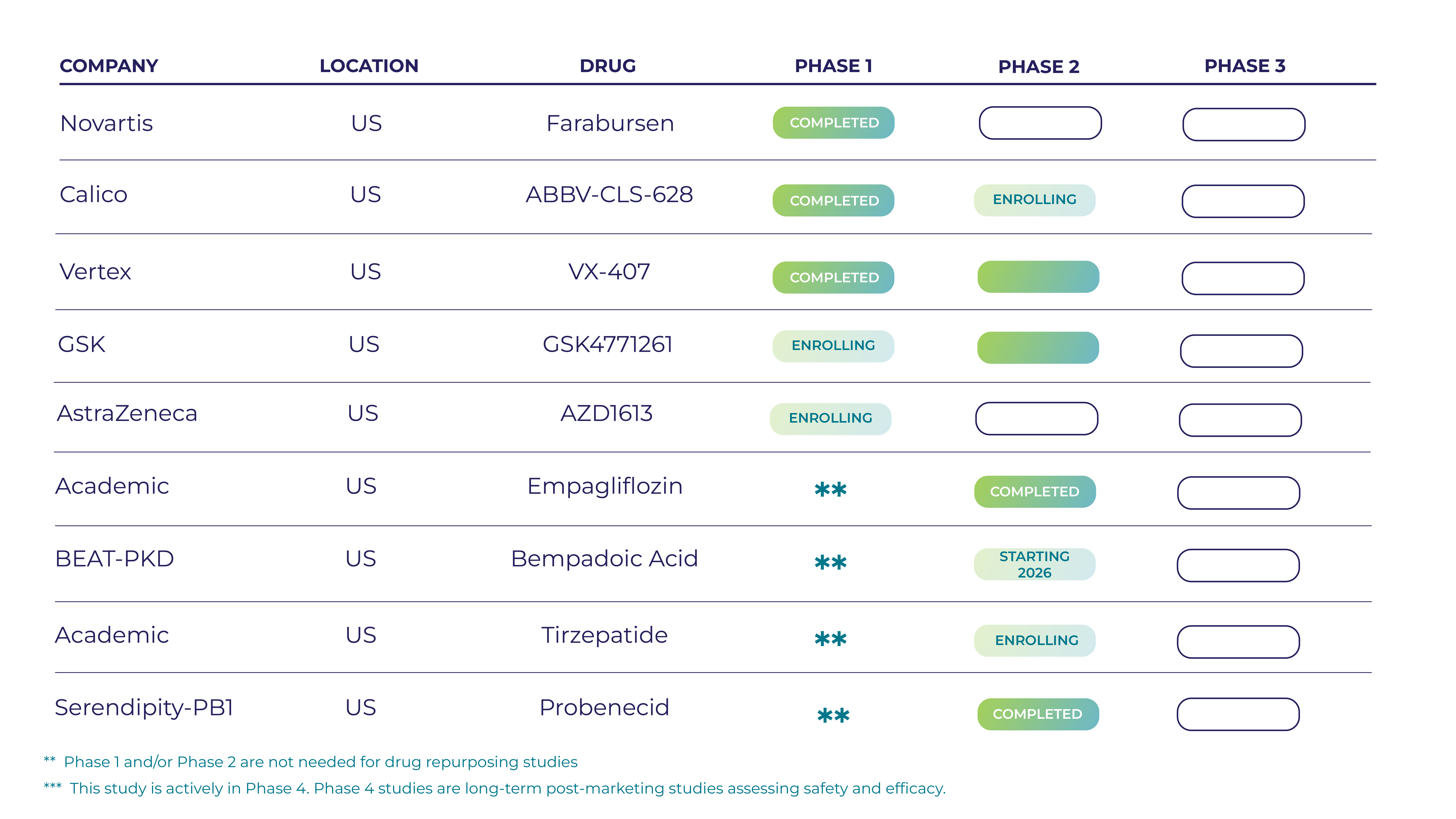
RGLS4326 is a novel drug candidate belonging to a class of drugs targeting microRNAs. MicroRNAs are a collection of RNA molecules in cells that play multiple roles in the regulation of cell function. RGLS4326 is being developed by Novartis for ADPKD.

Why it may be a potential treatment for PKD
The specific microRNA targeted by RGLS4326, miR-17, is involved in regulating the production of PKD1 and PKD2 proteins, the proteins encoded by the genes that cause ADPKD. Preclinical studies with RGLS4326 have demonstrated direct regulation (an increase in the amounts produced) of PKD1 and PKD2 in human ADPKD cyst cells, as well as a reduction in kidney cyst formation, decreased cyst cell growth, and preserved kidney function in animal models of ADPKD. A phase 1, multiple dose study of RGLS4326 was completed in healthy volunteers and demonstrated that the drug was generally well tolerated.

Clinical study status
The RGLS8429 trial began recruiting in Fall 2022. We rely on ADPKD patients to sign up for the study to move this research forward. Learn more about what participating in PKD studies looks like here.

Drug Repurposing
Empagliflozin
Metformin
Statin therapy
Empagliflozin

What it is
Empaglifozin is an FDA-approved medication used to manage and treat type 2 diabetes.

Why it may be a potential treatment for PKD
Limited data suggests SGLT2i drugs (such as empagliflozin) may stimulate vasopressin and vasopressin receptor expression in patients and animal models without ADPKD. Investigators want to see if the beneficial effects on kidney function, vascular function, and mortality in non-ADPKD patients with CKD will translate to this disease population.

Clinical study status
The University of Colorado Anschutz Medical Campus and the University of Maryland Baltimore are conducting a study on empagliflozin. Learn about what participation looks like here.

Metformin

What it is
Metformin is a first-line, FDA-approved drug to treat type 2 diabetes.

Why it may be a potential treatment for ADPKD
Mouse models have shown that metformin blocks the aerobic glycolysis pathway, which is linked to the cell proliferation that causes cysts to form and grow. When treated with metformin, mice with PKD show inhibition of cyst growth. Metformin has a long established safety profile because it’s been used for decades in the treatment of type 2 diabetes.

Watch our recorded webinar, PKD therapies and potential candidates, to learn more.

Clinical study status
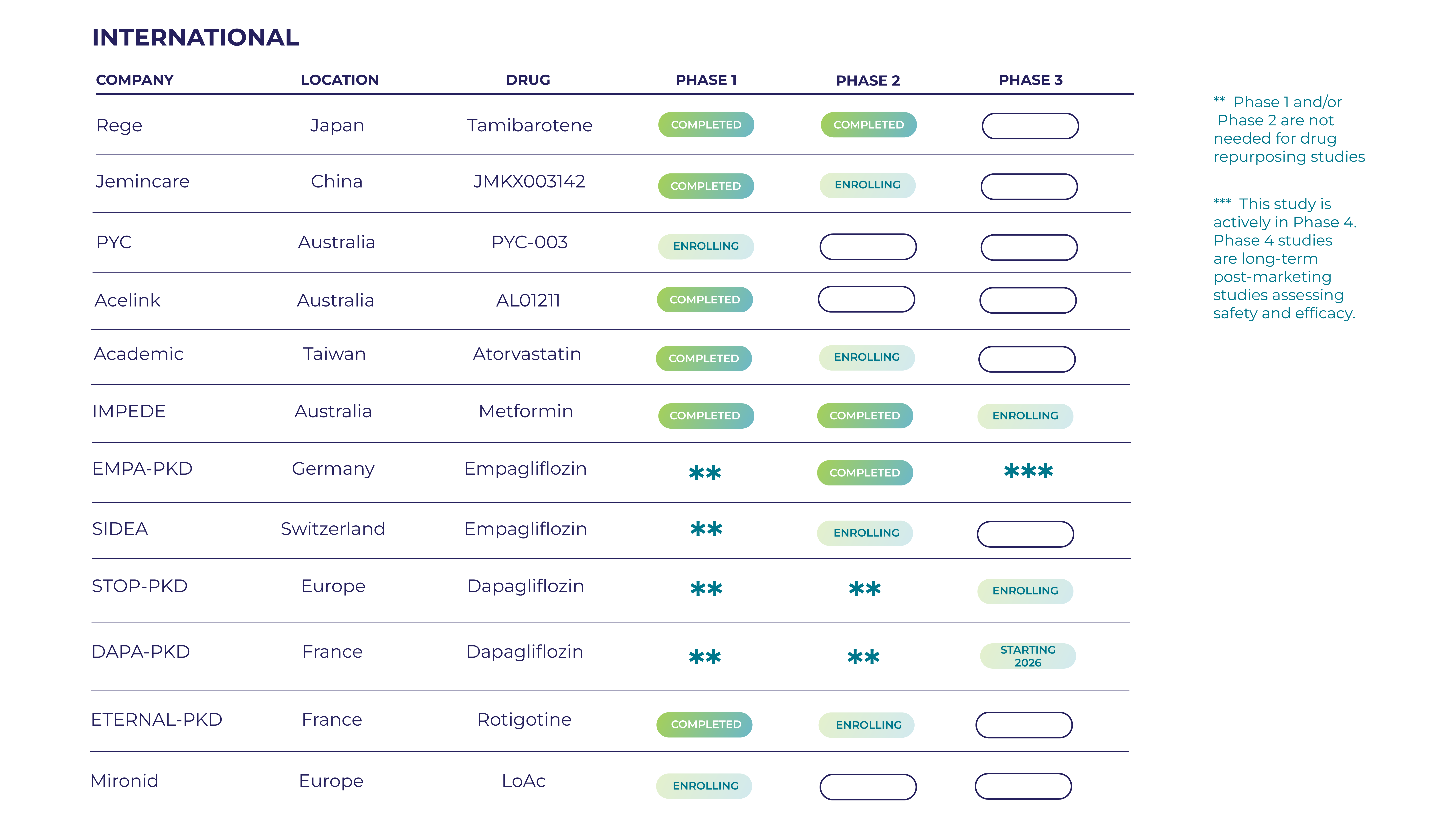
Researchers at Tufts University (Boston) and at the University of Maryland (Baltimore) recently finished a two-year clinical trial in 97 patients with ADPKD. They found that metformin in adults with ADPKD was safe and tolerable while slightly reducing kidney function decline (although not to a significant degree). Further evaluation of efficacy will require a larger trial. Read more here.

Statin therapy

What it is
Statins comprise a class of drug that lowers the level of cholesterol in the blood.

Why it may be a potential treatment for PKD
In addition to their efficacy in lowering cholesterol, statins also have anti-proliferative, anti-inflammatory, and antioxidant effects. Due to this and their relative safety, it’s thought they could potentially be used to slow the progression of ADPKD.

Clinical study status
The University of Colorado Anschutz Medical Campus is conducting a study to learn if pravastatin (a common statin) is helpful in slowing down the progression of ADPKD. This study is ongoing and met its recruitment goal of 150 adult patients with ADPKD.

Related Resources
Newly Diagnosed

A new diagnosis can leave you with many questions. Connect today to learn more about PKD and how we can help.

Find a Community

Our local Communities, and the volunteers who lead them, are the backbone of the PKD community.

Resources

With our resources you can find the answers to the questions you did and didn’t know you had about PKD.