



Award-Winner 2027
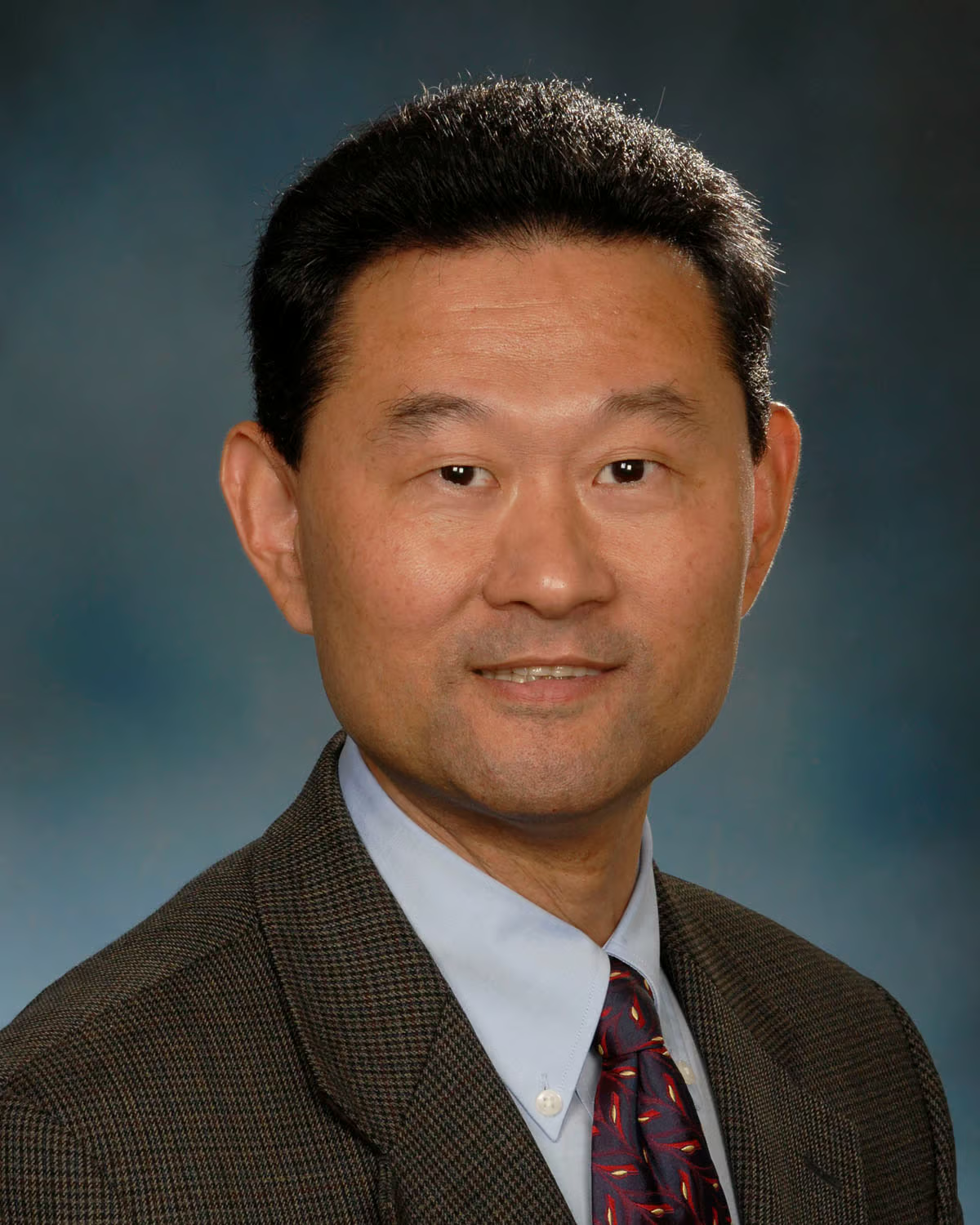
Congratulations to Feng Qian, Ph.D., professor of medicine at the University of Maryland School of Medicine, on receiving the 2027 Lillian Jean Kaplan International Prize for Advancement in the Understanding of Polycystic Kidney Disease.
Dr. Qian was a 2024 PKD Foundation research grant recipient, and his lab has investigated the molecular mechanisms of PKD for more than 25 years. He’s focused specifically on the functions of polycystin-1 (PC1), polycystin-2 (PC2), and fibrocystin, resulting in several seminal contributions that advanced our understanding of PKD pathogenesis.
Dr. Qian’s studies provided key experimental evidence supporting the two-hit mechanism of cystogenesis in ADPKD and helped establish the molecular interaction between PC1 and PC2. His laboratory discovered the cis-autoproteolytic cleavage of PC1 at its GPCR proteolysis site (GPS) and demonstrated that this processing event is essential for PC1 maturation, ciliary trafficking, and biological function. More recently, Dr. Qian’s lab identified a mitochondria-targeted fibrocystin C-terminal fragment that suppresses cystogenesis, revealing new mechanistic links between proteins responsible for ADPKD and ARPKD.
Beyond his research discoveries, Dr. Qian has a long history of leadership and service to the PKD community. As director of the Antibody and Vector Core of the PKD Research and Translation Core Center and the PKD Research Resource Consortium, he’s developed and distributed unique research reagents and technical resources to investigators worldwide. Dr. Qian’s work has fundamentally advanced the molecular understanding of PKD and continues to shape efforts toward mechanism-based therapies today.
Ron T. Gansevoort, M.D., Ph.D., FERA, FASN
University Medical Center Groningen
Marie Trudel, Ph.D.
Université de Montréal
Michael Caplan, MD, Ph.D.
Yale School of Medicine
Terry J. Watnick, MD
University of Maryland Baltimore
Baltimore, MD
Alessandra Boletta, Ph.D.
San Raffaele Scientific Institute
Italy
Albert Chee Meng Ong, B.M.B.Ch., M.A., D.M., F.R.C.P.
University of Sheffield
United Kingdom
Kyongtae (Ty) Bae, M.D., Ph.D., M.B.A.
University of Pittsburgh
Pittsburgh, PA
Arlene Chapman, M.D.
University of Chicago
Chicago
York Pei, M.D.
University of Toronto
Canada
Bradley Yoder, Ph.D.
University of Alabama at Birmingham
Birmingham, Ala.
Ronald D. Perrone, M.D.
Tufts Medical Center
Boston
David R. Beier, M.D., Ph.D.
Seattle Children’s Research
Seattle
Peter Igarashi, M.D.
University of Minnesota Medical School
Minneapolis
Gregory J. Pazour, Ph.D.
University of Massachussetts Medical School
Worcester, Mass.
Vincent Gattone, Ph.D.
Indiana University School of Medicine
Indianapolis
Dorien Peters, Ph.D.
Leiden University Medical Center
Leiden, Netherlands
Gerd Walz, M.D.
Freiburg Medical Center
Germany
James Calvet, Ph.D.
University of Kansas Medical Center
Kansas City, Kan.
Lisa Guay-Woodford, M.D.
University of Alabama at Birmingham
Birmingham, Ala.
Corinne Antignac, M.D., Ph.D.
Necker Hospital
Paris
Friedhelm Hildebrandt, M.D.
Harvard Medical School
Boston
Jing Zhou, M.D., Ph.D.
Harvard Medical School
Boston
Vicente Torres, M.D.
Mayo Clinic
Rochester, Minn.
Greg Germino, M.D.
Johns Hopkins University School of Medicine
Baltimore
Stefan Somlo, M.D.
Yale University School of Medicine
New Haven, Conn.
Jared J. Grantham, M.D.
University of Kansas Medical Center
Kansas City, Kan.Peter Harris, Ph.D.
Mayo Clinic
Rochester, Minn.